CSUSB ScholarWorks
CSUSB ScholarWorks
Electronic Theses, Projects, and Dissertations Office of Graduate Studies
6-2018
MODERN CRYPTOGRAPHY
MODERN CRYPTOGRAPHY
Samuel Lopez
California State University - San Bernardino
Follow this and additional works at: https://scholarworks.lib.csusb.edu/etd
Part of the Information Security Commons, and the Number Theory Commons
Recommended Citation Recommended Citation
Lopez, Samuel, "MODERN CRYPTOGRAPHY" (2018). Electronic Theses, Projects, and Dissertations. 729. https://scholarworks.lib.csusb.edu/etd/729
A Thesis
Presented to the
Faculty of
California State University,
San Bernardino
In Partial Fulfillment
of the Requirements for the Degree
Master of Arts
in
Mathematics
by
Samuel Lopez
A Thesis
Presented to the
Faculty of
California State University,
San Bernardino
by
Samuel Lopez
June 2018
Approved by:
Shawnee McMurran, Committee Chair Date
Joseph Chavez, Committee Member
Jeremy Aikin, Committee Member
Charles Stanton, Chair, Corey Dunn
Department of Mathematics Graduate Coordinator,
Abstract
We live in an age where we willingly provide our social security number, credit
card information, home address and countless other sensitive information over the
In-ternet. Whether you are buying a phone case from Amazon, sending in an on-line job
application, or logging into your on-line bank account, you trust that the sensitive data
you enter is secure. As our technology and computing power become more sophisticated,
so do the tools used by potential hackers to our information. In this paper, the
underly-ing mathematics within ciphers will be looked at to understand the security of modern
ciphers.
An extremely important algorithm in today’s practice is the Advanced
Encryp-tion Standard (AES), which is used by our very own NaEncryp-tional Security Agency (NSA)
for data up to TOP SECRET. Another frequently used cipher is the RSA cryptosystem.
Its security is based on the concept of prime factorization, and the fact that it is a hard
problem to prime factorize huge numbers, numbers on the scale of 22048 or larger. Crypt-analysis, the study of breaking ciphers, will also be studied in this paper. Understanding
Acknowledgements
I wish to thank Dr. Shawnee McMurran for all her help and support in the
development and formation of this paper. I also want to thank Dr. Joseph Chavez and
Dr. Jeremy Aikin for their comments on the paper as well. Your assistance was very
Table of Contents
Abstract iii
Acknowledgements iv
List of Tables vii
List of Figures viii
1 Introduction 1
2 Data Encryption Standard 3
2.1 Motivation . . . 3
2.2 Security . . . 3
2.3 Understanding the Data Encryption Standard . . . 4
2.4 Encryption Method . . . 4
2.5 Key Generation . . . 6
2.6 Decryption . . . 7
3 Advanced Encryption Standard 9 3.1 Motivation . . . 9
3.2 Security . . . 9
3.3 Understanding the Advanced Encryption Standard . . . 10
3.4 Encryption Method . . . 11
3.5 Key Expansion . . . 12
3.6 Example of Encrypting a 128-bit Message . . . 13
3.7 Decryption . . . 18
4 RSA 20 4.1 Motivation . . . 20
4.2 Security . . . 20
4.3 Method . . . 21
4.4 A Worked Example . . . 22
5 Discrete Logarithm Problem 25
5.1 Motivation . . . 25
5.2 Diffie-Hellman Key Exchange . . . 25
5.3 Discrete Logarithm Problem . . . 26
5.4 Small-Step Giant-Step Algorithm . . . 26
5.5 Elliptic Curves . . . 27
6 Hash Functions 31 6.1 Motivation . . . 31
6.2 Understanding Properties of Secure Hash Functions . . . 33
7 Blockchain Technology 35 7.1 “Satoshi Nakamoto’s” White Paper . . . 35
7.2 Security of Blockchain . . . 35
7.3 Bitcoin . . . 37
8 Conclusion 38
List of Tables
2.1 Expansion Function bit Mapping . . . 5
2.2 S1 Table With Decimal Numbers . . . 5
2.3 Permutation Choice 1 . . . 7
2.4 Permutation Choice 2 . . . 7
3.1 S-box for AES in Hexadecimal . . . 10
List of Figures
Chapter 1
Introduction
Many of us realize that mathematics has more applications than we know;
grow-ing up we were constantly reminded that math can apply to almost everythgrow-ing. One of
those things is keeping our sensitive data secure. One of the earliest uses of cryptography
dates back two-thousand years, developed when Julius Caesar realized the need to encode
military messages to and from his commanders. It was a simple substitution cipher where
every letter would be replaced by a different letter. For Caesar’s Cipher the shift was 3
letters; so every “A” in your original message would be replaced by a “D”, every “B” by
a “E,” and so on. To decrypt the message simply shift 3 letters in the opposite direction.
Frequency analysis provides a method to easily break substitution ciphers like Ceaser’s
Cipher, especially with the aid of technology, so cryptographers had to invent new ways
to encode information. Symmetric ciphers like the Data Encryption Standard (DES) and
the Advanced Encryption Standard (AES) encode blocks of information at a time using
a private key that all parties trying to communicate must know. Asymmetric ciphers like
RSA and Diffie-Helman key exchange use computationally hard mathematical problems
to allow one key to be public, so anyone can send an encrypted message, but also
incor-porate a private key that only selected individuals know. The private key allows one to
decrypt the message.
Sometimes we are required to have sensitive data stored on a database, like a
password or a pin number to a debit card. These are not messages that you want someone
to decode using a key, you just want the data stored to verify it is you every time you log
useful. Recent applications of hash functions have exposed the world of cryptography to
a much larger audience. For example, the invention of Blockchain technology, and as a
consequence Bitcoin, is shaping the future: from being able to securely send or receive
money from someone you may not trust, to establishing a smart contract between two
parties that everyone in the network can bear witness to. As we will see, cryptography
Chapter 2
Data Encryption Standard
2.1
Motivation
In 1977, the National Security Agency (NSA) announced that there was a need
for a secure standardized cipher for commercial use. IBM created the Data Encryption
Standard (DES), a block cipher that encodes blocks of bits at a time, as opposed to
a stream cipher, which encodes only one bit at a time. Although stream ciphers are
impossible to break using a cryptographic secure random number generator, they are too
impractical for general applications since keys can not be reused. Block ciphers are more
practical because keys are of reasonable length, at most 256 bits, and can be used securely
for a whole session of communication.
2.2
Security
In the 1970’s, block ciphers were in high demand because of how efficient they
are in encoding information. For example, the DES can encrypt 64 bits at a time. The
challenge was creating a block cipher both secure from attacks that plagued the block
ciphers of the past and, as later discovered, differential cryptanalysis attacks. The
inven-tor of information theory, Claude Shannon, stated that a secure block cipher must have
two main attributes: confusion, which is a basic substitution table, and diffusion, which
means a single bit should affect the entire message. Although differential cryptanalysis
was not public knowledge until 18 years after the publication of DES, the NSA and IBM
this attack. Today, DES is no longer secure after being under the microscope of so many
cryptographers for over 20 years. But 3DES, which encrypts using DES three times in a
row, is still a commonly used block cipher.
2.3
Understanding the Data Encryption Standard
DES is not too complex from an abstract perspective; encryption relies on
con-fusion and difcon-fusion functions. First, DES takes 64 bits of data at a time. The 64 bits
will go through 16 rounds that all have the same functionality. First, the 64 bits are split
into two groups, each consisting of 32 bits. Let us denote the first set of 32 bits L0, the
last 32 bits by R0. In any one round of DES, only the first 32 bits are encrypted. For
example, round 1 would encrypt L0 and set the encrypted 32 bits to be R1. The set R0
is kept the same and set to L1. For round 2 of encryption,L1 is encrypted and set to be
R2, while R1 is unchanged and set toL2. This process continues for 16 rounds.
2.4
Encryption Method
Now, with a general understanding of how DES encrypts, we can look at the
inner workings of each round and how the encryption actually works. As stated before,
64 bits are encrypted over 16 rounds. All rounds have the same operations, so we need
only understand one round. For simplicity, let us look at the first round of DES for 64
bits of data. The 64 bits of data are divided in half, giving us L0 and R0 as described
above. The block of 32 bits,R0, has two roles in the first round: R0 is set to beL1 ready
to be encrypted in the next round, and R0 along with the round key K0, are input into
a particular functionf, which we describe below. We setR1 =L0⊕f(R0, K0), where⊕
denotes the XOR operation.
“Exclusive or” (XOR) is a logical operation that outputs true only when inputs
differ. For example,
100011102
⊕ 100110002
= 000101102.
Table 2.1: Expansion Function bit Mapping
input 0 1 2 3 4 5 6 7 8 9 10 11 12 13 14 15 16 17 18 19 20 21 22 23 24 25 26 27 28 29 30 31 output 31 0 1 2 3 4 3 4 5 6 7 8 7 8 9 10 11 12 11 12 13 14 15 16 15 16 17 18 19 20 19 20 21 22 23 24 23 24 25 26 27 28 27 28 29 30 31 0
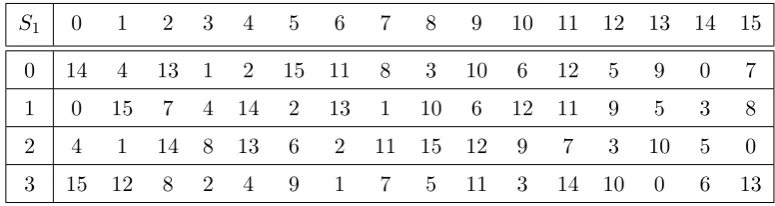
Table 2.2: S1 Table With Decimal Numbers
S1 0 1 2 3 4 5 6 7 8 9 10 11 12 13 14 15
0 14 4 13 1 2 15 11 8 3 10 6 12 5 9 0 7
1 0 15 7 4 14 2 13 1 10 6 12 11 9 5 3 8
2 4 1 14 8 13 6 2 11 15 12 9 7 3 10 5 0
3 15 12 8 2 4 9 1 7 5 11 3 14 10 0 6 13
four operations. First, the 32 bits pass through an expansion function E, making the 32
bits into 48 bits. Second, the 48 bits are XOR’d with the 48-bit round sub-key. Third, the
48 bits are separated into eight groups of 6 bits each and are changed via corresponding
substitution table S: S1 for the first group, S2 for the second group, and so on. Each
substitution table inputs 6 bits and outputs 4 bits, leaving us with 32 bits after the
substitution. Finally the 32 bits are permuted.
The expansion functionEapplies diffusion, something essential for block ciphers;
E takes 32 bits and outputs 48 bits. This is done by sending half of the 32 bits to two
locations. The other half of the 32 bits are mapped to just one bit in the output of E.
See Table 2.1 for a complete mapping of bits performed byE.
After the expansion function, the 48 bits are then XOR’d with the 48 bit round
key. We then still have 48 bits.
The 48 bits, in order from left to right, are separated into 8 groups, each
con-taining 6 bits of data. Each group of 6 bits have a particular address in a substitution
box. There are 8 different substitution boxes, one for each group. Intuitively, the first
group would use box S1, the second group box S2, and so on. We will illustrate this
process with an example. For simplicity we will look at only the first 6 bits of data and
Reading the S1 table may seem somewhat counterintuitive at first, but the
process is fairly straightforward after seeing it done. For example, if the first 6 bits
of data are 0110012, we would convert the middle four bits 11002 to decimal numbers
giving us 12. This directs us to look at column 12. We then take the outside two bits
012 and convert it to the corresponding decimal number 1. This tells us to look at row
1. Finally, we take the entry in column 12, row 1, and convert back to base 2. Thus,
S1(0110012) = 9 = 10012. Another computation, S1(1101012) = 3 = 00112. So, 6 bits
in gives us 4 bits out. After all 8 groups have passed through their corresponding S-Box,
we are left with 32 bits. This S-box is the element of confusion that DES uses.
Finally, the bits go through a permutation which are then output to encryptLi
via Ri+1=Li⊕f(Ri, Ki).
2.5
Key Generation
DES is a block cipher that encrypts data over 16 rounds. For each of those
rounds an encryption key is used. DES starts with a 64-bit key that undergoes multiple
permutations to generate a unique key for each round. The key generation starts by
permutation choice 1 (PC1), Table 2.3. The number in Table 2.3 represents the new
location for each bit. For example, the fifty-seventh bit in the original 64-bit key would
be the first bit after the permutation, the forty-ninth bit would become the second bit,
and so on. Permutation choice 1 is only performed once, on the original 64-bit key. We
also note that only 56 bits of the original 64 bits remain after PC1. For this reason DES
has a cryptographic strength of a 56-bit cipher, not the strength of a 64-bit cipher. Next,
the 56 bits are split into two groups, each group being 28 bits long. The next permutation
is a left shift of bits in the two groups. For rounds 1, 2, 9, and 16, the shift is one spot
to the left. For all the remaining rounds, the shift is two spots to the left. We observe
that the left shift is one spot to the left for four rounds and two spots for the remaining
twelve rounds; thus the total number of left shifts is 28 spots. This coincides with the fact
that the two groups are each 28 bits long. The final permutation is called permutation
choice 2 (PC2) and works in the same way as PC1. See Table 2.4 for the permutation
that PC2 performs. The 48 bits that remain after PC2 are used as the encryption key. In
general, key generation would go as follows. The original 64-bit key undergoes the first
Table 2.3: Permutation Choice 1
57 49 41 33 25 17 9 1 58 50 42 34 26 18
10 2 59 51 43 35 27 19 11 3 60 52 44 36
63 55 47 39 31 23 15 7 62 54 46 38 30 22
14 6 61 53 45 37 29 21 13 5 28 20 12 4
Table 2.4: Permutation Choice 2
14 17 11 24 1 5 3 28 15 6 21 10
23 19 12 4 26 8 16 7 27 20 13 2
41 52 31 37 47 55 30 40 51 45 33 48
44 49 39 56 34 53 46 42 50 36 29 32
bits long. Let us denote the first 28 bits c0 and the second 28 bits d0. Both c0 and d0
are permuted via a left shift of one spot. We will call the first group c1 and the second
groupd1after the left shift. Next, the 56 bits that make upc1 andd1undergo the second
permutation choice PC2. The 48 bits that remain are used as the first key for encryption.
For the second round of key generation, c1 and d1 undergo a left shift of one spot; after
the left shift c2 andd2 are permuted via PC2 where the resulting 48 bits are used for the
second round of encryption. For the third round of encryption c2 and d2 are shifted two
spots to the left. The resulting groups c3 and d3 are permuted via PC2 where the third
key for encryption is made. This process continues until 16 keys are generated for each
round of encryption.
2.6
Decryption
After all 16 rounds of encryption, the sender sends the final results L16 and
R16 to the intended receiver. Thus, the receiver will haveL16 and R16 directly from the
sender. For symmetric ciphers, it is necessary for all parties to have the encryption key, so
it is assumed that the receiver has access to the key and the ability to compute all round
sub-keys. Once the receiver has all round keys, they need only do the steps in reverse
only the calculation ofL15. We know from encryption thatR16=L15⊕f(R15, K15), thus
R16⊕f(R15, K15) = L15. This process continues until L1 and R1, the original message,
Chapter 3
Advanced Encryption Standard
3.1
Motivation
After attacks on DES became too efficient, there was a call by the NSA for a
new encryption standard. Unlike DES, which was developed in secret and then eventually
published a few years later, the need for a new encryption standard was announced as
a kind of competition. Many prominent cryptographers of the time formed teams and
created ciphers. In addition to the requirement to be very secure, there were other criteria
for submissions. Submissions must be 128-bit block ciphers, supporting 128-bit, 196-bit,
and 256-bit key lengths. Submissions must also be computationally efficient, enough so
for the commercial use the cipher was intended for. After a long evaluation process,
Rijndael, the submission by Vincent Rijmen and Joan Daemen, was chosen and became
the Advanced Encryption Standard (AES).
3.2
Security
Like DES, the security of AES comes from confusion and diffusion. The major
improvements to security in AES were the increased block length to 128 bits and the key
length. AES supports three different key lengths, 128, 198, and 256 bits. The different key
lengths require a different number of rounds to be considered secure. A 128-bit key needs
10 rounds, a 196-bit key requires 12 rounds, and a 256-bit key calls for 14 rounds. The
number of rounds for the various key lengths was determined by the team that developed
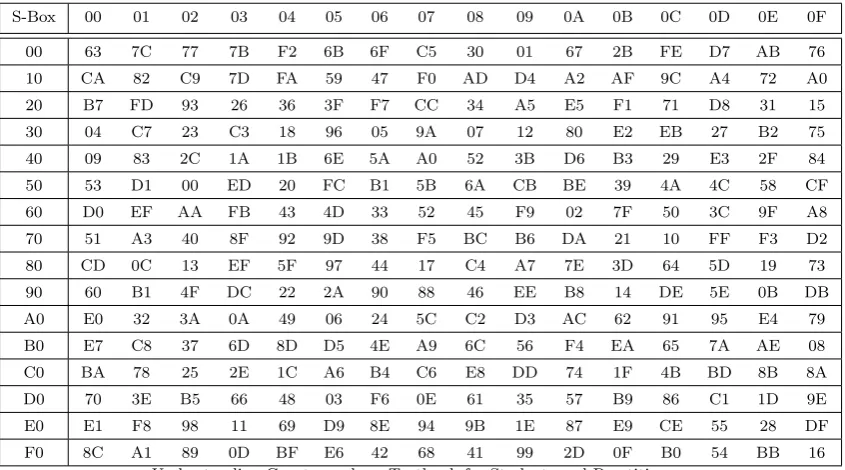
Table 3.1: S-box for AES in Hexadecimal
S-Box 00 01 02 03 04 05 06 07 08 09 0A 0B 0C 0D 0E 0F 00 63 7C 77 7B F2 6B 6F C5 30 01 67 2B FE D7 AB 76 10 CA 82 C9 7D FA 59 47 F0 AD D4 A2 AF 9C A4 72 A0 20 B7 FD 93 26 36 3F F7 CC 34 A5 E5 F1 71 D8 31 15 30 04 C7 23 C3 18 96 05 9A 07 12 80 E2 EB 27 B2 75 40 09 83 2C 1A 1B 6E 5A A0 52 3B D6 B3 29 E3 2F 84 50 53 D1 00 ED 20 FC B1 5B 6A CB BE 39 4A 4C 58 CF 60 D0 EF AA FB 43 4D 33 52 45 F9 02 7F 50 3C 9F A8 70 51 A3 40 8F 92 9D 38 F5 BC B6 DA 21 10 FF F3 D2 80 CD 0C 13 EF 5F 97 44 17 C4 A7 7E 3D 64 5D 19 73 90 60 B1 4F DC 22 2A 90 88 46 EE B8 14 DE 5E 0B DB A0 E0 32 3A 0A 49 06 24 5C C2 D3 AC 62 91 95 E4 79 B0 E7 C8 37 6D 8D D5 4E A9 6C 56 F4 EA 65 7A AE 08 C0 BA 78 25 2E 1C A6 B4 C6 E8 DD 74 1F 4B BD 8B 8A D0 70 3E B5 66 48 03 F6 0E 61 35 57 B9 86 C1 1D 9E E0 E1 F8 98 11 69 D9 8E 94 9B 1E 87 E9 CE 55 28 DF F0 8C A1 89 0D BF E6 42 68 41 99 2D 0F B0 54 BB 16
Understanding Cryptography a Textbook for Students and Practitioners
3.3
Understanding the Advanced Encryption Standard
The AES is a byte cipher in the sense that the operations that apply confusion
and diffusion work with bytes; bytes are simply larger bits, 8 bits make a single byte.
The AES is also a round cipher, confusion and diffusion take place in multiple rounds.
Before the first round, the original keyK0 is XOR’d byte by byte to the original 16 bytes
of data. In all the rounds except the last, there are four operations. The first operation
is the use of a substitution box. As we know from DES, this is an element of confusion.
Unlike DES, there is only one substitution box in AES. After substitution, there is a shift
row operation followed by a mix column operation, together applying diffusion among
the bytes. Finally, there is a key, which is XOR’d byte for byte. The last round skips
the mix column operation. The generation of the S-box for AES requires some general
understanding of Galois fields, in particular GF(28). This is significant because the S-box has a mathematical generation that can be understood, as opposed to the S-boxes of DES
3.4
Encryption Method
The key length does not actually change what operations take place in the
encryption, although longer keys have more rounds. For simplicity we will look at
en-cryption using a 128-bit key length which calls for 10 rounds. AES will encrypt 128 bits
at a time, regardless of key length. AES works with bytes, so the 128 bits are broken
up into bytes producing 1288 = 16 bytes. In this paper, the 16 bytes will be converted to hexadecimal. The 16 bytes are XOR’d with the original key. Then the 16 bytes pass
through the substitution box AES employs. The S-box for AES is more intuitive than
the S-box of DES. For example, if the byte in question was “C3”, we would use “C”
to determine which row to use, and “3” to determine which column. Referring to
Ta-ble 3.1, we see “C3” would have an output of “2E”. A byte of “F1” would use row F
and column 1, giving output “A1”. This is the confusion element of AES. The
remain-ing operations for the round are easier to understand via a matrix. We name the 16
bytes of data after the original key: A0, A1, A2, ..., A15. Suppose after the S-box we have
S(A0) = B0, S(A1) = B1, ..., S(A15) = B15, still leaving us with 16 bytes. Entering the
bytes column-wise into a 4×4 matrix produces,
M0 =
B0 B4 B8 B12
B1 B5 B9 B13
B2 B6 B10 B14
B3 B7 B11 B15
.
A shift row operation will shift the first row zero spots to the left, the second row one
spot to the left, the third row two spots to the left, and the fourth row three spots to the
left. Hence, M0 is mapped to,
M1 =
B0 B4 B8 B12
B5 B9 B13 B1
B10 B14 B2 B6
B15 B3 B7 B11
A mix column operation is the next step and it involves multiplying M1 by the constant matrix C =
02 03 01 01
01 02 03 01
01 01 02 03
03 01 01 02
,
where the matrix multiplication done over GF(28). The resulting matrix would then be XOR’d entry-wise with K1, thus completing round 1.
3.5
Key Expansion
It would be unwise to use the same key for each round of AES encryption. So,
an algorithm was developed to take a 128-bit key, and using the original 128 bits, generate
unique keys for each of the 10 rounds. This process is called key expansion and goes as
follows.
Given an original 128 bit key, 16 bytes, we enter the bytes column-wise into a
4×4 matrix. Let the first byte of the key bek0, the second byte bek1, and so on. Then
we have the key matrix
K0 =
k0 k4 k8 k12
k1 k5 k9 k13
k2 k6 k10 k14
k3 k7 k11 k15
.
The columns are then stored in what are called words,w0 ={k0, k1, k2, k3},
w1 = {k4, k5, k6, k7}, w2 = {k8, k9, k10, k11}, and w3 = {k12, k13, k14, k15}. We need a
total of forty-four words for a 128-bit key; four words, the original four, are used before
the plain-text enters the first round. The remaining forty words are used four at a time,
for each of the ten rounds of encryption. To compute the next four words we would first
computeg(w3) and setw4 =w0⊕g(w3),w5 =w4⊕w1,w6=w5⊕w2, andw7 =w6⊕w3.
In general, to calculate wi, wi+1, wi+2, and wi+3, where i is divisible by 4, we would
first compute wi = wi−4 ⊕g(wi−1). We then use wi to calculate wi+1 = wi ⊕wi−3,
wi+2 =wi+1⊕wi−2, and wi+3 =wi+2⊕wi−1.
Now, the functiongoperates in three steps. First it will shift the bytes to the left.
via the S-box as described in the encryption section. Finally, a round constant, ci, is
to be XOR’d. The round constant is generated recursively. To start, c1 = 012. Then,
the remaining round constants may by calculated by ci = 02×ci−1. It is important
to note that × is polynomial multiplication over GF(28) reduced by the AES modulo
x8+x4+x3+x+1. We note that 02 overGF(28) is multiplication with the corresponding polynomial ci−1 by x.
3.6
Example of Encrypting a 128-bit Message
Alice would like to send the message “THE BOSS IS HERE” to Bob. Alice and
Bob have already agreed to use the key “APPLE SAUCE OLI!” in case of an emergency.
Throughout the paper all text to hex conversion is done via the American Standard Code
for Information Interchange (ASCII). Now, “THE BOSS IS HERE” in hexadecimal is
54484520424F53532049532048455245
and “APPLE SAUCE OLI!” is
4150504C45205341554345204F4C4921.
This is the key used before the first round of encryption. Let us compute the key expansion
with the given 128-bit starting key:
K0 =
41 45 55 4F
50 20 43 4C
50 53 45 49
4C 41 20 21
.
We have w0 ={41,50,50,4C},w1 ={45,20,53,41},w2 ={55,43,45,20}, and
w3 ={4F,4C,49,21}. We must now computeg(w3), obtaining {4C,49,21,4F}after the
left shift of the bytes. Next, using the S-box, Table 3.1, we get {29,3B, F D,84}. Last,
we XOR the word with the first round constant,{01,00,00,00}. Consequently we have, 29 = 001010012,
2916⊕012 = 001010012⊕012
= 001010002
The remaining entries of w3 are unchanged. This yields g(w3) ={28,3B, F D,84}. We
compute w4 as described above:
w4 = w0⊕g(w3)
= {41⊕28,50⊕3B,50⊕F D,4C⊕84}
= {D9,6B, AD, C8}.
Performing the remaining XOR operations in the same way givesw5 ={9C,4B, F E,89},
w6 ={C9,08, BB, A9}, andw7 ={86,44, F2,88}, giving us our first round key,
K1 ={D9,6B, AD, C8,9C,4B, F E,89, C9,08, BB, A9,86,44, F2,88}.
Now, as before, to compute the next fourwords we start by computing g(w7):
{86,44, F2,88} → {44, F2,88,86}
→ {1B,89, C4,44}
→ {19,89, C4,44}.
Multiplication by 2 in binary shifts the number in question to the left one place value
and inserts a zero into the one’s place, in much the same way as multiplying by 10 with
decimal numbers. Thus, computing the round constant is trivial until the 9th round,
where the previous round constant was 100000002 and multiplication by 02 would push
the ‘1’ out of the 8 bits that make the byte. To fix this, the polynomial representation
of 10000000×02 = x7 ·x = x8, must be reduced back into the field GF(28) via the polynomial x8+x4 +x3 +x+ 1. So, the polynomial representation of our 9th round constant will be
x8 mod (x8+x4+x3+x+ 1)≡x4+x3+x+ 1 mod (x8+x4+x3+x+ 1),
which translates to our 9th round constant c9 = {00011011,00,00,00}. We compute
the 10th round constant by multiplying the 9th round constant by 02, which yields
c10={00110110,00,00,00}. Following the key expansion scheme as described, we obtain
all 10 round keys:
K0 ={41,50,50,4C,45,20,53,41,55,43,45,20,4F,4C,49,21}
K2 ={C0, E2,69,8C,5C, A9,97,05,95, A1,2C, AD,13, E5, DE,24}
K3 ={1D, F F,5F, F1,41,56, C8, F4, D4, F7, E4,59, C7,12,3A,7D}
K4 ={DC,7F, CD,37,9D,29,05, C3,49, DE, E1,9A,8E, CC, DB, E7}
K5 ={87, C5,59,2E,1A, EC,5C, ED,53,32, BD,77, DD, F E,66,90}
K6 ={1C, F6,39, EF,06,1A,65,02,55,28, D8,75,88, D6, BE, E5}
K7 ={AA,58, E0,2B, AC,42,85,29, F9,6A,5D,5C,91, BC, E3, B9}
K8 ={4F,59,39, EF, E3,0B, BC, C6,1A,61, E1,9A,8B, DD,02,23}
K9 ={95,2E,1F, D2,76,25, A3,14,6C,44,42,8E, E7,99,40, AD}
K10={4D,27,8A,46,3B,02,29,52,57,46,6B, DC, B0, DF,2B,71}
Now, we can start the encryption process. Entering our plain-text message into
a matrix as described in Section 3.4 we have
M0=
54 42 20 48
48 4F 49 45
45 53 53 52
20 53 20 45
.
We then XOR M0 entry-wise with the original key K0, obtaining
54 42 20 48
48 4F 49 45
45 53 53 52
20 53 20 45
⊕
41 45 55 4F
50 20 43 4C
50 53 45 49
4C 41 20 21
=
15 07 75 07
18 6F 0A 09
15 00 16 1B
6C 12 00 64
.
Next, we substitute each entry of our current matrix via the S-box from Table 3.1, which
gives us
59 C5 9D C5
AD A8 67 01
59 63 47 AF
50 C9 63 43
.
We then apply the shift row operation to get
59 C5 9D C5
A8 67 01 AD
47 AF 59 63
43 50 C9 63
The next step in Round 1 involves multiplying by the constant matrix C=
02 03 01 01
01 02 03 01
01 01 02 03
03 01 01 02
to obtain the matrix
55 C7 B2 7D
98 B1 BD 42
BA 17 6E 0B
82 3C 6D 5C
.
Finally, the above matrix is XOR’d entry-wise with K1, producing
M1=
8C 5B 7B F B
F3 F A B5 06
17 E9 D5 F9
4A B5 C4 D4
.
Round 1 is complete. This process repeats for 9 more rounds. The only exception is
Round 10 omits the shift column operation. Even after one round of AES, the 16 bytes
8CF3174A5BF AE9B57BB5D5C4F B06F9D4
have few recognizable characters, none of which were in the original plain-text message.
Continuing after Round 2 we have
M2=
34 05 43 18
91 47 80 CE
F E 33 E3 C4
9E B5 E0 1E
.
After Round 3 the matrix is
M3 =
60 CC 08 3C
92 93 E3 19
E9 4B 7C B3
36 8E F6 OA
Let us look at a new example. We will encrypt “THE BOSS iS HERE” and see how the
change of a single character, a capital I to lowercase i, affects the matrix after a single round of AES. The key will be the same, so the key expansion is the same. We start as
before, with an XOR operation. Our initial matrix this time is
M0∗=
54 42 20 48
48 4F 69 45
45 53 53 52
20 53 20 45
. We compute
54 42 20 48
48 4F 69 45
45 53 53 52
20 53 20 45
⊕
41 45 55 4F
50 20 43 4C
50 53 45 49
4C 41 20 21
=
15 07 75 07
18 6F 2A 09
15 00 16 1B
6C 12 00 64
.
Again, we substitute via the S-box from Table 3.1 to get,
59 C5 9D C5
AD A8 E5 01
59 63 47 AF
50 C9 63 43
.
Applying the shift row operation yields the matrix
59 C5 9D C5
A8 E5 01 AD
47 AF 59 63
43 50 C9 63
.
So, unsurprisingly our matrix still has only one byte different from the original
exam-ple; we have only applied confusion. The next step, mix column, applies the necessary
diffusion.
02 03 01 01
01 02 03 01
01 01 02 03
03 01 01 02
⊗
59 C5 9D C5
A8 E5 01 AD
47 AF 59 63
43 50 C9 63
=
55 5A B2 7D
98 AE BD 42
BA 95 6E 0B
82 BE 6D 5C
Finally, our current matrix is XOR’d with K1, which yields
M1∗ =
8C C6 7B F B
F3 E5 B5 06
17 6B D5 F9
4A 37 C4 D4
.
Thus, after one round of AES with a single character changed, we haveM1 differing from
M1∗ by an entire column. Moreover, in the second round, the shift row step will shift one of these four differing elements into each column. After the mix column operation, the
one differing element in each column will affect the entire matrix. Hence, a single byte
change has diffused into the entire message after the second round. The matrix after
Round 2 becomes
M2∗ =
33 04 0C 0A
62 CA CF 6D
0A BE 2C 06
6A 39 7E 7F
,
which is a completely different matrix than our original example. This helps illustrate
how effectively AES diffuses a single bit flip throughout the entire message.
3.7
Decryption
Decryption is required to retrieve the original message. The steps must be
re-versed and operations inverted. The XOR operation is its own inverse, X⊕X = 0 for
all X ∈ R, so the first operation for decryption would be to XOR the last round key.
The first round of decryption would skip inverting the mix column operation as it was
not performed in the last round of encryption. For all other rounds, we multiply by the
inverse of the constant matrix
C−1 =
0E 0B 0D 09
09 0E 0B 0D
0D 09 0E 0B
0B 0D 09 0E
.
To invert the shift row operation, one must keep the first row the same, shift the second
to the right. Finally, to undo the S-box, one could find their entry inside the table and
use the corresponding row and column to find the entry’s pre-image. For example, if we
wished to know what “6D” was before the S-box, we would locate “6D” in Table 3.1 and
Chapter 4
RSA
4.1
Motivation
The advanced encryption standard is a secure and efficient symmetric cipher.
The main disadvantage to AES is the need to establish a key that all parties wishing to
communicate must know. If the parties cannot physically meet, they must send the key
over a channel, which runs the risk of their key being intercepted and, in turn, all their
encrypted messages may be easily broken. A solution to this problem is to have one key
that encrypts a message, a public key, and one key that decrypts the message, a private
key.
4.2
Security
The simplicity of the RSA cryptosystem’s security adds to its beauty. It places
its bet on the simple fact that it is considered a hard problem to factor numbers. More
specifically, numbers composed of two primes. Factoring numbers will always involve
some trial and error. A problem like prime factoring 91 can easily be done by hand.
Factoring 4168723211, which is the product of two 5-digit primes, is much more difficult
to do without the assistance of a computer, even knowing the length of the two primes.
However, when the prime factors multiplied together are larger than 22048, even modern day super computers take countless years of computing time to factor the composite
number. On the other hand, multiplication is considered an easy problem because there
59359×70229 without the help of a computer. This is the core principal of an asymmetric
cipher. It is easy to compute one way, multiplication, but very difficult to take the inverse,
factoring.
4.3
Method
To set up an RSA system, there are six variables that a user, Alice, would first
have to determine. Since RSA is an asymmetric algorithm, a sender, Bob, does not
have to compute a key; most of the work is done by Alice. First, Alice would select
two primes, normally denoted as p and q. Then, Alice computes n =p∗q. Next, Alice
computes Φ(n), which normally would not be easy. However, since Euler’s Phi Function
Φ is multiplicative, along with the fact that Φ(u) =u−1 ifu is prime we have,
Φ(n) = Φ(p∗q)
= Φ(p)∗Φ(q)
= (p−1)∗(q−1).
So, Φ(n) = (p−1)∗(q−1), easy enough for Alice to compute. Alice would then select
a value e that is relatively prime to both p−1 and q−1, making it relatively prime to
Φ(n). Finally, Alice calculatesdsuch that e∗d≡1 mod Φ(n). Proof of d’s existence is
a consequence of Bezout’s Identity.
Theorem 1 (Bezout’s Identity). Letaand bbe integers with greatest common divisor d. Then, there exist integers x and y such that ax+by=d. More generally, the integers of the form ax + by are exactly the multiples of d.
For our application, take a = e, b = Φ(n), and d= GCD(e,Φ(n)) = 1. Note
that the d from the theorem is not the same dthat we are trying to show exists. Now,
from the theorem we have
de+kΦ(n) = 1.
Thus
from which it follows that
de mod Φ(n) = 1 mod Φ(n).
In practice, Alice would calculatedvia the Extended Euclidean Algorithm. Alice
publishes (e, n) for anyone to encrypt with and keeps (d, n) as a personal decryption key.
The method, in general, works as follows. Bob. who wants to send plain-text message
m, would first compute c ≡me mod n. Bob sends c to Alice. Alice computes m ≡ cd
mod n, thus getting the plain text back. An eavesdropper, Eve, knows eand n, as they
are publicly known, as well as c, which is the message Bob sent. Eve is missing the
decryption key d, as it is known only by Alice. Why does this work? After all, eand d
were inverses with respect to ZΦ(n) and the actual cipher text is computed in Zn. The
answer is a consequence of Euler’s Theorem.
Theorem 2 (Euler’s Theorem). Let a and n be two coprime positive integers, then
aΦ(n)≡1 mod n.
Manipulation of Euler’s Theorem gives us the following result:
aΦ(n)≡1 mod n
⇒ ak∗Φ(n)≡1 mod n
⇒ a∗ak∗Φ(n)≡a∗1 mod n
⇒ ak∗Φ(n)+1≡a mod n.
Now, sinceed≡1 mod Φ(n), there is somek∈Zsuch thated=k∗Φ(n) + 1. So Alice’s
decryption is computed as follows:
cd mod n ≡ (me)d modn
≡ med mod n
≡ mkΦ(n)+1 modn
≡ m mod n.
Ergo, the plain text message is retrieved.
4.4
A Worked Example
Let Alice be the user, Bob the sender, and Eve an eavesdropper that intercepts
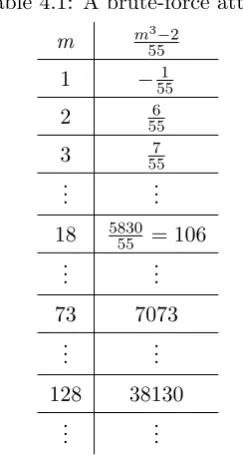
Table 4.1: A brute-force attack
m m553−2
1 −551
2 556
3 557
..
. ...
18 583055 = 106 ..
. ...
73 7073
..
. ...
128 38130
..
. ...
computes n = 55. Alice also computes Φ(55) = 4∗10 = 40. She has free choice for e
and selects 3 since it is relatively prime to both 4 and 10. Using the Extended Euclidean
Algorithm, Alice computes d= 27. Alice then publishes (3,55) for anyone to use. Bob
wants to send Alice the secret message m= 18. Bob computes
183 mod 55 ≡ 5832 mod 55 ≡ 2 mod 55,
and sends Alicec= 2. Now Alice, having the private keyd= 27, computes
227 mod 55 ≡ 134217728 mod 55 ≡ 18 mod 55,
retrieving the plain-text message that Bob sent. Eve has ciphertext 2, public modulus
55, and public key 3. Eve knows Bob’s encryption scheme: m3 mod 55≡2. Therefore,
m3 = 55k+ 2 for some k ∈ N. Thus, m553−2 = k ∈ N. In this case the code may be somewhat easily broken via trial and error and using technology. Since 18553−2 = 106∈N, we see that m = 18 is a possible message. However, there are more possible messages
as shown in Table 4.1, so Eve would need to see if any make sense. For the purposes of
key. In practice, the primes would be much larger and the private key less trivial, thereby
rendering an encryption that would, with todays technology, be nearly impossible to crack
via brute force.
One may immediately think, Φ(n) is very close tonsince n=p∗q and
Φ(n) = (p−1)(q−1), and that a descending approach from n to find Φ(n) could be a
possible attack. Of course, if Φ(n) was discovered by an attacker they need not worry
about factoring n, as they can just compute d via the Extended Euclidean Algorithm.
The problem with this strategy is that in practice, p > 21024 and q > 21024, making
n >22048, and Φ(n) >22048 which, unfortunately for any attacker, yields 22047 integers with bit length 2048. Let us put this in perspective by converting 22047 bits to something more tangible, decimal digits:
22047= 10u
⇒ log 22047= log 10u
⇒ 616≈u.
Thus, 2047 bits is approximately 616 decimal digits. The most powerful super computers
in the world (as of this writing) can compute 20 decimal digits per second. Thus, we
find it would take approximately 10596 seconds or greater than 3×10589 years to find Φ(n) with a backward approach starting at n. Needless to say, users following the RSA
protocol are safe from the na¨ıve attacker.
4.5
Application
In practice, RSA encryption involves extremely large numbers and it is not
always practical to encrypt a whole message using a RSA protocol. A potential application
of RSA would be the establishment of a session key, a key used for a particular session
of sending encrypted information. This is called a key exchange protocol. It could
work many ways, one way would be to encrypt a message using AES. We know AES is
an extremely efficient encryption algorithm; the main downside is that the two parties
communicating need to know the key. One could encrypt the AES key with RSA and
send the encrypted key and the encrypted message over an insecure network. The receiver
would be able to calculate the AES key using their RSA private key. Then using the
Chapter 5
Discrete Logarithm Problem
5.1
Motivation
The demand for an asymmetric cipher was still high even after RSA. There were
already very secure and computationally efficient symmetric algorithms in DES and later
AES. Their main weakness was that the establishment of keys could be difficult if the
two parties could not physically meet before communication began. The Diffie-Hellman
key exchange was invented to satisfy the demand.
5.2
Diffie-Hellman Key Exchange
The Diffie-Hellman key exchange uses cyclic groups, a class of groups with
gen-erators. Let us say that G is a cyclic group and that a ∈ G is a generator of G. So,
for all b ∈ G there exists some α ∈ N such that aα = b mod G. Now, say Alice and
Bob would like to exchange a key but do not have a secure chain of communication.
They could publicly select a cyclic group, G, and generator, a. They then each select
a group element and keep that element secret. Suppose Alice picks r and Bob selects
s. Alice would compute A =ar mod G and send the result to Bob. Bob computesAs
mod G. Bob now has the private key he and Alice will use for encryption. The process
is repeated for Alice to have the private key: Bob computes B =as modG and sends
the result to Alice. Alice then computes Br mod G and they now have the same key.
An eavesdropper, Eve, knows the group G, the generator a, and the public messages
only missing variable for Eve is r. If Eve could solve for r, then the system has been
broken as Br mod Gis easy to compute. The way to solve for an exponent is by using
logarithms; unfortunately for Eve, the typical logarithm approach learned in algebra class
is useless here. The approach to solve for the missing exponential in the Diffie-Hellman
key exchange leads to the discrete logarithm problem; the security of this key exchange
relies on the difficulty of the problem.
5.3
Discrete Logarithm Problem
The discrete logarithm problem is formulated as follows: Given prime number
p, an element β ∈ Z∗
p, and primitive element α, find x such that αx ≡ β mod p. If a
group has integer elements, as doesZ∗p, there are powerful algorithms that can solve this
problem ifpis not too large. To have the same security as AES with a 128-bit key,pmust
be 3072 bits long. Furthermore, to have the same level of security as AES with a 256-bit
key, p must be 15360 bits long. With numbers this large, trivial operations run slow.
What we will see is a cyclic group whose elements are points on an elliptic curve. Using
this type of group, a level of security comparative to AES with a 256-bit key requirespto
be 512 bits. This gives a huge boost in efficiency when compared to the former discrete
logarithm problem.
5.4
Small-Step Giant-Step Algorithm
A very powerful algorithm to solve the discrete logarithm problem, and in turn
a powerful attack against the Diffie-Hellman key exchange, is the small-step giant-step
algorithm. Consider the discrete logarithm problem. The small step is to select some
integerk, computea1, a2, a3, ..., ak−1, and also computeba−k, ba−2k, ba−3k, ..., ba−rkwhere
rk > N; all computations are done in Z∗p. Now, if we have a collision, i.e., ifan≡ba−mk
mod Z∗p for anyn andm, we have essentially solved the problem. All that is required is
to multiply both sides of the congruence by amk and we will have an+mk ≡ b mod Z∗p.
5.5
Elliptic Curves
The elliptic curveE overZp is defined as follows.
Definition. Suppose p >3and a,b ∈Zp. Further, suppose4a3+ 27b2 6= 0 modp. Then the elliptic curve E over Zp is defined to be the set of all pairs (x, y) ∈ Zp such that
y2 ≡x3+ax+b mod p, together with an imaginary point at infinity O.
For example, consider the elliptic curve y2 = x3−4x+ 10. There is a very nice geometric approach to point addition and point doubling inside of the elliptic curve.
To add two points P and Q where P 6= Q in the elliptic curve, we construct the line
connecting the two points, which leads to a third point of intersection. That point is
reflected across the x-axis. The resulting point is defined to be P +Q. If P = Q, we
construct the tangent to the curve atP which leads to a second point of intersection with
the elliptic curve. That point is reflected across the x-axis, and the resultant point is
defined to be 2P.
There is, of course, an analytic method for determining the points of intersection.
There are two cases. The first case is when P 6=Q, so there is a unique line connecting
the two points. To find P +Q, one solves the system of equations defined by the linear
equation and the elliptic curve equation to find the third solution. If P = Q then one
must find the equation of the line tangent to the elliptic curve at pointP, then solve the
corresponding system of equations. We demonstrate the general solution.
Given P(x1, y1) andQ(x2, y2) we calculate [P +Q](x3, y3) by
x3=s2−x1−x2 modp,
y3=s(x1−x3)−y1 mod p,
where
s=
y2−y1
x2−x1
mod p ifP 6=Q,
3x21+a
2y1
mod p ifP =Q.
Using these equations it can be shown that some elliptic curves contain cyclic subgroups.
In practice, standardized elliptic curve equations with calculated group orders readily
We will illustrate how the points of an elliptic curve form a cyclic subgroup using
the elliptic curve
y2 ≡x3+ 2x+ 2 mod 17.
Using the point P = (3,1) we generate the elements of the subgroup:
P = (3,1)
2P = (13,7)
3P = (0,11)
4P = (10,11)
5P = (5,1)
6P = (9,16)
7P = (7,6)
8P = (16,4)
9P = (6,14)
10P = (6,3)
11P = (16,13)
12P = (7,11)
13P = (9,1)
14P = (5,16)
15P = (10,6)
16P = (0,6)
17P = (13,10)
18P = (3,16)
19P =O
Since 19P =O, we know 20P = (3,1) because O is the identity of the group.
This also implies that 21P = (13,7), and so on. Thus the point P generates a cyclic
subgroup of the elliptic curve.
Now that we have a cyclic group, we can create a discrete log problem as follows.
Say Alice and Bob want to set up a key for AES and all of their messages are intercepted
by Eve. Let the elliptic curve equation be E :y2 ≡x3+ 2x+ 2 mod 17. The equation
E is publicly known. Next, select a generator of a cyclic subgroup of E, in this case we
will use the point (3,1). The generator is also publicly known. Now, Alice and Bob each
privately select an integer modulo 17. Say Alice selects 11 and Bob selects 15. Alice
would then calculate 11P and send the resulting point (16,13) to Bob. Likewise Bob
would calculate 15P and send the resulting point (10,6) to Alice. Alice would take 15P,
which she received from Bob, and use her private key 11 to calculate 11∗15P. Bob would
take 11P, which he received from Alice, and use his private key 15 to calculate 15∗11P.
They now have the same point and can use either the x or y value of the generated
point as a key for AES. Eve knows only the point (16,13), which was Alice’s message to
Bob, and the point (10,6), which was Bob’s message to Alice. Assuming Alice and Bob
each selected their private integer randomly, the quickest way of solving for their private
Figure 5.1: The elliptic curve defined byy2 =x3−4x+ 10.
Chapter 6
Hash Functions
6.1
Motivation
Hash functions are a different type of cryptographic tool. The purpose of a hash
function is not to encode information, rather it serves as a one-way function to verify the
integrity of a message. An example is Alice and Bob playing a game of rock-paper-scissors
over the Internet. How might we prevent one person from changing their answer in order
to win? This is where a hash function comes in. Like any function, the same input yields
the same output. For example, suppose Alice selects scissors and Bob selects rock. They
each will hash their choice and send the result to one another. Bob reveals to Alice that
he selected rock, if Alice were to respond with a lie and claim she selected paper, Bob
can hash “paper” and compare the result with the hash originally sent by Alice. Bob will
realize that the hash does not match and know Alice was lying. Another typical use of a
hash function is storing pin numbers in a database. When you first create a pin number
it is hashed and the result is stored in a database. The purpose of this is to ensure that
even if an attacker were to access the database, all they would be able to retrieve are
the hash results, not the actual pin. When you use your debit card and enter your pin,
the pin is hashed and compared to the hash recorded on the database; if the two hashes
match, it is assumed that the entered pin was correct and the ATM will give you the
requested money.
A hash functionh is considered secure if it has the following attributes. First,
fixed number of characters. If “Hello” is hashed through Sha-256, a very popular hashing
algorithm, the result is the 64 character output
66a045b452102c59d840ec097d59d9467e13a3f34f6494e539f f d32c1bb35f18.
If “Hello my name is Samuel, I am a math major at California State University San
Bernardino” is hashed through Sha-256, the result is
b813f6f e19598833d21e21b14f f4eda378f90ace49df e84da3301a9b7ea7e073
which has 64 characters, the same number of characters as the previous hash.
The second property of a secure hash function is that it must be second pre-image
resistant. Acollision occurs when two different messages have the same hash. Collision is unavoidable as a consequence of the first property since there are fewer possible outputs
than inputs. Second pre-image resistance is described as follows. Given a message x1
and hashy1 =h(x1), it should be infeasible to come up with an inputx26=x1 such that
y1 =h(x2).
A third property is collision resistance. It should be infeasible to find two distinct
messages x1 andx2 such that h(x1) =h(x2).
A fourth property ties in with the idea of collision resistance. Given a hash y1,
it should be impossible to create a plain-text messagex1 where h(x1) =y1.
A fifth property is similar to what we have seen in previous chapters, diffusion.
A small change in plain-text results in a completely different hash. Compare the hash of
“Hello” given earlier as
66a045b452102c59d840ec097d59d9467e13a3f34f6494e539f f d32c1bb35f18.
to the hash of “hello” which is
5891b5b522d5df086d0f f0b110f bd9d21bb4f c7163af34d08286a2e846f6be03.
Notice the apparent complete lack of similarity between the two hashes.
The final property is that hash functions should be one-way functions. Given a
hash, there should not be a way to invert the hash to retrieve the plain text. A hash is
6.2
Understanding Properties of Secure Hash Functions
We will now look at the purpose of the various properties for secure hash
algo-rithms by considering potential attacks. The first property is primarily for efficiency. In
practice it would be extremely inefficient to manually hash blocks of a message and then
for the receiver to again hash blocks of the message and check every single block to verify
that the message was not changed. By allowing any length messages, a hash must only
be computed and checked once.
The rest of the properties are for security purposes. Second pre-image resistance
aims to thwart the following attack. Imagine Alice sending $10 to Eve, an active attacker
who wants to change the dollar amount Alice is sending. If Eve were to change the $10 to
$20, the hash would not match and the bank would not release the funds. It is extremely
unlikely that the hashes would match for any random amount that Eve might choose. Eve
must find a dollar amount x1 such that h(x1) =h(10). If the hash function is not secure,
Eve will be able to calculate such a value for x1 and replace $10 with the new amount.
Since the hash results would match, the bank would release the funds to Eve. This attack
becomes easier to defend against by having a sufficiently large pool of hash results. For
example, SHA-256 has a 256-bit hash output resulting in 2256 possible results. Along
with the other properties, the only way to find a particular hash is by brute force. Every
dollar amount hashed has a probability of 22561 to have the same hash as $10.
Collision attacks are statistically harder to defend against. Imagine Eve finds
two dollar amounts that have the same hash, h(x1) = h(x2). Eve could list an item
for sale at dollar amount x1, then when someone is buying the item, switch x1 withx2,
which would execute because the hashes match. This attack is very powerful because of
the cascading effect that occurs while checking hash results. It goes as follows. Assume
Eve is trying to find a collision in SHA-256 and can choose any dollar amount x1 to start
with. Then Eve can choose any x2 6= x1 and check if h(x2) = h(x1). The probability
of a match is 22561 , which implies the probability of the results not colliding is 1−22561 . If x1 and x2 do not collide, Eve chooses x3 and computes h(x3). The major danger is
that now Eve can check to see if h(x3) = h(x1) or h(x3) = h(x2). The probability of a
collision is 22562 which implies the probability of not having a collision is 1− 22562 . The probability of there not being a collision after 3 dollar amounts are hashed and checked is
(1− 1
h(x4) to check ifh(x4) =h(x1) orh(x4) =h(x2) orh(x4) =h(x3). The probability of a
collision on this step is 22563 , thus the probability of no collisions after four dollar amounts are hashed and checked is (1−22561 )(1− 22562 )(1− 22563 ). The probability that at least t checks are required before achieving a collision is Πti=1−1(1− i
2256). The formula may be used to estimate t, hence t ≈ 2n+12
q
ln1−1λ where n is the number of bits and λ is the probability for at least one collision. As mentioned before SHA-256 has 2256 different possible hash results or 256 bits. How many checks would be required to provide a 50%
chance of collision? Substituting n= 256 andλ=.5 into the formula we would have
t ≈ 2256+12
s
ln
1 1−.5
= p2257·ln(2)
<
√ 2257·2
= 2128
We can see that the number of steps required for achieving a collision attack with 50%
probability is about the square root ofn. This indicates that SHA-256 is still secure from
this type of attack because of its colossal pool of possible hash results. It is still infeasible
to execute 2128 steps with today’s technology, which is why SHA-256 is still used. The remaining properties for hash functions are to ensure that the only viable
Chapter 7
Blockchain Technology
7.1
“Satoshi Nakamoto’s” White Paper
In 2008, a new type of cryptosystem protocol was published in the form of a
white paper under the pseudonym “Satoshi Nakamoto.” It is unknown who “Satoshi”
is, but since the publication of his white paper, thousands of crypto assets have been
developed. The technology went unseen by the majority of the population for many years.
More recently, the boom in value towards various crypto assets caught the attention of
mainstream media and investors hoping to ride Bitcoin or other altcoins to a Lamborghini.
The term altcoin is used to refer to all crypto assets that are not Bitcoin.
7.2
Security of Blockchain
The core cryptographic property used by blockchains are hash functions; the
Bitcoin blockchain uses SHA-256. The white paper starts by claiming there is a problem
with double spending money. The current way to avoid the double-spending problem
is by including a mutually trusted third party, the bank for example. Satoshi proposed
an alternate solution:“We propose a solution to the double-spending problem using a
peer-to-peer network. The network timestamps transactions by hashing them into an
ongoing chain of hash-based proof-of-work, forming a record that cannot be changed
without redoing the proof-of-work” (Nakamoto 1). There are two main principles being
introduced here. The first is that all transactions to be timestamped enter a block.
using the hash of the previous block in the hash of the current block, an ongoing chain
of timestamps is created in which each validates the timestamps of the previous block.
Proof-of-work is the key security feature that makes the blockchain secure. The “work”
for Bitcoin is to find a solution to a computationally hard mathematical problem. The
problem is to find a value x1 such thath(x1) starts with a given number of zero bits. As
we know from hash functions, the best way to find a particular hash is by brute force.
The idea is that all transactions and items enter a block; if there is no current block then
a block is created. For the block to be completed a solution to the problem described
above must be found. All CPUs on the network work together to find a solution for the
block. Once the solution is found, it is published for other CPUs to verify. It is much
easier to verify a solution than to find a solution as verification requires only hashing the
proposed solution and checking to see if it is indeed a true solution. If the solution is
correct, the block is verified and the CPUs work on creating a the next block. The hash
of the previous block is included in the current block, forming a chain of blocks. Visit [4]
to see the Bitcoin blockchain in action.
The second principle introduced in the quote is that the record of transactions
cannot be changed without redoing the proof-of-work. A major part of the security is
that for a typical attacker, the amount of CPU power and money required to attack the
network is not profitable. If someone wants to attack the network, for example reverse a
previous transaction, the attacker must resolve the proof-of-work problem for the block
where the transaction is stored, as well as all blocks that were chained after. In order for
the attack to be successful, the attacker must force the network to accept the chain that
contains the attacked block. The network accepts the longest chain as the true chain, so
the attacker must chain more blocks on the attacked block than the original chain has.
This type of attack is called the 51% attack because if an attacker possessed at least 51%
of all computing power on the network, they can solve blocks faster than all of the rest of
the network combined. Thus, if the attackers change a transaction they can chain blocks
faster than the rest of the network and force the whole network to accept the chain with
7.3
Bitcoin
The first recorded use of Bitcoin as a currency was its use in an order of two
pizzas from Papa John’s. Reportedly the two parties agreed to trade 10,000 Bitcoin for
the pizzas. On January 9, 2018, the value of a single Bitcoin was listed at $14,770. This
Chapter 8
Conclusion
Mathematics has played a crucial role in cryptography throughout the centuries,
particularly in the last century. As computers continue to get faster and, perhaps more
troublesome, as algorithms become more efficient, encryption based on computationally
hard mathematical problems may become less useful. Problems like factoring and the
discrete logarithm problem, where security relies in having a pool too large for
comput-ers to attack encryption via brute force, will be easily broken with quantum computcomput-ers
and quantum computing algorithms. When quantum computing becomes a reality, the
cryptography world will have to move to post quantum cryptography. But for now,
Bibliography
[Ire18] David Ireland. RSA Algorithm, 2002-18. DI Management Services. https:
//www.di-mgt.com.au/rsa_alg.html.
[Kak18] Avi Kak. Lecture Notes on “Computer and Network Security”,Lecture 8: AES: The Advanced Encryption Standard. Purdue University, 2018.
[Nak09] Satoshi Nakamoto. Bitcoin: A peer-to-peer electronic cash system. March 2009.