The Cambridge International Conference on Open and Distance Learning 2009
Ensuring Quality and Measuring Effectiveness, Impact and Capability
of e-Learning in the Workplace
Sarah-Jane Saravani
Waikato Institute of Technology [email protected]
John Clayton
Waikato Institute of Technology [email protected]
Abstract
In 2008 the Ministry of Education of New Zealand funded a project investigating the current use of e-learning in building workforce capability. From the literature reviewed and case-studies compiled it was evident employers who used e-learning applications to meet their workplace training needs and the employees who participated in the
e-learning events offered needed to be assured the e-activities deployed were effective (do what they say they will do) and were efficient and cost effective.
This paper focuses on three topics – quality, measurement and capability. The first topic – quality - will describe how the quality of workplace e-learning events can be directly attributed to the quality of the processes used in the creation of the event. It will then explore what has been conceptualised as the 5Ds of e-Learning in the workplace: define, design, develop, deliver and determine. The second topic – measurement - will outline how the effectiveness and impact of e-learning events occur at two levels of analysis. Firstly, at the individual level investigating competency and accomplishment and secondly, at the organisational level investigating strategic alignment and business impact. An evaluation framework based on five levels of evaluation (satisfaction, accomplishment, application, impact and return on investment) will be discussed. The third topic- capability - will investigate potential models for future assessment of components for successful deployment of e-learning within the workplace. The models highlighted – the reflection-action-measurement cyclical model (R.A.M.) and the A.C.E. conceptual framework model - have been developed by the authors as part of a research project investigating the effectiveness of e-Learning professional development across the New Zealand education sectors.
Context
The drive to improve capability in New Zealand industry has been outlined in the Human Capability Framework (HCF) (Department of Labour, 2005) where the
plans to improve workforce capability, increase productivity and reduce overall training costs through the implementation of e-learning applications, strategies and techniques (Business NZ & Industry Training Federation of NZ, 2003). To ascertain how
e-learning was being used in industry the New Zealand Ministry of Education funded, in
2008, a project titled Using e-learning to build workforce capability (Clayton, Elliott, Saravani, Greene & Huntington, 2008). As part of the project the research team
investigated how the effectiveness and impact of e-learning events could be measured and how the quality of e-learning events were determined.
Definition of Key Terms
In practice, e-learning typically involves interactivity, such as student engagement with stand-alone digital content, interactive games or virtual simulations, interaction between learners and their instructors and interaction between learners and their peers. It is facilitated by the use of computers (stand-alone and networked), mobile devices (such as laptops, PDAs, mobile phones), digital communication tools, facilitated by the Internet (such as chat, e-mail, forums, instant messaging, Voice over Internet Protocols (VoIP) and video for virtual discussions) digital content creation tools (such as Wikis, Blogs and Web-folios) and digital content (such as web pages, podcasts, audio and video files, CD-ROM and DVDs). In some cases, such as in an instructor-facilitated video/web-conference, e-learning activities are carried out in ‘real-time’ and the activity undertaken is time-constrained and dependent on the attendance of all participants. This is known as synchronous e-learning. In other instances, such as student engagement with a CD-ROM, interactive DVDs, stand-alone games and virtual simulations, the learning will occur in ‘nominal-time’ and the activity undertaken is not time-constrained and is independent of other participants. This is referred to as asynchronous e-learning. The working definition constructed for the research project defined e-learning as referring to the provision, administration and support for ‘off-the-job’ and ‘on-the-job’ training using information and communication technologies such as stand-alone and networked computers, Internet-based technologies and mobile devices.
On-the-job learning provides employees with the required hands-on experiences necessary to develop the specific skills that are relevant to a firm’s needs. In practice, on-the-job learning typically involves using the participants’ normal work-related tasks as a focus for learning, and recognising the skills that they develop through these tasks. Its primary intended outcome is performance improvement. It can involve all types of learning modes from self-initiated research through to discussion, demonstration and practise of work tasks. In essence, on-the-job learning can be described as learning that takes place in the workplace or the know what to do.
On-the-job training includes a range of activities, from structured, assessed learning, which leads to qualifications (like that arranged by many industry training
organisations) to informal and unstructured ad hoc learning and peer education. Using the technique of “learning by doing” it provides opportunities for participants to
improve basic skills and meet performance targets. Since the-job learning occurs on-site during the participants’ normal working day it has been described as work-place learning.
For the purposes of the project, “off-the-job” training referred to authentic, evidence-based learning activities and tasks designed and provided for workers at locations other than their normal place of work. Off-the-job learning resources are normally designed in context with the worker’s current working practices. This is also known as “work-based” learning.
Methodology
During the initial literature review a “broad-brush” approach was used in searching for
and locating material. The key concepts were used, individually and in various combinations, to search indices, data-bases, digital repositories, library holdings, bibliographies and websites. This literature review was complimented and
supplemented by firstly, desk top research, were telephone interviews with industry leaders were conducted and by the compilation of six case studies of e-learning in a range of industries.
Quality Assurance in e-Learning
Providers of e-learning modules, trainers delivering e-learning events and employees who participate in e-learning activities, need to be assured the training experiences developed and offered are effective and do what they say they will do. ‘Quality
Assurance (QA)’ is the activity undertaken to provide the evidence needed to establish confidence among all concerned, that quality-related activities are being performed effectively.
The concept of ‘Quality Assurance (QA)’ can be very difficult to define precisely. To some (Barron, 2003) it would include quality indicators such as, learning effectiveness, cost efficiency and learner experience. To others, (Scienter-MENON, 2004), quality could be based on participants’ perceptions of activities they engaged in. However, what is agreed is the quality of the experience of all participants in an e-learning environment can be directly attributed to the quality of all of the processes used in the creation of the training event (Barker, 2002). For example, the processes used in -
• the creation and publication of digital learning materials;
• the ongoing tutoring/mentoring/supporting of students in e-learning environments;
• the administration of e-learning activities.
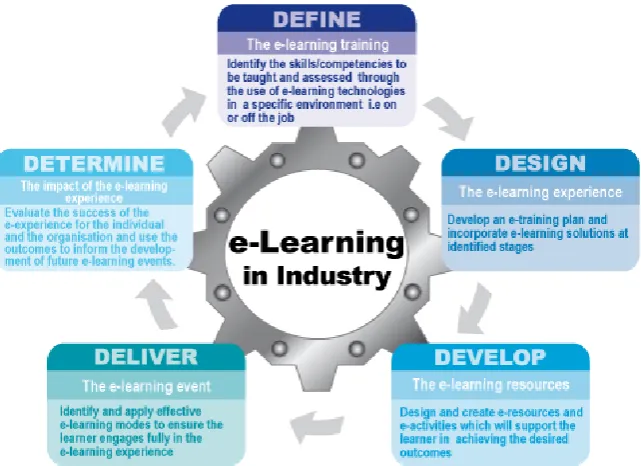
A lack of ‘quality’ during any of the identified processes ultimately affects the final e-learning experience of participants. To ensure quality, the creation of e-learning events should follow a recognized cyclical pattern conceptualised by the research team as the Five D’s (5Ds) of e-learning in industry:
• Define: the training requirement(s),
• Design: the training event(s),
• Develop: the resource(s),
• Deliver: the event(s),
The research team’s Five D’s (5Ds) of e-learning in industry is illustrated in Figure 1 below
Figure 1: The 5Ds of e-learning
Measuring Effectiveness and Impact
Measuring and proving the value of e-learning can be a complex task and, dependent on the “model selected”, perceptions on the impact and effectiveness can vary widely (Wilson, 2004). In evaluating the effectiveness and impact of e-learning the two target areas of analysis are firstly, the individual level investigating competency and
accomplishment and secondly, the organisational level investigating strategic alignment and business impact. At an individual level it is important to ascertain if the employee has “learnt” something from the training provided. For example, have they acquired a new skill, have they modified or changed behaviour, or are they “happier” in their workplace (Cooper, 2007). At an organisational level it is critical to understand how effectively the learning and training opportunities presented to employees have contributed to improving the organisation. For example, has quality of product improved, has the dollar value of sales increased, is there an increase in customer satisfaction, have staff retention rates increased, or is plant being used to optimum capacity (Walliker, 2005).
existing evaluation practices and would be more readily accepted (Skillsoft, 2005). The Kirkpatrick-Philips model is often conceptualised as a pyramid comprising five levels.
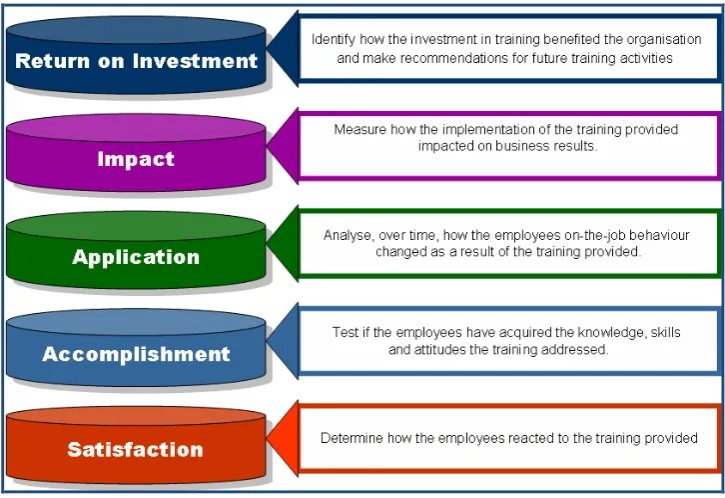
• Level one (satisfaction) evaluates if learners liked the activities undertaken,
• Level two (learning) measures if learners learned from the activities,
• Level three (impact) measures how learners have used their learning on task,
• Level four (results) measures the impact on the business’s performance, and
• Level five (return on investment measures if the investment in training paid off.
Using the Kirkpatrick-Philips model as a framework an evaluation model based on five levels (satisfaction, accomplishment, application, impact and return on investment was developed by the project team and this is illustrated in Figure 2 below.
Figure 2: Evaluating the effectiveness and impact of e-learning
Future quality assessment capability models
The authors appreciated that, while the concept of “e-learning capability” may be difficult define, it is of critical importance to the monitoring of the effectiveness and efficiency of e-learning activities in the work place. Assurance that effective, efficient and replicable e-learning activities are being implemented allows a comparison against the Kirkpatrick-Philips’ five levels (satisfaction, accomplishment, application, impact and return on investment) of evaluation.
The concept of benchmarking as a tool for establishing the capability of an organisation to be effective in a particular area of work is well-established (Paulk et al. 1993, El Eman et al. 1998, as cited in Marshall, 2006). Benchmarking is a critical feature of sustainable commitment to quality delivery of e-learning in the workplace and is based on the concept of comparison and measurement, using a clear set of measurable
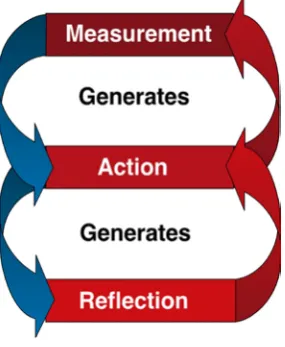
• Reflect on their strengths and weaknesses in the integration of e-learning training within their structures and processes,
• Identify action(s) that will facilitate increased learner competence, confidence and understanding of e-learning applications
• Measure and report on the impact e-learning events on strategic alignment and business operations.
In essence, benchmarking creates a reflection-action-measurement cyclical model (R.A.M.) that iteratively builds organisational capability and capacity in an ICT-literate and informed workplace. This is illustrated in Figure 3 below.
Figure 3:R.A.M. conceptual model
An understanding of quality and the impact of effectiveness cannot be divorced from the existing environment. Any model intended to be used as a tool for moving an organisation through the processes of building a skilled workforce and implementing improvements to planning and operations needs to allow for progression from a current state, which may not necessarily contain awareness of present capabilities, through to a desired state that includes commitment, evaluation, leadership and sustainability.
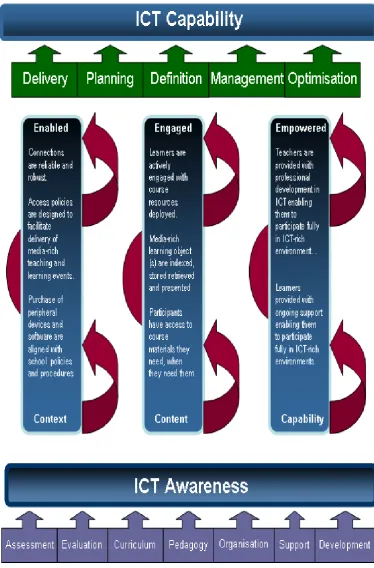
The research team developed the A.C.E. conceptual framework based on the 3 As, Cs, and Es (A.C.E.). The constituent parts of the framework are:
• The 3As: Awareness (policy makers reflect upon the existing educational capacity and capability), Action (policies are generated providing guidance for e-learning implementations) and
Accomplishment (the impact of e-learning implementations are measured).
• The 3Cs: Context (factors shaping and influencing perceptions), Content (factors influencing direction and focus) and Capability (factors shaping participant confidence and understanding).
Empowered (initiatives can be measured by how they have ensured capability of participation).
By combining the A.C.E. conceptual framework and the R.A.M. cyclical model and self-review framework, an e-Learning capability self-review conceptual framework was constructed. This is illustrated in Figure 4 below:
Figure 3: ICT capability self-review conceptual framework
The seven factors contributing to the baseline state of e-Learning Awareness provide the environment boundaries within which the organisation determines its activities and expectations. These can be cross-linked to the Five D’s of e-learning model mentioned earlier, which employs a cyclical pattern, also evidenced within the supporting pillars of the e-Learning Capability model in Figure 3. At each stage of the planning process, to move an organisation from an awareness of what is required of learners and trainers (R), through to an assessment of the capability of the organisation as a whole (A), the
presence of quality and how it is measured (M) will ultimately affect the ability either to progress to a further, or to return to an earlier, stage. The iterative quality of the process is an underlying strength as it recognises the goalposts of awareness and capability have the capacity to move over time.
For example, in defining, designing and developing an e-learning event within the workplace for the purpose of developing online course materials – Content - , similar planning will need to have occurred with the acquisition or deployment of peripheral devices - Context – in order for the event to be accepted as a quality experience by all those involved. Likewise, the measurements of success of an enabled, engaged and empowered workforce will vary from those of a workplace that is in the early stages of moving through the process towards achieving e-Learning capability. The process of self-review will involve identifying critical success factors, which will vary from one organisation to another, but will probably include
• Key drivers for deploying e-learning
• Determining work-force capabilities
• Barriers to implementation
• Impact upon the organisation as a whole
Conclusion
A 2008 investigation into the state of New Zealand businesses, trades and industry and their consideration of employing e-learning as an effective method for building a skilled workforce revealed that many were acquiring the necessary skills and operational experience in the deployment and implementation of e-learning systems, application and content for education and training. (Clayton, Elliott, Saravani, Huntington and Greene, 2008, p. i).
Planning for e-learning development and implementation needed to be part of larger strategic planning processes, with demonstrated commitment from senior management. The provision of e-learning needed to be seen to provide consistent quality of training which would result in a knowledgeable, skilled workforce and which resulted in identified, measurable return on investment.
participant’s current working practices. Both learners, trainers and senior managers need confidence that the e-learning event is of consistent, measurable quality. Experience has shown that quality is defined by the sum of all processes used in the creation and
outcomes of the e-learning event.
A variety of models can be employed to aid assessment of quality – the 5 Ds of e-learning is one such model developed by the authors for the purpose of integrating critical factors at the various stages in an overall life cycle.
A slightly-modified version of the widely-applied Kirkpatrick-Philips evaluation model can be used as a tool for measuring the effectiveness and impact of e-learning.
References
Barker, K. (2002). Canadian recommended elearning guidelines (CanREGs). FuturEd. Retrieved February 8, 2008, from: www.futured.com/pdf/CanREGs%20Eng.pdf Barron, T. (2003). LoD survey: Quality and effectiveness of e-learning: Learning
circuits. Retrieved February 8, 2008, from:
http://www.learningcircuits.org/2003/may2003/qualitysurvey.htm
Business NZ & Industry Training Federation of NZ. (2003). Report of the Business NZ Skills and Training Survey 2003. Department of Labour. Retrieved January 28, 2008, from:
http://www.dol.govt.nz/PDFs/Skills%20and%20Training%20Survey%20Report %20-%20June%202003.pdf
Clayton, J., Elliott, R., Saravani, S., Greene, N., & Huntington, N. (2008). e-Learning in industry: A summary of activities.: e-Learning in Industry. Wellington: Tertiary e-Learning Research Fund. Retrieved July 17, 2008 from http://ito.e-learning.ac.nz/
Cooper, C. (2007). Work-based learner ICT and e-learning survey: Final report.
Association of Learning Providers and the Learning and Skills Council. Retrieved January 28, 2008, from:
http://www.elearningproviders.org/HTML/images/cms/alp_e-learner_survey_final_report.pdf
Department of Labour. (2005). Human Capability Framework. New Zealand Government. Retrieved January 28, 2008, from
http://www.dol.govt.nz/initiatives/strategy/hcf/
Marshall, S. (2006). E-learning Maturity Model: Process assessment workbook.
Wellington: Victoria University of Wellington.
Scienter-MENON Network. (2004). Sustainable environment for the evaluation of quality in e-learning (SEEQUEL). MENON Network EEIG. Retrieved February 8, 2008, from:
http://www.education-observatories.net/seequel/SEEQUEL_core_quality_Framework.pdf
Skillsoft. (2005). What return on investment does e-learning provide? White Paper.
Skillsoft. Retrieved January 28, 2008, from: http://www.e-learningcentre.co.uk/eclipse/Resources/costs.htm#d2007
Walliker, P. (2005). Cost comparison: Instructor led Vs. E-learning. Learning Circuits. Retrieved January 28, 2008, from:
http://www.learningcircuits.org/2005/jun2005/walliker.htm
Wilson, D. (2004). Measuring and proving the value of learning: eLearnity viewpoint paper. Cirencester, UK. Retrieved January 28, 2008, from