3044
A New Analytical Method For Determination Of
Formaldehyde Content In Entecavir Drug By Using
High-Performance Liquid Chromatography (HPLC)
Vipul T Prajapati*, Dr. Akruti S Khodakiya
Abstract— To create an effective and flexible analytical tool for quantifying the toxic impurity trace amount, formaldehyde in the active pharmaceutical component or the product material. The procedure to be established must be accurate and precise, flexible, rough and simple in order to be reproducible in any laboratory, even taking into account the expense of the study. While formaldehyde was gas at room temp, it appears as a 37-40 percent formaldehyde solution as detailed in the introduction. Because the sample has only one carbon atom in it, it becomes difficult to quantify using a GC-FID detector, since it doesn't have enough energy for combustion. Nevertheless, the presence of formaldehyde often contributes significantly to the Blank in solvents such as Methanol and Acetonitrile as well as from the environment, and thus removing this intervening value from the Blank Chromatogram becomes a task. The chromatograph was filled with liquids that had a lower concentration of impurities. For the observed reaction the signal to noise ratios has been determined. The results of the initial analysis and the results of the post-preservation analysis were compared and found to suit well within the set limit for Entecavir up to 24 hours of solution stability testing. Because the findings of initial analysis and study are similar after survival up to 24 hours, the solution remains stable up to 24 hrs.
Index Terms— Entecavir, Formaldehyde, HBV infection, Hydrazine Hydrochloride, Linearity data, Peak area, System suitability.
—————————— ——————————
1 INTRODUCTION
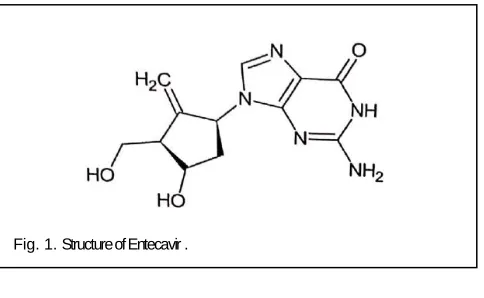
The most dangerous hepatitis B virus (HBV), side effects of entecavir treatment include fever, fatigue, dizziness, diarrhea, and vomiting. Lactic acidosis and hepatic steatosis can very rarely occur in patients. While other nucleoside analogs have been linked with drug-induced thrombocytopenia with action against HBV, such as lamivudine and adefovir, entecavir has a very low incidence. [1] HBV disease was the 10th largest manner of death worldwide, with almost one million deaths annually from chronic hepatitis, cirrhosis and hepato cellular carcinoma (HCC).The infection of HBV is a primary cause of acute liver cancer and is almost a hundred percent lower diagnosed with HIV.As of 1982, vaccines became available for HBV infection. As when the HBV vaccines have become a component of regular childhood immunization services significantly reduced the rate of HBV infection. Circa 1.25 million inhabitants are permanently infected from us &, despite the availability of safe and effective vaccinations, 73 000 new infections are established annually. [2].Entecavir is an oral antiviral drug used to treat hepatitis B infection Entecavir is a guanosine derivative that blocks reverse transcription, replication of DNA, and transcription during the process of viral replication. Entecavir is believed to be more effective than prior agents used for treating hepatitisB. Entecavir has been used in chronic hepatitis B treatments. It also helps prevent replication and colonization of new liver cells by the hepatitis B virus. Entecavir is still reported to treat chronic hepatitis B for people diagnosed with HIV / AIDS. Entecavir isn't successful against HIV, though. [3] Formaldehyde is a colorless, flammable, powerful-smelling compound that is commonly used during making products for home building. Some formaldehyde manufactured in the United States is used to create resins, such as urea-formaldehyde, which are used to make adhesives for pressed wood products, such as particleboards, chairs, doors, cabinets as well as other products. Formaldehyde is often widely used as a preservative, along with some hair smoothing & straightening products, in cosmetic labs, mortuaries, and consumer products. However, it is an among-product of engine combustion and is created among most living organisms, including humans, in small quantities.[4]
Up to 90 percent of total formaldehyde is produced by activities in the upper atmosphere. Formaldehyde has also been an intermediate in methane oxidation (or combustion) and other carbon substances, such as in forest fires, car exhaust, and smoke from tobacco. It becomes a part of smog as produced from the influence of sunshine and oxygen on methane & many other hydrocarbons in the atmosphere. Formaldehyde was found also in outer space. [5]
The formaldehyde and the hydrates & oligomers are rarely found in living organisms. Methanogenesis proceeds through analog formaldehyde, but, this one-carbon methanopterin genus disguises itself to be a group of methylene. As alcohol dehydrogenase metabolizes methanol into formaldehyde, formaldehyde is the major cause of methanol toxicity. Formaldehyde does not remain in the atmosphere because the sunshine or bacteria found in soil or water break it down within a
————————————————
Vipul Prajapati is pursuing as a Research Scholar in Pharmaceutical chemistry in C.U.Shah University, Wadhwan, India. E-mail: [email protected]
Dr. Akruti khodakiya is done doctorate degree program in Pharmaceutical chemistry in RK University, India. E-mail: [email protected]
3045 few hours. Formaldehyde is quickly metabolized by humans, Then
it does not grow and in the liver, it is converted into formic acid.
1.1 Mechanism Of Entecavir Action
DNA polymerase in the hepatitis B virus (HBV) is the main enzyme in virus replication. NAS (LAM, ADF, ETV) belongs to something like a drug class which inhibits its activity of polymerase HBV DNA. This class of drugs is the active form of triphosphate (TP). In the mammalian cell, Parent ETV is very efficiently phosphorylated into ETV-TP. There will be 3 different steps throughout the cycle-priming, reverse transcription, and synthesis of Rna-dependent HBV DNA replication. ETV-TP binds a very high affinity to HBV DNA polymerase and is a very potent inhibitor of all three phases. In comparison, LAM-TP doesn't hinder the process of priming. Research has shown that ETV's TP type is a successful HBV polymerase inhibitor with respect to dGTP and is preferentially utilized HBV DNA polymerase over most of the natural substrate. [6]
2
USING
TECHNIQUE
2.1 High-Performance Liquid Chromatography (HPLC) HPLC is indeed a kind of chromatography in columns really pumps a sample mix or analyte through some kind of column through chromatographic packaging material (stationary phase) at high pressure in a solvent (known as mobile phase). The sample is borne by a stream of flowing helium or nitrogen carrier gas. HPLC has the ability to separate and classify substances found in any sample that may dissolve at trace Concentrations in a substance as high as the parts per trillion. HPLC will be used in a number of industrial and scientific applications, including biomedical, medical, forensics, and chemistry, because of this versatility. The sample retention time will vary based on the relationship between the stationary phase, the molecules being examined and the solvent or solvent being used. This occurs at a different speed between both the two phases as when the sample passes through the tube, largely due to the various polarities in the analytes. Analytes with the least stationary phase interaction or the greatest amount of mobile phase interaction should leave the column more quickly. [7].
2.2 Gas Chromatography
A widely utilized analytical method in the petrochemical, pharmaceutical & natural gas industries is the Flame Ionization Detector or GC-FID. An FID generally uses a hydrogen/air flame in which the material is moved to oxidize organic compounds and produce molecules (ions) with an electrical charge.The ions are captured, as well as an electrical signal is produced which is then calculated. Like other GC approaches, low water and oxygen impurities require a carrier gas such as water and oxygen to interfere in both the stationary stage causes significant issues like high baseline leakage, column bleeding throughout the chromatogram of the exhaust gas of which limit the performance of the analyzer and reduce the lifetime of the sample. So the FID is extremely sensitive throughout the availability of flamming oxygen and hydrogen to hydrocarbon impurities. Hydrocarbon impurities can cause elevated baseline noise & decreased detector sensitivity. [8].
2.3 Gas chromatography-mass spectrometry(GC-MS) Gas chromatography (GC-MS) is also an experimental method that combines gas chromatography & mass spectrometry properties to classify different Compounds in a research model. Uses of GC-MS include drug identification, explosive monitoring, emissions analysis; explosive investigation and discovery of missing materials, as well as Element samples obtained by planet Mars as early as the 1970s, during observation flights. GC-MS would be used to protect airports for the identification of contaminants in baggage or on humans.Besides, trace elements may be detected from materials previously thought of disintegrating against identification. Similar to liquid chromatography-mass spectrometry, which allows for the study & measurement of only small quantities of material. [9]
Formaldehyde is a complex of simple chemical compounds composed of hydrogen, oxygen, and carbon. All types of life-bacteria, fungi, insects, animals, and humans-naturally produce formaldehyde as part of the digestion of cells. Formaldehyde may be renowned for its preservative & antibacterial effects, however, chemistry centered on formaldehyde is used to cover a wide variety of value-added items. Formaldehyde is among the most researched and very well-understood commercially available chemicals. [10] Formaldehyde is used primarily in manufacturing because it is highly versatile in facilitating a large number of reactions. For most fungi and bacteria, the formalin used as an antiseptic and disinfectant solution, and also for storing biological samples. The pentaerythritol compound produces formaldehyde and is used in explosive and paint production. In addition, formaldehyde is used to synthesize a wide variety of resins. [11]
2.4 Nuclear magnetic resonance (NMR)
Nuclear magnetic resonance (NMR) is a mechanical calculation mechanism where a small oscillating magnetic field interferes with nuclei in a solid, steady magnetic field (in the near field, therefore not requiring electromagnetic waves) & react by generating an electromagnetic pulse with a magnetic field frequency characteristic at nucleus. This process is happening past resonance when the oscillation frequency approaches the nuclei's intrinsic frequency, which depending on the intensity of the static magnetic field, the chemical environment, as well as the magnetic characteristics of the involving isotope; in useful applications from stable electric fields until ca. The 20-tesla frequency is closest to that of VHF and UHF TV (60–1000 MHz). [12]
3046 solvent that has been specifically prohibited in HPLC, as it is
devastating to the stationary system but has since been judiciously used for other sample solubilities. The material was therefore dissolved in DMSO so that the overall concentration of DMSO in the diluent does not exceed 10 percent.
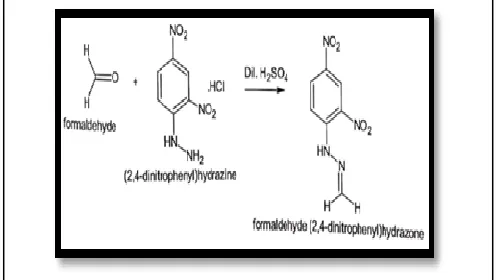
Due to its solubility in organic solvents, the derivatizing reagent, that is 2,4-Dinitro phenylhydrazine, also acetonitrile prepared.The conditions for the reaction as well as the chromatographic conditions were tailored bearing in mind that the resulting derivative is an imine. In the presence of an acid, preferably mineral acids, the derivative is known to be formed. Nevertheless, due to the fact that the sulfuric acid is the hydrolyzed oleum, sulfuric acid was favored over the other acids, and the possibility of metal corrosion in the same, which may hamper the column output, was avoided. Sulfuric acid's function throughout the process was no more than catalysis and has been prepared in acetonitrile to prevent any possible formaldehyde sources. The equal number of Sulfuric acid was added in Acetonitrile to the Formaldehyde Impurity Storage Solution stored in Dimethyl sulfoxide. The addition of acid protonates the formaldehyde and thereby accelerates the formation in a carbocation.
This carbocation so formed is readily now available for the nucleophilic addition of the amine-containing the Derivatizing reagent, 2, 4-Dinitrophenyl hydrazine in Acetonitrile. Nonetheless, this is a well-known fact that the amine and hydroxyl groups show secondary associations with the stationary phase residual silanols, corrupted by how they should be done. The most common end traditional approach to eliminating these types of interactions is, therefore, to introduce about 0.1 percent of Triethylamine into the mobile phase's aqueous component. Competitively interacting with the residual silanols, the Triethylamine inhibits the basic sample's interaction with the residual silanols.Further, since the addition of the base shifts the pH towards that basic range (normal working range for a C18 column is around 2-8), and the pH of the mobile phase is adjusted ± 2 units of the pH depending on the pKa value of the sample, the acid employed here was Trifluoroacetic acid. The pH was adjusted to about 3.0.Though the acid employed, that is, Trifluoroacetic acid has a high UV Cut off Value, it has as no impact on the response of the sample, as the wavelength for measuring the absorbance was set at 360nm, where no solvents have any response and there would be hardly any influence of the acid in the chromatogram.In addition, the method's flow rate was standardized to 1.5mL / min. Keeping the time required for analysis in check in a variable proportion, as shorter techniques also reduce the time and cost of the analysis. A 5 μl volume of injection was also judiciously optimized to have sharper peaks. The corresponding derivative, which is the
2,4-Dinitro phenyl hydrazine formaldehyde derivative, eluted at about 6 minutes and was 15 minutes average run time. Although there are several recorded approaches for the quantitative of formaldehyde by GC, the current study describes a simple technique for detecting trace levels of formaldehyde using HPLC as the quantification device. The procedure is performed by derivatizing formaldehyde with a well-known derived reagent, 2,4-Dinitro phenylhydrazine, that has been used for as long as the Reagent for the Confirmation of Aldehydes and Ketones.2, 4-Dinitro Phenyl Hydrazine may be used for the qualitative analysis of the functionality of the carbonyl group ketone or aldehyde. A bright, orange, or red precipitate (called a dinitrophenyl hydrazone) shows a positive test. The precipitate will be purple if the carbonyl compound is aromatic; whether it is aliphatic, the precipitate will also be a yellow color. Below is a 2, 4-Dinitro Phenyl Hydrazine reaction with a ketone;
RR'C=O + C6H3 (NO2)2NHNH2 ―› C6H3 (NO2)2NHNCRR' + H2O Its process could be described as both a condensation reaction, 2 substances moving together just to remove water. Often called is the addition-elimination reaction:the nucleophilic addition of the -NH2 group to the carbonyl group C = O accompanied by the removal of a molecule H2O. [13]
3 PROPOSE
WORK
Formaldehyde, a harmful impurity, is expected or rather researched to derive from methanol; a solvent widely used in organic chemistry for washing precipitates, in this case, active pharmaceutical additives, regulation of any chances of having this impurity in the product content is of serious concern. Through means of reliable and correct analytical data, the regulation of this impurity in the drug product should be justifiable as per the International Regulatory Standards.
3.1 Principle of 2,4-Dinitro Phenyl Hydrazine Hydrochloride
Also, Dinitro Phenyl Hydrazine was abbreviated to DNP or DNPH. The Brady's reagent is known as a 2,4-Dinitro Phenyl Hydrazine solution in a mixture of methanol and sulphuric acid.Even though the name sounds confusing and the concept seems very complex, it's very easy to work out in reality. Actually, begin to hydrazine formula. That's practically everything one has to recall.
3.2HYDRAZINE
H2N-NH2
Structure of Hydrazine
One of the hydrogen in 2,4-Dinitro Phenyl hydrazine is substituted by a unit of phenyls C6H5. That is based on even a loop of benzene.
There Are Two Nitro Groups In 2,4-Dinitro Phenyl Hydrazine, No2, Attached To The 2- And 4-Position Group Of Phenyls. An Angle With Both The Attached Nitrogen Is Listed As The Fig. 2. Keto-Enol Tautomerism.
3047 Number 1 Position, As Well As The Number Around The
Triangle In A Clockwise Direction.
3.3 Desired impurity synthesis using Derivatization
Its specifics are slightly different based on both the aldehyde or ketone shape as well as the solventwhere the 2,4-Dinitro Phenyl Hydrazine is dissolved. When one utilizes the Brady reagent (a methanol and sulfuric acid solution of 2,4-Dinitro Phenyl Hydrazine): adding unless Several drops of aldehyde, ketone, or perhaps a methanol aldehyde or ketone solution, to both the Brady chemical compound, bright orange or yellow precipitate indicates the presence of aldehyde or ketone double bond carbon-oxygen.For a ketone or an aldehyde, this is the most simple confirmatory test.
3.4 Normal Entecavir Formaldehyde Preparations And Sample Preparations
The empty solution is prepared by transferring 1.0 ml of Catalyst Solution to a 10 ml volumetric flask of 1.0 ml DMSO content.This solution was swirled to be correctly blended and then diluted with both the derivative reagent to the target. Applying approximately 260 mg of formaldehyde to a 100 ml volumetric flask containing sufficient acetonitrile, the formaldehyde storage method was primed, then diluted with acetonitrile. A subsequent solution has been further purified with acetonitrile for formaldehyde processing of 10 ppm as a pure distilled solution. Similarly, pass 1.0ml of the distilled solutions containing 10 ppm formaldehyde to a 10 ml volumetric flask carrying 1.0 ml from each DMSO, a precursor product & a reagent analog.Dilute the above solution with Acetonitrile to the label, and blend well. This is the regular formaldehyde treatment.
The Entecavir Test Solution was ready by moving 10 mg of the sample to a volumetric flask of 10 ml and then adding 1 ml of DMSO, Catalyst Solution, and Derivatizing Reagent. Marking with Acetonitrile then extracts this solution.
3.5 System Suitability
To decide if the operating system is running correctly a software suitability test should be conducted. Unit suitability tests are being used to make sure the reproducibility of the device is adequate for review carried out.Such experiments are based on the concept that the to be tested devices, electronics, analytical processes, and samples represent an
integrated structure which one can evaluate as such.
Unit adequacy test was conducted in conjunction with ICH specifications to verify whether the reproducibility of the device was appropriate for the analysis to be conducted.By injecting the system suitability solution and determining theoretical plates and tailing factor, system suitability was performed. Also, the number of RSD of Formaldehyde derivative peak responses in diluted regular solution was determined (less than 5 percent). The element of tailing has been calculated. The results are presented in Table.1.
3.6 Resolution
The resolution is a mixture separation of two components, and has been measured by:
RS = 2(tR2-tR1)/ (W1 +W2)
While tR2 & tR1 were both preservation intervals of dual components or where W2 &W1 are the equivalent widths on the largest base acquired by extrapolation of the relative straight sides of the reference peaks. Throughout the case of electronic integration, evaluating a solution through means of the equation may be convenient:
RS = 1.18(tR2 -tR1)/ (W1, h/2 + W2, h/2)
4
RESULTS
AND
DISCUSSION
The device's versatility is its capability to detect and eliminate all of the material's impurities. The accuracy of the approach is demonstrated both in terms of the substance's spectral and optimal purity data and the impurities discovered in the material. Optimum has passed the test of peak purity.
TABLE1 SYSTEM SUITABILITY
Parameter Value Limit
Tailing factor 0.9 Between 0.8
to 2.0
Theoretical plates 18117 Not less than 2000
. TABLE1
SYSTEM SUITABILITY
.
TABLE2 PEAK AREA RESPONSES
Sr. No. Formaldehyde
1 170430
2 170050
3 170200
4 169777
5 169319
6 169857
Average 169940
SD 395189
% RSD 0.2%
.
3048 4.1 Limit of detection
Detection sensitivity could be demonstrated by setting the detection limit (LOD). Normally, signals to noise ratio (S / N) around 3 and 10 is considered ideal for evaluating the individual S / N peak detection ratios at different concentrations at the expected LOD, and the corresponding RSD percentage for replication injections (n=3) was calculated.The LOD for formaldehyde was found to be 0.018 percent. The findings are expressed in Table 3.
An important device fit parameter is A signal-to-noise ratio (S / N) is the following: S / N=2H / h
While H is a height for both its maximum was calculated from both the maximum apex to a median extrapolated at its half-height 5 times an average length over a range: but H is the difference here between maximum and the smaller noise values found at both the point of interest 5 times the width at the half-height of the peak centered similarly.
4.2 Measurement Limit
The measurement limits are the minimum quantity to be directly measured with sufficient precision and consistency of a substance. In general, Usual S / N ratio is considered 10-30 appropriate for measuring the quantification limit.At different concentrations, the S / N the individual peak ratios were estimated to approximate the quantification limit (LOQ) and the proportional percentage of RSD was measured for replication injections (n=6). It was found that the LOQ was 0.06%. The findings are presented in Table 4.
TABLE3
LOD AND LOQ RESULTS OF FORMALDEHYDE IMPURITY
Compound Name
LOD (µg/ml)
%RSD LOQ (µg/ml)
%RSD
Formaldehyde 0.2 S/N Ratio: 33
NA 0.6
S/N Ratio: 92
0.1%
.
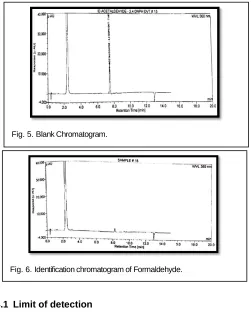
Fig. 5. Blank Chromatogram.
Fig. 6. Identification chromatogram of Formaldehyde.
Fig. 7. Identification chromatogram of Entecavir.
Fig. 8. Chromatogram for Limit of Detection.
3049 4.3 Linearity
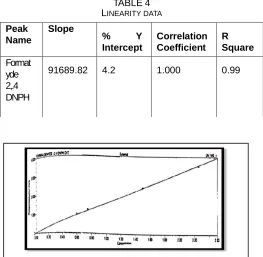
Linearity of both the process was verified by the processing of 4 concentration level derivatives of 0.012% (Level 1), 0.06% (Level 2), 0.15% (Level 3) and 0.225% (Level 4); respectively, while the levels 2 and 3 were injected twice. The mean responses obtained for the derivative formaldehyde were plotted against the concentration. It was observed that the correlation coefficient is 1,000, suggesting strong linearity. (Illustration 4).
4.4 Precision on system and method
Repeatability tests were carried out on the system for formaldehyde impurity. The sample was treated with
formaldehyde by spiking entecavir and a dose of the target analyte concentration for 0.15 percent was formulated &inject 6 times. A computer accuracy degree of RSD was estimated to be below 5.0percent. To assess the process consistency, six different solutions were formulated through spiking Entecavir at such a concentration of 0.15 of impuritiespercent compared to the goal analyte concentration. They injected every single solution.The variations in Formaldehyde outcomes were presented as percentage RSD. The measured values for impurities were found to be below 15.0 percent RSD, suggesting adequate precision of the process.
4.5 Entecavir sample preparation to routine analysis
Exactly weighed 50 mg of the Entecavir sample was transferred to a 50ml volumetric flask, dissolved in the diluent, and the volume with the diluent was made up to the mark. To determine the amount of formaldehyde present in the sample this solution was injected into the HPLC system. Under the established conditions three separate batches of Entecavir
were analyzed. The findings are laid out in Table 6.
4.6 Stability Approach
The consistency of the solution is tracked to test solution consistency. For a period of 0, 4, 8, 12, 16, 20 and 24 hours, a sample solution was stored and evaluated after the specified time intervals.
The results of the initial analysis and the results of the post-preservation analysis were compared and found to suit well within the set limit for Entecavir up to 24 hours of solution stability testing. Because the findings of initial analysis and study are similar after survival up to 24 hours, the solution remains stable up to 24 hrs. TABLE4
LINEARITY DATA
Peak Name
Slope
% Y
Intercept
Correlation Coefficient
R Square
Format yde 2,.4 DNPH
91689.82 4.2 1.000 0.99
.
TABLE5
RESULTS OBTAINED FROM THREE BATCHES OF ENTECAVIR
Compound Name Formaldehyde
B. No. A Not Detected
B. No. B Not Detected
B. No. C Not Detected
.
Fig. 11. The linearity of Formaldehyde Derivative. Fig. 10. Chromatogram for Quantification Bound.
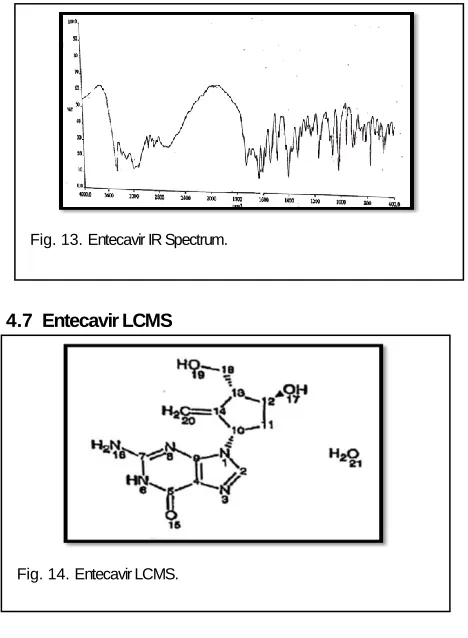
3050 4.7 Entecavir LCMS
4.8 Entecavir Proton NMR in DMSO
5 CONCLUSION
The chromophore is absent, formaldehyde doesn't really display UV absorption spectrum &thereforecannot be observed through HPLC fitted via UV detectors. Nevertheless, its identification can be significantly increased by precolumn derivatization using chromatographic reagents. The literature reported various derivatizing reagents for formaldehyde detection. We used 2, 4-DNPH in the present work, as it offers a stable derivative with maximum absorption at 360 nm.The HPLC approach proposed for quantification of formaldehyde in Entecavir is selective and sensitive.
The approach is checked all of thesemethodological criteria that could also be used to test consistency with regular analysis.
REFERENCES
[1] Binoy Yohannan, Dai Chu N. Luu, and Mark Feldman, ―Entecavir-Associated Thrombocytopenia: A Case Report and Review of the Pathophysiology, Diagnosis, and Treatment of a Rare but Reversible Cause of Thrombocytopenia‖ Received 6 November 2018; Accepted 19 February 2019; Published 12 March 2019
[2] Rivkin, A. (2005). A review of entecavir in the treatment of chronic hepatitis B infection. Current Medical Research and Opinion, 21(11), 1845– 1856. DOI:10.1185/030079905x65268
[3] https://en.wikipedia.org/wiki/Entecavir
[4] ―National Institute of Environmental HealthSciences‖, https://www.niehs.nih.gov/health/topics/agents/formal dehyde/index.cfm
TABLE6
CHEMICAL SHIFT OF ENTECAVIR OF ENTECAVIR
Chemical shift
Number of Proton
Multiplicity Assignment
2.0-2.5 2 Multiplet 11
2.53 1 Multiplet 13
3.52 2 Triplet 18
4.22 -- Singlet 12
4.55 1 Triplet 20
4.84 1 Triplet 19
4.88 1 Doublet 17
5.09 1 Triplet 20
5.35 1 Triplet 10
6.40 2 Singlet 16
7.65 1 Singlet 2
10.55 1 Singlet 6
.
Fig. 13. Entecavir IR Spectrum.
Fig. 14. Entecavir LCMS.
Fig. 15. Entecavir Proton NMR in DMSO.
3051 [5]
https://www.sgsgalson.com/when-sampling-formaldehyde-the-medium-matters/
[6] Chee-Kiat Tan, ―ENTECAVIR: A REVIEW‖ Article in Hepatitis B Annual · January 2006
[7]
http://hiq.linde-gas.com/en/analytical_methods/liquid_chromatograph y/high_performance_ liquid_chromatography.html [8]
https://www.airproducts.com/industries/Analytical- Laboratories/analytical-lab-applications/product- list/gc-with-flame-ionization-detector-gc-fid-analytical-laboratories.aspx?itemId=D6D6641C668A47139A6F1 960D9441B93
[9] https://en.wikipedia.org/wiki/Gas_chromatography%E 2%80%93mass_spectrometry
[10]https://www.chemicalsafetyfacts.org/formaldehyde/ [11]http://www.softschools.com/formulas/chemistry/formal
dehyde_formula/414/
[12]https://en.wikipedia.org/wiki/Nuclear_magnetic_reson ance