ISSN (Online): 2320-9364, ISSN (Print): 2320-9356
www.ijres.org Volume 1 Issue 8
ǁ
Dec2013
ǁ
PP.33-41
Surface Quality Improvement Using Modified Tool Clamping In
Boring Operations
Tanmaya Mohanty
Abstract:
Boring operations are challenging owing to limited process performance due to inherent tool overhang and resulting vibrations. The tool vibrations can be suppressed with insertion of suitable damping methodology. The present work adopts a method suitable for machine operators, where in insertion of packing sheets at the boring tool support has been suggested. Insertion of number of layers causes frictional phenomenon to dissipate the exciting energy thereby damping the vibrations. Substantial improvement of surface quality of the internally machined surfaces has been noticed in the experiments.Keywords
: Boring operation, vibration suppression, surface qualityI.
Introduction
Machining process carries lot of significance since almost all products get their final shape and size by metal removal, either directly or indirectly. The machining processes can be seen as external machining and internal machining depending upon the surface where material removal is occurring. Cutting processes used for removing material from inside the surface of the work part are referred as internal machining processes. The focus of the present study is on the boring operation, wherein a single point boring tool is employed. Boring operations are used to enlarge drilled holes to design specified dimensions. Owing to the overhang factor cutting tool vibrations and chatter are quite common. These vibrations unless damped out, can produce detrimental effects including poor surface quality and reduced tool life. There have been numerous researches in the area of boring operations in order to improve the machining performance. The machining performance measurement criteria include material removal rate, cutting forces, surface quality of jobs, tool life, micro-structural changes in tool and work piece and chip morphology.
Adopting passive, active and semi-active vibration control solution, several strategies have been developed and exploited to mitigate the chatter. Seifring [1] was awarded a patent for damping using a sandwich of multiple layers of steel and viscoelastic solid material alternately. Sexton et al [2] demonstrated possible modulation of cutting speed to enhance stability. Thompson [3] was awarded patent for a system that detects the lobe precision angle and adjusts the feed in turning operation to maintain stability. Nachtigal [4] patented an apparatus using an updated synthesis circuit which sensed the cutting tool motion to interpret and actuate essential cutting forces to suppress chatter. The active control scheme proposed by Tewani et al [5] and the device they patented uses a piezoelectric reaction mass actuator mounted inside a boring bar. Rivin et al [6] achieved an increased stability by using layers of viscoelastic materials in a redesigned tool holder for added stiffness and damping. Ema et al [7] demonstrated improvement of damping capability of boring tools using impact dampers. Weck et al [8] placed roller bearings in a hydrostatic arrangement as passive damping elements in the tool holding fixture to optimize dynamic behaviour of the spindle tool system. Dai Gil Lee et.al [9] conducted detailed investigation on design, manufacturing and dynamic characteristics study of carbon fibre epoxy rotating boring bar. Mei et al [10] developed an innovative chatter suppression method based on magneto-rheological fluid control in boring bar. Wang and Fei [11-15] used electrorrheological fluid to control the stiffness of the boring bar and found that the chatter can be suppressed through application of this technique. Adoption of the methods suggested from research is still beyond the machine operators. The aspects related to reliability, power requirement, cost and availability makes the above strategies commercially infeasible. The applicability of the techniques in wide range of cutting speed continues to be a matter of investigation.
Surface Quality Improvement Using Modified Tool Clamping In Boring Operations
study is the roughness average (Ra). The Surtronic 25 model Surface roughness tester by Taylor Hobson has been used as surface roughness testing instrument.
Preliminary cleaning, facing and drilling (Fig 1-2) were done using standard HSS tools in the NH 22 lathe machine. Boring operation was performed at constant feed and depth of cut at varying speed conditions. The packing sheets of Copper, Aluminum, Brass, GI and MS have been procured from the market with thickness 1mm (Fig 4). The sheets have been processed to have length of 100 mm and width of 20mm. Surface roughness was measured for each of the experiment conducted. The experiments have been conducted by varying cutting speed in five steps and the number of layers of the packing materials from 1 to six. The surface roughness has been measured as Ra value through averaging three measurements. During all experiments same feed, depth of cut, the tightening torque at the tool, work-piece material and tool parameters have been maintained. The machining was carried out in dry condition in the NH 22 machine. The ambience conditions were controlled since the operations were carried out in an air conditioned environment. The schematic of the operations has been shown in Fig 5.
Working conditions
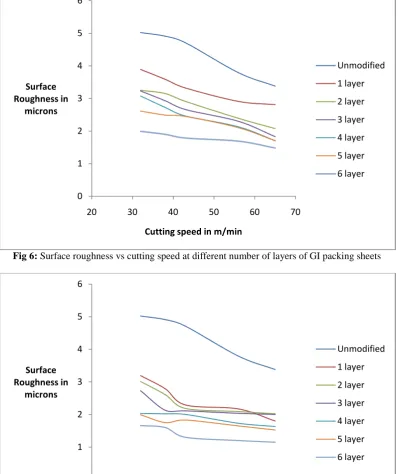
Fig 6: Surface roughness vs cutting speed at different number of layers of GI packing sheets
Fig 7: Surface roughness vs cutting speed at different number of layers of Copper packing sheets
0 1 2 3 4 5 6
20 30 40 50 60 70
Surface Roughness in
microns
Cutting speed in m/min
Unmodified
1 layer
2 layer
3 layer
4 layer
5 layer
6 layer
0 1 2 3 4 5 6
20 30 40 50 60 70
Surface Roughness in
microns
Cutting speed in m/min
Unmodified
1 layer
2 layer
3 layer
4 layer
5 layer
Surface Quality Improvement Using Modified Tool Clamping In Boring Operations
Fig 8: Surface roughness vs cutting speed at different number of layers of Aluminium packing sheets
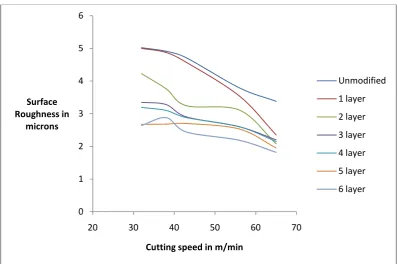
Fig 9: Surface roughness vs cutting speed at different number of layers of Brass packing sheets
0 1 2 3 4 5 6
20 30 40 50 60 70
Surface Roughness in
microns
Cutting speed in m/min
Unmodified
1 layer
2 layer
3 layer
4 layer
5 layer
6 layer
0 1 2 3 4 5 6
20 30 40 50 60 70
Surface Roughness in
microns
Cutting speed in m/min
Unmodified
1 layer
2 layer
3 layer
4 layer
5 layer
Fig 10: Surface roughness vs cutting speed at different number of layers of MS packing sheets
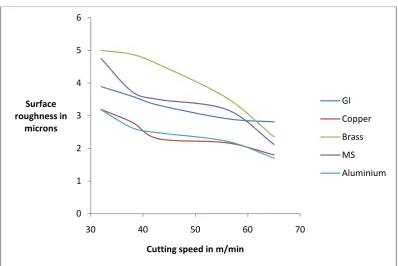
Fig 11: Surface roughness vs cutting speed using 1 layer of packing sheet of different material
0 1 2 3 4 5 6
20 30 40 50 60 70
Surface Roughness in
microns
Cutting speed in m/min
Unmodified
1 layer
2 layer
3 layer
4 layer
5 layer
6 layer
0 1 2 3 4 5 6
30 40 50 60 70
Surface roughness in
microns
Cutting speed in m/min
GI
Copper
Brass
MS
Surface Quality Improvement Using Modified Tool Clamping In Boring Operations
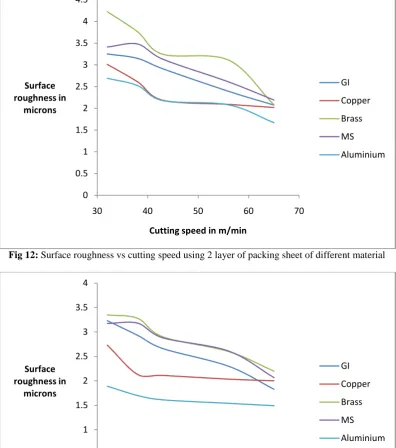
Fig 12: Surface roughness vs cutting speed using 2 layer of packing sheet of different material
Fig 13: Surface roughness vs cutting speed using 3 layer of packing sheet of different material
0 0.5 1 1.5 2 2.5 3 3.5 4 4.5
30 40 50 60 70
Surface roughness in
microns
Cutting speed in m/min
GI
Copper
Brass
MS
Aluminium
0 0.5 1 1.5 2 2.5 3 3.5 4
30 40 50 60 70
Surface roughness in
microns
Cutting speed in m/min
GI
Copper
Brass
MS
Fig 14: Surface roughness vs cutting speed using 4 layer of packing sheet of different material
Fig 15: Surface roughness vs cutting speed using 5 layer of packing sheet of different material
0 0.5 1 1.5 2 2.5 3 3.5
30 40 50 60 70
Surface roughness in
microns
Cutting speed in m/min
GI
Copper
Brass
MS
Aluminium
0 0.5 1 1.5 2 2.5 3 3.5
30 40 50 60 70
Surface roughness in
microns
Cutting speed in m/min
GI
Copper
Brass
MS
Surface Quality Improvement Using Modified Tool Clamping In Boring Operations
Fig 16: Surface roughness vs cutting speed using 6 layer of packing sheet of different material
II.
Discussion of experimental results
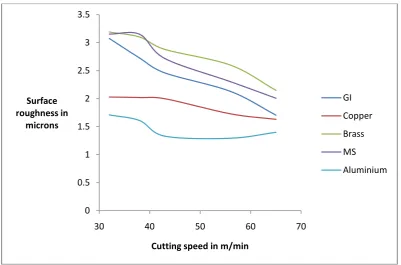
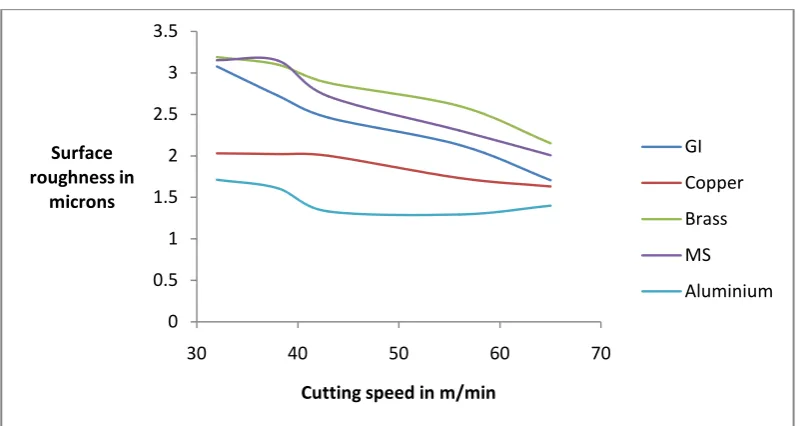
With increase in number of layers a remarkable improvement in the surface quality is noticed. With the increase in number of the layers of the packing sheets the surface roughness measured by Ra is seen to be decreasing.
Increase in number of layers of the support sheets increases the resulting frictional coefficient. Increasing coefficient of friction results in higher fraction of strain energy that can be dissipated compared to the total strain energy. This results in damping phenomenon thus reducing the effect of the boring tool vibrations.
It is well known that the surface quality obtained in internal machining processes including boring is limited owing to the process related tool overhang. Since overhang cannot be reduced, the resulting tool vibrations hamper the surface finish. However, it is being observed that, use of number of layers of the tool support sheets at the tool holder enhance the part of energy that can be dissipated. This opens up a scope for getting better surface quality using the suggested mechanism.
Figures 6-10 illustrate that Surface roughness reduces with increasing cutting speed. The decreasing trend may be attributed to the aspects of reduced cutting force at higher cutting speeds. The lower cutting force indicates a lower excitation to induce vibration at the tool tip and hence the vibrations induced are of lower amplitude. The surface quality of the internally machined surface is greatly influenced by the vibrations. Since the vibrations set up are of lower magnitude a better surface finish can be observed. Also these figures reveal that surface quality improves with higher number of layers of the sheets used at tool support. Figure 11-16 depict the variation of surface roughness obtained experimentally varying the material of packing sheets. It is observed that surface quality improvement depends on the material of the support sheet. The decreasing trend in roughness value is noticed when the materials of the support sheets are varied from Brass, MS, GI, Copper and Aluminium in order. Copper and Aluminium sheets give close values. It therefore becomes evident that the effect of vibrations resulting in poor surface quality can be negated using tool support sheets of material with higher coefficient of friction and lower modulus of rigidity.
III.
Significance testing
In order to verify the significance of the number of layers and the material being used as support sheet on the surface roughness analysis of variance test has been carried out, whose results have been summarized in Table 4.8 and 4.9 respectively. The Analysis of variance test yield both the factors to be significantly contributing to the surface quality
Table 1: ANOVA to test significance of impact of number of layers of tool support sheet on Surface quality
0 0.5 1 1.5 2 2.5 3 3.5
30 40 50 60 70
Surface roughness in
microns
Cutting speed in m/min
GI
Copper
Brass
MS
Error 667.79792 28 23.849926
Total 9499.545 39
Table 2: ANOVA to test significance of impact of material of the tool support sheet on Surface quality Anova: Two-Factor Without Replication
Source of Variation SS df MS F P-value F crit
Rows 90.4947 4 22.623683 0.7072765 0.5963679 2.86608 Columns 8212.72 5 1642.5448 51.350318 9.953E-11 2.71089
Error 639.74 20 31.987043
Total 8942.96 29
IV.
Conclusions
Based on the experimental investigations following conclusions can be drawn. 1. Surface roughness value (Ra) decreases in the modified boring tool support system.
2. The surface roughness value decreases when number of layers of sheets are used at the boring tool support 3. The surface roughness value decreases with increase in cutting speed
4. The surface quality improves, when material with high friction coefficient and low modulus of rigidity are used at the boring tool support.
5. The number of layers of the support sheets and the material of the support sheet contribute significantly towards surface quality improvement.
In boring operations, where surface quality is usually limited owing to process inherent tool vibrations, employment of suggested mechanism will yield better surface quality. Surface quality can be improved using higher number of layers of the support sheets. Use of material with higher friction coefficient and lower rigidity modulus as support sheet material improves the surface quality substantially. Better surface quality can be achieved in internally machined surfaces using the modified boring tool support. Surface finish is observed to be better at higher cutting speed, higher number of layers of the support sheets and using Aluminium as the support sheet material. Analysis of variance indicates all three factors to be significant in affecting surface quality. It is therefore conclusive that the machining performance in boring operations can be better if layers of support sheets are used at the tool holder. Use of material with higher frictional coefficient and low modulus of rigidity as support sheets can result achieving better surface quality and low chip reduction coefficient by improving system damping.
References
[1] Seifring, L., 1991, Apparatus and Method for Tool Vibration Damping, U.S. Patent, No. 5033340.
[2] Sexton, J. S., Milne, R. D., and Stone, B. J., 1977, A Stability Analysis of Single Point Machining with Varying Spindle Speed," Appl. Math. Modelling, Vol. 1, p.310
[3] Thompson, R. A., 1986, Method and Apparatus for Optimizing Grinding, U.S. Patent,No. 4604834.
[4] Nachtigal, C. L., Klein, R. G., and Maddux, K. C., 1976, Apparatus for Controlling Vibrational Chatter in Machine-tool Utilizing an Updated Synthesis Circuit, U.S. Patent, No. 3967515
[5] Tewani, S. G., Walcott, B. L., and Rouch, K. E., 1991, Active Optimal Vibration Control using Dynamic Absorber," in Proceedings of the 1991 IEEE International Conference on Robotics and Automation, Vol. 2, p. 1182.
[6] Rivin, E. I. and Kang, H., ‘Improvement of machining conditions for slender parts by tuned dynamic stiffness of tool’, International Journal of Machine Tools Manufacturing 29, 1989, 361–376
[7] Satoshi Ema , Etsuo Marui Suppression of chatter vibration of boring tools using impact Dampers International Journal of Machine Tools & Manufacture 40 (2000) 1141–1156.
[8] M. Weck , N. Hennes, M. Krell Spindle and Toolsystems with High DampingLaboratory of Machine Tools, Aachen, Germany Received on January 7,1999
[9] Dai Gil Lee , Hui Yun Hwang, Jin Kook Kim Design and manufacture of a carbon fiber epoxy rotating boring bar Composite Structures 60 (2003) 115–124.
[10] Deqing Mei, Tianrong Kong, Albert J. Shih, Zichen Chen; Magnetorheological fluid-controlled boring bar for chatter suppression, Journal of materials processing technology 2 0 9 ( 2 0 0 9 ) 1861–1870