1958
Performance Improvement Of Data Fusion Based
Real Time Multi Layered Gesture Recognition
Using One-Shot Learning Approach With Kinect
V2.
S.Chandrasekhar, Dr.N.N.Mhala
Abstract— Gesture recognition offers a new medium for human-computer interaction that can be both efficient and highly intuitive. This paper proposes a data fusion based l multi-layered gesture recognition method using one shot learning approach with Kinect V2. The Kinect sensor, have provided new opportunities for human-computer interaction. In recent years, human action recognition has drawn increasing attention of researchers, primarily due to its potential in areas such as video surveillance, robotics, human computer interaction, user interface design, and multimedia video retrieval. Kinect V2 to recognize different human hand gestures. It is fused with many advanced visual technologies and has been widely used in various kinds of computer vision tasks, such as face recognition, scene understanding, and human gesture recognition . Kinectv2 sensor which is capable of providing Depth Image ,RGB(intensity) Image , real time provision and Low cost.
Index Terms— One-Shot-Learning, Gesture Recognition, Multi-layered classification, depth image, Kinect.
—————————— ——————————
1
I
NTRODUCTIONResearch on multi layered gesture recognition has been intensified in the last decade. [1] In a multilayered framework, which extracts features from both the segmented semantic units and the whole gesture sequence and then sequentially classifies the motion, location and shape components. [3]Gestures are both natural and intuitive for Human-Computer- Interaction (HCI) and the one-shot learning scenario is one of the real world situations in terms of gesture recognition problems.[3] data fusion-based gesture recognition model by fusing depth information and RGB data. One-shot learning is an object categorization problem, found mostly in computer vision. one-shot learning involves three main challenges Representation, Learning and recognition. [4] One-shot-learning technique training only one example of each class is considered as the unique trait of this challenge whilst using more examples per sign typically improves accuracy.[5] Recently, Microsoft’s Kinect has attracted increasing interest in both industry and research communities. Kinect v2 capture both RGB and depth information of a scene. When applied to gesture recognition, the depth information recorded by Kinect can be used to accurately track the human. Due to this appealing feature, it has been widely used in human action recognition and also gesture recognition. [5] In a multi-layered framework is proposed for gesture recognition, which first segment the moving hands and then extracts features from both the segmented semantic units and the whole gesture sequence. Although, the depth information recorded by Kinect can help us to detect and track the moving hands, accurately segmenting the fingers is still very challenging since fingers have many complicated articulations and they usually occlude each other.To explore one-shot learning gesture recognition, uses only one training sample per each class. Some important challenging issues for one-shot learning gesture recognition are the Following: To extract distinctive features and select the suitable model. The above two challenging issues and propose a new approach to achieve good performance for one-shot learning gesture recognition. Our experimental results reveal that our method is competitive to the state-of-the-art methods. The key
contributions of the proposed method are summarized as follows:
The phonological model of gestures inspires us to propose a novel multi-layered gesture recognition framework, which sequentially classifies the motion, location and shape components and therefore achieves higher recognition
accuracy while having low computational complexity.
Inspired by the linguistic sequential organization of gestures the matching process between two gesture sequences is divided into two steps: their semantic units are matched first, and then the frames inside the semantic units are further registered. A novel particle- based descriptor and a weighted dynamic time warping are proposed to classify the location component.
The spatial path warping is proposed to classify the shape component represented by unclosed shape context, which is improved from the original shape context but the computation complexity is reduced from O(n3) to O(n2).
Performed the operation of feature extraction Initially scaling down the frame sizes, local MHI i.e. obtaining MHI for the last N frames at each consecutive frames, calculating the percentage change in MHI values in comparison to the total change in MHI values at each pixel, dividing the resultant frame into blocks, calculating the percentage change in interest points (IP) at each block finally performing two dimensional Fourier transform(2D-FFT) to get the final feature. Temporal segmentation of different gestures from the gesture sequences.
Finally features are extracted for each gesture in a manner similar to that done for training samples. The testing and classification was done1959
pexisting approaches. In Section 3, we describe the proposed approach in detail. Section 4 presents the experimental results. In Section 5, we conclude the paper.
2.
R
ELATED WORKFarhad Dadgostar et al. [7] explored a Multi-layered Hand and Face Tracking for Real-Time Gesture Recognition system. In this method consist of three layers .Adaptive skin detection and segmentation, hand and face tracking which is performed by a fuzzy-based Mean-shift algorithm, and gesture recognition. This technique can be used with a variety of frontend input systems such as vision-based input, hand and eye tracking, digital tablet, mouse, and digital glove. The real world applications are affected by its cost and adaptability to the existing technology.
Lei Zhang et al. [8] proposed a novel bag of manifold words (BoMW) based feature representation for gesture recognition. In contrast to most existing feature extraction methods for gesture recognition, the proposed BoMW does not depend on the accurate segmentation of the body or fingers and therefore is suitable for more practical scenes .In this gesture recognition method is composed of several key parts including dense covariance descriptor extracting, cookbook learning on SPD manifold, BoW histogram representation and nearest neighbour classification. To detects the hands using scene depth information and then employs Dynamic. Time Warping for recognizing gestures The effectiveness of the proposed feature extraction method is also validated on a new RGB-D action recognition dataset.
Yared Sabinas et al. [9] Implemented a new approach for early recognition of full-body gestures based on dynamic time warping (DTW) that uses a single example from each category. Our method is based on the comparison between time sequences obtained from known and unknown gestures. The classifier provides a response before the unknown gesture finishes. Input sequences are compared with stored ones by using DTW, a prediction criterion is proposed to determine when the method is confident of the identity of the gesture depicted in input sequences. In this method can work under the one-shot learning framework that is, using a single example of each gesture category to be recognized. This approach is easy to implement, it has no training phase and it is very efficient.
Decebal Mocanu et al[10] developed a Mixture of Variational Auto Encoders(MoVAE). to perform classification. Complementary to prior studies, MoVAE represents a shift of paradigm in comparison with the usual one-shot learning methods, as it does not use any prior knowledge. MoVAE is capable to successfully perform the one-shot learning task, without the need of having prior knowledge, due to its generalization learning capabilities. MoVAE achieves very good results and high accuracy on a much more complicated real-world task, fashion products recognition. Even MoVAE shows to be very successfully in one-shot learning without prior knowledge, we believe that by making use of prior knowledge, its performance can be further improved.
Tao Yu et al[11] propose a RNN-based multilayer parallel LSTM network to recognize human activities. This method focus on the HAR with smartphone sensors by deep learning methods. We propose an approach based on the long short-term memory (LSTM) network to recognize human activities from the time series data collected by the inertial sensors attached to smartphones. In this method automatically extract
features of time dependency from the original sensor data and classifies the activities with a softmax. This approach performs better than the traditional machine-learning methods, and achieves the similar performance as that of CNN, but it has lower computation complexity than CNN-based methods.
3.
M
ULTI LAYERED GESTURE RECOGNITION USING ONE-SHOT LEARNING APPROACH
Gesture recognition offers a new medium for human-computer interaction that can be both efficient and highly intuitive. The multilayered gesture recognition system should be able to work with a variety of input devices. As the number of sensors is reduced, the performance might degrade, but it should degrade gracefully. In order to achieve device independence, we have reconceptualized gesture recognition in terms of a multi-layer framework. This involves generating a high-level, device-independent description of the sensed object. Multi layered Gesture recognition then proceeds from this description, independent of the characteristics of any given input device. [12]Depth imaging technology has advanced dramatically over the last few years, finally reaching a consumer price point with the launch of Kinect. Depth cameras offer several advantages over traditional intensity sensors, working in low light levels, giving a calibrated scale estimate, being color and texture invariant, and resolving silhouette ambiguities in pose.
1960
N
Figure1.Proposed Architecture
The ChaLearn Gesture challenge encouraged a few researchers to attack the problem of one- shot learning gesture recognition from RGB and depth images of the Kinect sensor provided in the ChaLearn Gesture dataset. The data are available from 2 formats A lossy compressed AVI format (5 GB) and a quasi-lossless AVI format (30 GB). It presents various features of interest.[15] The ChaLearn Gesture Dataset is designed for one-shot learning and comprises more than 50,000 gesture sequences recorded with Kinect. [16]The dataset was divided into training, validation and test sets by the challenge organizers. All three sets include data from different subjects and the gestures of one subject in validation and test sets do not appear in the training set.
3.1MOTION COMPONENT CLASSIFICATION
During gesture recognition, gesture components in the order of importance are motion, location and shape. Understanding a gesture requires the observation of all these gesture components. None of these components can convey the complete gesture meanings independently. These gesture components complement each other.Gesture segmentation is used to segment a multi- gesture sequence into several gesture sequences. After the frames of the test and reference sequences are aligned, the next problem is how to represent the location information in a frame. In a multi-gesture sequence, each frame has the relevant movement with respect to its adjacent frame and the first frame. These movements and their statistical information are useful for inter- gesture segmentation. For a multi-gesture depth sequence I, the Quantity of Movement (QOM) for frame t is defined as a two-dimensional vector
QOM (I ,t) QOM Local (I ,t),QOM Global (I ,t)] (1)
Where QOM Local (I , t) and QOMGlobal (I ,t) measure the relative movement of frame t respective to its adjacent frame and the first frame, respectively. They can be computed as
QOM Local (I ,t) = ∑σ(It (m, n),It-1 (m, n)) (2) m,n
QOM Global (I , t) (I t (m, n), I1 (m, n)) (3)
m,n
where (m, n) is the pixel location and the indicator function σ(x, y) is defined as
σ(x,y)={1if|x-y|≥thersholdqon} (4)
otherwise
where ThresholdQOM is a predefined threshold, which is set to 60 empirically in this paper.
Dynamic regions in each frame contain the most meaningful location information. A simple thresholding-based foreground-background segmentation method is used to segment the user in a frame. The mask frame is then denoised by a median filter to get a denoised frame. The denoised frame is first binarized and then dilated with a flat diskshaped structuring element with radius 10 the binarized denoised frame from the dilated frame.The swing region (those white pixels in the swing frame) covers the slight swing of user’s trunk and can be used to eliminate the influence of body swing. From frame t, define as
{(m, n) | F1(m, n) Ft (m, n) ThresholdQOM ( 5) (5)
where F1 and Ft are the user masks of the first frame and frame t, respectively. To compute the overlap rate between this region and the swing region. If the overlap rate is larger than r, it is reasonable to think this region is mainly produced by the body swing. Therefore, it should be further removed. [17]To calculating the absolute depth difference between current frame and the start frame for each gesture segment, as the input data of deep learning network
3.2LOCATION COMPONENT CLASSIFICATION
location component of two aligned frames can be represented as two particle sets
P P1, P2...PN}and Q Q1 ,Q2 QN }.
The matching cost between particle Pi and Qj ,
denoted by C(Pi,Qj), is computed as their Euclidean distance. The distance of the location component between these two aligned gesture frames is defined by the minimal distance between P and Q. Computing the minimal distance between two particle sets is indeed to find an assignment _
to minimize the cost summtion of all particle pairs arg min C(Pi , Q (i) ) i (6)
This is a special case of the weighted bipartite graph matching and can be solved by the Edmonds method. where n is the number of particles. The distance of the location component between two aligned gesture frames is obtained
N dis(P, Q) C(Pi , Q (i) ) (7)
i
1961
between the location components of the aligned frames . Two factors influence the choice of the parameter ε. [18]The first one is the number of the gesture candidates and the other one is the type of gestures. When the number of the gesture candidates is large or most of the gesture candidates are the shape dominant gestures, a high threshold is preferred.
3.3SHAPE COMPONENT CLASSIFICATION
The shape in a hold phase is more discriminative than the one in a movement phase. The key frame in a gesture sequence is defined as the frame which has the minimization
QOMLocal. Shape component classifier classifies the shape features extracted from the key frame of a gesture sequence using the proposed Spatial Path Warping (SPW), which first extracts unclosed shape context (USC) features and then calculates the distance between the USCs of the key frames in the reference and the test gesture sequences. The test gesture sequence is classified as the gesture whose reference sequence has the smallest distance with the test gesture sequence. Spatial Path Warping algorithm (SPW) is proposed to compute the minimal distance between
two unclosed contours. The contour of a shape consists of a 2-D point set P P1, P2 PN }
Their relative positions are important for the shape recognition. Assume P and Q are the point sets for the shape contours of two key frames, the matching cost (pi, qj) between two points
pi P and qj Q is defined as
k
p[hqj(k)-h(k)]
2
(8) 2∑k=1 hp(k) –hqj(k)
Given the set of matching costs between all pairs of points
pi P and qj Q, computing the minimal distance between P and Q is to find a permutation to minimize the following sum
Ψ pi , q i ) ) (9)
An unclosed contour contains valuable spatial information. Thus, a Spatial Path Warping algorithm (SPW) is proposed to compute the minimal distance between two unclosed contours. Compared with the Edmonds algorithm, the time complexity of the proposed SPW is reduced from O(n3) to
O(n2) where n is the size of the point set of an unclosed shape contour.
3.4FEATURE EXTRACTION AND TRAINING
The depth data provided in the dataset are in RGB format and therefore need to be converted to grayscale before processing. The proposed methods of gesture recognition are an outcome of the series of operations performed for feature extraction. Scaling down is performed in order to reduce computational complexity. In the proposed scheme, the each frame is scaled down to s% of its original size and therefore the size of each m×n frame become mscale×nscale where
mscale =m×s/100 and nscale = n× s/100. In order to capture the direction of flow of motion and thereby the temporal position information of the moving parts the operation of taking the motion history image (MHI) of the lexicon is proposed. [19] These advantages make these templates as a suitable candidate for motion and gait analysis. In the MHI, the silhouette sequence is condensed into grayscale images, while dominant motion information is preserved. Therefore, it
can represent motion sequence in compact manner. This MHI template is also not so sensitive to silhouette noises, like holes, shadows, and missing parts. These advantages make these templates as a suitable candidate for motion and gait analysis. Conventional MHI has the advantage of representing a range of times encoded in a single frame, and this way, the MHI spans the time scale of human gestures. In the proposed scheme, unlike the conventional approach of taking MHI over a complete action, a local MHI of the last N frames is considered. The local MHI is taken on every one of the background subtracted depth image frames of the gesture samples. The advantage of performing Fourier transform is that when the depth values of the person are taken to the frequency domain, the position of the person becomes irrelevant, i.e., any slight movement of the camera vertically or horizontally would be nullified in the frequency response. The above operation is performed on all the test vectors and the outcome of the 2D Fourier transform is utilized as feature for a particular action.
3.5TEMPORAL SEGMENTATION
The test samples provided in the ChaLearn Gesture Dataset contain one or more gestures. Therefore, the first task is temporal segmentation of different gestures from the gesture sequences.. The test samples provided in the ChaLearn Gesture Dataset contain one or more gestures. Therefore, the first task is to separate the different gestures from the gesture sequences. However, in order to focus solely on the gesture recognition task, the temporal segment positions provided with the ChaLearn Gesture Dataset by the developers is utilized directly for separating different actions from a single video file.[20]
3.6TESTING AND CLASSIFICATION
After extracting the features from the gestures in the training dataset of a particular lexicon, a feature vector table is formed .Then, for the test samples, first temporal segmentation is done if multiple gestures exist. Then features are extracted for each gesture in a manner similar to that done for training samples. It is a widely used measure for image and gesture recognition[19] One of the classifiers used is the correlation based distance measure. The correlation coefficient is calculated between the features obtained from the test gesture to that similar feature obtained from each of the training gestures. [21]The coefficient of correlation, r, is a mathematical measure of how much one value is expected to be influenced by change in another one. It is a widely used measure for image and gesture recognition. The correlation coefficient between two images A
and B is define (10)
where, Akl is the intensity of pixel (k, l) in image A and Bkl is the intensity of pixel (k, l) in image
B. A and B are the mean intensity of all the pixels of image A
and B, respectively. A high value of the correlation coefficient between the same features of the test sample with that of one of the training samples indicates a higher probability of the two gestures to be identical and vice versa for a low value of correlation coefficient.
3.7ONE SHORT LEARNING GESTURE RECOGNITION
1962
steps: temporal gesture segmentation, feature descriptor extraction, coding descriptor, coefficient histogram calculation and the recognition results[22]. The overall process is discussed in Algorithm1.
Algorithm 1: one-shot learning gesture recognition Input:
•
Training samples (RGB-D data): Tr = [tr1, ..., trK]•
A learned codebook: B (computed from training stage)•
Coefficient histograms of training samples: Hr = [hr1,hr2, ...,hrK] via Equation (11) (computed from training stage)•
A test sample (RGB-D data): teOUTPUT:
The recognition results: class 1: Initialization: class = [ ]
2: Temporal gesture segmentation: [te1 , te2 , ..., teN ] = DTW(Tr, te), N ≥ 1 3: for i = 1 to N do
4: Spatio-temporal feature extraction: Xte = 3D EMoSIFT(tei) 5: For Xte , calculate its sparse representation C over the pre-trained codebook B minC kXte −BCk2
F s.t. kcjk0 ≤ k, j
6: Calculate the coefficient histogram hte via Equation (11) 7: Recognition: tmp calss = nn classi f y(Hr,hte)
8: class = [class tmp calss] 9: end for
10: return class
This method gives superior recognition performance than many existing approaches. Then, features from each gesture sequence are extracted based on percentage change of interest points. In a multi-layered framework is proposed for gesture recognition, which first segment the moving hands and then extracts features from both the segmented semantic units and the whole gesture sequence
4.
E
XPERIMENTALR
ESULTSIn this section to evaluate these 3 classifiers and determinate which component is more essential to gesture recognition. The results evaluated on development batches are separately shown in Figure 2 where the integrated feature
consists of the gradient-based and motion-based features. It can be seen that the performance of the gradient-based features, which are comparative to the results of the integrated feature, are much better than the performance of the motion-based features.
Fig.2. Classification with detection time of samples
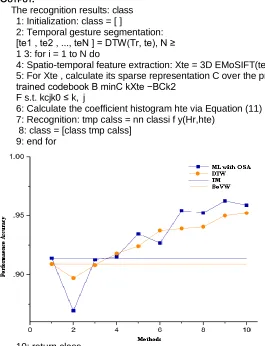
Fig. 3 is the graphical representation of the overall accuracy as a function of the number of original examples used to generate artificial examples to augment the training data set. A reference value for the one-shot learning was included based on the recognition accuracy of each classification algorithm. As the number of real observations grow, there is an increasing trend for the recognition accuracy in both classifiers used.
Fig 3: Accuracy of gesture Recognition for One shot approach (OSA) with ML(multilayered approach) and as number of samples
The performances of the proposed method are also limited by the accuracy of separation of different actions from the videos and unexpected movements of the performer. Also in some videos, the performer changed position while performing a gesture which added some unexpected features in the model that gave a wrong match. The performance of the proposed method is compared with a number of other methods proposed by several methods.
FIG.4.PERFORMANCE ACCURACY WITH PROPOSED APPROACH
1963
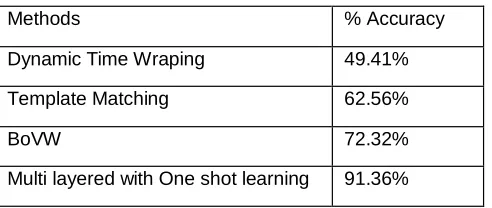
frames for each action is used as the descriptor. The test video is split in slices estimated using the average size of actions. In recognition phase each slice of the video is compared with all the templates. The performance of the proposed method is compared with a number of other methods proposed by several researchers in Table I.
Table 1. Performance Comparison
From these comparison results, we can see that the proposed method achieves high recognition accuracy while having low computational complexity. The first layer can identify the gesture candidates at the speed . The second layer has relatively high computational complexity. If we only use the second layer for classification, the average computing time is roughly n times of the first layer. Despite with relatively high computational cost, the second layer has stronger classification ability. Compared with using only the second layer, the computational complexity of using the first two layers in the proposed method is distinctly reduced and can achieve high. To describe the gesture data set used and present the framework for one-shot learning from one example of each gesture class. In this method we extracting a set of salient points within the gesture trajectory and finding a compact representation of each gesture class. This representation is then used to augment the number of examples of each gesture class artificially, maintaining intrinsic characteristics of the gestures within that class. Then the selection of classification algorithms and the training or testing methodology is presented. The used performance metrics are described, and finally an extension to adaptive learning approach is presented with preliminary results. Results of overall accuracy are calculated as the average of gesture accuracy per class.
5.
C
ONCLUSIONThis paper proposed a novel multi-layered gesture recognition with Kinect, by one shot approach for achieve high accuracy. In the firstlayer, an improved standard movement is connected to demonstrate the signal movement segment. In the second layer, a molecule based descriptor is proposed to extricate dynamic signal data and after that a weighted unique time traveling is proposed to characterize the area segment. In the last layer, the spatial way twisting is additionally proposed to characterize the shape segment spoken to by unclosed shape setting, which is improved from the first shape setting however needs lower coordinating time. The proposed technique can acquire moderately superior for one-shot learning motion acknowledgment. The proposed technique gives unrivaled acknowledgment execution than many existing methodologies. We would also like to combine more than one discriminatory window for each gesture to improve performance. The hand gesture recognition technique can mimic the communications
between human and involve hand gesture as a natural and intuitive way to interact with machines.
6.
R
EFERENCES[1] Jiang, Feng, Shengping Zhang, Shen Wu, Yang Gao, and Debin Zhao. "Multi-layered gesture recognition with kinect." The Journal of Machine Learning Research 16, no. 1 (2015): 227-254.
[2] Wu, Di, Fan Zhu, Ling Shao, and Hui Zhang. "One shot learning gesture recognition with Kinect sensor." In Proceedings of the 20th ACM international conference on Multimedia, pp. 1303-1304. ACM, 2012.
[3] Lan, Yuhai, Jing Li, and Zhaojie Ju. "Data fusion-based real-time hand gesture recognition with Kinect V2." In 2016 9th International Conference on Human System Interactions (HSI), pp. 307-310. IEEE, 2016.
[4] Wu, Di, Fan Zhu, and Ling Shao. "One shot learning gesture recognition from rgbd images." In 2012 IEEE Computer Society Conference on Computer Vision and Pattern Recognition Workshops, pp. 7-12. IEEE, 2012. [5] Zhang, Lei, Shengping Zhang, Feng Jiang, Yuankai Qi,
Jun Zhang, Yuliang Guo, and Huiyu Zhou. "Bomw: Bag of manifold words for one-shot learning gesture recognition from kinect." IEEE Transactions on Circuits and Systems for Video Technology 28, no. 10 (2018): 2562-2573.
[6] Wan, Jun, Qiuqi Ruan, Wei Li, and Shuang Deng. "One-Shot Learning Gesture Recognition from RGB-D Data Using Bag of Features." In Gesture Recognition, pp. 329-364. Springer, Cham, 2017.
[7] Dadgostar, Farhad, Abdolhossein Sarrafzadeh, and Chris Messom. "Multi-layered hand and face tracking for real-time gesture recognition." In International Conference on Neural Information Processing, pp. 587-594. Springer, Berlin, Heidelberg, 2008.
[8] Z. Ren, J. Yuan, J. Meng, and Z. Zhang, ―Robust
part-based hand gesture recognition using Kinect sensor,‖ IEEE Transactions on Multimedia, vol. 15, no. 5, pp. 1110–1120, 2013
[9] Sabinas, Yared, Eduardo F. Morales, and Hugo Jair Escalante. "A one-shot DTW-based method for early gesture recognition." In Iberoamerican Congress on Pattern Recognition, pp. 439-446. Springer, Berlin, Heidelberg, 2013.
[10]Mocanu, Decebal Constantin, and Elena Mocanu. "One-shot learning using mixture of variational autoencoders: a generalization learning approach." In Proceedings of the 17th International Conference on Autonomous Agents and MultiAgent Systems, pp. 2016-2018. International Foundation for Autonomous Agents and Multiagent Systems, 2018.
[11]Yu, Tao, Jianxin Chen, Na Yan, and Xipeng Liu. "A Multi-Layer Parallel LSTM Network for Human Activity Recognition with Smartphone Sensors." In 2018 10th International Conference on Wireless Communications and Signal Processing (WCSP), pp. 1-6. IEEE, 2018. [12]Shotton, Jamie, Toby Sharp, Alex Kipman, Andrew
Fitzgibbon, Mark Finocchio, Andrew Blake, Mat Cook, and Richard Moore. "Real-time human pose recognition in parts from single depth images." Communications of the ACM 56, no. 1 (2013): 116-124.
[13]Ren, Zhou, Junsong Yuan, Jingjing Meng, and Zhengyou Zhang. "Robust part-based hand gesture
Methods % Accuracy
Dynamic Time Wraping 49.41%
Template Matching 62.56%
BoVW 72.32%
1964
recognition using kinect sensor." IEEE transactions on multimedia 15, no. 5 (2013): 1110-1120.
[14]Guyon, Isabelle, Vassilis Athitsos, Pat Jangyodsuk, Hugo Jair Escalante, and Ben Hamner. "Results and analysis of the chalearn gesture challenge 2012." In International Workshop on Depth Image Analysis and Applications, pp. 186-204. Springer, Berlin, Heidelberg, 2012.
[15]Guyon, Isabelle, Vassilis Athitsos, Pat Jangyodsuk, and Hugo Jair Escalante. "The ChaLearn gesture dataset (CGD 2011)." Machine Vision and Applications 25, no. 8 (2014): 1929-1951.
[16]Wang, Pichao, Wanqing Li, Song Liu, Yuyao Zhang, Zhimin Gao, and Philip Ogunbona. "Large-scale continuous gesture recognition using convolutional neural networks." In 2016 23rd International Conference on Pattern Recognition (ICPR), pp. 13-18. IEEE,2016
[17]Asadi-Aghbolaghi, Maryam, Albert Clapes, Marco Bellantonio, Hugo Jair Escalante, Víctor Ponce-López, Xavier Baró, Isabelle Guyon, Shohreh Kasaei, and Sergio Escalera. "A survey on deep learning based approaches for action and gesture recognition in image sequences." In 2017 12th IEEE international conference on automatic face & gesture recognition (FG 2017), pp. 476-483. IEEE, 2017.
[18]N. Neverova, C. Wolf, G. Paci, G. Sommavilla, G. W. Taylor, and F. Nebout. A multi-scale approach to gesture detection and recognition.In ICCVW, pages 484–491, 2013.
[19]L.-F. Liu, W. Jia, and Y.-H. Zhu, ―Survey of gait recognition,‖ in Proceedings of the intelligent computing 5th International Conference on EmergingIntelligent Computing Technology and Applications, pp. 652–659, 2009.
[20]U. Mahbub, H. Imtiaz, T. Roy, M. S. Rahman, and M. A. R. Ahad, ―A template matching approach of one-shot-learning gesture recognition,‖ Pattern Recognition Letters, 2012
[21][21]Y. M. Lui, ―Human gesture recognition on product manifolds,‖ Journal of Machine Learning Research, vol. 13, pp. 3297– 3321, 2012