R E S E A R C H
Open Access
Detecting concept mentions in biomedical text
using hidden Markov model: multiple concept
types at once or one at a time?
Manabu Torii
1*, Kavishwar Wagholikar
2and Hongfang Liu
2Abstract
Background:Identifying phrases that refer to particular concept types is a critical step in extracting information from documents. Provided with annotated documents as training data, supervised machine learning can automate this process. When building a machine learning model for this task, the model may be built to detect all types simultaneously (all-types-at-once) or it may be built for one or a few selected types at a time (one-type- or a-few-types-at-a-time). It is of interest to investigate which strategy yields better detection performance.
Results:Hidden Markov models using the different strategies were evaluated on a clinical corpus annotated with three concept types (i2b2/VA corpus) and a biology literature corpus annotated with five concept types (JNLPBA corpus). Ten-fold cross-validation tests were conducted and the experimental results showed that models trained for multiple concept types consistently yielded better performance than those trained for a single concept type. F-scores observed for the former strategies were higher than those observed for the latter by 0.9 to 2.6% on the i2b2/VA corpus and 1.4 to 10.1% on the JNLPBA corpus, depending on the target concept types. Improved boundary detection and reduced type confusion were observed for the all-types-at-once strategy.
Conclusions:The current results suggest that detection of concept phrases could be improved by simultaneously tackling multiple concept types. This also suggests that we should annotate multiple concept types in developing a new corpus for machine learning models. Further investigation is expected to gain insights in the underlying mechanism to achieve good performance when multiple concept types are considered.
Keywords:Natural language processing, Information storage and retrieval, Data mining, Electronic health records
Background
Concept mention detection is the task of identifying phrases in documents that refer to particular concept types. Provided with documents annotated with concept phrases as training data, supervised machine learning can be used to automate concept mention detection. In the biological domain, sets of annotated documents have been developed and made publicly available over the years [1,2]. Similarly in the clinical domain, annotated clinical notes have been recently released to the research community through pioneering efforts [3,4]. These an-notated data sets have promoted application of machine
learning methods to concept mention detection in the clinical domain [5-8].
When the detection task involves two or more target concept types, there is an option to build one machine learning model for all types (all-types-at-once strategy) or to build multiple models each tackling one type (one-type-at-a-time strategy). The former strategy may have an advantage in exploiting dependency among concept types. In this work, we posed a question if these strat-egies have impacts on detection performance. We found this question important in two ways. First, it is useful to know if one strategy is better than the other in terms of the detection performance. Second, when a new corpus is developed, the results of the current study may en-courage us to annotate additional concept types in order to potentially enhance detection of the target concept type. With current ongoing efforts on corpus development
* Correspondence:[email protected] 1
Department of Radiology, Georgetown University Medical Center, Washington, DC, USA
Full list of author information is available at the end of the article
in the clinical domain, we believe this would be a timely question to pose.
In this study, we used two kinds of annotated corpora. The one is a clinical corpus released in the 2010 i2b2/ VA natural language processing (NLP) shared-task challenge [4] and the other is a biological literature corpus released in the Joint Workshop on Natural Language Processing in Biomedicine and its Applica-tions (JNLPBA) [9]. The two corpora are different in terms of writing styles as well as concepts presented and annotated, while they share challenges in identifying bio-medical concepts, such as difficulty in detecting proper names that may not have initial capital letters and in processing ambiguous acronyms and abbreviations. The best performing system in the i2b2/VA challenge and that in the JNLPBA workshop achieved, respectively, F-scores of 0.852 and 0.726 on the evaluation corpora. These and the other top-ranked systems in the work-shops used various machine learning methods, includ-ing Hidden Markov Model (HMM), Support Vector Machine (SVM), and Conditional Random Field (CRF), along with various techniques and resources. Our inter-est in this work is to compare all-type-at-once and one-type- (or a-few-types-) at-a-time strategies, and not to aim for the best performance on these corpora by ex-ploring rich domain features. To focus on this goal, we employed HMM that uses features internal to input text.
Methods
Experimental design
One strategy we considered in building a concept detec-tion system was to train one machine learning model that covered all concept types. An alternative strategy tested was to build separate models for different concept types. An HMM program implemented in the LingPipe suite [10] was used to train these models. Detection per-formance was measured with F-score, the harmonic mean of precision (the number of correctly extracted phrases divided by the number of all extracted phrases) and recall (the number of correctly extracted phrases di-vided by the number of all phrases to be extracted). We conducted 10-fold cross-validation tests and calculated the average F-score.
Data
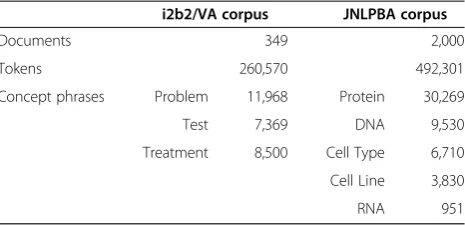
Descriptive statistics of the two data sets used in our ex-periments are shown in Table 1. The first data set used was a training corpus in the 2010 i2b2/VA NLP shared-task challenge [4]. This data set was made available through our participation in the shared-task challenge and, hence, no additional ethical approval was required for the current study. This corpus consists of 349 clinical documents, including 268 discharged summaries from three institutions and 81 progress notes from one
institution. The documents were manually annotated with three concept types: Problem, Test, and Treatment. These annotations (spans of concept phrases) do not overlap each other in text, except for eight annotations that we excluded in the current study.
The second data set used was a training corpus of the Bio-Entity Recognition Task in the JNLPBA workshop, which was publicly available online. The corpus consists of 2,000 abstracts of biology research articles retrieved from the MEDLINE database using the search terms (Medical Subject Headings) of ‘human’,‘blood cells’and ‘transcription factors’[9]. It is the same document set as the GENIA version 3.02 corpus, but the thirty six con-cept types originally annotated in the corpus were sim-plified to five types for the shared-task workshop: Protein, DNA, Cell Type, Cell Line, and RNA. There is no overlap among annotated concept phrases in this corpus.
Detection strategies
One or a few concept types at a time
In this strategy, independent detection tasks were as-sumed for subsets of the target concept types. For each subtask, the BIO notation was used [11]. Each token in the corpus was assigned one of the labels, B_ConceptType, I_ConceptType, and O, representing a token being the Be-ginning of a concept phrase, Inside of a concept phrase, or Outside of a concept phrase. For example, in order to in-dicate Problem phrases in the i2b2/VA corpus, the three labels, B_Problem, I_Problem, and O, were used.
All concept types at once
In this strategy, a single detection task was assumed for all the target concept types. For example, given the three concept types in the i2b2/VA corpus, one HMM model was built using the seven labels, B_{Problem, Treatment, Test}, I_{Problem, Test, Treatment}, and O.
Machine learning method
Concept mention detection was often tackled as a se-quence labeling problem [4,9]. Input text is viewed as a sequence of tokens and the task is defined as assignment Table 1 Descriptive statistics of the corpora
i2b2/VA corpus JNLPBA corpus
Documents 349 2,000
Tokens 260,570 492,301
Concept phrases Problem 11,968 Protein 30,269
Test 7,369 DNA 9,530
Treatment 8,500 Cell Type 6,710
Cell Line 3,830
of each token with an appropriate label to demarcate spans of tokens referring to target concept types. We used a sequence labeling program, named CharLmRes-coringChunker, from the LingPipe suite [10,12]. This program was chosen because it exploits features internal to text and the performance is not affected by additional external resources and parameters associated with them. Also, this program runs fast and it was desirable in con-ducting cross-validation tests. A model trained with this program first extracts candidate concept phrases using a first-order Hidden Markov Model (HMM). In HMM, the likelihood of a sequence of labels is calculated based on the two types of probabilities, the transition probabil-ities and the emission probabilprobabil-ities, learned from the training data set. In the implementation of the LingPipe suite, the emission probabilities that capture the relation between observed words and corresponding labels are calculated using character language models. Transition probabilities that capture the ordering of labels assigned to words are calculated using a bigram model. As for la-bels to demarcate phrases, instead of using BIO lala-bels given as inputs to the program, enriched BMEWO + rep-resentation is used internally [13]. Namely, B of BIO is divided into W (a token of a single-word concept) and B (beginning of a multi-word concept), I into M and E (Middle or End of a multi-word concept), and similarly O into {B, M, E, W}_O, where {B, E, W}_O is further di-vided based on the type of the neighboring concept. Candidate concept phrases extracted by an HMM model are rescored using another level of character language models to identify the best candidates. We varied the
character n-gram size in our experiments, but the ex-perimental results exhibited the same trends across the different choices of the size n and they did not affect our conclusion. Therefore, we chose to report the results for n = 50 that generally yielded good performance. In train-ing the two kinds of models involved, the model for can-didate phrase detection and that for their rescoring, eighty and twenty percent of sentences in the training data were used, respectively.
Results and discussion
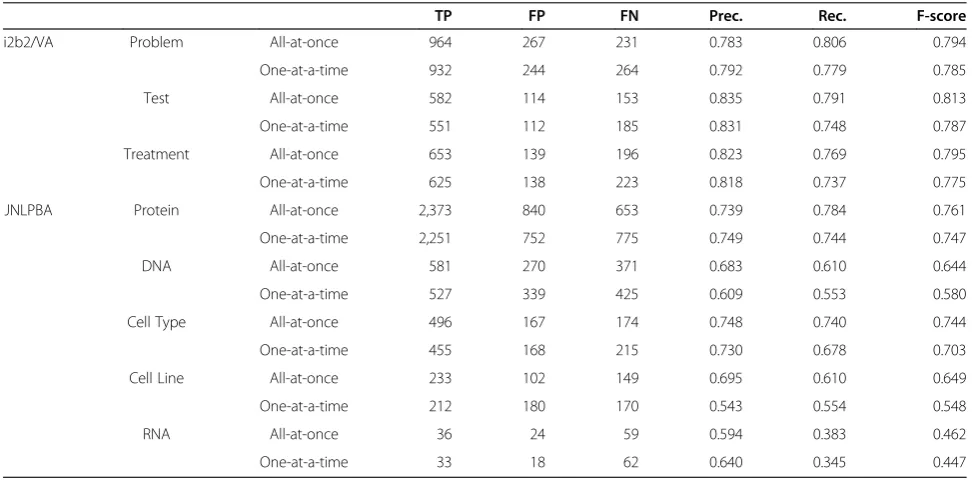
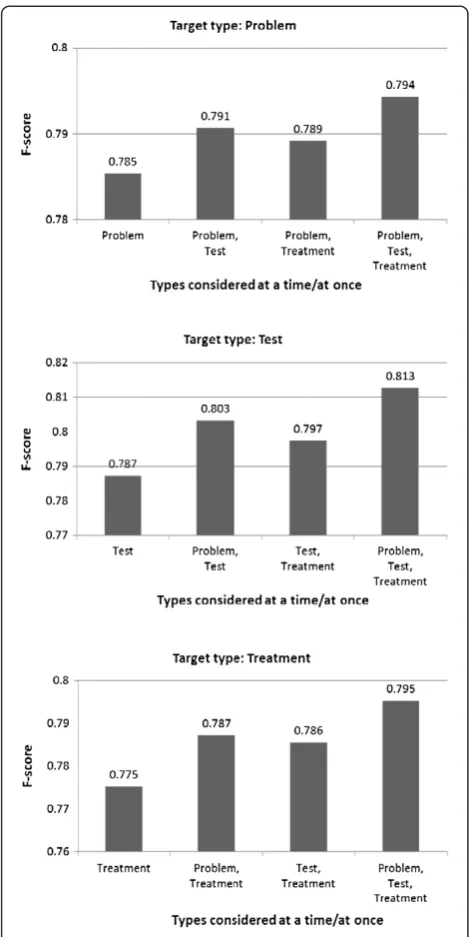
Table 2 shows the performance of HMM models trained using the all-types-at-once and the one-type-at-a-time strategies. As stated in the Methods section, we con-ducted ten-fold cross-validation tests on the two corpora and the detection performance was measured with the average F-score. Figure 1 shows how the detection per-formance varies when a-few-types-at-a-time was em-ployed for all the three concept types annotated in the i2b2/VA corpus. As for the JNLPBA corpus that is anno-tated with five concept types, there are many combina-tions for“a few types”to be selected for the strategy and hence we report on selected combinations for a single tar-get type, Protein, in Figure 2. As seen in the figures as well as in the table, for every concept type annotated in the two corpora, the F-score was the highest when all concept types were considered simultaneously, and the lowest when each type was tackled individually. The differences in the F-scores were statistically significant at the 0.01 alpha level using the two-tailed pairedt-test. We inspected errors in one-type-at-a-time that were correctly handled
Table 2 Comparison of detection performance
TP FP FN Prec. Rec. F-score
i2b2/VA Problem All-at-once 964 267 231 0.783 0.806 0.794
One-at-a-time 932 244 264 0.792 0.779 0.785
Test All-at-once 582 114 153 0.835 0.791 0.813
One-at-a-time 551 112 185 0.831 0.748 0.787
Treatment All-at-once 653 139 196 0.823 0.769 0.795
One-at-a-time 625 138 223 0.818 0.737 0.775
JNLPBA Protein All-at-once 2,373 840 653 0.739 0.784 0.761
One-at-a-time 2,251 752 775 0.749 0.744 0.747
DNA All-at-once 581 270 371 0.683 0.610 0.644
One-at-a-time 527 339 425 0.609 0.553 0.580
Cell Type All-at-once 496 167 174 0.748 0.740 0.744
One-at-a-time 455 168 215 0.730 0.678 0.703
Cell Line All-at-once 233 102 149 0.695 0.610 0.649
One-at-a-time 212 180 170 0.543 0.554 0.548
RNA All-at-once 36 24 59 0.594 0.383 0.462
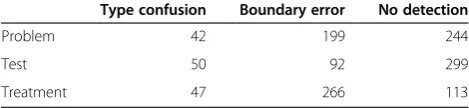
in all-types-at-once, anticipating that the latter would take advantage of multiple concept types to identify target phrases. We noticed three major error patterns, and one of them, type confusion, explicitly involves multiple con-cept types. In the following description of the error pat-terns, we use examples of the Problem type, but similar instances were observed for the other concept types con-sidered in the experiments.
Type confusion
In one-type-at-a-time, phrases not of the target type may be falsely detected as target type phrases, e.g., “<Treatment (durg)> for <Treatment (procedure)>” where the latter Treatment phrase was falsely detected as Problem, when Problem alone was tackled.
Boundary errors
We observed that boundary detection was degraded in one-type-at-a-time. Such cases included simple errors, e.g., “His melanomaProblem” where the word “His” was
missed when Problem type was tackled alone, and also errors involving more complex syntactic patterns, e.g., “his<Problem> and <Problem>”where the first Problem phrase (and the word “his”) was missed. Over extension of boundaries was also observed for one-type-at-a-time, but majority of its boundary errors were under extension.
No detection
Concept phrases correctly identified in all-types-at-once were sometimes totally missed in one-type-at-a-time, e.g., “The patient had no further complaintsProblem” where the
Problem phrase was not detected at all when Problem type was tackled alone.
In our review, type confusion was observed less than what we anticipated. For example, when Problem type was tackled alone, across ten folds, there were 42 phrases falsely detected as Problem (false negatives) that were correctly identified as Test (8 phrases) and Treat-ment (34 phrases) when all the types were tackled simul-taneously. Meanwhile, there were 439 Problem phrases that were correctly identified when all the types were tackled but were not identified either partially (199 cases Figure 1Detection performance for the 2010 i2b2/VA
challenge corpus.The horizontal axis shows incremental sets of types, including the selected target type (e.g.,“Problem”in the top figure), and the rightmost set corresponds to the all-at-once setting. The reported F-scores are for the selected target type.
of boundary errors) or fully (240 cases of no detection) when Problem type was tackled alone. Note, however, counting and interpretation of such error types involves subtlety when more closely relevant concept types are densely annotated as in the JNLPBA corpus because boundary errors and type confusion errors coincide fre-quently. We summarize the numbers of error instances on the i2b2/VA corpus in Table 3. We initially expected that different outputs would be observed among cases involving different concept types, e.g., “<Test> demon-strated <Problem>”, where we might imagine that the recognition of the Test phrase affects that of the Prob-lem phrase or vice versa. We, however, encountered such instances rarely, e.g.,“<Test> revealed <Problem>” and“<Test> showed <Problem>”, in which the Problem phrases were not detected when Problem alone was tackled. The detection mechanism in the all-concept-types-at-once strategy needs to be examined to under-stand the advantage it has.
In selecting these detection strategies, another im-portant consideration is the time to train and apply de-tection models. As shown in Table 4, it took more time to train a model using the one-type-at-a-time strategy. Training of an HMM model does not require optimization unlike other popular machine learning methods, such as SVM and CRF, and the increase in the number of target types may not incur extra training time. However, reduction in the training time for all-types-at-once was not expected. That may be attributed to smaller per-type data structures used in all-types-at-once, compared to larger per-type data structures in one-type-at-a-time. The size of the model file was smaller for all-concept-types-at-once, compared to that for one-type-at-a-time, e.g., 159 MB for all-types-at-once and 255 MB for Problem in one run of ten-fold cross-validation.
Review of individual errors and analysis of run time made us pay attention to the implementation of the HMM program and the impacts of model parameters in-volved, such as pruning of n-grams in the model and smoothing of probabilities. We explored a wide range of n-gram sizes to test if the choice of the tagging strategy, but it was difficult to explore all the parameters simul-taneously, e.g., the n-gram size, the smoothing param-eter, and the pruning parameter. Further investigation is required to gain insight in the combination of different
parameters, as well as the use of different machine learn-ing paradigms other than HMM.
Conclusions
In this study, we compared all-types-at-once and one-type-at-a-time strategies in applying HMM taggers on a clinical corpus released in the 2010 i2b2/VA NLP chal-lenge workshop and a biological literature corpus released in the JNLPBA workshop. We also tested a-few-types-at-a-time in building a model. The experimental result shows that tackling multiple concept types at once could im-prove concept mention detection performance. When building a new corpus, which has become an imminent agenda particularly in the clinical domain, we should con-sider annotating multiple concept types. The current re-sults are limited to one machine learning method, but notably the best performing systems in the i2b2/VA chal-lenge and the NLPBA workshop employed all-types-at-once for Semi-Markov CRF [14] and HMM with SVM [15]. Further investigation is expected to test various machine learning methods for these different detection strategies.
Availability of supporting data
The clinical corpus used in this research was a training data set in the Fourth i2b2/VA Shared-Task and Work-shop Challenges in Natural Language Processing for Clinical Data. Information of this data set is found at https://www.i2b2.org/NLP/Relations/.
The biology literature corpus used in this research was a training data set for the Bio-Entity Recognition Task in the Joint Workshop on Natural Language Processing in Biomedicine and its Applications. The data set is avail-able at http://www.nactem.ac.uk/tsujii/GENIA/ERtask/ report.html.
Table 3 Additional errors introduced in one-type-at-a-time on the i2b2/VA corpus
Type confusion Boundary error No detection
Problem 42 199 244
Test 50 92 299
Treatment 47 266 113
Table 4 Time to train and apply HMM models on the i2b2/VA and JNLPBA corpora1
A set of types considered Training (sec)
Application (sec)
i2b2 Problem, Test, Treatment 619 42
Problem, Treatment 763 41
Problem, Test 879 42
Problem 1,117 43
JNLPBA Protein, DNA, Cell Type, Cell line, RNA 3,010 88
Protein, DNA, Cell Type, Cell line 3,812 92
Protein, DNA, Cell Type 4,292 98
Protein, RNA 4,694 100
Protein 4,763 98
1
Abbreviations
i2b2:Informatics for integrating biology and the bedside; CRF: Conditional random field; FN: False negative; FP: False positive; HMM: Hidden Markov Model; JNLPBA: Joint Workshop on Natural Language Processing in Biomedicine and its Applications; NLP: Natural Language Processing; SVM: Support Vector Machine; TP: True positive.
Competing interests
The authors declare that they have no competing interests.
Authors’contributions
HL conceived the original idea of the study and coordinated the resources for the experiments. MT designed the experiments and carried them out with KW. All authors participated in the analysis of the experimental results. MT drafted the manuscript, and KW and HL significantly revised it. All authors read and approved the final manuscript.
Acknowledgements
This article has been published as part of thematic series“Semantic Mining of Languages in Biology and Medicine”of Journal of Biomedical Semantics. An early version of this paper was presented at the Fourth International Symposium on Languages in Biology and Medicine (LBM 2011), held in Singapore in 2011. De-identified clinical records used in this research were provided by the i2b2 National Center for Biomedical Computing funded by U54LM008748 and were originally prepared for the Shared Tasks for Challenges in NLP for Clinical Data organized by Dr. Ozlem Uzuner, i2b2 and SUNY. The authors also thank all the other researchers and developers who made their software resources and annotated corpora available to the research community. The authors acknowledge the funding from National Science Foundation (ABI: 0845523) and the National Institute of Health (R01LM009959A1).
Author details
1
Department of Radiology, Georgetown University Medical Center, Washington, DC, USA.2Department of Health Sciences Research, Mayo Clinic College of Medicine, Rochester, MN, USA.
Received: 5 September 2012 Accepted: 26 November 2013 Published: 17 January 2014
References
1. Kim J-D, Ohta T, Tateisi Y, Tsujii J:GENIA corpus–semantically annotated corpus for bio-textmining.Bioinformatics2003,19(Suppl 1):i180–i182. 2. Tanabe, Xie N, Thom LH, Matten W, Wilbur WJ:GENETAG: a tagged corpus
for gene/protein named entity recognition.BMC Bioinformatics2005, 6(Suppl 1):S3.
3. Uzuner Ö, Solti I, Cadag E:Extracting medication information from clinical text.J Am Med Inform Assoc2010,17(5):514–518.
4. Uzuner Ö, South BR, Shen S, DuVall SL:2010 i2b2/VA challenge on concepts, assertions, and relations in clinical text.J Am Med Inform Assoc 2011,18(5):552–556.
5. Doan, Xu H:Recognizing medication related entities in hospital discharge summaries using support vector machine.Beijing, China: presented at the 23rd International Conference on Computational Linguistics (COLING); 2010:259–266.
6. Halgrim SR, Xia F, Solti I, Cadag E, Uzuner O:Extracting Medication Information from Discharge Summaries.Los Angeles: presented at the NAACL-HLT 2010 Second Louhi Workshop on Text and Data Mining of Health Documents; 2010:61–67.
7. Halgrim SR, Xia F, Solti I, Cadag E, Uzuner O:A cascade of classifiers for extracting medication information from discharge summaries.J Biomed Semantics2011,2(Suppl 3):S2.
8. Torii M, Wagholikar K, Liu H:Using machine learning for concept extraction on clinical documents from multiple data sources.J Am Med Inform Assoc2011,18(5):580–587.
9. Kim J-D, Ohta T, Tsuruoka Y, Tateisi Y:Introduction to the bio-entity recognition task at JNLPBA.Geneva, Switzerland: presented at the Joint Workshop on Natural Language Processing in Biomedicine and its Applications (JNLPBA); 2004:70–75.
10. Alias-i:LingPipe.http://alias-i.com/lingpipe. [Accessed: 18-Feb-2012].
11. Ramshaw LA, Marcus MP:Text Chunking using Transformation-Based Learning.Somerset, New Jersey: presented at the ACL Third Workshop on Very Large Corpora; 1995:94–82.
12. Carpenter B:LingPipe for 99.99% Recall of Gene Mentions.Madrid, Spain: presented at the BioCreative Challenge Evaluation Workshop; 2007:307–309. 13. Carpenter B:Coding Chunkers as Taggers: IO, BIO, BMEWO, and BMEWO + .
[Online]. Available: http://lingpipe-blog.com/2009/10/14/coding-chunkers-as-taggers-io-bio-bmewo-and-bmewo/. [Accessed: 18-Feb-2012]. 14. de Bruijn B, Cherry C, Kiritchenko S, Martin J, Zhu X:Machine-learned
solutions for three stages of clinical information extraction: the state of the art at i2b2 2010.J Am Med Inform Assoc2011,18(5):557–562. 15. Zhou G, Su J:Exploring Deep Knowledge Resources in Biomedical Name
Recognition.Geneva, Switzerland: presented at the Joint Workshop on Natural Language Processing in Biomedicine and its Applications (JNLPBA); 2004:96–99.
doi:10.1186/2041-1480-5-3
Cite this article as:Toriiet al.:Detecting concept mentions in biomedical text using hidden Markov model: multiple concept types at once or one at a time?Journal of Biomedical Semantics20145:3.
Submit your next manuscript to BioMed Central and take full advantage of:
• Convenient online submission
• Thorough peer review
• No space constraints or color figure charges
• Immediate publication on acceptance
• Inclusion in PubMed, CAS, Scopus and Google Scholar
• Research which is freely available for redistribution