ISSN (Online) 2347-3207
FPGA implementation of AES using Vedic Mathematics
Ambika R
1, C S Mala
2, S K Pushpa
3 Dept. of ECE1, Dept. of TCE2 , Dept. of ISE3BMSIT Bangalore, INDIA
[email protected], [email protected], [email protected]
Abstract-In recent years, the importance of security in the information technology has increased significantly. This paper presents a new efficient architecture for high speed advanced encryption standard algorithm using Vedic Mathematics. The proposed architecture is implemented using Field Programmable Gate Array. Keywords- AES, Cryptography, Decryption, Encryption, FPGA, LUT, Vedic Mathematics.
I. INTRODUCTION
In cryptography, encryption is the process of translation of data into a secret code. It is unreadable by anyone except those possessing the key. Encryption is important to secure data such that it is received with full integrity at the receiver end. There are two types of encryption called asymmetric encryption (public-key encryption) and symmetric encryption. Decryption is the process of converting the data back into its original form. Advanced Encryption Standard (AES) was developed by J. Daemen and V. Rijmen [1] and set as the standard by The National Institute of Standards and Technology (NIST) in the year 2001.The AES algorithm is a symmetric block cipher. The advantages of using AES algorithm are low power consumption, low cost implementation and resistance to brute force attack.[1] and [2]include comparison of Candidate Algorithms on FPGA, implementation of Sub-bytes and its inverse using combinational logic replacing the look-up table approach, decomposition of inverse Mix Column. [3]deals with high speed encryption using merging technique.[2] and [4] explain resource sharing in terms of functional unit and expressing decryption matrix using encryption matrix.
AES was defined with the following requirements:
• 128-bit blocks (solves issues with CBC)
• Accepts keys of size 128, 192 and 256 bits (128 bits are enough to resist exhaustive key search; • Has no academic weakness worse than exhaustive key search
• should be as fast as 3DES (AES turned out to be much faster than 3DES in software, typically 5 to 10 times faster)
The resistance of AES towards differential and linear cryptanalysis comes from a better "avalanche effect" (i.e. a bit flip at some point quickly propagates to the complete internal state) and contains, bigger "S-boxes" (a S-box is a small lookup table used within the algorithm, and is an easy way to add non-linearity; in DES, S-boxes have 6-bit inputs and 4-bit outputs; in AES, S-boxes have 8-bit inputs and 8-bit outputs).
APPLICATIONS:
Encryption plays an important role in authentication of identity in various institutions and companies, credentialing Systems, electronic Signatures, electronic cash transfers, Email, secureelectronic transactions, generating password, digital mobile phones and Confidential documents in the office. Vedic Mathematics can be suitably used to enhance the speed.
II. AES ALGORITHM:
ISSN (Online) 2347-3207 column operation isn't performed just in case of secret writing and inverse combine column in case of decoding operation.
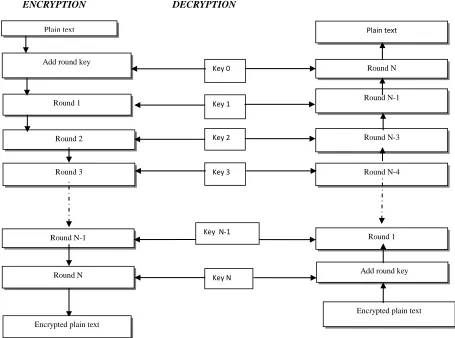
ENCRYPTION DECRYPTION
Figure 1.AES algorithm flow chart.
Figure 2. Block diagram of Single round in AES
Plain text
Add round key
Round 1
Round 2
Round 3
Round N
Plain text
Round N
Round N-1
Round N-3
Round N-4
Round 1
Add round key
Encrypted plain text Round N-1
Key 0
Key 1
Key 2
Key 3
Key N-1
Key N
ISSN (Online) 2347-3207
Each round of AES consists of four transformations:-
1.
Sub bytes: This block uses the S-box to perform byte by byte substitution of each byte of the state matrix in case of encryption and inverse S-box in case of decryption.A00 A01 A02 A03 A10 A11 A12 A13 A20 A21 A22 A23 A30 A31 A32 A33
Example: if A32= EC, then using the s-box transformation we get B32 = CE. Using the inverse s-box and B32 as input we get A32 = EC.
2.
Shift rows:Here we perform shifting operation. The first row is left unchanged, in the second row one byte circular left shift is performed, in the third row two byte circular left shift is performed, and in the fourth row three byte circular left shift is performed as shown.B00 B01 B02 B03
B10 B11 B12 B13
B20 B21 B22 B23
B30 B31 B32 B33
A00 A01 A02 A03
A10 A11 A12 A13
A20 A21 A22 A23
A30 A31 A32 A33
B00 B01 B02 B03
B10 B11 B12 B13
B20 B21 B22 B23
B30 B31 B32 B33
S-
BOXISSN (Online) 2347-3207
B00 B01 B02 B03
B10 B11 B12 B13
B20 B21 B22 B23
B30 B31 B32 B33
The similar process is repeated for inverse shift rows by performing shifts to the opposite direction (right shifts). The first row is left unchanged whereas in the second, third, fourth rows one, two, three byte circular right shifts are performed respectively.
3. Mix Columns: Here Galois field multiplication (GF 28 ) is performed. It is finite field multiplication. In finite field multiplication the operands belong to a finite range of number and the result of the multiplication operation also results in a value within the finite field.For encryption the state matrix is multiplied with
02 03 01 01 01 02 03 01
01 01 02 03
03 01 01 02
i.e., the following operation is performed:-
Similarly for decryption the state matrix is multiplied with
0E 0B 0D 09 D00 D01 D02 D03 C00 C01 C02 C03
09 0E 0B 0D D10 D11 D12 D13 C10 C11 C12 C13
0D 09 0E 0B D20 D21 D22 D23 C20 C21 C22 C23
0B 0D 09 0E D30 D31 D32 D33 C30 C31 C32 C33
Rules of multiplication in Galois field:
a) Multiplication by 02: Check the MSB of the byte being multiplied. If it is '1' then shift it to the left by '1' bit and XOR with '1B', else just perform shift left by '1' bit.
C00 C01 C02 C03
C11 C12 C13 C10
C22 C23 C20 C21
C33 C30 C31 C32
AF FE 08 47
EB 56 45 0D
82 BC 34 AE
99 01 0F EC
AF FE 08 47
56 45 0D EB
34 AE 82 BC
EC 99 01 0F
1
ISSN (Online) 2347-3207 b) Multiplication by 03: '03' can be split up as '02+01'. Hence we make use of the previous stated rule for '02' and then XOR the answer with the current byte value.
For decryption we make use of look up table method(LUT method).
4. Add round key:Each of the 16 bytes of the state matrix is XORed against each of the 16 bytes of a portion of the expanded key for the current round. Similar process is repeated for decryption.
Key expansion algorithm takes a 16 byte key an input and produces an array of 156 bytes. It was designed to be resistant to known cryptanalytic attacks.
In general,this algorithm takes an input key of ‘k’ bytes where k may be 4, 6 or 8.The output is 16*(Nr+1) bytes. This is the expanded key.Nr refers to the number of rounds.
III LOOK UP TABLE (LUT) Method
The LUT is used in encryption and decryption using AES algorithm. It is used in the mix columns block where Galois field multiplication is performed. Galois field multiplication is a finite field multiplication. Here the finite field is limited to 28.
02 03 01 01
For encryption, the state matrix is multiplied with 01 02 03 01
01 01 02 03
03 01 01 02
For decryption, the state matrix is multiplied with 0E 0B 0D 09
09 0E 0B 0D
0D 09 0E 0B
0B 0D 09 0E
There are two ''look up'' tables. ''Look up'' tables are pre-computed tables that are used to compute multiplication in Galois field(28) for any input value. The 'L' table and 'E' table. We first refer to the 'L' table and then we refer to the 'E' table as shown in the example.
Example
Consider the hexadecimal numbers '47' and ‘0E’.
First we refer to the L table and find the L value of ‘47’ = '94' = Ans1. We once again refer to the L table and find Lvalue of ‘0E’ = 'DF' = Ans2. Now we do the following computation Ans3 = Ans1 + Ans2 = '94' + 'DF' = '173'. Since '173' is greater than 'FF' we subtract ‘FF’ from it i.e., Ans4='173' - 'FF' = '74'. Now we refer to E table i.e., look up of '74' in E table is '87'= Ans.
Therefore the summarized steps for two hexadecimal numbers are L (n1) + L(n2)=Ans3. Check for Ans3>‘FF’, if greater Ans4= Ans3 - 'FF' else Ans4=Ans3.
ISSN (Online) 2347-3207
NO
YES
Disadvantages of LUT method
1. More memory is required to store the two look up tables.
2. Computation time is more since we refer two tables for calculating one product.
IV PROPOSED APPROACH
Vedic Mathematics[5]is an ancient form of Mathematics which existed in ancient India in 1500 B.C. But was rediscovered by Sri Bharthi Krishna Tirthaji between 1911 and 1918.He bifurcated the entire subject into 16 mathematical Sutras/formulae. These Sutras are easy to understand and fast in terms of computation. Of which, UrdhwaTiryakbhyam Sutra is one of the most popular sutra used to multiplication.
UrdhwaTiryakbhyam technically means “vertically crosswise”. Therefore each step of multiplication involves multiplication of the extreme digits.After which the results of all the stages are concatenated in order to arrive at the final result of the product.
Start
Enter the two hexadecimal numbers to be multiplied in
Galois field(n1,n2)
Ans1 = Look up to 'L' table for n1
Ans2 = Refer to 'L' table for n2
Ans3 = Ans1 + Ans2
Is
Ans3>'FF'
?
Ans= Refer to 'E' table
for Ans4
End Ans4 = Ans3
ISSN (Online) 2347-3207 In a regular Urdhwa sutra multiplier, partial products are obtained by ANDing the inputs and addingthe bi-products. In our approach, we replace addition with XORing. The product obtained is limited to 8 bits using conventional methods of Galois field restriction. The addition of XOR gates reduces the complexity of the existing Vedic Mathematics Architecture.
V RESULTS & CONCLUSION
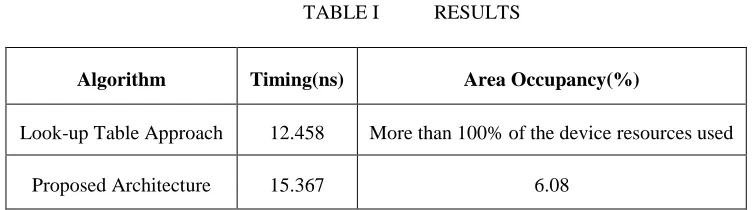
The look up table approach & our proposed architecture was implemented on Spartan 3e series of FPGA and the synthesis results for the same is as shown below.It is clearly observed the LUT approach is 3 ns faster than our proposed architecture. Yet, it is not preferable sincemore than 100% of the FPGA resources are utilized.On the other hand, the Vedic Mathematics approach occupies only 6% of area when implemented on a Spartan 3e series of FPGA.
Step1
Step 2
ISSN (Online) 2347-3207
TABLE I RESULTS
Algorithm Timing(ns) Area Occupancy(%)
Look-up Table Approach 12.458 More than 100% of the device resources used
Proposed Architecture 15.367 6.08
REFERENCES: