Page 336
INTEGRATING THE CAPABILITIES OF THE PUBLIC AND PRIVATE CLOUDS FOR THE PURPOSES OF INNOVATIVE LEARNING
Daniela Georgieva Pavlova
University of Library Studies and Information Technologies, Sofia, Bulgaria
Abstract
The proposed material considers the reform in education systems around the world as an inevitable necessity and arguments the need to use reliable, secure, accessible and scalable ICT infrastructure for the needs of innovative and modern learning. The knowledge economy poses new challenges to education and learning environments, and not all educational institutions are prepared to respond adequately to the increased and highly demanding requirements. At the same time, many of the global IT leaders, for various reasons, mainly related to their long-term business goals, have all the resources needed to provide the necessary conditions for advanced learning and training methodologies (augmented reality, process simulation etc.) and could be used accordingly. In order to preserve the learning diversity and the development of innovative thinking, direct implementation of ready-made corporate models on the learning process is usually inappropriate, and the decision to combine academic freedom with the corporate opportunities turns out to be the winning combination. The article examines the hypothesis that a large number of universities around the globe have purchased or developed distance learning platforms, situated in their private ICT infrastructure, but such data and application centers have relatively modest computing resources and often suffer from a lack of adequate technical support, computing capacity or disk resources. At the same time, global providers of ICT services such as Google and Microsoft, who develop their business on a long-term basis, can satisfy a significant part of such needs, upgrading their infrastructure on the fly, without in any way endangering their other businesses. One of the main challenges for innovative 21st century lecturers is to find the balance of combining educational services offered by their own academic infrastructure and the capabilities of the large IT players in order to optimize resources, time and expertise.
Keywords: cloud technologies, innovative practices, heterogeneous environment, e-learning
INTRODUCTION
The knowledge economy poses serious challenges to traditional education systems. On one hand, the dynamics of the accumulation, processing and dissemination of information is exceptional and, on the other hand, people increasingly need to take decisions in exclusive time pressure situations. The existing educational content and programs in this dynamic environment are often ineffective, the need for more flexible and adaptive learning methods is obvious. Against this backdrop, it is particularly important to introduce different innovative distance learning platforms into the education. They have the advantage to be flexible and able to quickly adapt content according to the learner's needs, and at the same time they are globally accessible and some innovative and professionally designed courses can easily reach millions of people, overcoming the limitations of the traditional classroom.
Page 337
Fig. 1. Typical annual growth of ICT global vendor cloud services
STEPPING ON THE OTHERS’ SHOULDERS
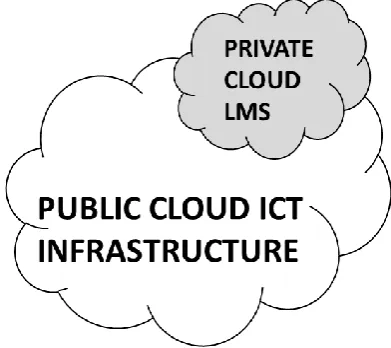
The need for a win-win move to catch up with the large suppliers is to find a relatively inexpensive way to exploit their opportunities and to find reasonable ways to exploit their infrastructure capabilities – (Fig. 2 [1]). Yes, for sure there are a lot of different e-learning platforms [2] in the field of education, but if we don’t like any as a complete solution, we can safely look for a way to use only parts of it - disk space, forum or chat, recording format, videoconference module, etc. As a matter of fact, the initial concept of the World-Wide-Web for the distributed content and service model suggests that the attempt to combine the capabilities of our private (in most cases) ICT infrastructure with a powerful enough public one (like that of Adobe, Google or Facebook) is a reasonable guarantee for success. This model is also supported by successful, purely commercial practices. In fact, a huge mass of e-commerce or gaming industry providers for example, use Facebook appropriately to ensure the authentication and security of their users, and the model is good for both parties. For the big vendor (Facebook), this works like an ad and a kind of an added value, and for the small one – brings additional security and raises the confidence of the consumers, who already step on something familiar.
Page 338
It is true that most of the global providers are seeking ways to integrate us as fully as possible into their own ecosystem, step by step expanding their service portfolio (including complete training platforms), which is not so difficult considering their significant technological and financial capabilities. Given the dynamics of the online market, however, there will always be alternatives, and there will always be something in which someone else is better, so in the long run, an educational professional should be flexible to use from every cloud environment its main advantage to the rest. As far as the opportunities for working in a homogeneous environment are concerned, there is no doubt that open standards will be imposed on the market in a sufficiently flexible manner over time so that the trainer and the trainees should feel comfortable enough, using multiple resource options from different suppliers. Very often, consumers will not even think about where one or another resource is, because the distributed cloud model has taught them enough that this is a minor issue against the issue for the overall consumer satisfaction. What is important, however, is that the consumer will feel confident and secure enough, given the capacity and the capabilities of the global provider, and can concentrate on his core business - teaching (in the case of teachers) or studying (for the students) without worrying that he/she will not get the necessary bandwidth or that there will be no room on the disk to record the next lesson.
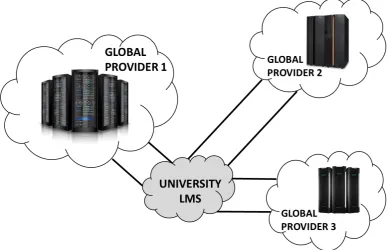
We can become even more powerful if we combine the capabilities of several global vendors, taking from each the feature he is famous for. For example, we can use Skype's video capabilities, Google’s disk space and translation engine and Facebook’s authentication to "stitch" them to our virtual learning platform. Naturally, some of these options may not be free, but given the unprecedented scale and global coverage they provide, the price in any case will be fewer times less compared to our potential to provide them alone (Fig.3).
Fig. 3. Using various global ICT vendor opportunities to reinforce the corporate private LMS
Page 339 PAY IT FORWARD
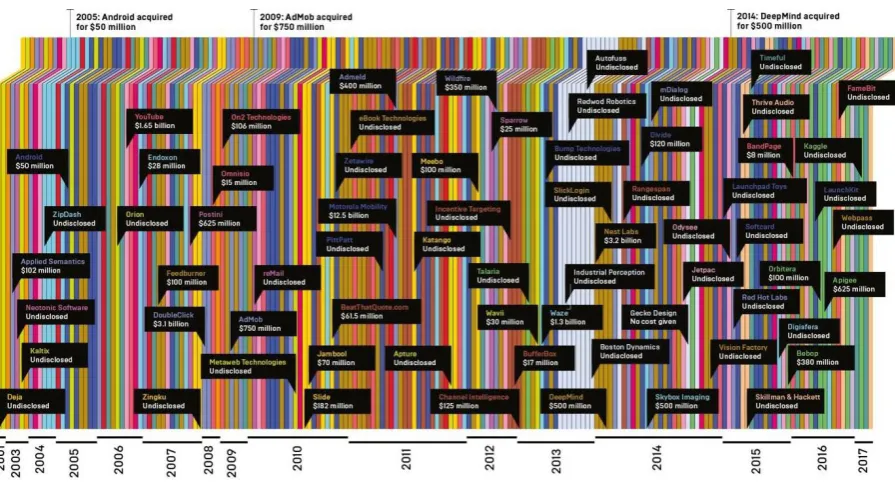
In fact, the educational innovations require more and more resources - we talk about speed, capacity, screen resolution, security, modularity, realism, and so on. From holographic imagery to the traditional classroom but with augmented reality, technological opportunities for educational experts are constantly improving, and no one can tell where this will bring us in 20, 10 or even 5 years. And how can we dare to predict, having in mind that we currently held in our pockets smartphones that are better than the most powerful computers at the turn of the century, and our access to the Internet for the same time has improved a thousandfold. With time we gradually become accustomed to consider many things for granted, and it is difficult to even imagine what we would do if they were not present. For example, everyone has long considered it normal for apartments and offices to have electricity, and even the thought that they may lack such will be perceived as insane. Over the time, in a similar way, we will begin to perceive the availability of an Internet access - in many parts of the world, tourists are taking for granted that their hotel will have a Wi-Fi network and the lack of it can cause serious concerns as they are already used to rely on it. Many of us do not realize that most of the public cloud services that we already consider as our constant companion might drop out, and we would feel very uncomfortable if suddenly find ourselves without an access to Google, YouTube or Facebook. Following the same logic, it is not difficult to predict that many cloud services that were regarded as extras in the past, over the time will very likely become an integral part of our social ecosystem and we would be able to safely build innovation on them without the need to „rediscover the hot water“. Thus, the expected symbiosis between public and private clouds is likely to happen much earlier than expected, and the field of innovative learning is among those niches, where this is most likely to happen in the nearest future. As a matter of fact the major cloud providers create hundreds and thousands of new innovative businesses around them, sweeping along, like a tornado, small innovative companies, while at the same time they encourage, support, inspire or even compete with them in the search for ever-new and exciting challenges. They save us time and money, allowing us to use their infrastructure without having to spend much effort on what allows us to focus on our long-term goals. "By tapping into these resources, as needed, businesses and individuals can stay flexible and efficient, allowing for the time needed to be creative and to think." [3]. Not surprisingly, one of the traditional methods of each of the major IT giants is buying hundreds of smaller suppliers (Fig. 4 [7]) with various internet based solutions following the desire to quickly cover a maximum volume of services needed in the online space, but since the market is too diverse, there is no tendency this process to fade away in the near future.
Page 340 A VIEW INTO THE FUTURE
The world is rapidly become digital and obviously the classical education cannot remain as it stands today. The global competition transfers more and more training activities online, and the reasons quite vary - from financial (saving) and technological (more educational opportunities such as streaming, 3D modeling, etc.) to organizational (we can get access to the world's best speakers) and others (for example, we want to graduate in parallel at several universities), and the labor market is pressing us for more and more qualifications and interdisciplinary skills, where the internet training has undoubted advantages.
In view of the above, there is no need to try to predict what part of our future educational ecosystem will be covered by public and what - from private cloud services. What is more important is that these technologies will be able to work in parallel, and the benefits will be for all the citizens who will have flexible and yet powerful training opportunities, where the individual needs will determine the quantity and quality of the lessons learned, unlike the retrograde conveyor models typical for the past and (unfortunately still) the present in the education.
It is expected that in the very near future in the sphere of education, the artificial intelligence systems will enter and secure intelligent algorithms to determine the level of our knowledge and, on the basis of expectations for our future professional commitments, to offer us an optimal training program, online training courses or educational videos. "... The use of artificial intelligence tools and systems to support and improve the learning process is an essential element of the educational transformation as the information avalanche has long made the traditional educational practices inadequate to the needs of the modern society" [6]. The modern methods of social engineering are already advanced enough to allow us to trust a computerized judgment, and even the ways in which Internet search engines, such as Google, already work, are convincing proof of the above for the so called adaptive algorithms, tailored to our desires and skills.
The evolution of man has lasted for hundreds of thousands of years, but never before in the human history people needed such speed and urgency in order to acquire new skills as in the early 21st century. According to Kevin Johnson, "It’s a whole different challenge to prepare yourself for tools and technologies that may exist only in the minds of engineers, if at all." [5].
According to the majority of the modern educational experts "... the emergence of the knowledge economy poses a new challenge for education" [4]. I would rather add - the knowledge economy requires many and solidary efforts from the whole society not just to hold back the information avalanche but also to learn to manage it and to use the newly acquired skills for improvement, for a better way of life and for personal happiness. To meet this escalating dynamics, man faces serious challenges and without a revolutionary change in the way we train and educate, we will quickly be off the board. The good news is that more and more people are aware of this fact and do not save efforts to educate themselves and their children because they are aware that the future belongs to educated people, but not to those with diplomas, but to those who have real knowledge and skills.
The distance learning platforms are a must-have layer in the social palette of the future - whether it's a simple illustrative video on how to launch a new robotic vacuum cleaner or a virtual simulator to let us "feel" the advantages of our new car, the vast majority of our future skills we will get online. This is not only more practical and cheap but at some point it will be without an alternative because of the global nature of the economy and, while knowledge is generally considered only as an accompanying component of life, in the dynamic technological reality, it becomes a binding companion of anyone who wants to survive and succeed.
Page 341 CONCLUSION
We are entering dynamically into a world, filled with computers and robots, and the global economy forces us to develop more and more "smart" skills. In order for the process of our education and training to become smoothly continuous, we need a new type of educational ecosystem, based exclusively on online services, where public cloud ICT infrastructures such as Google or Facebook will play an increasingly important role in the process - if not directly, through their own educational services, then indirectly - by supporting different educational platforms and applications. This integrated approach is at the heart of the development of the knowledge economy, while the lifelong learning in the dynamic technological reality that we already face, will become a natural and binding process for everyone and that should not bother us in our quest for individual competitiveness and personal happiness.
REFERENCES
1. Columbus, Louis. Roundup of Cloud Computing Forecasts and Market Estimates, 2018. Sep 23, 2018, viewed 14.11.2018 <https://www.forbes.com/sites/louiscolumbus/2018/09/23/roundup-of-cloud-computing-forecasts-and-market-estimates-2018/#3a43f4aa507b>
2. Dalton, W., Best online learning platforms of 2018, techradar.pro, June 21, 2018, viewed 14.11.2018 <https://www.techradar.com/news/best-online-learning-platform>
3. Foote, K., Cloud Computing: Latest Trends, Issues, and Innovations, DATAVERSITY, November 30, 2016 <http://www.dataversity.net/cloud-computing-latest-trends-issues-innovations/>
4. Guile, D., The Learning Challenge of the Knowledge Economy, The Knowledge Economy and Education, Vol.3, Sense Publishers, 2010, ISBN Paperback: 9789460912573
5. Johnson, K., The Most Important Skill For 21st-Century Success, Forbes, Jul 31, 2018
6. Kouzov, O., Art, Social and Culture Education Supported by Artificial Intelligence Tools, Proceedings of the International Conference „Digital Presentation and Preservation of Cultural and Scientific Heritage”, Burgas 27-29 September 2018, Volume 8, p. 110-120, Published by Institute of Mathematics and Informatics - BAS, ISSN: 1314-4006