SUPPLEMENT ARTICLE
Pediatric Fellows: Perspectives on Training and
Future Scope of Practice
Gary L. Freed, MD, MPHa,b, Kelly M. Dunham, MPPa,b, Kara E. Switalski, MPHa,b, M. Douglas Jones, Jr, MDc, Gail A. McGuinness, MDd, and the
Research Advisory Committee of the American Board of Pediatrics
aChild Health Evaluation and Research Unit, Ann Arbor, Michigan;bDivision of General Pediatrics, University of Michigan, Ann Arbor, Michigan;cDepartment of Pediatrics, University of Colorado Denver, School of Medicine, Aurora, Colorado;dExecutive Vice-president, American Board of Pediatrics, Chapel Hill, North Carolina
The authors have indicated they have no financial relationships relevant to this article to disclose.
ABSTRACT
OBJECTIVE.Training for pediatric residents who intend to pursue fellowship differs little
from training for residents who intend to practice general pediatrics. It is unknown how well residents who intend to pursue subspecialty training believe that residency prepares them for subspecialty fellowships or future careers. To characterize the strengths and weaknesses of residency training and the factors influencing subspe-cialty choice from the perspective of subspesubspe-cialty fellows, we conducted a survey of current fellows on these issues.
METHODS.A random sample of 1000 physicians who were entering their second or
third year of fellowship in the United States in 2007 received a structured question-naire by mail. The survey focused on decision-making in selection of residency and fellowship programs, strength of residency training in preparation for fellowship, and plans for future practice.
RESULTS.The overall response rate was 81%. A majority of the fellows would not have
shortened their general pediatrics residency before fellowship if given the option
(64% [n⫽482]). However, more than half (52% [n⫽390]) of the fellows would have chosen a 2-year fellowship without research or scholarly activity over the current 3-year structure. Few current fellows believed they could have used any additional training in the areas of patient safety, coordination of care for children with complex illnesses, or patient communication.
CONCLUSIONS.The finding that a large proportion of fellows would opt for shortened subspecialty training should
prompt discussion and debate within the profession regarding the skills necessary for a pediatric subspecialist. Patient safety, physician-parent communication, and care coordination are emphasized primarily through informal training during residency. Although most clinicians believe themselves to be adequately prepared, research has identified gaps in clinician skills and understanding of these issues of great importance to patients and their families.Pediatrics2009; 123:S31–S37
W
ITH RARE EXCEPTIONS,pediatric subspecialists complete 3 years of fellowship training after pediatric residency. Training for residents who intend to pursue fellowship differs little from training for residents who intend to practice general pediatrics. Requirements for rotations, experiences, and competencies are similar for all residents, as prescribed by the Accreditation Council for Graduate Medical Education (ACGME). To the extent that differences exist, they would be principally in selection of subspecialty electives or, perhaps, in the type of patients seen in a continuity clinic. It is unknown how well residents who intend to pursue subspecialty training believe that residency prepares them for subspecialty fellowships or future careers.To characterize the strengths and weaknesses of residency training and the factors that influence subspecialty choice from the perspective of subspecialty fellows, we conducted a survey of current fellows on these issues.
METHODS
Sample
The American Board of Pediatrics maintains a database of all physicians who are currently in subspecialty training within the field of pediatrics. We selected a random sample of 1000 physicians who were entering their second or third year of fellowship in the United States in 2007.
Survey Instrument
In collaboration with the American Board of Pediatrics Research Advisory Committee, we developed a structured questionnaire to be administered by mail. The survey contained 13 items and was designed to be completed in 10
www.pediatrics.org/cgi/doi/10.1542/ peds.2008-1578I
doi:10.1542/peds.2008-1578I
Key Words
fellows, subspecialists, training, career choice, residency
Accepted for publication Sep 22, 2008
Address correspondence to Gary L. Freed, MD, MPH, University of Michigan, 300 N Ingalls, Building 6E08, Ann Arbor, MI 48109-0456. E-mail: [email protected]
minutes or less. The survey focused on decision-making in selection of residency and fellowship programs, strength of residency training in preparation for fellow-ship, and plans for future practice. The questionnaire was a composite of fixed-choice and Likert-scale ques-tions.
Questionnaire Administration
The first mailing of questionnaires was sent via priority mail to the 1000 fellows in the sample in August 2007. The survey packet contained a personalized cover letter, the instrument, a business reply mail envelope, and a $5 bill as an incentive to complete the questionnaire. Two additional mailings were sent to nonrespondents in Sep-tember and October 2007. The second and third mailings were sent via first-class mail and contained a personal-ized cover letter, the instrument, and a business reply mail envelope.
Data Analysis
Frequency distributions were calculated for all survey items. Next,2statistics were used to compare responses according to gender. Comparisons were also made be-tween fellows in the neonatal-perinatal and critical care subspecialties and respondents in other subspecialties.
The study was approved by the University of Michi-gan Medical School Institutional Review Board.
RESULTS
Response Rate
Of the initial 1000 survey packets mailed, 55 were re-turned as undeliverable by the postal service and 763 physicians returned the survey; this yielded an overall response rate of 81%.
The response rates of second-year (83% [n ⫽388]) and third-year (79% [n⫽375]) fellows were similar.
Eight respondents were ineligible because they were no longer enrolled in a fellowship program. Thus, the final sample for analysis was 755. Because not every pediatrician responded to every question, the total num-ber for each question may differ slightly.
Respondent Characteristics
More than half (57% [n ⫽ 431]) of the respondents were female, and 26% (n ⫽ 194) were international medical school graduates. Twenty-three percent (n ⫽
170) of the respondents were enrolled in neonatal-peri-natal fellowships, and 10% (n ⫽ 70) were enrolled in critical care medicine fellowships (Table 1).
Residency and Fellowship Program Selection
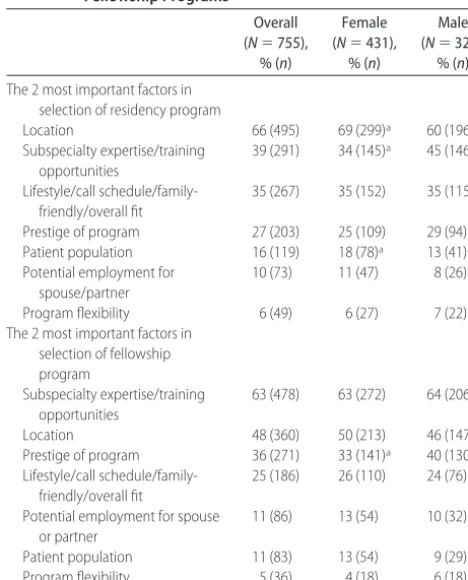
When asked to indicate the 2 most important factors in selection of their specific residency program, the largest proportion (66% [n ⫽ 495]) of fellows identified pro-gram location, and more than one third (39% [n⫽291]) reported subspecialty expertise or training opportunities at the program site. Table 2 provides additional details on the factors that influenced residency program selection. Women were more likely than men to indicate that location (69% vs 60%;P⫽.011) and patient population (18% vs 13%; P ⫽ .0422) were the most important factors, whereas men were more likely to select subspe-cialty expertise or training opportunities at the program (45% vs 34%;P⫽.0014).
When asked to indicate the 2 most important factors in selection of their specific fellowship program, the largest proportion (63% [n⫽478]) of fellows reported subspecialty expertise or training opportunities at the program. Almost half (48% [n ⫽ 360]) of the fellows identified location to be 1 of the 2 most important factors in selecting their fellowship program. Men were more
TABLE 1 Respondent Demographics (Nⴝ755)
Demographic % (n)
Female 57 (431)
International medical graduate 26 (194)
Fellowship area
Neonatal-perinatal medicine 23 (170)
Pediatric cardiology 11 (86)
Pediatric emergency medicine 11 (86)
Pediatric hematology-oncology 10 (77)
Pediatric critical care medicine 10 (73)
Pediatric endocrinology 9 (68)
Pediatric gastroenterology 9 (66)
Pediatric infectious diseases 5 (39)
Pediatric pulmonology 4 (30)
Pediatric nephrology 3 (23)
Adolescent medicine 3 (19)
Pediatric rheumatology 2 (18)
TABLE 2 Most Important Factors in Selection of Residency and Fellowship Programs
Overall (N⫽755),
% (n)
Female (N⫽431),
% (n)
Male (N⫽324),
% (n)
The 2 most important factors in selection of residency program
Location 66 (495) 69 (299)a 60 (196)a
Subspecialty expertise/training opportunities
39 (291) 34 (145)a 45 (146)a
Lifestyle/call schedule/family-friendly/overall fit
35 (267) 35 (152) 35 (115)
Prestige of program 27 (203) 25 (109) 29 (94) Patient population 16 (119) 18 (78)a 13 (41)a Potential employment for
spouse/partner
10 (73) 11 (47) 8 (26)
Program flexibility 6 (49) 6 (27) 7 (22)
The 2 most important factors in selection of fellowship program
Subspecialty expertise/training opportunities
63 (478) 63 (272) 64 (206)
Location 48 (360) 50 (213) 46 (147)
Prestige of program 36 (271) 33 (141)a 40 (130)a Lifestyle/call
schedule/family-friendly/overall fit
25 (186) 26 (110) 24 (76)
Potential employment for spouse or partner
11 (86) 13 (54) 10 (32)
Patient population 11 (83) 13 (54) 9 (29)
Program flexibility 5 (36) 4 (18) 6 (18)
likely than women (40% vs 33%;P ⫽.0349) to select program prestige (Table 2).
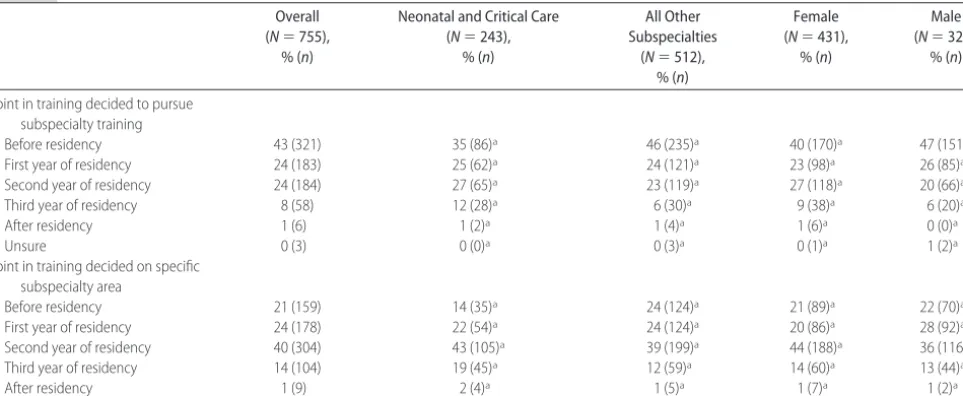
Almost half (43% [n⫽321]) of the fellows made the decision to pursue subspecialty training before resi-dency, whereas approximately half made the decision during their first 2 years of residency (Table 3). Fellows pursuing subspecialty training in areas other than neo-natal and critical care were more likely than their peers (46% vs 35%;P⫽.0179) to report deciding to pursue subspecialty training before residency. Male fellows were more likely to report that they decided to pursue subspecialty training before residency (47% vs 40%;P⫽
.0171), whereas female fellows were more likely to de-cide during their second year of residency (27% vs 20%;
P⫽.0171).
The largest proportion (40% [n ⫽ 304]) of fellows reported that they decided on their specific subspecialty area in their second year of residency (Table 3). Neonatal and critical care fellows were less likely than other sub-specialty fellows (14% vs 24%;P⫽.0046) to decide on a specific subspecialty area before residency.
Adequacy of Residency Training
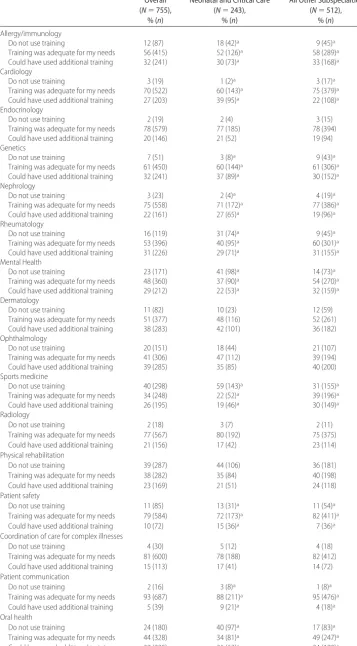
A majority of the fellows considered their residency training in most subspecialty areas or topics to be ade-quate preparation for their fellowship (Table 4). How-ever, results for some subspecialty areas were inconsis-tent. For example, more than one third of the fellows reported that they do not use the training they received in sports medicine (39% [n⫽298]), whereas 26% (n⫽
195) reported that they could have used additional train-ing in this area. Similar results were seen for physical rehabilitation, with 39% (n⫽287) reporting that they did not use the training they received during residency and 23% (n⫽169) believing that they could have used additional training in this field. Approximately one third of the fellows reported that they could have used addi-tional training in ophthalmology (39% [n⫽285]), der-matology (38% [n ⫽ 283]), allergy or immunology
(32% [n⫽241]), genetics (32% [n⫽241]), and rheu-matology (31% [n⫽226]).
Neonatal and critical care fellows were more likely than fellows in other specialties to report that they could have used additional training in cardiology (39% vs 22%; P ⬍ .0001) and neonatology (10% vs 2%; P ⬍
.0001). Fellows in other subspecialties were more likely to report that they could have used more training in mental health (32% vs 22%; P⬍.0001), sports medi-cine (30% vs 19%;P⬍.0001), and oral health (34% vs 26%;P⬍.0001).
In nonsubspecialty areas of training, few fellows be-lieved that they could have used any additional training in patient safety (10%), coordination of care for complex illnesses (15%), or patient communication (5%). Table 4 provides additional details on adequacy of residency training.
Flexibility in Residency Training
Half (n ⫽ 380) of the respondents reported that their residency program provided some training flexibility in terms of subspecialty electives, and one third (n⫽248) reported flexibility in choice of subspecialty electives and access to specific patient populations.
Fellows were asked to report what they would have done differently if given 6 to 12 months of additional flexibility in their 3-year residency program. More than 40% reported that they would have added additional outpatient subspecialty care (43% [n⫽320]) and addi-tional inpatient general or subspecialty care (41% [n⫽
304]). Neonatal and critical care fellows were more likely than fellows in other subspecialties to report that they would have spent additional time in the NICU (34% vs 2%;P⬍.0001) and the PICU (33% vs 20%; P ⬍ .0001). Other subspecialty fellows were more likely to report that they would have added additional outpatient subspecialty care (52% vs 22%;
P ⬍.0001) and outpatient general care (15% vs 6%;
P⫽ .0002) (Table 5).
TABLE 3 Point in Training That Fellows Decided on Subspecialty Training and Area (Nⴝ755)
Overall (N⫽755),
% (n)
Neonatal and Critical Care (N⫽243),
% (n)
All Other Subspecialties
(N⫽512), % (n)
Female (N⫽431),
% (n)
Male (N⫽324),
% (n)
Point in training decided to pursue subspecialty training
Before residency 43 (321) 35 (86)a 46 (235)a 40 (170)a 47 (151)a
First year of residency 24 (183) 25 (62)a 24 (121)a 23 (98)a 26 (85)a
Second year of residency 24 (184) 27 (65)a 23 (119)a 27 (118)a 20 (66)a
Third year of residency 8 (58) 12 (28)a 6 (30)a 9 (38)a 6 (20)a
After residency 1 (6) 1 (2)a 1 (4)a 1 (6)a 0 (0)a
Unsure 0 (3) 0 (0)a 0 (3)a 0 (1)a 1 (2)a
Point in training decided on specific subspecialty area
Before residency 21 (159) 14 (35)a 24 (124)a 21 (89)a 22 (70)a
First year of residency 24 (178) 22 (54)a 24 (124)a 20 (86)a 28 (92)a
Second year of residency 40 (304) 43 (105)a 39 (199)a 44 (188)a 36 (116)a
Third year of residency 14 (104) 19 (45)a 12 (59)a 14 (60)a 13 (44)a
After residency 1 (9) 2 (4)a 1 (5)a 1 (7)a 1 (2)a
TABLE 4 Adequacy of Residency Training in Preparation for Current Practice (Nⴝ755)
Overall (N⫽755),
% (n)
Neonatal and Critical Care (N⫽243),
% (n)
All Other Subspecialties (N⫽512),
% (n)
Allergy/immunology
Do not use training 12 (87) 18 (42)a 9 (45)a
Training was adequate for my needs 56 (415) 52 (126)a 58 (289)a Could have used additional training 32 (241) 30 (73)a 33 (168)a Cardiology
Do not use training 3 (19) 1 (2)a 3 (17)a
Training was adequate for my needs 70 (522) 60 (143)a 75 (379)a Could have used additional training 27 (203) 39 (95)a 22 (108)a Endocrinology
Do not use training 2 (19) 2 (4) 3 (15)
Training was adequate for my needs 78 (579) 77 (185) 78 (394) Could have used additional training 20 (146) 21 (52) 19 (94) Genetics
Do not use training 7 (51) 3 (8)a 9 (43)a
Training was adequate for my needs 61 (450) 60 (144)a 61 (306)a Could have used additional training 32 (241) 37 (89)a 30 (152)a Nephrology
Do not use training 3 (23) 2 (4)a 4 (19)a
Training was adequate for my needs 75 (558) 71 (172)a 77 (386)a Could have used additional training 22 (161) 27 (65)a 19 (96)a Rheumatology
Do not use training 16 (119) 31 (74)a 9 (45)a
Training was adequate for my needs 53 (396) 40 (95)a 60 (301)a Could have used additional training 31 (226) 29 (71)a 31 (155)a Mental Health
Do not use training 23 (171) 41 (98)a 14 (73)a
Training was adequate for my needs 48 (360) 37 (90)a 54 (270)a Could have used additional training 29 (212) 22 (53)a 32 (159)a Dermatology
Do not use training 11 (82) 10 (23) 12 (59)
Training was adequate for my needs 51 (377) 48 (116) 52 (261) Could have used additional training 38 (283) 42 (101) 36 (182) Ophthalmology
Do not use training 20 (151) 18 (44) 21 (107)
Training was adequate for my needs 41 (306) 47 (112) 39 (194) Could have used additional training 39 (285) 35 (85) 40 (200) Sports medicine
Do not use training 40 (298) 59 (143)a 31 (155)a
Training was adequate for my needs 34 (248) 22 (52)a 39 (196)a Could have used additional training 26 (195) 19 (46)a 30 (149)a Radiology
Do not use training 2 (18) 3 (7) 2 (11)
Training was adequate for my needs 77 (567) 80 (192) 75 (375) Could have used additional training 21 (156) 17 (42) 23 (114) Physical rehabilitation
Do not use training 39 (287) 44 (106) 36 (181)
Training was adequate for my needs 38 (282) 35 (84) 40 (198)
Could have used additional training 23 (169) 21 (51) 24 (118) Patient safety
Do not use training 11 (85) 13 (31)a 11 (54)a
Training was adequate for my needs 79 (584) 72 (173)a 82 (411)a Could have used additional training 10 (72) 15 (36)a 7 (36)a Coordination of care for complex illnesses
Do not use training 4 (30) 5 (12) 4 (18)
Training was adequate for my needs 81 (600) 78 (188) 82 (412) Could have used additional training 15 (113) 17 (41) 14 (72) Patient communication
Do not use training 2 (16) 3 (8)a 1 (8)a
Training was adequate for my needs 93 (687) 88 (211)a 95 (476)a Could have used additional training 5 (39) 9 (21)a 4 (18)a Oral health
Do not use training 24 (180) 40 (97)a 17 (83)a
Training was adequate for my needs 44 (328) 34 (81)a 49 (247)a Could have used additional training 32 (235) 26 (62)a 34 (173)a
Factors That Influence the Decision to Pursue Fellowship Training
When asked to indicate the 2 most important factors in their decisions to become subspecialists, fellows most commonly selected interest in a specific disease or organ system (67% [n⫽506]) and interest in a specific patient population (43% [n⫽324]). Neonatal and critical care fellows were more likely than other fellows to cite in-terest in a specific patient population (70% vs 30%;P⬍
.0001) and earning potential (34% vs 14%;P⬍.0001) as the most important factors in becoming a subspecial-ist. Other subspecialty fellows were more likely to report interest in a specific disease or organ system (78% vs 45%;P⬍.0001) and structured hours or lifestyle (30% vs 20%;P⫽.0026) as the primary reasons they became subspecialists. Male fellows were more likely than fe-male fellows (27% vs 15%;P⬍.0001) to report earning potential as 1 of the 2 most important factors in their decision to become a subspecialist (Table 6).
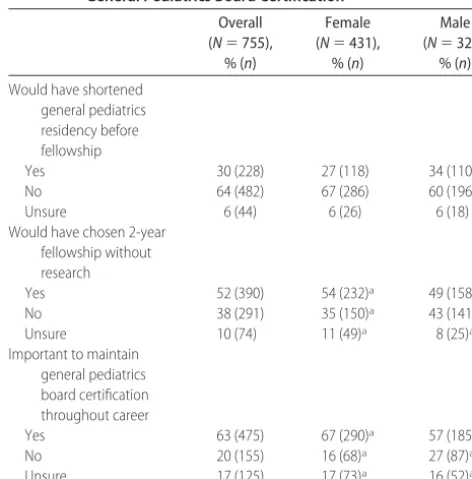
A majority (64% [n⫽482]) of the fellows would not have shortened their general pediatrics residency before fellowship if given the option. However, more than half (52% [n ⫽ 390]) of the fellows would have chosen a 2-year fellowship without research or scholarly activity over the current 3-year structure. Male fellows were slightly more likely to prefer the current structure (43% vs 35%;P⫽.0290) (Table 7).
Future Career Plans
Almost three quarters (72% [n ⫽544]) of the fellows had no plans to practice general pediatrics in the future, whereas 12% (n⫽88) planned to practice some general pediatrics and some subspecialty care, and a similar number (16% [n⫽121]) of them were unsure.
As future subspecialists, a majority (63% [n⫽475]) of respondents felt that it is important to maintain their board certification in general pediatrics throughout their career. Female fellows were more likely than male fel-lows (67% vs 57%; P ⫽ .0008) to believe that it is important to maintain general pediatrics board certifica-tion.
DISCUSSION
One of the most important findings from our study was that few current fellows believed that they could have used any additional training in the areas of patient safety, coordination of care for children with complex
TABLE 5 Given 6 –12 Months Additional Flexibility in Residency Program, How Fellows Would Spend Time
Overall (N⫽750),
% (n)
Neonatal and Critical Care
(N⫽243), % (n)
All Other Specialties (N⫽507),
% (n)
Additional outpatient subspecialty care
43 (320) 22 (54)a 52 (266)a
Additional inpatient general or subspecialty care
41 (304) 45 (110) 38 (194)
Additional time in PICU 24 (180) 33 (80)a 20 (100)a
Nothing different 13 (99) 12 (30) 14 (69)
Additional time in NICU 12 (91) 34 (83)a 2 (8)a Additional outpatient general
care
12 (92) 6 (14)a 15 (78)a
Don’t know 5 (36) 4 (9) 5 (27)
aPⱕ.05.
TABLE 7 Perspectives on Scope of Training and Importance of General Pediatrics Board Certification
Overall (N⫽755),
% (n)
Female (N⫽431),
% (n)
Male (N⫽324),
% (n)
Would have shortened general pediatrics residency before fellowship
Yes 30 (228) 27 (118) 34 (110)
No 64 (482) 67 (286) 60 (196)
Unsure 6 (44) 6 (26) 6 (18)
Would have chosen 2-year fellowship without research
Yes 52 (390) 54 (232)a 49 (158)a
No 38 (291) 35 (150)a 43 (141)a
Unsure 10 (74) 11 (49)a 8 (25)a
Important to maintain general pediatrics board certification throughout career
Yes 63 (475) 67 (290)a 57 (185)a
No 20 (155) 16 (68)a 27 (87)a
Unsure 17 (125) 17 (73)a 16 (52)a
aPⱕ.05.
TABLE 6 The 2 Most Important Factors in Decision to Become a Subspecialist
Overall (N⫽754),
% (n)
Neonatal and Critical Care (N⫽243),
% (n)
All Other Subspecialties
(N⫽511), % (n)
Female (N⫽430),
% (n)
Male (N⫽324),
% (n)
Interest in specific disease or organ system 67 (506) 45 (109)a 78 (397)a 68 (292) 66 (214) Interest in specific patient population 43 (324) 70 (169)a 30 (155)a 46 (199)a 39 (125)a
Research/academic environment 32 (243) 22 (53)a 37 (190)a 30 (131) 35 (112)
Structured hours/lifestyle 27 (202) 20 (48)a 30 (154)a 29 (124) 24 (78)
Earning potential 20 (152) 34 (82)a 14 (70)a 15 (65)a 27 (87)a
Loan repayment 1 (9) 2 (5) 1 (4) 1 (6) 1 (3)
Location 1 (5) 0 (1) 1 (4) 1 (4) 0 (1)
illnesses, or patient communication. These 3 areas rep-resent domains in which recognized deficiencies have been observed in clinical practice.1–6
Patient safety, coordination of care, and patient com-munication are among the Accreditation Council for Graduate Medical Education’s general competencies.7 These are overarching topics in the field of medicine that, ideally, are part of every clinical experience in residency. However, these practical aspects of medicine may not be addressed directly in the curriculum.8
Walsh et al9 found that patient safety training in pediatric residency programs is most frequently per-formed on an informal basis. Although most fellows in our study were comfortable with the patient safety train-ing that they received, research has shown that residents are also uncomfortable disclosing medical errors, which is an important component of patient safety.10–13
Pediatric subspecialists are most likely to care for chil-dren with complex illnesses and to need greater skills and training in coordination of care and patient commu-nication than others in the profession. Recent research has revealed that there is no standard definition for care coordination.14Thus, although only 15% of the fellows reported that they could have used additional training in coordination of care for complex illnesses, the propor-tion could potentially be higher because of differences in interpretation as well as differences in perspective as to the role of physicians in this process.
Furthermore, although only 5% of the fellows re-ported that they could have used additional training in patient communication, the issue remains important from the perspective of patients.15 Research has identi-fied specific gaps in clinician-parent communication both overall16and specifically in technical areas such as genetic testing.17,18
These findings are inconsistent with most fellows’ responses to our survey. Previous work has demon-strated that physicians often have limited ability to ac-curately self-assess their own knowledge and actions, and those who believe that they are best prepared may be the ones with the greatest shortcomings.19 In addi-tion, the organizational culture and norms in hospitals, as well as across health care systems, may limit the ability of physicians and other staff to accurately assess and correct organizational deficiencies.20,21 Thus, our findings should not be interpreted to indicate that addi-tional emphasis in these areas is not needed in pediatric residency training.
Fellows were consistent in the selection of program location and subspecialty expertise or training as the 2 factors most frequently identified to be of greatest im-portance in both residency and fellowship program choice. The fact that location is of high importance has implications for some subspecialty training programs and may indicate an immutable factor for some in filling open positions.
The timing of the decision to pursue fellowship train-ing is of great importance. Currently, many fellowships require residents to apply during their second year of residency. Anecdotal reports have indicated that some residents do not feel prepared to make fellowship
deci-sions at that time. Our results indicate that almost half of fellows (43%) made the decision to pursue fellowship training before residency, and another 24% decided in their first year. However, only 45% of residents had decided on their specific subspecialty focus by their first year of residency. Thus, the majority decide just before the deadline for application. It is unknown if a later application cycle would affect the rates of subspecialty training or the specific subspecialties that are selected.
There was wide variation in the perceptions of resi-dents regarding the adequacy of their residency training to prepare them for fellowship. One of the more striking differences was seen with regard to training in physical medicine and rehabilitation, with 39% reporting that they did not use the training from residency and 23% believing that they could have used more. Although some of this variation could be a result of the differences between residency programs, it may also reflect the dif-ferent needs of the difdif-ferent subspecialties. Such findings indicate that a “one-size-fits-all” approach to residency training does not uniformly meet the needs of all sub-specialty fellows, a point highlighted by our finding that both neonatology and critical care fellows, compared with all other fellows, had different perspectives on the value of many aspects of their residency training.
Despite the perceptions by some fellows that certain aspects of their residency were not relevant to their current training, only 30% reported that they would have shortened their residency training if given the op-tion. Although this is an important proportion, it is unknown how many would have actually pursued this option if it was available. More striking was the finding that 52% of the respondents would have selected a 2-year fellowship without research training if it were offered. The 3-year fellowship, which includes 1 year of research training, was institutionalized in pediatrics over 20 years ago.22 The length of training is a distinction between subspecialty training in pediatrics and many internal medicine subspecialties23,24 and may have had implications for the pediatrics workforce.25A better strat-egy for communicating the rationale for both the extra year of training and its expected impact on the future career of a subspecialist seems to be warranted.
CONCLUSIONS
Fellows represent the future of the subspecialty work-force. A better understanding of their motivations and perspectives on residency training can provide important information to future subspecialists and to pediatrics residency programs. The finding that a large proportion of fellows would opt for shortened subspecialty training should prompt discussion and debate within the profes-sion regarding the skills necessary for a pediatric subspe-cialist.
ACKNOWLEDGMENTS
This work was funded by the American Board of Pedi-atrics Foundation.
We gratefully acknowledge the assistance of the Res-idency Review and Redesign in Pediatrics Committee and the project group in formulation of the research questions.
REFERENCES
1. Corrigan J, Kohn L, Donaldson M, eds.To Err Is Human: Build-ing a Safer Health Care System. Washington, DC: National Acad-emy Press; 2000
2. Makoul G, Curry RH. The value of assessing and addressing communication skills.JAMA.2007;298(9):1057–1059 3. Stille CJ, Jerant A, Bell D, Meltzer D, Elmore JG. Coordinating
care across diseases, settings, and clinicians: a key role for the generalist in practice.Ann Intern Med.2005;142(8):700 –708 4. Stille CJ, Primack WA, Savageau JA. Generalist-subspecialist
communication for children with chronic conditions: a re-gional physician survey. Pediatrics. 2003;112(6 pt 1): 1314 –1320
5. Teutsch C. Patient-doctor communication.Med Clin North Am. 2003;87(5):1115–1145
6. Wise PH, Huffman LC, Brat G.A Critical Analysis of Care Coor-dination Strategies for Children With Special Health Needs. Techni-cal Review No. 14. Rockville, MD: Agency for Healthcare Re-search and Quality; 2007
7. Accreditation Council for Graduate Medical Education. Common program requirements: general competencies. Available at: www. acgme.org/outcome/comp/GeneralCompetenciesStandards 21307.pdf. Accessed May 14, 2008
8. Leape L. Is hospital patient care becoming safer? A conversa-tion with Lucian Leape. Interview by Peter I. Buerhaus [pub-lished correction appears inHealth Aff (Millwood). 2007;26(6): following w696].Health Aff (Millwood).2007;26:687– 696 9. Walsh KE, Miller MR, Vinci RJ, Bauchner H. Pediatric resident
education about medical errors. Ambul Pediatr. 2004;4(6): 514 –517
10. Fischer MA, Mazor KM, Baril J, Alper E, DeMarco D, Pugnaire M. Learning from mistakes: factors that influence how stu-dents and resistu-dents learn from medical errors.J Gen Intern Med. 2006;21(5):419 – 423
11. Garbutt J, Brownstein DR, Klein EJ, et al. Reporting and dis-closing medical errors: pediatricians’ attitudes and behaviors. Arch Pediatr Adolesc Med.2007;161(2):179 –185
12. Kaldjian LC, Jones EW, Wu BJ, Forman-Hoffman VL, Levi BH, Rosenthal GE. Reporting medical errors to improve patient safety: a survey of physicians in teaching hospitals.Arch Intern Med.2008;168(1):40 – 46
13. Wu AW, Folkman S, McPhee SJ, Lo B. Do house officers learn from their mistakes?JAMA.1991;265(16):2089 –2094 14. McDonald KM, Sundaram V, Bravata DM, et al. Care
Coordi-nation Vol 7. In: Shojania KG, McDonald KM, Wachter RM, Owens DK, eds.Closing the Quality Gap: A Critical Analysis of Quality Imporvement Strategies, Technical Review 9. AHRQ Publi-cation No. 04(07)-0051-7. Rockville, MD: Agency for Health-care Research and Quality; 2007
15. Pear R. Study finds many patients dissatisfied with hospitals. New York Times.March 29, 2008:Sect. A
16. Cramm KJ, Dowd MD. What are you waiting for? A study of resident physician-parent communication in a pediatric emer-gency department.Ann Emerg Med.2008;51(4):361–366 17. Farrell MH, Kuruvilla P. Assessment of parental understanding
by pediatric residents during counseling after newborn genetic screening.Arch Pediatr Adolesc Med.2008;162(3):199 –204 18. La Pean A, Farrell MH. Initially misleading communication of
carrier results after newborn genetic screening.Pediatrics.2005; 116(6):1499 –1505
19. Davis DA, Mazmanian PE, Fordis M, Van Harrison R, Thorpe KE, Perrier L. Accuracy of physician self-assessment compared with observed measures of competence: a systematic review. JAMA.2006;296(9):1094 –1102
20. Shortell SM, Singer SJ. Improving patient safety by taking systems seriously.JAMA.2008;299(4):445– 447
21. Tucker AL, Edmondson AC. Why hospitals don’t learn from failures: organizational and psychological dynamics that inhibit system change.Calif Manage Rev.2003;45(2):55–72
22. Cleveland WW, Brownlee RC. Future training of pediatricians: summary report of a series of conferences sponsored by the American Board of Pediatrics.Pediatrics.1987;80(3):451– 457 23. Society of General Internal Medicine. Policy statement for
general internal medicine fellowships.J Gen Intern Med.1994; 9(9):513–516
24. Whitcomb ME, Walter DL. Research training in 6 selected internal medicine fellowship programs.Ann Intern Med.2000; 133(10):800 – 807
DOI: 10.1542/peds.2008-1578I
2009;123;S31
Pediatrics
A. McGuinness
Gary L. Freed, Kelly M. Dunham, Kara E. Switalski, M. Douglas Jones, Jr and Gail
Pediatric Fellows: Perspectives on Training and Future Scope of Practice
Services
Updated Information &
http://pediatrics.aappublications.org/content/123/Supplement_1/S31
including high resolution figures, can be found at:
References
BIBL
http://pediatrics.aappublications.org/content/123/Supplement_1/S31#
This article cites 20 articles, 5 of which you can access for free at:
Subspecialty Collections
_management_sub
http://www.aappublications.org/cgi/collection/administration:practice
Administration/Practice Management
b
http://www.aappublications.org/cgi/collection/medical_education_su
Medical Education
following collection(s):
This article, along with others on similar topics, appears in the
Permissions & Licensing
http://www.aappublications.org/site/misc/Permissions.xhtml
in its entirety can be found online at:
Information about reproducing this article in parts (figures, tables) or
Reprints
http://www.aappublications.org/site/misc/reprints.xhtml
DOI: 10.1542/peds.2008-1578I
2009;123;S31
Pediatrics
A. McGuinness
Gary L. Freed, Kelly M. Dunham, Kara E. Switalski, M. Douglas Jones, Jr and Gail
Pediatric Fellows: Perspectives on Training and Future Scope of Practice
http://pediatrics.aappublications.org/content/123/Supplement_1/S31
located on the World Wide Web at:
The online version of this article, along with updated information and services, is
by the American Academy of Pediatrics. All rights reserved. Print ISSN: 1073-0397.