627
Security Model for Healthcare Application
In Cloud Computing
E Kanchana1 R Vasanthi21
PG Student 2Asst. Prof Dept. of CSE,
1&2
Affiliated to Anna University Chennai, Dept. of Computer Science and Engineering Idhaya Engineering College for Women
[email protected],[email protected]
Abstract
Personal Health Records (PHRs) is based on cloud virtual machine in web oriented application in which the lifelong health data of patients, who should be able to show them conveniently and securely to selected disables in an institution. The MyPHRMachines, a cloud-based PHR system taking a radically new architectural solution to health record portability. In MyPHR Machines, health-related data and the application software to view and analyze it are separately deployed in the PHR system. After uploading their medical data to MyPHRMachines, patients can access them again from remote virtual machines that contain the right software to visualize and analyze them without any need for conversion. Patients can share their remote virtual machine session with selected caregivers, my aim at providing patients (and their trusted caregivers) remote desktop or tablet computer access to all their PHR data, and support this access by the software that matches the data format. Since do not tackle semantic data integration in the paper, one can more specifically label this as health record mobility and portability. The person will need only a Web browser to access the pre-loaded fragments of their lifelong PHR.
Index Terms: Cloud computing, electronic health record, personal health record, electronic medical record, radiology, personalized medicine.
I. Introduction
IN a recent review paper, Kaelber et al. define a personal health record (PHR) as “a set of computer-based tools that allow people to access and coordinate their lifelong health information and
make appropriate parts of it available to those who need it”. PHRs should be portable, i.e., remain
with the patient, contain lifelong information, and should not be restricted by file formats or other local issues. In other words, they are electronic health records (EHRs) that are owned by patients. These are usually opposed to hospitals’ electronic medical records (EMRs), which only contain medical data generated within one specific care institution. Attribute based encryption; the on demand user revocation is a challenging problem. So the cipher text policy –attribute based encryption and key- policy based attribute based encryption are also applied for the security of the personal health record.
Sustainability in this context refers to the financial and political aspects of the health care and software industries. Point (1) focuses on raw PHR data since care institutions may not be able or willing to provide their EHR data in “one” standardized PHR format. Tang et al. mention in their PHR adoption barrier analysis that “(US) Government can play a number of important roles in increasing PHR use. At the infrastructure level, the federal government could catalyze development
and adoption of data and interchange standards for key PHR content areas.” [3]. Such standards are
useful and slowly emerging, but we argue that regardless of such evolution, patients should already be empowered with the ability to manage their own (potentially raw) data. With point (2) we aim at the
628 so-called functional interoperability (i.e., “the ability of two or more systems to exchange information
so that it is human readable by the receiver” [4]). Concretely, we aim at providing patients (and their
trusted caregivers) remote desktop or tablet computer access to all their PHR data, and support this access by the software that matches the data format. Since we do not tackle semantic data integration in this paper, one can more specifically label this as health record mobility and portability.
Cloud computing offers unique opportunities for supporting long-term record preservation [5]. In this paper, we present MyPHRMachines, a cloud-based PHR system that answers our research question. One of the agreed key requirements for share-ability of the EHR is to break the nexus between the EHR and the EHR system [4]. The MyPHRMachines architecture clearly separates PHR data from the software to work with these data. This paper demonstrates how this creates novel opportunities for the market of PHR software services without compromising patient privacy.
Commercial PHR systems positioning themselves within the cloud computing paradigm are emerging. For example, SeeMyRadiology [6] enables patients to upload their medical images and then selectively share these with caregivers. Unfortunately, such so-called software-as-a-service (SaaS) systems are typically (1) specialized for one medical function and (2) specifically programmed for web browsers. The SeeMyRadiology example indeed consists of a DICOM viewer that has been programmed in HTML 5 and related technologies. MyPHRMachines is an academic prototype that is more generally applicable since it exposes to its users the so-called infrastructure-as-a-service (IaaS) tier of cloud architectures [7]. In a nutshell, the system provides infrastructure to (1) store and share (subsets of) patient data and (2) deploy and use specialized software in remote virtual machines (VMs).
A hypervisor or virtual machine monitor is a piece of computer software, firmware or hardware that creates and runs virtual machines. A computer on which a hypervisor is running one or more virtual machines is defined as a host machine. Each machine is called a guest machine. The hypervisor presents the guest operating systems with a virtual operating platform and manages the execution of the guest operating systems.
II. Design and Implementation MyPHRMachines System Architecture
Technique Used: EMR System
An existing system PHR can be done by EMR system it has wide verity of Virtual machine to straightforward extension at derived directly from the analysis of the radiology use case is the integration with existing EMR systems. This is required to free the patient and care givers from the burden of transferring to the PHR system all health information and, consequently, is likely to foster adoption of MyPHRMachines, from the technical implementation standpoint, this extension does not represent a substantial obstacle.
In this architecture Recommender systems developed as an independent re-search area in the mid-1990s when recommendation problems started focusing on rating models. According to the definition of recommender system in, recommender system can be defined as system that produces individualized recommendations as output or has the effect of guiding the user in a personalized way to interesting or useful services in a large space of possible options. Current recommendation methods usually can be classified into three main categories: content-based, collaborative, and hybrid recommendation approaches.
629 Architecture diagram of proposed system
Fig.1: Technical Architecture of MyPHRMachine
The prototype reuses parts of SHARE [15], a mature system for making computational research results more accessible and reproducible. The key technological components have, therefore, undergone various development cycles, which adds to the robustness of MyPHRMachines technical architecture. On the one hand, MyPHRMachines excludes functionality developed for the SHARE-specific use cases (e.g., generating BibTeX code for conveniently citing a VM image from a research paper). On the other hand, MyPHRMachines requires the development of new functionality specific to the PHR context (e.g., access delegation to a VM session). We also redesigned the user interface of the Web portal to become simpler and coherent to facilitate access by nonexpert users.
Within MyPHRMachines, we distinguish between the Execution and Storage layers. Each VM in the execution layer represents the virtualization of specific application software (ora software bundle) serving the purpose of either viewing or analyzing patients’ health data. Patients can log into MyPHRMachines and decide which VM to load in a given session using a standard Web portal. The Hypervisor is a generic piece of software to start, stop, clone VMs, and control their Internet access. For our prototype, we decided to use VirtualBox, an off-the-shelf hypervisor. Being heavily used in several industries, VirtualBox benefits from periodic functionality updates and security reviews. Note that, as discussed more in depth later, the VMs for specialist software are stateless and deprived of Internet access.
The PHR data are stored into network folders, which remain private folders within the MyPHRMachines domain. Put differently, the VM-based architecture ensures that all patient data can remain on the server-side, on a trusted infrastructure. The latter feature, combined with stateless VMs deprived of Internet access, guarantees the privacy of the patient’s health-related data. In particular, even if software in one of the VMs is programmed with some sort of malware, this will not be able to push PHR data outside the network domain of MyPHRMachines.
About radiology, the patient obtains PHR (radiology) data, e.g., a DICOM CD, from the radiology provider r. The sequence diagram in Fig. 6 shows two options for loading PHR data into MyPHRMachines, i.e., by the Radiology provider (see the first opt block in the sequence diagram) and by the patient (see the second opt block in the diagram). Note again that an automatic file transfer from PACS archives to MyPHRMachines network folders has not yet been implemented. Once the radiology data are in MyPHRMachines, the patient starts a VM and shares the access to this VM with
630 provider c. Steps 10 and 11 in the diagram represent the case in which the patient delegates VM access to a care provider c which represents for this use case a physiotherapist from another hospital. About personalized medicine the patient first acquires the DNA sequence from a specialized care institution and then stores it into MyPHRMachines. In order to receive genetic counseling, the patient starts a new VM with software specialized for genome analysis and grants access to it to a medical expert. The PHR data are stored into network folders, which remain private folders within the MyPHRMachines domain. Put differently, the VM-based architecture ensures that all patient data can remain on the server-side, on a trusted infrastructure. The latter feature, combined with stateless VMs deprived of Internet access, guarantees the privacy of the patient’s health-related data.
Dynamo: amazon’s highly available key-value store
Reliability at massive scale is one of the biggest challenges they face at Amazon.com, one of the largest e-commerce operations in the world; even the slightest outage has significant financial consequences and impacts customer trust. The Amazon.com platform, which provides services for many web sites worldwide, is implemented on top of an infrastructure of tens of thousands of servers and network components located in many datacenters around the world. At this scale, small and large components fail continuously and the way persistent state is managed in the face of these failures drives the reliability and scalability of the software systems. The design and implementation of Dynamo, a highly available key-value storage system that some of Amazon’s core services use to provide an “always-on” experience. To achieve this level of availability, Dynamo sacrifices consistency under certain failure scenarios. It makes extensive use of object versioning and application-assisted conflict resolution in a manner that provides a novel interface for developers to use.
Fig.2: Conceptual model of MyPHRMachines. Seemyradiology - medical image sharing
SeeMyradiology -medical image sharing (Accelared - 2012), SeeMyradiology is a cloud based medical image sharing and collaboration solution. While boasting a large network of hospitals and physicians, SeeMyRadiology sought to improve the experience for their existing users as well as to expand their offering to a new patient user group. The design team works closely with SeeMyRadilogy's development team during agile sprint cycles to provide expert review and
631 recommendation for improving the current system. They also use a user-centered approach to designing feature enhancements and new workflows that accommodate the new patient user group.
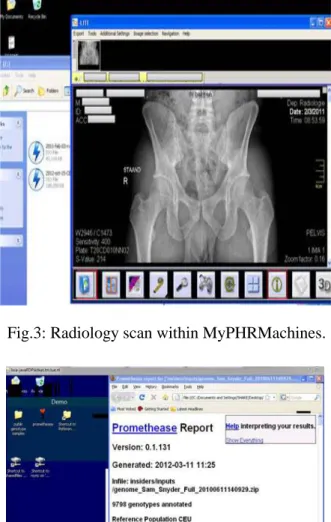
With each sprit they provide functional and virtual design specifications and work closely with the development team through implementation. The diagnosis and treatment of such conditions is not an easy task and physicians often tend to waive intensive and expensive treatment referring the patients to physiotherapy or even commercial fitness clubs for palliative therapy. The condition however may remain latent for years and reappear in the long run. The decision to start a professional, long term validation program may be postponed too long especially when caregivers lack access to prior scans and analyses. About radiology, the patient obtains PHR (radiology) data, e.g., a DICOM CD, from the radiology provider. The sequence two options for loading PHR data into MyPHRMachines,that is the radiology provider automatic file transfer from PACS archives to MyPHRMachines network.www.seemyradiology.com.
Fig.3: Radiology scan within MyPHRMachines.
632 III. Module Description
a. User Interface
Given Input: Create node and set name, Ip, port for that node. Output: Nodes are created and displayed.
To connect with server user must give their username and password then only they can able to connect the server. If the user already exits directly can login into the server else user must register their details such as username, password and Email id, into the server. Server will create the account for the entire user to maintain upload and download rate. Name will be set as user id. . Logging in is usually used to enter a specific page.
System Initialization and Authentication of users in Cloud Registration
Input : New user, AA (Attribute Authorities) Output: Id from CA (Certificate Authorities)
Each user registers to the CA by providing their details. CA provides a global unique ID and certificate for each user who entering into the system. AA should also be registered to the CA. For each AA, CA provides Global unique ID and submits the certificates provided for each user in the system. The user details, AA details are stored in database.
Authentication: Input : User ID Output: Access by CA
Users provide the id obtained from CA, while login for the data access in CSP. CSP validates the id using the details stored in database. If the id is valid, users are allowed for the data access in cloud, Otherwise access is denied for the user.
b. Personal Health Record
Given Input: The data is given by user requests arrive at each front-end proxy server. Output: It passes to the data base.
Each patient has separate health related record. That all are stored into on temporary areas like one database. This database contain all are original data. And also each patient record contains some description and also some important data like x-ray. All are separate format like doc for description and x-ray like image formar that is pdf like that.
c. Hyper visor
Given Input: Given query from user. Output: Maintain the user response.
633 Hyper visor is very important for maintain the cloud database. And also maintain the user request and response. Suppose the user give one request mean hyper visor find out what type of request is that and transfer into correct course. And then transfer the response to the client or user. This all works are maintained by the hyper visor.
d. ABE (Attribute Based Encryption) Given Input: User requirement from query. Output: To improve the Fetching value in cloud.
This is one algorithm they include in proposed system for what are the drawbacks in existing system that all are override using this algorithm. Attribute contain (e.g. what are the attributes for patient record mean description and some data) data all are separate format for easy to find out the data. This all are stored into cloud database.
e. Improve the user performance Given Input: User requirement and value Output: To filter the value relevant in cloud database.
How to improve the server performance in cloud using ABE (Attribute Based Encryption). This is one algorithm for easy to find out separate file description and data. And also here used more servers for data storage and maintains. So they reduce the server workload and also improve the server performance.
IV. Related work
Frst classify current PHR solutions into free-standing (third party), provider-tethered, and integrated PHR systems [1]. In terms of the number of users, the most successful PHR solutions belong to the latter category, with examples such as the EPIC MyChart system [2], tethered from hospitals using the EPIC EHR, and MyHealtheVet [3], promoted by the US Department of Veterans Affairs. Besides increasing efficiency, by reducing the need for patient data collection or duplicate clinical exams, provider tethered PHRs promote a stickier relationship between the provider and the patient. Kaelber et al. have demonstrated theoretically that the large-scale deployment of such PHR systems would have significant economic drawbacks [4].
MyPHRMachines can be classified as an integrated PHR solution [5]. Integrated PHRs are free-standing solutions that collect information from a variety of information sources, such as EMRs, insurance claims, pharmacy data, or data entered directly by patients. Integrated solutions, such as Indivo X [6] or Microsoft HealthVault [7] are less successful in terms of adoption when compared to provider-tethered solutions [8], [9]. Patients, in fact, are required to proactively experiment with the technology without being pushed in doing so by a given provider. Moreover, the interoperability of the PHR with other proprietary systems and, more generally, the provider willingness to trust and use the PHR, are not guaranteed.
It makes the PHR information trustworthy by delivering original PHR data and related application software directly to care institutions instead of providing patient-entered information [10]. Second, the bar- rier to accessing a MyPHRMachines session is minimal, since only one hyperlink needs to be clicked for accessing the trusted health data and its corresponding software. As far as the architecture is concerned, PHR systems rely on a client-server, Web-based architecture [11]. PHR data security and privacy are concerned, Web-based PHR systems usually allow patients to collect and store digitized health information, but they usually implement only very simple selective access delegation policies [12].
Advantage
• Data’s are saved in encrypted format using public key encryption. • Providing more security of data.
634 • Easy to access a PHRs system to sharing the data for caregiver.
• Unique privacy protection mechanism.
• Efficient to provide data in secured manner in a primitive data.
Application
• HealthCare management. • HealthCare insurance for PHR. V. Conclusion
They MyPHRMachines, a novel PHR system. Leveraging virtualization techniques, MyPHRMachines allows patients to build lifelong PHRs. The records can be shared by the patient with any stakeholder interested in those. MyPHRMachines allows also the controlled sharing of application software that is required to view and/or analyze health records. Patients seeking care by caregivers in different geographical areas will be able to reproduce their original health records, no matter the limitations imposed by the heterogeneity of local health care information systems. Moreover, as technology evolves, patients will always be able to use original software to view and analyze data, even when that software becomes obsolete and possibly no longer supported by the stakeholder that produced the data.
Future Work
Future enhancement of lifelong PHRs. The records can be shared by the patient with any stakeholder interested in those. My PHR Machines allows also the controlled sharing of application software that is required to view and/or analyze health records. Patients seeking care by caregivers in different geographical areas will be able to reproduce their original health records, no matter the limitations imposed by the heterogeneity of local health care information systems. Moreover, as technology evolves, patients will always be able to use original software to view and analyze data. References
[1] Accelarad. (2012, July). SeeMyradiology - medical image sharing. OnlineAvailable: www. seeMyradiology.com.
[2] Alvaro Garcia-Recuero, Sergio Esteves and Luis Veiga "Quality-of-data for consistency levels in geo-replicated cloud data stores", April 2011.
[3] I. Carrion, J. Fernandez Aleman, and A. Toval, “Personal health records: New means to safely handle our health data?,” IEEE Comput., 2012, vol.pp, no. 99, p. 1, 2012.
[4] Douglas Thain, Todd Tannenbaum, and Miron Livny "Distributed Computing in practice the conder experience", May 2010.
[5] D. C. Kaelber, A. K. Jha, D. Johnston, B. Middleton, and D. W. Bates, “Viewpoint paper: A research agenda for personal health records (PHRs),” J. Amer. Med. Inform. Assoc., vol. 15, no. 6, pp. 729–736, 2008.
[6] D. T. Mon, J. Ritter, C. Spears, and P. Van Dyke, “PHR system Functional model,” HL7 PHR Standard, May 2008.
[7] Giuseppe Decandia, Deniz Hastorun and Madan Jampani "Dynamo: Amazon's highly available key-value store", March 2012. Online Available: www. Amazon .com.
[8] Hiroshi Wade, Alan Feket and Liang Zhao "Data consistency properties and the tradeoffs in commercial cloud storages: The consumer's perspective", Oct 2011).
635 [9] Pieter Van Gorp and Marco Comuizz "Lifelong Personal Health Data and Application Software via Virtual Machines in the Cloud: IEEE Journal of Engineering and Advanced Technology (IJEAT)", ISSN: 2249 - 8958, Volume-2, Issue-4, and April 2014.
[10] Priyanka Korde, Vijay Panwar and Sneha Kalsh, "Securing personal health records in cloud using attribute based encryption: International Journal of Engineering and Advanced Technology (IJEAT)", ISSN: 2249 - 8958, Volume-2, Issue-4, April 2013.
[11] Robert G.Fichman, Rajiv Kohli and Ranjani Krishnan "The role information systems in healthcare: Current research and future trends" Vol. 22, No. 3, Sep 2011.
[12] S. Marston, Z. Li, S. Bandyopadhyay, J. Zhang, and A. Ghalsasi, “Cloud computing - The business perspective,” Decis. Supp. Syst., vol. 51, pp. 176–189, April 2011.
[13] Wojciech Gloab, Muntasir Raihan Rahman and Alvin Auyoung "Client-centric benchmarking of eventual consistency for cloud storage systems", March 2010.