Hale, P. (2012) User driven modelling: Visualisation and system-atic interaction for end-user programming with tree-based structures.
PhD, University of the West of England. Available from: http://eprints.uwe.ac.uk/17918
We recommend you cite the published version. The publisher’s URL is:
http://eprints.uwe.ac.uk/17918/
Refereed: No
A thesis submitted in partial fulfilment of the requirements of the University of the West of England, Bristol
for the degree of Doctor of Philosophy
This research programme was carried out partly in collaboration with Airbus and Rolls?Royce aerospace
I would like to thank Tony Solomonides and Ian Beeson for their supervi-sion, help and support for this thesis. Prior to this I have also had support from Professor James Scanlan and Dr John Lanham. I am further indebted to my examiners, Professor Atta Badii, Dr Peter Strachan and Professor Alan Winfield, for many incisive questions and insightful comments. Since the viva I have had additional critical help and support from Dr Stewart Green and Dr Jin Sa.
Faculty of Environment and Technology, University of the West of England, Bristol
October 2011
Disclaimer
UWE has obtained warranties from all depositors as to their title in the material deposited and as to their right to deposit such material.
UWE makes no representation or warranties of commercial utility, title, or fit-ness for a particular purpose or any other warranty, express or implied in respect of any material deposited.
UWE makes no representation that the use of the materials will not infringe any patent, copyright, trademark or other property or proprietary rights.
UWE accepts no liability for any infringement of intellectual property rights in any material deposited but will remove such material from public view pend-ing investigation in the event of an allegation of any such infrpend-ingement. PLEASE SCROLL DOWN FOR TEXT.
Abstract
This thesis addresses certain problems encountered by teams of engineers when modelling complex
structures and processes subject to cost and other resource constraints. The cost of a structure or process may be ‘read off’ its specifying model, but the language in which the model is expressed (e.g. CAD) and the language in which resources may be modelled (e.g. spreadsheets) are not naturally compatible. This thesis demonstrates that a number of intermediate steps may be introduced which enable both meaningful
translation from one conceptual view to another as well as meaningful collaboration between team members. The work adopts a diagrammatic modelling approach as a natural one in an engineering context when seeking to establish a shared understanding of problems.
Thus, the research question to be answered in this thesis is: ‘To what extent is it possible to improve user-driven software development through interaction with diagrams and without requiring users to learn particular computer languages?’ The goal of the research is to improve collaborative software development through interaction with diagrams, thereby minimising the need for end-users to code directly. To achieve this aim a combination of the paradigms of End-User Programming, Process and Product Modelling and Decision Support, and Semantic Web are exploited and a methodology of User Driven Modelling and Programming (UDM/P) is developed, implemented, and tested as a means of demonstrating the efficacy of diagrammatic modelling.
In greater detail, the research seeks to show that diagrammatic modelling eases problems of maintenance, extensibility, ease of use, and sharing of information. The methodology presented here to achieve this involves a three step translation from a visualised ontology, through a modelling tool, to output to interactive visualisations. An analysis of users groups them into categories of system creator, model builder, and model user. This categorisation corresponds well with the three-step translation process where users develop the ontology, modelling tool, and visualisations for their problem.
This research establishes and exemplifies a novel paradigm of collaborative end-user programming by domain experts. The end-user programmers can use a visual interface where the visualisation of the software exactly matches the structure of the software itself, making translation between user and computer, and vice versa, much more direct and practical. The visualisation is based on an ontology that provides a
representation of the software as a tree. The solution is based on translation from a source tree to a result tree, and visualisation of both. The result tree shows a structured representation of the model with a full
visualisation of all parts that leads to the computed result.
In conclusion, it is claimed that this direct representation of the structure enables an understanding of the program as an ontology and model that is then visualised, resulting in a more transparent shared
understanding by all users. It is further argued that our diagrammatic modelling paradigm consequently eases problems of maintenance, extensibility, ease of use, and sharing of information. This method is applicable to any problem that lends itself to representation as a tree. This is considered a limitation of the
Contents
Ch 1 - Introduction
1.1 Explanation of the Problem 1.2 Research Hypothesis 1.3 Research Aims 1.4 Objectives1.4.1 Enabling Better and more Adaptable Modelling 1.4.2 Methodology for Achievement of Objectives 1.5 Target Users 1.5.1 System Creator 1.5.2 Model Builders 1.5.3 Model Users 1.6 Thesis Structure
Ch 2 - Literature Review
2.1 Introduction2.2 Past Research of others and how this affects present modelling problems 2.3 Structure and Implicit Knowledge
2.3.1 Ontologies for Modelling and Simulation 2.3.2 Semantic Web and Ontologies
2.4 Interaction for Modelling with Ontologies 2.5 Visualisation and Interaction
2.6 Model-Driven Programming for Better Model Production 2.7 Accessibility of Models
2.7.1 Translation Steps 2.7.2 Better Models
2.8 Conclusions - Focus for Developing a Theory and Apparatus
Ch 3 - User Driven Programming/Modelling Theory
3.1 Building a Theoretical Apparatus3.2 Information Structuring and Navigation 3.3 Visualisation and Interaction for Modelling 3.3.1 Users and De-abstraction for Translation 3.3.2 Translation Process
3.5.2 Web and Interoperability Standards
3.6 Ontologies and Semantic Web technology and their role in Modelling 3.6.1 Semantic Web and Web 2.0 Collaboration
3.6.2 Central Ontology Management
3.7 Meta-Programming as a Model Creation Technique 3.7.1 Model-Driven Programming
3.8 Conclusions
Ch 4 - Research Design: Methodology
4.1 Creation of a modelling system4.2 Modelling Tools
4.2.1 Improving and Building On End-User Interaction and Ease of Use 4.3 Spreadsheets
4.3.1 Improving and Building On Information Structuring and Visualisation 4.4 Ontology Tools
4.4.1 Improving and Building on Modelling Capability and End-User Interaction 4.5 Semantic Web/Web 2.0
4.5.1 Improving and Building on Modelling Capability and End-User Interaction 4.6 System to be Developed
4.7 Building a System for Ontology and Semantic Web based Modelling 4.8 Enabling User Driven Modelling/Programming
4.9 Conclusions
Ch 5 - Development: Early Prototypes
5.1 Illustration of the problems to be addressed5.1.1 Spreadsheet Modelling 5.1.2 ACCS Example 5.1.2.1 Project Aim
5.1.2.2 ACCS Implementation
5.2 Macros and Programming by Example 5.3 Visualisation and Interactivity for Translation 5.4 Web Spreadsheet and Semantic Modelling Examples 5.5 Necessary Improvements
5.5.1 Better Visualisation
5.5.2 Better Representation and Structure 5.5.3 Better Interactivity
5.6 Discussion 5.7 Recommendations
Ch 6 - Development: Final Prototype Implementation
6.1 Background to Projects and Implementation6.2 Wing Spar Explanation
6.3 Implementation Techniques and Examples 6.3.1 Implementation Simple Example 6.3.1.1 Step 1
6.3.1.2 Step 2 6.3.1.3 Step 3
6.4 Implementation Results and Benefits 6.4.1 Modelling Tools 6.4.2 Spreadsheets 6.4.3 Ontology Tools 6.4.4 Semantic Web/Web 2.0 6.4.4.1 Semantic Search 6.5 Examples 6.5.1 Step 1 - Ontology 6.5.2 Step 2 - Modelling Tool
6.5.3 Step 3 - Interactive Visualisation
6.5.3.1 Step 3 - CAD Style Interactive Visualisation 6.5.3.2 Translation to Program/Meta-Program Code 6.6 Wider Engineering Translation
6.7 End-user Programming/Modelling Evaluation 6.7.1 End-user Survey
6.7.2 Usability Evaluation 6.8 Analysis and Reflection
Ch 7 - Discussion
7.1 Enabling Visual Semantic Web programming
7.2 Widening user programming participation: Generic Modelling 7.3 Widening Participation: Online Editable Systems
7.4 User Driven Modelling Solutions 7.4.1 Method
7.5 Business Benefits 7.5.1 Visualising Reports
7.6 User Driven Modelling - Intermediate Benefits
8.1.2 Extensibility 8.1.3 Ease of Use 8.1.4 Sharing of Information 8.2 Conclusion 8.3 Further Research 8.3.1 Ontology Development
8.3.2 Ontology Visualisation and Interaction 8.3.3 Modelling and Simulation
8.3.4 Meta-Programming and Rule Based Programming 8.3.5 Visualisation and Taxonomy Management 8.3.6 Research Connectivity
8.3.7 User Management 8.4 Final Statement
Ch 9 - Appendix
9.1 Process Modelling9.1.1 DATUM Process Modelling Example 9.2 Process Specification Language - PSL 9.3 STEPml
9.4 XMI (XML Metadata Interchange) 9.5 Yahoo Pipes
Figures
Figure 1. Research Area ... 10
Figure 2. How Objectives and Methodology will aid better modelling ... 15
Figure 3. Layered Architecture, sourced from Berners-Lee (2000) and McGuinness (2003) ... 32
Figure 4. Java Graph Layout example, possible user interface for user driven program ... 57
Figure 5. Early End-user Modelling Example ... 58
Figure 6. Early End-user Modelling Example 2 ... 58
Figure 7. Translation Process ... 64
Figure 8. Translation for Interaction and Visualisation ... 65
Figure 9. Translation Process Design ... 66
Figure 10. Recursive Translation - Automated Copying from ontology to modelling system ... 68
Figure 11. Translation Process for User Driven Modelling/Programming (UDM/P) ... 70
Figure 12. Visualising and Interacting with database/ontology information ... 86
Figure 13. Methodology Diagram - Enabling User Driven Modelling/Programming ... 93
Figure 14. Translation Process Chain ... 98
Figure 15. Research Development Iterations ... 101
Figure 16. User Driven Modelling/Programming System ... 106
Figure 17. ACCS spreadsheet model navigation ... 110
Figure 18. Distributed Spreadsheet Spar Definition ... 111
Figure 19. DAML+Oil Web Program linking to ontology information ... 113
Figure 20. Ontology of Engine Components and related information ... 114
Figure 21. Selection of Material for components ... 115
Figure 22. XML Based Software for capturing information ... 116
Figure 23. Automated Generation of Web Forms ... 117
Figure 24. Wing Spar Diagram ... 120
Figure 25. Stepped Translation and Visualisation ... 121
Figure 26. Rectangle Definition in Ontology ... 123
Figure 27. Rectangle Area Attribute ... 124
Figure 28. Step 2 - Translation and Calculation ... 124
Figure 29. Results Output as Tree (XML based) ... 125
Figure 30. CAD type interface and User Interaction and Calculation ... 126
Figure 31. Cube model example - illustrates choice of process etc. ... 127
Figure 32. Translation to SVG Visualisation ... 128
Figure 33. Ontology to Model Conversion... 129
Figure 34. Translation Process Implementation ... 131
Figure 35. Semantic Search interface ... 133
Figure 36. Results from semantic search ... 133
Figure 37. Web Protégé Interface... 134
Figure 38. Bitriple Ontology Creation Screenshot ... 135
Figure 39. Translation of Equation Representation from Protégé to Vanguard System... 136
Figure 40. Spar branch automatically created from information source ... 138
Figure 41. Part Definition Branch ... 139
Figure 42. Pre Preg Mass Calculation ... 140
Figure 43. Hand Layup Calculation ... 140
Figure 44. Using the tree view for cost drill down ... 141
Figure 45. Spar Volume calculation model running on the web ... 142
Figure 46. Web page showing translated XML displayed as interactive web application ... 143
Figure 47. Flash interface for navigating exported XML tree ... 144
Figure 48. Flash viewing of Spar Part Definition node ... 145
Figure 49. Interactive Spar Diagram (SVG) ... 146
Figure 50. Translation from decision tree into Java ... 147
Figure 51. Translation from decision tree into Java web Applet ... 147
Figure 52. Translation from decision tree to Cost Estimator... 148
Figure 53. Parametric Cost Estimation ... 149
Figure 54. End-user programming survey ... 150
Figure 59. Generic Modelling ... 157
Figure 60. End-User Programming, Modelling and Meta-Programming with Semantic Web ... 159
Figure 61. Solution for User Driven Programming ... 161
Figure 62. Two Way Translation between users and computers ... 171
Figure 63. E-Learning, End-User Programming, and the Semantic Web ... 173
Figure 64. Representation of Engine Ring Manufacturing Sequence ... 187
Figure 65. Section from PSL Process Taxonomy and sequence rendered with stylesheet - PSL Class Definition ... 189
Figure 66. PSL Instance Creation... 190
Figure 67. PSL Time Point Creation ... 190
Figure 68. PSL Activity Specifications ... 191
Figure 69. Activity Occurrence Times ... 192
Figure 70. STEPml example rendered with stylesheet ... 193
Figure 71. XMI Taxonomy - Product Data Structure - Visualised with Stylesheet ... 194
Figure 72. Example Yahoo Pipe ... 195
Tables
Table 1. Users and De-abstraction for Translation ... 62Table 2. Language and Tool Mapping ... 81
Table 3. Roles, Skills, and Translation ... 165
Table 4. Stepped Translation and Modelling ... 165
Chapter 1 Introduction
1.1 Explanation of the Problem
Diagrammatic modelling plays a major role in current practice in the design of software, and in the design of engineering components. Diagrams also play a role in Business Modelling, and Scientific Modelling and Visualisation. The problem to be investigated is how to use such tools within engineering to create or enable a shared understanding, and what is common in the use of these tools for engineering modelling to other types of modelling.
This research involves enabling computer literate people who are not programmers to create software. The means for this is construction of visual diagrams that represent the task, in a similar way to how family trees and taxonomies can be represented as diagrams. The research involves translating from an ontology to modelling system code and meta-code, and also to a visual interface produced by automated translation, and demonstrated on a website (Hale, 2011). The aim is to enable programming without requiring people to learn computer languages. Of particular interest is making it possible for a wider range of people to collaborate on development of computer models. The main objective of this research is to create a modelling system that can be edited by computer literate non-programmers, and so demonstrate an application of end-user programming that could be used in a generic way. The methodology for this is automation by translation from a human level of abstraction to software. This is explained in chapter 3.
The aspiration behind this thesis is that it is possible to create a systematic diagrammatic representation of logical thought to enable representation of user's wishes to a computer. C.S. Peirce (1906) proclaimed in 'Prolegomena to an Apology for Pragmaticism', "Come on, my Reader, and let us construct a diagram to illustrate the general course of thought; I mean a system of diagrammatization by means of which any course of thought can be represented with exactitude". Perhaps use of new technologies can solve this old problem. That is the purpose of this research, but to limit the scope and so make application of this theory testable, the research is restricted mainly to engineers (because they often think in terms of diagrams) and to the domain of modelling (which often requires diagrams). Others can expand it for different domains and users. So the aim is to apply the research first where it can have the most immediate use and encourage others to expand it for other domains and other users. This research is intended to simplify computing for computer literate non-programmers, this includes many engineers. The main research area is enabling users such as engineers to model the problems they encounter in manufacturing and design. However, the wider aim is to prototype research for enabling a larger range of software users to model their problems. The intention is to create collaborative tools that allow users to develop software in a way they will be familiar with from their use of spreadsheets.
also programmatically as it is recursive; so this is the application for the research. A further advantage is that taxonomy representations are common for fields outside engineering. The example problem examined in this thesis is that of allowing domain experts to create decision support software. This is a way of testing the assumption that these domain expert's thoughts can be represented in a systematic diagrammatic way, and then translated to computer code, which will simplify the tasks of engineers, who experience problems in creating and sharing their software. The main emphasis is on engineers who need to develop and share models and information. The alternatives they have for creation of software are spreadsheets, which do not have collaboration and information modelling abilities sufficiently built in, or complex software that needs considerable expertise to use, and often still has insufficient collaboration or information modelling capabilities. The research is aimed towards the early stage of design where tree-based diagrams are most advantages, rather than the later stages where complex models such as CAD and Finite Element Analysis, are used. Crapo et al. (2002) assert the need for a methodology for creation of systems to enable more
collaborative approaches to modelling by domain expert end-users, and that this combined with visualisation would allow engineers to model problems accurately.
1.2 Research Hypothesis
End-User Programming, and Modelling are both related to construction of this hypothesis. End-User Programming involves representing the program to enable end-users to interact with it. The way chosen as most relevant to this thesis is representation by visualisation of the problem. This visualisation effectively shows a model of the program, this model can be represented and interacted with diagrammatically. The target for testing this hypothesis is modelling, such as for engineering problems. So the terms User Driven Programming and User Driven Modelling are used in combination.
Therefore the research question to be answered in this thesis is - ‘To what extent is it possible to improve user-driven software development through interaction with diagrams and without requiring users to learn particular computer languages?’
To investigate this question, it is also necessary to investigate collaborative knowledge management in order to enable creation of a shared understanding of diagrammatic modelling and programming, and of the domain the diagrams/models/programs represent.
The hypothesis is that it is possible to create an End-User Programming environment, usable by non-programmers, which can have a wide variety of uses especially for modelling. This involves a technique termed throughout the thesis as User Driven Modelling (UDM) and/or User Driven Programming (UDP), which are both aspects of the same problem of enabling production of better and more accessible
models/programs. The possibilities for a generic User Driven Programming (UDP) environment will be explained. It is possible to create an end-user visual programming environment using Semantic Web
technologies, especially for modelling of information, where this approach is well suited. To achieve this itis necessary to link the information visually via equations, perform calculations, and store results for reuse and
as programming languages would assist greatly with interoperability as these modelling languages are standardised for use in a wide range of computer systems. The main focus is creation of modelling systems for decision support.
This hypothesis needs to be tested with a practical application via creation of a modelling/programming system for a real and common problem, supported by diagrams. The problem chosen is design for manufacture as this is a common problem in engineering that needs the use of product and process tree structures. Design for manufacture can also be aided by translation of early stage product design parameters into CAD style diagrams to aid later stage design. Further the problem is collaborative and this requires navigation of a graph/web structure, Semantic Web technologies can be used for this. These structures are also common to problems other than engineering.
1.3 Research Aims
The main aim is to improve collaborative software development through the interaction with diagrams and minimise the need for end-users to learn code. The thesis explains research into modelling problems using software. It advocates an approach to software that enables users to create models, and share them online. This can assist modellers to become end-user programmers and be in control of the model creation process.
This research arises out of projects to create systems to facilitate management of design and cost related knowledge within aerospace organisations, with the aim of using this knowledge to reduce the costs of designing and manufacturing products. This thesis identifies ways that problems arising from the model development process can be addressed, by a new way of providing for the creation of software. With experience from projects, which have used a combination of proprietary software solutions and bespoke software, it is possible to identify the approach of User Driven Programming (UDP) as an effective software development technique. This research brings together approaches of object orientation, the Semantic Web, relational databases, and Model-Driven and Event-Driven programming. Frankel et al. (2004) explain the opportunities for, and importance of this kind of research, and Uschold and Gruninger (2004) discuss such an approach. The approach encourages much greater user involvement in software development. The advantages of increasing user involvement in software development are explained by (Olsson, 2004). The intention of this research is to allow users to create the model/program they develop without the need for writing code. This research brings together End-User Programming, Modelling and the Semantic Web approaches, so the shaded area is examined. Figure 1 shows this :-
Visualisation is important to all three of these research areas. The representation of program structure also needs to be visualised to End-User Programmers so they can create and edit content. Semantic Web research is not an end in itself as without the combination with End-User Programming/Modelling in order that people can create programs; there is insufficient incentive for creation and use of information and knowledge to be represented using Semantic Web technologies. The reverse of this combination is that end-user
modelling/programming is not practical without creation and use of structured knowledge/information representation available through an accessible interface, such as representations using the Semantic Web. This fusion of research and technologies is illustrated by the relationships between the research shown by Lieberman (2000), and McGuinness (2003), which contain explanations and links between End-user
Programming and Semantic Web research areas. In order to increase the use of Semantic Web technologies it is necessary to create applications that make use of the Semantic Web for practical applications. Enabling modelling with Semantic Web technologies could encourage domain experts to fill ontologies with useful information, so generating more benefit from their use.
Within this thesis the terms 'user', and 'domain expert' are used interchangeably. The user or domain expert may be an end-user, or an end-user programmer/modeller depending on their circumstances and purposes. The user is a domain expert who wants a problem represented and modelled using software. The domain is engineering, but this research could be applied to other domains.
This thesis involves automatically producing modelling software from ontologies. The methodology for this is creation of an ontology of items that hold equations and values, and then converting this automatically to a visual model. This allows non programmers to create and share models. An important area of research is a technique for end-user programming, that of allowing visual modelling of information. This corresponds to the type of work normally undertaken using spreadsheets. This research involves using Semantic Web technologies to enable end-user programming. The technology is applicable to any problem that involves user interaction, calculation, and modeling so it can be applied to a wide range of tasks and subject areas.
1.4 Objectives
This thesis outlines techniques used, in order to enable decision support during product development, whilst minimising dependence on specialist software and detailed programming effort. The User Driven
Modelling/Programming (UDM/P) approach and its application to the systems modelling research explained above, is developed using examples ranging from visualisation and calculation of the area of a rectangle, to the modelling and costing of complex processes, and the visualisation of component design.
This research will examine creation of models and modelling systems, and how this can be eased so that a wider range of the population can achieve this. It will also identify ways that creation of models and modelling systems is similar to other types of programming, and how the research can be applied more generally. The main users of the system will be engineers; possibilities for wider usage will be explored.
and modelling systems. This is in order to develop a systematic methodology for creation of models that are adaptable and applicable to a range of situations, and so to enable end-users to produce better models of their domain problems. Section 1.41 explains the main objectives, section 1.42, and Figure 2 explain how these objectives are to be achieved. The research will investigate the following areas in order to ease the process of model creation.
1.4.1 Enabling Better and more Adaptable Modelling
Maintenance
Maintenance of models and modelling systems will be improved by :-
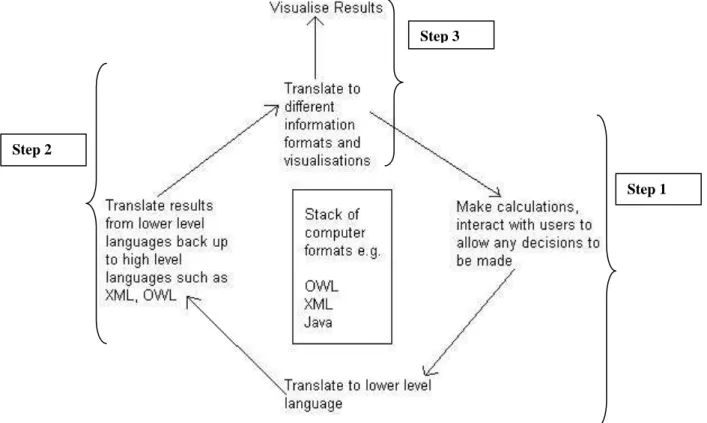
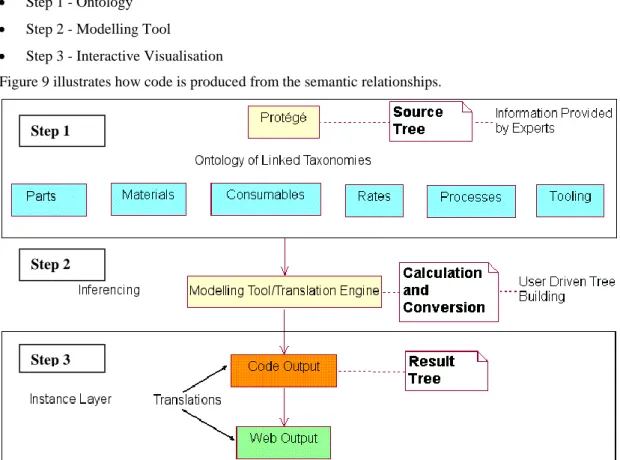
A stepped translation process consisting of Step 1 - Ontology/Taxonomy creation, Step 2 Translation and Modelling, Step 3 - Translation and Visualisation (there is some overlap e.g. modelling is possible at all stages).
Use of open standards to represent information in a format available to the maximum range of maintainers without being dependent on the computer system or software they use.
Ensuring that the structure of the modelling/programming system and all its related information is visualised clearly.
Minimising the amount of code necessary to create a model, and structuring the model so that all connections can be seen.
Extensibility
Extensibility will also be improved by the above means; this enables understanding of a model and so allows for easier re-use. Enoksson (2006) explains the advantages for extensibility of an open standard language, he used RDF for Conceptual Browsing on the Semantic Web. A clear structure and visualisation can be edited with fewer worries about unintended consequences (side effects). This is to be achieved by enabling model builders and users to modify the ontology, and to provide and use translation/modelling capability, and visualisation. This is the three-step translation process developed for User Driven Programming/Modelling. A person could make changes to whichever step is most appropriate depending on the task they are
performing and their interests and preferences. McGuinness (2003) observes the importance of extensibility, “Extensibility. It will be impossible to anticipate all of the needs an application will have. Thus, it is important to use an environment that can adapt along with the needs of the users and the projects.”
Ease of Use
Maximising accessibility is important to ease of use and vice versa, use of open standards helps achieve this, together with enabling models to run on software and systems that people are widely
Ease of use enables interaction with models that is essential for understanding and trust of the models, which in turn enables sharing of information.
Clear structuring and visualisation of information also assists in making a modelling system easier to use.
Sharing of Information
Maintenance, extensibility and ease of use are the key drivers for sharing of information. Achievement of the objectives in these areas would enable collaboration. Ontologies are used as a way of representing explicit and implicit knowledge. This is visualised as a taxonomy type view of the ontology information. Lack of sharing of information and of the collaboration that this makes possible increases cost. For engineering and many other types of modelling, sharing of information is necessary for enabling of jointly accepted accountable models that demonstrate the cost and value, verification, and validation of processes.
1.4.2 Methodology for Achievement of Objectives
Achievement of the above objectives can make possible creation of manageable, maintainable, and flexible models. To enable these objectives, a diagrammatic representation of models will be used as well as the taxonomy based visualisation. This will make it possible for engineers to use an interface that many of them are familiar with.
Translation
Translation capabilities will be provided to enable better communication between computer systems, and between humans and computer systems. This will allow visualisation of chains of equations, which are common in cost modelling. This visualisation will make it easier for people to add and manage information in large models, and identify cost information. A cost modelling example will be used throughout the thesis, but this work is relevant to modelling in general. To model complex problems a structured approach is needed for representing explicit and implicit knowledge. A translation will be provided in 3 steps :-
Step 1 - Ontology Step 2 - Modelling Tool
Step 3 - Interactive Visualisation
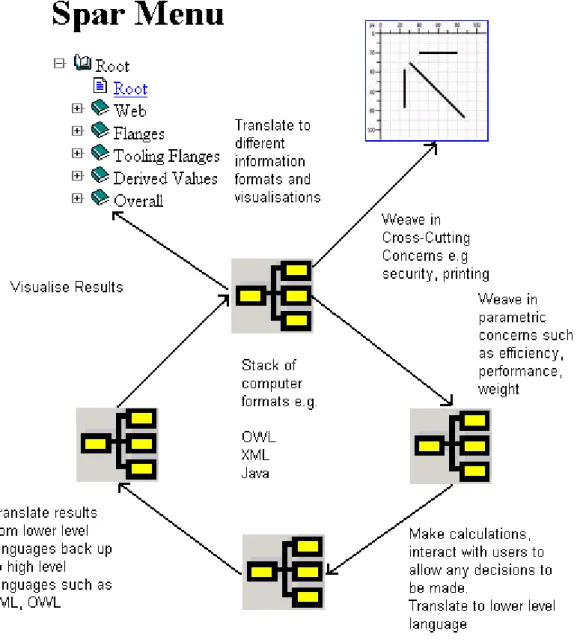
Step 3 visualises the results and allows interaction with the information to establish the meaning of the results. The translation is based on Semantic Web standards to enable widespread applicability and help ensure this is a generic solution. The visualisation and interactions can be tree/graph based, spreadsheet type, and CAD style as necessary. A further alternative is translation to programming or Meta-programming languages so the information can be re-used by developers who are creating systems with these languages.
interacts with the user to establish what information is required, how it should be processed, what
calculations should be made, and how it should be displayed, e.g. as a diagram or taxonomy. A methodology that involves structuring of information through Ontology and Semantic Web techniques and enabling end-user programming through visualisation and interaction aims to achieve effective production of generic models. The research has been applied mainly to aerospace cost modelling.
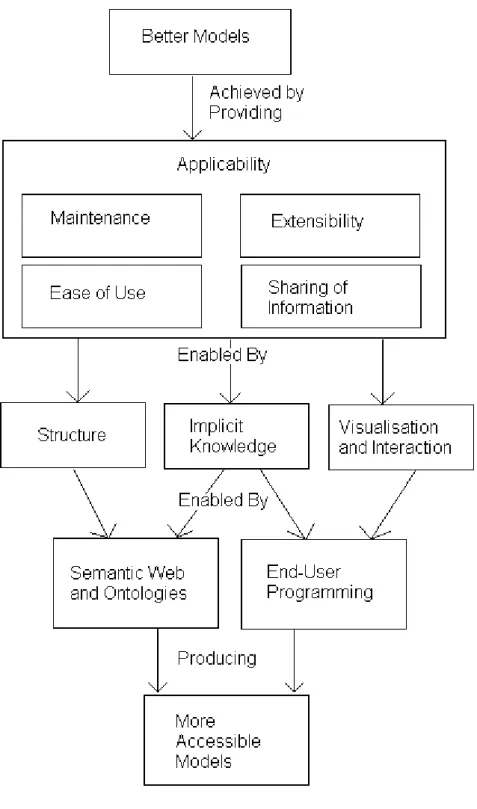
The diagram below (Figure 2) illustrates how production of better and more adaptable and applicable models is to be enabled by meeting the objectives of enabling better Maintenance, Extensibility, Ease of Use, and Sharing of Information. These objectives will be enabled by better structuring and better visualisation; this requires work on structuring knowledge using Semantic Web and Ontologies, and enabling better
visualisation through end-user programming techniques. This structuring and visualisation makes the models more accessible, and so easier to edit, reuse, adapt and maintain.
Figure 2. How Objectives and Methodology will aid better modelling
Semantic Web and Ontologies, and End-User Programming are realisation of the Knowledge Management enabled and supported by Visualisation and Interaction. Visualisation, Modelling, Translation and
Management via an umbrella process/system and activities is a means for achieving the enabling process for the objective of enabling production of better, accessible, adaptable models.
Programming/Modelling to achieve better and more accessible models. The thesis examines how a system for model creation could be developed and by whom, and assumes the system developer and user categories outlined below. A more detailed explanation of this methodology is provided in chapter 4.
1.5 Target Users
The methodology to achieve the objectives of Maintenance, Extensibility, Ease of Use, and Sharing of Information needs to be adapted to the way people work, with steps matched to people, skills, and roles. Ideally and as a long term aim it would be good to enable all users to interact with all parts of the program. However, organisations have hierarchies, employees have specialisms and for engineering the main argument to support this research is that of importance of this research for management of complex engineering projects rather than as better modelling, and user involvement being an end in itself.
Although a simplification of reality separating out the types of users into three basic types allows enough differentiation to provide a way forward for research and implementation of the methodology. Separating out the three main categories of user assists with matching the users to the tools and technologies they use, and supporting the overall knowledge transfer with a three step translation process. This would provide an infrastructure to enable collaboration. The actual follow up of analysing the collaboration then made possible is not covered in this thesis, which concentrates on the supporting structures and process.
1.5.1 System Creator
The system developer role is represented by people who would use the system advocated in this research in order to develop a domain specific system to create models. For the implementation in this thesis the author takes on the roles of a researcher who develops the capability for the ‘System Creator’, then represents the ‘System Creator’ who creates a modelling capability for a specific modelling problem. Then the author takes on the second role of a ‘Model Builder’ who uses the implementation to solve an aircraft wing related modelling problem. Also, some parts of the implementation were used by Airbus and Rolls-Royce employees both as System Creators, and Model Builders and Users.
This research is mainly aimed towards engineers who develop using spreadsheets, and for spreadsheets there are two main types of users. These types are :-
1.5.2 Model Builders
Model Builders are those who build and adjust equations (formulae) in spreadsheets and tend to protect their spreadsheet against unintended overwriting of cell values.
1.5.2 Model Users
Although there are grey areas between these three categories, it is intended that the thesis uses only these categories in order to simplify the problem of access control and model protection, and engineers would be familiar with this division. A more complex strategy for user rights and management will be left for future work, and in any case such strategies have been applied to work implemented in relation to this thesis by Airbus and Rolls-Royce.
Model Builders - Characteristics
Model builders will create or edit the semantic representation of the model in an ontology editor in order to create models. Model builders do not need knowledge of a programming language, but do need training in how to use the ontology interface to create a model. Also research will be undertaken into making ontology editing easier and more accessible. The system to be created needs to cater for different types of modellers. Expert modellers aim to build models, whereas novice modellers are more inclined to search for a specific numerical answer (Willemain and Powell, 2006). A problem mentioned by Willemain and Powell is that novice modellers often have little or no training in modelling. “Little is known about how they go about their tasks and whether they succeed.” So it is important to make technologies accessible for modellers, and to enable models to be shared and navigated, so that expert modellers can assist novices to create better models.
Model Users - Characteristics
Model users use the models created by model builders to make decisions based on their domain knowledge. This type of user manipulates the tree/graph representation to obtain a result based on the input values they know, or otherwise based on default values. They will use a model to evaluate a problem in order to help in decision making. Ernst et al. (2003) use a similar categorisation, they call model builders ‘modelers’, and models users ‘end-users’. Leaver (2008) uses categories of ‘Application Definer’, ‘RDF Querier’ and ‘Information Editor’ that are equivalent to categories of System developer, Model Builder, and Model User respectively.
1.6 Thesis Structure
In this introduction the aims and objectives were discussed and the theory and methodology introduced.
Chapter 2 - ‘Literature Review’ examines the research that was the main influence on this thesis. The areas investigated are 'Structure and Implicit Knowledge', 'Ontologies for Modelling and Simulation', 'Semantic Web and Ontologies', 'Interaction for Modelling with Ontologies', 'Visualisation and Interaction', 'Model-Driven Programming for Better Model Production', 'Accessibility of Models', 'Translation Steps', 'Better Models'. The main influences on the research are Ontology and Semantic Web research, End-User Programming, Modelling, and Model-Driven Programming. These areas were heavily investigated, as in order to enable the User Driven Programming/Modelling (UDM/P) approach it is necessary to improve accessibility of modelling to enable better model production in order to aid translation from implicit human knowledge into computer models. The means for this is improved user interaction, via visualisation of the structured representation of all relevant information. This is an adaptation of end-user programming towards
this research is adapted to enable use and development of software tools to provide the structuring and translation of information in a way appropriate for visualisation to and interaction with users, collaboration, and modelling.
Chapter 3 - ‘User Driven Programming/Modelling (UDM/P) Theory’ examines the theory behind bringing together the research areas explained in chapter 2. Chapter 3 also examines the problem to be solved to enable UDM/P, and explains how Ontology and Semantic Web research can provide the infrastructure for a system to enable Modelling using End-User Programming techniques and translation influenced by Model-Driven Programming. Without Visualisation and Interaction research the UDM/P approach would not be practical, as the approach depends on user interaction and collaboration with the Ontology and Modelling system. Therefore the Ontologies, Modelling, and Visualisation and Interaction research examined in chapter 2 ‘Literature Review’ is necessary for UDM/P combined with research into Human to Computer translation to aid end-user programming. Empowering end-users to model and program, combined with the translation process then enables collaboration via improved Human to Human, and Human to Computer translation. The Position of software tools investigated, within a table, is analysed, to develop a way of combining tools for the User Driven Modelling/Programming (UDM/P) approach. This is examined in Table 2. Language and Tool Mapping and developed further in Table 3. Language and Tool Mapping - Further Development. The layered architecture achieved by a planned use and matching of software tools from Table 3 then aids in the research design and methodology to be outlined in chapter 4, by aiding interoperability to aid translation via open standards. Interoperability makes possible Computer to Computer translation, and translation from human to computer and vice versa through translation between layered open standard software tools. Those software tools nearer the human level of representation act as part of the translation process between humans and the lower layer computer systems/software. Thus structure of representations to enable translation, collaboration and improved interaction to increase end-user involvement in ontology and model
development, and so to provide a human to computer interface, is all researched ready for planning of the research design and methodology outlined in Chapter 4.
Chapter 4 - ‘Research Design: Methodology’ examines the design and methodology for a mechanism to apply this combined research explained in chapters 2 and 3. The research design and methodology involves creation of a system to demonstrate implementation prototypes that follow the theory, design and
methodology so far explained. This is the means for improving Maintenance, Extensibility, Ease of Use, Sharing of Information, by combining the best aspects of existing research and applying it to improve these factors and so enable User Driven Modelling/Programming (UDM/P). This combination is illustrated by the development of tools created from such research in the areas of Modelling, Spreadsheets, Ontology, and Semantic Web/Web 2.0. This is illustrated with a diagram that shows UDM/P in the middle as a way of combining the advantages of each technology. This is the important area of overlap explored through chapter 4. This overlapping of this research design and methodology leads directly from the research overlap between End-User Programming, Modelling, and Semantic Web. Each of the areas of technology - Modelling, Spreadsheets, Ontology, and Semantic Web/Web 2.0 are examined in detail. This is applied to diagrammatic
of the translation process, which is aligned to a 3 step process of Step 1 Ontology, Step 2 Modelling, and Step 3 Visualisation. This 3 step process translates the source tree created as a diagram into a result tree and/or CAD style diagram according to what is most suitable to the user. This research design and methodology enables the implementation and prototyping outlined in Chapters 5 and 6.
The prototypes were created in two stages and stage each has a chapter to explain them. Chapter 5 - ‘Development: Early Prototypes’ examines the first stage of early prototyping to test ideas developed from the literature review and research design and methodology. This examination is in order to understand how to bring the research strands together, and implement them. In this chapter, the work conducted for the ACCS Aerospace Composite Costing System that is relevant to this thesis is examined. For the ACCS project an approach is taken of adapting and extending spreadsheet capabilities towards in depth cost modelling. This approach is not sufficiently generic for this thesis, so within chapter 5 more collaborative spreadsheet type tools are created and implemented as prototypes. This is still not sufficient for the requirement of enabling end-user modelling as it is necessary to provide user interaction direct with the ontology and model, by visualising the tree structure. This issue is examined in section 5.5. Section 5.6 outlines outstanding issues where further work is needed towards an improved implementation. Section 5.7 makes recommendations that need to be followed for the chapter 6 improved implementations. These recommendations are for tools and techniques that improve structuring, user interaction with and visualisation of the model structure.
The final prototype is developed later and is explained in chapter 6 - ‘Development: Final Prototype Implementation’. This brings together the various elements of Ontology and Semantic Web infrastructure, translation, modelling and End-User Programming into a single system. Chapter 6 also demonstrates prototype examples of increasing complexity, of representing a rectangle, cost modelling of a manufactured cube, and cost modelling of an aircraft wing spar. These implementations are demonstrated in the context of the 3 step translation process, of Step 1 Ontology, Step 2 Modelling, and Step 3 Visualisation; and the overlapping areas of technology - Modelling, Spreadsheets, Ontology, and Semantic Web/Web 2.0. Survey results are then displayed and an analysis and reflection undertaken to prepare for the Chapter 7 Discussion and Chapter 8 Conclusions.
The way in which the final prototype examined the research question explained in the introduction is discussed in Chapter 7 - ‘Discussion’. Chapter 7 examines how the prototype tested the design and implementation that was to meet the research question of ‘To what extent is it possible to improve user-driven collaborative software development through interaction with diagrams and without requiring users to learn particular computer languages?’Chapter 7 examines how bringing together the research areas and combining them in a single implementation simplifies the problem analysed and makes it solvable. This examination prepares for the Chapter 8 Conclusion on the extent to which the research assists with the aims of improving Maintenance, Extensibility, Ease of Use, and Sharing of Information, as the step towards making diagrammatic User Driven Modelling/Programming (UDM/P) practical.
Chapter 8 - ‘Conclusion and Further Research’ examines the extent to which this research met aims of improving Maintenance, Extensibility, Ease of Use, and Sharing of Information. Meeting of these objectives
enabling diagrammatic programming. Different options are examined for enabling this diagrammatic
programming, based on the research undertaken, and uses to which the research can be developed. Modelling areas and types and the use of the 3 step process are analysed in partnership with examination of the roles of users of the modelling tools to show who could model in what way. The analysis is made of how this assists with Maintenance, Extensibility, Ease of Use, and Sharing of Information. The conclusion is reached that for the research hypothesis of ‘to what extent was it possible to improve user-driven collaborative software development through interaction with diagrams and without requiring users to learn particular computer languages?’, this is possible for tree based modelling (common for engineering cost and process modelling) given the right tools and techniques as evaluated in this thesis. This concluding chapter also includes future work needed in order to fully meet the aim of improving collaborative software development through interaction with diagrams without requiring people to learn computer languages.
Chapter 2 Literature Review
2.1 Introduction
The main areas researched were ‘Structure and Implicit Knowledge’, ‘Interaction for Modelling with Ontologies’, ‘Visualisation and Interaction’, ‘Model-Driven Programming for Better Model Production’, and ‘Accessibility of Models’. These research areas were investigated in order to provide the knowledge needed for researching and development of the User Driven Modelling/Programming system explained in chapter 1.
2.2 Past Research of others and how this affects present modelling
problems
The main areas researched were ‘Structure and Implicit Knowledge’ targeted towards ‘Semantic Web and Ontologies’, ‘Interaction for Modelling with Ontologies’, ‘Visualisation and Interaction’, ‘Model-Driven Programming for Better Model Production’, and ‘Accessibility of Models’. Tthe method for choosing these research areas was examination of the history of end-user programming, and relevant references were tracked down for the period since typing of code became possible to the present day, to establish where the gap was that needed to be researched to make diagrammatic end-user programming practical.These research areas were chosen as they were all necessary for the translation process from human based diagrammatic
representations to computer models and code. These research areas were investigated in order to provide the knowledge needed for researching and development of the User Driven Modelling/Programming system explained in chapter 1.
Investigation of ‘Model-Driven Programming for Better Model Production, and ‘Accessibility of Models’ was the beginning of the design process for a system based on the research included in this chapter, in order to improve translation between person and software. This translation is to assist with providing better models.
Within each of the above subject areas the problems of enabling people to interact with models of their domain problems were researched. This was in order to provide the knowledge needed for research and development of the system explained in subsequent chapters. The literature review made it possible to investigate how to combine different research and technologies to create a modelling system for end-users.
2.3 Structure and Implicit Knowledge
2.3.1 Ontologies for Modelling and Simulation
The infrastructure of the research for this thesis is an ontology that can be visualised and edited in structured form. This ontology development is step 1 of a translation process that generates a modelling system and visualisation.
The literature review supported research for this thesis that will look to investigate a range of ontology representations as necessary in order to know when a simple representation will be sufficient and when it is necessary to move towards a more formal and machine readable representation, to ensure the modelling approach works. From the literature review it was found that the degree of formality employed in capturing ontology information can be quite variable, ranging from natural language to logical formalisms to facilitate machine understanding. This ontology research links with research into the Semantic Web for interoperable representation of information within each stage of translation.
Author(s) Title Comments
Gruber, T. R., 1993b
Toward Principles for the Design of Ontologies Used for Knowledge Sharing
Introduction Context and Audience
Formal Ontology in conceptual Analysis and Knowledge Representation. Kluwer Academic Publishers. Issues
Definition and explanation of Ontologies, and explanation of how they can be used, and case study. Gruber (1993b, 1) defines an ontology, “An ontology is an explicit specification of a conceptualization. The term is borrowed from philosophy, where an Ontology is a systematic account of existence. For AI systems, what ‘exists’ is that which can be represented.” Gruber goes on to explain design criteria for ontologies. Gruber explains software agents which can be a way of accessing and using ontology knowledge.
Methods
Gruber defines ontologies and explains their design and use. Gruber examines how agreement could be achieved for ontology terms, and using an engineering case study examines how useful an ontology would be to engineers, and others who often make use of equations and values with standard units.
Outcomes
This is a useful definition and explanation of ontologies and how to apply them to engineering, the explanation of how to use equations in an ontology is important as equations defined in an ontology can make possible an ontology based modelling system. This system would be generic if agreement could be reached on how to define equations.
Uschold, M., 2003
Uschold, M., 2006
Where are the semantics in the semantic web?
Ontologies Ontologies Everywhere - but Who Knows What to Think?
Introduction Context and Audience
9th Intl. Protégé Conference - July 23-26, 2006.
This paper is especially relevant to those who manage information and modelling systems in industry. Issues
Uschold (2003) and (2006) outline a knowledge representation continuum of :-
“Implicit - Informal (explicit) - Formal (for humans) - Formal (for machines)”
Uschold (2003) and (2006) show a diagram of this continuum and include on it various things ranging from informal such as glossary, thesauri, through such things as schemas and UML to formal logic. Uschold (2003) explains that though the word Semantics actually means ‘meaning’ there is no clear definition of the term “Semantic Web”, instead Uschold defines Semantic Web related technologies and ideas using examples. Uschold (2003) concludes that there is “consensus that the key defining feature is machine usable Web content.”
Methods
Uschold (2006) states that “there is nothing inherently good about being further along the semantic continuum. In some cases there will be advantages; in other cases there will not. What is good is what works.” Though Uschold (2003) argues that evolution along this continuum will happen over time, as the relevant technology advances; (section 3.6 - ‘Ontologies and Semantic Web and their role in Modelling’). His main point in both papers is to have in mind what the Semantics are to be used for and how they are to be used. More machine readability, and a reduction in ambiguity can be worth the extra effort if the project is sufficiently important and long term, because the advantages are “more robust, correctly functioning and easy to maintain” applications, Uschold (2003).
Outcomes
This research explains and demonstrates the ideas behind an ontology based translation between humans and computers to aid modelling/programming.
Horrocks, I., 2002
DAML+OIL: a Reason-able Web Ontology Language.
Introduction Context and Audience
Proceedings of the Eighth Conference on Extending Database Technology (EDBT 2002).
This is a more theoretical paper than that of Uschold above. Issues
Horrocks explains, “An ontology typically consists of a hierarchical description of important concepts in a domain, along with descriptions of the properties of each concept.” He also discusses ontology languages and their role in assisting with interoperability.
Methods
Horrocks argues the advantages of moving towards a more formal ontology. This is in contrast to Uschold’s argument of only moving to more formal ontologies as necessary, however, this is merely a difference of emphasis as Horrocks argues for their theoretical importance, while Uschold is examining practical difficulties of finding and managing information for formal ontologies. Horrocks examines ontology languages such as RDF, RDF(S) (RDF Schema), and DAML+OIL, which provide languages for the layers ‘RDF + rdfschema’, and ‘Ontology vocabulary’ in Berners-Lees’ diagram shown in section 2.3.2 Figure 3 of this thesis. Horrocks et al. (2003) and Miller and Baramidze (2005) explain other ontology languages OWL (Web Ontology Language) and SWRL (Semantic Web Rule Language).
languages. This illustrates the linked nature of Ontology and Semantic Web research. Horrocks also examines the use of meta-data annotations and how they can make resources accessible to agents. Agents are another important aspect of Ontologies and the Semantic Web. Such research is the basis for provision of an ontology infrastructure for a visual rule and equation editor for modelling/programming. For this thesis RDF, RDF(S), DAML+OIL and OWL have all been used as structured ways to represent information.
Huber, G. P., 2001
Transfer of knowledge in knowledge management systems: unexplored issues and suggested studies
Introduction Context and Audience
Written for ‘European Journal of Information Systems’. Issues
Huber examines the issues in ensuring people transfer their knowledge and suggests the organisation’s culture is important in peoples’ resistance to this.
Methods
Analysis and Surveys.
Outcomes
This resistance can be a further reason why employees often prefer putting their knowledge into spreadsheets under their own control, rather than into a shared knowledge base.
2.3.2 Semantic Web and Ontologies
Author(s) Title Comments
Berners-Lee, T., Fischetti, M., 1999
Weaving the Web Introduction Context and Audience
The book covers early years of Semantic Web creation - Harper San Francisco; Paperback. Issues
Berners-Lee and Fischetti sum up the advantage of a Semantic Web program over programs in other languages. They write, “The advantage of putting the rules in RDF is that in doing so, all the reasoning is exposed, whereas a program is a black box: you don’t see what happens inside it.” The Semantic Web makes use of tree and graph relationships to relate information and people. This relating of information is explained as a ‘web’, and Berners-Lee and Fischetti, 1999 explain that the term ‘web’ is used by mathematics to denote a collection of nodes and links in which any node can be linked to any other node.
Methods
Berners-Lee and Fischetti also argue for collaborative interactivity, which they call ‘Intercreativity’. They explain, “the world can be seen as only connections, nothing else. We think of a dictionary as the repository of meaning, but it defines words only in terms of other words. A piece of information is really defined only by what it’s related to and how it’s related.” … “There is really little else to meaning. The structure is
everything.” Berners-Lee and Fischetti make the point that it is not the power of the language that is important in providing this intercreativity. The simplicity of a language such as RDF makes it easier to provide interconnected solutions to complex problems, without becoming bogged down with the complexity
of the language itself, and interoperability problems.
Outcomes
So connectivity and structure are the crucial factors, enabling users to create and follow the information connections that are required for solving a problem and specify this to the computer. Berners-Lee and Fischetti also discuss the use of Semantic Web languages as programming languages and explain the benefits, declaring “The Semantic Web, like the Web already, will make many things previously impossible just obvious. Visual Semantic Web programming is one of those obvious things.”
An illustration of collaborative interactivity, connectivity and structure, and use of information connections for visual Semantic Web programming is Yahoo Pipes. This is discussed in section 3.3.
McGuinness, D. L., 2003.
Berners-Lee, T., 2000.
Chapter - Ontologies Come of Age.
Semantic Web on XML.
Introduction Context and Audience
McGuinness - In the book Spinning the Semantic Web: Bringing the World Wide Web to Its Full Potential. MIT Press.
Berners-Lee W3C talk http://www.w3.org/2000/Talks/1206-xml2k-tbl/slide1-0.html Issues
McGuinness (2003) provides a useful guide on how ontologies can assist in linking distributed data. This linking and connectivity is also explained by Uschold and Gruninger (2004). McGuinness cites a diagram by Berners-Lee (2000); this diagram is reproduced for this thesis in Figure 3 in this section. The concept illustrated, linked with that of ontologies contains representations of the place of each language in a stacked representation alongside the purpose of the language.
This layered architecture enables an approach to interoperable and collaborative programming using Semantic Web languages for the middle layers including the ontology. McGuinness considers the role of markup languages in defining content to be machine readable. McGuinness encourages creation of web-based visual representations of information to allow people to examine and agree on information structures. McGuinness outlines 7 ways simple ontologies may be used in practice. These are :-
1 controlled vocabulary.
2 site organization and navigation support.
3 expectation setting.
4 “umbrella” structures from which to extend content. 5 browsing support.
6 search support.
7 sense disambiguation support.
For this thesis ontologies were created for all of these purposes except 1 and 4, where ontologies of others were investigated.
McGuinness also explains that ontologies can assist with resolving the meaning and consistency of terms. This increased understanding can aid interoperability. For a simple ontology this assists the human reader, and more structured ontologies can also assist automated systems to resolve terms. This subject is explored in sections 3.6 - ‘Ontologies and Semantic Web and their role in Modelling’, and 4.7 - ‘Building a System for
Ontology and Semantic Web based Modelling’.
Outcomes
McGuinness (2003) also explains with the aid of a diagram the level of definition in ontologies, from purely human readable to machine readable (Figure 2 in McGuinness’ chapter ‘Ontologies Come of Age’). This is also explained by Uschold (2003), Uschold (2006) (discussed in 2.31) and Uschold and Gruninger (2004). McGuinness writes about how ease of use via conceptual modelling support and graphical browsing tools is essential if systems are to be usable in the mainstream. So this is an area to be investigated for this thesis. This argument is expanded on in 3.6 - ‘Ontologies and Semantic Web and their role in Modelling’ and 4.21 - ‘Improving and Building On End-User Interaction and Ease of Use’. McGuinness explains the need to examine and agree on information structures, using taxonomies/ontologies.
Berners-Lee et al., 2001
The Semantic Web Introduction Context and Audience
Scientific American article.
Issues
The Semantic Web was defined by Berners-Lee (2001) as “a web of data that can be processed directly or indirectly by machines”.
Methods
Berners-Lee et al. advocate an interdisciplinary open standard approach; this was later expanded to envisage a “Science of the Web”.
in a structured form where content is separated from formatting.
5 Berners-Lee et al., 2006
Creating a Science of the Web Introduction Context and Audience This was published in Science - 11 August 2006.
Issues
Berners-Lee et al. also explain, “The Web is an engineered space created through formally specified languages and protocols. However, because humans are the creators of Web pages and links between them, their
interactions form emergent patterns in the Web at a macroscopic scale.” Berners-Lee et al. argue the importance of visualisation for navigation of information :-
“Despite excitement about the Semantic Web, most of the world’s data are locked in large data stores and are not published as an open Web of inter-referring resources. As a result, the reuse of information has been limited. Substantial research challenges arise in changing this situation: how to effectively query an
unbounded Web of linked information repositories, how to align and map between different data models, and how to visualise and navigate the huge connected graph of information that results.”
This is discussed in relation to engineering modelling in section 3.5 - ‘Ontologies for Interoperability and Reuse of Models’.
Methods
This article advocates an interdisciplinary collaboration and systematic approach. Visualisation, navigation and interactivity can enable this.
The above are key questions for this thesis, where information has to be held and managed to enable modelling. The Semantic Web provides the infrastructure for distributed collaborative modelling, interaction and visualisation.
A diagram of Berners-Lee’s, and McGuinness’ layered architecture is shown above1 in Figure 3. Corcho et al. (2003, 55) show a similar stacked diagram of the middle layers of the above architecture focussing on ontology development. Carroll explained in a talk based on this technical report (Carroll and Turner, 2008) that for OWL, RDF(S) and RDF “Each layer does not break the previous layer”. This shows that for at least the middle layers of the above diagram translation is possible. This thesis mainly uses light ontologies as they can be represented in several layers whereas for a more structured ontology, information could be lost as it was translated down the layers. A more ambitious translation to and from all the layers, not just the middle ones would be future research, discussed in section 8.21.
For the hypothesis, investigation of Structure and Implicit Knowledge and breaking this down into Ontologies for Modelling and Simulation, and Interaction for Modelling with Ontologies, was
necessary to find ways of providing structure. Then this structure was needed for enabling end-users to diagrammatically enter the information needed by the ontologies for collaboration and for the models, via representation/translation of diagrams created by the end-users.
2.4 Interaction for Modelling with Ontologies
Ontologies can be made editable for maintenance and extension, and modelling tools based on ontologies can provide a structured system for building and editing of models. An ontology can store related information and calculations, any required calculations would then be made and translated to provide a model that can be interpreted by users. The research for this thesis is intended to solve the problems of translation from human to computer and vice versa. This is to be achieved by giving users more involvement in the translation process by letting them interactively model the problem
themselves until they are satisfied with the solution. This allows the user to establish “common ground” with the computer, an expression used by Johnson (2004). As well as translating between the user and computer systems it is important to provide translations between different computer systems. An objective of this thesis is to make progress towards providing a modelling and simulation environment over the web as a product of translation from an ontology.
Author(s) Title Comments
Miller and Baramidze , 2005
Simulation and the Semantic Web Introduction Context and Audience
Proceedings of the 2005 Winter Simulation Conference.
This paper describes the process of building ontology based simulation, and analyses how to achieve this.
Issues
Miller and Baramidze (2005) establish that for a “simulation study that includes model building, scenario creation, model execution, output analysis and saving/interpreting results. Ontologies can be useful during all of these phases.”
Methods
However, they also explain that building generic ontologies for modelling and simulation is hard, as this is not domain specific and there is need for rigorous definitions of mathematical concepts.
Outcomes
Miller and Baramidze advocate the use of interrelated ontologies rather than one monolithic ontology. For this thesis many related ontologies were used, divided based on commonly used engineering definitions and relationships.
Kim et al., 2002
A Two Stage Modeling and Simulation Process for Web-Based Modeling and Simulation.
Introduction Context and Audience
ACM Transactions on Modeling and Computer Simulation.
Issues
Kim et al. describe their approach to modelling and simulation and how a Web-based solution can be applied to distributed process planning.
Methods
They explain how techniques of generating executable code from documents specified in standardised XML (eXtensible Markup Language) can be used to create simulations.
Outcomes
This standards and web-based modelling/simulation approach is an important area of research for this thesis, as it combines modelling with use of XML, other Semantic Web and domain specific standards, and the web to provide accessible models. Section 3.5 - ‘Ontologies for Interoperability and Reuse of Models’ builds on such research.
Cheung et al., 2005
Ontological Approach for Organisational Knowledge Re-use in Product Developing Environments.
Introduction Context and Audience
This paper discusses user friendly ontology tools in an engineering context.
Issues
Cheung et al. explain that until recently ontologies have been predominately applied in the medical informatics field. Cheung et al. argue that “With the development of user-friendly ontology editing software and automatic data exchange functions, the application of ontological approaches to exchange information across the WWW is most likely to be an essential aspect of the next generation of global knowledge management tools.”
Methods
Cheung et al. demonstrate the importance of XML for interoperability and knowledge re-use.
Outcomes
This is a useful guide to visualising and editing ontologies for use by engineers, and this combined with interoperability via open standards languages helps to make modelling practical. Linking ontologies with modelling tools will also make ontologies useful in engineering and science, and mathematics, whenever calculations are required.
The research into Interaction for Modelling with Ontologies was necessary in order to find ways to ensure it would be possible for computer literate end users to diagrammatically interact with the ontologies/models in order to provide meaningful information for translation to programs/models that could make and feedback calculations.