as an Intermedium for Data-Driven and
HPSG-Based Parsing
Doctoral Dissertation by
Angelina Ivanova
Department of Informatics
Faculty of Mathematics and Natural Sciences
University of Oslo
Submitted for the degree of Philosophiae Doctor
November, 2015
$QJHOLQD,YDQRYD
Series of dissertations submitted to the
Faculty of Mathematics and Natural Sciences, University of Oslo No. 1690 ,661 $OOULJKWVUHVHUYHG1RSDUWRIWKLVSXEOLFDWLRQPD\EH UHSURGXFHGRUWUDQVPLWWHGLQDQ\IRUPRUE\DQ\PHDQVZLWKRXWSHUPLVVLRQ &RYHU+DQQH%DDGVJDDUG8WLJDUG 3ULQWSURGXFWLRQ-RKQ*ULHJ$6%HUJHQ 3URGXFHGLQFRRSHUDWLRQZLWK$NDGHPLND3XEOLVKLQJ 7KHWKHVLVLVSURGXFHGE\$NDGHPLND3XEOLVKLQJPHUHO\LQFRQQHFWLRQZLWKWKH WKHVLVGHIHQFH.LQGO\GLUHFWDOOLQTXLULHVUHJDUGLQJWKHWKHVLVWRWKHFRS\ULJKW KROGHURUWKHXQLWZKLFKJUDQWVWKHGRFWRUDWH
Bilexical dependencies capturing asymmetrical lexical relations between heads and depen-dents are viewed as a practical representation of syntax that is well-suited for computation and intelligible for human readers. In the present work we use dependency representations as a bridge between data-driven and grammar-based parsing, both for cross-framework parser com-parison and for parser integration.
We observe that the state of the art in dependency parsing for English is characterized by broad diversity of dependency representations and seek to systematize properties of various de-pendency formats pointing out their similarities and differences by carrying out qualitative and quantitative structural analysis and furthermore exploring learnability of four of these represen-tations in automatic syntactic analysis. In addition to comparing syntactic dependencies along several evaluation measures for parsing, we also evaluate the representations in application to the negation resolution task.
Using a dependency representation extracted from HPSG structures we contrast three dif-ferent approaches to parsing—data-driven dependency, phrase structure and a hybrid grammar-based—observe what trade-offs apply along accuracy, efficiency, coverage, and resilience to domain variation and show that explicit, hand-engineered grammatical knowledge helps in both accuracy and cross-domain parsing performance. We complement intrinsic parser evaluation with extrinsic comparison on the negation resolution and semantic dependency parsing tasks discovering that accuracy gains sometimes but not always translate into improved end-to-end performance.
A combination of complementary approaches is often a good strategy for achieving im-provement. We explore parser integration as a method for advancing the efficiency of a grammar-based parser. Bilexical dependencies serve as an interface for enforcing constraints drawn from the output of the statistical, data-driven systems on the unification-based processing of the grammar-based parser. We experiment with confidence thresholding, filtering and parser ensembles for tackling the problem of selecting high-quality dependencies and propose a tech-nique of static analysis as preliminary evaluation in navigating a large space of various combi-nation setups. We choose configurations optimizing for speed, coverage and balancing the two metrics and carefully evaluate the trade-offs along efficiency, coverage, accuracy and domain-resilience.
I would like to express my deep gratitude to my advisors, Lilja Øvrelid and Stephan Oepen, for their encouragement, advice and patience. It is a great pleasure to work with them, I appre-ciate their warm and caring attitude and admire their insight into the field, professionalism and knowledge. Thank you for numerous discussions, lots of proofreading, continuous guidance and making time for meetings and answering my emails even during the busiest times. I would like to express my gratitude to the members of my reading committee, Joakim Nivre, Jennifer Foster and Martin Giese, for careful reading of the present thesis.
A very special thank to Rebecca Dridan for being always helpful with all sorts of questions, for guidance in the universe of DELPH-IN tools, positive attitude, encouragement and proof-reading. Thanks for bringing up cheerfulness and humor in the daily office life, and reminding the group about opportunities of having a coffee or lunch in the sunshine whenever the sun was out.
I would like to warmly thank the former and present members of the Language Technology Group at the Department of Informatics at the University of Oslo, Jan Tore Lønning, Pierre Li-son, Elisabeth Lien, Gordana Ili´c Holen, Emanuele Lapponi, Arne Skjærholt, Milen Kouylekov, Gisle Ytrestøl, Erik Velldal, Jonathon Read, Murhaf Fares, Herman Ruge Jervell, Asbjørn Brændeland, Aleksander Øhrn, for a unique friendly and motivating environment. Thank you, Pierre, Arne, Eman, Milen, Gisle, for discussions on parsing and statistics and your help with all sorts of questions. Thank you, Elisabeth and Gordana, for your care and support.
I would like to acknowledge the support of the Norwegian Research Council. I am grateful to the Scientific Computing staff at the University of Oslo and the Norwegian Metacenter for Computational Science. Experimentation was made possible through access to the TITAN and ABEL high-performance computing facilities and the NorStore storage facilities at the Univer-sity of Oslo.
I am very grateful to Gertjan van Noord for his guidance of my exchange project, invaluable feedback and critical comments. I would like to thank former and present members of Alfa-informatica at the University of Groningen, John Nerbonne, Gosse Bouma, Johan Bos, Simon Šuster, Valerio Basile, Kilian Evang, Noortje Venhuizen, Harm Brouwer, Daniël de Kok, Malv-ina Nissim, Çagri Çöltekin, Leonie Bosveld, Gideon Kotzé, for making my stay in Groningen so memorable.
I owe a lot of thanks to Joakim Nivre for organizing my visit to his group at the Department of Linguistics and Philology at the Uppsala University on a very short notice. Special thanks to Jörg Tiedemann, Christian Hardmeier and Sara Stymne.
I also want to give a special thanks to Marco Kuhlmann, Bernd Bohnet, André Martins, Ryan McDonald, Richard Eckart de Castilho and Pedro Santos for helpful suggestions, and
advice related to parsing software.
I would like to thank participants of DELPH-IN community for motivation and inspiring discussions. I would particularly like to thank Dan Flickinger, Emily Bender, Yi Zhang, Rui Wang, Francis Bond and Ann Copestake for raising challenging questions and giving use-ful suggestions that helped to shape this thesis. Thanks to Petya Osenova, Antske Fokkens, Michael Goodman, Tim Baldwin, Tania Avgustinova, Montserrat Marimon, António Branco, Kiril Simov, Sanghoun Song, Lars Hellan, Zina Pozen, João Silva, Guy Emerson, Li Ling Tan and Ned Letcher for interaction and talks at DELPH-IN meetings and other conferences.
I would like to thank Tatiana, Maria, Thu, Le, Joachim, Jelke, Tina, Nathan, Amir, Bushra, Evgeny for their friendship and support. Thank you, Dima, for inspirational discussions about Python programming, statistics, natural language processing and sports. Thank you, Ke, for helping me to work out the details of a smoothing algorithm. I owe a lot of thanks to all my friends.
A very special thanks are dedicated to my parents for their love, help and eternal patience. I am very grateful to my in-law family for their kindness and the good times. And finally I would like to thank my dear husband for endless love, patience and positive outlook. You make me happy!
Abstract iii
Acknowledgements v
List of Figures xi
List of Tables xiii
1 Introduction 1 1.1 Research questions . . . 3 1.2 Contributions . . . 4 1.3 Thesis outline . . . 6 1.4 Publications . . . 8 2 Background 9 2.1 Syntactic theories . . . 9 2.1.1 Phrase-structure grammar . . . 9 2.1.2 Dependency grammar . . . 14
2.1.3 Head-Driven Phrase Structure Grammar . . . 18
2.2 Syntactic parsing . . . 23
2.2.1 Data-driven parsing . . . 24
2.2.2 Deep grammar parsing . . . 30
2.3 Parser combination . . . 39
2.4 Parser evaluation measures . . . 43
2.5 Linguistic resources . . . 47
2.6 Summary . . . 49
3 Syntactico-semantic dependencies 51 3.1 Why bilexical dependencies? . . . 51
3.2 Motivation . . . 52
3.3 Related work . . . 53
3.4 Conversion procedure . . . 55
3.4.1 Syntax: derivations to dependencies . . . 56
3.4.2 Semantics: logical form to dependencies . . . 58
3.4.3 Tokenization styles . . . 63
3.4.4 Output format . . . 64 vii
3.5 Contrasting analysis . . . 65
3.5.1 Variation in dependency representations . . . 65
3.5.2 Qualitative analysis . . . 70
3.5.3 Quantitative analysis . . . 78
3.6 Summary . . . 82
4 Contrasting parsing experiments 85 4.1 Related work . . . 85 4.2 Experimental setup . . . 90 4.3 Results . . . 96 4.4 Error analysis . . . 105 4.5 Extrinsic evaluation . . . 109 4.6 Summary . . . 112
5 Cross-framework parser evaluation 113 5.1 Motivation . . . 113
5.2 Related work . . . 114
5.3 Experimental setup . . . 116
5.4 In-domain parsing results . . . 121
5.5 Cross-domain parsing results . . . 122
5.6 Error analysis . . . 123
5.7 Sanity experiments . . . 132
5.8 Extrinsic evaluation on negation resolution task . . . 134
5.9 Extrinsic evaluation on semantic dependency parsing . . . 137
5.10 Reflections on the SDP 2014 results . . . 139
5.11 Summary . . . 140 6 Parser combination 143 6.1 Introduction . . . 143 6.2 Related work . . . 144 6.2.1 Efficiency . . . 144 6.2.2 Coverage . . . 145 6.2.3 Accuracy . . . 146
6.2.4 Parser combination for improved efficiency and accuracy . . . 147
6.3 Hypothesis testing . . . 148 6.4 Experimental setup . . . 150 6.5 Tuning . . . 155 6.5.1 Filtering parameters . . . 157 6.5.2 Confidence thresholding . . . 160 6.5.3 Ensembles of parsers . . . 167
6.6 In-domain parser integration experiments . . . 171
6.7 Cross-domain parser integration experiments . . . 174
7 Conclusion 181
7.1 Main conclusions . . . 181 7.2 Research questions revisited . . . 184 7.3 Future research . . . 185
2.1 Two syntactic analyses for the sentence “He saw a star with a telescope” . . . . 12
2.2 Constituency and dependency analysis of the sentence “Mike plays football” . 15 2.3 Levels of sentence representation and modules of the MTT (Kahane, 2003) . . 16
2.4 Projective dependency tree example from Nivre (2008) . . . 17
2.5 Non-projective dependency tree . . . 17
2.6 The type hierarchy from Sag et al. (2003) . . . 19
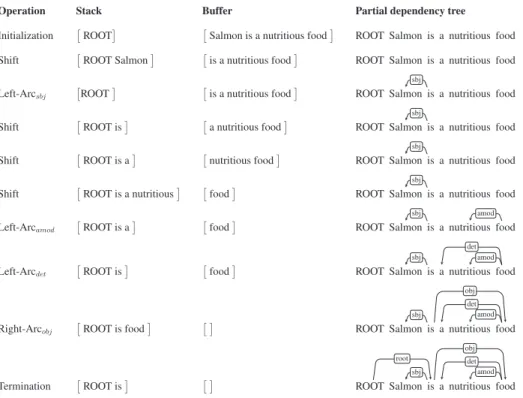
2.7 Syntactic analysis of the sentence “Salmon is a nutritious food” with the arc-eager algorithm . . . 26
2.8 Lexical entry “ahead of” in the ERG lexicon . . . 31
2.9 Derivation tree for the sentence “Every child probably has a funny toy”. . . 33
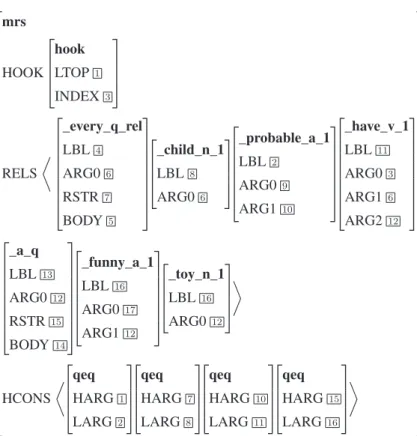
2.10 MRS for the sentence “Every child probably has a funny toy” . . . 35
2.11 MRS for the sentence “Every child probably has a funny toy” in feature struc-ture representation . . . 36
2.12 EDS for the sentence “Every child probably has a funny toy” . . . 37
2.13 Example of flat and extended analyses of the noun phrase “Air Force contract” from Vadas and Curran (2007) . . . 38
2.14 Packed forest with sub-node decompositions . . . 38
2.15 Crossing brackets . . . 43
3.1 Simplified lexical entry from Alpino grammar for a finite transitive verb taking a direct object (Malouf and van Noord, 2004) . . . 54
3.2 Dependency representations in DELPH-IN formats . . . 56
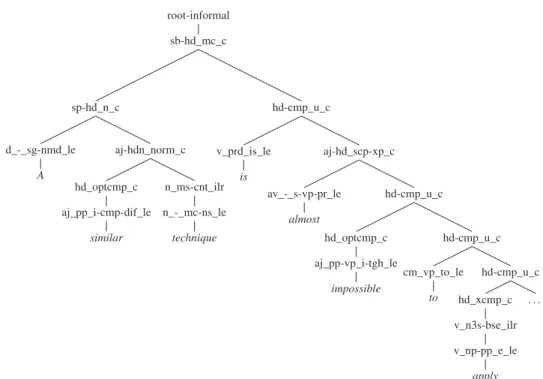
3.3 ERG syntactic derivation tree for the sentence “A similar technique is almost impossible to apply to other crops, such as cotton, soybeans and rice.” . . . 57
3.4 ERG Elementary Dependency Structure . . . 59
3.5 Excerpt from the ERG configuration file . . . 60
3.6 A WSJ sentence annotation using PTB-tokenization style . . . 64
3.7 Dependency representations in CoNLL, Stanford, Enju, Prague, and DELPH-IN formats . . . 66
5.1 Ambiguous token lattice . . . 118
5.2 Character ranges for the phrase “in the ’70" which is tokenized differently in parser output with respect to the gold standard . . . 119
5.3 Domain: WSJ. Distribution of dependency labels; precision of attachment of the most frequent dependency types . . . 124
5.4 Domain:CB. Distribution of dependency labels; precision of attachment of the most frequent dependency types . . . 124 5.5 Domain:SC. Distribution and precision of dependency; attachment of the most
frequent dependency labels . . . 124 5.6 Domain:VM. Distribution of dependency labels; precision of attachment of the
most frequent dependency types . . . 125 5.7 Domain:WS. Distribution of dependency labels; precision of attachment of the
most frequent dependency types . . . 125 5.8 Domain: WSJ. Dependency label precision relative to predicted dependency
length; label recall relative to gold dependency length . . . 126
5.9 Domain: CB. Dependency label precision relative to predicted dependency
length; label recall relative to gold dependency length . . . 126 5.10 Domain: SC. Dependency label precision relative to predicted dependency
length; label recall relative to gold dependency length . . . 127 5.11 Domain: VM. Dependency label precision relative to predicted dependency
length; label recall relative to gold dependency length . . . 127 5.12 Domain: WS. Dependency label precision relative to predicted dependency
length; label recall relative to gold dependency length . . . 127 5.13 Domain: WSJ. Distribution of PoS tags; accuracy of parsers for different PoS
tags . . . 129 5.14 Domain:CB. Distribution of PoS tags; accuracy of parsers for different PoS tags 129 5.15 Domain:SC. Distribution of PoS tags; accuracy of parsers for different PoS tags 129 5.16 Domain:VM. Distribution of PoS tags; accuracy of parsers for different PoS tags 130 5.17 Domain:WS. Distribution of PoS tags; accuracy of parsers for different PoS tags130 6.1 Precision versus annotation rate for B&N on the development set . . . 165 6.2 Tuning standard deviation and K of the KD-Fix algorithm on the development set166
2.1 Types of variables in MRS . . . 34
3.1 ERG configuration file that describes how many child nodes each grammar con-struction has and which daughter is the head . . . 58
3.2 Tokenization pipeline during parsing with PET (Dridan, 2013b) . . . 64
3.4 Summary of dependency formats . . . 71
3.9 Statistics of the DM, EP and PT dependency graphs . . . 82
4.8 Evaluation of automatic übertagging on the test set before conversion to PTB tokenization . . . 95
4.9 Performance of the English Stanford Tagger and TnT taggers on the develop-ment set . . . 95
4.10 Results of the automatic PTB PoS tagging and supertagging on the test set . . . 95
4.11 Parsing results of Malt on SB, CD, DT and PA w/o scoring punctuation . . . . 96
4.12 Parsing results of MST on SB, CD, DT and PA w/o scoring punctuation . . . . 97
4.13 Parsing results of B&N on SB, CD, DT and PA w/o scoring punctuation . . . . 98
4.14 Parsing results of Malt on SB, CD, DT and PA including punctuation in the scoring . . . 99
4.15 Parsing results of MST on SB, CD, DT and PA including punctuation in the scoring . . . 100
4.16 Parsing results of B&N on SB, CD, DT and PA including punctuation in the scoring . . . 101
4.17 Performance of Malt on the data annotated with PET-predicted supertags . . . . 102
4.18 Distribution of accuracy over PTB PoS tags when parsing with the Malt parser on the four dependency formats . . . 105
4.19 Precision and recall of the labeling and attachment of the outgoing arcs for the coordinating conjunction for the Malt parser on different dependency formats with PTB PoS tags . . . 106
4.20 Recall and precision of dependency relation and attachment for root when pars-ing with the Malt parser on the four dependency formats with PTB PoS tags . . 108
4.21 Conan Doyle corpus statistics (Morante and Blanco, 2012) . . . 110
4.22 Performance of the negation resolution system UiO2 (Lapponi et al., 2012b) using dependency features from the analyses of B&N with CD, SB and DT dependencies in contrast with previous work . . . 111
5.1 Sentence, token, and type counts for the DeepBank and Redwoods data sets . . 117 xiii
5.2 Parsing accuracy of B&N with three dependency schemes . . . 117
5.3 Tuning of B&N on section 20 of DeepBank . . . 120
5.4 Tagging accuracy,PARSEVAL F1, and dependency accuracy for the Berkeley parser on the development data . . . 121
5.5 In-domain parsing experiments . . . 121
5.6 Cross-domain parsing experiment . . . 123
5.9 Number of total and correctly analyzed with ERGa, Berkeley and B&N prepo-sitional complements for various lexical types of the head—adjunct, noun and verb—on theWSJdomain . . . 132
5.10 Number of total and correct analyses of prepositional complement structures . . 132
5.11 Coverage and dependency accuracies with PTB tokenization and either detailed or coarse lexical categories . . . 133
5.12 Dependency accuracies computed with the eval.pl software for PTB tokeniza-tion and coarse lexical categories . . . 134
5.13 Parse failures and token mismatches (‘gaps’), and tagging and dependency ac-curacy on the sub-set of the Conan Doyle development data . . . 135
5.14 PET coverage on Conan Doyle training, development and test sets . . . 135
5.15 Performance of the negation resolution system UiO2on thedevelopmentset using dependency features from the analyses of ERGa, ERGe and B&N with DT dependencies in contrast with the analyses of the Malt parser with SB de-pendencies from Lapponi et al. (2012b) . . . 136
5.16 Performance of the negation resolution system UiO2on thetestset using de-pendency features from the analyses of ERGa, ERGeand B&N with DT depen-dencies in contrast with the analyses of the Malt parser with SB dependepen-dencies from Lapponi et al. (2012b) . . . 136
5.17 SemEval 2014 open track results of the Priberam system on DM . . . 138
5.18 SemEval 2014 open track results of the Priberam system on PAS . . . 138
5.19 SemEval 2014 open track results of the Priberam system on PCEDT . . . 139
5.20 Labeled Dependencies Including TOP Nodes . . . 140
5.21 Unlabeled Dependencies Including TOP Nodes . . . 141
6.1 Sentence and token counts and average sentence length for data sets of Deep-Bank 1.1 and Redwoods prepared with ERG 1214 . . . 152
6.2 Tokenization pipeline during parsing with PET (Dridan, 2013b) . . . 154
6.3 Baseline and upper bound for parser combination on the development set . . . 155
6.4 Evaluation of individual parsers on the development set . . . 156
6.5 Results of parser combination without filtering on the development set . . . 157
6.6 Tuning filtering parameter length of dependency . . . 158
6.7 Filtering parameter part-of-speech tag of dependent . . . 159
6.8 Filtering dependencies that have frequency less than 300 and precision less than 70% . . . 160
6.9 Selecting only dependency types for which precision is minimum 80% . . . 161
6.10 Selecting only dependencies of 11 types . . . 161
6.12 Selecting only dependencies of 8 types . . . 162
6.13 Selecting only dependencies of 7 types . . . 162
6.14 Parser integration: Turbo and PET . . . 163
6.15 Correlation of per-dependency confidence scores of the B&N parser with cor-rectness of attachment and labeling . . . 164
6.16 Confidence thresholding with B&N . . . 165
6.17 Correlation of MST per-dependency confidence scores with correctness of at-tachment and labeling . . . 166
6.18 Confidence thresholding with MST . . . 167
6.19 Ensemble BMT, tuning . . . 168
6.20 Ensemble MMMT, tuning . . . 169
6.21 Ensemble BMMMT, tuning . . . 170
6.22 Evaluation of individual parsers on the test set . . . 171
6.23 In-domain parser combination experiments . . . 172
6.24 Evaluation of individual parsers onCB,VM,SCandWS. . . 174
6.25 Out-of-domain parser combination experiments onCB . . . 175
6.26 Out-of-domain parser combination experiments onVM . . . 176
6.27 Out-of-domain parser combination experiments onSC . . . 177
Introduction
Isn’t the language that ordinary people speak a wonderful thing that deserves to be studied in its own right?
— Martin Kay.A Life in Language
In the present work we focus on automatic syntactic analysis of natural language, called parsing, which assigns grammatical structures to an utterance. The main hypothesis motivat-ing the parsmotivat-ing task is that grammatical structure contributes to meanmotivat-ing. There is a historic distinction between data-driven and grammar-based parsing approaches where the data-driven methods learn from labeled data relying on statistical algorithms and the grammar-based meth-ods make parsing decisions with respect to an explicit, often hand-engineered system of syn-tactic knowledge usually with the aid of statistical means. The main hypothesis of data-driven parsing concerns the possibility for generalization about language using empirical data as a source of knowledge, and the most commonly exploited techniques employ machine learning algorithms that induce language models or grammars from annotated corpora. Grammar-based systems usually incorporate a hand-crafted grammar grounded in a linguistic theory and exploit statistical methods in a disambiguation module that selects the first-ranked analysis.
In the early days there was a strong tradition of grammar formalization in the field of compu-tational linguistics that flourished after the publication of the monographs of Noam Chomsky in the tradition of Transformational Grammar (Chomsky, 1957, 1965, 1995, inter alios). Present-day Combinatory Categorical Grammar (CCG) (Steedman, 2000), Tree Adjoining Grammar (TAG) (Joshi et al., 1975), Lexical-Functional Grammar (LFG) (Kaplan and Bresnan, 1982) and Head-driven Phrase Structure Grammar (HPSG) (Pollard and Sag, 1994) represent broadly used, theoretically well-motivated grammar formalisms originating from research initiatives from the period of 1950-1990s. A paradigm shift within the field of syntactic parsing began with automatic grammar induction as advances in technology and algorithms made it possi-ble to acquire grammatical rules from manually annotated data that could still be extracted and comprehended by an interested user. Thus the Charniak-Johnson (Charniak and John-son, 2005), Collins (Collins, 1999) and Berkeley (Petrov et al., 2006) parsers still make use of actual grammar rules, albeit often counting in the tens of thousands, based on principles of context-free grammar and training examples from a treebank. The next transition in the field has been to what we may call grammar-less parsing where explicit linguistic rules are not recon-structed during the training phase, with such prominent examples of purely data-driven parsers
as Malt (Nivre et al., 2007b) and MST (McDonald et al., 2005b). Following the predominance of research on statistical algorithms, the traditional grammar-oriented systems were modernized and augmented with various mechanisms for improved performance which currently makes the distinction between data-driven and grammar-based approaches less clear-cut today. At the moment there is an increasing interest in semantic processing which might require a shift of paradigm, possibly reviving the interest in a more theoretical study of language.
The common performance challenges attributed to parsing with hand-crafted grammars con-cern achieving a balance across efficiency (computational complexity and processing speed), robustness (ability of the parser to produce analysis for any given input) and accuracy (ade-quacy and correctness of analyses assigned by a parser). The issue of efficiency is related to building a complete parse forest for a sentence during parsing and the implementation of such an ambitious process would be computationally demanding and slow with any type of parsing. However thanks to numerous developments of the last decades parsing with broad-coverage hand-crafted grammars is currently operational and competitive. The issues with coverage are related to difficulties of parsing ungrammatical inputs due to strict restrictions in a hand-crafted lexicon and system of rules, and research of effective methods to reduce and close this gap has produced many fruitful results. In terms of accuracy, grammar-based parsing is capable of producing linguistically precise and sound analyses. A systematic comparison of the perfor-mance of state-of-the-art grammar-based and data-driven parsers is complicated by theoretical and structural differences in corresponding analyses, however is necessary for a better under-standing of how these frameworks currently relate to each other.
This thesis investigates various aspects of grammar-based and data-driven parsing paradigms using bilexical dependencies as the basis for comparison. The notion of bilexical dependency is central in dependency-based theories of syntax and has lately been widely adopted as a pars-ing representation in the field. The choice of bilexical dependencies as a basis for comparison in the current work is motivated by their expressivity to directly represent predicate-argument relations (such as subject and object), the existence of transformational rules from phrase struc-ture trees into dependency representations, the central position of the notion of the head in Head-driven Phrase Structure Grammar and practical usage of bilexical dependencies in vari-ous applications such as machine translation, sentiment analysis, text summarization, question answering and others. Historically there was no unique standard in dependency representation even for the English language and different research groups manufactured their own formats, such as Prague Dependency (Hajiˇc, 1998) with a long tradition rooted in Functional Generative Description (Sgall et al., 1986) and Stanford Dependencies (de Marneffe et al., 2006) inspired by Lexical-Functional Grammar (Kaplan and Bresnan, 1982). One question that remains open is to what degree the differences in various representations are contentful and significant in parsing, as well as for downstream applications.
Our working environment is the LinGO English Resource Grammar (ERG) (Flickinger, 2000) and the HPSG-based parser PET (Callmeier, 2000) which carries out the construction of a meaning representation in the form of Minimal Recursion Semantics (Copestake et al., 2005) in parallel with the derivation of a syntactic analysis according to the grammar. Experiments are carried out on resources annotated with the English Resource Grammar taken from a va-riety of different domains and genres, including the newspaper text of the Wall Street Journal (Flickinger et al., 2012), Wikipedia fragments (Ytrestøl et al., 2009), transcripts of spontaneous
speech (Oepen et al., 2004) and others. All these open source tools and resources are part of the international Deep Linguistic Processing with HPSG Initiative (DELPH-IN). Within the DELPH-IN partnership, the modeling of natural language in its complexity is grammar-centric, highly-lexicalized and aiming at high precision and broad coverage.
In the present work we seek to compare the performance of the grammar-based approach to purely statistical state-of-the-art frameworks and furthermore to improve the efficiency of the grammar-based parser by combining it with syntactic dependency parsers.
1.1
Research questions
In the present section we introduce several research questions addressed in this thesis. • Which abstract commonalities and differences can be identified among various
depen-dency representations?
Bilexical dependency representations have developed into a prevailing annotation format along-side the phrase structure representations that are more traditional in the study of English syntax. There are a number of studies aiming to contrast phrase structure and dependency representa-tions (Rambow and Joshi, 1994; Xia and Palmer, 2001; Klein and Manning, 2004; Gerdes and Kahane, 2011), however, to the best of our knowledge, there has been little work on differ-ences and commonalities of various dependency formats at the time when this PhD project was launched. We are therefore interested in examining a variety of dependency formats and deter-mining which differences in dependency representations are linguistically contentful or rather of a more technical or superficial nature.
• How and to what degree can the syntactic and semantic layers of HPSG be expressed in the form of bilexical dependencies?
The motivation for expressing HPSG analyses in dependency-style representations is to increase accessibility of the DELPH-IN resources and facilitate cross-framework parse evaluation. La-beled bilexical dependencies are useful for applications such as information extraction, machine translation, sentiment analysis and others. In addition, bilexical dependencies offer ease of readability for consumers of the representation which is an important property of user-centered design. The distinction between syntax and semantics is fundamental to the study of language, and in ERG syntactic information is encoded in a form of a derivation tree and semantics is expressed in the Minimal Recursion Semantics formalism (Copestake et al., 2005). Immediate applications of dependencies representing the syntactic and semantic levels of the ERG anal-ysis are statistical syntactic dependency parsing and statistical semantic dependency parsing, correspondingly.
• How does the choice of syntactic dependency annotation format affect the performance of dependency parsers and downstream applications?
The choice of dependency representation touches upon issues that are relevant for dependency parsing and downstream applications. Intrinsic evaluation characterizes parsing performance
mainly with respect to a pre-defined gold standard while extrinsic evaluation assesses the con-tribution of a syntactic analysis to a certain application. It can be helpful to understand how easy it is to automatically produce different dependency representations, which linguistic phenom-ena are particularly hard for automatic processing, whether differences in syntactic dependency representations have significant effects on parsing performance and practical tasks, and whether the results of intrinsic and extrinsic evaluation of dependency formats correlate.
• How does the performance of the HPSG parser relate to data-driven syntactic analyzers?
With a goal to contribute to our understanding of different approaches to parsing, we are in-terested in comparing representatives of three different parsing frameworks: phrase structure, dependency and HPSG parsers. The three considered approaches to parsing make different as-sumptions and produce different output structures which complicates the comparison between them.
• How can the performance of the HPSG parser be improved by reducing its search space with a native dependency parser?
The main challenge of parsing with broad-coverage precision grammars is achieving a good balance between efficiency, coverage and accuracy. When optimizing a grammar-based parser for one of these conflicting criteria it is important to account for negative effects in terms of the other two criteria, and for this reason such a study should convey a three-way trade-off evaluation. To address this research question one has to explore a large space of parser inte-gration setups and tackle the problem of choosing high-quality dependencies, and there is little pre-existing knowledge on relevant trade-offs for this particular parser combination problem.
1.2
Contributions
This project can be seen as an attempt to identify and combine the strengths of two paradigms of automatic syntactic analysis: parsing with a hand-crafted grammar grounded in linguistic theory developed over decades by professional linguists, and data-driven statistical parsing im-plementing modern machine learning algorithms for probabilistic modeling of language from annotated resources. To achieve this goal we extract a dependency backbone from HPSG struc-tures, train statistical dependency parsers on the resultant structures and restrict the search space of the grammar-based parser with the output of the dependency parsers. There are several in-dependent steps involved in this process and below we highlight the main contributions of the present work.
Dependency representations from the ERG analysis layers We develop a fully automated deterministic reduction procedure for transforming internal ERG structures to bilexical de-pendencies, introducing two novel DELPH-IN dependency schemes. Syntactic dede-pendencies, which we abbreviate DT, are derived directly from the ERG derivation tree, while for semantic dependencies, which we abbreviate DM, a two-step process is implemented for transformation from the native Minimal Recursion Semantics structures into bilexical dependency graphs.
We chose to avoid conversion to existing dependency formats as that involves heuristics and/or rules that modify native properties of the grammar. The use of these conversion heuristics would have introduced confusion in our comparison of the PET parser to data-driven analyzers by making it unclear whether the results of evaluation describe properties of the parser or the converter, and in this light the DT format can be seen as a tool for cross-framework comparison. Another reason why we restrained from conversion to an existing format is that at the start of this PhD project there was no consensus in the field about a syntactic dependency representation standard, something which later motivated the emergence of Universal Stanford Dependencies (de Marneffe et al., 2014) and Universal Dependencies (Nivre, 2015), an attempt to generalize the Stanford dependency format across languages and stimulate the establishment of a unified, cross-linguistic de facto standard.
With an opportunity to derive dependencies from the rich structures of the English Resource Grammar, semi-automatically annotated resources, such as Redwoods (Oepen et al., 2004) and WeScience (Ytrestøl et al., 2009), created within the DELPH-IN partnership become available for direct usage by a broader community in the field. In fact, our semantic dependency format DM has already found an application beyond the present project and was exploited in the Se-mEval shared tasks of 2014 and 2015 on broad-coverage semantic dependency parsing (Oepen et al., 2014, 2015).
Analysis of dependency representations We performed an in-depth analysis of structural differences and commonalities of a collection of different syntactic and semantic dependency representations, including our two novel DELPH-IN schemes deduced from the ERG. In a qual-itative analysis we examine the variations in choices of head and dependents, graph structure and connectivity and discover surprising disagreement among formats for some of the basic syntactic constructions. Quantitative analysis, on the other hand, is interesting for exploring overlap between formats by measuring similarity scores between various formats which pro-vides information about the possibility of interconversion. The syntactic dependency formats are compared on the tasks of dependency parsing and negation resolution. Important findings are that the choice between Stanford Basic (de Marneffe et al., 2006), CoNLL (Johansson and Nugues, 2007) and DT dependencies does not significantly influence parsing performance for state-of-the-art data-driven systems, and that the three schemes are comparable in terms of their utility to the downstream application of negation resolution.
Cross-framework parser comparison Since the structural differences between the three aforementioned representations do not strongly affect syntactic parsing, DT offers a legitimate candidate format for cross-framework parser comparison. In a set of experiments, we find that the grammar-based parser PET shows higher accuracy and better cross-domain resilience than the data-driven direct dependency B&N parser (Bohnet and Nivre, 2012) and PCFG Berkeley parser (Petrov et al., 2006). We carry out several control experiments to ensure that this result is not due to the choice of specific tokenization or part-of-speech tagging convention. The ef-ficiency of PET is similar to the efef-ficiency of B&N which has state-of-the-art accuracy but is slower than most of the other dependency parsers. Unlike dependency parsers, both PET and Berkeley have incomplete coverage although PET to a larger degree. The HPSG and depen-dency parsers are extrinsically compared on two tasks that use syntactic dependepen-dency features:
negation resolution and semantic dependency parsing. We find that negation resolution is not sensitive to the differences in parsing results, while the results of the second task are more accurate when employing the grammar-based parser.
Parser combination We investigate a range of parser combination setups for improved effi-ciency of HPSG-based parsing via a new interface incorporated in the English Resource Gram-mar version 1212. We explore several methods for selecting high-quality bilexical dependencies from the output of statistical dependency parsers: a) filtering by part-of-speech of dependent, dependency type and length of dependency span; b) thresholding per-dependency confidence values; c) training an ensemble of parsers with a voting approach. We propose “static” analysis as a method to evaluate the quality of selected dependencies before actual integration with the PET parser relying on precision and annotation rate metrics. On the test sets we discover that a domain-resilient balance across evaluation metrics is achieved when the PET parser is restricted with dependencies selected from the filtered output of parser ensembles with strict voting.
1.3
Thesis outline
This section provides a chapter-by-chapter guide of the dissertation. The thesis structure follows a coherent line of experimental research of the present PhD project.
Chapter 2: Background In this chapter we discuss three syntactic theories that play an im-portant role in contemporary parsing technology. Then we turn to specific parsing algorithms and software examples of constituency, dependency (transition-based and graph-based) and deep grammar parsers. Further we introduce some components of the DELPH-IN computa-tional framework such as the English Resource Grammar (Flickinger, 2000), Minimal Recur-sion Semantics (Copestake et al., 2005) and Elementary Dependency Structures (Oepen and Lønning, 2006). We review a number of approaches for parser combination and parser evalu-ation proposed in previous work and describe several linguistic resources that are used in the present work.
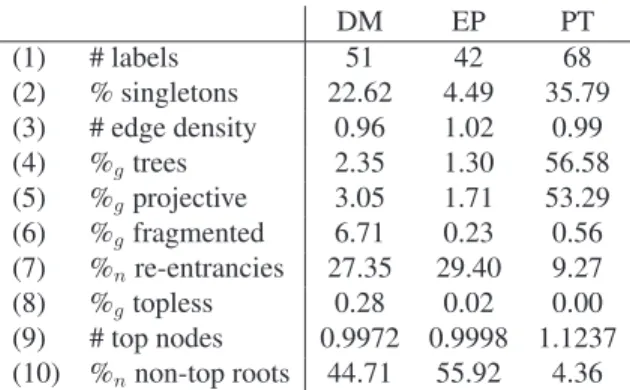
Chapter 3: Syntactico-semantic dependencies In this chapter we briefly discuss a usage of bilexical dependencies in such applications as machine translation, semantic search and on-tology learning and then motivate the decision to extract dependency representations from the English Resource Grammar. To begin with, we describe our own procedure of reducing the rich HPSG structures to syntactic and semantic dependency graphs, dubbed DT and DM corre-spondingly. We then carry out a contrasting analysis of nine syntactico-semantic dependency formats examining common linguistic phenomena and measuring the relatedness of the formats using Jaccard similarity and unlabeled F1 score.
Chapter 4: Contrasting parsing experiments Following the structural analysis of depen-dency representations, we investigate how the properties of syntactic dependencies influence parser results as previous work shows that dependency annotation format may have a signif-icant impact on the parser accuracy. We are contrasting parsing Stanford Basic (de Marneffe
et al., 2006), CoNLL (Johansson and Nugues, 2007), DT and Prague dependencies from the analytical layer of representation (Hajiˇc, 1998). The results are broken down by parser, de-pendency format, tag set, and in addition we evaluate the effects of including punctuation into scoring and the availability of more training data. In an error analysis we focus on accuracy of the most frequently occurring part-of-speech tags and we exemplify common problems in parsing coordination conjunctions and verbs. In an extrinsic evaluation of the dependency for-mats on a negation resolution task we get a range of performance differences across different evaluation metrics. An important conclusion of the chapter for the current project is that DT is a good candidate representation for parsing and applications relying on syntactic dependency parsing and that DT compares favorably to the Stanford Basic and CoNLL formats.
Chapter 5: Cross-framework parser evaluation Using DT as a representation for cross-framework parser comparison, we contrast data-driven dependency, statistical phrase struc-ture and HPSG-based parsing architecstruc-tures—B&N (Bohnet and Nivre, 2012), Berkeley (Petrov et al., 2006) and PET (Callmeier, 2000)—evaluating trade-offs in terms of accuracy, coverage and efficiency on in- and out-of-domain data. The grammar-based parser is available in two con-figurations: a standard setup optimized for accuracy and a setup optimized for efficiency from Dridan (2013a), with the latter one giving a speed-up of almost a factor of six and achieving parsing speed similar to the dependency parser of Bohnet and Nivre (2012). In our experiments, the grammar-based parser shows significantly higher accuracy and better resilience to domain variation than the two purely statistical systems, but it fails to achieve complete coverage. The error analysis investigates the accuracy of individual dependency types, dependency accuracy relative to dependency length, and distribution of labeled accuracy scores over different lexical categories.
The dependency and HPSG parsers are further compared in two applications that exploit rich syntactic features: negation resolution and semantic dependency parsing. According to the results of our experiments, the first task appears to be insensitive to the choice between HPSG-based and dependency parsers, at least in our setup. The results of the second task indicate that (a) the correlation of syntactic and semantic dependency schemes are important in semantic parsing (e.g. the results are best if syntactic and semantic annotation formats are derived from the same treebank) and (b) grammar-based parsers are very competitive with the purely statistical systems on the semantic annotation formats DM and Enju predicate-argument structures (Miyao and Tsujii, 2005).
Chapter 6: Parser combination The objective of this chapter is to investigate whether the efficiency of the grammar-based parser can be improved without significant loss of accuracy and coverage by its combination with dependency parsers. In the beginning of the chapter we review methods for improving efficiency, coverage and accuracy of HPSG parsing proposed in literature. Subsequently, we move on to discuss experiments on HPSG parsing with dependency constraints. In general, syntactic rules incompatible with enforced dependency relations fail in unification which leads to the reduced search space of the HPSG parser.
One of the main challenges is to select only high-quality dependency relations for integra-tion, and we use several filtering techniques, probability scores of individual parsers and voting in parser ensembles to tackle this problem. We present a series of experiments on the
develop-ment set aiming to choose the best potential configurations and further test the chosen combined setups on in- and out-of-domain sets. Combining parsing ensembles with an HPSG parser we obtain improved efficiency and good coverage without loss of accuracy.
Chapter 7: Concluding remarks The final chapter summarizes the main results of the project, describes some possible refinements and extensions of the presented approaches and outlines directions for the future work experimentation.
1.4
Publications
Parts of this dissertation are based on the following publications. Footnotes at the beginning of the chapters point out which publications are relevant for the respective chapter.
Angelina Ivanova, Stephan Oepen, Lilja Øvrelid, and Dan Flickinger. Who Did What to Whom? A Contrastive Study of Syntacto-Semantic Dependencies. InProceedings of the ACL 2012 Sixth Linguistic Annotation Workshop. Jeju, South Korea, 2012.
Angelina Ivanova, Stephan Oepen and Lilja Øvrelid. Survey on parsing three dependency rep-resentations for English. InProceedings of the 51st Annual Meeting of the Association for Computational Linguistics Proceedings of the Student Research Workshop. Sofia, Bulgaria, 2013.
Angelina Ivanova, Stephan Oepen, Rebecca Dridan, Dan Flickinger and Lilja Øvrelid. On Dif-ferent Approaches to Syntactic Analysis Into Bi-Lexical Dependencies An Empirical Compari-son of Direct, PCFG-Based, and HPSG-Based Parsers. InProceedings of the 13th International Conference on Parsing Technologies (IWPT). Nara, Japan, 2013.
Stephan Oepen, Marco Kuhlmann, Yusuke Miyao, Daniel Zeman, Dan Flickinger, Jan Hajiˇc, Angelina Ivanova and Yi Zhang. SemEval 2014 Task 8: Broad-Coverage Semantic Dependency Parsing. InProceedings of the 8th International Workshop on Semantic Evaluation (SemEval 2014). Dublin, Ireland, 2014.
Angelina Ivanova, Stephan Oepen, Rebecca Dridan, Dan Flickinger, Lilja Øvrelid and Emanuele Lapponi. On Different Approaches to Syntactic Analysis Into Bi-Lexical Dependencies An
Em-pirical Comparison of Direct, PCFG-Based, and HPSG-Based Parsers. Journal of Language
Background
The goal of this chapter is to introduce the relevant theoretical background, to equip the reader with the necessary terminology and give an overview of the origins of the challenges that are addressed in the present work.
First we will briefly review three linguistic theories that constitute a foundation for the data representations and software tools exploited in our experiments, as well as explain important linguistic notions which we will use in subsequent chapters. Thereupon we will launch the discussion of the core topic of this thesis—automatic syntactic analysis, e.g. parsing. We pro-vide a high-level description of both data-driven and grammar-based approaches to parsing and give examples of parsers representing the different frameworks. Further on we will describe various approaches to parser combination, summarize a range of evaluation metrics used in parser comparisons and introduce several important linguistic resources that will be central in the remaining chapters of the thesis.
2.1
Syntactic theories
The wordsyntaxderives from ancient Greekσυντ αξις(“arrangement”) and refers to the arrangement of words in sentences, e.g. the structure and formation of sentences and the rela-tionship of their component parts. The first grammar developments originated in ancient India and ancient Greece. One of the oldest prominent grammar studies is P¯an.ini’s theoretical anal-ysis of Sanskrit known as As.t.¯adhy¯ay¯i (ca. 350 BC). This grammar formulates morphological, syntactic and phonological rules though this subcategorisation is not clear-cut in the original work. Since then, a range of different theories have been proposed to account for the syntactic properties of natural languages.
This section addresses three influential modern theories of syntax: Phrase-Structure Gram-mar, Dependency Grammar and Head-Driven Phrase Structure Grammar.
2.1.1
Phrase-structure grammar
The concept ofphrase structure(constituency) suggests that groups of words may behave as a single unit or constituent, e.g. “a star” is a noun phrase that acts as one entity in an English sentence. Constituency tests, such as topicalization and coordination, allow us to determine whether a sequence of words forms a constituent. Topicalization is a syntactic movement that
places the emphasis on the topic by positioning it in the beginning of the sentence (compare “He sawa starwith a telescope” and “A starhe saw with a telescope”). A string of words can be topicalized in a sentence if, and only if, it is a constituent. As a general rule, only constituents (of the same type) can be coordinated in a sentence using coordinating conjunctions (e.g. “He sawa star andthe moon with a telescope”), with an exception of so-called coordination of unlikes (e.g. “He is wealthy and a Republican”). Constituent categories are also motivated by distributional equivalence, e.g. constituents can be identified with substitution tests: if a group of words can be substituted with a pro-form, it is a constituent (e.g. since the substitution “He sawa starwith a telescope”—“He sawitwith a telescope” is valid, “a star” is a constituent).
Phrase-structure rules formalize generalizations about the phrase and sentence structure. Some concepts of phrase structure grammar can be traced back to the analysis of logical propo-sitions by ancient Stoics and centuries later passed through formal logic to linguists such as Leonard Bloomfield, Rulon Wells, Zellig Harris, and Noam Chomsky (Covington, 2001).
In 1957, Noam Chomsky published his book on Syntactic Structures (Chomsky, 1957), where he formalized the idea of basing a grammar on constituent structure usingcontext-free grammar(CFG) (see below). Since then Chomskyan theories have become a very influential school of thought in linguistics. The theories were developed in the framework ofgenerative grammarbased on the view that humans have an innate capacity for language and attempting to describe principles and rules sufficient to generate all and only the well-formed sentences of a language.
The common ancestor for phrase structure theories of syntax is Transformational Grammar (Chomsky, 1957, 1965) which augments a lexicon and phrase structure rules expressing “deep structure” of the sentence with transformations that map sentence configurations to the “surface structure” of the sentence. For example, passive voice is a surface structure that can be recovered via a series of transformations of the active form of the sentence representing its deep structure. Natural language processing implementations of phrase structure grammars departed from direct realizations of later linguistic theories in the Chomskyan tradition, such as Government and Binding (Chomsky, 1981) and the Minimalist Program (Chomsky, 1995), comprising only some aspects of these theoretical views like, for example, the formal model of CFG (Chomsky, 1957) and some of the notions of X’ theory (Chomsky, 1970). Below we will introduce the notions from these theories that have had an important influence in computational linguistics.
Context-Free Grammar (CFG)
Context-Free Grammar (CFG)(Chomsky, 1957) is a formalism for modeling constituent structure in natural languages which is defined as a quadrupleG= (N,Σ, R, S)(Jurafsky and Martin, 2009, p.425):
• Cis a set ofnon-terminal symbols(syntactic categories); • Σis a set ofterminal symbols(lexical categories); • Ris a set ofproductions, orrules;
The productions formally explain generalizations about the phrase and sentence structure and are denoted asA → β whereAis a non-terminal andβ is a string of non-terminals and/or terminals. A production of the formA→εis called anepsilon rule, ornull rule.
A stringAderivesa stringβifAcan be rewritten asβby a sequence of rule applications (Hopcroft and Ullman, 1979):
• ifA→β∈Randα, γ∈(Σ∪C)∗thenαAγ⇒αβγ(αAγderivesαβγ);
• ifα1, α2, . . . , αn∈(Σ∪C)∗andα1⇒α2, α2⇒α3, . . . , αn−1⇒αn, thenα1⇒∗ αn(α1 derivesαn).
A context-free grammarG defines a formal languageL(G) = {w ∈ Σ∗|S ⇒∗ w}, i.e. if a string of words can be derived from the initial symbol by sequential applications of the grammar rules, it is licensed by the grammar as a valid sentence of the languageL(G). Strings that cannot be derived are considered ungrammatical. Grammars that define a language by the set of possible sentences “generated” by the grammar are called generative.
A toy example of a CFG is shown in Example (1); productions on the right are calledlexical rulesas they do not contain non-terminal symbols on the right-hand side.
(1) S→NP VP NP→PRP NP→DT N NP→DT N PP VP→V NP VP→V NP PP PP→P NP PRP→He V→saw DT→a N→star N→telescope P→with
Our grammar may generate multiple analyses for a given sentence due to the lexical or structural ambiguity of a sentence. Typically, syntactic ambiguity, e.g. the availability of multi-ple distinct derivations, is considered an indicator of semantic ambiguity, i.e. different possible interpretations, as demonstrated in Figure 2.1 with an example of two context-free grammar analyses for the ambiguous sentence “He saw a star with a telescope”. The first syntactic struc-ture suggests that the (movie?) star was holding the telescope, while the second interpretation indicates that the telescope was used to see the star.
Probabilistic Context-Free Grammar (PCFG)
Probabilistic Context-Free Grammar (PCFG)first proposed by Booth (1969), is a proba-bilistic version of a CFG. The formal definition of a PCFG differs from the definition of a CFG presented above only by the fact that all productions are assigned some probabilityp:
A→α[p]
pis the conditional probability of the right-hand-side stringα given the left-hand-side non-terminalA. Probabilities of all productions of a non-terminal must sum up to one:
α
a. S VP NP PP NP N telescope DT a P with N star DT a V saw NP PRP He b. S VP PP NP N telescope DT a P with NP N star DT a V saw NP PRP He
The assumption of the grammar is that the rules are independent of the context, therefore the joint probability of a treeTand a sentenceSis the product of the probabilities of the rules used to build the tree:
p(T, S) =
r∈T
p(r)
The probability of the sentencewequals to the sum of probabilities of all possible parse trees that could generate this sentence:
p(w) =
T:s(T)=w
p(T, S), wheres(T)is the terminal yield ofT
A PCFG is consistent if and only if the sum of the probabilites of all sentences in the language
is one (Wetherell, 1980):
w∈L(G)
p(w) = 1
In practice the probabilities of productions are empirically approximated from a corpus.
X’ theory
X’ theory(Chomsky, 1970) introduces abstract patterns characterizing internal phrasal and sentential structures in a language. The main syntactic properties of the phrase are centered in the head and the phrase is said to be a projection of the head. Most commonly two levels of projection are employed. One of the versions of the X’-scheme for English is shown in Example (2): (2) X” X’ X’ complement X modifier specifier
where X is the head, X’ is a semi-phrasal intermediate projection of X and X” is the maximal projection of the head. V-VP-S and N-N’-NP are common instances of this schematic version.
Themodifier is an optional word or phrase that limits or changes the sense of its head (another word or phrase). A modifier appearing before its head, e.g. “What abeautifulday!”, is called a premodifier, and a modifier in position after the head, e.g. “a girlin the blue dress”, is called a postmodifier. Modifiers cause recursive X’ nodes to appear.
Thecomplementis a word or phrase that completes the sense of its predicate, e.g. “He has acceptedmy apology”.
Thespecifieris defined as a non-recursive left daughter of the phrasal node. Determiners are NP specifiers, e.g. “theboy”. A specifier at a sentence level is subject. A head can have several modifiers and complements, but only one specifier.
The theory abstracts from the linear order of the constituents at each level and constrains only the hierarchical structure. X’ theory was integrated in Government and Binding system of theories and concerned with the representation of sentences as hierarchical structures in the form of tree diagrams.
Generalized Phrase-Structure Grammar (GPSG)
Generalized Phrase Structure Grammar (GPSG)(Gazdar et al., 1985) is a theory that de-scribes the syntax of natural languages in the framework of context-free grammars. The mathe-matical properties of this theory were the focus of the research and the grammar was thoroughly formalized whereby there emerged parsing systems built on this formalism (Ramsay, 1985; De-vos and Gilloux, 1990). GPSG had a direct influence on the development of the HPSG theory (Pollard and Sag, 1994) that we are going to introduce in this chapter and that will be central in this thesis.
Whereas Transformational Grammar and Government and Binding assume that sentences have two levels of syntactic representation, deep and surface structures, GPSG posits only one level which is closer to surface structure, therefore GPSG, and for the same reason HPSG, are called “monostratal” theories. The effects of transformations are achieved by capturing long-distance dependencies in complex features and using metarules for generalization instead of using the movement rules (Horáˇcek et al., 2011a). The feature-based analysis of filler-gap constructions (such as topicalization,wh-questions, and relative clauses) is retained in the HPSG approach. Context-free grammar rules are divided into rules of immediate dominance (“ID rules”) and rules of linear precedence (“LP rules”) which are also employed in HPSG (Sag et al., 2003)[p. 536].
The theory introduces the operation of feature unification, which is similar to the set union operation but undefined for the case when features contradict each other (Horáˇcek et al., 2011a). Phrases are considered to have a head, which is a category-defining element, and a foot, which is a complement, and the grammar imposes the head and foot principles. The head principle declares that the head features of a child node in a tree must be identical to the head features of the parent node (Horáˇcek et al., 2011a). The foot principle states that the foot features instantiated on a parent category in a tree must be identical to the unification of the foot features in all its child nodes (Horáˇcek et al., 2011a).
2.1.2
Dependency grammar
In contrast to a phrase structure grammar that employs constituents as its main building blocks, a dependency grammar highlights lexical items. While in a phrase structure grammar sentences are built up from constituents, in a dependency grammar sentence structure is based on dependency relations between lexical items.
Adependency relationholds between ahead(governor) and itsdependent(s)(modifier(s)). The intuition that the notion “head” conveys is that one element characterizes or dominates the whole unit in a syntactic structure (Zwicky, 1985). Some common criteria for identifying heads and dependents are the following (Zwicky, 1985; Hudson, 1990; Nivre, 2005):
S VP NP N football V plays NP Mike plays football Mike
Figure 2.2: Constituency and dependency analysis of the sentence “Mike plays football”
• the head bears the semantic category and is specified by the dependents;
• the head is mandatory and it determines whether dependents are obligatory or optional; • grammatical categories of dependents are defined by the head via agreement or
govern-ment;
• the head specifies the linear order of its dependents.
Dependency relations are binary asymmetric relations between lexical items (Kübler et al., 2009)[p. 2]. Every dependency relation bears a syntactic function which can be explicitly expressed via a dependency label. Dependency relations often express grammatical relations that refer to syntactic functions of the constituents in a clause, e.g. subject, direct object, indirect object, attribute, complement, specifier, determiner, modifier and others.
In 1959, the book “Elements of Structural Syntax” of the French linguist Lucien Tesnière was published posthumously introducing his theory of syntax that later became known as de-pendency grammar. Tesnière (1959) emphasizes that components of the sentence are words that are connected by syntactic relations. For example, the phrase “John slept” consists of the words “John”, “slept” and the syntactic relation that joins the two elements and expresses the fact that it was John who slept.
Tesnière argued for the autonomy of syntax from morphology and semantics, based in part on the observations that:
• syntax investigates the inner form of the sentence, conceptually different from the outer form of the sentence studied by morphology and both obey their own rules;
• there are semantically absurd sentences that are structurally correct.
Tesnière proposed that dependency grammars are verb-centered (e.g. a finite verb often func-tions as head in binary relafunc-tions and often appears at the root of a clause) unlike constituency grammars that suggest a subject-predicate division of the clause S→NP VP (see Figure 2.2).
In the mid-1960s Mel’˘cuk and ˘Zolkowskij developed the Meaning-Text Theory (MTT) (Žolkowskij and Mel’ˇcuk, 1965, 1967). The authors postulate dependencies to account for
the syntactic analysis within their framework. MTT is a multi-stratal linguistic model that es-tablishes correspondence between meanings and sounds. In MTT, the meaning is “the only invariant property of all possible paraphrases of an utterance” (Mel’ˇcuk, 2012)[p.22], the text is “any linguistically valid segment of speech” (Mel’ˇcuk, 2012)[p.91], the surface form of mean-ing, and the sentence is “a maximal utterance that consists of clauses and is a complete unit of communication” (Mel’ˇcuk, 2012)[p.31]. The model consists of seven levels of sentence rep-resentation with six modules that establish correspondence between the adjacent levels (see Figure 2.3 from Kahane (2003)).
Semantic representation (the meaning)
semantics Deep-syntactic representation deep syntax Surface-syntactic representation surface syntax Deep-morphological representation deep morphology Surface-morphological representation surface morphology Deep-phonological representation phonology
Surface-phonological representation (the text)
Figure 2.3: Levels of sentence representation and modules of the MTT (Kahane, 2003) Surface phonology, or phonetics, which establishes the correspondence between the surface-phonological representation (phonetics) and actual sounds is outside of the MTT scope. MTT postulates that a natural language is a logical device that provides many-to-many correspon-dences between meanings and texts. Synonymy is the phenomenon of one meaning corre-sponding to many texts and homonymy/polysemy is the phenomenon of one text correcorre-sponding to many meanings. The model describes how to synthesise a sentence from a semantic repre-sentation and how to do the inverse (analysis), with more emphasis on the synthesis direction under the assumption that the real language knowledge requires the ability of speaking it.
The surface-syntactic structure of a sentence is a tree with all lexemes of the sentence (in-cluding all auxiliary words) as nodes and language-specific surface-syntactic relations as arc labels (syntactic dependencies).
The deep syntactic structure of a sentence is a tree with the lexemes of the sentences as nodes and universal deep-syntactic relations as arc labels (syntactic dependencies). Some lexical units of the sentence (auxiliaries, substitute pronouns, governed prepositions and conjunctions) are not represented in this tree while there are additional empty (fictitious) lexemes exemplifying syntactic constructions that are not realized in the surface form of the original sentence. An example of such fictitious lexeme is “approximately” in noun+numeral constructions in the Russian language, cf. “5 dnej” (“5 days”) and “dnej 5” (“approximately 5 days”).
The semantic structure of a sentence is a network with nodes representing meanings and arcs expressing predicate–argument relations (semantic dependencies).
The MTT theory was successfully implemented in a number of engineering systems, in-cluding French-to-Russian and English-to-Russian machine translation systems (Apresjan et al., 1984-85, 1989), and in text generation systems to produce multilingual weather forecasts (Kit-tredge and Polguère, 1991; Coch, 1998).
Dependency-based theories of syntax did not receive as much attention as phrase structure theories until recently in part due to the publication of Gaifman (1965) where it was shown that i) dependency and context-free grammars describe the same class of languages – context-free languages; ii) for every dependency grammar there exists a corresponding CFG but not vice versa (Nivre, 2005). The conversion from dependency to constituency grammar is thus one-way, as the inverse operation is possible only for a subclass of CFG. However these claims hold only for the restricted variant of dependency grammars formally described in Hays (1964) and Gaifman (1965), whereas in general, dependency grammar is not a subclass of CFG (Neuhaus and Bröker, 1997). One of the restrictions that the Hays and Gaifman grammar had was a
projectivityproperty that does not allow dependency arcs to cross (compare Figures 2.4 and 2.5 from Nivre (2008)).
A hearing on the issue is scheduled today
ROOT ATT ATT SBJ VC TMP PC ATT
Figure 2.4: Projective dependency tree example from Nivre (2008)
A hearing is scheduled on the issue today
ROOT ATT ATT SBJ VC TMP PC ATT
Figure 2.5: Non-projective dependency tree example from Nivre (2008). Dependencies in bold are non-projective.
Dependency grammar is more expressive than CFG because non-projective dependencies cannot be directly conveyed in CFG. Non-projectivity is more common in languages with a more flexible word order than English, such as Russian and German.
For practical purposes dependency representations may be formalized as dependency graphs (Nivre et al., 2007b):
Adependency graph for a sentenceis a labeled directed graphG= (V, E, L)with the indexed nodes corresponding to the tokens of the sentencex= (w1, . . . , wn)where
• V = (v0, v1, . . . , vn)is the set of indexed nodes with the indexes from0ton;
• E ⊆ V ×V is the set of arcs connecting pairs of nodes(vi, vj)with theith node being the head and thejth node its dependent;
• L:E→Ris a labeling function that assigns types (arc labels) from the setRto the arcs from the setE.
For example, the indexed nodes of the graph in Figure 2.4 correspond to the ordered set of in-dexed sentence tokensV ={ROOT0, A1, hearing2, on3, the4, issue5, is6, scheduled7, today8}; the set of arcs isE ={(ROOT0, is6, ), (hearing2, A1), (hearing2, on3), (on3, issue5), (issue5,
the4), (is6, hearing2), (is6, scheduled7), (scheduled7, today8)} and the set of arc labels isR={ATT,
SBJ, PC, VC, TMP, ROOT}.
Dependency graphs can be ordered or unordered. For example, the Prague Theory (Sgall et al., 1986) uses unordered dependency trees at the deeper level of representation and ordered dependency trees at the surface level. However, most formalizations only support ordered tree representations.
The dependency graphGis well-formed if the following conditions are satisfied (Nivre et al., 2007b):
• the node with the index0is a root; • Gis weakly connected;
• every node inGcan have at most one head, e.g. ifvi→vjthen ∃{k|k=iandvk→vj}; • Gis acyclic, i.e. ifvi→vjthenvj→∗ vi
Both dependency trees in Figure 2.4 and Figure 2.5 are well-formed.
As it has been mentioned above, some variants of dependency grammar have a projectivity constraint:
ifvi →vjtheni→∗ k, for every nodeksuch thati < k < jorj < k < i.
The tree in Figure 2.4 satisfies the projectivity constraint, while the tree in Figure 2.5 does not.
2.1.3
Head-Driven Phrase Structure Grammar
Head-Driven Phrase Structure Grammar(HPSG) (Pollard and Sag, 1994) is a lexicalized formal theory of language that encodes syntactic and semantic information in feature structures. HPSG was initially developed as an extension of Generalized Phrase Structure Grammar (see Section 2.1.1). The following introduction will be loosely based on a simplified presentation of HPSG by Sag et al. (2003).
HPSG incorporates linguistic information intyped feature structures and embodies gen-eralizations over classes of related objects in atype hierarchy. The main components of the grammar are thelexicon,principlesandrulesand the main operation to check and aggregate in-formation isunification. HPSG shares the central position of syntactic heads with dependency-based theories of syntax and the use of phrase-structure rules from constituent-dependency-based theories.
Feature structures
Afeature structure(Kay, 1985; Shieber, 1986; Carpenter, 1992) is a set of feature-value pairs representing grammatical information. It is common to depict them in anattribute-value
feature structure . . . l-rule pi-rule d-rule i-rule pos . . . agr-pos verb nominal comp noun det prep adj sign expression phrase . . . hd-mod hd-spec hd-comp word lexeme . . .
Figure 2.6: The type hierarchy from Sag et al. (2003)
matrixrepresentation as shown in (3), wherePOSandNUMare features andnounandsgare their corresponding values.
(3) ⎡ ⎣POS noun NUM sg ⎤ ⎦
Feature structures can be nested because some features take other feature structures as their values. In HPSG, each feature structure is associated with a type that imposes appropriate constraints on the occurrences of features and on the values that they take. More formally, a typed feature structure is a rooted, directed, labeled graph.
Type hierarchy
Linguistic entities are attributed to certain classes, called grammatical types, that are asso-ciated with features. The types are organized in a multiple-inheritance hierarchy like the one partially presented in Figure 2.6 (Sag et al., 2003) [p. 492].
HPSG is related to the sign-based conception of Ferdinand de Saussure: words and phrases of the language are represented assigns. Saussure suggested that a sign establishes an associa-tion of a mental representaassocia-tion of a sound with a mental representaassocia-tion of a meaning. In HPSG a sign is the most general type of feature structure that includes phonological, syntactic and semantic information (Sag et al., 2003) [p. 475]. Lexemeis an abstract class of all forms of a word, e.g. {go, goes, going, went, gone} for the lexeme “go”.Wordsandphrasesare subtypes of the classexpressionwhich expresses the intuition of their common properties, such as the feature HEAD with part-of-speech value, verb inflection etc. Examples (4) and (5) illustrate a feature structure representation of the lexical entry for a noun and of the category NP.
(4) ⎡ ⎣word HEADnoun ⎤ ⎦ (5) phrase HEADnoun
Part-of-speech types, orlexical categories, form a hierarchy with respect to the features that they share: for example, nouns, verbs and determiners take the feature AGR (“agreement”).