EMPEROR INTERNATIONAL JOURNAL OF FINANCE AND
MANAGEMENT RESEARCH [EIJFMR]
ISSN : 2395-5929
Chief Editor
Dr. C. THIRUCHELVAM,
Registrar, Bharathidasan
University
Tiruchirapalli,Tamilnadu, India
Founder &
Editor
Dr. R. MAYAKKANNAN, Assistant
Professor of Commerce, Sri Sankara
Arts & Science College, Enathur,
Kanchipuram,
Tamilnadu, India.
Published by
Mayas PublicationTM
#45/5, Unathur Post, Attur (T.K), Salem Dt., Tamil Nadu
www.mayapublication.com
[email protected],[email protected]
9944387367; 9655933100
Emperor International Journal of Finance and Management Research
[EIJFMR]
Published by
Mayas Publication™
# 45/5 Unathur. Post Attur. Tk, Salem. Dt Tamilnadu, India
www.mayaspublication.com [email protected]
Board of Editor’s
Founder &
Editor
Dr. R. MAYAKKANNAN,
Assistant Professor of Commerce,
Sri Sankara Arts & Science College,
Enathur, Kanchipuram, Tamilnadu,
Dr.Kuppusamy Singaravelloo,
Dept. of Administrative Studies and Politics,
Faculty of Economics and Administration,
University of Malaya, Malaysia.
Dr.Balakrishnan,
Dept. of International Business,
Administration, Nizwa College of Applied
Science, Sultanate of Oman.
Dr.Pratapsingh Chauhan,
Dean and Syndicate Member,
Saurashtra University,
Rajkot, Gujarat. India
Dr. Bharati Pathak,
Professor, School of Commerce,
Gujarat University,
Ahmadabad. India
Chief Editor
Dr. C. THIRUCHELVAM,
Registrar, Bharathidasan
University Tiruchirapalli
Dr. Mohan,
Professor of Commerce,
Management and Information
Sciences,
Sri Venkateswara University,
Thirupati, Andhra Pradesh, India
Dr.Meenu Meheshwari Assistant
Professor,
Department of commerce and
Management,
University of Kota, Kota
Dr. R. Periyasamy
Head & Assistant Professor,
Department of Commerce, Barathiyar
University Constitutional College,
Dr. G. Raju,
Professor of Commerce,
School of Management Studies,
University of Kerala Kariavattam
University P.O.
Thiruvanathapuram- 695 581.
Kerala, India.
Dr.Vijaya,
Professor of Commerce,
Gulbarga University,
Gulbarga, Karnataka.
Dr.T.J.Arun,
Associate Professor of Commerce,
Annamalai University, Chidambaram,
Tamilnadu,India.
Dr. P. Uma Meheshwari Assistant
Professor of Economics Barathiyar
University College, Coimbatore,
Tamilnadu, India
Dr.Dhanalakshmi,
Acharya Bangalore Business School,
Andhrhalli Main Road, Bangalore. Dr.
G. Sudhakar,
Principal & Professor,
St. Martin’s PG College of Technology,
Maisammaguda, Gundlapochampally,
Sec-bad
Dr. R.Suresh babu,
Assistant Professor of Commerce,
Patrician College of Arts & Science,
Chennai.Tamilnadu, India,
Dr.A.L.Mallika,
Associate Professor and Head,
Dept. of Management Studies,
Mother Teresa Women’s University,
Kodaikanal.
Dr.A.Ravikumar,
Assistant Professor of Commerce,
Bishop Heber College (Autonomous),
Puttur, Trichy-17.
Dr.R.Govindarajan,
Associate Professor of Commerce (CS),
Govt.Arts College for Men,
Nandanam,Chennai.
Dr.Leela,
Professor of Commerce,
T.S.Narayanaswami College, Chennai.Dr.
B.Narayana Babu
Department of Computer Science and
Information Technology
Adigrat University, Tigray Region,
Adigrat, Ethiopia
Dr .K.Krishnamurthy,
Assistant Professor of Commerce,
Rajeswari Vethachalam Govt. Arts College,
Chengalpattu – 603 001
Dr. C. Saraswathy
Assistant Professor of Commerce,
Agurchand Manmull Jain College,
Meenambakkam, Chennai – 600114.
Dr.A.Vijaykanth
Assistant Professor of Economics,
Dr.Ambedkar Government Arts
College (Autonomous),
Dr. V. Rengarajan,
Assistant Professor, Management Studies
SASTRA University,
Vallam, Tanjavur.
Dr. N. R.Vembu,
Professor of Commerce,
Sri Sankara Arts and Science College,
Enathur, Kanchipuram.
Dr. R. Hariharan,
Associate Professor of Commerce,
National College, Trichy.
Dr.Ramanathan,
Principal and Head,
Nethaji Subbash Chandra Bose College,
Tiruvaurur.
Dr. L.Gomathy
Assistant Professor of Commerce,
Agurchand Manmull Jain College,
Meenambakkam, Chennai – 600114.
Dr.S.Raju
Assistant Professor of Commerce
A.V.V.M Sri Pushpam College
(Autonomous)
Poondi-613503, Thanjavur.
Dr.A.Ranga Reddy
Professor Emeritus,
Sri Venkateshwara University,
Andhra Pradesh.
Mr.S.Azhagam Perumal
Advocate
138, Thamu Chetty Street
Parrys,Chennai-01
Dr. R. Mathavan
Assistant Professor of Commerce,
Kandaswami Kandar’s College,
P.Velur, Namakkal (Dt)
Mr.M.G.Sankar,
Advocate, Egmore Court, Chennai.
Tamilnadu, India,
Dr. S.Prabhu
Head & Assistant Professor of Commerce
Annai Vailankanni Arts and Science College,
Thanjavur -613 007 Tamilnadu
Dr.F..Elayaraja HOD
of Commerce TKU
Arts College
Karanthai, Thanjavur, Tamilnadu.
Dr.P.Arunachalam
HOD ,Department of applied Economics,
Cochin University, Kerala. Dr.S.R.Keshava
Professor of Economics Bangalore
University, Bangalore.
Dr.S.Chinnammai,
Associate Professor of Economics,
University of Madras,Chennai.
Dr.Bama Sampath
Assistant Professor of Commerce
Dr.Ambedkar Govt. Arts College
Chennai-39. Dr.V.Dheenadhayalan
Assistant Professor in Commerce,
EMPEROR INTERNATIONAL JOURNAL OF FINANCE AND
MANAGEMENT RESEARCH [EIJFMR] ISSN : 2395- 5929
CONTE
NTS
S.
No
Name of the Paper
Author(s)
Page.
No
1
Integrated Child Development Services
(ICDS): An Appraisal of Projects and Services
in Andhra
Dr. V.Vijay Durga Prasad
01-10
2
A Study on Employee Performance Appraisal
at Gokal Doss Export LTD
Mr.K. Ranjith
11-16
3
A Study On Innovation Management of SMES
in Creative Sector at Kanchipuram District
Ms.K.Sandhiya
17-21
4
A Study on Problems Faced by Street Vendors
a Special Reference to Thiruvannamalai
District
Ms P.Valarmathi
22-24
5
The Impact of Customer Knowledge towards
Virtual Banking in Kanchipuram
Mr.C.Jayasankar
Mr.G.Logeshwaran
25-29
6
A Study on Effectiveness of Labour Welfare
Measures with Special Reference to
Murugappa Morgan Thermal Ceramics Ltd,
Ranipet
Ms.B.Malini
30-36
7
Current Issues and Challenges in Indian
Banking Sector
R.Kogila
37-46
8
Employees Performance Apprisal of Visteon
Automotive Systems India Private Ltd.,
Mr.D. Jaisankar
47-52
9
Role of Green Marketing in Current Scenarios
Mr.P.Murugan
53-62
10
Profitability Analysis of Selected New
Generation Private Sector Banks in India
Mr.A.Santhanakannan
63-71
11
A Study on Leadership Style and its Impact of
Organizational Performance
Dr. S. Abdul Sajid
S. Sathiyamoorthy
S. Anbalagan
72-78
12
Customer Preference and Satisfaction towards
Information Technology based Products and
Services in Banking Industry
Ms. P.Nithya
79-82
13
Human Resource Management in Commercial
Bank in India
P.Anuradha
83-89
14
Factors of Employee Attrition in the Profit and
15
Problems and Prospects of the Export
Marketing of T-Shirts
V.Subasini
97-101
16
Textile Industry in India – An
Overview
Dr.R.Subha
102-108
17
A Critical Appraisal of Profitability of
Canara Bank
Mr. V.Thambignanadhayalan
Mrs. F.Mary JuliaValarmathi
109-117
18
Consumer Preference Towards ‘Brand’
Milk Products in Kancheepuram
Mrs.R.Pushpalatha
Mr.A.Santhanakannan
118-126
19
Motivational and Emotional Factors in
Traditional Sports
K.Musthafa Kamal Basha
127-129
20
Acuity on the Atmosphere of Amma
Unavagam in Chennai
Dr.A.Ravikumar
130-138
21 An Adoption of Gaming and Simulation
Technique in Teaching Pedagogy and Its
Impact on Learning outcome of the
Students
Emperor International Journal of Finance and Management Research [EIJFMR] ISSN: 2395-5929
Emperor International Journal of Finance and Management Research [EIJFMR] ISSN: 2395-5929 Page 139
AN ADOPTION OF GAMING AND
SIMULATION TECHNIQUE IN
TEACHING PEDAGOGY AND ITS
IMPACT ON LEARNING OUTCOME OF
THE STUDENTS
Experiential learning helps in gaining
more insight and helps in learning the subject and
its concept precisely. The study will focus on which
method are more effective namely traditional
method, simulation method and combination of
both traditional and simulation method. The study
also focuses on learning outcomes of different
methods using blooms taxonomy. In particular the
study will focus on inventory model in operation
research subject. The study is an experimental
analysis of a simulation game called Whipped
cream (EOQ based inventory game) provided by
LearnBiz Simulation and will be conducted for first
year MBA students. The study will divide the
students into group and different teaching methods
will be used to teach the subject on different group
and at the end of session test will be conducted
using MCQ’s which is designed using the blooms
taxonomy of learning and student will be compared
on the marks scored in different method. The study
will throw light on which method (traditional
method, simulation method or combination of both
traditional and simulation method) is more
effective in improving the learning outcome of
MBA student.
Introduction
Learning is an integral part of teaching
and effective learning happens when your teaching
is effective. Universities and colleges are
undergoing an era of unprecedented change.
Students are dissatisfied with the old lecture style
of teaching; they are the interactive generation,
used to games which require high engagement
levels. Students want an interactive, online and
experiential education, one in which they can
engage their curiosity and receive feedback as to
their progress. There is a shift in learning and
instruction from “instructive” to “constructivist”
approach.
Research conducted by (Wawer, Milosz,
Muryjas, & Rzemieniaksuch, 2010)on modern
students’ education techniques and methods
demonstrate that education supported on practical
usage of knowledge and training in a target activity
environment is the most effective. Depending on
the discipline, an environment can have real
character, i. e. it exists in reality, or a virtual
character, i.e. it comes into being through
simulation of real phenomena. In many fields of
activity, such as business, the usage of simulation
games is one of the most popular ways of education
(Wawer, Milosz, Muryjas, & Rzemieniaksuch,
2010). Abstract
Dr. T.M. PRASHANTH KUMAR
Assistant Professor,
Emperor International Journal of Finance and Management Research [EIJFMR] ISSN: 2395-5929
Emperor International Journal of Finance and Management Research [EIJFMR] ISSN: 2395-5929 Page 140 Experiential learning
Experiential learning involves providing
the learner with some model of the domain and
allowing him or her to utilize that resource to meet
individual learning goals or to resolve individual
problems or questions. For some types of expert
skill refreshing, such an approach may be effective
at least for a portion of the student's time. In
general, however, the learner requires more than
the domain simulation to proceed productively. At
the other extreme, one involving close intervention
and assistance, the training system attempts to
perform as an expert personal tutor. The
effectiveness with which this has been done is
highly variable and relatively domain-dependent.
Simulation helps in overcome the above problem.
Simulation
Simulation can be used for various
contexts, such as simulation for video games,
testing, training, technology for performance
optimization and education. Usually for the study
of simulation models computer experiments are
used. It is also used to gain insight in scientific
modelling of human systems or natural systems.
Simulation helps us in showing the
eventual effects of an alternative condition and
course of action. In some situation real system
cannot be engaged or it may not be accessible, does
not exist, unable to engage, simulation will be
helpful (Sokolowski & Banks, 2009).
Simulation in education and training
To train military and civilians personnel
simulation is often used. Simulation is used in
scenario where it is too dangerous or very
expensive to use equipment in the real world.
Simulation tries to create a virtual environment
where it is safe and make it feel like real world
environment. Mistakes are permitted so that they
learn from the mistake and that mistake is not made
during exposure to real situations.
Business simulation
The simulation of business scenarios for
business training, education or analysis is called as
business simulation. Business simulation can be
based either on numeric or Scenario. Business
simulation helps in increasing business acumen by
improving the decision making skills. The main
learning objective of business simulation includes
problem solving, decision making, financial
analysis, strategic thinking, market analysis,
leadership, operations and teamwork.
Data management simulations are the
most often seen game in business simulation.
Usually in data management game have members
who will be handling different roles like planners
or managers. Different teams will be managing and
allocate an economic resource which in turn helps
in achieving a common or particular goal.
A typical business simulation game
involves creating a imaginary environment of
business and take decision based on the variable in
that business environment for example production
target, price of raw materials, production capacity,
etc. According to (Elgood, 1996) a Business
simulation game is usually made up of financial or
commercial background, industrial background.
Business simulation games are most often of the
first kind. A participant in a data management
simulation typically functions as a member of a
team of managers or planners. Each team is
managing a company allocating economic
resources to any of several variables in order to
achieve a particular goal.
Learning Outcomes
Learning outcomes are statements that
specify what learners will know or be able to do as
a result of a learning activity. Outcomes are usually
expressed as knowledge, skills, or attitudes.
Learning outcomes should flow from a needs
Emperor International Journal of Finance and Management Research [EIJFMR] ISSN: 2395-5929
Emperor International Journal of Finance and Management Research [EIJFMR] ISSN: 2395-5929 Page 141 determine the gap between an existing condition
and a desired condition. Learning outcomes are
statements which described a desired condition –
that is, the knowledge, skills, or attitudes needed to
fulfil the need.
Bloom’s taxonomy delineates a hierarchy of cognitive-learning levels ranging from
knowledge of specific facts and conventions, to
more advanced levels of analysis, synthesis, and
evaluation. Bloom’s taxonomy is presented to help
students strive to attain more sophisticated levels of
understanding and abstraction in this course and
their entire educational experience. Blooms
taxonomy are categorised as follows.
Remembering - Recognising, listing,
describing, identifying, retrieving, naming,
locating, finding
Understanding - Interpreting, Summarising,
inferring, paraphrasing, classifying,
comparing, explaining, exemplifying
Applying - Implementing, carrying out, using,
executing
Analysing - Comparing, organising,
deconstructing, Attributing, outlining, finding,
structuring, integrating
Evaluating - Checking, hypothesising,
critiquing, Experimenting, judging, testing,
Detecting, Monitoring
Creating - designing, constructing, planning,
producing, inventing, devising, making
Literature review
A survey of 95 business graduate students
was conducted for a subject Business process
management with simulation as integral part of
teaching pedagogy offered by an accredited
University in the North-eastern U.S. In their survey
they classified the sample into two groups and one
group was taught using simulation model and the
other group was taught with conventional method
and compared. A significant difference was seen in
five out of fifteen survey items such as creating
process models, analyzing process performance,
understanding process concepts and applies process
controls. The major focus of the paper was
implication of simulation model on teaching
Business process management courses in business
schools (Anderson, Saraswat, & Chircu, 2015).
In a study conducted by (Klerk, 2015)
using Business simulation to teach business
concepts in United Arab Emirates on graduate
students. The research study used a qualitative,
phenomenological approach to determine the
perceptions of Emirati students of the effectiveness
of a business simulation to improve their
application of business concepts in a real-world
environment. The study used a focus group
discussion to capture the lived experiences of
students who completed a business simulation as
part of a course in their degree program. The study
indicated that students perceived simulations as a
support to understand and apply business concepts.
In a study conducted by (Jain, 2014) focused on
various simulation packages used in teaching
pedagogy. The survey was conducted on two major
continents namely North America and Europe. The
results showed that majority of B-schools are using
simulation in their pedagogy to teach important
management concept. The paper concluded by
saying that skill should be developed for faculty
and students in order to use simulation as an
effective tool in teaching business simulation.
A research was conducted on using
simulation video game as a teaching pedagogy in
Management information system MIS in British
Columbia Institute of Technology’s for second year
business diploma program in two courses. It
involved training the students by introducing a built
in tutorials to use the simulation game and then
making all the students play a multiplayer
Emperor International Journal of Finance and Management Research [EIJFMR] ISSN: 2395-5929
Emperor International Journal of Finance and Management Research [EIJFMR] ISSN: 2395-5929 Page 142 themselves at the end of the course to build a
successful business and fight for market share with
other students. Students gave a positive feedback
about the game and it was proposed to be used for
next year as well (Ferrier, 2009).
(Soundattika & Naik, 2016)Maintaining
service quality in any service industry is a big
challenge and engineering education is not an
exception. The students possess different learning
styles and accordingly teaching methods also vary.
Some instructors deliver lecture, demonstrate or
discuss. Some focus on applications while some
emphasize on understanding. If there is a disparity
between learning objectives and traditional
teaching styles in engineering education, students
become bored and inattentive in class. They may
get unenthusiastic about the courses and the
curriculum. Bloom's taxonomy developed by
Benjamin Bloom can be used in this context as this
model can help teachers to teach a topic to the
group of students with different levels of abilities,
needs and learning styles. It supports the need to
differentiate the curriculum so all the students are
able to participate in the same content area during a
lesson. The paper deals with the learning styles and
few innovative teaching methods designed on the
basis of Bloom's Taxonomy, used for teaching
Total Quality Management subject at Final year
Mechanical class as a case study and the results
obtained.
(Chugh & Madhuravani, 2016)Bloom
proposed the taxonomy of thinking skills. The
thinking skills are defined at six levels, specified as
Level 1 (Remembering), Level 2 (Understanding),
Level 3 (Applying), Level 4 (Analysis), Level 5
(Evaluation) and Level 6 (Creating). The first three
levels are generally classified as low order learning
skills and next three levels are often referred as
critical thinking/Higher order skills. It is imperative
that the "Chalk and Talk" method of teaching be
complimented with On-line Engineering Education.
The Online Engineering education coupled with
Chalk and Talk method will allow the
implementation of all levels of Bloom's Taxonomy
in the Engineering curriculum thus fulfilling the
learning objectives can be possible.
Research Objectives
1. The impact of simulation on learning outcome
in quantitative based course.
2. To compare and contrast on learning outcome
between traditional teaching and simulated
teaching.
3. To compare and contrast on the learning
outcome between simulated teaching and
traditional with simulated teaching.
Hypothesis
H0: There is no difference between Traditional
teaching and simulated teaching.
H1: There is a difference between Traditional
teaching and simulated teaching.
H0: There is no difference between simulated
teachings and traditional with simulated teaching.
H1: There is a difference between simulated
teachings and traditional with simulated teaching.
Research Approach and Data Analysis
Research methodology and design
The study focuses on both primary
analytical as well as descriptive method of research
and focuses on the impact of business simulation as
an effective teaching tool with traditional teaching.
The study focused on learning outcomes of
Inventory model in operation research subject and
student were divided into three groups. The first
group was taught using traditional teaching
method, second group was taught using simulated
teaching method and the third group was taught
using traditional with simulated teaching. Then a
common MCQ’s test designed using Bloom’s
taxonomy was conducted on the three groups. The
Emperor International Journal of Finance and Management Research [EIJFMR] ISSN: 2395-5929
Emperor International Journal of Finance and Management Research [EIJFMR] ISSN: 2395-5929 Page 143 students and was dived into three groups which
consisted of 20 students in each group. Other data
and reports relating to the proposed study were
collected from the published articles, books and
related research works. Simulation Package called
Whipped cream (EOQ based inventory game)
provided by LearnBiz Simulation was used for
simulation activity. Then Paired sample t test was
performed using excel on Traditional teaching and
Simulated teaching, Simulated teaching and
Traditional teaching with Simulated teaching.
Data Analysis
Descriptive Statistics for the various
teaching technique was calculated using Excel.
Table 1 Descriptive Statistic For The Various Teaching Technique
The above table indicate the various
descriptive statistics such as Mean, Standard error,
standard deviation and variance. When compared
to traditional teaching with simulated teaching had
a lower range when compared to simulated
teaching and traditional teaching which indicates
that student marks had low variation when
compared to other methods. Sample variance was
low in traditional teaching with simulated teaching
when compared to other teaching method.
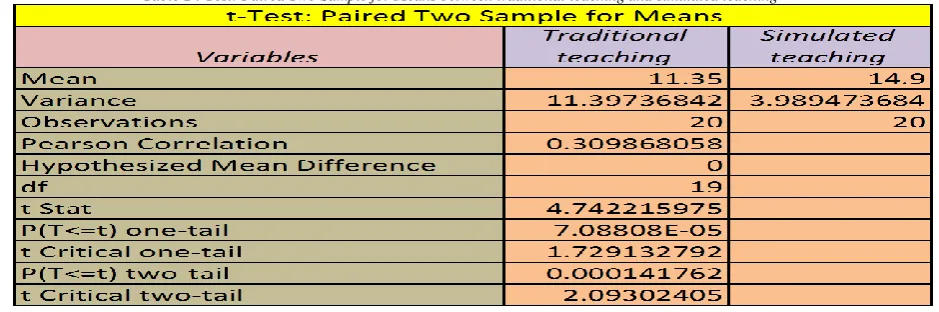
To study the difference between
traditional teaching and simulated teaching Paired
sample t-test was conducted on marks scored by the
student in traditional teaching and simulated
teaching using excel data analysis and the results is
shown in the below table.
Table 2 t-Test: Paired Two Sample for Means between traditional teaching and simulated teaching
H0: There is no difference between Traditional
teaching and simulated teaching.
H1: There is a difference between Traditional
teaching and simulated teaching.
Since the t-value 0.000708808 is less than 0.05 the
null hypothesis H0 is rejected. There is a difference
between Traditional teaching and simulated
teaching.
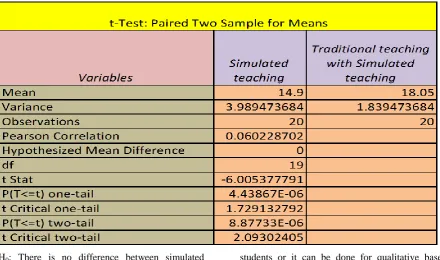
To study the difference between simulated teaching
and Traditional teaching with Simulated teaching
Paired sample t-test was conducted on marks
scored by the student in simulated teaching and
Emperor International Journal of Finance and Management Research [EIJFMR] ISSN: 2395-5929
Emperor International Journal of Finance and Management Research [EIJFMR] ISSN: 2395-5929 Page 144 excel data analysis and the results is shown in the
below table.
Table 3 t-Test: Paired Two Sample for Means between simulated teaching and traditional teaching with Simulation
H0: There is no difference between simulated
teaching and traditional with simulated
teaching.
H1: There is a difference between simulated
teachings and traditional with simulated
teaching.
Since the t-values 0.00000443867 is less than 0.05
null hypotheses is rejected.
There is a difference between simulated teachings
and traditional with simulated teaching.
Conclusion
The most important activity in education
system is teaching and learning an effective
teaching will lead to better performance of student
in exam as well as overall development of the
student. This study which aimed at looking into
new way of teaching using simulation in
quantitative subjects explored the possibility of
various teaching method. The results showed that
not only using simulation but traditional teaching
with the help of simulation will yield better results
when compared only to use of simulation. So
further study can be conducted on under graduate
students or it can be done for qualitative based
subject to see whether it has an impact on learning
outcomes when traditional teaching with simulation
is used.
Bibliography
1) Anderson, D. M., Saraswat, S. P., & Chircu, A.
M. (2015). Teaching Business Process
Management with Simulation in Graduate
Business Programs: An Integrative Approach.
Journal Of Information Systems Education ,
221-232.
2) Avramenko, A. (2012). Enhancing students'
employability through business simulation.
Education + Training, 54 (5), 355-367.
3) Chugh, K. L., & Madhuravani, L. (2016).
On-Line Engineering Education with Emphasis on
Application of Bloom’s Taxonomy. Journal of
Engineering Education Transformations .
4) Drury-Grogan, M. L., & Russ, T. L. (2013). A
Contemporary Simulation Infused in the
Business Communication Curriculum: A Case
Study. Business Communication Quarterly ,
Emperor International Journal of Finance and Management Research [EIJFMR] ISSN: 2395-5929
Emperor International Journal of Finance and Management Research [EIJFMR] ISSN: 2395-5929 Page 145 5) Elgood, C. (1996). Using Management Games.
Hampshire: Gower Press.
6) Ferrier, M. (2009). Simulation Video Games as
a Business School Teaching Tool. Proceedings
of EdMedia: World Conference on Educational
Media and Technology , 3570-3573.
7) J, B., Carson, J., Nelson, B., & Nicol, D.
(2001). Discrete-Event System Simulation.
Prentice Hall.
8) Jain, S. (2014). Teaching of simulation at
business schools. Proceedings of the 2014
Winter Simulation Conference , 3684-3695.
9) Klerk, J. d. (2015). Exploring the use of a
business simulation to teach business concepts
to emirati students. Developments in business
simulation and experiential learning, 42.
10) Proserpio, L., & Magni, M. (2012). Teaching
without the teacher? Building a learning
environment through computer simulations.
International Journal Of Information
Management , 99-105.
11) Seethamraju, R. (2011). Enhancing Student
Learning of Enterprise Integration and
Business Process Orientation through an ERP
Business Simulation Game. Journal Of
Information Systems Education , 19-29.
12) Sokolowski, J. A., & Banks, C. M. (2009).
Principles of Modeling and Simulation: A
Multidisciplinary Approach. In J. A.
Sokolowski, & C. M. Banks, Principles of
Modeling and Simulation: A Multidisciplinary
Approach (p. 4). Hoboken, NJ: Wiley.
13) Soundattika, S. A., & Naik, V. R. (2016). A
Case Study on Teaching and Learning
Innovations Applied to Engineering Education.
Journal of Engineering Education
Transformations .
14) Wawer, M., Milosz, M., Muryjas, P., &
Rzemieniaksuch, M. (2010). Business
Simulation Gamesin Forming of Students’
Entrepreneurship. International Journal of