The University of San Francisco
USF Scholarship: a digital repository @ Gleeson Library |
Geschke Center
Master's Theses Theses, Dissertations, Capstones and Projects
Summer 8-29-2014
Mechanistic Studies of Salt Effects on Bimolecular
Electron-Transfer Reactions of Pentaamine
Ruthenium Pyridyl Complexes Studied by 19F
NMR Line-Broadening and T2 Spin-Echo
Techniques
Nicholas J. MagarianFollow this and additional works at:https://repository.usfca.edu/thes
Part of theInorganic Chemistry Commons, and thePhysical Chemistry Commons
This Thesis is brought to you for free and open access by the Theses, Dissertations, Capstones and Projects at USF Scholarship: a digital repository @ Gleeson Library | Geschke Center. It has been accepted for inclusion in Master's Theses by an authorized administrator of USF Scholarship: a digital repository @ Gleeson Library | Geschke Center. For more information, please [email protected].
Recommended Citation
Magarian, Nicholas J., "Mechanistic Studies of Salt Effects on Bimolecular Electron-Transfer Reactions of Pentaamine Ruthenium Pyridyl Complexes Studied by 19F NMR Line-Broadening and T2 Spin-Echo Techniques" (2014).Master's Theses. 101.
Mechanistic Studies of Salt Effects on Bimolecular Electron-Transfer
Reactions of Pentaamine Ruthenium Pyridyl Complexes Studied by
19
F NMR Line-Broadening and T
2
Spin-Echo Techniques
A Thesis Presented to the Faculty of the Department of Chemistry at the University of San Francisco
in partial fulfillment of the requirements for the Degree of Master of Science in Chemistry
Written by
Nicholas Magarian
Bachelor of Science in Chemistry
California Polytechnic State University, San Luis Obispo, California
Mechanistic Studies of Salt Effects on Bimolecular Electron-Transfer
Reactions of Pentaamine Ruthenium Pyridyl Complexes Studied by
19
F NMR Line-Broadening and T
2
Spin-Echo Techniques
Thesis Written By Nicholas Magarian
This thesis is written under the guidance of the Faculty Advisory Committee, and approved by all its members, has been accepted in partial fulfillment of the
requirements for the degree of
Master of Science in Chemistry
at
The University of San Francisco
Thesis Committee
Jeff Curtis, Ph. D. Research Advisor
Tami Spector, Ph. D. Professor
William Melaugh, Ph. D. Professor
Acknowledgements
I would first like to acknowledge my advisor Dr. Jeff Curtis for his patience,
support, and guidance, as well as for providing me with skills I will carry with me
throughout my career. I would like to give a special thanks to Dr. William Melaugh
and Dr. Tami Spector for their advice and time in reviewing my work. I would also
like to thank the technical support staff: Jeff Oda, Andy Huang, Chad Schwietert, and
Angela Qin for all their assistance throughout my time at USF. I would also like to
thank the program assistant, Deidre Shymanski, as well as the USF chemistry
department staff. Finally, to my family and friends, thank all of you for listening and
iv
Table of Contents
Chapter 1 - An Overview of Electron-Transfer Reactions
1.1 Introduction ...1
1.2 Complementary Aspects Between Thermal and Optical ET ...2
1.2.1 Thermal ET ...2
1.2.2 Optical ET ...5
1.3 The Outer-Sphere Mechanistic Pathway for Activated ET ...7
1.4 The Reorganizational Energy Barrier, λ, Associated with ET ...11
1.4.1 The “inner-sphere” reorganizational energy, λin ...13
1.4.2 The “outer-sphere” (solvent) reorganzational energy, λout ...14
1.5 Potential Energy Surfaces ...16
1.5.1 The harmonic oscillator approximation ...16
1.5.2 Potential energy surfaces in the “zero-order” diabatic limit ...21
1.5.3 Potential energy surfaces to first-order (adiabatic ET) ...24
1.5.4 The ET rate expression ...25
1.6 Quantum Super-Exchange Theory of HAB Modulation ...31
1.7 Debye-Hückel Theory and the Effects of Ionic Strength on Activity Coefficients ...34
v
Chapter 2 - Kinetic Studies of Salt Effects and Concentration Effects of
Reactants on Self-Exchange Reactions Monitored by 19F NMR Spectroscopy
2.1 Introduction ...61
2.1.1 Known effects of added simple salts on ET rates ...65
2.1.2 Known effects of added dicarboxylate salts on the rate of ET ...70
2.1.3 Known effects of added hexacyano complexes (K4M(CN)6,
where M= FeII, RuII, OsII) on the rate of ET ...75
2.2 Determination of Kinetic Rate Constants from NMR Line-Broadening
and T2 ...79
2.3 The T2 Spin-Echo Experiment ...90
2.4 Synthesis and Purification of Reactants and Salts ...98
2.4.1 Preparation of ruthenium(III)chloropentaaminedichloride,
[(NH3)5RuIIICl]Cl2...98
2.4.2 Recrystallization of ruthenium(III)chloropentaaminedichloride,
[(NH3)5RuIIICl]Cl2...99
2.4.3 Preparation of Zn/Hg amalgum ...99
2.4.4 Preparation of ruthenium(II)L-pentaamminehexafluorophosphate,
[(NH3)5RuII-L](PF6)2, where L= tfpm ...100
2.4.5 Acetone/Ether purification pentaammineruthenium(II)-L-
hexafluorophosphate, [(NH3)5RuII-L](PF6)2 where L= tfpm ...101
2.4.6 Preparation of pentaamineruthenium(II)-L-chloride,
[(NH3)5RuII-L]Cl2 where L = tfmp ...101
vi
2.4.7 Preparation of pentaamineruthenium(III)-L-chloride,
[(NH3)5RuIII-L]Cl3, where L = tfmp ...102
2.4.8 Preparation of disodium dicarboxylate salts, Na2-X, where X = muc, tere, 1,4-dcch, adip ...103
2.4.9 Preparation of potassium ruthenocyanide, K4RuII(CN)6 ...103
2.4.10 Preparation of potassium osminocyanide, K4OsII(CN)6 ...104
2.4.11 Recrystallization of potassium ferrocyanide, K4FeII(CN)6 ...104
2.4.12 Recrystallization of potassium hexacyano complexes, K4M(CN)6, where M = RuII, OsII ...105
2.5 Solution Preparation...106
2.5.1 Solution preparation of reactant solutions for NMR ET self-exchange measurements ...106
2.5.2 Solution preparation for added-salt NMR kinetic measurements ....107
2.6 NMR Instrument Set-Up and Experiment Execution ...108
2.6.1 Setting up the 19F NMR experiment ...108
2.6.2 NMR pulse calibration ...109
2.6.3 Setting up the 19F spin-lattice (longitudinal) relaxation, T1, experiment ...114
2.6.4 Setting up the 19F T2 spin-echo experiment ...120
2.6.5 NMR probe/sample temperature calibration ...124
2.7 Experimental Methodology used in Measuring Kinetic Salt Effects ...132
2.8 Sample Degassing ...133
vii
2.8.2 Degassing by vacuum ...134
2.8.3 Saturation with oxygen ...136
2.9 Methods for Assessing the Effects of Degassing on the 19F T2 Spin-Echo ET Kinetic Measured with added Sodium Muconate ...136
2.10 NMR Temperature Dependent Kinetic Experiments ...138
2.10.1 Line-broadening measurements ...138
2.10.2 19F T2 spin-echo measurements ...139
2.11 Validation of the 19F T2 Spin-Echo Experiment ...140
2.12 Reactant Concentration Effects on the Rate of ET (Self-Salting) ...146
2.13 Kinetic Salt Effects at Various (Constant) Reactant Concentrations ...151
2.14 Sodium Muconate Effects on the Rate of ET as Established by NMR ...173
2.15 Effect of Added Group VIII Metal Hexacyano Salts on the Rate of ET ...185
2.16 Temperature Dependent Kinetic Studies ...195
2.16.1 Reactant concentration effects on activation parameters ...198
2.16.2 The effects of added salts on activation parameters ...211
2.16.3 Effects of added Group VIIIb hexacyano salts on reaction (2-2) activationparameters ...231
2.17 Kinetic Modeling ...243
2.17.1 Application of our model to self-salting data ...254
2.17.2 Salt-specific kinetic modeling at 0.10 mM reactants ...259
2.17.3 Salt-specific kinetic modeling at 0.50 mM reactants ...281
2.17.4 Salt-specific kinetic modeling at 1.00 mM reactants ...296
viii
2.17.6 Kinetic modeling of added hexacyano’s at 0.10 mM reactants ...321
2.17.7 Kinetic modeling of added hexacyano’s at 5.00 mM reactants ...326
2.18 Discussion ...332
2.19 Conclusions ...347
ix
List of Figures
Chapter 1 - An Overview of Electron-Transfer Reactions
Figure 1.1 Optical and thermal ET mechanisms ...3
Figure 1.2 Harmonic osciallator and associated wavefunctions ...18
Figure 1.3 Potential energy surfaces showing non-adiabatic ET ...22
Figure 1.4 Potential energy surfaces showing adiabatic ET ...25
Figure 1.5 Surfaces and vibrational levels relevant to the three types of tunneling processes in the quantum non-adiabatic ET model ...30
Figure 1.6 The “electron-transfer” and “hole-transfer” quantum super-exchange mechanisms ...34
Figure 1.7 The collective charge-dipole behavior which results in the bulk observable Ds allowing for the medium to be treated as a “polarizable isotropic continuum” ...38
Figure 1.8 The first and second hydration spheres around the reactant ions forming the Debye-Hückel ion-atmosphere ...39
Figure 1.9 A simple cubic “lattice” model which can be used to calculate the effective center-center interreactant distance ...49
Figure 1.10 A representation of the interpenetrating crystal lattice structures ...51
x
Chapter 2 - Kinetic Studies of Salt Effects and Concentration Effects of
Reactants on Self-Exchange Reactions Monitored by 19F NMR Spectroscopy
Figure 2.1 A schematic of reaction (2-1), the “pseudo-self-exchange” reaction
between [(NH3)5RuII3-Fpy]2+ and [(NH3)5RuIIIpy]3+ ...61
Figure 2.2 A schematic of reaction (2-2), the “true” (zero-driving force) ET
self-exchange reaction between [(NH3)5RuIItfmp]2+ and
[(NH3)5RuIIItfmp]3+ ...62
Figure 2.3 Effect of the halide salts on the rate of reaction (2-1) measured by
stopped-flow at an equimolar reactants concentration of 0.10 mM ...67
Figure 2.4 Effect of the halide salts on the rate of reaction (2-2) measured by
NMR line-broadening at an equimolar reactants concentration of
5.00 mM ...69
Figure 2.5 Effect of the dicarboxylate salts on the rate of reaction (2-1) measured
by stopped-flow at an equimolar reactants concentration of
0.10 mM ...72
Figure 2.6 Effect of the dicarboxylate salts on the rate of reaction (2-2) measured
by NMR line-broadening at an equimolar reactants concentration of
5.00 mM ...74
Figure 2.7 Effect of the hexacyano salts on the rate of reaction (2-1) measured
by stopped-flow at an equimolar reactants concentration of
xi
Figure 2.8 Effect of the hexacyano salts on the rate of reaction (2-2) measured
by NMR line-broadening at an equimolar reactants concentration of
5.00 mM ...78
Figure 2.9 A schematic illustration of how NMR peak resonances arise ...81
Figure 2.10 An illustration of how NMR line-shapes depend on exchange rate
processes as the magnitudes of and T are varied ...87 2
Figure 2.11 The CPMG T2 spin-echo pulse sequence diagram ...94
Figure 2.12 The rotating frame depiction the net of magnetization vector and
Isochromat behaviors during execution of the T2 spin-echo pulse
sequence ...95
Figure 2.13 An illustration of a pw90 determination via peak intensity vs.
angular rotation plot out past pw360 ...111
Figure 2.14 A coarse pw90 calibration curve for the complex
[(NH3)5RuIItfmp]Cl2 in D2O at a concentration of 5.00 mM using
the 19F nucleus...113
Figure 2.15 A screenshot of the “Channels” sub-tab showing the correct
parameters for the 19F T1 inversion-recovery determination ...115
Figure 2.16 A screenshot of the “Acquisition” sub-tab showing the correct
parameters for the 19F T1 inversion-recovery determination ...116
Figure 2.17 A screenshot of the “Array Parameter” window for the 19F T1
inversion-recovery experiment on the [(NH3)5RuIItfmp]Cl2 complex
xii
Figure 2.18 The 19F T1 inversion-recovery pulse sequence displaying
parameters associated with the [(NH3)5RuIItfmp]Cl2 complex
in D2O at a concentration of 5.00 mM ...118
Figure 2.19 An example of the 19F T1 inversion-recovery curve corresponding to
the spin-lattice relaxation of the [(NH3)5RuIItfmp]Cl2 complex in D2O
at a concentration of 5.00 mM ...120
Figure 2.20 The 19F T2 spin-echo pulse sequence displaying the
parameters associated with the [(NH3)5RuIItfmp]Cl2 complex in D2O
at a concentration of 5.00 mM ...123
Figure 2.21 An example of The 19F T2 spin-echo decay curve of the
[(NH3)5RuIItfmp]Cl2 complex in D2O at a concentration of
5.00 mM ...124
Figure 2.22 The 1H NMR spectrum of the standard 100% methanol sample
displaying the chemical shift difference between the two peaks,
Δδ, arising from the -OH and -CH3 functional groups of
the methanol ...125
Figure 2.23 The temperature calibration curve obtained over the range of
263.15 K (-10°C) to 328.15 K (55°C) using the standard 100%
methanol sample ...128
Figure 2.24 The instrument readout temperature error as the increment
(TSample – TReadout) over the temperature range 263.15 K (-10°C) to
xiii
Figure 2.25 The measured logkexvs. GP behavior found for reaction (2-2) as
measured by the T2 spin-echo method and NMR line-broadening
data as well as for reaction (2-1) measured previously by
stopped-flow ...148
Figure 2.26 The effect of added KF, NaCl, and KBr on the measured kex for
reaction (2-2) at a reactants a concentration of 0.10 mM ...155
Figure 2.27 The effect of added Na2muc, Na2adip, Na2tere, Na2(1,4-dcch), KF,
and KBr on the kex for reaction (2-2) at a reactants concentration of
0.10 mM ...156
Figure 2.28 The effect of added KF, NaCl, and KBr on the measured kex for
reaction (2-2) at a reactants a concentration of 0.50 mM ...162
Figure 2.29 The effect of added Na2muc, Na2adip, KF, and KBr on the kex for
reaction (2-2) at a reactants concentration of 0.50 mM ...163
Figure 2.30 The effect of added KF, NaCl, KBr, and Na2muc on the measured kex
for reaction (2-2) at a reactants a concentration of 1.00 mM ...166
Figure 2.31 The effect of added KF, NaCl, and KBr on the measured kex for
reaction (2-2) at a reactants a concentration of 5.00 mM ...169
Figure 2.32 The effect of added Na2muc, Na2adip, KF, and KBr on the kex for
reaction (2-2) at a reactants concentration of 5.00 mM ...170
Figure 2.33 The effect of added Na2muc on the rate of ET for reaction (2-1) as
measured by stopped-flow6 compared to the effect on the rate of
reaction (2-2) found using the T2 spin-echo NMR method at the
xiv
Figure 2.34 The effect of sodium muconate on the rate of ET for reaction (2-2) as
measured by T2 at a reactants concentrations of 0.10 mM in D2O and
H2O ...178
Figure 2.35 Degassing and O2-saturation effects on the rate of reaction (2-2) in
D2O at a reactants concentration of 0.10 mM using raw logkex
values for the effects of air-saturation, vacuum degassing, Ar
degassing, and O2 saturation.. ...181
Figure 2.36 Degassing and O2-saturation effects on the rate of reaction (2-2) in
D2O at a reactants concentration of 0.10 mM using logkex values
normalized to the average logkex starting value for effects of air-
saturation, vacuum degassing, Ar degassing, and O2 saturation...182
Figure 2.37 The temporal decay of the measured logkex over a period of 25
minutes for reaction (2-2) at a reactants concentration of 5.00 mM
with the addition of K4FeII(CN)6 at 0.01 mM ...188
Figure 2.38 The stability of the measured logkex over a period of 25 minutes for
reaction (2-2) at a reactants concentration of 5.00 mM with the
addition of K4FeII(CN)6 at 0.39 mM ...189
Figure 2.39 The effect of added K4FeII(CN)6, K4OsII(CN)6, and K4RuII(CN)6 on
kex for reaction (2-2) at a reactants concentration of 5.00 mM along
xv
Figure 2.40 The effect of added K4FeII(CN)6, K4OsII(CN)6, and K4RuII(CN)6 on
kex for reaction (2-2) at a reactants concentration of 0.10 mM along
with previous results obtained via stopped-flow (reaction 2-1) by
Mehmood ...194
Figure 2.41 Erying plots of the data in Tables 2.21 and 2.22 at equimolar
reactants concentrations of 0.10 mM, 0.50 mM, 3.00 mM,
5.00 mM, 5.30 mM, 5.50 mM, 6.50 mM, and 8.00 mM ...204
Figure 2.42 The approximately linear relationship between ΔH≠vs. GP (reactant concentrations ranging from 0.10 mM to 8.00 mM) for reaction (2-2)
as taken from Table 2.24 ...207
Figure 2.43 The approximately linear relationship between ΔS≠vs. GP (reactant concentrations ranging from 0.10 mM to 8.00 mM) for reaction (2-2)
as taken from Table 2.24 ...208
Figure 2.44 ΔH≠vs.ΔS≠ for reaction (2-2) at reactant concentrations ranging from 0.10 mM to 8.00 mM showing evidence for enthalpy-entropy
compensation ...210
Figure 2.45 Temperature dependent normalized rate data for reaction (2-2) at
0.10 mM reactants with no added salt, added KF (1.80 mM), KBr
(1.80 mM), Na2muc (0.60 mM), and Na2adip (0.60 mM) ...214
Figure 2.46 Temperature dependent rate data for reactions (2-1) and (2-2)
observed via stopped-flow and T2 spin-echo, respectively, at
0.10 mM reactants with added KF (1.80 mM), Na2muc (0.60 mM),
xvi
Figure 2.47 Enthalpy-Entropy compensation at a 0.10 mM reactants in the
presence of KF, KBr, Na2Muc, and Na2Adip ( non-forcing
conditions, GP = 0.0494) for reaction (2-2) studied by NMR
compared with the entire halide series and dicarboxylate salts for
reaction (2-1) studied by stopped-flow ...220
Figure 2.48 Temperature dependent normalized rate data for reaction (2-2) at
0.10 mM reactants with no added salt (GP=0.0291), added KF
(6.00 mM), and KBr (6.00 mM) such that the total solution GP
was 0.0767 (“forcing conditions”) ...223
Figure 2.49 Enthalpy-Entropy compensation at 0.10 mM reactants in the
presence of KF and KBr (forcing conditions, [X-] = 0.006 M) for
reaction (2-2) studied by NMR compared with kinetic data for the
entire halide series obtained in studies of reaction (2-1) by
stopped-flow ...228
Figure 2.50 Enthalpy-Entropy compensation at 0.10 mM reactants in the
presence of the halides and dicarboxylate salts for reaction (2-2)
studied by NMR (red circles) compared with kinetic data for the
entire halide series and dicarboyxlate salts obtained in studies of
reaction (2-1) by stopped-flow6 (blue circles) at both non-forcing
xvii
Figure 2.51 Temperature dependent line-broadening data for reaction (2-2)
obtained at 5.00 mM reactants with no added salt (GP = 0.171),
and 3.9x10⁻⁴ M added K4FeII(CN)6, K4RuII(CN)6, and K4OsII(CN)6
such that the total solution GP = 0.181 compared with previous data
obtained by Qin ...234
Figure 2.52 Enthalpy-Entropy compensation at 5.00 mM reactants in the
presence of the hexacyano salts (at 3.9x10⁻⁴ M) for reaction (2-2)
compared with previous data obtained by Qin ...238
Figure 2.53 Temperature dependent rate data for reaction (2-2) at 0.10 mM
reactants with no added salt (black squares, GP = 0.0291), added
K4RuII(CN)6 (8x10⁻⁶ M, green circles), and K4OsII(CN)6
(8x10⁻⁶ M, yellow circles) making a total solution GP = 0.0295 ...241
Figure 2.54 Showing experimental dervived logkex values vs. GP compared
with calculated values of logkex theoretically predicted by both the
Debye-Hückle-Bronsted equation (1-38) and equation (2-36) ...255
Figure 2.55 Experimental data and kinetic modeling results for the self-salting
curve (reactants concentration 0.10 mM – 5.00 mM) ...258
Figure 2.56 Experimental data and kinetic modeling results at 0.10 mM
reactants with added KF (presumed crystallographic F- radius of
1.50 Å). Also shown are Sista and Mehmood’s stopped flow data
xviii
Figure 2.57 Experimental data and kinetic modeling results at 0.10 mM
reactants with added KF now using the hydrated F- radius of
3.89 Å. Also shown are Sista and Mehmood’s stopped flow data
for added NaF and KF...267
Figure 2.58 Experimental data and kinetic modeling results at 0.10 mM
reactants with added NaCl using the crystallographic Cl- radius
for of 1.90 Å compared with previous stopped-flow data
for added KCl ...268
Figure 2.59 Experimental data and kinetic modeling results at 0.10 mM
reactants with added NaCl now using the hydrated Cl- radius
of 4.41 Å compared with previous stopped-flow data
for added KCl ...269
Figure 2.60 Experimental data and kinetic modeling results at 0.10 mM
reactants with KBr using the crystallographic Br- radius
of 2.61 Å compared with previous stopped-flow data ...270
Figure 2.61 Experimental data and kinetic modeling results at 0.10 mM
reactants with added KBr now using the hydrated Br- radius
of 4.08 Å compared with previous stopped-flow data ...271
Figure 2.62 Experimental data and kinetic modeling results at 0.10 mM
reactants with added Na2muc using the crystallographic muc2-
xix
Figure 2.63 Experimental data and kinetic modeling results at 0.10 mM
reactants with added Na2adip using the crystallographic adip2-
radius of 3.97 Å compared with previous stopped-flow data ...273
Figure 2.64 Experimental data and kinetic modeling results at 0.10 mM
reactants with added Na2tere using the crystallographic tere2-
radius of 4.13 Å compared with previous stopped-flow data ...274
Figure 2.65 Experimental data and kinetic modeling results at 0.10 mM
reactants with added Na2(1,4-dcch) using the crystallographic
dcch2- radius of 4.11 Å compared with previous
stopped-flow data ...275
Figure 2.66 Experimental data and kinetic modeling results at 0.50 mM
reactants with added KF using the crystallographic F- radius of
1.50 Å ...287
Figure 2.67 Experimental data and kinetic modeling results at 0.50 mM
reactants with added KF now using the hydrated F- radius of
3.89 Å ...288
Figure 2.68 Experimental data and kinetic modeling results at 0.50 mM
reactants with added NaCl using the crystallographic Cl- radius
of 1.90 Å ...289
Figure 2.69 Experimental data and kinetic modeling results at 0.50 mM
reactants with added NaCl now using the hydrated Cl- radius
xx
Figure 2.70 Experimental data and kinetic modeling results at 0.50 mM
reactants with added KBr using the crystallographic Br- radius
of 2.61 Å ...291
Figure 2.71 Experimental data and kinetic modeling results at 0.50 mM
reactants with added KBr now using the hydrated Br- radius
of 4.08 Å ...292
Figure 2.72 Experimental data and kinetic modeling results at 0.50 mM
reactants with added Na2muc using the crystallographic muc2-
radius of 3.86 Å ...293
Figure 2.73 Experimental data and kinetic modeling results at 0.50 mM
reactants with added Na2adip using the crystallographic adip2-
radius of 3.97 Å ...294
Figure 2.74 Experimental data and kinetic modeling results at 1.00 mM
reactants with added KF using the crystallographic F- radius of
1.50 Å ...300
Figure 2.75 Experimental data and kinetic modeling results at 1.00 mM
reactants with added KF now using the hydrated F- radius
3.89 Å ...301
Figure 2.76 Experimental data and kinetic modeling results at 1.00 mM
reactants with added NaCl using the crystallographic Cl- radius
xxi
Figure 2.77 Experimental data and kinetic modeling results at 1.00 mM
reactants with added NaCl now using the hydrated Cl- radius
of 4.41 Å ...303
Figure 2.78 Experimental data and kinetic modeling results at 1.00 mM
reactants with added KBr using the crystallographic Br- radius
of 2.61 Å ...304
Figure 2.79 Experimental data and kinetic modeling results at 1.00 mM
reactants with added KBr now using the hydrated Br- radius
of 4.08 Å ...305
Figure 2.80 Experimental data and kinetic modeling results at 1.00 mM
reactants with added Na2muc using the crystallographic muc2-
radius of 3.86 Å ...306
Figure 2.81 Experimental data and kinetic modeling results at 5.00 mM
reactants with added KF now using the crystallographic F- radius
of 1.5 Å ...312
Figure 2.82 Experimental data and kinetic modeling results at 5.00 mM
reactants with added KF now using the hydrated F- radius
of 3.89 Å ...313
Figure 2.83 Experimental data and kinetic modeling results at 5.00 mM
reactants with added NaCl using the crystallographic Cl- radius
xxii
Figure 2.84 Experimental data and kinetic modeling results at 5.00 mM
reactants with added NaCl now using the hydrated Cl- radius
of 4.41 Å ...315
Figure 2.85 Experimental data and kinetic modeling results at 5.00 mM
reactants with added KBr using the crystallographic Br- radius
of 2.61 Å ...316
Figure 2.86 Experimental data and kinetic modeling results at 5.00 mM
reactants with added KBr now using the hydrated Br- radius
of 4.08 Å ...317
Figure 2.87 Experimental data and kinetic modeling results at 5.00 mM
reactants with added Na2muc using the crystallographic muc2-
radius of 3.86 Å ...318
Figure 2.88 Experimental data and kinetic modeling results at 5.00 mM
reactants with added Na2adip using the crystallographic adip2-
of 3.97 Å ...319
Figure 2.89 Experimental data and kinetic modeling results at 0.10 mM
reactants with added K4Fe(CN)6 using the crystallographic
Fe(CN)64- radius of 4.24 Å ...323
Figure 2.90 Experimental data and kinetic modeling results at 0.10 mM reactants
with added K4Os(CN)6 using the crystallographic Os(CN)64- radius
xxiii
Figure 2.91 Experimental data and kinetic modeling results at 0.10 mM reactants
With added K4Ru(CN)6 using crystallographic Ru(CN)64- radius
of 4.38 Å ...325
Figure 2.92 Experimental data and kinetic modeling results at 5.00 mM
reactants with added K4Fe(CN)6 using the crystallographic
Fe(CN)64- radius of 4.24 Å ...329
Figure 2.93 Experimental data and kinetic modeling results at 5.00 mM
reactants with added K4Os(CN)6 using the crystallographic
Os(CN)64- radius of 4.35 Å ...330
Figure 2.94 Experimental data and kinetic modeling results at 5.00 mM
reactants with added K4Ru(CN)6 using crystallographic Ru(CN)64-
radius of 4.38 Å ...331
Figure 2.95 The ratios of kETX/kET arrived at for the halides studied at
as a function of the reactants concentration using crystallographic
radii (0.10 mM to 5.00 mM reactants) ...339
Figure 2.96 The ratios of kETX/kET arrived at for the dicarboxylate salts studied
as a function of the reactants concentration(0.10 mM to 5.00 mM
reactants) ...340
Figure 2.97 The ratios of kETX/kET arrived at for the halides studied at
as a function of the reactants concentration using both
crystallographic and hydrated radii ...342
Figure 2.98 The log of the kETX/kET ratios arrived at for the various
xxiv
List of Tables
Chapter 1 - An Overview of Electron-Transfer Reactions
Table 1.1 A list of center-center and edge-edge distances for
reaction (1-27) at various equimolar reactants concentrations,
compared with center-center distances proposed by Robinson and
Stokes ...54
Chapter 2 - Kinetic Studies of Salt Effects and Concentration Effects of
Reactants on Self-Exchange Reactions Monitored by 19F NMR Spectroscopy
Table 2.1 The structures, names, and abbreviations for the dicarboyxlate salts
used in this work ...64
Table 2.2 The structures, names, and abbreviations group VIII B hexacyano
salts used in this work ...65
Table 2.3 Comparison of T2 relaxation times and 1/2 values arrived at using
both T2 spin-echo measurement and experimental line-widths ...92
Table 2.4 Spectroscopic and electroanalytical characterization data for the
complexes used ...105
Table 2.5 Instrumental readout temperatures and the actual sample temperatures
calculated using equation (2-17) ...127
Table 2.6 The T2 value of the proton of the methyl group on the methanol in the
xxv
Table 2.7 The measured ET self-exchange rates obtained for reaction (2-2) at
different equilmolar reactant concentrations through the T2 spin-echo
method, T2, and the line-broadening method, Δν1/2 ...145
Table 2.8 Rates of reaction (2-2) at various concentrations of equimolar reactants
showing the “self-salting” rate increase ...147
Table 2.9 Previous rates obtained by stopped-flow at various concentrations of
equimolar reactants showing the self-salting acceleration of
reaction (2-1) ...147
Table 2.10 Self-salting slopes taken from Figure 2.25 for the various concentration
ranges of reactants ...149
Table 2.11 The effect of various added salts on kex for reaction (2-2) at a reactants
concentration of 0.10 mM ...153
Table 2.12 The effect of various added salts on kex for reaction (2-2) at a reactants
concentration of 0.50 mM ...160
Table 2.13 The effect of various added salts on kex for reaction (2-2) at a reactants
concentration of 1.00 mM ...165
Table 2.14 The effect of various added salts on kex for reaction (2-2) at a reactants
concentration of 5.00 mM ...168
Table 2.15 A summary of the measured early slopes for plots of logkexvs. GP for
reaction (2-2) due to added inert salts at the various reactant
concentrations investigated ...173
Table 2.16 The rates of ET for to reaction (2-2) at a reactants concentration of
xxvi
Table 2.17 The effects of various degassing methods on the rate of exchange for
reaction (2-2) at a reactants concentration of 0.10 mM with Na2muc
concentrations of 0 M and 0.004 M ...180
Table 2.18 Kinetic data showing time-related decay of kex over a period of 25
minutes in the presence of K4FeII(CN)6 at a concentration of 0.01 mM
for reaction (2-2) at an equimolar reactants concentration of
5.00 mM ...187
Table 2.19 Kinetic data showing stability of catalyzed kex over a period of 25
minutes in the presence of K4FeII(CN)6 at a concentration of 0.39 mM
for reaction (2-2) at an equimolar reactants concentration of
5.00 mM ...187
Table 2.20 The effect of added [K4MII(CN)6] on kex for reaction (2-2) at 5.00 mM
reactants as measured by line-broadening ...190
Table 2.21 The effect of added [K4MII(CN)6] on kex for reaction (2-2) at 0.10 mM
reactants as measured by T2 ...193
Table 2.22 Temperature dependent rate data obtained via T2 spin-echo at
0.10 mM, 0.50 mM, and 3.00 mM reactants ...201
Table 2.23 Temperature dependent rate data obtained via NMR line-broadening
at 5.00 mM, 5.30, mM, 5.50 mM, 6.50 mM, and 8.00 mM
reactants ...202
Table 2.24 The best-fit TST activation parameters, ΔH≠ and ΔS≠, for
xxvii
Table 2.25 Temperature dependent rate data at 0.10 mM reactants in the presence
of various added salts making a total GP = 0.0494 ...212
Table 2.26 The activation parameters, ΔH≠ and ΔS≠, for reaction (2-2) at 0.10 mM reactants in the presence of added electrolytes at
“non-forcing conditions” (constant solution GP = 0.0767,
except for the no-salt case) ...215
Table 2.27 The activation parameters, ΔH≠ and ΔS≠ derived from the regression lines in Figure 2.46 for reactions (2-1) and (2-2) at 0.10 mM reactants
in the presence of added salt at “non-forcing conditions” ...217
Table 2.28 Temperature dependent rate data at 0.10 mM reactants in the presence
of various added salts making a total GP = 0.0767 (0.006 M salt). ...222
Table 2.29 The activation parameters, ΔH≠ and ΔS≠, for reaction (2-2) at 0.10 mM reactants in the presence of added electrolytes at “forcing
conditions” (constant solution GP = 0.0767, except for the
no-salt case) ...224
Table 2.30 The activation parameters, ΔH≠ and ΔS≠, for reactions (2-1) and (2-2) at 0.10 mM reactants in the presence of added salt at “forcing”
conditions” (constant solution GP = 0.0767, except for the
no-salt case) ...224
Table 2.31 Temperature dependent rate data at 5.00 mM reactants in the presence
of the three hexacyano salts making a total GP = 0.181
(3.9x10⁻⁴ M salt) compared with previously obtained values from
xxviii
Table 2.32 The activation parameters, ΔH≠ and ΔS≠, for reaction (2-2) at 0.10 mM reactants in the presence of added electrolytes at
3.9x10⁻⁴ M (constant solution GP = 0.181, except for the
no salt case) ...235
Table 2.33 The activation parameters, ΔH≠ and ΔS≠ derived from the
regression lines in Figure 2.51 for reaction (2-2) at 5.00 mM reactants
in the presence of added hexacyano salts (constant solution
GP = 0.0181, except for the no-salt case) ...235
Table 2.34 Temperature dependent rate data at 0.10 mM reactants in the
presence of K4Ru(CN)6 and K4Os(CN)6 making a total GP = 0.0295
(8x10⁻⁶ M salt) ...240
Table 2.35 The activation parameters, ΔH≠ and ΔS≠, for reaction (2-2) at 0.10 mM reactants in the presence of added electrolytes at added
hexacyano salts at a concentration of 8x10⁻⁶ M (constant solution
GP = 0.0295, except for no-salt) ...242
Table 2.36 The experimentaland calculated radii of the various added-salt and
reactant ions used in kinetic simulations ...252
Table 2.37 The calculated radii of various ion-pairs using values of bare radii listed
xxix
Table 2.38 Best-fit kET, kETX, and kETXX rate constants for reaction (2-2)
corresponding to first-order ET inside the presumed PC, PCX,
and PCXX reactive intermediates (based on iterative fitting of
the logkexvs. the self-salting curve over the reactants
concentration range of 0.10 mM to 5.00 mM) ...257
Table 2.39 Experimental and calculated rate constants for reaction (2-2) as a
function of GP arrived at using our three-channel model over a
reactants concentration range of 0.10 mM – 5.00 mM ...257
Table 2.40 Best-fit kET, kETX, and kETXX rate constants for reaction (2-2)
corresponding to first-order ET inside the presumed PC, PCX, and
PCXX reactive intermediates arrived at by iterative fitting of the
logkexvs. salt curves measured at 0.10 mM reactants for the halide
and dicarboxylate anions studied ...261
Table 2.41 Experimental and calculated rate constants for reaction (2-2) as a
function of GP arrived at using our three-channel model at
0.10 mM reactants ...262
Table 2.42 Best-fit kET, kETX, and kETXX rate constants for reaction (2-2)
corresponding to first-order ET inside the presumed PC, PCX, and
PCXX reactive intermediates arrived at by iterative fitting of the
logkexvs. salt curves measured at 0.50 mM reactants for the halide
xxx
Table 2.43 Experimental and calculated rate constants for reaction (2-2) as a
function of GP arrived at using our three-channel model for reaction
(2-2) at 0.50 mM reactants ...284
Table 2.44 Best-fit kET, kETX, and kETXX rate constants for reaction (2-2)
corresponding to first-order ET inside the presumed PC, PCX, and
PCXX reactive intermediates arrived at by iterative fitting of the
logkexvs. salt curves measured at 1.00 mM reactants for the halide
and dicarboxylate anions studied ...297
Table 2.45 Experimental and calculated rate constants for reaction (2-2) as a
function of GP arrived at using our three-channel model for reaction
(2-2) at 1.00 mM reactants ...298
Table 2.46 Best-fit kET, kETX, and kETXX rate constants for reaction (2-2)
corresponding to first-order ET inside the presumed PC, PCX, and
PCXX reactive intermediates arrived at by iterative fitting of the
logkexvs. salt curves measured at 5.00 mM reactants for the halide
and dicarboxylate anions studied ...308
Table 2.47 Experimental and calculated rate constants for reaction (2-2) as a
function of GP arrived at using our three-channel model for reaction
xxxi
Table 2.48 Best-fit kET, kETX, and kETXX rate constants for reaction (2-2)
corresponding to first-order ET inside the presumed PC, PCX, and
PCXX reactive intermediates arrived at by iterative fitting of the
logkexvs. salt curves measured at 0.10 mM reactants for the various
hexacyano salts studied ...321
Table 2.49 Experimental and calculated rate constants for reaction (2-2) with
various added hexacyano salts as a function of GP arrived at using
our three-channel model for reaction (2-2) at 0.10 mM reactants ...322
Table 2.50 Best-fit kET, kETX, and kETXX rate constants for reaction (2-2)
corresponding to first-order ET inside the presumed PC, PCX, and
PCXX reactive intermediates arrived at by iterative fitting of the
logkexvs. salt curves measured at 5.00 mM reactants for the various
hexacyano salts studied ...327
Table 2.51 Experimental and calculated rate constants for reaction (2-2) with
various added hexacyano salts as a function of GP arrived at using
our three-channel model for reaction (2-2) at 5.00 mM reactants ...328
Table 2.52 The ratios of kETX/kET arrived at for the F- and Br- anions at
0.10 mM and 5.00 mM reactants using both explicit integration
limit values and infinite integration limits ...336
Table 2.53 The computed kai and kdi values for the the F- and Br- anions at 0.10 mM
reactants with 0.0005 M added salt ...337
Table 2.54 The ratios of kETX/kET arrived at for the halides at the various
xxxii
Table 2.55 The ratios of kETX/kET found for the various hexacyano salts at
5.00 mM reactants as well as their associated redox
potentials (vs. SCE) ...344
Abstract
Kinetic salt effects on the bimolecular ET self-exchange reaction between
pentaamineruthenium(II)(3-trifluoromethylpyridine)2+, (NH3)5RuIItfmp2+, and
pentaamineruthenium(III)(3-trifluoromethylpyridine)3+, (NH3)5RuIIItfmp3+, have been
measured using both 19F NMR line-broadening and CPMG T2 spin-echo relaxation
techniques in H2O and D2O. Over the equimolar reactants concentration range of 0.10
mM – 8.00 mM there was a definite “self-salting” rate increase arising from the
increased solution ionic strengths due to the reactants and counterions themselves.
The magnitude of this effect diverged significantly, however, from predictions based
on the classical Debye-Huckle-Bronsted theory of kinetic salt effects. In agreement
with earlier stopped-flow work, addition of alkali-metal fluoride salts increased the
rate of ET between the like-charged redox reactants in good quantitative agreement
with the quantitative predictions of the Debye-Huckle-Bronsted theory of ion
atmosphere charge screening effects, but the other halides exhibited
progressively-increasing, non-linear upward deviations from theory in the order Cl- < Br- < I- .
Catalytic effects on the rate of ET from the addition of various dicarboxylate salts
were also found to deviate in a non-linear fashion from theory. In sharp contrast to
previous stopped-flow work wherein addition of the trans,trans-muconate dianion
showed a uniquely-large catalytic affect, NMR investigations established a complete
loss in catalytic efficacy for muconate. Numerous control experiments force us to
conclude that it is the presence of the magnetic field itself which quenches the
catalysis as probed by NMR. Similar investigations showed that additions of even
Ru) caused much larger ET catalytic effects than those seen with any of the added
halides or dicarboxylates. Consideration of the redox thermodynamics of the metal
centers involved supports an interpretation of the catalysis based on hole-transfer
quantum super-exchange mediation by virtual states corresponding to hole creation
on the bridging anions in presumed ternary ionic assemblies involved in the ET
1
Chapter 1
An Overview of Electron-Transfer Reactions
1.1 Introduction
Electron-transfer, ET, reactions have been widely studied over the past 60
years.1-3 The underlying physical chemistry of ET reactions holds relevance to
diverse areas of chemical reactivity including naturally-occurring biochemical and
application-related chemistry such as battery and fuel cell technology. Some
examples would include photosynthesis (the anabolic pathway which uses light
energy to drive the catalytic conversion of carbon dioxide into sugars), the electron
transport chain in human body (the metabolic pathway in the mitochondria which
contributes to produce the enzyme ATP), and photovoltaic devices which use light to
create electrical energy by exploiting the photo-physical and electron transport
properties of semiconductors.4-6
All “redox” reactions imply the existence of an ET elementary step at some
point in the mechanism. This is the point at which an electron (or some substantial
fraction of a unit electron charge) is transferred from donor (reductant) to acceptor
(oxidant). The work described in this thesis will involve a solution-phase sub-case of
these reactions known as “bimolecular self-exchange reactions” in which, for
example, two transition metal complexes in different oxidation states collide through
diffusive encounter and then undergo an ET event over some narrow range of
interreactant distance during the encounter.7, 8 Much of the work here will describe
2
water, as well as the possible role of specific anion catalysis due to enhanced
quantum “super-exchange” mediation between the donor and acceptor in proposed
ternary encounter assemblies (vide infra).9, 10
The theoretical model pertaining to the details of how ET reactions take place
was first established by Rudolph Marcus and Noel Hush beginning in 1956.11-14 This
model came to be known as the “Marcus-Hush theory.” It used a simplified model of
the reactant structural characteristics and a polarizable dielectric continuum
approximation of the surrounding solvent in order to arrive at the first quantitative
understanding of ET reaction rates. Rudolph Marcus won the noble prize in
chemistry for this model in 1992. The Marcus-Hush model of ET will be outlined
below as a part of our description of the reactions studied in this work.
1.2 Complementary Aspects Between Thermal and Optical ET
1.2.1 Thermal ET
Thermally-induced or “activated” ET can take place in both intramolecular
and intermolecular contexts. In the intermolecular (bimolecular) case, the donor, D,
and acceptor, A, reactant species first diffuse together and upon encounter form what
is known as the “precursor complex” (associated pair) as shown in Figure 1.1. In the
classical picture, the precursor complex reorganizes its nuclear coordinates through a
thermal activation barrier, ΔGth, to form a transition state configuration relevant to the
ET event. This transition state is located at, or near the intersection point of the
3
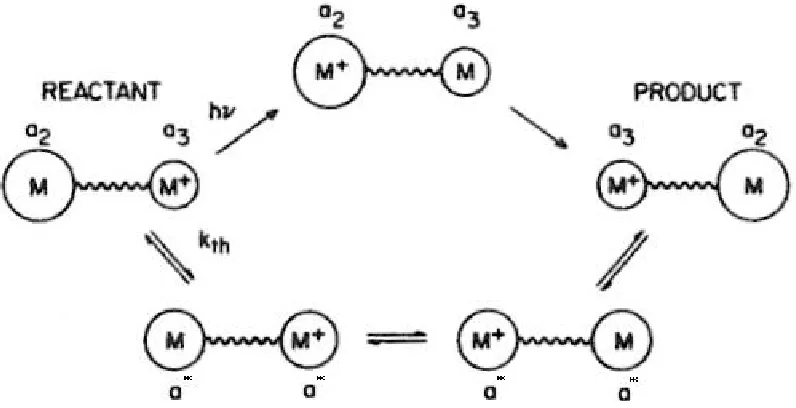
In the schematic illustration of the ET processes shown in Figure 1.1, a2 and a3
represent the average coordination sphere radii, assumed to be proportional to
metal-ligand bond lengths, of the two reactant complexes involved in the ET reaction. M
and M+ represent the reactants respective oxidation states, and a* represents the radii
of the thermally activated reactants in which a2 and a3 have “compressed” or
“expanded” respectively, such that the nuclear coordinates are equal at the
intermediate, transition state geometry (independent of electronic state). In this
representation, the reactants start in an already formed associated pair or “symmetric
binuclear encounter complex” (labeled REACTANT). From this starting point, ET
may occur through one of two pathways: thermal ET (lower pathway, represented by
kth) or optical ET (upper pathway, represented by hν, vide infra).
Figure 1.1 An illustration of optical (represented by “hν”, upper pathway) and
thermal (represented by “kth”, lower pathway) ET processes relevant to a symmetric
4
At the transition state geometry, the electron is then able to be transferred on a
rapid timescale (defined by a tunneling frequency, el, vide infra), such that the
nuclear coordinates and momenta are unchanged during the electronic transition as
required by the Franck-Condon principle. The Franck-Condon principle comes from
the fact that the time scales of electronic density fluctuations (< 10-15 sec), and
presumably any transitions between allowed electronic wavefunctions, ψel, are much
faster than nuclear motion which occurs on the vibration/libration timescale of 10-13 -
10-11 sec. Therefore, it can be assumed that the nuclei remain “frozen” with respect to
their positions and momenta during an electronic transition.11, 15 The Franck-Condon
principle is also related to the Born-Oppenheimer approximation by which the
wavefunction for some molecular system is divided into two parts; the separated
electronic,ψel, and vibrational (or nuclear, χnu) wavefunctions. It is the probability
density overlap between nuclear wavefuntions of two different electronic states which
directly yields the quantity known as the Franck-Condon “factor”.16, 17 These are
most often discussed with respect to spectroscopic (“vertical”) transitions between
ground and excited electronic states, but they may be applied to thermally-induced
barrier crossings as well. In our case, the nuclear coordinates, which remain frozen
during the thermally-activated transition, would include both metal-ligand and all
other skeletal bond lengths, as well as solvent shell configurations which are
electrostatically coupled to the location of the probability density centroid of the
“exchanging” electron (corresponding to the difference at the transition state between
5
Once the electron is transferred within the encounter/precursor complex and
some degree of vibrational relaxation has begun, the resulting successor complex is
now considered to be “locked” in the products electronic configuration for at least
some number of vibrations which can then lead to full relaxation in the
thermally-equilibrated product state. This means that the bond lengths of the two complexes, as
well as the “solvent shell” around the products now re-adjust to the new electrostatic
field corresponding to the products electronic surface. The products then separate
and diffuse apart. In the bimolecular thermal ET case, it should be noted that the
displacement associated with nuclear relaxation from the activated
precursor/successor intermediate nuclear configuration (transition state geometry) to
the ET product state is about half of the total nuclear displacement corresponding to
going from fully equilibrated reactants to equilibrated products (vide infra).
1.2.2 Optical ET
The two reactants, donor and acceptor, can exist together in close proximity in
an electrostatically- disfavored “like-charged” encounter complex, a favored,
unlike-charged “mixed-valence” ion pair, or in a covalently-bound bridged binuclear
complex as shown in Figure 1.1 (where the wavy line represents the bridge). In some
cases, the bimolecular, non-bridged encounter (or “precursor”) complex is a stable
species, such as the known class of ion pairs of the composition
(NH3)5RuIIIL/MII(CN)6 where M = FeII, RuII, or OsII. These strongly-charged (+3)
and (-4) acceptor and donor ions are now electrostatically held in an overall (-1)
6
M~M+ as in Figure 1.1 or by a general associated donor-acceptor pair [D,A], can
then result in sudden ET from donor to acceptor, and this vertical or “optical” ET
transition necessarily occurs without any change in nuclear coordinates as required by
the Franck-Condon principle (vide supra). In covalently linked D-A mixed-valence
dimers as in Figure 1.1, the bridging group holds the two metal centers at a fixed
distance and typically modulates the quantum interaction between D and A (or “M”
and “M+”). Now both optical and thermal ET may occur just as in the case of an
associated bimolecular ion pair, but now there is no associative step to form the
precursor complex and spectroscopic study of the optical ET is facilitated.15
The “charge-transfer state” or “intervalence-transfer excited state” arrived at
upon vertical transition caused by photon absorption is necessarily created in a
vibrational excited state of the new electronic surface since nuclear positions are slow
to adjust to the new charge distribution. In the case of symmetrical mixed-valence
dimer systems where there is no driving force or “0-0” band energy, this
Franck-Condon state (or initially-populated vibrational excited state) is at an energy λ above
the ground state.15 The energy λ is known in the ET literature as the “nuclear
reorganizational energy” (vide infra).18 The excited state thus formed can then relax
to form the thermally-equilibrated products “redox isomer” of the former reactants
ground state, now described by the product’s electronic distribution [D+, A-] and with
nuclear coordinates corresponding to, and in equilibrium with, the new electronic
7
1.3 The Outer-Sphere Mechanistic Pathway for Activated ET
The “outer-sphere” mechanism of thermally induced ET has been shown to
underlie a large fraction of the ET reactions studied thus far.7-9, 19 In the work
described here, all the reactions studied were outer-sphere reactions. The key defining
feature of this mechanism is that no covalent bonds directly join the donor or acceptor
sites at any point along the ET reaction coordinate. Therefore, all quantum
interactions governing the rate of the elementary ET step are necessarily established
by relatively weak and fleeting Van der Waals interactions taking place between the
donor and acceptor species at contact during the lifetime of the encounter complex.
The outer-sphere mechanism can be divided into three identifiable steps as
represented by equations (1-1a) to (1-1c). The basic mechanistic scheme is shown
below, where A is the electron acceptor and D is the electron donor.
(1-1a)
(1-1b)
(1-1c)
In this work, the electron acceptor was the 4d5 (NH3)5RuIII
(3-trifluoromethylpyridine)3+ ion in aqueous solution and the donor (or reducing agent)
was the 4d6 (NH3)5RuII(3-trifluoromethylpyridine)2+ ion. Specifics of the reactants as
8
In the initial, associative step, the two reactants diffuse together to form the
encounter or precursor complex (also known as the reactants “ion pair”). In the
formation of [A, D], the primary coordination spheres of both complexes remain
unchanged. The association rate constant, ka, for formation of the precursor complex
has an upper bound at the maximum rate at which such reactants can diffuse through
the solvent. This is known as the “diffusion-controlled limit” (vide infra).20 In order
for the elementary ET event to occur, as shown in step (1-1b), both the primary ligand
sets (the “inner-spheres”) of the reactant ions and their solvation or “outer-sphere”
molecular environments must be activated to some intermediate transition-state
geometry such that ET may now occur without any change in energy (as required by
the Franck-Condon principle in the context of activated rate processes, see the lower
leg in Figure 1.1). This activation occurs as a result of stochastic thermal fluctuations
of the metal-ligand bond lengths and other nuclear coordinates of the respective
inner-coordination spheres along with simultaneous activation of the outer (solvent
shell) coordinates. Due to the smaller quantum level spacing’s of the low-frequency
solvent dipole librations involved, the rearrangement of the outer-sphere is generally
the slower process.21 After fluctuations take the system to the correct set of nuclear
coordinates, ET occurs via tunneling from D to A within the precursor complex and
creates the successor complex [D+, A-] as shown by step (1-1b). The successor
complex can then relax and diffuse apart into separated products or revert back to
9
An expression for the bimolecular ET rate constant, k , can be arrived at ex
using a steady-state kinetic analysis of steps (1-1a) to (1-1c) based on the precursor
A]
[D, species as shown below,
' d ET d ET ET d a ex k k k k k k 1 k k
(1-2)20
here ka is the kinetically second-order association rate constant, k is the first-order d
rate of dissociation of [D,A] back to reactants, kET is the first-order rate of ET (see
equation (1-16)), k is the rate of dissociation of [Dd' +, A-] to products and all other
variables have been previously defined. If k and a k are much greater than d kET,
then the reaction is “activation” controlled and ka/kd can be treated as an association
equilibrium constant, KA. Equation (1-2) is then inverted (to aid in algebraic
simplification20, 22-24) and upon employing the pre-equilibrium constant form of
d a/k
k , equation (1-2) then transforms into,
' d ET ET A a ex k k 1 k K 1 k 1 k 1 (1-3)
If the rate of dissociation of the successor complex, k , is also much larger than the d'
backwards rate of ET, kET, then kET/kd' is negligible and equation (1-3) reduces
10
Furthermore, if the rate of dissociation of [D, A] back to reactants, k , is much larger d
than the forward rate of ET, kET, then equation (1-4) reduces to,
ET A ex K k
k (1-5)
This equation describes the commonly-encountered “pre-equilibrium” kinetic limit25
and frequently applies in low-driving force bimolecular reactions between transition
metal complexes such as the ones used in this work. On the other hand, if k is d
smaller than kET, then an important sub-case of equation (1-4) results,
a ex k
k (1-6)
This represents the “diffusion-controlled” limit and we see that kex will not contain
any direct information about the rate of the elementary ET step.25 For all the
reactions studied in this work, the driving force was zero and the
formation/dissociation rates of the precursor complex are known to be fast compared
to the rate of ET, therefore equation (1-5) can be rigorously applied.19, 24
The association equilibrium constant, KA, in equation (1-5) depends on the
relative magnitudes of k and a k since Kd A=ka/kd. The factors governing k and a k d
include, among other things, the sizes of the diffusing reactant species and their
charge types. In all cases when the charge product of the reactants is not equal to
zero, the magnitudes of ka and kd will depend on the ionic strength, µ, of the reactant
solution. This is the underlying basis of the simplest type of “kinetic salt effect” and
the studies to be reported in this thesis will address this behavior in depth. We will
11
theories of this rate effect in the context of our NMR-based kinetic rate
measurements.
1.4 The Reorganizational Energy Barrier, λ, Associated with ET
For optical ET in a symmetric system (vide supra), the reorganizational
energy, λ, is a “pure” Franck-Condon energy (where symmetric refers to
thermodynamically symmetrical cases where the relaxed [D,A] and [D ,A-]
electronic states are energetically indistinguishable). In the case of transition metal
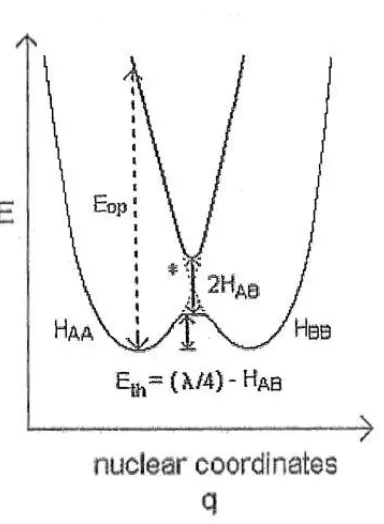
complexes, the experimental λ or “Eop” (as seen later in Figure 1.3) will arise both
from redox-state dependent structural shifts in the primary coordination sphere
(ligand set) and in the secondary/tertiary coordination spheres (or first and second
“hydration” shells) surrounding the reactant ions. Frequently it is assumed that the
total nuclear reorganizational energy, λ, can be apportioned into separate
“inner-sphere”, λin, and “outer-sphere”, λout, reorganizational energy contributions as
described below,
out in λ
λ
λ (1-7)19, 23
where λOwould presumably capture all reorganization exterior to the ligand sphere.
The Gibbs activation free energy for the thermal ET process, G*, is the
energy required to reach transition state geometry through which reactants must pass
on their way to products. This energy has been shown by Marcus and Hush26-28 to be
12 2 r * λ G Δ 1 4 λ G
(1-8)19, 22, 23
in the limit of linear solvent response to field fluctuations and strictly harmonic
free-energy surfaces.25, 29 Here ΔrGis the driving force (if any) for reaction (equivalent
to the “standard reaction Gibb’s free energy change” or ΔE1/2 as measured
electrochemically). Equation (1-8) follows from the assumption of parabolic
(harmonic) potential/free-energy surfaces as defining the shape of the reaction
coordinate (with negligible departure due to resonance interactions) and in the limit of
negligibly small changes in the harmonic oscillator force constants (of all relevant
modes) upon going from [D,A] to [D ,A-].12, 26, 30 The activation free energy can
also be apportioned into inner- and outer-sphere components by applying equation
(1-7) to equation (1-8) and thus,
* out *
in
* G G
G
(1-9)
where *
in
G
is the inner-sphere (skeletal) part of the Gibbs activation energy and
* out
G
is the (presumably separable) outer-sphere (solvent) part. For ET
self-exchange reactions such as the ones to be discussed here, the [D,A] and [D ,A-]
ground state species are thermodynamically indistinguishable, therefore ΔG
r is
necessarily zero and equation (1-8) simplifies to,
4
13
1.4.1 The “inner-sphere” reorganizational energy, λin
In the case of ET between transition metal complexes, the “inner-sphere”
reorganizational energy, λin, can sometimes be treated in an especially simple way if
the reactant complexes contain identical small (or even mono-atomic) ligands which
then carry the bulk λin simply in the metal-ligand equilibrium bond distance changes
attending ET at each metal center. In such cases, λin can be expressed as,
) ( 2 ) d ( n 2 1 2 2 1 f f f f in
(1-11)22
where n is the number of identical ligands coordinated to one of the reactant metals
(typically six), f1 and f2 are the symmetric stretching force constants for these
modes in the two different redox states at the metal center and d is the difference
between the equilibrium metal-ligand bond distances in the two different redox states
(as typically measured on separated reactant ions by crystallography). This
expression for the inner-sphere reorganization energy is a highly simplified model in
which the reactants are treated as two roughly spherical complexes with only one
specific force constant being ascribed to each reactant ion. A more realistic portrayal
of the inner-sphere reorganization energy encompasses the summation over all
intramolecular vibrations of each complex involved in the reaction which change
upon ET. In this more general approach, λin is described by,
i
i i in f ( d )2
2 1
14
where fi = 2 f1 f2/( f1+ f2) and is the “reduced” force constant for the ith
inner-sphere vibration, and (d)i is the difference in the equilibrium metal-ligand bond
distances in the two oxidation states.
1.4.2 The “outer-sphere” (solvent) reorganzational energy, λout
The energy required to reorganize the medium outside of the primary
coordination spheres of the reactant ions is defined as the “outer-sphere”
reorganziational energy, λout. It is related to the change in solvation due to solvent
dipole electrostriction, orientation, libration, and other effects which contribute to the
overall λ for reaction.31 Generally, the reactant with the higher charge (the species
“A” in our notation thus far but soon to be specified as “RuIII”) is more strongly
solvated by the polar solvent molecules than its partner in the encounter complex, and
this leads to significantly different degrees of polarization of the solvent medium
exterior to the primary ligand sphere around A.
In the early model developed by Marcus and Hush, the medium outside of the
inner-coordination sphere was treated as a “dielectric continuum” with two
identifiable parts of the total polarization response assumed separable on the basis of
their respective timescales. The rapid, smaller portion of the response was ascribed to
the electronic polarizability of the molecules of the medium, and the slow, larger
portion to the vibration-libration-orientation polarization of the molecular dipoles of
the medium.23 They used the fact that the rapid electronic polarizability of the
15
realization was that this “optical-frequency” electronic polarizability of the medium
remains in equilbrium with the electrostatic change accompanying an ET event, while
the slow vibration-orientaition polarization of the medium has to fluctuate/adjust to a
non-equilibrium value appropriate to the “averaged” charge distribution of the
activated complex prior to a thermally-activated ET event. This is the constraint
which governs whether the electronic ET transition is “allowed” within the
zero-Franck-Condon energy or “isoenergetic” requirement for the elementary ET step.12, 32
The free-energy change necessary to produce the non-equilibrium polarization of the
solvent appropriate to the transition state when the reactants are treated as spheres
was then independently derived by Marcus and Hush as,
s 2 2 1 2 out D 1 n 1 d 1 r 2 1 r 2 1 ) (
λ e (1-13)12, 23, 26, 27
where e is the amount of charge transferred in the reaction, r1 and r2 are the radii
of the two reactant complexes, d is the distance between the centers of the two
reactants, n is the refractive index (which upon squaring gives the “optical” dielectric
constant, D ), and op D is the “static” dielectric constant of the medium (which s
describes the ability of any solvent or other condensed medium to screen electric
fields at low frequency). In our case n2 is 5.533 and D is 78.5 at 298 K for water s
(negligibly different at 298 K for D2O) . Equation (1-13) is rigorously valid only if,
) r (r
d 1 2 (1-14)
which implies that the “contacting spheres” idea is actually outside the range of


![Figure 1.8 Solvent dipoles representing the first and second hydration spheres and the counter ions forming the Debye-Hückel “ion atmosphere” around the reactant ions, [(NH3)5RuIIL]2+ and [(NH3)5RuIIIL]3+](https://thumb-us.123doks.com/thumbv2/123dok_us/8925673.1845351/74.612.124.505.206.425/figure-solvent-dipoles-representing-hydration-huckel-atmosphere-reactant.webp)