Vol. 14, No. 2, 2017, 171-177
ISSN: 2320 –3242 (P), 2320 –3250 (online) Published on 11 December 2017
www.researchmathsci.org
DOI: http://dx.doi.org/10.22457/ijfma.v14n2a1
171
International Journal of
Dual and Partial Primal Solution for Solving Linear Sum
Feasible Fuzzy Assignment Problem
A. Nagoor Gani1 and T. Shiek Pareeeth2
PG & Research Department of Mathematics Jamal Mohammed College (Autonomous)
Tiruchirappalli-620020, Tamilndu, India.
1
Email: [email protected], 2Email: [email protected]
Received 2 November 2017; accepted 10 December 2017
Abstract. In this paper we proposed a dual and partial Primal feasible fuzzy assignment
problem which cost coefficient is -Trapezoidal fuzzy numbers. The linear programming problem of the fuzzy assignment problem is converted into fuzzy dual problem and also presented fuzzy complementary slackness by using duality theory. This paper developed an approach to solved proposed method called dual and partial feasible fuzzy assignment problem and illustrated with a numerical example.
Keywords: Assignment problem, fuzzy assignment problem, dual and partial primal
fuzzy assignment, fuzzy linear sum assignment problem, -Trapezoidal fuzzy number feasible and fuzzy partial assignment.
AMS Mathematics Subject Classification (2010): 0372, 03E72
1. Introduction
The first algorithm for linear sum assignment problem (LSAP) was presented in 1946 by Easterfield. It is a non-polynomial O(2) time approach. Based on iterated application of a particular class of admissible transformations. The first primal simplex algorithms, proposed in the mid-1970s by Cunningham and Barr, Glover and Kingman required exponential time due of the high degeneracy of the linear program associated with LSAP. The first primal(non-simplex) algorithm was proposed in 1964 by Balinski and Gomory. It iteratively improves through alternating path, a feasible assignment and dual solution satisfying complementary slackness and solves the problem O() time. The first dual (non-simplex) algorithm for LSAP appeared in the already mentioned1969 paper Dinic and Kronrod.
172
assignment model that considers all persons to have same skills. The fuzzy assignment problem is a special type of fuzzy linear programming problem the concept of fuzzy set theory was first introduced Bellman and Zadeh. Lin and Wen [5] proposed an efficient algorithm based on the labelling method for solving the linear fractional programming.
We proposed dual and primal partial feasible fuzzy assignment problem. Let ‘n’ number of jobs is performed by ‘m’ number of persons, where the costs coefficient is depend on -Trapezoidal fuzzy numbers. Which stores the partial feasible fuzzy assignment is defined by if column ‘j’ is assigned to row ‘i’ then row(j) = i; if column ‘j’ is not assigned to row ‘i’ then row(j) =0.
2. Preliminaries on − Trapezoidal fuzzy number
In this section we will review the basic concepts of fuzzy set, − Trapezoidal fuzzy number, dual and primal fuzzy assignment, complementary slackness, partial fuzzy assignment problem.
Definition 2.1. (Fuzzy set)
A fuzzy set is characterized by a membership function mapping element of a domain, space or universe of discourse X to the unit interval [0,1].i.e.,à ={(X,(); x∈ )},: X → 0,1is a mapping called the degree of membership function of the fuzzy set à and
() is called membership value of x∈X in the fuzzy set Ã. These membership grades are often represented by real numbers ranking from [0,1].
Definition 2.2. (Fuzzy number)
A real fuzzy number is a fuzzy subset of the real number R with membership function
is satisfying the following conditions.
1) is continuous from R to the closed interval [0,1] 2) is strictly increasing and continuous on [,] 3) is strictly decreasing and continuous on [,]
Definition 2.3. ( − Trapezoidal fuzzy number)
A fuzzy number = (a, b, c, d : )is saidto be a −Trapezoidal fuzzy number if its membership function is given by,
! =
" # $ #
% &'()(* , if a ≤ ≤ b
, if b ≤ ≤ 0 &1(' 1(2* , if c ≤ ≤ 4
0 , if x ≥ 4
7
Problem
173
Figure 1: − Trapezoidal fuzzy number
Definition 2.4. (Arithmetic operations)
Let =( , 9, 0,4 : ) and = (,9,0,4 :) be two −Trapezoidal fuzzynumbers and : ∈ R ,then the arithmetic operations on and are given by,
1) : ≥ 0 , : = (:, :9,:0,:4 : ) 2) : <0 , : = (:4,:0,:9,: : )
3) + = ( + ,9+9,0+0,4+4 : min (, )) 4) − = (− ,9− 9,0− 0,4− 4 : (− )).
Properties of − Trapezoidal fuzzy number
1) − Trapezoidal fuzzy number = (a,b,c,d : ) is said to be positive − trapezoidal fuzzy number if and only if a–c ≥ 0.
2) −Trapezoidal fuzzy number = (a,b,c,d : ) is said to be zero
−Trapezoidal fuzzy number if and only if a=b=c=d=0.
3) Let =( , 9, 0,4 : ), and = (,9,0,4: ) are any two −trapezoidal fuzzy numbers is said to be equal if and only if = ,9=
9,0= 0, 4 = 4, = .
4) −Trapezoidal fuzzy number = (a,b,c,d : ) is said to be symmetric
−trapezoidal fuzzy number if and only if c = d i.e, = (a,b,c,c : ).
Definition 2.5. (Fuzzy Linear Sum Assignment Problem (FLSAP))
174
Definition 2.7. (Partial Feasible Assignment (PFA) or Partial Feasible Solution (PFS)
If the column ‘j’ is assigned to row ‘i’ then row (j) = i, otherwise row (j) =0.(or)If the row ‘i’ is assigned to column ‘j’ then column(i) = j, otherwise column(i) = 0,that is called partial feasible assignment (or) partial feasible solution.
Definition 2.8. (Fuzzy Partial Feasible Matching (FPFM))
In a bipartite graph G = (U,V: E) having a vertex of U for each row, a vertex of V for each column and - Trapezoidal fuzzy cost 0@>? associated with edge [i,j] (i,j=1,2....n). Then the problem is then to determined partially and feasible matching in G.
3. Mathematical formulation
3.1. Fuzzy assignment problem (FAP)
Suppose there are ‘m’ workers and ‘n’ jobs. Each job must be done by exactly one worker can do, at only one job. The problem is to assign jobs to the workers so as to minimize to the total cost, where cost is -Trapezoidal fuzzy numbers.
Min Z = ∑ ∑ED CD0@>? BC
Subject to ∑CDBC =1; for i = 1,2...,n
∑ BD BC =1; for j =1,2..., n
BC = 0 or 1
3.2. Fuzzy dual assignment problem (FDAP)
By associating fuzzy dual variables F> and G? with fuzzy assignment constraints and then fuzzy dual problem is
Max ∑ FBD> + ∑CDG?
Subject to F> + G?≤0@>? (i,j = 1,2...,n)
3.3. Fuzzy complementary slackness
By duality theory, a pair of solutions respectively feasible for the fuzzy primal and the dual is optimal if and only if (complementary slackness)
BC(0@ − F>? − G> ?) = 0 (i,j=1,2...n) the values
H̅J>? = 0@ − F>? − G> ? (i,j = 1,2....n)
are the linear programming reducedcost. This transformation from 0@>? to 0̅J>?is a special case of admissible transformation. For any feasible solution, the transformed objective function is
∑ ∑ (0BD CD @>?− F − G> ?)BC
=∑BD ∑ 0BD@>?BC− ∑BD F>B∑ BD BC− ∑CD G?C∑ BD BC
Problem
175
4. An algorithm for solving feasible dual and partial primal linear sum fuzzy assignment problem with − trapezoidal fuzzy numbers
Step 1: Construct the fuzzy assignment table for the given balanced fuzzy linear
assignment problem.
Step 2: Calculate the dual variablesF> , G? and reduced cost matrix 0@>?Row reduction Calculate the row (F>)
F> = L B L MB{0@>?} , for ( j = 1,2...n).
Step 3: Column reduction [Calculate the column (OP)]
G? = LC L MB{0@>?− F>} , for( i = 1,2...n).
Step 4: [Reduced cost matrixQJRP]
Given matrix 0@>? and we obtain the dual variables F> and G?(shown on the
left and on the top of the given matrix 0@>? then find the reduced cost matrix HJ>?
HJ>? = 0@– F >? @ − G> ?, for(i,j = 1,2...n).
Step 5: [Partial assignment]
Select the first column having any zero and assigned to row i, then row (j) = i and cross out corresponding grow and column. select the second column having any zero and assigned to rowi, then row(j) = i and cross out corresponding in row and column, then row(j) = i and cross out corresponding row and column.
Suppose, if the column is not assigned to row i, then row(j) = 0.
Step 6: [Partial assignment that implements the inverse of row]
Select the ‘i’th row having any zero and assigned to column ‘j’ then column (i)=j and cross corresponding row and column. Suppose if the row is not assigned to column j, then column(i) = 0.
Step 7: Draw a bipartite graph of partial feasible solution or partial feasible
matching.
Step 8: Stop.
5. Numerical example
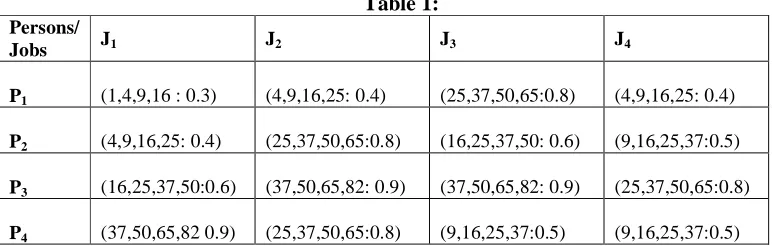
To illustrate the proposed algorithm let us consider −Trapezoidal fuzzy assignment problem with obtain ‘i’ throws and ‘j’th column from the fuzzy cost matrix by using dual and primal fuzzy assignment problem. In ‘i’ throws represented four persons P1, P2, P3, P4
and in ‘j’th column represented the four jobs J1, J2, J3, J4 .The cost matrix [0̃ij] is given
176
Solution: The fuzzy assignment problem given in Table −1. Construct the fuzzy assignment table for the givenbalanced fuzzy linear assignment problem.
Table 1:
Persons/
Jobs J1 J2 J3 J4
P1 (1,4,9,16 : 0.3) (4,9,16,25: 0.4) (25,37,50,65:0.8) (4,9,16,25: 0.4)
P2 (4,9,16,25: 0.4) (25,37,50,65:0.8) (16,25,37,50: 0.6) (9,16,25,37:0.5)
P3 (16,25,37,50:0.6) (37,50,65,82: 0.9) (37,50,65,82: 0.9) (25,37,50,65:0.8)
P4 (37,50,65,82 0.9) (25,37,50,65:0.8) (9,16,25,37:0.5) (9,16,25,37:0.5)
Calculate the dual variables F> , G? and reduced cost matrix 0@ ;>? Row reduction and Calculate the row (F>).
Table 2:
Persons/Jobs J1 J2 J3 J4
(1,4,9,16 : 0.3) (1,4,9,16 : 0.3) (4,9,16,25: 0.4) (25,37,50,65:0.8) (4,9,16,25: 0.4)
(4,9,16,25: 0.4) (4,9,16,25: 0.4) (25,37,50,65:0.8) (16,25,37,50:0.6) (9,16,25,37:0.5)
(16,25,37,50:0.6) (16,25,37,50:0.6) (37,50,65,82:0.9) (37,50,65,82: 0.9) (25,37,50,65:0.8)
(9,16,25,37:0.5) (37,50,65,82:0.9) (25,37,50,65:0.8) (9,16,25,37:0.5) (9,16,25,37:0.5)
Table 3: Column reduction and Calculate the column (G?)
Persons/jobs
(0,0,0,0) (3,5,7,9 ; 0.1) (0,0,0,0) (0,0,0,0)
(1,4,9,16 : 0.3) (1,4,9,16 : 0.3) (4,9,16,25: 0.4) (25,37,50,65:0.8) (4,9,16,25: 0.4)
(4,9,16,25: 0.4) (4,9,16,25: 0.4) (25,37,50,65:0.8) (16,25,37,50: 0.6) (9,16,25,37:0.5)
(16,25,37,50:0.6) (16,25,37,50:0.6) (37,50,65,82:0.9) (37,50,65,82: 0.9) (25,37,50,65:0.8)
Problem
177
Table 4: Given matrix 0@>? and we obtain the dual variables F> and G? (Shown on the left
and on the top of the given matrix 0@>? then find the reduced cost matrix HJ>?).
(0,0,0,0) (0,0,0,0) (24,33,41,49: 0.5 ) (3,5,7,9; 0.1)
(0,0,0,0) (18,23,27,31: 0.3 ) (12,16,21,25 : 0.2) (5,7,9,12: 0.1)
(0,0,0,0) (18,20,21,23: 0.2) (21,25,28,32 : 0.3) (9,12,13,15:0.2)
(28,34,40,45: 0.2) (13,16,18,19 : 0.2 ) (0,0,0,0) (0,0,0,0) Select the ‘j’ th column having any zero and assigned to row i, then row(j) = i, otherwise, row(j) = 0, row (j) = (1,0,4,0) and inverse of row U(i) = (1,0,0,3).
5. Conclusion
In this paper, a new algorithm has been developed for solving assignment problem with costs as − Trapezoidal fuzzy numbers by using dual and primal of partial feasible linear sum fuzzy assignment problem. There are several papers in the literature for solving assignment problem with Trapezoidal fuzzy costs, but no one has used −Trapezoidal fuzzy number. The algorithm is easy to understand and can be used for all types of assignment problems as well as − Trapezoidal fuzzy numbers.
REFERENCES
1. R.Burkard, M.Dell’ Amico and S. Martello, Assignment Problems, SIAM, 2009. 2. Chen Liang Hsuan, Lu Hai Wen, An extended assignment problem Considering
multiple outputs, Applied Mathematical Modelling, 31 (2007) 2239 – 2248.
3. M.S.Chen, On a fuzzy assignment problem , Tamkang Journal, 22 (1985) 407–411. 4. A .Emrouznejad, M. Z.Angiz, and L,W.Ho., An alternative formulation for the fuzzy 5. assignment problem, Journal of the Operational Research Society, 63 (2012) 59-63. 6. Lin Chi-Jen, Wen Ue-Pyng, A labelling algorithm for the fuzzy assignment problem,
Fuzzy Sets and Systems, 142 (2004) 373−391.
7. J.Majumder and A.K.Bhunia, Elitist, Genetic algorithm for assignment problem with 8. imprecise goal, European Journal of Operation Research, 177 (2007), 684 – 692. 9. R. E. Machol, An application of the assignment problem, Operations Research,
(1970) 745–746.
10. E. S. Page, A note on assignment problems, Computer Journal, 6 (1963) 241–243. 11. Y.L.P.Thorani and N.Ravi Shanka, Fuzzy assignment problem with generalized
fuzzy numbers, Applied Mathematical Sciences, 7(71) (2013) 3511–3537
12. L.Zadeh and R.Bellman, Decision making is a fuzzy environment, Management