90
Copyright © 2018. IJEMR. All Rights Reserved.
Volume-8, Issue-4, August 2018
International Journal of Engineering and Management Research
Page Number: 90-94
DOI: doi.org/10.31033/ijemr.8.4.11
Conclusive Review on Adaptive Headlight System for Four-Wheeler
Frontlight using Stepper Motor
Onkar Deshpande1 Amar Kekare2 Sunil Waghmare3 and Varun Bukka4
1
Project Engineer, Department of Mechanical Engineering, Vaibhav Engineering, INDIA
2Assistant Professor, Department of Mechanical Engineering, SETI, Panhala, MS, INDIA 3Deputy Manager, Department of Production Engineering, Mahindra & Mahindra, Chakan, INDIA
4Student, Department of Mechanical Engineering, Solapur University, INDIA
1Corresponding Author: [email protected]
ABSTRACT
Major road mishaps occur at night on account of curve roads and glare caused from the headlights of incoming vehicles. Night time driving with conventional headlamps is particularly unsafe: only 25% of the driving is done at night but 55% of the driving accidents occur during this period. The existing conventional light system does not provide illumination in the right direction and at the precise angle. Due to this constrain, a need to understand an alternative technology solution. Adaptive front lighting system (AFS) helps improve driver’s visibility at night time hence achieving enhance safety. The objective of this work is to design and build an AFS Prototype. From the results, it is concluded that the headlamp swings in horizontal direction by sensing steering angle and vertical by sensing distance between subject vehicle and next vehicle. Accuracy, reliability and availability of the components were few considerations during the conceptualization stage.
Keywords— Adaptive Front Lighting System (AFS), Conventional Light System, Steering Angle, Sensing distance
I.
INTRODUCTION TO ADAPTIVE
HAEDLIGHT SYSTEM
The current static headlamp provides illumination in tangent direction of the headlamp without any consideration towards the steering shaft angle and the distance between incoming vehicle and subject vehicle. The driver is therefore subjected to insufficient illumination and unreliable or incomplete view of the road. It is therefore imperative to study new technology. Adaptive front light system (AFS) is an innovative
technology and is being studied by researchers across the globe. The AFS controls the aiming direction and lighting distribution of the low beams according to the amount of turn applied to the steering wheel during cornering or turning and distance between the incoming and subject vehicle.
Figure 1: Car 1 without AFS and Car 2 with AFS
Figure Explanation: When driving on the winding road, AFS will change the lighting pattern to compensate for the curvature of the road to help enhance night visibility.
AFS therefore improves driver’s visibility during night driving by automatically turning the headlamp in the direction of travel according to steering wheel angle and the distance between two vehicles.
91
Copyright © 2018. IJEMR. All Rights Reserved.
if it applies, the main-beam (driving-beam) with a minimum functional content; such systems consist of the "system control", one or more "supply and operating device(s)", if any, and the "installation units" of the right and of the left side of the vehicle”
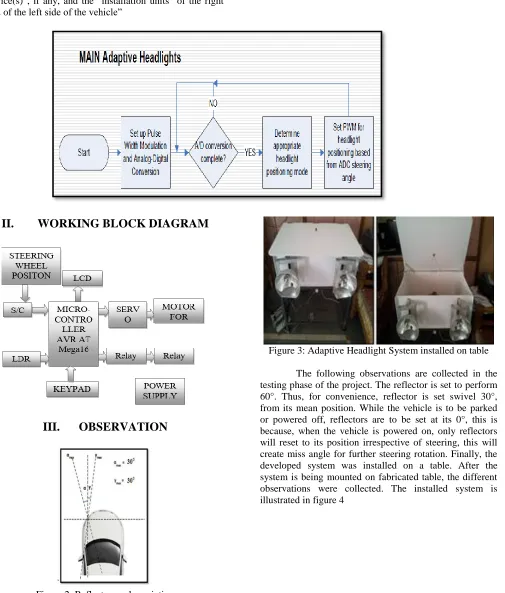
The following flowchart illustrates about working methodology;
II.
WORKING BLOCK DIAGRAM
III.
OBSERVATION
Figure 2: Reflector angle variation
Figure 3: Adaptive Headlight System installed on table
92
Copyright © 2018. IJEMR. All Rights Reserved.
.
Figure 4: Illumination observation at different position from 5feet
One can notice that, when the headlight position is at the center position, representing an obstacle, can barely be seen on the right-hand side of the picture (Fig. 5 a). However, when the headlight is positioned at far-right position, the obstacle was illuminated very clearly, as seen in Fig. 5b. Normal headlights cannot illuminate this obstacle while cornering and this is a proof of how effective this system can be.
IV.
RELEVANCE
The researches on AFS are gradually being carried out. ALC (Adaptive Light Control) system of BWM Company obtains front light adaptive control signal from steering wheel angle sensor, velocity sensor, deflection angular velocity sensor and GPS navigation technology to adjust the horizontal and vertical swing angle. Active style front light of ALS (Adaptive Light System) of Benz company adjusts the swing angle of front light almost equal with front wheel steering angle, which can lift the range of effective lighting above 90%.
The AFS (Adaptive Forward Light System) developed by Opel and Hella include two parts: curve light control and turning light control. Curve light is mainly used at Continuous curve whose radius is relatively big. The module of turning light control takes effect when velocity is under 50km/h, so it doesn’t take action in freeway. Audi has employed a suit of forwardly active assistant lighting system on curve roads, which helps to illuminate the turning area. The system gets work when velocity is above 70km/h, and the maximal turning corner
is 15 degrees. Lexus has also exploited AFS which controls the front light.
V.
EXISTING SYSTEMS
ALC (Adaptive Light Control) system of BMW Company obtains front light adaptive control signal from steering wheel angle sensor, velocity sensor, deflection angular velocity sensor and GPS navigation technology to adjust the horizontal and vertical swing angle.
Active style front light of ALS (Adaptive Light System) of Benz company adjusts the swing angle of front light almost equal with front wheel steering angle, which can lift the range of effective lighting above 90%.
The AFS (Adaptive Forward Light System) developed by Opel and Hella include two parts: curve light control and turning light control.
VI.
PROBLEM DEFINITION
Night time driving with conventional headlights is particularly unsafe. Only 25% of the driving is done at night time, but 55% of the driving accidents occur during this period with compared to day time accidents.
The existing conventional light system does not provide illumination in the right direction and at the precise angle. Due to this constrain, a need to understand an alternative technology solution. After doing lot of research, we know that Adaptive head light system / (AFS-adaptive front light system) helps to improve driver’s visibility at night time & hence achieving enhance safety.
A variety of potentially dangerous situations, including the following:
An animal lingers on the road just around a poorly lit curve.
An oncoming vehicle negotiating a sharp curve is drifting into your lane.
Another motorist has stopped his vehicle at the side of the road, just beyond a corner.
You are on a narrow road at night cresting a hill, but cannot see if another vehicle is coming in the opposite direction.
By pointing your vehicle’s headlights in the direction your car is moving, adaptive headlights increase your ability to see what is in front of you, whether it is around a corner or over a hill.
VII.
SCOPE
93
Copyright © 2018. IJEMR. All Rights Reserved.
A drive is given by means of stepper motor to the entire frame so that the reflector with HID bulb will move as per the drive given. That head light will move in 45°, which will be at the side of turn & another will move 30°, about its pivot.
So, we can provide an adequate illumination during the travelling through curve roads. In this manner we can avoid the accidents during the night time driving, happens due to inadequate illumination in curve roads.
VIII. PROBLEM STATEMENT
Dangerous traffic accidents are easy to happen when vehicles move on curve roads at night. The main reason is conventional front light do not provide sufficient and reasonable illumination for nighttime visibility to be adapted to curves.
Figure 5: Daytime-night time ratio in vehicle to fatal accident
So, to avoid this situation it’s necessary to provide an effective system to travel along curve roads during night time, with adequate light illumination.
IX.
CONCLUSION
The Adaptive Front Lighting System is a system which regulates automatically the light distribution of a vehicle. A specific control algorithm is developed for different driving conditions – curve roads and incoming vehicle’s. AFS can be formally defined as maintaining a presumptively desired light distribution adapted to the above road environment. The system tested does so by way of input from in-vehicle parameters like steering wheel angle and distance between incoming vehicle and subject vehicle etc.
The horizontal headlight movement through movement of steering shaft and vertical movement of headlamp due to distance between the two vehicles is
achieved by the means of AFS system architecture. Few critical design factors considered during inception stage were ease of availability, affordability and reliability of the components use. It is also observed that the system can be accommodated in the current low-cost models without major changes.
AFS appears to offer potential for a favorable night driving behavior potentially reducing accident risk, compared to standard headlights.
X.
FUTURE WORK
This system relies on information obtained from various sensors and considers only a next vehicle. A step forward can be achieved by adding computer vision-based image processing algorithms. Instead of only fixed ultrasonic module we can add radar type mechanism to scan the vehicle coming from all directions. With this consideration, a neighboring and backside vehicle can also be traced. A second dimension may also use external input from satellite positioning (GPS or Galileo) to determine current road environment in order to control desired light distribution. The current system tested has no user interface allowing system parameters to be set or overridden by the driver. Accordingly, the learning process is different form a user-controlled interface, e.g. Adaptive Cruise Control, were the user controls and learns to set system parameters according to his/her preferences. According to suppliers the current automatic AFS system matches user preference for desired light distribution in 90% of the driving situations.
The AFS system should thus alleviate the driver in choice of light distribution choices, provide safety profits in terms of enhanced perception of the night-time environment reduce accident risk, driver workload and increase driver comfort and possibly exhibit positive effects on traffic flow.
REFERENCES
[1] C. Falcon. (2007). Stepper motors assist adaptive headlights. Available at:
https://www.eetimes.com/document.asp?doc_id=1272693 &page_number=1
[2] C.K. Chan, K.W.E. Cheng, & S.L.Ho. (2006). Development of packaging and Electrical Interfacing for Electrical Vehicles. IEEE, 2nd International Conference on Power Electronics Systems and Applications, Hong Kong, China . Available at:
https://ieeexplore.ieee.org/document/4147818/
94
Copyright © 2018. IJEMR. All Rights Reserved.
https://www.sae.org/publications/technical-papers/content/980319/
[4] Vaishali D. Todkar, Mrs. M.R. Bachut. (2016). Adaptive front light system. International Journal of Advanced Research, 4(5), 907-913.
[5] A. Ekrias, M. Eloholma, & L. Halonen. (2008). The contribution of vehicle headlights to visibility of targets in road lighting environments. International Review of Electrical Engineering, 3(1), 208. Available at:
https://www.researchgate.net/publication/283599731_The _contribution_of_vehicle_headlights_to_visibility_of_targ ets_in_road_lighting_environments
[6] Priyanka M Dubal & Dr. Alam N. Shaikh. (2018). Adaptive head-light system for vehicle. International Journal of Engineering Research in Computer Science and Engineering, 5(2), 44-47.
[7] H. Hogrefe. (2000). Adaptive frontlighting systems for optimum illumination of curved roads, highway lanes and other driving situations. SAE International, 109(7), 196-201. Available at: