FRI OMANI Uok
Reprinted from:
OPTIMIrING THI SOIL PHYSICAL ENVIRONMENT TOWARD GREATER CROP VIEWS
© 1972
Academic Prou. km, New York end Wolin
PROGRAMMING IRRIGATION FOR GREATER EFFICIENCY
M.E. Jensen
Agricultural Research Service U.S. Department of Agriculture
Introduction
Programming irrigation for greater efficiency implies maximizing water use efficiency. However, though this in itself is an important objective for water deficient areas, the farm manager or owner is more interested in maximizing his net income by optimum use of irrigation water,
fertili-zers, and other inter-related inputs. Fortunately, if max-imum net income is achieved, optmax-imum water use efficiency usually has also been attained. More progress toward
greater efficiency can be expected by working toward the goal of greater net income rather than greater water use. efficiency,
Rer
se.Evaluations of farm irrigation practices in the western United States during the late 1950's and early 1960's (Ty-ler et al., 1964; Willardson, 1967) showed little change in irrigation scheduling practices in 25 years (Israelsen, 1944). No single factor related to the system, soil, or crop appeared to be limiting irrigation efficiency. During this same era, irrigation science and technology made sig-nificant advancements.
There are two major reasons why irrigation scheduling practices, involving both timing and amount of water ap-plied, have not changed substantially: (1) The needs of managers of irrigated farms and the acceptability of sug-gested scheduling procedures have not been adequately eval-uated; (2) The cost of irrigation water often has not been
upper-area irrigators.
Irrigation scientists and technologists know how to
op-timize production by manipulating irrigation practices, but these specialists are not makingcurrent irrigation
deci-sions on each farm. Irrigation decideci-sions are made by peo-ple who have limited time andtraining. They do not have
the meteorological and crop growth data and forecasts topredict the next date of irrigation so that farm work can
be planned accordingly. The modern farm manager can
ac-quire irrigation equipment to apply the amount of water
needed when it is needed, but he still must decide "when"
and "how much" water to apply. Predictions of needed
irri-gation several days in advanceare essential for planning
other farm work and for completing the required irrigationswhen the capacity of the irrigation system or allotted flow
is limited.
Basically, current estimates and predictions of
irriga-tion needs are not available to most managers of irrigated farms, or at least they are not available in a form thatcan be used. Irrigation scheduling is a decision-making
process requiring current information, trends, projections,
and alternatives much the same as required by managers of
large industries. The modern farm manager needs and wants
a continuing service that gives the present soil water sta-tus on each of his fields, predicts irrigation dates,and
specifies the amounts of water to apply on each field. He could also use predictions of adverse effects, such as theeffects of delaying an irrigation for several days, or per
haps terminating irrigations, on the yield of marketable products. This information would increase the manager'sskills in making better and more profitable irrigation
de-cisions.
An irrigation management service is
often needed to supplement practical irrigation experience withirrigation
science on a day-to-day basis. The potential economicre-turns to
the farm manager or owner can exceed the cost of this service severalfold. Moreover, the increase in netincome to the farmer and
greaterwater use efficiencies are
not the only benefits to be derived from this service. The
moisture deficits become severe. With the current high in-terest and enthusiasm by the managers of irrigated farms in the United States for a service such as this, and the es-tablishment of new irrigation service companies or the ad-dition of irrigation scheduling services to existing compa-nies, it is expected that a significant portion of the ir-rigated farms in the United States will be scheduled using procedures such as described in this chapter within the next few years.
Alternative Methods of Imuoving Irrigation Programming
There are currently four general approaches to improv-ing irrigation schedulimprov-ing practices.
A. Irrigation Programming Instruments
Tools and instruments, such
as
tensiometers, soil water blocks, evaporation pans, and soil sampling augers and tubes have long been recommended or supplied to farm mana-gers with instructions for their use. These instruments are often supplemented with guides to interpreting the re-sults obtained. This has been the general approach taken by most irrigation technologists during the last three dec-ades to improve irrigation water management, and there are numerous technical publications and manuals on this subject. New and better soil water instruments are technical aids tothe solution of the problem, but do not in themselves en-sure a practical solution, as evidenced by continued poor irrigation practices in many areas.
B. Irrigation Management Services Using Instruments
always aware of the
need and benefit of good irrigation wa-ter management. Services using tensiomewa-ters are more com-mon, especially with high-value crops, but these instru-ments must be read frequently, which involves significanttravel and labor costs.
C. General Irrigation Forecasts
Generalized forecasts of irrigation needs for common crops and the major soils in the area based on local or re-gional experimental data are frequently used in areas need-ing only infrequent supplemental irrigations. This ap-proach is economical, but generally requires the farm man-ager to interpret the forecasts and monitor his own fields to verify the predictions (Jensen, 1969). This type of service has also been adapted to arid conditions. For
ex-ample, a general forecast
service is
being developed in southern Idaho with the predictions provided by the U.S.Bureau of Reclamation and the A & B Irrigation District of
the Minidoka Project (Brown and Buchheim, 1971).D. Field Scheduling and Monitoring
Irrigations are predicted for each
fieldutilizing
me-teorological data combined with soils, crop, and experimen-tal data, but these predictions are supplemented with a field monitoring service. This alternative has been tried and is readily accepted by the managers of irrigated farms(Jensen et al., 1970; Franzoy and Tankersley, 1970).
Irrisation Management Service Requirements
The scientific knowledge to estimate and predict the depletion of soil water by evapotranspiration has been the
subject of
world-wide research since the late 1940's, but • estimating or predicting soil water depletion solves only part of the problem. Some of the additional requirementsthat are essential in providing an irrigation management
service are described in this section.
A.
Technical Competencetechnical competence to collect and interpret essential
basic data and develop the predictions. There are
advan-tages in private groups providing this service, as the
pri-vate consultant can supply other personalized management
services to the farm manager. Many private firms, for
ex-ample, have the skills in other areas such as fertilizer
management, pesticide control, cost accounting, and general
agronomy. Private service groups should develop
self-regu-lating standards of staff competence to assure dependable
recommendations for irrigation clients. If this is not
done, state licensing as required for other professional
services, will soon be required.
B. Economic Feasibility
Unwarranted accuracy or complexity should be avoided in
order for a service to be self-supporting. The costs of an
irrigation scheduling service should be economical relative
to other irrigation operation and maintenance costs. This
means that expensive instrumentation and detailed
measure-ments on each farm probably will not be feasible. Also, it
means that some basic meteorological data cannot be used
because complicated
instrumentation, data processing, andinstrument servicing would be required. The service
compa-ny or agency must utilize meteorological data that are
eas-ily obtainable from existing weather stations, or that can
be obtained with reliable instruments that function
throughout the season with few or minor mechanical problems.
C. Basic Farm Data and Records
The servicing group must collect background information
on each field, including soils data, the crops to be grown,
past cropping history where soil fertility is involved,
D. Communications
When operating on a field-by-field basis, a two-way communication system must be an important part of the pro-gram and has been one of the major problems encountered by service groups. Complete reliance on a mail service has not been fully satisfactory because of the time lag
occa-sionally encountered. Also, farm managers frequently neg-lect to promptly provide the desired feedback information, such as the date a field has been irrigated, which would be valuable even to a company that relies on soil sampling. A
telephone service for collecting the feedback information has been tried. However, this procedure has not been
sat-isfactory because the farm manager frequently is not in when called, or the service company office may be closed when the farm manager chooses to make his own call. Pri-vate service groups in Southern Idaho are considering in-stalling automatic telephone recording systems so that the
farm manager can call the service
center and provide feed-back information at his convenience.The Salt River Project at Phoenix,
Arizona, is
contem-plating using remote computer terminals connected by tele-phone network to a centralcomputer. The remote
terminals will be located in outlying field offices where the farmmanagers regularly stop to order irrigation water. The terminal operator can reach the central computer files and obtain an updated
printout
for the manager's farm without delay. The printout lists the predicted irrigation dates for each of the fields involved in the scheduling program. This arrangement is desirable when an irrigation district is providing the service since it also controls waterdis-tribution and maintains records of
irrigation waterdeliv-eries. As an alternative, the Salt River Project is
evalu-ating the use of a time-sharing terminal in the main office.with data available to the
field by telephone.E. Verification and Field Inspection
sampler in a soil sampling program. Preferably, one tech-nician serves a specific group of faitm managers so that the manager develops a personal rapport with his
service
tech-nician. He looks to the technician or his supervisor as anexpert in irrigation water management, and one who can also provide guidance on other aspects of surface or sprinkler irrigation. The Salt River Project at Phoenix, Arizona utilizes technicians in this manner with one technician serving about 20 farms. He visits each farm weekly, and if he encounters questions that he cannot answer, his vehicle is equipped with a two-way radio so that he can call his supervisor or a specialist in the central office to obtain a specific recommendation.
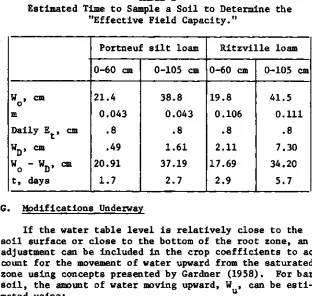
Meteorological Data Limitations
Energy balance and, in some cases, mass transfer meas-urements have become reliable and accurate methods of de-termining daily evapotranspiration in experimental studies. However, the cost, technical skills, and data processing required effectively prohibit these techniques on a contin-uing daily basis even for a single reference field within a project. Instead,
estimates of "potential
evapotranspira-tion," or evapotranspiration that occurs with a well-wa-tered reference crop like alfalfa with 30 to 50 cm of growth within the area, areadequate. Also, if
a combina-tion equacombina-tion is used, only daily values of meteorological data are needed to provide the necessary accuracy of ± 10 to 15% on a daily basis. The accuracy for 5- to 20-day periods will be better if the errors are random.required for energy balance computations may actually re-quire a scientist's daily attention. Since this degree of skill is not practical for most irrigation scheduling ser-vices, procedures that require daily, precise
meteorologi-cal measurements are restricted.
TABLE 1
Technical Skills Required to Obtain Reliable Daily Meteorological Data on a Routine Basis without Daily
Supervision by a Research Engineer or Scientist. (The x i s denote an acceptable level of training.)
Training required Meteorological
parameters Observers Technicians Meteorologists
Air temperatures
Max-min thermometers x x
Thermographs x* x
Humidity (dew point)
Sling psychrometer x* x
Hygrograph x
Wind (daily run)
Integrating anemometer x* x x
Solar radiation (daily)
Actinograph xt
Integrating unit xt
(sensor-integrator)
Sunshine hours x* x
Net radiation
Integrating unit x*
Evaporation
Standard pans x* x
* Periodic calibration, maintenance and instruction needed. t Periodic calibration, maintenance and instruction by a
trained meteorologist, research engineer or scientist.
Effective Use of Regional Experimental Data
In the U.S.A., the amount of research data available far most large irrigated areas is often extensive and rep-resents a large investment of private and public funds. The interpretation of experimental data for optimum irriga-tion water management requires skills in the science of agronomy and plant-soil-water relations. Similarly, the collection and interpretation of soils data available from previous experiments requires practical knowledge of soil-water principles. Workshops are frequently conducted for
farm managers. Similar but more technical workshops are needed for the professional staff members of service compa-nies. There are some circumstances in which knowledge of
soil-water storage is of no avail. These usually occur when the irrigation system can apply only a limited amount of water per irrigation, less than the generally allowable soil water depletion for a given soil and crop, and when expected rainfall is insignificant. In such cases, the ac-tual allowable depletion of soil water between irrigations will be largely determined by the irrigation system and not by soil characteristics.
USDA-ARS-SWC Irrigation-Scheduling Computer Program
A. History of Development
The USDA computer program was developed cooperatively with farm managers and service groups as a tool for
provid-ing managers of irrigated farms with scientific estimates of irrigation needs for each field. This approach is not the only solution to the problem, but it is one that has gained rapid acceptance. The computer program requires limited input data and uses simple, basic equations so that each can be replaced as more accurate relationships are de-veloped. The principles and procedures involved are de-scribed in several recent publications (Heermann and Jensen, 1970; Jensen, 1969; Jensen and Reerman, 1970; Jensen et al., 1971). A summary of the computer program is given in the next section.
the Salt
River project (Franzoy and Tankersley, 1970). During 1970, a number of service groups and companiesgained experience in
the use of this general
concept of ir-rigation scheduling. The Salt River Project at Phoenix, Arizona, for example, has used the program for three years. After the first two years, the original program was revised, retaining the basic components, but the input-output data and format and some of the crop curves were changed to fit local facilities and crops (Franzoy and Tankersley, 1970). The irrigation predictions should be updated twice a week when shallow-rooted crops are involved or when evapotrans-piration rates are high. Weekly updating suffices for most field crops.The U.S. Bureau of Reclamation has modified the program to provide general irrigation forecasts for major crops in an area. This
service was made available to
southern Idaho for 54 farm operators in 1970. A field-by-field scheduling and monitoring service was provided for 68 fields on 15 farms within the same area (Brown and Buchheim, 1971). Thegeneral forecasts
were updated once a week and distributedto cooperators who provided their own field monitoring. An
agricultural technician made weekly visits
throughout the irrigation season onthe 15 farms on
the field-by-field program. Additional changes have been made for 1971 which include both the General Irrigation Forecasts and Field Scheduling and Monitoring Methods.These methods will be
used in 1971 on two irrigation districts in southern Idaho with field monitoring provided by trained technicians on each farm.An agriculture technology company in McCook, Nebraska is using a modified version of an earlier program in Ne-braska and Kansas (Corey, 1970). This company is also
planning to add
fertilizermanagement
to its service in1971.
Approximately 8,000 hectares were scheduled in 1970 by
various groups
in
Idaho, Nebraska, and Arizona. An
esti-mated 50,000 hectares will be scheduled in 1971, with near-ly half of the area involving cotton on the Salt River Pro-ject. Other private companies are adding this service toThe concept of scheduling irrigations using climatic data is not new. Das (1936) suggested using climatic data to control irrigations in the 1930's. The concept received
more attention following the publications of Penman (1948,
1952) and Thornthwaite (1948). In 1954, Baver stated:
The meteorological approach to irrigation has the advantage of simplicity of operation when compared with methods based upon measurement of soil moisture changes. If it is proved satisfactory, the costs of using this system
would be relatively small. Undoubtedly, new
techniques will be developed that will give an
integrated measure of daily temperature, sun-shine and solar energy. When such methods are available, meteorological data can becorre-lated better
with evapotranspiration.Many others have since discussed this approach (Beier, 1957, 1959; Pierce, 1958, 1960; Pruitt and Jensen, 1955; Rickard, 1957; van Bavel, 1960; van Bevel and Wilson, 1952).
However, prior to 1965 this method had not been adapted for
general practical use or tested extensively in the United States. The Penman equation is often referred to as beingtoo complex for practical use (Fitzpatrick and Cossens,
1965). However, with modern low cost computers, there is no justification in using less refined methods of computa-tion when the meteorological data are easily obtainable.B. Operatinig Costs
The current costs of this service range from $4.00 to $10.00 (U.S.) per hectare. The lower cost is for large acreages, crops requiring less frequent monitoring, and short-season crops.
C. Operational Steps
preferably in an open area over a surface that does not change significantly in roughness or displacement height during the growing season. Prior to 1971 (Jensen et al., 1971), the combination equation as presented by Penman (1963) was used in the following format:
E* = q
+
y (R n + G) + (15.36)(1.0 + 0.0062u2)(es -e
d)A
A +y
(1) where q is the slope of the sat
uration vapor pressure-tem-perature curve, (de/dJ), mb "C - ; y is the psychrometric constant (0.66 nib 0 C -L at 20'C and 1 bar pressure); e is the mean saturation vapor pressure in mb (mean at maximum and minimum daily air temperatures); and ed is the satura-tion vapor pressure at mean dewpoint temperature in mb; u 2 is total daily wind run in km day -1 at a height of 2 m; R is net radiation in cal cm -2 day-1 , and G is heat flux from the soil in cal cm-2 day-1 (negative when the heat flux is
to the soil). The parameters qRq + y) and y/(q + y) are mean air temperature weighting factors whose sum is 1.0.
Since the percent of sunshine or degree of cloud cover, normally used to estimate net longwave radiation, are gen-erally not available, or are qualitative rather than quan-titative, procedures were developed for estimating net ra-diation using observed daily solar rara-diation, R , relative to solar radiation that would normally be expected on that day if there were no clouds, R o . Cloudless-day values can be obtained from various tables such as those by Fritz
(1949) or Budyko (1956) or by plotting observed solar radi-ation to obtain an envelope curve through the high points. Net radiation in cal em-2 day -1 is then estimated as fol-lows:
Rn m (1 - cl) Rs Rb
where a is the mean daily shortwave reflectance or albedo, and Rb is the net outgoing longwave radiation. An albedo of 0.23 is currently used in the program. R h is estimated
as follows:
R s
Rb (al b l ) Plc
so
where Rho is the net outgoing longwave radiation on cloud-less days. The constants a i and b 1 derived with data from
(2)
Davis, California
are 1.35 and -0.35, respectively, and
)for Idaho 1.22 and -0.18, respectively (Wright and Jensen,
1971).
The net outgoing longwave radiation on cloudless days
is estimated using:
T,
4+ T
4 Rbo
(a2
1'2/C)(11.71 x 10
-) '
1 2
where e, is the saturation vapor pressure at mean dewpoint
temperature in mb; 41.71 x 10' is the Stefan-Boltzmann
constant in cal cm
-' day
-1 0K-4 ; and T2 and T1 are the max-imum and minmax-imum daily air
temperatures,
respectively, in°K. The constant, a
2'
formerly used was 0.32.
However, recently a slight variation in the constant a 2 improved the estimates of net radiation (Wright and Jensen, 1971):a
2 = 0.325 + 0.045 sin [30(H + D/30 - 1.5)] (5)
where M is the month, 1-12, and D is the day, 1-31. The constant, b,, now used is-0.044, which is the
average of
the valueobtained by Goss and Brooks (1956) in California,
0.040, and the value obtained by Fitzpatrick and Stearn(1965) in Australia, 0.049.
Thesi
-constants in
the Bruntequation for effective atmospheric
emittance were found tobe more suitable for arid conditions than those originally
proposed by Penman.Daily soil heat flux, G, is estimated with a simple
em-pirical equation using the
difference betweenmean daily
air temperature and the average temperature for the threeprevious days. This component is currently being revised.
For practical purposes,
it can be assumed to be zero under a crop with a full cover, such as alfalfa.Estimates of daily evaporative flux for the reference crop, E*, in cal cm -2 day are converted to depth equiva-are lent, , using 585 cal
g
-1 as the heat of vaporization.EvapotrRspiration for
a given agricultural crop, E t , isestimated from the daily reference evaporative flux as
fol-lows:
E
t K cEtp (6)
where K
c is a dimensionless coefficient similar to that
lW.O. Pruitt, personal communication.
M. E. JENSEN
proposed by van Wijk and
De Vries (1954)
and Makkink and van Hermst (1956). This Crop coefficient represents thecombined relative effects of the resistance of water move-ment from the soil to the various evaporating surfaces and
the resistance to the diffusion of water vapor from the surfaces to the atmosphere, as well as the relative amount of radiant energy available as compared to the reference crop (Jensen, 1968).
R + G + A
K = (7)
c R + G + A
no o o
where A is the sensible heat flux to (-) or from the air (+) and G is the sensible heat flux to (-) or from the soil (+); and R is net radiation to the crop-soil surface (+). The subscrRpt o designates concurrent values for the refer-ence crop in the immediate vicinity (in this case, alfalfa). The major term affecting K is A, which is usually negative on a daily basis for crops with small amounts of leaf area in arid zones, but it may be positive for alfalfa. The crop coefficient can also be expressed in terms of mean daily Bowen ratios and net radiation (Jensen, 1968).
Typical examples of the effects of growth stage on the crop coefficient. where soil water is not limiting have been presented for grain sorghum by Jensen (1968), and for corn by Denmead and Shaw (1959). More recently, there have been numerous publications presenting observed relative rates of evapotranspiration as
compared to an estimate or
measure-ment of the evaporative potential (e.g., Ritchie, 1971; Ritchie and Burnett, 1971). Mathematical models of K based on leaf area index, leaf stomatal resistance to cdif-fusion of water vapor, soil water, and other relevant pa-rameters, may be used in place of experimental
values
when they become practical for use with limited data.Since the actual crop coefficient K is generally in-fluenced by the wetness of the soil surface, it is automat-ically adjusted in the computer program as follows:
K
c = KcoKa + Ks (8)
where K is the expected crop coefficient based on
experi-mentalaata where soil water is not limiting and normal
plant densities are used; and K a is the relativecoeffi-cient related to available soil water. Currently K is as-sumed to be proportional to the logarithm of the pe
a
of remaining available soil moisture (AM):
K
a = In (AM + l)/ln 101—
IC
s is the increase in the coefficient as a result of the soil surface being wetted by irrigation or rainfall. The maximum value of K normally will not exceed 1.0 for most crops. Currently,
o
the values for K for the first, second and third day after a rain or irrigation have been taken as follows: (0.9 - K oo ) 0.8; (0.9 -co ) 0.5; and (0.9 - K co ) 0.3, respectively.
Soil water depletion after an irrigation is calculated as follows:
D = (E
t - Re - I + W d ) i
where D is the depletion of soil water
(after a
thorough irrigation D • 0); Re is effective rainfall (excluding run-off); I is irrigation water applied, Wd isdrainage from
the root zone or upward movement from a saturated zone; and i = 1 for the first day after a thorough irrigation when D = 0. The terms on the right hand side of the equation are daily totals in centimeters.
The date of the next irrigation is predicted by the re-maining soil water that can
be safely
depleted and the cur-rent average E t .. (10)
where N is the estimated days to the next irrigation if no rain occurs; D is the current optimum depletion of soil
water in cm; D o
is the estimated depletion to
datv
in cm; and is thecurrent mean rate of E t in an day -'. The magnitude of D will vary with each crop and field, and will be partially dependent on the irrigation practice usedThe amount of water added to a given soil by furrow irriga-tion during a 12-hour irrigairriga-tion, for example, will be af-fected by furrow slope, stream size, etc.
The amount of water required for the next irrigation, WI , is calculated by dividing D 0 by the attainable effi-ciency for the irrigation system.
(9)
D - D
N o
Et
N = 0 for D D
Adjustments for leaching can be made, if necessary. At this time periodic monitoring of the salt concentration in the soil
is
recommended. If the amount of water applied and its salt concentration are known, then automatic ad-justments for leaching can be added to the program.D. Input Data
There are three categories of input data
required
which should be provided by the service groups working with the farm managers.Basic Data: Basic data consist of the regional con-stants for the E* equations, taking into account the dif-ferences in height of wind measurements, and the crop-soil system data for each field.
The latter item involves
the farm name, crop code number, crop-field identification, planting date, estimated effective cover date, estimatedharvest date,
estimated overall irrigation efficiency for each field based on the system being used, and the maximum amount of soil water that could be depleted by evapotrans-piration for each crop. The maximum depletion by evapo-transpiration is estimated as the difference between a soil water content about four days after irrigation of a soilthat is about 60 to 90 cm deep and has been covered to
pre-vent evaporation (Miller, 1967), and the soil
water contentreached when the given crop with a fully developed root
system is allowed to
grow without irrigation until growth ceases. If the amount of water applied is known, then a function for WA can also be used in equation (9).Current Meteorological Data: Current
meteorological
data required for each region are: daily minimum and maxi-mum air temperatures, daily solar radiation, daily dewpointtemperature, and total daily wind run for each day since
the
last computation date. An optional brief weatherfore-cast can be included for each region, and a coefficient
ad-justing the expected E* for the next five days either up-ward or downup-ward can be included based on current forecasts.OPTIMIZING THE SOIL ENVIRONMENT
E. Output Data
The output data can be modified by the service groups
to suit their operating procedures and facilities. A
typi-cal example of the output received by a farm manager is
il-lustrated in Computer Output Sheet
A.A
typical example of a portion of the output provided
the farm managers receiving generalized forecasts of
irri-gation needs is given in Computer Output Sheet B.
F.
Recent Modifications
Calibration of E* Equations: Under arid conditions,
the constants in the Penman equation tend to underestimate
E* during high advective conditions (Jensen et al., 1971;
Rosenberg, 1969). Under theseconditions, the magnitude of
the aerodynamic portion of the combination equation is
sig-nificantly larger than in semihumid areas. This can best
be illustrated by
useof several examples and a derivation
similar to that presented by van Bevel (1966) as follows:
E* = A (R + G) + —Y---LBd (11)
A + y n A +y v a
where L is the latent
eat of vaporization; B y is a
trans-fer coefficient, g cm- min-1 ; and da
is the saturation va-por pressure deficit of the air, mb. By algebraic manipu-lation of equation (11) and the energy balance equationgiven in the next paragraph, it can be shown that:
L By da = E* + 7 A
(12)
For the examples, assume the following energy balance
equation and meteorological conditions:
E* = (Ra + G) + A
T = 26°C
P = 1000 mb
Under these conditions,
0O Pr P., cy 0.4 0%
ri ri ri
z
H
ex
1 5g
3.
0c, rn on ri Nt ul ON C7 v-1
en rn r4 ul CA 0 r4
E-n
.•
0 .0 n 7 en co
tg r4 N 0 04 04 01 1.4 r4
I-110
A OACqi7 ri P• ri 9.0 0 .0 ...1"tiC
N 8
4g
OD CD CD Pr 1,1 01 C7
ri ri 01 rl r4 CD
r4 r4
r4 0 0 0 el 4:
r•-• f•••• 0 rl Ch a% CA VD CO
8
0• • 0•0•0•0•0
•0•cs
d E-I
R
04 2 c%
CO
as
6
••
• • • • • •
ul r4 lel CO CO CO OD r4 r4
6
0
Ifl mpr. CO C; 0
1
1.4 P4 r4 ri ri C4
c
AN44eA4
n-4 Fa
rn
0
ICC !E
0 0
R7c4
N
E4
U,
8
a
00
CR
ri
.
07
ti
CD
F4
4.7
6
P4 P
tn
tn Pq
tg
0 C4 4.1
0 0
8
g
dg
d d110 "1 PI 1'1 1-1 1-7
01 vl VD 00 o'
CD
F4 4I ul vp Ch 0 C4
M 1
:4 5! ;.
1
.4 ;1 4 4
t4gB)
4
gtn
P4 GI vl f". OD CD F-4 r4 r4
F4 kl rA 1-4 rA
r541°A
dd
1-1 0
MOD0h.-INC•CM .4 O H N C4
hERN4
g,40,
Example (1) advective conditions:
(Rh + G) = 370 cal cm-2 day-1
A
= 130 cal cm-2 day
-1
E*
= 500 cal cm-2 day
-1
From equations (11) and (12), the following results are
ob-tained:
E* = 0.75(370) + 0.25[3(130) + 500] = 277.5 + 0.25(890) =
500 cal cm-2 day 1
Example (2) sensible heat transfer to the air:
(R + G) = 370 cal cm 2 day-1
When these data are substituted into equations (11) and
(12), the following results are obtained:
E* = 0.75(370) + 0.25[3(-70) + 300] = 277.5 + 0.25(90) =
300 cal cm-2 day-1
These two examples clearly illustrate that the
aerody-namic term becomes significantly larger when there is warm
air advection. Consequently, the aerodynamic term must be
more accurate under arid conditions where warm air
advec-tion is common (a negative mean daily Bowen ratid) than in
semihumid areas where sensible heat is generally
trans-ferred to the air from the crop surface (a positive mean
daily Bowen ratio).
Since the Penman equation underestimates E*, Wright and
Jensen (1971) developed the following empirical
coeffi-cients for a linear wind function in equation (1) using
ly-simeter data and local U.S. Weather Service meteorological
observations:
f(u) = 0.75 + 0.0114u2 (13)
where u2 is the winds peed measured at a height of 2 m in km
day-1 . This wind function gives essentially the same
re-sults at moderate windspeeds as does the van Bevel
aerodynamic term (7.15ualn(z/z)12 in place of 15.36(1.0 + 0.0062u
2) in equation z
(1), providing that the roughness
parameter, z,, is no greater than 1 cm.
Probability of Rainfall: Heermann and Jensen (1970)
modified the computer program to include expected rainfall in predictingthe date of the
next irrigation. They also modified theestimates of
expected potential evapotranspi-ration when the irrigation date is more than five days in the future, as follows:E[E
tp] = Etp exp [ (
t
At
t"
)2] (14)
where
E[Et ] is theexpected
value of potential evapotrans-piration a€ a given day t (in Julian days); t' is the Jul-ian calendar day when the maximum mean potential evapo-transpiration, Eip, occurs (about July 15 to July 25 in thenorthern hemisphere); and At is the days
before and thedays after t' when E[E
t= 0.37E'
tp. Normally a different
value of At is used fort < t' as compared to t a t'.
The
major advantage of this procedure is that expected
poten-tial evapotranspiration is represented by a simple 3-param-eter equation using E;,, t', and At. For example, in southern Idaho E; = 081 cm, t' = 206, and At = 150 for t < t' and 93 foiPt a t'.Two expected dates of the next irrigation are
then
cal-culated: one assuming norain, and one
assuming 50%proba-ble rainfall. Daily
depletion is first calculated untilD D
o using equations (9) and (15).
(E
t) = (I{cE[Etp]) (15)i
Then this date is extended by the expected rainfall during
thewintervening period. If the next irrigation is
pre-dicted within the next five days, then E[E
r,] is increased
or decreased by a current forecast coeffici&t.
Effective Field Capacity:
Abetter estimate of
"effec-tive field capacity" can be obtained by estimating
cumula-tive drainageexpected between irrigations.
Estimates of the cumulative drainage, WD, between irrigations can be ob-tained using the following equations that are based on the empirical relationship of water content and time for a soil that is draining:W = cW ot
-M
M. E. JENSEN
where W is the water content in cm; W A the water content
when. t = 1; m is a constant for a soil; and c is a
dimen-sional constant, tm (Ogata and Richards, 1957).
According-ly,
ddt
dW
_
raw H
1
(17)
The cumulative drainage can be calculated in a manner
simi-lar to that proposed by Wilcox (1962):
W
D
= y m[Wi-1 -
(
Et
)]
14
i-1
i=1
[
-
I
W
m
o
(Et)
1
(18)
where W
n
is drainage, cm; i is the number of the day after irrigation; and Et
is the evapotranspiration for the day incm. The most representative time to sample a soil that has
been covered to prevent evaporation after a thorough
irri-gation can be obtained by integrating equation (17) between
the limits of Wo and WD.
t = (
14
cW)
1(19)
Since dW/dt rapidly + 0 using equation (17), about 5 to 20
days of calculations are needed before dW/dt < 0.01 cm
day I. Example calculations based on data from southern
Idaho and unpublished data from D.E. Miller (USDA-ARS-SWC,
Prosser, Washington) are summarized in Tab
j
e 2.
In these
examples, Et was assumed to be 0.8 cm day -i . In detailed
laboratory measurements, Miller and Aarstad (1971) found
that sampling 3.5 days after irrigation slightly
underesti-mated the available water for the 0- to 70-cm depth, and
TABLE 2
Estimated Time
to Sample a Soil to Determine the
"Effective Field Capacity."Portneuf silt loam
Ritzvi le loam
0-60
cm0-105 cm 0-60 cm
0-105 cm
Wo , cm
21.4
38.8
19.8
41.5
m
0.043
0.043
0.106
0.111
Daily E t , cm
.8
.8
.8
.8
WD , cm
.49
1.61
2.11
7.30
Wo - WD' cm
20.91
37.19
17.69
34.20
t, days
1.7
2.7
2.9
5.7
G. Modifications Underway
If the water table level is relatively close to the
soil surface or close to the bottom of
the root zone, an adjustment can be included in the crop coefficients to ac-count for the movement of water upward from the saturated zone using concepts presented by Gardner (1958). For bare soil, the amount of water moving upward, Wu
, can be esti-mated using:W
u -
0.9
z i nE
atl)
for z > a w — C
with a crop,
fAM - a4 ][ z e in
(
Wu m 1 100 - a4j zw - zr Et
where z is the effective height of the capillary fringe
above
tffe watertable, cm; zw is the depth to the water
ta-ble, cm; z r is the depth of roots, cm; AM is available soil
(20)water to Z r in percent; a4
is
a constant (about 25); and is a constant for a given soil and crop (expected to vary between 1 and 3). An example of this approximation of W u is presented in Figure 1 using unpublished data from L.N. Namken (USDA-ARS-SWC, Weslaco, Texas). (Constants used in equation (20) are zw = 273 cm, z c = 50 cm, n = 1.22, and a4 = 25%.)
q O.2 04 0.6 0.6 10 OBSERVED Wu ( cm day" 1 )
accuracy of all projected irrigations.
Summary
Irrigation programming practices have not changed ap-preciably in many areas during the past three decades be-cause suggested techniques have not been acceptable, and the direct and indirect
effects of excessive water use were
not readily apparent.Several
alternative methods of pro-gramming irrigations are now available. The scheduling of irrigations for each field using meteorological, soil, and crop data, coupled with field inspection, appears to be an economical and acceptable irrigation management service in the U.S.A. An irrigation management service requires tech-nical competence and a good communications network. Relia-ble meteorological data also require technical competence,and periodic calibration of instruments.
The USDA-ARS-SWC irrigation scheduling computer program using meteorological techniques and soil-crop data is de-scribed in this chapter. Since its development and use for
several years in Arizona,
Idaho, and Nebraska, several mod-ifications have been completed and others are under way.This problem has enabled private firms and
service
agencies to gain experience in providing irrigationmanagement
ser-vice while
additional refinements are under way.References
1. Baier, W. (1967). Recent advancements in the use of standard climatic data for estimating soil moisture.
Ann. Arid Zone 6, 1-21.
2. Beier, W. (1969). Concepts of soils moisture availa-bility and their effect on soil
moisture estimates from
a meteorological budget. Agr. Meteorol. 6, 165-178. 3. Bever, L.D. (1954). The meteorological approach toir-rigation control. Hawaiian Planter's Record 54, 291-298.
4. Brawn, R.J. and Buchheim, J.F. (1971). Water schedul-ing in southern Idaho, "A Progress Report," USDI Bur. of Reclamation. (Presented at the Nat. Conf. on Water Resources Eng., ASCE, Phoenix, Ariz., 1971.)
5. Budyko, I.I. (1956). The heat balance of the earth's surface. U.S. Dept. Com . Weather Bur. PB 131692
6. Corey, P.C. (1970). Irrigation scheduling by computer. Presented at the Joint Canv, of the Neb. State Irrig. Assn. and the Neb. Reclamation Assn., Grand Island, Neb., 1970.
7. Das, U.K. (1936). A suggested scheme of irrigation control using the day-degree system. Hawaiian Plan-ter's Record 37, 109-111.
8. Denmead, 0.T. and Shaw, R.H. (1959). Evapotranspira-tion in relaEvapotranspira-tion to the development of the corn crop. Agron J. 51, 725-726.
9. Fitzpatrick, E.A. and Cossens, G.G. (1966).
Applica-tions of Penman's and Thornthwaite's methods of
esti-mating transpiration rates to determination of moisture
of three Central Otago soils. N.Z. J. Agric. Res. 9, 985-994.10. Fitzpatrick, B.A. and Stern, W.R. (1965). Components of the radiation balance of irrigated plots in a dry monsoonal environment. J. Applied Meteorol. 4, 649-660. 11. Franzoy, C.E. and Tankersley, E.L. (1970). Predicting
irrigations from climatic data and soil parameters. Trans. Amer. Soc. Agr. Engs. 13, 814-816.
12. Fritz, S. (1949). Solar radiation during cloudless days. Heating & Ventilating 46, 69-74.
13. Gardner, W.R. (1958). Some steady state solutions of the unsaturated moisture flow equation with application to evaporation from a water table. Soil Sci. 85, 228-232.
14. Goss, J.R. and Brooks, P.A. (1956). Constants for em-pirical expressions for downcoming atmospheric radia-tion under cloudless skies. J. Meteorol. 13, 482-488. 15. Heermann, D.F. and Jensen, M.E. (1970). Adapting
me-teorological approaches in irrigation scheduling. Proc. ASAE Nat. Irrig. Symp., Lincoln, Neb., 1970, 00-1 to 00-10.
16. Israelsen, 0.W., et al. (1944). Water application ef-ficiencies in irrigation. Utah Agr. Exp. Sta. Bul. 311. 17. Jensen, M.E. (1968). Water consumption by agricultural
plants. In "Water Deficits and Plant Growth" (T.T. Kozlowski, ed.), Vol. II, pp. 1-22. Academic Press, New York.
18. Jensen, M.E. (1969). Scheduling irrigations using com-puters. J. Soil and Water Conserv. 24, 193-195.
20. Jensen, M.E., Wright, J.L., and Pratt, B.J. (1971). Estimating soil moisture depletion from climate, crop, and soil data. Trans. Amer. Soc. Agr. Eng. Winter Meeting, 1969, Paper No. 69-641 (in press).
21. Jensen, M.E. and Heermann, D.P. (1970). Meteorological approaches to irrigation scheduling. Proc. Amer. Soc. Agr. Eng. Nat. Irrig. Symp., Lincoln, Neb, 1970, NN-1 to NN-10.
22. Makkink, G.F. and van Hermst, H.D.J. (1956). The ac-tual evapotranspiration as a function of the potential
evapo-transpiration
and the soil moisture tension.Neth. J. Agr. Sci. 4.
23. Marshall, W.G. (1971). Operating a farm consulting
business. Proc. Sprinkler Irrig. Tech. Conf er Denver,Colo 1971.
24. Miller, D.E. (1967). Available water in soil as influ-enced by extraction of soil water by plants. Agron. J. 59, 420-423.
25. Miller, D.E. and Aarstad, J.S. (1971). Available water as related to evapotranspiration rates and deep drain-age. Soil Sci. Soc. Amer. Proc. 35,.131-134.
26. Ogata, G. and Richards, L.A. (1957). Water content changes -following irrigation of bare-field soil that is protected from evaporation. Soil Sci. Soc. Amer. Proc. 21, 355-356.
27. Penman, H.L. (1948). Natural evaporation from open wa-ter, bare soil and grass. Proc. Roy. Soc. A93, 120-145. 28. Penman, H.L. (1952). The physical basis of irrigation
control. Proc. Int. Hort. Cong. t. London 13, 913-924. 29. Penman, H.L. (1963). Vegetation and hydrology. Tech.
Commun. No. 53, Commonwealth Bur. of Soils, Harpenden, England.
30. Pierce, L.T. (1958). Estimating seasonal and short-term fluctuations in
evapo-transpiration from meadow
crops. Bul. Amer. Meteor. Soc. 39, 73-78.31. Pierce, L.T. (1960). A practical method of determining
evapotranspiration from temperature
and rainfall.Amer. Soc. Agr. Eng. Trans. 3, 77-81.
32. Pruitt, W.O. and Jensen, M.C. (1955). Determining when
to irrigate. Agr. Eng. 36, 389-393.
33. Rickard, D.S. (1957). A comparison between measured
and calculated soil moisture deficit. N.Z. J. Sci. and
Tech. 38, 1081-1090.
T
OPTIMIZING THE SOIL ENVIRONMENTsubhumid climate: I. Micrometeorological influences. Agron. J. 63, 51-55.
35. Ritchie, J.T. and Burnett, E. (1971). Dryland evapora-tive flux in a subhumid climate: II. Plant influences. Agron. J. 63, 56-62.
36. Rosenberg, N.J. (1969). Seasonal patterns in evapo-transpiration by irrigated alfalfa in the Central Great Plains. Agron. J. 61, 879-889.
37. Thornthwaite, C.W. (1948). An approach toward a ra-tional classification of climate. Geograph. Rev. 38, 55-94.
38. Tyler, C.L., Corey, G.L., and Swarner, L.R. (1964). Evaluating water
use on a
new irrigation project. Ida-ho Agr. Exp. Sta. Res. Bul. No. 62.39. van Bavel, C.H.M. (1960). Use of climatic data in guiding water management on the farm. In "Water and Agriculture," pp. 80-100. Amer. Assn. Advan. Sci. 40. van Bavel, C.H.M. (1966). Potential evaporation: The
combination concept and its experimental verification. Water Resources Res. 2, 455-467.
41. van Bavel, C.H.M. and Wilson, T.V. (1952). Evapotrans-piration estimates as a criteria for determining time of irrigation. Agr. Eng. 33, 417-418, 420.
42. van Wijk, W.A. and de Vries, D.A. (1954). Evapotrans-piration. Neth. J. Agr. Sci. 2, 105-119.
43. Wilcox, J.C. (1960). Rate of soil drainage following