The Journal of Social Sciences Research
ISSN(e): 2411-9458, ISSN(p): 2413-6670
Vol. 5, Issue. 12, pp: 1758-1767, 2019 URL: https://arpgweb.com/journal/journal/7 DOI: https://doi.org/10.32861/jssr.512.1758.1767
Academic Research Publishing Group
Original Research Open Access
The Role of Gastronomy in Trips: Types and Motivations
Miguel Jesús Medina-Viruel
Department of Applied Economics, Agrifood Campus of International Excellence, ceiA3, University of Córdoba, Córdoba, Spain, Faculty of Law and Business Administration, St. Puerta Nueva, s/n. E-14071-Córdoba, Spain
Pedro Antonio Fuentes Jiménez
Coordinator of the Doctorate in Business Management Royal Mayor and Pontifical University of San Francisco Xavier in Chuquisaca, Sucre, Bolivia Aniceto Arce # 46 – Sucre, Bolivia
Jesús Claudio Pérez Gálvez
Department of Applied Economics, Agrifood Campus of International Excellence, ceiA3, University of Córdoba, Córdoba, Spain Faculty of Law and Business Administration, St. Puerta Nueva, s/n. E-14071-Córdoba, Spain
Francisco González Santa Cruz
*Department of Business Administration, Agrifood Campus of International Excellence, ceiA3, University of Córdoba, Córdoba, Spain Faculty of Law and Business Administration, St. Puerta Nueva, s/n. E-14071-Córdoba, Spain
Abstract
Currently, gastronomy is a fundamental pillar for tourists to discover the cultural potential of the places that they visit, with culinary pleasures becoming determining motivations in the choice of a destination. With this idea, this research investigates the gastronomic experiences of tourists who visit a place recognized by UNESCO as a World Heritage Site, the city of Sucre in Bolivia. It highlights the existence of three types of tourists, based on their perceptions regarding the gastronomic experiences in the city (known as survivors, enjoyers, and experiencers). Additionally, it concludes that the local gastronomy of the destination provides significant culinary motivations.
Keywords: Gastronomy; Tourism; Bolivia; Segmentation; Motivation.
CC BY: Creative Commons Attribution License 4.0
1. Introduction
Tourists are increasingly determining their satisfaction with a destination according to their evaluation of their gastronomic experience there, especially in places with great historic–cultural symbolism. This way, gastronomic traditions and heritage are constructs very closely linked due to the first being born from the customs and different cultures that have inhabited a specific place and the relationship of these with its surroundings (Björk and
Kauppinen-Räisänen, 2019; Hwang et al., 2005; Sampaio, 2018). Hence, the formation of elder knowledge related
to gastronomy has developed parallel to the transformation of the territory and the building up of its heritage´s wealth (Gacnik, 2012; Su, 2013). The diversity and the wealth in cuisine of the city of Sucre have awarded it being recognized as one of the gastronomic capitals of Bolivia (declared so in the Legislative Plurinational Assembly, December 28th, 2011, through Law Number 217, which acknowledges the culinary diversity in the regions, provinces and towns of Chuquisaca). Due to this the main objective of this research is to analyse the interest and the motives of travellers related to local food in a first-class heritage destination, the city of Sucre (Bolivia), which has been recognized by UNESCO as a World Heritage Site (WHS) since 1991, under the name of the Historic City of Sucre.
The value that determines the gastronomy of a place can range from purely physiological aspects, derived from individuals’ need to eat and whether they are a tourist, to considering it as a privileged way of understanding the ancient customs of the destination, its history, or its social relationships. In this case, it is necessary to determine the different segments of tourists according to their inter-relationship with the gastronomy of the place visited and to
know their motivations and perceptions in relation to this variable of tourist attraction and loyalty (Hjalager, 2004;
Pesonen et al., 2011). Accordingly, a wide range of possibilities determine the gastronomic experience, from the purely helpful and logistical support of the trip to a key part of the composition of the tourist experience and even the
determining factor of the choice of the destination (Basil and Basil, 2009; López-Guzmán et al., 2017). On the other
hand, a new relationship has recently been seen between gastronomy and tourism, represented by exclusive travellers, such as chefs who seek to discover new culinary techniques, products, flavors, textures, and so on for their renowned restaurants by visiting these places. In this way, the destination visited becomes the source of innovation for culinary developments (Baldwin, 2017).
Additionally, gastronomy is becoming a factor for the economic improvement of destinations, especially in
countries that are still developing (Mgonje et al., 2016). Therefore, gastronomic tourism is being discovered to be a
from point of view of the economic–social development that it provides for the destination (Anderson et al., 2017;
Vázquez-Martínez et al., 2019).
With these initial ideas, the goal of this article is to complete a segmentation of the tourists who visit the heritage city of Sucre in the Plurinational State of Bolivia and, on the basis of this segmentation, to discover their motivations and their level of satisfaction in relation to the gastronomy of this World Heritage Site. In this case, it intends to advance the emerging research into gastronomy in Latin American cities. On this continent, considerable development of this tourist attraction has been pursued in recent years, with the aim of making the most of its culinary richness as a vehicle for the development and consolidation of tourism, as has been achieved on other continents, such as Asia (Baldwin, 2017).
2. Literature Review
2.1. Segmentation of Tourists on the Basis of Gastronomy
The segmentation of the tourism of a destination allows for the public and private organizations in charge of its management to create tourist products adapted to the needs and demands of the homogeneous groups of tourists that have been identified. In the area of gastronomy, this segmentation is fundamental. If the culinary experience of the place visited responds to the desires of the tourists, it will be possible to increase their satisfaction with the local gastronomy and hence their loyalty to the destination. In this case, Kivela and Crotts (2005) indicated three ideas regarding the relationship between gastronomy and tourists: the first determines the direct relationship between local cuisine and tourism, analyzing the motivation (primary or secondary) that the gastronomy of the destination has in the decision to visit that place; the second seeks to study tourists’ way of approaching the gastronomic legacy of the destination; and the third considers the impact that gastronomy has on the economic and social development of the tourist destination being analyzed.
For the generation of consumption segments, the scientific literature has used different approaches. In this case, one of the techniques that may be used is factor–cluster analysis (Park and Yoon, 2009; Prayag, 2010). However, this approach has been the subject of severe criticism as a result of the loss of original information, abstract interpretations, or inexact conclusions (Dolnicar, 2008; Dolnicar et al., 2012; Prayag and Hosany, 2014). Due to this, this research uses the segmentation approach proposed by Dolnicar (2008), which involves the direct grouping of the original scores, allowing for a more detailed and robust segmentation given its capacity to preserve a greater amount of original data (Dolnicar, 2002; Prayag and Hosany, 2014; Sheppard, 1996).
The scientific studies focusing on the segmentation of gastronomic tourism are mainly collected into three
different blocks, analyzing tourist destinations (Kivela and Crotts, 2005; López-Guzmán et al., 2017; McKercher et
al., 2008), food festivals (Kim et al., 2015; López-Guzmán et al., 2017), and food markets (Crespi-Vallbona and
Dimitrovski, 2016). Hjalager (2004), analyzed a segmentation model of gastronomic tourists determining four
groups of visitors according to their culinary experience: recreational, existential, diversionary, and experimental gastronomy tourists.
This research about the role of gastronomy in trips (specifically in the city of Sucre, Bolivia) was based on the most recent segmentation model of gastronomic tourists provided by Björk and Kauppinen-Räisänen (2016). These researchers proposed tourist segmentation based on three questions related to the destination’s gastronomy: “how important are food and eating as motives for traveling,” “how important are food and eating experiences when choosing a destination,” and “how important are food and eating for travel satisfaction?” From the analysis of these questions, the model proposed differentiates three segments of gastronomic tourists: (1) experiencers, those who travel to gain food experiences; (2) enjoyers, those with a positive attitude toward food; and (3) survivors, those with very little or no interest in food.
As a result of the literature review, the hypothesis to confirm is the following:
H1: The visitors have different attitudes toward local gastronomy.
2.2. Motivation and Gastronomy
The gastronomy of a place may represent a primary consumption motivation of a purely alimentary nature, until it becomes the determining factor for the choice of a specific destination. Therefore, the first case anticipates a type of gastronomic motivation that is secondary for the tourist, without involving any particular incentive
(López-Guzmán et al., 2017). For this tourist segment, given the lack of interest in the local cuisine, on many occasions in
the destination, the same food products are consumed in the same restaurant chains as in the tourists’ place of residence. For Fields (2002), this group of tourists should also be the subject of study, determining it as the first of four gastronomic motivation types, specifically to satisfy the physiological need to eat, which was discovered in the research. The second of these motivations is specified as being of a cultural nature, that is, the desire to discover the destination and its heritage through gastronomy, the third as being of an interpersonal nature, that is, seeking to meet the social need for relationships with other individuals through gastronomy, and the fourth is focused on the search for status and prestige, which tourists may achieve thanks to the social recognition and differentiation that their approach to the gastronomy of other cultures might give them.
Babolian (2016) highlighted the significance of the motivations regarding local gastronomy in the decision to visit one place or another. Additionally, Mgonje et al. (2016), in their study, emphasized the relationship that is established between motivation and tasting local foods.
Finally, with more or less intensity, gastronomic motivations are part of the tourist experience of the destination
and, in this case, Anderson et al. (2017) classified the experiences with local gastronomy into three groups: sensory,
cultural, and social. Crespi-Vallbona and Dimitrovski (2016), also constructed a grouping of gastronomic
motivations consisting of three ideas: sensory appeal, local food experience, and health concern. On their part,
López-Guzmán et al. (2017) studied the relationship between tourism, motivations, and experiences resulting from
gastronomic festivals, once again establishing the different motivations that determine the local cuisine of the tourists who comes to taste it, classifying them into new food experiences, culture, and socialization.
In accordance with the review of the scientific literature, the hypothesis to confirm is the following:
H2: The interest in local gastronomy is a determining factor of culinary motivations.
2.3. Gastronomy and Satisfaction
The competitiveness that is currently being generated among the different tourist destinations determines the need to join cultural and authentic aspects in the face of the traditional standardization in this sector. Due to this, the appropriate management of a destination and its differentiation may not be based solely on a general offer of natural resources or generalized leisure. Twenty-first-century tourists will achieve satisfaction with the destination if it
provides them with an attractive tourist offer that responds to the experience of the tourist demand Cracolici et al.
(2008). Therefore, the research on tourists’ satisfaction with the local gastronomy is transcendent because of its double cognitive–affective component, representing the loyalty to the destination as a consequential variable of the satisfaction attained; because of this, the local gastronomy is defined as an important ally in the development of unique and unforgettable experiences (Haven-Tang and Jones, 2005).
Babolian (2016), reached an interesting conclusion that is applicable to this research, affirming that tourists’ satisfaction with a destination’s gastronomy is conditioned by the cultural richness that gives birth to this gastronomy and by the natural and healthy nature of the products used in its preparation, usually from local producers. In any case, gastronomic satisfaction is also influenced by taste Crespi-Vallbona and Dimitrovski (2016), which is often derived from preparations of ancestral recipes that are an integral part of the cultural heritage of the destination and provide unique and different experiences from those that may be enjoyed by travellers in their place of origin. Thus, in this way, dining experiences are a determining factor of tourist satisfaction (Babolian, 2016).
Finally, the local gastronomy may be a determining factor of the composition of tourists’ satisfaction with the
destination (Björk and Kauppinen-Räisänen, 2016; López-Guzmán et al., 2017), relating constructs of great
magnitude for them, such as motivation, experience, and satisfaction.
In accordance with the literature review, the research hypotheses to be confirmed are the following:
H3: The interest in local gastronomy is a determining factor that conditions the overall experience and the tourist satisfaction.
H4: The culinary motivations regarding local gastronomy condition the tourist experience
3. Methodology
3.1. Survey Design
The methodology developed in this research has its basis in fieldwork completed with a survey of a representative sample of tourists visiting the city of Sucre in Bolivia, with the aim of discovering their opinion about the gastronomy of the city, which was named a world heritage site by UNESCO. In order to count with a representative sample surveys were done in several culinary locations in the tourist area in the city in different days and times to try and catch as many different kinds of tourists as possible. This technique is widely used in this type
of research, where the people surveyed are available at a specific place and time (Finn et al., 2000).
Starting with an initial questionnaire and after further refinement that included a pre-test given to a sample of tourists with analogous characteristics to those of the final sample, the final format was achieved. The idea behind the process was to provide a questionnaire with maximum clarity in the questions and the best setting for the responses to the targets that were initially pursued in the research. The survey used has its basis in different previous works and seeks responses to diverse questions regarding tourism and gastronomy (Björk and Kauppinen-Räisänen, 2016; Kim et al., 2009; López-Guzmán et al., 2017; Pérez-Gálvez et al., 2017).
The questionnaire refinement mentioned was carried out in three consecutive phases: (1) the proposed items were revised by a researcher specializing in gastronomic tourism; (2) afterwards, the questionnaire was analyzed by various tourist managers from the city of Sucre; and (3) the indicated pre-test was carried out with 50 tourists in the city, these were chosen randomly inside the culinary locations we selected in the tourist area of Sucre. During this period, some questions and answers that were not clearly understood by those surveyed were detected. The corresponding corrections were made and finally the items were assessed again; once their viability had been determined, the intended fieldwork was undertaken.
questions with open and closed answers, others with yes/no-type answers, and others with measurements on a Likert scale of 5 points were posed.
3.2. Data Collection
The fieldwork was undertaken by a team of surveyors with a link to the Royal and Pontifical Major University of Saint Francis Xavier of Chuquisaca (Bolivia). The questionnaires were distributed in two languages (Spanish and English), with those surveyed being able to choose the language in accordance with their habitual language and their place of origin, not excluding any tourists who wanted to participate voluntarily in the research. In no case did the duration of the survey last for more than 10 minutes.
In total, 567 surveys were received, of which 529 were valid. The fieldwork was carried out between November 2017 and March 2018, corresponding with months of medium tourist season (February-March) and low season (November-January).The survey was completed in different gastronomic establishments in the historic center of Sucre (considered a WHS by UNESCO) on different days and at different times during the months of the fieldwork with the aim of obtaining the widest possible range of tourists and situations. A non-probabilistic sampling technique was applied, as is usually the case in this type of research, in which those surveyed are available at a specific place and time (Finn et al., 2000). It was not stratified by age, sex, marital status, educational level, country of origin, or any other variable, as no other previous studies had supported such stratification. The rejection rate of the questionnaire was low and insignificant in terms of any variable.
The absence of previous studies and disaggregated statistic data of tourism in the city of Sucre justify the no-stratification of the sample based on the socio-demographic variables and/or the variables of the researched subject. This implies that the sample can be less representative than the objective study population due to it not having guarantees of the elements of each stratus not being represented in the sample. All this said, this limitation does not disallow us to make general assertions, with due statistical rigor, over the population.
Surveyed people were chosen randomly inside the locations of the tourist area of Sucre. The percentage of tourists that declined the survey was 12%.
Out of all people who did the survey, 55% were men and 45% were women without this mattering in harnessing data over different months. Generally surveyed people were young; 80% of the sample was under 40 years of age. Their education level was high, again 80% of the surveyed people had a university degree or higher. About their nationality 50.5% of them were nationals (from Bolivia) and 49.5% were foreigners.
3.3. Sample and Sampling Error
The defined focus for this research was tourists (national or foreign) who visited the WHS of the Historic City of Sucre, regardless of whether they stayed overnight in the city or whether they visited other places in the Department of Chuquisaca. In terms of the size of the population subject of the study, the number of tourists staying in hotel establishments in the city in the year 2017 was considered. In this case, and according to the data of the Instituto Nacional de Estadística de Bolivia (Bolivian National Institute of Statistics), a total of 143,294 tourists stayed in hotel establishments in the city in 2017. Accordingly, and as approximate data, the sampling error for the confidence level of 95% would be ±4.25%, a random sample being used in this research.
3.4. Data Analysis
The SPSS v. 22 program was used for the development of the statistical analysis of the data. Its use allowed for, firstly, the application of statistics to determine the reliability of the scale for the answers provided by those surveyed (Cronbach’s alpha). Therefore, the multi-variate technique of case grouping was used (a method of hierarchical grouping followed by a non-hierarchical method) with the aim of studying the degree of similarity among the tourists. The variables associated with the gastronomic interest or motivation were used as a reference. With the aim of confirming the correct grouping of tourists in each gastronomic segment, the discriminant analysis technique was used. Once the goodness of the segmentation carried out had been confirmed, and with the idea of studying the relationships between these and different variables, diverse statistics and means of association were used (tables of bi-dimensional contingencies). For their part, with the purpose of analyzing the existence of differences between the resulting segments in the first part of the study, non-parametric statistical procedures were used (Kruskal–Wallis’s H and Mann–Whitney’s U).
4. Results
4.1. Gastronomic Cluster
For the purpose of studying and categorizing the interest that the surveyed tourists have regarding gastronomy, the people surveyed were asked about the relevance that gastronomy has in their trips based on three questions collected in Table 1. These three questions inspired by the Björk and Kauppinen-Räisänen (2016). The Cronbach’s alpha coefficient of the final scale reached a value of 0.775, indicative of worthy internal consistency among the elements of the scale. The critical level (p) associated with Friedman’s χ2 statistic (51.791; sg. 0.05) rejected the hypothesis that the means of the elements are the same and confirmed the validity of the scale.
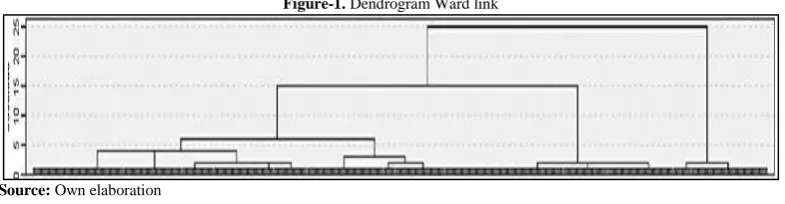
(Dolnicar, 2002). The aim of the use of these techniques is to identify groups of tourists with similar gastronomic interests when it comes to travelling. The examination of the resulting clustering chronograms and the dendrograms suggested the existence of two or three clusters. Afterwards, a non-hierarchical K-means cluster algorithm was used which confirmed that the most ideal solution was that with three clusters. The result of the segmentation has been validated through the discriminant analysis to identify the percentage of subjects which are correctly assigned. In this way, 99.2% of the tourists surveyed were correctly classified.
Figure-1.Dendrogram Ward link
Source: Own elaboration
Following the model of Björk and Kauppinen-Räisänen (2016), we named the resulting clusters or segments
survivors, enjoyers, and experiencers. The first segment is formed by 24.2% of the tourists surveyed. As can be seen
in Table 1, this group notes significant low scores for the three items (1: How would you rate your knowledge of
gastronomy?; 2: How would you rate your interest in gastronomy?; 3: How much has Sucre’s gastronomy influenced your visit to the city?). As such, this segment is known as survivors, being a group of low gastronomic interest. The second group represents 51.0% of the sample and gives intermediate scores for the three items. This segment, composed of tourists with an average or moderate interest in gastronomy, is known as enjoyers. The third segment of tourists provides high scores for the three items, representing 24.8% of the tourists of the sample. This segment has been named experiencers and consists of tourists with a high gastronomic interest.
The three groups obtained have their reflection in the scientific literature, where researchers pointed out in the segmentation of the groups at least one of the groups was very interested in gastronomy and another was very little interested. Thus, regarding what we called “experiencers” in this research; it has its identity based in other previous
investigations. Hjalager (2004), calls them experimental gastronomy tourists and McKercher et al. (2008) calls them
definite culinary tourist. Opposite to this, we have the group called survivors. Thus Hjalager (2004) characterizes one of the groups discovered in his research as recreational, McKercher et al. (2008) as non-culinary tourist or Thompson and Prideaux (2009) as a not interested group.
The analysis of the difference of means, completed using Kruskal and Wallis (1952), confirms that the means of the items used are not equal in the different segments. In turn, to identify where these differences occur, Mann and Whitney (1947) was used.
Table-1. Characterization clusters from gastronomy attitude
Gastronomy attitude Food clusters Kruskal–Wallis H
Survivors Enjoyers Experiencers
χ² Sig.
How would you rate your
knowledge of gastronomy?
1.99(*) 3.40(*) 4.36(*) 298.552 < 0.000
How would you rate your interest in gastronomy?
1.93(*) 3.11(*) 3.91(*) 298.405 < 0.000
How much has Sucre’s gastronomy influenced your visit to the city?
2.40(*) 3.88(*) 3.98(*) 196.502 < 0.000
(*) The values in italic type present significant differences in two of the three means clusters. To be able
to test for the significant differences between the different means, the Mann–Whitney U test was applied.
Source: Own elaboration
The results obtained in this research are in accordance with other research that was previously carried out (Björk and Kauppinen-Räisänen, 2016; López-Guzmán et al., 2017; Pérez-Gálvez et al., 2017) and support the first hypothesis established in this study (H1): The visitors have different attitudes toward local gastronomy.
4.2. Motivation and Gastronomy
To analyse the gastronomy tourism, it is necessary to focus on the tourist’s behaviour in a special way. One of the aims of this research is to study the motivations that tourists have to taste the local gastronomy. With the idea of studying the reasons for tasting the local gastronomy, a scale aiming to collect the reasons for the consumption of the local gastronomic products most frequently studied in previous research was designed (Kim et al., 2013;
López-Guzmán et al., 2017; Pérez-Gálvez et al., 2017). Once a pre-test had been carried out, the most identified items of
Table-2. Food motivational dimensions
Food motivational dimensions Mean Ranking
Sensory appeal
Cronbach’s alpha (0.654)
Mean (3.82)
The taste of the dish is different from the one prepared in my region
4.04 1
Local gastronomy tastes good 3.91 3
Local gastronomy looks nice 3.72 8
Local gastronomy smells nice 3.62 10
Cultural experience
Cronbach’s alpha (0.767)
Mean (3.72)
Discover something new 3.90 4
An authentic experience 3.78 6
Increase my knowledge about different cultures
3.77 7
Discover the taste of local food 3.65 9
It offers a unique opportunity to understand local culture
3.52 12
Excitement Cronbach’s
alpha (0.671)
Mean (3.63)
It excites me to taste local food in its place of origin
3.95 2
It is different from what I eat every day 3.88 5
Relaxing 3.43 16
Get away from noise and people 3.24 19
Interpersonal relationship
Cronbach’s alpha (0.723)
Mean (3.48)
Enjoy pleasant moments with family and/or friends
3.60 11
Give advice about gastronomical
experiences to other travelers
3.52 13
Being able to transmit my experiences with local food
3.49 15
Tasting local food increases family and friendship bonds
3.30 17
Health concern
Cronbach’s alpha (0.885)
Mean (3.30)
Local dishes contain a great quantity of fresh produce sourced locally
3.52 14
Local dishes are nourishing 3.26 18
Local gastronomy is healthy 3.20 20
Source: Own elaboration
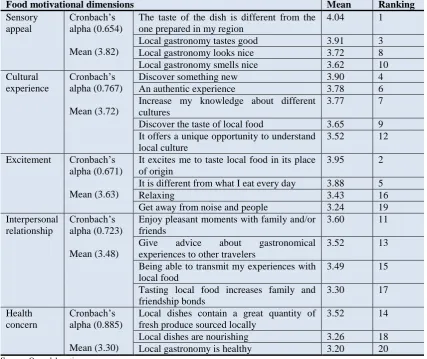
In Table 2, the surveyed tourists’ different interests in and motives for tasting the local gastronomy are shown.
The Cronbach’s alpha coefficient of the final scale reaches a value of 0.870 and indicate elevated internal consistency among the elements of the scale. The critical level (p) associated with Friedman’s χ2 statistic (733.263) is less than 0.001, which supports the inequality of the means of the elements. The ranking carried out identifies the sensory appeal and cultural experience dimensions as the most determining ones. Along this line, “the taste of the dish is different from the one prepared in my region” is the motive that tourists indicate as the most important for experiencing the local gastronomy. Also highlighted were motives such as “it excites me to taste local food in its place of origin,” “local gastronomy tastes good,” and “discover something new.” In turn, the least important motives were “local gastronomy is healthy” and “get away from noise and people.”
The comparison by gastronomic segments allowed for the confirmation of the existence of significant
differences in the gastronomic motivational dimensions (see Table 3). Experiencers have the highest scores in all the
motivational dimensions, being significantly greater than the scores of the other segments in the “cultural experience” dimension. In turn, the survivor segment shows the lowest scores in all the motivational dimensions, with significant differences from the other segments. These results indicate that the interest in local gastronomy is a
determining factor of culinary motivations (H2) (Kim et al., 2009;2013; López-Guzmán et al., 2017; Pérez-Gálvez
et al., 2017; Pérez-Priego et al., 2019). Additionally, we can confirm that tourists use gastronomy as a tool to
increase their knowledge of the culture and heritage of the destination by seeking new experiences or satisfying interpersonal needs with friends and/or family members.
Table-3. Characterization of the clusters from the average of motivational dimensions
Food motivational dimensions Food clusters Kruskal–Wallis H Survivors Enjoyers Experiencers χ² Sig.
Sensorial appeal 3.55(*) 3.90 3.91 18.491 <.000
Cultural experience 3.35(*) 3.81 3.91 35.783 <.000
Excitement 3.26(*) 3.65 3.78 41.030 <.000
Interpersonal relationship 3.10(*) 3.57 3.62 28.049 <.000
Health concern 3.04(*) 3.42 3.42 15.490 <.000
(*) The values in italic type present significant differences in two of the three means clusters. To be
able to test for the significant differences between the different means, the Mann–Whitney U test was applied.
4.3. Gastronomy and Satisfaction
A tourist destination is more than a complex of natural and/or leisure resources, which should also be reflected
in the experience sought by the visitor (Cracolici et al., 2008). Due to this, tourist destinations should consider the
relevance that gastronomy has as a basic aspect when creating a unique experience for the tourist who visits this place (Haven-Tang and Jones, 2005). Babolian (2016) stresses the idea that the tourist satisfaction of a visitor can be achieved through the gastronomy of the destination as a result of, in a large part, the cultural richness that comes from the bases of the gastronomy itself. In conclusion, gastronomy can become a key aspect for improving the
visitor’s satisfaction in a specific tourist destination (Björk and Kauppinen-Räisänen, 2016; López-Guzmán et al.,
2017). The average level of satisfaction shown by the tourists is 3.64 points (on a Likert scale of 5 points). However, only 16.4% of them declared full satisfaction. The experiencers (19.1%) stand out among those who declared full satisfaction. On the other hand, only 11.5% of the tourists declared themselves to be dissatisfied or little satisfied. These data indicate the positive effect of gastronomy on tourists’ experience and satisfaction (Haven-Tang and
Jones, 2005; López-Guzmán et al., 2017; Pérez-Gálvez et al., 2017).
In the analysis by segments, Table 4 shows a positive evaluation of the gastronomic experience. In this case, it
differs significantly according to the interest in local gastronomy. The evaluation is higher for experiencers, providing evidence that greater importance in the five motivation dimensions results in better gastronomic satisfaction for the visitors. These results show that the interest in local gastronomy is a determining factor that conditions the experience and tourist satisfaction (H3).
Table-4. Characterization cluster from the variable food satisfaction
Food clusters Kruskal–Wallis H
Survivors Enjoyers Experiencers χ² Sig.
3.09(*) 3.79 3.83 49.603 <.000
(*) The values in italic type present significant differences in two of the three means clusters. To
be able to test for the significant differences between the different means, the Mann–Whitney U test was applied.
Source: Own elaboration
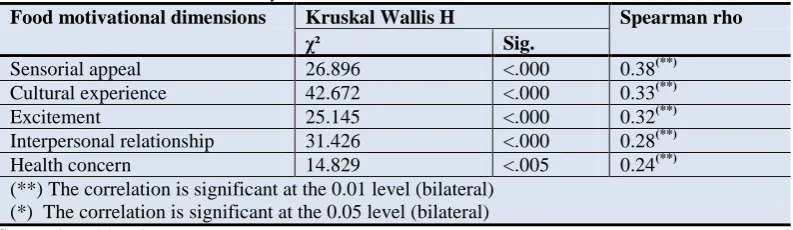
Having confirmed that the tourists are happy with the cuisine in Sucre when they leave, we focus on this aspect, analyzing the possible relationship with the reasons or motives for tasting the local gastronomy. In this case, all of
the dimensions discriminate significantly in relation to the degree of perceived gastronomic satisfaction (see Table
5). The Spearman correlations corroborate the relationship between the degree of satisfaction and the motivational
dimensions. These results show that the motivations of the “sensorial appeal” and “cultural experience” types make a greater contribution to the satisfaction of visitors in relation to the gastronomy in Sucre. This is particularly interesting in a city recognized as a WHS by UNESCO, given its highlighted heritage and cultural component.
Table-5. Analysis of food satisfaction and motivational dimensions
Food motivational dimensions Kruskal Wallis H Spearman rho
χ² Sig.
Sensorial appeal 26.896 <.000 0.38(**)
Cultural experience 42.672 <.000 0.33(**)
Excitement 25.145 <.000 0.32(**)
Interpersonal relationship 31.426 <.000 0.28(**)
Health concern 14.829 <.005 0.24(**)
(**) The correlation is significant at the 0.01 level (bilateral) (*) The correlation is significant at the 0.05 level (bilateral)
Source: Own elaboration
In conclusion, the results of this research allows us to confirm how te traveller´s motivational dimensions regarding local cuisine influence and condition the tourist experience for the confirmation of how the traveller’s motivational dimensions regarding local gastronomy condition the tourist experience (H4), in accordance with
previous studies (Björk and Kauppinen-Räisänen, 2016; López-Guzmán et al., 2017; Pérez-Gálvez et al., 2017).
5. Discussion
The grouping of tourists into homogeneous segments based on their gastronomic interest has been addressed in
numerous previous studies (Björk and Kauppinen-Räisänen, 2016; Kivela and Crotts, 2005; McKercher et al., 2008;
Thompson and Prideaux, 2009). In these studies, as well as in this research, it has been shown that visitors have different attitudes toward the local gastronomy as a determining factor in the selection of a place to visit. At the same time, previous studies have identified groups of tourists with a high gastronomic interest as well as those with little interest. In this study, the group with a high interest in local gastronomy is called experiencers, based on the model
by Björk and Kauppinen-Räisänen (2016). Hjalager (2004), named this segment experimental gastronomy tourists.
In McKercher et al. (2008) research, it was called definite culinary tourists. In the case of the group of tourists with
Kauppinen-Räisänen (2016). Other research has named this segment recreational Hjalager (2004); non-culinary
tourists (McKercher et al., 2008); and not interested (Thompson and Prideaux, 2009).
This study, based on its analysis, holds that the culinary motivations of tourists are heterogeneous and conditioned by their gastronomic interest in their trips. In this way, these motivations have been grouped together, on
the basis of Kim et al. (2013) model, into five different gastronomic dimensions: cultural experience, excitement,
interpersonal relationships, sensory appeal, and health concern. Previous research has addressed the analysis of the
motivations regarding the gastronomy of the destination through different dimensions (Björk and
Kauppinen-Räisänen, 2016; Kim et al., 2009;2013; Sims, 2010) analyzed gastronomic motivations through the different
experiences that may be obtained: sensory, cultural, and social. Babolian (2016), indicated the following dimensions as outstanding: heritage, serving, food environment, variety, availability, sensory, and ingredients.
This study reaffirms the results of previous research (Björk and Kauppinen-Räisänen, 2016; López-Guzmán et
al., 2017) in which the local gastronomy enables an increase in visitor satisfaction as well as the gastronomic experience. Accordingly, Haven-Tang and Jones (2005) held that tourist destinations should consider gastronomy as a fundamental tool for offering a unique experience to tourists. On the other hand, Babolian (2016) stated that the role of gastronomy is fundamental for contributing to visitors’ satisfaction and is based on the cultural heritage of each place, which is precisely the reason for the importance of studies focusing on the analysis of the concepts of tourism, heritage, and gastronomy in specific cities, such as the city of Sucre (Bolivia), recognized as a World Heritage Site (WHS) by UNESCO and named the Historic City of Sucre.
6. Conclusions
Gastronomic tourism is no longer an area of little interest for the tourist management of destinations; it is now becoming a great challenge for the promotion and consolidation of specific places, especially for those with an important historic and heritage legacy. In this case, this research studied the perception and opinion of tourists who visit the city of Sucre and who experience, in one way or another, its rich gastronomy.
This research has shown that visitors have different attitudes toward local gastronomy. This was used as a variable for the segmentation of tourists, from which three different types were obtained: survivors, enjoyers, and experiencers. Additionally, this research indicated that an interest in local gastronomy is a determining factor of culinary motivations. Accordingly, and on the basis of statistical study, the existence of five different motivational dimensions was confirmed: cultural experience, excitement, interpersonal relationship, sensory appeal, and health concern. In relation to the satisfaction level of visitors regarding the gastronomy of Sucre, the results showed that the sensory appeal and cultural experience dimensions contribute greatly to the configuration and increase of gastronomic satisfaction. From this analysis of tourists’ satisfaction, it stands out that they show an important level of satisfaction with their culinary experience. In this case, the satisfaction level is statistically different according to the attitudes toward local gastronomy.
One of the main contributions of this research is the demonstration that satisfaction towards the gastronomy of the destination is conditioned by the culinary motivations of the tourist. The results show that the sensory appeal and cultural experience motivational dimensions contribute greatly to the satisfaction with the gastronomy. The visitors indicate a high satisfaction with the culinary experience, with the evaluation being significantly different in dealing with the stated interest in the gastronomy by each one of the segments.
Additionally, this research also provides practical implications. The main contribution of this study is to provide a better understanding of the differentiating characteristics of the segments of travellers with the aim of being able to design a tourist offer that better suits their needs. This contributes to conceive tourist products that satisfy better the needs of the traveller and, at the same time, are compatible with the sustainable management of local cuisine. With the purpose of empowering the development of local cuisine it is necessary to stablish measures that favor innovation and new flavors in dishes of the culinary locations in the city. On the one hand, the quality of the culinary heritage will improve the loyalty towards the destination and so more people would want to return. On the other hand, the promotion and presentation of the culinary resources of the city has to be done in a differentiated manner, this needs a wide variety of places where tourist can experience different specialties.
Regarding the restrictions of this research, the time period of the fieldwork can be highlighted, meaning that an expansion of the study to all of the months of the year would be necessary to avoid possible seasonal bias. On the other hand, a complete analysis of the tourist sector in Sucre would demand the carrying out of parallel research into the tourist offer businesses and the local community. Because of this, as a future line of research, it is recommended to conduct in-depth research into the tourist offer in Sucre.
Acknowledgments
The authors of this paper wish to thank Mgr. Ivan Tolavi Soruco, member of the Faculty of Economics at Royal Mayor and Pontifical University of San Francisco Xavier in Chuquisaca, for his support in conducting this research.
References
Anderson, T., Mossberg, L. and Therkelsen, A. (2017). Food and tourism synergies: Perspectives on consumption,
production and destination development. Scandinavian Journal of Hospitality and Tourism, 17(1): 1–8.
Babolian, H. R. (2016). Effect of food experience on tourist satisfaction: The case of Indonesia. International
Baldwin, W. (2017). The transference of Asian hospitality through food: Chef’s inspirations taken from Asian
cuisines to capture the essence of Asian culture and hospitality. International Journal of Gastronomy and
Food Science, 8: 7–13. Available:
https://www.sciencedirect.com/science/article/abs/pii/S1878450X17300112
Basil, M. D. and Basil, D. Z. (2009). Reflections of ultra-fine dining experiences. In a. Lindgreen, j. Vanhamme, and
m. B. Berveland (eds.), memorable customer experiences: A research anthology. Gower Publishing
Company: Surrey. 135–47.
Björk, P. and Kauppinen-Räisänen, H. (2016). Exploring the multi-dimensionality of ors’ culinary-gastronomic
experiences. Current Issues in Tourism, 19(12): 1260–80.
Björk, P. and Kauppinen-Räisänen, H. (2019). Destination foodscape: A stage for travelers´ food experience.
Tourism Management, 71: 466-75. Available:
https://www.sciencedirect.com/science/article/abs/pii/S0261517718302747
Cracolici, M. F., Nijkamp, P. and Rietveld, P. (2008). Assessment of tourism competitiveness by analyzing
destination efficiency. Tourism Economics, 14(2): 325–42.
Crespi-Vallbona, M. and Dimitrovski, D. (2016). Food markets visitors: A typology proposal. British Food Journal,
118(4): 840–57.
Dolnicar, S. (2002). A review of data-driven market segmentation in tourism. Journal of Travel and Tourism
Marketing, 12(1): 1–22.
Dolnicar, S. (2008). Market segmentation in tourism. In a. Woodside and d. Martin (eds.), tourism management,
analysis, behavior and strategy. CABI: Cambridge. 129–50.
Dolnicar, S., Kaiser, S., Lazarevski, K. and Leisch, F. (2012). Biclustering: Overcoming data dimensionality
problems in market segmentation. Journal of Travel Research, 51(1): 41–49.
Fields, K. (2002). Demand for the gastronomy tourism product. Motivational factors. In a. M. Hjalager and g.
Richards (eds.). Tourism and gastronomy. Routledge: London. 36–50.
Finn, M., Elliott-White, M. and Walton, M. (2000). Tourism and leisure research methods: Data collection, analysis
and interpretation. Pearson Education: Harlow.
Gacnik, A. (2012). Gastronomy heritage as a source of development for gastronomy tourism and as a means of
increasing Slovenia’s tourism visibility. Academia Turistica, 5(2): 39-60.
Hair, J., Black, W., Babin, B. and Anderson, R. (2010). Multivariate data analysis: A global perspective. Pearson Prentice Hall: Boston.
Haven-Tang, C. and Jones, E. (2005). Using local food and drink to differentiate tourism destinations through a
sense of place: A story from Wales – Dining at Mommouthshire’s great table. Journal of Culinary Science
and Technology, 4(4): 69–86.
Hjalager, A. M. (2004). What do tourists eat and why? Towards a sociology of gastronomy and tourism. Tourism,
52(2): 195-201.
Hwang, L., van Westering, J. and Chen, H. (2005). Exploration of the linkages between the gastronomy and heritage
of Tainan city, Taiwan. In advances in hospitality and leisure. Emerald Group Publishing Limited: Bingley.
1: 223-35.
Kim, Eves, A. and Scarles, C. (2009). Building a model of local food consumption on trips and holidays: A
grounded theory approach. International Journal of Hospitality Management, 28(3): 423–31.
Kim, Eves, A. and Scarles, C. (2013). Empirical verification of a conceptual model of local consumption at a tourist
destination. International Journal of Hospitality Management, 33(1): 484–89.
Kim, Ducan, J. and Chang, B. W. (2015). Involvement, satisfaction, perceived value, and revisit intention: A case
study of a food festival. Journal of Culinary Science and Technology, 13(2): 133–58.
Kivela, J. and Crotts, J. (2005). Gastronomy tourism: A meaningful travel market segment. Journal of Culinary
Science and Technology, 4(2/3): 39–55.
Kruskal, W. H. and Wallis, W. A. (1952). Use of ranks in one-criterion variance analysis. Journal of the American
Statistical Association, 47(260): 583–621.
López-Guzmán, T., Uribe-Lotero, C. P., Pérez-Gálvez, J. C. and Ríos-Rivera, I. (2017). Gastronomic festivals:
Attitude, motivation and satisfaction of the tourist. British Food Journal, 119(2): 267–83.
Mann, H. B. and Whitney, D. R. (1947). On a test of whether one of two random variables is stochastically larger
than the other. Annals of Mathematical Statistics, 18(1): 50–60.
McKercher, B., Okumus, F. and Okumus, B. (2008). Food tourism as a viable market segment: It’s all how you cook
the numbers! Journal of Travel and Tourism Marketing, 25(2): 137–48.
Mgonje, J. T., Backman, K. F., Backman, S. J., Moore, D. D. and Hallo, J. C. (2016). A structural model to assess
international visitors’ perceptions about food in Tanzania. Journal of Sustainable Tourism, 25(6): 796–816.
Park, D. B. and Yoon, Y. S. (2009). Segmentation by motivation in rural tourism: A Korean case study. Tourism
Management, 30(1): 99–108.
Pérez-Gálvez, J. C., Torres-Naranjo, M., López-Guzmán, T. and Carvache-Franco, M. (2017). Tourism demand of a
WHS destination: An analysis from the viewpoint of gastronomy. International Journal of Tourism Cities,
3(1): 1–16.
Pérez-Priego, M. A., García-Moreno, M., Gómez-Casero, G. and Caridad, L. (2019). Segmentation based on the
gastronomic motivations of tourists: the case of the Costa del Sol (Spain). Sustainability, 11(2): 409.
Pesonen, J., Komppula, R., Kronenberg, C. and Peters, M. (2011). Understanding the relationship between push and
Prayag, G. (2010). Images as pull factors of a tourist destination: A factor-cluster segmentation analysis. Tourism
Analysis, 15(2): 213–26.
Prayag, G. and Hosany, S. (2014). When Middle East meets West: Understanding the motives and perceptions of
young tourists from United Arab Emirates. Tourism Management, 40: 35–45. Available:
https://www.sciencedirect.com/science/article/abs/pii/S0261517713001039
Quan, S. and Wang, N. (2004). Towards a structural model of the tourist experience: An illustration from food
experiences in tourism. Tourism Management, 25(3): 297–305.
Sampaio, E. D. A. (2018). Gastronomy as cultural heritage and its potential for the competitiveness of tourist
destinations. TURyDES: Revista Turismo y Desarrollo Local, 11(25): 1-14.
Sheppard, A. G. (1996). The sequence of factor analysis and cluster analysis: Differences in segmentation and
dimensionality through the use of raw and factor scores. Tourism Analysis, 1(1): 49–57.
Sims, R. (2010). Putting place on the menu: The negotiation of locality in UK food tourism, from production to
consumption. Journal of Rural Studies, 26(2): 105–15.
Su, C. S. (2013). An importance-performance analysis of dining attributes: A comparison of individual and packaged
tourists in Taiwan. Asia Pacific Journal of Tourism Research, 18(6): 573-97.
Thompson, M. and Prideaux, B. (2009). Developing a food and wine segmentation and classifying destinations on the basis of their food and wine sectors, chen, j. (ed.) advances in hospitality and leisure. Advances in
Hospitality and Leisure, 5: 163–83. Available:
https://www.researchgate.net/publication/235293569_Developing_a_food_and_wine_segmentation_and_cl assifying_destinations_on_the_basis_of_their_food_and_wine_sectors
Vázquez-Martínez, U., Sanchís-Pedregosa, C. and Leal-Rodríguez, A. (2019). Is gastronomy a relevant factor for