Fajda Oleksandra I., Drach Oleksandr V., Barylyak Liliya G., Zukow Walery. Relationships between Ca/K plasma ratio and parameters of heart rate variability at patients with diathesis urica. Journal of Education, Health and Sport. 2016;6(1):295-301. eISSN 2391-8306.
DOI http://dx.doi.org/10.5281/zenodo.45359
http://ojs.ukw.edu.pl/index.php/johs/article/view/3368 https://pbn.nauka.gov.pl/works/710817
The journal has had 7 points in Ministry of Science and Higher Education parametric evaluation. Part B item 755 (23.12.2015). 755 Journal of Education, Health and Sport eISSN 2391-8306 7
© The Author (s) 2016;
This article is published with open access at Licensee Open Journal Systems of Kazimierz Wielki University in Bydgoszcz, Poland
Open Access. This article is distributed under the terms of the Creative Commons Attribution Noncommercial License which permits any noncommercial use, distribution, and reproduction in any medium, provided the original author(s) and source are credited. This is an open access article licensed under the terms of the Creative Commons Attribution Non Commercial License (http://creativecommons.org/licenses/by-nc/4.0/) which permits unrestricted, non commercial use, distribution and reproduction in any medium, provided the work is properly cited. This is an open access article licensed under the terms of the Creative Commons Attribution Non Commercial License (http://creativecommons.org/licenses/by-nc/4.0/) which permits unrestricted, non commercial
use, distribution and reproduction in any medium, provided the work is properly cited. The authors declare that there is no conflict of interests regarding the publication of this paper.
Received: 01.01.2016. Revised 12.01.2016. Accepted: 31.01.2016.
RELATIONSHIPS BETWEEN Ca/K PLASMA RATIO AND PARAMETERS OF HEART RATE VARIABILITY AT PATIENTS WITH DIATHESIS URICA
Oleksandra I. Fajda1, Oleksandr V. Drach2, Liliya G. Barylyak2,3, Walery Zukow4
1
JSC „Dnipro-Beskyd“, Truskavets’, Ukraine [email protected]
2JSC “ Truskavets’kurort”, Truskavets’, Ukraine
3Laboratory of Experimental Balneology, OO Bohomolets’ Institute of Physiology NAS, Truskavets’-Kyiv, Ukraine [email protected]
4
Faculty of Physical Education, Health and Tourism, Kazimierz Wielki University, Bydgoszcz, Poland [email protected]
Abstracts
Background. Previously we shown that Kerdö’s Vegetative Index is not marker of sympatho-vagal balance, but reflects above all Amplitude of α-Rhythm EEG and its Power Spectrum Density in Parietal and Central loci, less options HRV. The aim of present study is analyze the relationships other marker of sympatho-vagal balance Ca/K Plasma Ratio with parameters of HRV. Methods. In basal conditions in twentee volunteers – ten women add ten men aged 33-76 years with diathesis urica recorded Heart Rate Vatiability (HRV) (“Cardiolab+VSR”, KhAI Medica, Ukraine). In blood plasma measured the concentration of Calcium and Potassium. Results. No correlation ascertained between Ca/K Plasma Ratio and LF/HF Ratio (r=-0,07) and LFnu (r=0,09). However, Ca/K Plasma Ratio moderately negatively correlated with vagal markers: SDNN (r=-0,30), RMSSD (r=-0,34), pNN50 (r=-0,36), HRV TI (r=-0,34), absolute PS
HF (r=-0,33) and positively with sympathetic marker Amplitude of Moda (r=0,24 for actual values and 0,38 for portion of age norm) as well as with relative PS ULF (r=0,39). The strongest correlations of Ca/K Plasma Ratio proved with absolute PS LF (r=-0,45) and variational sweep: r=-0,42 for actual values and -0,49 for portion of age norm. Canonical correlation between Ca/K Plasma Ratio, on the one hand, and the parameters of HRV, on the other hand, is strong: R=0,713; R2=0,509; Adjusted R2=0,437; F(5,3)=7,0; χ2(5)=25,2; p=10-4. Conclusion. Ca/K Plasma
Ratio reflects inversely vagal tone and less direct sympathetic tone, therefore is really marker of sympatho-vagal balance.
INTRODUCTION
Previously we showed that the vegetative index Kerdoe, calculated on the basis of frequency rate and diastolic blood pressure, contrary to tradition, is not a marker sympatho-vagal balance [2]. It has long been known another marker tone of the autonomic nervous system - the ratio K/Ca in serum. It is believed that improving potassium corresponds to vagus stimulation effect or action of acetylcholine, while increasing the level of calcium in the blood stimulates sympathicus [5]. Popovych IL [9] applied this indicator in the battery of tests to assess stress levels in rats for the convenience transforming it into (Ca/K)0,5 Ratio. The goal of this study - to analyze correlations (Ca/K)0,5 Ratio with parameters Heart Rate Vatiability (HRV).
MATERIALS AND METHODS
The study involved twenty volunteers – ten women add ten men aged 33-76 years with diathesis urica. In the morning, seated in each ECG recorded for 7 min, using hardware-software complex " КардиоЛаб+ВСР" (XAИ-MEДИКA, Kharkiv, Ukraine) in standard lead II [1,10,11]. In sample of plasma of venous blood measured levels of Calcium (by a reaction with arsenazo III) and Potassium (by the method of flaming photometry) according to instruction [3] with use the analyzers “Reflotron” (USA) and “СФ-46” ПФМУ (URSS). After 7 days ECG recording and elecrtolytes measuring repeated. For further analysis the following parameters heart rate variability (HRV) were selected. Temporal parameters (Time Domain Methods): the standart deviation of all NN intervals (SDNN); the square root of the mean of the sum of the squares of differences between adjacent NN intervals (RMSSD); the percent of interval differences of successive NN intervals greater then 50 ms (pNN50); triangulary index (TI); heart rate (HR);
moda (Mo); the amplitude of moda (AMo); variational sweep (Delta X). Spectral parameters (Frequency Domain Methods): absolute (in ms2) and relative (% of total) power spectral density (PSD) components of HRV - high-frequency (HF, range 0,4÷0,15 Hz), low frequency (LF, range 0,15÷0,04 Hz), very low frequency (VLF, range 0,04÷0,015 Hz) and ultra low frequency (ULF, range 0,015÷0,003 Hz). Expectant as classical indexes: LF/HF, LFnu=100%•LF/(LF+HF) and Baevskiy Stress Index (SI=AMo/2•Mo•DX) [1].
For statistical analysis applied doubles, regression and canonical correlation analysis using the software package "Statistica 5.5" [9].
RESULTS AND DISCUSSION
According to the summary and recommendations of the Task Force [4] for interpretation of HRV components, vagal activity is the major contributor to the HF component. Time domain variable approximate correspondences HF (RMSSD, pNN50) or total power (SDNN, HRV TI).
relationship VLF rhythms of thermoregulation, asked hypothalamus. Discovered rhythms associated with oscillation blood level of renin (0,04 Hz), epinephrine (0,025 Hz), norepinephrine (0,002 Hz), 17-OCS (0,0019 Hz) [8].
There is also speculation that LF (0,14÷0,06 Hz) component of HRV is linked to the operation of baroreflex mechanism, whereas the VLF (0,06÷0,01 Hz) component of HRV associated with changes in sympathetic activity [7].
We detected relationships between the parameters HRV and background EEG activity in healthy men [11] as well as in patients suffering from chronic renal pathology [10].
According to calculations by the formula [10]: |r|={exp[2t/(n - 1,5)0,5] - 1}/{exp[2t/(n - 1,5)0,5] + 1} for a sample of n=40 critical value |r| at p<0,05 (t>2,00) is 0,31.
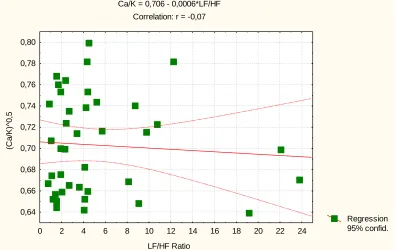
Contrary to expectations, no correlation ascertained between Ca/K Plasma Ratio and LF/HF Ratio (Fig. 1) as well as LFnu (r=0,09).
Regression 95% confid. Ca/K = 0,706 - 0,0006*LF/HF
Correlation: r = -0,07
LF/HF Ratio
(C
a
/K)^
0
,5
0,64 0,66 0,68 0,70 0,72 0,74 0,76 0,78 0,80
[image:3.612.109.506.256.506.2]0 2 4 6 8 10 12 14 16 18 20 22 24
Fig. 1. Correlation between LF/HF HRV Ratio (axis X) and Ca/K Plasma Ratio (axis Y)
However, Ca/K Plasma Ratio moderately negatively correlated with vagal markers SDNN (r=-0,30), RMSSD (r=-0,34), pNN50 (r=-0,36), HRV TI (r=-0,34) and absolute PS HF (r=-0,33).
Regression 95% confid. Ca/K = 0,722 - 0,00002*LF
Correlation: r = -0,451
LF, msec^2
(C
a
/K)^
2
0,64 0,66 0,68 0,70 0,72 0,74 0,76 0,78 0,80
[image:4.612.107.503.69.327.2]0 500 1000 1500 2000 2500 3000 3500 4000
Fig. 2. Correlation between PS LF HRV (axis X) and Ca/K Plasma Ratio (axis Y)
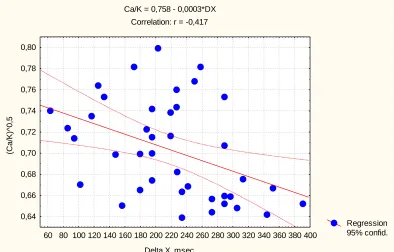
Regression 95% confid. Ca/K = 0,758 - 0,0003*DX
Correlation: r = -0,417
Delta X, msec
(C
a
/K)^
0
,5
0,64 0,66 0,68 0,70 0,72 0,74 0,76 0,78 0,80
60 80 100 120 140 160 180 200 220 240 260 280 300 320 340 360 380 400
Fig. 3. Correlation between variational sweep (axis X) and Ca/K Plasma Ratio (axis Y)
[image:4.612.101.495.373.625.2]Regression 95% confid. Ca/K = ,760 - 0,1165*DX (pn)
Correlation: r = -0,492
Delta X, portion norm
(C
a
/K)^
0
,5
0,64 0,66 0,68 0,70 0,72 0,74 0,76 0,78 0,80
0,1 0,2 0,3 0,4 0,5 0,6 0,7 0,8 0,9
Fig. 4. Correlation between portion norm of variational sweep (axis X) and Ca/K Plasma
Ratio (axis Y)
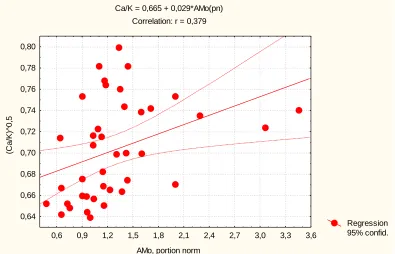
On the other hand, Ca/K Plasma Ratio correlates positively with sympathetic marker Amplitude of Moda (r=0,24 for actual values and 0,38 for portion of age norm: AMoan=23,0 –
0,0114•Age2
+0,8763•Age) (Fig. 5).
Regression 95% confid. Ca/K = 0,665 + 0,029*AMo(pn)
Correlation: r = 0,379
AMo, portion norm
(C
a
/K)^
0
,5
0,64 0,66 0,68 0,70 0,72 0,74 0,76 0,78 0,80
0,6 0,9 1,2 1,5 1,8 2,1 2,4 2,7 3,0 3,3 3,6
[image:5.612.111.504.71.326.2] [image:5.612.109.504.429.683.2]We detected also positively correlation Ca/K Plasma Ratio with relative PS ULF (r=0,39) and VLF (r=0,31).
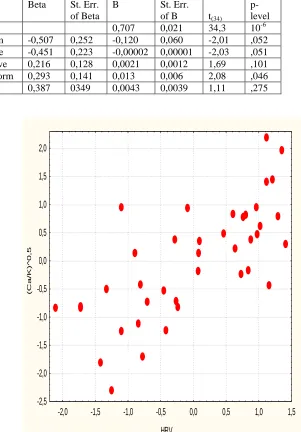
[image:6.612.144.445.197.629.2]Canonical correlation between Ca/K Plasma Ratio, on the one hand, and the parameters of HRV, on the other hand, is strong (Table 1, Fig. 6).
Table 1. Regression Summary for Dependent Variable: Ca/K-Ratio
R=0,713; R2=0,509; Adjusted R2=0,437; F(5,3)=7,0; χ2(5)=25,2; p=10-4; Std. Error of estimate: 0,03
Beta St. Err. of Beta
B St. Err.
of B t(34)
p- level
Interception 0,707 0,021 34,3 10-6
ΔX, portion norm -0,507 0,252 -0,120 0,060 -2,01 ,052
LF HRV absolute -0,451 0,223 -0,00002 0,00001 -2,03 ,051
ULF HRV relative 0,216 0,128 0,0021 0,0012 1,69 ,101
RMSSD, port. norm 0,293 0,141 0,013 0,006 2,08 ,046
HRV TI 0,387 0349 0,0043 0,0039 1,11 ,275
HRV
(C
a
/
K)^
0
,
5
-2,5 -2,0 -1,5 -1,0 -0,5 0,0 0,5 1,0 1,5 2,0
-2,0 -1,5 -1,0 -0,5 0,0 0,5 1,0 1,5
References
1. Baevskiy RM, Ivanov GG. Heart Rate Variability: theoretical aspects and possibilities of clinical application [in Russian]. Ultrazvukovaya i funktsionalnaya diagnostika. 2001; 3: 106-127.
2. Fajda OI, Hrinchenko BV, Snihur OV, Barylyak LG, Zukow W. What Kerdoe’s Vegetative Index Really Raflects? Journal of Education, Health and Sport. 2015; 5(12): 279-288.
3. Goryachkovskiy АМ. Clinical Biochemistry [in Russian]. Odesa: Astroprint. 1998. 608 p.
4. Heart Rate Variability. Standards of Measurement, Physiological Interpretation, and Clinical Use. Task Force of ESC and NASPE. Circulation. 1996; 93(5): 1043-1065.
5. Kazakova M, Nemski B. Functional Diagnostics of Vegetative Nervouse System [Transl. from Bulgarian to Russian]. Functional Diagnostics in Childhood /Edit-s Kolarov S and Gatev V.-Sophia: Meditsina i Phyzkultura. 1979: 91-104.
6. Kerdö I. An index for evaluation of vegetatine tonus calculated from the data of blood circulation [in German: Ein aus Daten der Blutzirkulation kalkulierter Index zur Beurteilung der vegetativen Tonuslage]. Acta Neurovegetativa (Wien). 1966; 29(2): 250-268.
7. Korkushko OV, Pysaruk АV, Shatylo VB. Importance of Heart Rate Variability Analysis in Cardiology: Age Aspects [in Russian]. Circulation and Hemostase. 2009; 1-2: 127-139.
8. Kotel’nikov SA, Nozdrachov AD, Odynak ММ et al. Heart Rate Variability: Notions about Mechanisms [in Russian]. Fiziologiya cheloveka. 2002; 28(1): 130-140.
9. Popovych IL. Stresslimiting Adaptogene Mechanism of Biological and Curative Activity of Water Naftussya [in Ukrainian]. Kyiv: Computerpress. 2011. 300 p.
10. Popovych IL, Kozyavkina OV, Kozyavkina NV, Korolyshyn TA, Lukovych YuS, Barylyak LG. Correlation between Indices of the Heart Rate Variability and Parameters of Ongoing EEG in Patients Suffering from Chronic Renal Pathology. Neurophysiology. 2014; 46(2): 139-148.