USF Scholarship: a digital repository @ Gleeson Library |
Geschke Center
Master's Theses Theses, Dissertations, Capstones and Projects
Spring 5-17-2013
Risk, Religion, and Islamic Microfinance
Dunia AburishFollow this and additional works at:https://repository.usfca.edu/thes
Part of theEconometrics Commons
This Thesis is brought to you for free and open access by the Theses, Dissertations, Capstones and Projects at USF Scholarship: a digital repository @ Gleeson Library | Geschke Center. It has been accepted for inclusion in Master's Theses by an authorized administrator of USF Scholarship: a digital repository @ Gleeson Library | Geschke Center. For more information, please [email protected].
Recommended Citation
Risk, Religion, and Islamic Microfinance
Master’s Thesis
International and Development Economics
Key Words: Islamic Microfinance, Summary Index, Risk, Religiosity
Dunia Aburish
Department of Economics University of San Francisco
2130 Fulton St. San Francisco, CA 94117
e-mail: [email protected]
May 2013
Abstract: This research design creates a framework in which the risk preferences and Islamic religiosity of Jordanian borrowers can be estimated. Specifically, this study highlights the different characteristics of conventional and Islamic microfinance borrowers. Although there is extensive literature on the topics of conventional microfinance and Islamic finance individually, few studies characterize borrowers who choose between these financial products. For this study, field research was conducted in conjunction with the National Microfinance Bank (NMB) and the Development and Employment Fund (DEF) in Jordan. Overall, 143 conventional and 78 Islamic borrowers were surveyed for a total sample of 221 borrowers. To estimate the determinants of taking up an Islamic microfinance loan, a linear probability model is utilized. Moreover, to create an index for measuring risk preferences and religiosity, both principal component analysis and summary index are used. Theories behind Islamic microfinance inherently suggest that it will appeal to risk-averse and more religious individuals. Contrary to theoretical propositions, the results indicate that Islamic borrowers tend to have risk-seeking preferences. The results also show that that Islamic borrowers are more religious than conventional borrowers.
1. Introduction
Since its inception in the early 1980s, microfinance has been widely acclaimed as a paradigm for poverty alleviation in addition to enhancing economic and social development in developing countries. As a result, microfinance has rapidly spread to many regions of the world as a potential solution for poverty. One of the most recent areas to adopt microfinance practices is the Middle East, where there is a budding market for financial inclusion in the form of microfinance. Although it has only been implemented within the past two decades, microfinance has already reached millions of those living in poverty in the Middle East and North Africa.
Despite the recent success of microfinance in the Middle East, many argue that outreach is not as effective as it could be and there is the potential to access more clients (Dhumale and Sapcanin, 1999, and Obaidullah, 2008). In Arab countries alone, the outreach gap is estimated to be approximately 53 million (Malkawi et al., 2011). Among other things, some authors argue that the reason for this disparity is a fundamental difference in the clientele that are taking up loans in the Middle East (National Impact Study, 2007). Essentially, many potential Middle Eastern clients practice Islam under Shari’a law, which specifically classifies riba, or interest, as prohibited in economic transactions (Obaidullah, 2008). Since interest is a main component of microfinance, several authors argue that many Middle Easterners living in poverty do not participate in credit programs (Abdul-Rahman, 2007, Dusuki, 2008). For this reason, these authors agree that the outreach of microfinance can be significantly more widespread in the region, and it has not reached its full potential (National Impact Study, 2007, Dhumale and Sapcanin, 1999, and Obaidullah, 2008).
To adapt to the alternative preferences of Middle Eastern clientele, Islamic microfinance has been suggested as a remedy (Havel, 2007). Rather than use interest rates as a form of revenue in Islamic microfinance, the borrowers and the sellers of the transaction jointly share risks and profits in a project. In addition, the principles of Islamic microfinance vary from those of conventional microfinance, as they follow the philosophy of Islamic law. Primarily, Islamic microfinance is based on social welfare and justice, fixed prepayment rates, transparency, and risk and profit sharing (IFAD, 2012). Islamic microfinance has consequently been described as an asset-based approach instead of a debt-based approach, like conventional microfinance. Though there are several types of contracts inherent within Islamic microfinance, the overarching goal is that of profit and loss sharing and creating an equity-oriented environment that facilitates participation and frowns upon speculation and moral hazard (Seibel, 2006).
between these two financial products. Whether these programs lack regulatory support or simply lack popular demand, it is clear that a more methodical study of Islamic microfinance will greatly contribute to current literature. Through this study, it is possible to understand what type of client desires the availability of Islamic microfinance. While few studies have distinctly characterized Islamic microfinance clients due to its novelty, the fundamental aspects of this type of financing suggest certain attributes. Mainly, because Islamic microfinance offers a risk-sharing alternative to conventional microfinance, several authors posit that Islamic microfinance will attract risk-averse individuals (IFAD, 2012, Abdul Rahman, 2007 and Dusuki, 2008). Moreover, because Islamic microfinance contracts do not charge interest on loans and the basic appeal of Islamic finance is to attract religious individuals, it can be argued that Islamic microfinance will appeal to more religious individuals. To properly investigate these hypotheses, this research takes advantage of the unique microfinance market in Jordan where both conventional and Islamic microfinance loans are available. Using this information, it is possible to explore the differences between these two types of borrowers. Specifically, this study addresses whether conventional microfinance borrowers are more risk-loving than Islamic borrowers, and whether Islamic microfinance borrowers are more religious than conventional borrowers.
This research was carried out between two microfinance institutions at a total of nine branches throughout Jordan. Overall, the sample consists of 221 participants with 143 conventional borrowers and 78 Islamic borrowers. Each borrower was randomly selected to participate in a survey either in person or on the phone. The survey included questions regarding basic demographics, in addition to questions aimed at eliciting risk preferences and Islamic religiosity. For instance, a set of questions explore an individual’s risk preference in the context of personal life, business decisions, relationships with others, and entrepreneurial decision-making. In addition, several questions addressed various features of religiosity. In order to develop a set of questions that accurately captured overall religiosity, this section of the survey was developed during the preliminary period in Jordan. Each question was thoughtfully created through the help of focus groups, native Jordanians, enumerators, and bank employees. Ultimately, these questions emphasize the role of religion in daily life, the extent to which individuals practice religion, and overall sentiments towards financial products, including microfinance loans.
by approximately 20 percentage points. This conclusion holds when controlling for various factors, including time preference, branch location, whether the survey was conducted in Ramadan, and the size of the loan. On the contrary, the results for risk preferences are more sensitive to specification. Although the coefficients are all positive and some have significance, this result varies according to how the model is specified. In general, the results indicate that risk-loving borrowers are more likely to take out Islamic loans. In addition to religiosity and risk preferences, the estimations show that conventional loans are primarily comprised of female borrowers. In other words, men are considerably more likely to participate in Islamic microfinance, and therefore increase the probability of taking up an Islamic microfinance loan. Similarly, Islamic borrowers tend to have larger loan sizes than conventional borrowers. There are also high levels of significance on the dummy variables for a phone interview as well as if the survey was conducted in Ramadan. Although these results are potentially due to the fact that the majority of Islamic borrowers were surveyed on the phone and almost all the Islamic borrower surveys were conducted in Ramadan, the previously mentioned findings hold when controlling for these two factors.
The rest of the paper is organized in the following manner: Section 2 presents the literature review, Section 3 provides a description of the sample and data collection, Section 4 presents the empirical model for this research, Section 5 presents the results, and Section 6 provides a discussion of the results.
2. Literature Review
2.1 Risk Preferences and Decision-Making
A significant portion of this research is dedicated to estimating the risk preferences of Islamic microfinance borrowers. Previously, the poor and their decisions in the face of risk have garnered much attention in economics literature. In developing countries, risk is widespread primarily due to the potential for frequent, unpredictable shocks, and the inability of the poor to provide insurance against these shocks (Banerjee and Duflo, 2007). Theoretically, Islamic microfinance is identified as a model inherently tailored to risk-averse individuals. This is because in Islamic microfinance contracts, the borrower engages in a profit and loss sharing contract with the microfinance institution (MFI). In other words, when undertaking a contract with a borrower, the MFI will bear a portion of the risk, providing the borrower with an opportunity that is less risky overall.
the use of probabilities, the EUT derives an individual’s utility when they espouse different risk preferences (Leiberman, 2011). Neumann and Morgenstern (1953) argue that with the EUT, rational decision-makers will select the payoff that offers the highest utility. In contrast, Kahneman and Tversky (1979) hypothesize that the EUT is not an adequate representation of risk preferences, leading them to modify the EUT in order to incorporate loss aversion into the model. With these changes, Kahneman and Tversky (1979) developed prospect theory. In this theory, the initial stage of decision-making consists of deciding on a particular point in which people consider anything higher as a gain and anything lower as a loss (Kahneman and Tversky, 1979). In the next phase, decision-makers evaluate utility according to the respective probabilities of potential outcomes, taking both gains and losses into account. The authors highlight that people experience more discontent from losing a sum of money than pleasure in gaining an equivalent amount. Still, Leiberman (2011) argues that prospect theory is a simplified, incomplete, and an approximate description of risky prospects, though it “performs as a better evaluator of rationality” than the EUT.
Moving towards risk preferences in the context of microcredit, Stiglitz (1990) introduced a model of ex ante moral hazard in microfinance. In the context of peer monitoring, Stiglitz’s model reveals that transferring risk to a cosigner improves a borrower’s overall welfare (Stiglitz, 1990). Akin to much of the theoretical work on microfinance, Stiglitz’s model assumes that safer projects have higher expected returns than riskier projects, leading people to prefer less risky projects. On the contrary, de Meza and Webb (1990) posit that realistically, risky projects have higher expected returns than safe projects. Consequently, they argue that expanding financial access enables borrowers to make risky investments in pursuit of higher incomes (Giné et al., 2006). In contrast, this research explores riskiness in the context of an individual’s risk preferences, as opposed to the project’s riskiness.
borrowers are innately similar to entrepreneurs, they still present several disadvantages. Vereshchagina et al. (2009) do not take into account individual heterogeneity of preferences or beliefs. This is a key aspect that this study attempts to address by taking into account the different characteristics of borrowers, such as risk preferences and religiosity. Similarly, Cressy (2000) and Polkovnichenko (2003) suggest that entrepreneurs may be less risk averse because they have more human capital, or because they are wealthier. While this assumption may hold for entrepreneurs, it is not representative of microfinance borrowers in developing countries.
In a related study, Pearlman (2012) deals specifically with risk and microfinance selection. By outlining a model involving the risk level of projects and a household’s ability to manage risk, the author determines that risk is significant in determining overall microfinance participation. In the context of this study, this idea would hold if Islamic and conventional borrowers had different risk preferences. Similar to choosing between conventional and Islamic microfinance, the microentrepreneurs have the opportunity to engage in a risky or safe enterprise within the model. Here, Pearlman (2011) attributes low microfinance penetration rates (or outreach) to a client’s vulnerability, or the difficulty of smoothing their consumption when faced with negative income shocks over time. In contrast to Pearlman’s conclusion, this research proposes that minimal outreach previously occurred due to a lack of diverse funding options available to borrowers. With the introduction of Islamic microfinance, however, credit rationing becomes less of an issue for borrowers and more financing options are available.
2.2 Islamic Microfinance
To understand why there may be differences between borrowers who take up conventional loans compared to Islamic loans, it is important to understand the difference between these two loan products. Islamic microfinance can be understood in the context of Islamic attitudes towards wealth distribution, ethics, and social and economic justice (Dhumale and Sapcanin, 1999). Contrary to conventional microfinance, Islamic finance is guided by certain Islamic objectives that circulate wealth to as many people as possible, ensuring that growth and equity promote justice and social welfare (Dusuki, 2008). Consequently, Islamic loan products are substantiated by Islamic code as well as Islamic principles.
riba has been contested in practice, with some identifying it as exploitative or excessive interest rates, and others basing the definition on the concept of interest as a whole (Abdul Rahman, 2007). Literally translated, riba refers to an excess, addition, expansion or growth, all of which are related to the practice of lending (Dhumale and Sapcanin, 1999). In addition to banning
riba, another requirement of Islamic law is the prohibition of gharar. Gharar has been defined by Islamic scholars as implying uncertainty and deceit (Obaidullah, 2008). Though gharar is a broad concept, it is classified as a form of exposure that leads to uncertainty, deceit, fraud, or undue advantage in business transactions (Obaidullah, 2008). It is mainly associated with speculation and ambiguity in economic transactions. The next principle is the idea of risk sharing between the lender and the borrower. This idea promotes profit and loss sharing between the two during both positive and negative time periods (El-Komi and Croson, 2011). When the MFI becomes a co-owner of the business, it means that both the borrower and the lender have a strong interest in the success of the project (IFAD, 2012). Finally, the fourth principle of Islamic law specifies that money can solely be utilized as a medium of exchange, and cannot be used as an investment towards unproductive activities.
Likewise, Dhumale and Sapcanin (1998) conclude that this contract is advantageous to the Mudaraba model. The authors also argue that overall, the Murabaha model is more cost effective, provides immediate collateral for a MFI, and has a lower margin of error. Accordingly, the Murabaha model is the model that is most often used in practice, and is the contract employed by the Islamic borrowers in this study.
While Islamic microfinance fundamentally differs from Western practices of finance, it also varies from traditional microfinance. Primarily, microfinance has not been as widespread in the Islamic world because it violates the basic principles of the Quran, because women are not as independent as in other regions, and because in the Islamic world, average incomes are generally greater than the poverty level (Obaidullah, 2008). Karim et al. (2008) suggest that about 72 percent of Muslims do not access formal financial services because it is interest-based, which is prohibited in Islamic Shari’a law. In contrast, Islamic microfinance is a synthesis between Islamic finance and conventional microfinance that is compliant with the basic principles of the Quran, that meets the needs of the poor by targeting families (not just women), and is an element of poverty alleviation that attempts to reduce social marginalization and poverty. In addition, Islamic MFIs take a different approach to default rates. The main theory outlines that a spirit of brotherhood and mutual help will encourage borrowers to repay their loans, especially because failure of repaying debt is considered unlawful in Islam (Ahmed, 2002). For these reasons, Islamic microfinance has been presented as a viable alternative to conventional microfinance that can appeal to Middle Eastern populations.
2.3 Islamic Microfinance and Outreach
Although empirical research on Islamic microfinance is limited in scope, several studies have presented support for the fusion of Islamic products in the market. Dutta and Magableh (2006) investigate the socio-economic determinants of different stages in the borrowing process in Jordan. Utilizing a probit model, they measure the determinants of an individual taking up a conventional loan. They find that a respondent’s religious beliefs followed by lack of information on alternative sources of credit are the biggest barriers to pursuing microcredit (Dutta and Magableh, 2006). Similarly, in Syria, Karim et al. (2008) reveal that 43% of respondents cite religious reasons as a major obstacle to obtaining microfinance loans. Additionally, a survey conducted in the West Bank and Gaza Strip determined that 60% of low-income individuals prefer Islamic products to conventional ones, even if they come at a higher price (Planet Finance, 2007).
all. Some authors argue that the moral and ethical values related to Islamic microfinance loans draw a larger client base that will have higher repayment rates as a result. Abdul Rahman (2007) argues that Islamic finance can play an important role in increasing the socioeconomic development of microentrepreneurs without charging riba. He asserts that the moral and religious attributes of Islamic finance successfully motivate microentrepreneurs; ensuring that the client will make regular payments, drawing new clients, and also helping them thrive. Additionally, Dusuki (2006) evaluates the idea of Islamic microfinance in terms of social solidarity with an emphasis on loyalty and group efforts over an individual’s self-interests. Arguing in favor of Islamic microfinance, he states that it can be supported through group lending to the poor who are generally denied access to conventional banking services (Dusuki, 2006).
Several studies outline the prospect for Islamic MFIs to have greater outreach in many Middle Eastern countries, specifically targeting the poorest of the poor. Primarily, Ahmed (2002) critically evaluates conventional microfinance, presenting Islamic microfinance as an alternative model. Combining a theoretical basis, the groundwork for an operational framework and case studies, he contends that Islamic microfinance has the potential to cater to the needs of the poor (Ahmed, 2002). Focusing on the inherent characteristics of Islamic MFIs, he argues that they have the capability to alleviate common problems faced by conventional MFIs, such as providing financial services to those in extreme poverty, and targeting the family as loan recipients, as opposed to just women (Ahmed, 2002). Furthermore, Karim et al. (2008) conducted a survey spanning 125 institutions in 19 Muslim countries. The researchers found that Islamic microfinance providers access only 380,000 clients, with one-third of clients residing in Bangladesh alone. In order to reach more people and build sustainable institutions, they argue that it is necessary to focus on designing affordable products, training skilled administrators and loan officers, and improving operational efficiency (Karim et al., 2008). In this way, it is possible for Islamic microfinance to be a feasible loan product.
2.4 Islamic Microfinance and Measuring Religion
Seibel, 2008). The majority of these articles contend that religious restrictions are a key impediment to loan take-up because conventional loans charge interest rates, which are prohibited in Islam (Abdul-Rahman, 2007, Dusuki, 2008, and Karim et al., 2008).
The aforementioned studies indicate that through the proliferation of Islamic microfinance, more individuals will choose to access microcredit. The studies also suggest that the main justification for the spread of Islamic microfinance is in order to tap into a more religious population. Consequently, this paper attempts to test the assumption that Islamic microfinance borrowers have stronger religious beliefs than conventional borrowers. In order to test this assumption, it is first important to assess how previous studies have measured Islamic religiosity of individuals.
Albelaikhi’s “Development of a Muslim Religiosity Scale” (1997) attempts to measure religiosity through the use of an index. In his study, Albelaikhi’s creates a scale using principal component analysis (PCA). Utilizing a questionnaire, the author measured six components of Islamic religiosity representing different dimensions of practice, societal value, and belief in central tenets. Though the multidimensionality of the participants’ religiosity was generally supported, the author concedes that further work is necessary in order to establish psychometric robustness. Nevertheless, the author addresses critical issues in religiosity studies, such as measuring the belief dimension, offending participants, and gender of participants. A significant portion of this research is modeled after Abelaikhi’s method of measuring religiosity.
summary index method can be applied to this study. In this way, an alternative to PCA is provided and it is not necessary to test each of the questions individually.
Other attempts have been made to measure Islamic religiosity. Many of these studies have fallen below adequate psychometric standards and measurement validity. Tessler and Nachtwey (1998) utilized a three-item instrument to measure religiosity; however, their instrument was solely based on behavior. Furthermore, Al-Sabwah and Abdel-Khalek (2006) attempted to measure the importance of religion in one’s life, though their study only used a one-item scale. Similarly, Huntington et al. (2001) had shortcomings in that the majority of their questions consisted of yes or no answers, drastically limiting the variability of responses. Finally, two separate studies used a religiosity measure called the Muslim Attitudes Towards Religion Scale (Ghorbani et al., 2002 and Wilde et al., 1997). Though this measure has been developed with an Islamic perspective and contains valid psychometric properties, it is argued to have a predominantly Shiite perspective that would address only a portion of the Muslim population (Jana-Masri et al., 2011).
2.5 Intersection of Conventional and Islamic Microfinance
Two studies specifically focus on the intersection of conventional microfinance and Islamic microfinance, allowing us to draw preliminary conclusions regarding the differences between clients who choose the former versus the latter. Primarily, El-Komi et al. use a game-theoretic experimental design to test Islamic microfinance products in the context of moral hazard and default rates. Specifically, the dependent variable is compliance rates, or the rate at which individuals follow the loan terms, with two Islamic-based contracts and one interest-based contract. In the Islamic-interest-based contracts, solely the borrowers know whether the project was successful or not, raising the issue of moral hazard. The authors find that compliance rates are higher in the joint venture and profit-sharing (Islamic finance) contracts than in the interest-based contract. While this study explores the differences between Islamic and conventional microfinance, the study is implemented through an experiment presenting the choice between one contract and the other. In contrast, a key advantage of this research is that Islamic microfinance is observed in practice, rather than in the context of an experiment.
a strong statistical effect on take-up and repayment rates, suggesting that subjects prefer this mode of financing compared to conventional microfinance. Again, these authors experimentally test the appeal of an Islamically accepted contract, rather than an actual Islamic microfinance contract. In contrast, this research observes Islamic microfinance contracts that are utilized in practice.
In all, the literature suggests that several different aspects of Islamic microfinance work in favor of its continued implementation in the Middle East, predominantly in order to access a broader client base. The primary goal of this paper is to test the proposed rationale that Islamic microfinance targets risk averse and religious borrowers. Based on the current literature, there is no previous research characterizing conventional and Islamic microfinance borrowers in the same setting. The presence of both of these credit markets in Jordan creates a unique situation in which this is possible. This information will be vital for a MFI in terms of understanding the appeal of Islamic microfinance to a specific population and ultimately determining the demand for Islamic microfinance overall.
3. Data Description
3.1 SubjectsFor this study, field research was carried out in conjunction with the National Microfinance Bank of the Hashemite Kingdom of Jordan (NMB) and the Development and Employment Fund (DEF). Household data was collected throughout June, July, and August of 2012. A period of survey collection coincided with the holy month of Ramadan, which is widely practiced in Jordan, and is accounted for within the estimations. The sample size consists of 221 total borrowers with 143 conventional and 78 Islamic borrowers. In addition, a total of nine branches were surveyed from both NMB and DEF.
In addition, information on Islamic borrowers was collected in conjunction with the Development and Employment Fund (DEF) in Jordan. Established in 1989, DEF currently has 12 operating branches throughout Jordan. The branches are located in Ajlun, Amman, Aqaba, Irbid, Jarash, Karak, Ma’an, Mafraq, Marka, Salt, Tafailah, and Wehdat. In the context of microfinance, DEF’s main goal is to promote development by financing small business projects. Similar to NMB, DEF also offers both conventional and Islamic loan products, with loan sizes ranging from 150 to 3,500JD. Moreover, DEF offers both direct and indirect financial services, with an emphasis on rural women empowerment and group lending. This study focuses only on Islamic loans offered by DEF, which all fall under the amount of 3,000JD. Though DEF was established 17 years prior to NMB, the MFIs both have approximately 30,000 active borrowers.
One disadvantage of comparing clients at these two institutions is the potential for heterogeneous differences between the borrowers. In order to minimize these disparities, the problem is addressed in two ways. A primary concern is of the eligibility criteria to be as similar as possible at the two institutions. Fittingly, the main eligibility requirements at both NMB and DEF are the same: the individuals must be of Jordanian nationality, and they must have cosigners for their loans. In addition to eligibility requirements, borrowers were randomly selected from all but two NMB branches, Mafraq and West Amman, due to limitations of data collection at the time of the research. To maintain similarities between the borrowers, only common branches between the two MFIs were surveyed. In all, 9 of 11 NMB branches and 5 of 12 DEF branches were selected for this research. Once the branches were chosen, borrowers were randomly selected from the database of conventional borrowers at NMB and Islamic borrowers at DEF.
3. 2 Focus Group and Survey
Focus groups also helped to ensure that both of these potentially sensitive topics were approached in an appropriate and thoughtful manner that resulted in an authentic measure of risk preferences and Islamic religiosity.
In addition to the focus group, information was obtained from clients through the use of a survey. The main sections comprising the survey include a measurement of individual and household characteristics as well as sections for risk preferences and religiosity. The survey section on risk preferences explored various aspects of risk and how it may affect the borrowers. Specifically, the questions involved the individual’s risk preferences in the context of personal life, business decisions, relationships with others, and entrepreneurial decision-making. Moreover, the focus group assisted in generating questions to measure Islamic religiosity. As this is a sensitive topic, each question was thoughtfully created through the help of various populations. In addition to focus groups, the research team consulted native Jordanians, enumerators, and bank employees in order to attain an appropriate measure of this variable. Ultimately, these questions explore religion in the context of daily life, the extent to which individuals practice religion, and overall sentiments towards Islamic and non-Islamic banking products.
3.3 Data Summary
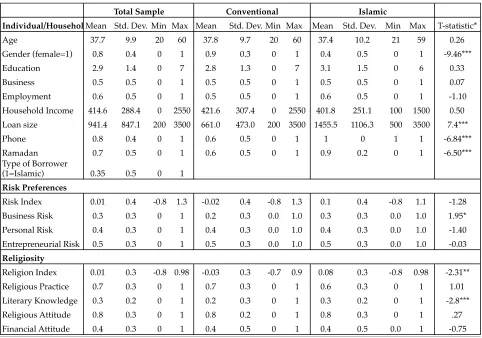
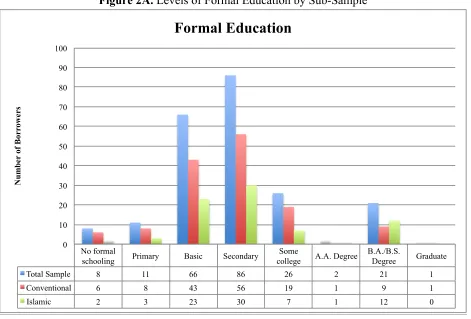
Table 1 shows summary statistics for this study. Within the sample of 221 borrowers, 65 percent of the respondents took up a conventional microfinance loan, whereas 35 percent have taken up an Islamic microfinance loan. Approximately 76 percent of the respondents are female. The age distribution of the sample shows that the respondents’ ages range between 20 and 60 years, with an average of 37 years old. Moreover, the mean age is very similar across both conventional and Islamic borrowers. In terms of formal education, a majority of the respondents have obtained a level of secondary school or less. Very few respondents have obtained an A.A. or B.A./B.S. degree, though Islamic clients boast a slightly higher level of education. Figures 1A and 1B further describe the distribution in the levels of education between conventional and Islamic borrowers. When looking at education levels as a percentage of total borrowers, these graphs reveal that there are no major disparities between conventional and Islamic borrowers. For the most part, across the measures of age, education, household income, employment status, and business ownership, the borrowers in both subsamples have similar characteristics.
loans, but only 45 percent of Islamic loans. Similarly, a dummy variable for whether the survey took place throughout the month of Ramadan is included, as this could potentially influence the responses to questions on religiosity. Whereas 57 percent of conventional borrower surveys took place in Ramadan, almost 94 percent of Islamic borrower surveys took place in this time period. Similar results hold for whether the interview was conducted over the phone, with all Islamic borrowers and the majority of conventional borrowers being surveyed in this way. Finally, although loan sizes were capped at 3,500JD for both conventional and Islamic borrowers, Islamic loans have a higher average loan value.
Figures 3A, 3B, 4A, and 4B show the differences between various risk and religiosity measures across the two subsamples. Figures 3A and 3B observe the risk and religiosity measures obtained through Principal Component Analysis (PCA), whereas Figures 4A and 4B display the risk and religiosity measures obtained through summary index. Figure 3A indicates that Islamic borrowers have a higher average level of risk for each of the measures, suggesting that they are more risk-seeking overall. In contrast, the results for Islamic religiosity are not uniform. Figure 3B shows that conventional borrowers have a higher average total for some religiosity measures, and Islamic borrowers have a higher average total for other measures. This dissimilarity justifies the need for a total measure of religiosity that takes into account each of the factors for both conventional and Islamic borrowers, and allows an overall measure of this variable. Fortunately, this is possible through the use of summary index. Figure 4A explores the risk summary index, indicating that Islamic borrowers have a higher average value when compared to conventional borrowers. These are similar to the results of PCA in Figure 3A, where Islamic borrowers have a higher average level of risk for each measure. When observing the religion summary index, Figure 4B indicates that Islamic borrowers also have a higher average value of religion compared to conventional borrowers. Without controlling for other factors, these tables initially suggest that Islamic borrowers are more risk-seeking and more religious than conventional borrowers.
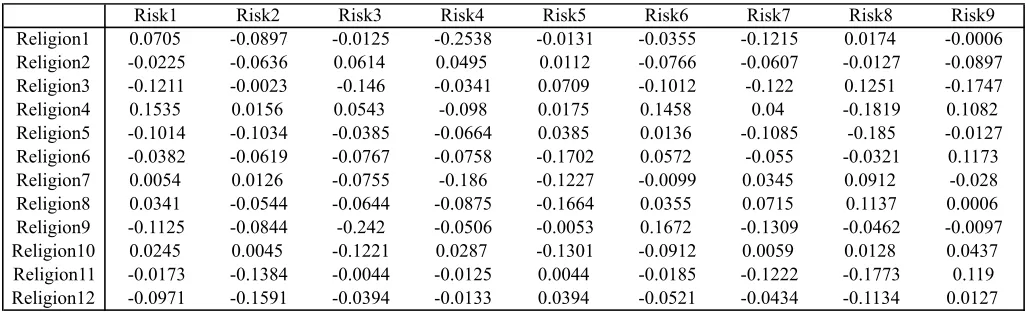
approximately 65% of the correlations being negative. These findings also suggest that overall, more religious individuals tend to be more risk averse.
4. Empirical Strategy
4.1.1 Principal Components AnalysisThe goal of this research is to analyze the risk preferences and religious characteristics of borrowers who choose to take up Islamic microfinance loans as opposed to conventional loans. The purpose is to elicit a framework in which it is possible to analyze the demand for Islamic microfinance in Muslim communities as well as to determine the risk preferences of individuals choosing Islamic microfinance versus conventional microfinance. To obtain appropriate measures of risk preferences and Islamic religiosity, principal component analysis (PCA) and summary index are utilized. These techniques consolidate the number of questions comprising overall risk and Islamic religiosity into a smaller number of variables. Consequently, this analysis explores both indices and their results for risk and religiosity measures.
In general, PCA is a type of factor analysis that exposes the latent dimensions of a set of variables. Essentially, it reduces a large number of variables to a smaller number of factors. To do this, PCA accounts for maximum variance in the data set by identifying linear combinations of raw parameters (McDonald, 1998). The first factor accounts for the largest variance in the data, and each subsequent factor will account for the next largest variance. These factors, or dimensions, are often a combination of two or more items. Therefore, this method results in optimal linear reconstruction of the variable being measured using the fewest number of parameters (McDonald, 1998.) In addition, PCA extracts a number of factors according to different criterion. The default criterion for extracting factors is when the greatest variation, measured by Eigenvalues, are greater than 1 (Hamilton, 2008).
4.1.2 Principal Component Analysis: Risk
business, the desire to take additional risks when the individual is initially successful, and whether it is more important to be cautious or bold overall. Compared to the other risk preference questions, the theme of this factor can be described as measuring risk when considering one’s personal preferences.
4.1.2 Principal Component Analysis: Islamic Religiosity
In order to obtain an appropriate measure of Islamic religiosity, thirteen items were analyzed using PCA. The original item pool consists of various binary indicators of religiosity, including beliefs, attitudes, practices, financial preferences, and knowledge. These questions were generated with the assistance of native Jordanians, enumerators, focus groups, and MFI employees to obtain an authentic measure of Islamic religiosity. Here, values of 0 are coded for less religious, and values of 1 are coded for more religious responses. Section 2 of the Appendix shows the four factors that are identified with Eigenvalues greater than 1. To estimate the probability of taking up an Islamic loan, all four factors are retained. These factors measure financial belief, religious practice, religious attitude, and literary knowledge, and each is described in further detail in Appendix A. To exemplify the use of PCA, it is possible to explore the factor “religious practice”. This factor consists of three items predominantly related to the religious practices of individuals. Specifically, this component incorporates whether the individual prefers an Islamic or conventional loan, if they believe consulting a sheikh or imam1 is an ideal way to verify the validity of Islamic loans, and if they seek advice from a sheikh or imam on a consistent basis.
4.2 Multiple Inference and Summary Index
In addition to PCA, a summary index is constructed as an alternative measure of risk preferences and religiosity. The summary index utilized in this research is largely based on a paper written in 2006 by Michael Anderson, entitled Multiple Inference and Gender Differences in the Effects of Preschool. The idea is to correct for the over-rejection of the null hypothesis that is sometimes a result of multiple inference and when there are many outcomes being tested. Essentially, if risk preference and religiosity outcomes were tested individually, it is possible that some outcomes would display significance even if there were no effect. This occurrence is especially likely in smaller samples when there are a large number of outcomes being tested. To address this possibility, this study follows the corrections outlined by Anderson (2006). First, a specific set of risk and religious outcomes are selected based on their a priori notions of relevance and importance. In this way, the degree of over-testing is minimized (Anderson, 2006). In total, nine risk preference and thirteen religiosity outcomes are utilized in the model.
1
Next, a summary index is constructed for both risk preferences and religiosity. Fundamentally, a summary index is the weighted mean of multiple standardized outcomes, (Anderson, 2006). In addition to outlining a specific set of outcomes for risk and religion, creating a summary index also reduces the total number of tests being conducted in the regression. Anderson (2006) states that summary indices present two distinct advantages over the testing of individual outcomes. Primarily, summary indices are not prone to Type I error, and are actually robust to over-testing. This is because the addition of outcomes to summary index will not increase the probability of Type I error (Anderson, 2006). Furthermore, summary indices have the potential to be even more powerful than individual tests. While multiple outcomes may indicate only marginal significance, aggregating these variables into a single index may result in stronger statistical significance overall.
In general, the goal of summary index is to combine data from multiple measures and outcomes into a single index. This consolidates several individual tests into a single test. To do this, summary indices utilize weights that are calculated to maximize the amount of information that is captured by the index. In essence, outcomes that have high levels of correlation between one another receive less weight in the index. The weighting technique is as follows:
𝑟!" = ω!"!!"#!! !!" !"!
!∈!!"
where 𝑟!" is the new indexed variable. This variable represents the mean of the normalized,
demeaned outcomes for each observation i in area j. To construct 𝑟!", the outcomes 𝑜!"# are weighted by the inverse of the covariance matrix of the outcomes. The row entries are then summed in the inverted covariance matrix to obtain the weight on each outcome. In this equation, M!" signifies the non-missing outcome total for observation i in area j. Moreover, the standard deviation of the group is denoted by 𝜎!", whereas ω!" is the outcome weight for the covariance matrix. For each observation, the weights are normalized such that they sum to one. Missing outcomes are ignored in the creation of 𝑟!". In this way, the new index makes use of all available data, in addition to weighting outcomes with fewer missing values more greatly (Anderson, 2006).
4.3 Take-up of Islamic Loans: Linear Probability Model
probability model, robust standard errors are used with each linear probability estimate. As mentioned in the previous sections, PCA and summary index are used to create factors and accurately estimate risk and religiosity. Although probit and logit models are commonly used in conjunction with probability, they are not frequently used with PCA and summary index (Train et al., 1987). Rather, when using PCA or summary index, probit and logit estimation methods are not favored due to the variation in the distribution values surrounding the mean, which result in asymptotic bias (Train et al., 1987). Consequently, the results are more robust when combining PCA or summary index with a linear probability estimator. In addition, the linear probability model is computationally simpler to work with and allows a more straightforward interpretation of marginal effects (Heckman, 1985). The model is as follows:
Yi = β0 + β1Xi + β2 Bi + β3RPIi + β4RIi +εi (1)
Here, Yi is a binary variable taking on a value of 1 when the individual has an Islamic microfinance loan and 0 otherwise. Xi denotes a vector of individual and household control variables, Bi represents a dummy variable for each branch, RPIi denotes a vector of the
individual’s risk preferences, RIi represents a vector of Islamic religiosity measures, and εi signifies the error term. The model is run under four different specifications. The first two specifications utilize PCA as a proxy for risk and religiosity factors, and the last two specifications utilize summary index as a proxy for risk and religiosity. Through the use of the linear probability model, it is possible to test the main hypotheses of this research:
Hypothesis I: Risk Preferences
Ho: There is no significant difference between the risk preferences of conventional and Islamic microfinance borrowers
Ha: There is a significant difference between the risk preferences of conventional and Islamic microfinance borrowers
Hypothesis II: Islamic Religiosity
Ho: There is no significant difference in the levels of Islamic religiosity between conventional and Islamic microfinance borrowers
Ha: There is a significant difference in the levels of Islamic religiosity between conventional and Islamic microfinance borrowers
4.4 Robustness Checks
differs. In the Murabaha contract, the MFI must first purchase the goods or product, and then sell it back to the borrower at a fixed marked-up price for the service. For this reason, the application process for Islamic microfinance loans is lengthier than that of conventional loans. To control for this difference, a time preference index is included in the regressions in order to measure whether Islamic borrowers are also more patient than conventional borrowers. If conventional borrowers are simply more impatient than Islamic borrowers, this could be an important reason they choose to take up this type of loan.
The second variable that is included in the regression estimates is whether the survey took place during the holy month of Ramadan. One reason this variable is included is because the majority of Islamic microfinance surveys were conducted in this month. Moreover, the holy month of Ramadan is widely practiced in Jordan, and is considered a month for spiritual reflection and a time to reconnect to religious beliefs. Accordingly, it is possible that individuals who are surveyed during this time period will respond more positively to questions about Islamic religiosity than individuals who were not surveyed in this time period. As a result, a control is included for whether the survey was conducted in the holy month of Ramadan.
It is also important to mention that enumerators are not included as controls in the estimations. Enumerator controls are excluded for two reasons. First, when conducting surveys, enumerators were assigned to a specific type of borrower survey: either conventional or Islamic borrowers. Therefore, their distribution will automatically favor either conventional or Islamic borrowers. The second reason enumerators are not included as a control lies in the similarities between the enumerators. Specifically, the enumerators were alike in terms of their training as well as their personal traits. In order to prevent discrepancies between the survey results, enumerators were trained for three weeks prior to field research. Moreover, the enumerators were native Jordanians, males, and recent college graduates. With this in mind, it is considered unlikely that survey participants will vary their answers according to the enumerator who conducted the survey. Rather, it is more likely that any variation captured by this variable is due to the differences in the distribution of enumerators across conventional and Islamic borrowers.
5. Data Analysis and Results
5.1.1 Principal Component Analysis: RiskIslamic loan. Although two of the risk measures are positive, none of the values are significant. The risk preference measures are still insignificant when adding a dummy variable for whether the survey took place in Ramadan. Overall, the table indicates that different measures of risk preferences have varying effects on the probability of taking up an Islamic microfinance loan, and it is not possible to draw an overall conclusion.
Despite these results, this model also incorporates various controls related to religiosity and socio-economic characteristics. Literary knowledge was used in the estimation as a religious control. With all five measures of risk, literary knowledgeis found to have a positive, significant effect on the probability of taking up an Islamic loan. The results also significantly show that female borrowers are approximately 20 percentage points less likely to take up an Islamic loan. Table 1 provides an explanation for these findings in particular, where the female distribution clearly favors conventional loans. Furthermore, both employment status and owning a business are both significant indicators of taking up an Islamic loan.
5.1.2 Principal Component Analysis: Islamic Religiosity
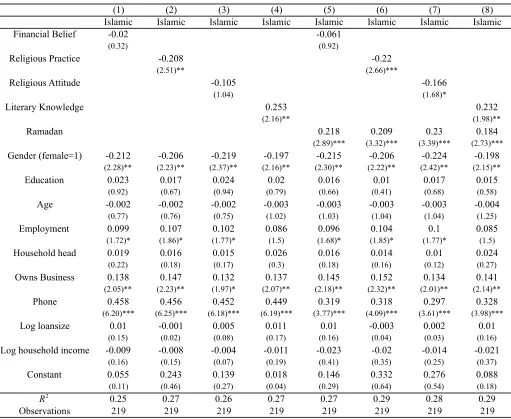
Additionally, Table 4 shows the linear probability estimations with alternative measures of Islamic religiosity using PCA. In this estimation, four different measures of religiosity are included. Two out of four measures have negative coefficients, while the other two have positive coefficients. Also, two out of four measures are significant in these estimations: religious practice and literary knowledge. While religious practice has a negative significant value, literary knowledge has a positive significant value. In addition, although the directions of the coefficients vary, both of these variables are significant at the 5% level. Similar to risk, the components of religiosity have varying effects on the probability of taking up of Islamic loans, making it difficult to draw an overall conclusion. These results hold when controlling for whether the survey was conducted in Ramadan. The only observed change is that religious attitude becomes significant at the 10% level.
5.1.3 Principal Component An Effective Measure?
The results of the linear probability model when utilizing PCA are conflicting for both risk preference and religiosity measures. Though PCA effectively reduced the number of variables that were utilized in the regression, it was not possible to draw an overall conclusion from the factors. Instead, different factors had opposite effects, though they were measuring the same variable. Therefore, though PCA is advantageous in that it reduces a large number of correlated variables to a smaller number of uncorrelated factors and it identifies underlying themes of a variable, it may not be the best tool to attain an aggregate measure of risk and religiosity. PCA also gives a higher weight to the factors that are most correlated with one another, suggesting why the results vary across different factors. In contrast, summary index gives a smaller weight to factors that are correlated with one another, since they are being measured in multiple ways and are attempting to measure the same thing.
5.2.1 Summary Index: Risk
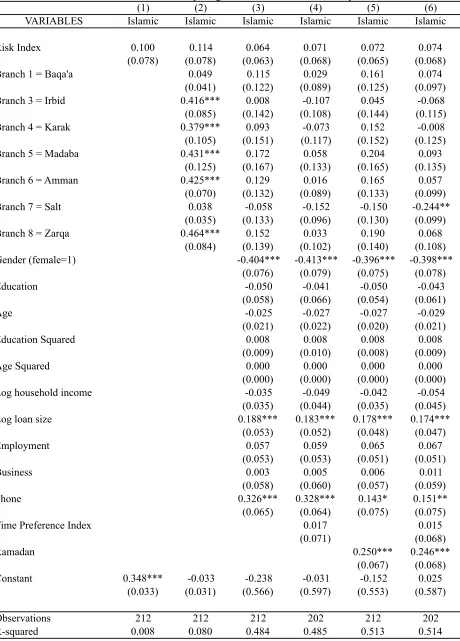
In this section, three different specifications are observed when using summary index. Initially, risk preferences and Islamic religiosity summary indices are observed individually. Then, a third table includes risk preferences and Islamic religiosity indices in the same estimation. Table 5 shows the results for the risk summary index. For each specification, there is a positive value for the coefficient on risk index. However, none of the equations for risk have significance, despite including a number of different specifications. These results are similar to the risk results using PCA in Table 3, where the coefficients are positive but insignificant. From these results, it is not possible to reject the null hypothesis that Islamic and conventional microfinance borrowers have different levels of risk preferences.
there is little change in the results. In addition, the branch controls do not have any significance when the model is fully specified. For the most part, the branch controls also maintain the directions of their coefficients throughout the different specifications.
5.2.2 Summary Index: Islamic Religiosity
Additionally, Table 6 shows the results for the religion summary index. For each of the five specifications, there is a positive, significant coefficient for the religion index on the probability of taking up an Islamic microfinance loan. As more variables are specified, the coefficients decrease. Moreover, as more variables are added, the significance of the religion index is lower, changing from 5% to 10%. Still, from these results, it is possible to deduce that higher levels of Islamic religiosity increase the probability of taking up an Islamic microfinance loan by an average of 20 percentage points.
These estimations also show comparable results for the control variables. Similar to Table 5, females are approximately 40 percentage points less likely to take up an Islamic microfinance loan, and this variable is significant at the 1% level for each estimation. In addition, the values for loan size and whether the interview was conducted over the phone all present similar, positive influences on the probability of taking up an Islamic loan. There are also corresponding results when including controls for time preference and Ramadan. The time preference index is insignificant, while the dummy variable for Ramadan is significant at the 1% level for each estimation. Finally, the dummy variable for each branch show irregular significance throughout each specification. Despite these additions, the religion index maintains its significance.
5.2.3 Summary Index: Risk and Islamic Religiosity
Table 7 presents the results of the summary index for risk and Islamic religiosity in the same estimation. Although Table 5 demonstrates that the risk index is positive but insignificant, this variable becomes positive and significant when it is tested in conjunction with the religion index. In general, according to these results, the risk index increases the probability of taking up an Islamic microfinance loan by approximately 11 percentage points. Six of the seven risk index values are significant at the 10% level, with the value for equation (6) losing significance. The change in significance occurs through the addition of the risk-religion interaction term. Nevertheless, the addition of the interaction term in column (7) as well as the Ramadan control restores significance to the risk index. Overall, in this table, there are uniformly positive results for the risk index on the probability of Islamic loan take-up.
specifications, and maintains a uniformly positive value for each estimation. The values for the religion index are significant at the 1% and 5% levels for six out of seven specifications. Again, as the equation becomes more specified, the religion index’s coefficient and significance decrease. Specifically, the significance is the weakest when including the risk-religion interaction term and the dummy variable for Ramadan. Nonetheless, from this table, it is possible to conclude that religiosity increases the probability of taking up an Islamic microfinance loan by approximately 22 percentage points. This is a similar value to that of Table 6, when the risk index was not included in the model.
The same individual, household, and branch controls are also included, as in the previous estimations. Again, there are similar results across each model specification. Table 7 shows that females are approximately 40 percentage points less likely to take up an Islamic microfinance loan. Contrary to the PCA results, employment status and owning a business are not significant in any of these estimations. However, loan size, Ramadan, and the phone dummy are all positive and significant in these estimations as well. The effect of the time preference index is also insignificant, and the branch controls show irregular significance throughout different specifications.
6. Discussion
6.1 Risk PreferencesSince the enforcement mechanisms vary between Islamic and conventional financing, more seeking borrowers may be attracted to Islamic financing. Moreover, in terms of risk-seeking borrowers, this doctrine can also create an opportunity for moral hazard.
Another possibility of why risk-seeking borrowers select into Islamic microfinance considers the idea of credit rationing, and how it plays a role in determining what type of loan to obtain. Credit rationing occurs when there is a limited supply of lending to borrowers, even if there is a high demand for funds (Stiglitz and Weiss, 1981). This market failure does not arise because credit is too expensive; rather, lenders are already maximizing profits, preventing them from loaning more funds or raising the interest rate to attract more borrowers. Some types of credit rationing occur when a specific group of borrowers, who share a common trait, are unable to obtain credit from a given supply of funds (Stiglitz and Weiss, 1981). In the context of this research, it is possible that risk-loving borrowers may not qualify for conventional loans, or that conventional MFIs target female clients. In both of these cases, it is likely that the rejected borrower will turn to Islamic financing as an alternative.
6.2 Islamic Religiosity
The second and stronger conclusion suggested by the linear probability estimations is that more religious individuals are more likely to take up an Islamic loan. This result is not especially surprising, as the main justification for the proliferation of Islamic microfinance is to provide a method of financing to religious individuals without charging interest rates. Along with this idea, an abundance of research argues that Islamic microfinance will intuitively attract more religious individuals (Dutta and Magableh, 2004, Abdul Rahman, 2007 and Ashraf, 2010). The results confirm the hypothesis that more religious individuals will take up Islamic microfinance loans. Still, Islamic microfinance is a novel concept, meaning this hypothesis has not previously been tested. Consequently, these results offer a glance at the potential relationship between Islamic borrowers and their overall levels of religiosity. Since this hypothesis holds empirically, it suggests that Islamic microfinance is another avenue in which the poor can access financial services.
6.3 Gender and Loan Size
true target of Islamic microfinance is the family, and not just women (Ahmed, 2002; Obaidullah, 2011). As a result, it is likely easier as well as more acceptable for men to access Islamic microfinance loans.
Across the different estimations, loan size is an important variable when characterizing conventional and Islamic microfinance loans. Though loan sizes for both clients were capped at 3,500JD, the average loan size for Islamic borrowers is 1,455JD, compared to 661JD for conventional borrowers. One possible reason for this disparity is the nature of Islamic microfinance contracts, particularly in relation to the Murabaha contract that is employed by DEF. In this type of contract, the MFI will purchase the asset or goods, and sell them back to the borrower at a marked-up cost. In this way, the MFI engages in a profit and risk-sharing endeavor with the borrower. Since there are two parties participating, as opposed to just one in the conventional microfinance contract, it may encourage the participants to purchase or invest in a more expensive item. This is especially likely when both parties have a strong incentive for the success of the project, such as with Islamic financing. Overall, larger or more expensive investments would consequently lead to a higher average loan size for Islamic borrowers.
6.4 Principal Component Analysis and Summary Index
Through this study, it is also possible to draw conclusions regarding the use of indices. Principal component analysis (PCA) was initially utilized in conjunction with risk preferences and different measures of Islamic religiosity. Although PCA was successful in reducing a large number of correlated variables to a smaller number of uncorrelated factors, it presents somewhat of a disadvantage when measuring broad ideas. Primarily, since the factors generated by PCA had opposing coefficients in the regression estimations, it was not possible to determine the overall effect of risk preferences or Islamic religiosity on the take-up of Islamic microfinance loans.
6.5 Limitations
Several limitations are apparent for this study. Primarily, the borrowers are chosen from different microfinance institutions in Jordan, and thus do not provide an ideal sample. Variations in the distribution of the sub-samples also provide some weaknesses: gender, loan size, and survey time period all greatly differ between the samples. This makes it difficult to determine causality when testing these factors in the model. Furthermore, since the sample is so small, it is not possible to split the sample according to these distributions. For example, it would be advantageous to observe those borrowers who were surveyed in Ramadan and compare them to borrowers who were not surveyed in Ramadan. Since the sample is already limited, conducting these tests yields little statistical power and meaning. In addition, it is difficult to interpret several of the variables due to the nature of the project. Specifically, this research observes a decision from the past: the take-up of a conventional microfinance loan. In the analysis, current variables, such as Ramadan or household income, are used to explain this decision. As a result, interpreting the meaning of present variables on a past decision is sometimes ambiguous.
6.6 Conclusion
References
Abdul-Rahman, Abdul Rahim (2007). “Islamic microfinance: A missing component in Islamic banking,” Kyoto Bulletin of Islamic Area Studies, 1 (2), pp. 38-53.
Ahmad, Abu Umar Faruq and A.B. Rafique Ahmad (2009). “Islamic Microfinance: The Evidence from Australia,” Humanomics, 25 (3), pp. 217-235.
Ahmed, Habibi (2002). “Frontiers of Islamic Banking: a synthesis of social role and
microfinance,” European Journal of Management and Public Policy, 3 (1).
Albelaikhi, Abdulaziz (1998). Development of a Muslim Religiosity Scale, University of Rhode
Island.
Al-Sabwah, Mohammed and Ahmed Abdel-Khalek (2006). “Religiosity and Death Distress in Arabic College Students,” Death Studies, 30 (4), pp. 365-375.
Anderson, Michael (2006). “Multiple Inference and Gender Differences in the Effects of Preschool: A Reevaluation of the Abecedarian, Perry Preschool, and Early Training Projects,” Journal of the American Statistical Association, 103 (484): pp. 1481-1495.
Ashraf, Mohammad (2010). “The Effectiveness of Microcredit Programs and Prospects of Islamic Microfinance Institutes (IMFIs) in Muslim Countries, A Case Study in Bangladesh,” Journal of Islamic Economic, 6 (4), 69-85.
Ashta, Arvind and Rosita de Selva (2012). “Religious Practice and Microcredit: Literature Review and Research Direction,” Postmodern Openings, 2 (8), 33-44.
Banerjee, Abhijit and Esther Duflo (2007). “The Economic Lives of the Poor,” Journal of Economic Perspectives, 21 (1), 141-167.
Bhuiyan, Abul Bashar, Chamhuri Siwar, Aminul Islam, and Mamunur Rashid (2011). “Islamic Microcredit is the Way of Alternative Approach for Eradicating Poverty in
Bangladesh,” Australian Journal of Basic and Applied Sciences, 5 (5), pp. 221-230.
Cressy, Robert (2000). “Credit Rationing or Entrepreneurial Risk Aversion? An Alternative Explanation for the Evans and Jovanovic Finding,” Economic Letters, 66(2), 235-240.
Dawood, N.J (2006). “The Koran (translated with a parallel Arabic text),” Penguin Books, New York, NY.
Dhumale, Rahul and Amela Sapcanin (1999). “An Application of Islamic Banking Principles to Microfinance,” Regional Bureau for Arab States, pp. 1-14.
Dusuki, Asyraf (2008). “Banking for the poor: the role of Islamic banking in microfinance initiatives,” Humanomics, 24 (1), 49-66.
Dutta, Dilip and Ihab Magableh (2006). “A socio-economic study of the borrowing process: The case of microentrepreneurs in Jordan,” The University of Sydney School of Economics and Political Science, 1-20.
El-Gamal, Mahmoud, Mohamed El-Komi, Dean Karlan, and Adam Osman (2011). Bank-
Insured RoSCA for microfinance: Experimental evidence in poor Egyptian villages. Rice University Department of Economics, 1-27.
El-Komi, Mohamed and Rachel Croson (2011). “Efficiency of Islamic finance contracts: Microfinance Experiments,” Center for Islamic Economics and Finance, Qatar Faculty of Islamic Studies.
Giné, Xavier, Pamela Jakiela, Dean Karlan, and Jonathan Morduch (2006). “Microfinance Games,” Economic Growth Center. 936, 1-46.
Ghorbani, Nima, P. J. Watson, Ahad Ghramaleki, R. J. Morris, and Ralph Hood, (2000). “Muslim Attitudes Towards Religion Scale: Factors, validity, and complexity of
relationships with mental health in Iran,” Mental Health, Religion, & Culture, 3, 125-132.
Hamilton, Lawrence (2006). Statistics with STATA: Version 10, Duxbury Press.
Havel, Safrankova (2007). “Impact of Microfinancing on Reducing Poverty in Developing Countries, Case Jordan,” Agricultura Tropica et Subtropica, 40 (1), pp. 24-28.
Heckman, James and Thomas Macurdy, (1985). "A simultaneous equations linear probability model,” The Canadian Journal of Economics.
Huntington, Ray, Camille Fronk, and Bruce Chadwick (2001). “Family Roles of Contemporary Palestinian Women,” Journal of Comparative Family Studies, 32 (1), pp. 1-19.
Jana-Masri, Asma and Paul Preister (2007). “The development and validation of a Qur’an-based instrument to assess Islamic religiosity: The Religiosity of Islam Scale,” Journal of Muslim Mental Health, 2 (2), pp. 177-188.
Jobst, Andreas (2007). “The Economics of Islamic Finance and Securitization,” IMF Working Paper, pp. 1-35.
Under Risk,” Econometrica, 47( 2), pp. 263-292.
Karim, Nimrah, Michael Tarazi and Xavier Reille (2008). “Islamic microfinance: An emerging market niche,” Consultative Group to Assist the Poor, Focus Note 49, pp. 1-15.
Kihlstrom, Richard and Jean-Jacques Laffont (1979). “A General Equilibrium Entrepreneurial Theory of Firm Formation Based on Risk Aversion,” Journal of Political Economy, 87 (4), pp. 719-748.
Kim, Jae-On and Charles Mueller (1978b). Factor analysis: Statistical methods and practical issues. Beverly Hills, CA: Sage.
Leiberman, Eric (2011). “Behavioral Economics and Microfinance: A Study of Risk Preferences in Rural Africa,” pp. 1-28.
Malkawi, Eyad and Radi Al Atoom (2011). “Jordan microfinance institutions’ financial viability to achieve microcredit outreach,” European Journal of Economics, 42, pp. 121-132.
McDonald, Gene, Evan Dom, Kenneth Nealson and Michael Storrie-Lombardi, M.C. (1998). “Principal Component Analysis for Biosignature Detection in Extraterrestrial Samples,”
Martian Metoerites.
Moskowitz, Tobias and Annette Vissing-Jorgensen (2002). “The Returns to Entrepreneurial Investment: A Private Equity Premium Puzzle?” American Economic Review, 92 (4), pp. 745-778.
Neumann, John and Oskar Morgenstern (1953). Theory of Games and Economic Behavior, Princeton: Princeton University Press.
Obaidullah, Mohammed (2008). Introduction to Islamic Microfinance, New Delhi: International Institute of Islamic Business and Finance.
Pearlman, Sarah (2012). “Too Vulnerable for Microfinance? Risk and Vulnerability as
Determinants of Microfinance Selection in Lima,” Journal of Development Studies, 48 (9), pp. 1342-1359.
Planet Finance (2007). “Microfinance Market Survey in the West Bank and Gaza Strip,” Washington, D.C.
Polkovnichenko, Valery (2003). “Human Capital and the Private Equity Premium,” Review of Economic Dynamics, 6 (4), pp. 831-845.
Business, 3 (3), pp. 826-836.
Seibel, Hans and Wahyu Dwi Agung (2006). “Islamic microfinance in Indonesia,” Working Paper, University of Cologne Development Research Center.
Stiglitz Joseph and Andrew Weiss (1981). “Credit Rationing in Markets with Imperfect Information,” The American Economic Review, 71 (3): pp. 393-410.
Stiglitz, Joseph (1990). “Peer Monitoring and Credit Markets,” The World Bank Economic Review, 4 (3), pp. 351-366.
Tessler, Mark and Jodi Nachtwey (1998). Islam and Attitudes toward International Conflict: Evidence from Survey Research in the Arab World. Journal of Conflict Resolution. 42 (5), pp. 619-636.
Train, Kenneth, Daniel McFadden, and Andrew Goett (1987). “Consumer Attitudes and Voluntary Rate Schedules for Public Utilities,” The Review of Economics and Statistics, 69 (3), pp. 383-391.
Vereshchagina, Galina, and Hugo Hopenhayn (2009). “Risk Taking by Entrepreneurs,” The American Economic Review, 99 (5), pp. 1808-1830.
Wilde, Alex and Stephen Joseph (1997). “Religiosity and Personality in a Muslim Context,”
Personality and Individual Differences, 23, pp. 899-900.
(2013). “Unlocking new potential to fight rural poverty,” International Fund for Agricultural Development. Retrieved from: