679
Copyright © 2011-15. Vandana Publications. All Rights Reserved.
Volume-5, Issue-3, June-2015
International Journal of Engineering and Management Research
Page Number: 679-684
Static Analysis of Crane Hook with I-Section Using Ansys
M.N.V Krishnaveni1, M.Amareswari Reddy2, B.Nagaraju3
1,2,3
ANITS, Department of Mechanical Engineering, Andhra University, Visakhapatnam, INDIA
ABSTRACT
Crane hooks are highly liable components that are typically used for industrial purposes. Failure of a crane hook mainly depends on three major factors i.e. dimension, material. In this paper load carrying capacity is studied by varying the cross sections. The selected sections are Circular, Trapezoidal and I-section. The area remains constant while changing the dimensions for the four different sections. The crane hook is modeled using SOLIDWORKS software. The stress analysis is done using ANSYS 14.0 workbench Educational version. It is found that T cross section yields minimum stresses at the given load of 6ton for constant cross section area among four cross sections. The stress distribution pattern is verified for its correctness on model of crane hook using Winkler-Bach theory for curved beams.
Keywords— Crane hook, Static analysis, Winkler-Bach
theory, ANSYS 14.0.
I.
I
NTRODUCTIONCrane Hooks are highly responsible components that are typically used for handling material in industries. It is basically a hoisting fixture designed to engage a ring or link of a lifting chain or the pin of a shackle or cable socket and must follow the health and safety guidelines. Thus, the aim of the work is to study the stress distribution pattern of a crane hook using finite element method and to verify the results using scathing method.
The lifting of material generally occurs on construction sites, in factories and other industrial situations. Correct lifting can move large objects efficiently and reduce manual handling operations. Improper design of crane hook lead to disastrous accidents. Every year, incorrect lifting procedures cause injuries, loss of work time and property. People, machinery, loads, methods and the work environment, are all important factors for correct lifting. Provided that enough safety measures are fully implemented, lifting accidents can be reduced. The Fig 1.1 as shows the general diagram of crane hook.
Fig 1.1 Crane Hook
II.
LITERATURE REVIEW
Crane hooks are the components which are generally used to elevate the heavy load in industries and constructional sites. Recently, excavators having a crane-hook are widely used in construction works site. One reason is that such an excavator is convenient since they can perform the conventional digging tasks as well as the suspension works. Another reason is that there are work sites where the crane trucks for suspension work are not available because of the narrowness of the site. In general an excavator has superior manoeuvrability than a crane truck. However, there are cases that the crane hooks are damaged during some kind of suspension works. From the view point of safety, such damage must be prevented. Identification of the reason of the damage is one of the key points toward the safety improvement. If a crack is developed in the crane hook, mainly at stress concentration areas, it can cause fracture of the hook and lead to serious accidents. In ductile fracture, the crack propagates continuously and is more easily detectable and hence preferred over brittle fracture. In brittle fracture, there is sudden propagation of the crack and the hook fails suddenly. This type of fracture is very dangerous as it is difficult to detect.
680
Copyright © 2011-15. Vandana Publications. All Rights Reserved.
prepared in CAE software having dimension and material similar to the crane hook which was purchased from the market. The results obtained were compared with theoretical analysis. Then cross section in which minimum stress induced for given load was modified through FEM.
A. Gopichand [2] carried an optimization of design parameters for crane hook using Taguchi method. Crane hooks are one of the important components which are used to transfer materials having heavy loads, mainly in industries. Crane hooks are liable components subjected to failure due to stress in accumulation of heavy loads. The design parameters for crane hook are area of cross section, material and radius of crane hook. In the present work optimization of design parameters is carried out using Taguchi method, total three parameters are considered with mixed levels and L16 orthogonal array is generated .The optimum combination of input parameters for minimum Vonmises stresses are determined.
Rashmi Uddanwadikerin [3] discussed on stress analysis of crane hook and validation by photo-elasticity. Crane hooks are highly liable components and are always subjected to failure due to accumulation of large amount of stresses which can eventually lead to its failure. To study the stress pattern of crane hook in its loaded condition, a solid model of crane hook is prepared with the help of CMM and CAD software. Real time pattern of stress concentration in 3D model of crane hook is obtained. The stress distribution pattern is verified for its correctness on an acrylic model of crane hook using Diffused light Polari scope set up. By predicting the stress concentration area, the shape of the crane is modified to increase its working life and reduce the failure rates.
III.
DESIGN OF CRANE HOOK
Machine frames having curved portions are frequently subjected to bending or axial loads or to a combination of bending and axial loads. With the reduction in the radius of curved portion, the stress due to curvature become greater and the results of the equations of straight beams when used becomes less satisfactory. For relatively small radii of curvature, the actual stresses may be several times greater than the value obtained for straight beams. It has been found from the results of Photo elastic experiments that in case of curved beams, the neutral surface does not coincide with centroidal axis but instead shifted towards the Centre of curvature. It has also been found that the stresses in the fibers of a curved beam are not proportional to the distances of the fibers from the neutral surfaces, as is assumed for a straight beam. The design of crane hook was done by taking the data pertaining to load(w), C.S.A and curvatures which are used in industrial applications of crane hook
3.1 Theoretical Design of Crane Hook with I C.S.A
Considering same cross sectional area as of T-section for I-T-section. P =6 Ton=58860 N ;R1= 60.625 mm;
R4= 139.375 mm; H = 80 mm ; b1=72 mm; b2=32 mm
b3=72 mm t1=20 mm t2=44 mm t3
Total equivalent stress, σ=σ0+σb
=16 mm with these values we done a modeling in SOLIDWORKS with I cross section as shown in Fig 3.1.
Direct stress due to load,
σ0=PA =588603980 = 14.788 N mm⁄ 2
Bending stress due to load,
σb=A × R−M �1 +R 2
h2�
y R + y��
P=6 Ton= 58860 N
R1 = 60.625 mm ,R2 = 80 mm,R3 = 124 mm,R4 = 139.375
mm
H = 80 mm, b1= 72 mm, b2 = 32 mm, b3= 72 mm, t1= 20
mm t2= 44 mm, t3= 16 mm, d1=39.12 mm,d2=H-d1
=80-9.12=40.88 mm, R= R1+d1=99.12 mm
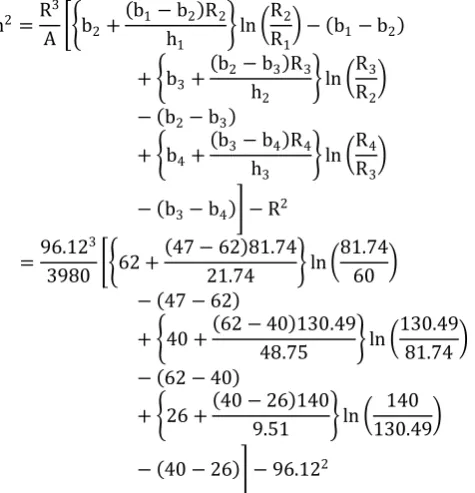
Taking sectional constant h2 for Trapezoidal section, based on Winkler-Batch theory
h2=R3
A ��b1loge� R2
R1�
+�b2loge�RR3
2�+ b3loge�
R4
R3���� −R 2
=99.1239803��72 loge�60.62580 �
+�32 loge�12480�
+ 72 loge�139.375124 ���� −99.122
= 552.16 𝑚𝑚𝑚𝑚2
Maximum stress in hook is,
σmax = 14.788−14.788�1 +99.12
2
552.16�
−39.12
99.12−39.12��
= 171.571 N mm⁄ 2
Minimum stress in hook is,
σmin = 14.788−14.788�1 +552.1699.122�99.12 + 40.8840.88 �� =−76.84 N mm⁄ 2
Fig 3.1 Design of Crane Hook with I C.S.A
3.2 Theoretical Design of Crane Hook with Circular
C.S.A
Considering the same cross sectional area as of T-section for circular cross T-section. P = 6 Ton = 58860 N; Ri=
60 mm; Ro= 131.18 mm; d=71.18mm with these values we
done a modeling in SOLIDWORKS with circular cross section.
Total equivalent stress, σ=σ0+σb Direct stress due to load,
σ0=PA =588603980 = 14.788 N mm⁄ 2
681
Copyright © 2011-15. Vandana Publications. All Rights Reserved.
σb=A × RM �1 +R 2
h2�
y R + y��
Taking sectional constant h2 for circular section, based on Winkler- Batch theory
h2=d2
16 + 1 128
d4
R2
=71.1816 +2 1281 71.1895.5942
h2= 338.61 mm2
σb(outer )=−14.788�1 +338.6195.592�95.59 + 35.5935.59 ��
= –123.065 N/mm2
σb(inner )=−14.788�1 +95.59 2
338.61�
−35.59
95.59−35.59��
= 221.935 N/mm
Fig 3.2Design of Crane Hookwith Circular C.S.A
3.3 Theoretical Design of Crane Hook with Trapezoidal C.S.A
Considering same cross sectional area as of T-section for Trapezoidal cross T-section. P = 6 Ton = 58860 N; R
2
Maximum stress in hook is
σmax = 14.788 + 221.935 = 236.723 N mm⁄ 2
Minimum stress in hook is
σmin = 14.788−123.065 =−108.277 N mm⁄ 2
1= 60 mm; R2= 140 mm; H= 80 mm; b1=70 mm;
b2=36mm with these values we done a modeling in
SOLIDWORKS with Trapezoidal cross section. d1= 36.12 mm (From Solid works data)
𝑑𝑑2=𝐻𝐻 − 𝑑𝑑1= 80−36.12 = 43.88 𝑚𝑚𝑚𝑚
𝑅𝑅1= 60 𝑚𝑚𝑚𝑚
𝑅𝑅2= 140 𝑚𝑚𝑚𝑚
R= 60 + 36.12 = 96.12 𝑚𝑚𝑚𝑚
Total equivalent stress, σ=σ0+σb Direct stress due to load,
σ0=PA =588603980 = 14.788 N mm⁄ 2
Bending stress due to load,
σb=A × R−M �1 +R 2
h2�
y R + y��
Taking sectional constant h2 for Trapezoidal section, based on Winkler-Batch theory
h2=R3
A ��b2+(b1−hb2)R2
1 �ln�
R2
R1� −(b1−b2)
+�b3+(b2−hb3)R3
2 �ln�
R3
R2�
−(b2−b3)
+�b4+(b3−hb4)R4
3 �ln�
R4
R3�
−(b3−b4)� −R2
=96.1239803��62 +(47−62)81.74
21.74 �ln�
81.74
60 �
−(47−62)
+�40 +(62−48.7540)130.49�ln�130.4981.74� −(62−40)
+�26 +(40−26)140
9.51 �ln�
140
130.49�
−(40−26)� −96.122
= 223.13[1.732 + 15 + 46.255−22 + 16.33−14]
−9239.05
= 426.27 mm2
Maximum stress in hook is,
σmax = 14.788−14.7888�1 +96.12
2
426.27�
−36.12
96.12−36.12��
= 192.965 N mm⁄ 2
Minimum stress in hook is,
σmin = 14.788−14.788�1 +426.2796.122�96.12 + 43.8843.88 �� =−100.466 N mm⁄ 2
Building a model in SOLIDWORKS usually starts with a 2D sketch (although 3D sketches are available for power users). The sketch consists of geometry such as points, lines, arcs, conics (except the hyperbola), and splines. Dimensions are added to the sketch to define the size and location of the geometry. Relations are used to define attributes such as tangency, parallelism, perpendicularity, and concentricity. The parametric nature of SOLIDWORKS means that the dimensions and relations
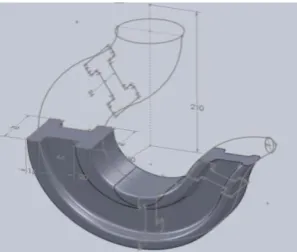
Fig 3.3 Design of Crane Hook with Trapezoidal C.S.A
682
Copyright © 2011-15. Vandana Publications. All Rights Reserved.
drive the geometry, not the other way around. The dimensions in the sketch can be controlled independently, or by relationships to other parameters inside or outside of the sketch.
In an assembly the relations are mates. Just as sketch relations define conditions such as tangency, parallelism, and concentricity with respect to sketch geometry, assembly mates define equivalent relations with respect to the individual parts or components, allowing the easy construction of assemblies. SOLIDWORKS also includes additional advanced mating features such as gear and cam follower mates, which allow modeled gear assemblies to accurately reproduce the rotational movement of an actual gear train.
Finally, drawings can be created either from parts or assemblies. Views are automatically generated from the solid model, and notes, dimensions and tolerances can then be easily added to the drawing as needed. The drawing module includes most paper sizes and standards (ANSI, ISO, DIN, GOST, JIS, BSI and SAC).
Fig 4.2 Solidworks Model of Crane Hook with Circular-section
Fig 4.1 Solidworks Model of Crane Hook with I-section
Fig 4.3 Solidworks Model of Crane Hook with Trapezoidal -section
V. FINITE ELEMENT ANALYSIS OF
CRANE HOOK USING ANSYS
WORKBENCH
The finite element method has become a dominant tool for the numerical solution of wide range of engineering problems. Applications range from deformation and stress analysis of automotive aircraft, building, and bridge structures with advances in computer technology and CAD systems, complex problems can be modelled with relative alleviate.
In this method of analysis, a complex region defining a continuum is discretized into simple geometric shapes called finite elements. The material properties and the governing relationships are considered over these elements and considering the loading and constraints, results in a set of equations. Solution of these equations gives us the approximate behaviour of the continuum.
VI. RESULTS AND DISCUSSION
In this paper Three sections of crane hooks are designed according to curved beam concept. Stresses are found for 6 Ton load using curved beam concept.
Total model is modeled in SOLIDWORKS and IGES model is imported in to ANSYS, here top side of hook is fixed and at the inner curvature of hook 58860 N (6 Ton) load is applied on nodes and stresses and deformation are plotted.
Table 6.1 Properties Materials taken for FEA of crane hook
Nickel Alloy (Wrought
N06230)
Structural Steel
Density (Kg/m3
9000 )
7850
Young’s modulus (GPa)
210 200
Strength to weight ratio
93 _
Tensile strength-Yield (MPa)
400 250
Tensile strength-Ultimate (MPa)
840 460
Thermal Expansion
(Base 22o
12
C)
12
6.1 Nickel Alloy (Wrought N06230)
683
Copyright © 2011-15. Vandana Publications. All Rights Reserved.
Fig 6.1(a) Equivalent stresses in Circular-Section
6.1.2 Trapezoidal cross section
Fig 6.1(b) Equivalent stresses in Trapezoidal-Section
6.1.3 I-section
Fig 6.1(c) Equivalent stresses in I-Section
6.2 Structural Steel
6.2.1 Circular cross section
Fig 6.2(a) Equivalent stresses in Circular-Section
6.2.2 Trapezoidal section
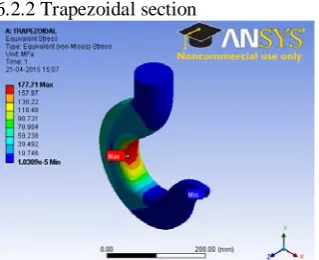
Fig 6.2(b) Equivalent stresses in Trapezoidal-Section
6.2.3 I-section
Fig 6.2(c) Equivalent stresses in I-Section
6.3 Values of Maximum Stresses in Different Cross Sections of Steel Crane hook
Table 6.1 Comparison of Stresses in Different Cross Sections
SECT
ION NAM E
ARE A OF CRO
SS SECT
ION (mm
INNE R RADI
US OF CUR VAT URE (mm)
2)
LO AD (To
n)
THE ROTI
CAL STRE SS (N/m
m2
ANS YS STRE
SS (N/m
m )
2
ANS YS STRE
SS (N/m
m ) Nicke
l Alloy
2
) Struct
ural Steel CIRC
ULA R
3980 60 6 236.7 23
241.5 5
241.0 8
TRAP E ZOID
AL
3980 60 6 192.9 65
177.9 6
177.7 1
I- SECT
ION
3980 60 6 171.5 71
165.5 8
166.7 2
Theoretical stresses calculated based on Winkler-Batch theory and the corresponding crane hook model stresses determined by using ANSYS were tabulated as shown above and found that the deviations are at minimum of 5%. The factor of safety for crane hook under static analysis is 2 based on yield stress value.
684
Copyright © 2011-15. Vandana Publications. All Rights Reserved.
VII.
CONCLUSION
Three types of crane hooks are designed according to curved beam concept and the induced stresses were determined by Winkler-Batch theory. Total three models are prepared in CAD software (SOLIDWORKS) and imported into ANSYS. Stresses and deformation values are noted from ANSYS software. Theoretical stresses and ANSYS values are compared and deviation is at minimum of 5%. For 6 Ton loading the stresses induced in Circular, Trapezoidal and I-section of Structural Steel and Nickel Alloy (Wrought N06230) are below the allowable stresses. The stresses induced in the I section are little less than the other sections for same area of cross section and loading. It concludes that I section of Nickle Alloy offers good results for optimization of the crane hook design.
R
EFERENCES[1] AjeetBergaley and AnshumanPurohitdescribed their work on “Structural Analysis of Crane Hook Using Finite Element” International Journal of Science and Modern Engineering (IJISME) ISSN: 2319-6386, Volume-1, Issue-10, September 2013
[2] A.Gopichand carried an optimization of design parameters for “Crane Hook Using Taguchi Method” International Journal of Science and Modern Engineering (IJISME) ISSN: 2319-8753 An ISO 3297: 2007 Certified Organization Vol. 2, Issue 12, December 2013
[3] RashmiUddanwadikerin discussed on “Stress Analysis of Crane Hook and Validation by Photo-Elasticity” International Journal of Engineering Research & Technology ISSN: 2278-0181 Vol.3 - Issue 1 (January - 2014)
[4]Chetan N. Benkar explained the “Finite Element Stress Analysis of Crane Hook with Different Cross Sections” International Journal for Technological Research in Engineering ISSN (Online): 2347 – 4718 Volume 1, Issue 9, May-2014
[5] Ismail Gerdemeli, G. U. Rajurkar, Dr. D. V. Bhope,
Prof. S. D. Khamankar explained the “Finite Element
Analysis of the Tower Damage which Occurs Due to Heavy
Loads” International Journal of Engineering Research & Technology ISSN: 22780181 Vol.2 Issue 8 (August -2013)
[6] ShyamLal Sharma, Tasmeem Ahmad Khan, Md. Parvez and KamleshKumariexperimented on “Design of Hoisting Arrangement of E.O.T. Crane (2008) International Journal of Engineering & Robotics Research ISSN 2278 – 0149 Vol. 2, No. 3, July 2013
[7] Santosh Shaun, RiteshDewangan, ManasPatnaik and NarendraYadav describes the “Study of Crane Hook Having Trapezoidal Section by Finite Element Method & Design of Experiments” International Journal of Modern Engineering Research (IJMER)ISSN: 2249-6645 Vol.2, Issue.4, July-Aug 2012 PP-2779-2781
[8] Takuma Nishimura, Takao Muromakiet, Kazuyuki Hanahara, Yukio Tada, Shigeyuki Kuroda and Tadahisa Fukui “Damage Factor Estimation of Crane-Hook (A Database Approach with Image, Knowledge and
Simulation)”, 4th International Workshop on Reliable Engineering Computing (REC 2010).