Volume 3, Issue 3, March 2014
Page 418
Abstract
Cloud computing is becoming more interesting day by day. As the use of cloud services increases it’s now important to do something for improving efficiency and security of cloud computing. Cloud storage contains huge amount of data, in such case to search that data efficiently becomes a challenging task. Also security vulnerability of such online storage systems is always non trustable. The recent researches are trying to solve this problem by the method of keyword search. But these methods solves this problem to some extend but some methods increases the computational burden on the cloud server or makes the retrieval of files the costly by means of bandwidth efficiency by sending all similar files to the requesting user. This paper discuses this problem and later gives the solution to solve this problem. To solve this problem the method of keyword search has been used. This paper tries to solve the problem of searching files through the huge amount of files securely and efficiently. The previous methods makes the search non efficient by means of time and computational cost, but the method discussed in this paper makes the searching very efficient and secure. It also reduces the burden on the cloud server by sharing it to the user or owner side. Thus makes it very efficient technique in the era of mobile devices where the cloud services can be used on any devices with the expectation of lesser computational cost which finally results into improved performance.
Keywords: cloud computing, keyword search, security, efficiency.
1.
I
NTRODUCTIONCloud computing is the platform for various services like software, infrastructure as a service and everyone wants to enjoy services of cloud computing, which eventually increases the size and load of data on cloud servers. Due to increased number of files on the cloud database the retrieval of files becomes much more time consuming and complex. Also this file retrieval doesn’t ensure the exact retrieval of files from the storage. It results into time and bandwidth loss of an individual or a company. Also the data shared and uploaded on the cloud by any user which may surely affect the security and overall decreasing the trust on that server. These factors thus affect the overall performance of cloud services.
As cloud computing is emerging trend in computing the trust gain becomes very important factor. There are two parameters which can help to improve the trust on the cloud services. One is to improve efficiency and another for improving security. To improve the efficiency the keyword search technique is better as it provides two way communications between cloud server and the user. But while deploying security the burden on cloud server gets increased unexpectedly. Thus it is very important to maintain these two factors so that to improve overall efficiency of the cloud services [5]. Also the world is of mobile devices, so everyone wants to use cloud services on their mobile devices and if the computational cost goes to higher then it results into heavy resource consumption, which is not suitable for mobile devices. So there is need of efficient cloud services in the future.
Cloud is a service which can be accessed from anywhere if deployed in that fashion. It causes lots of parties or persons using it for their purpose. In such case the data some parties may share within them on the cloud server can be confidential. Also every person who uses cloud services doesn’t like to get tracked. In such cases it is very important to maintain their privacy [1]. Thus to maintain their privacy the files and even the search requests are encrypted as soon as the request is sent to the server. This encryption may also affect the efficiency of searching techniques as the search should go on in encrypted manner.
This paper deals with the problem of file searching technique. Large companies, organizations nowadays want their data on cloud and they assume that it will improve their productivity. For such cases if the data or file retrieval takes too much time or becomes a complex task then it cannot help to that company or organization to improve their productivity. So to improve efficiency for searching files, this paper have used most widely discussed technique of keyword search. In previous techniques [2], [3], [4], [5], [6], [9] this issue was trying to solve, they gave a nice solution for this keyword search but they either failed to give truly efficient method by increasing load on the cloud server or by compromising security of the cloud server.
The keyword search method works really well if some modifications will be done. So this paper also used the keyword search method. There are some types of keyword search like “two step searchable encryption method” [9]; “ranked
Secure and Efficient Retrieval
of Data in Cloud
Akshay D. Kapse1, Piyush K. Ingole2
1
M.E. (Student), G.H.R.C.E. Nagpur 2
Volume 3, Issue 3, March 2014
Page 419
searchable encryption scheme” [6]; “ranked Multikeyword searchable encryption scheme” [11], [13], [2]; “fuzzy keyword search” [12].2.
R
ELATEDW
ORKAs the cloud computing becoming more famous the load on the server goes on increasing. Due to which lots of researchers are trying to solve the problems occurred due to this increasing load. This paper focuses on the keyword search method to retrieve data efficiently from the huge database. The previous work havs been studied and their analysis is done bellow.
In fuzzy keyword search [12] a trapdoor request is generated to search for the files. It uses three steps as setup, encryption and decryption. In setup phase the index is created from the files and then the files in encrypted formats sent to the database. When user wants to retrieve the file, a trapdoor request is generated to search for the specific file and then the keyword is matched with the index entries from the database and set of matching file entries are sent to that user.
This scheme works well but it also compromises security as the index is sent to the server is not in encrypted format and only files are sent in encrypted format. Thus it is not the secure method as it does not guarantee the privacy of the user.
In ranked searchable symmetric encryption scheme [15], [6], a trapdoor request is generated to search the files. This keyword searches files through the index generated from the files and searches for the similar matching files through the database. The files stored on database are encrypted by using SHA-1 160 bit, and then these files were sent to the database along with the index files. Here the index files are not encrypted. This scheme gives better results for the single keyword search but the security is again compromised by letting the index files in non encrypted format on the database.
In secure rank-ordered multi-keyword search [13], both the index and files are encrypted before sending to the database. The security is well guaranteed here. The index is encrypted with SHA-1 160 bits while the files are encrypted with the AES algorithm containing CTS functions. The index created for the particular file takes much more time to build and the size of index file is much higher yet it doesn’t support the misspelled words. Thus the overall efficiency of the scheme decreased with improved load on the system to handle and search through this large set of index files.
In multi-keyword ranked query [11], both the files and their respective indexes are uploaded to cloud in encrypted form. The search in the form of query for the files searches for the matching indexes and then retrieves only to matching files based on the index scores gained by these files. The encryption is done by using AES OR DES. This scheme works well for the multi-keyword search but it compromises security in order to achieve efficiency in file retrieval. There exist some better algorithms like RSA or ECC which have better security which is most important for corporate cloud services.
The secure erasure code-based cloud storage system with secure data forwarding [8], says about the file sharing between the users. Security is applied for sharing the key and encrypting the files. It works only when shares files but for searching the files through large amount of files.
In Secure Multikeyword Top-k Retrieval over Encrypted Cloud Data [2], the index and the files both are encrypted before uploading to the cloud server. The trapdoor request is generated by the user searches for the files through the uploaded index and depending on the similarity score, the files are sent to the user. The file on the top of the list is decided by the relevance score of the file, higher the score then higher the chances of that file to be on the top of the list of retrieved files. But the problem here is security algorithm. The homo-morphic encryption scheme makes encrypted files to the highly larger in size. This happens because of the larger length of the encryption key length. Due to this while retrieving such files the cost of calculation increases. This results in improved load on the cloud. This improved load makes the server impractical for actual implementation as the efficiency is so much low.
3.
M
ETHODOLOGYTo make the cloud server efficient for the users the encryption and searchable technique is very important. But the past techniques are not so good to make the system actual efficient for practical implementation. So to make the cloud server efficient for practical implementation we have proposed a new searchable technique for efficient data retrieval along with maintaining the privacy of groups or an individual user.
Volume 3, Issue 3, March 2014
Page 420
The setup phase includes the indexing of the file and the encryption process for files and their indexes. In most of the techniques the main reason for increasing complexity is the encryption algorithm key length. As in the paper [2] the homo-morphic encryption scheme is used. The key length of the homo-morphic encryption scheme makes it a complex structure which results into eventually lowered efficiency of the cloud server. Also the other encryption schemes like AES, DES [13] also have the large key length. Thus the use of encryption algorithm with smaller key length becomes important, so as to improve efficiency of the scheme. But the algorithms like RSA, AES, DES are very weak with smaller key length. To solve this issue our technique uses Elliptical Curve Cryptography (ECC) which works much better than RSA, AES, DES and SHA with comparatively very smaller key length. Thus without compromising security of the cloud server and privacy of the users the objective of secure and efficient cloud server can be obtained [7], [14].
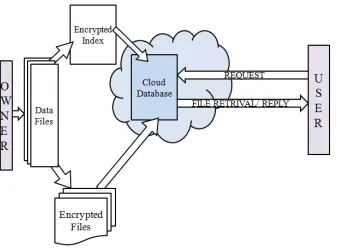
Figure 1 Cloud working scenario
Consider three main entities as cloud data owner, cloud data user and cloud server. Cloud server contains the large database where the data owner can upload files and the data user is the entity who can download these files.
The data files which are going to be uploaded to the database are always be in encrypted form. But before encrypting these files the index will be created and uploaded along with these files also be in encrypted form only, so to maintain privacy and security of the data owner.
The users who will search for the file will send a request and the keywords from the index are matched with this by using array matching. The resulting files list will be sent to the user. In that list the file which is most downloaded will be in the top as it gets highest score which increases per download of the specific file. After receiving that list user can download the file as per the requirement.
As there is only the list of the files is sent to the user and given the choice to select among them, the bandwidth consumption is highly reduced which results into higher efficiency. Again here the level of security is enhanced by allowing this service only to the registered users and the users are requested to enter the secret key that would be sent on their personal email account as per file request they wish to download. Only after inputting this secret key the user could get the decrypted file.
The algorithm works as follows:
Step 1: Authentication Process
a. Authenticating users and identify them by categorizing them into data owners and data users.
b. If it is data user then give permission to manage its files and allow uploading files with index keywords. If it is data user then allow to search files only.
Step 2: Uploading file
a. Data owner with number of files (f1, f2….fn) will be authenticated by password. b. Creation of index (f1’, f2’….fn’) for every separate file before uploading. c. Then, f and f’ will be encrypted.
d. Upload encrypted f and f’ to cloud server.
Step 3: File Retrieval
a. Users have to authenticate themselves by entering password.
Volume 3, Issue 3, March 2014
Page 421
c. Matching k with f1’, f2’…..fn’.d. For matching the arrays of searched keywords is compared with the index files. e. Based on this result (k~f’) the list of files (fm…fx) is sent to the user.
f. The files are arranged in ascending order of their relevance score.
g. Higher score will be given to the most downloading file and this score will be updated as per download. h. Users have the choice to select file from fm….fx to download.
i. Then, after selection of file the code will be generated for that specific file for specific period of time and will be email to the user, after entering this code then only the decrypted version of the file is available to that user.
Encryption process:
The encryption of the files will be done using ECC algorithms as gives better security even for smaller key size comparing to any other algorithm [16].
Basic ECC equation is: y2 = x3 + ax + b
The files and their respective indexes are encrypted with this and then uploaded to the database. As it has two keys public key and private keys the security is more and the only private key which can be separate for each file will be used for encryption and using the public key the users can decrypt the files.
4.
R
ESULT&
A
NALYSISThe scheme in this paper uses ECC algorithm which uses very smaller length of key like 160 bits and gives security of about 048 bits of RSA [16]. Thus the computational cost is very low and gives higher security. So, without compromising any security this algorithm provides highly efficient scheme.
As the scheme is very lightweight and efficient it can be easily accessible through mobile devices like cell phone, tablet with browsing capacity. So it gives its users anytime anywhere service.
The authentication level in this scheme makes it more robust and secure to defend with the intruders and for intruders only encrypted copy is available.
5.
C
ONCLUSIONThis scheme has been tested by us and the results obtained are as follows.
a)The keyword search method works well and the output file list firstly comes to the requesting user, so avoiding directly sending the matching files to the user and saves bandwidth.
b)Even if any valid user didn’t enter the secret key for decryption of the requested file then in such case only encrypted file is available to that user else the user can download the decrypted file, making it very secure scheme.
c)The relevance score of the files are very helpful to know the top downloaded file and sorts the file list very efficiently while giving results to the user. Also whenever the new download occurs it updates the score for that particular file.
R
EFERENCES[1] Cong Wang, Sherman S.M. Chow, Qian Wang, Kui Ren, and Wenjing Lou, ” Privacy-Preserving Public Auditing for Secure Cloud Storage”, IEEE Transactions on Computers, Vol. 62, No. 2, February 2013.
[2] Jiadi Yu, Peng Lu, Yanmin Zhu, Guangtao Xue, Minglu Li, “Toward Secure Multikeyword Top-k Retrieval over Encrypted Cloud Data”, IEEE transactions on dependable and secure computing, vol. 10, no. 4, july/august 2013. [3] Xuefeng Liu, Yuqing Zhang, Member, IEEE, Boyang Wang, and Jingbo Yan, “Mona: Secure Multi-Owner Data
Sharing for Dynamic Groups in the Cloud”, IEEE Transactions on Parallel And Distributed Systems, Vol. 24, No. 6, June 2013.
[4] Larry A. Dunning and Ray Kresman, “Privacy Preserving Data Sharing With Anonymous ID Assignment”, IEEE Transactions On Information Forensics And Security, Vol. 8, No. 2, February 2013.
[5] Kui Ren, Cong Wang and Qian Wang, “Toward Secure and Effective Data Utilization in Public Cloud”, IEEE Network, November/December 2012.
[6] Cong Wang, Ning Cao, Jin Li, Kui Ren, and Wenjing Lou, “Enabling Secure and Efficient Ranked Keyword Search over Outsourced Cloud Data”, IEEE Transactions On Parallel And Distributed Systems, Vol. 23, No. 8, August 2012.
Volume 3, Issue 3, March 2014
Page 422
[8] Hsiao-Ying Lin and Wen-Guey Tzeng, “A Secure Erasure Code-Based Cloud Storage System with Secure DataForwarding”, IEEE Transactions on Parallel And Distributed Systems, Vol. 23, No. 6, June 2012.
[9] Jun Xu, Weiming Zhang, Ce Yang, Jiajia Xu, Nenghai Yu, “Two-Step-Ranking Secure Multi-Keyword Search Over Encrypted Cloud Data”, IEEE 2012.
[10]Ce Yang, Weiming Zhang, Jun Xu, Jiajia Xu, Nenghai Yu, “A Fast Privacy-Preserving Multi-keyword Search Scheme on Cloud Data”, International Conference on Cloud Computing and Service Computing, IEEE 2012. [11]Zhiyong Xu, Wansheng Kang, Ruixuan Li, KinChoong Yow, and Cheng-Zhong Xu, “Efficient Multi-Keyword
Ranked Query on Encrypted Data in the Cloud”, IEEE 18th International Conference on Parallel and Distributed Systems, 2012.
[12]J. Li, Q. Wang, C. Wang, N. Cao, K. Ren, and W. Lou, “Fuzzy Keyword Search over Encrypted Data in Cloud Computing,” Proc. IEEE INFOCOM ’10, 2010.
[13]Ayad Ibrahim, Hai Jin, Ali A. Yassin, Deqing Zou, “Secure Rank-ordered Search of Multi-keyword Trapdoor over Encrypted Cloud Data”, IEEE 2012.
[14]Yingjie Xia, Mingzhe Zhu, Junhua Xuan and Ze Chen, “Hierarchy-Aware ECC Model for Cloud”, 2nd International Conference on Industrial and Information Systems, IEEE 2010.
[15]Cong Wang, Ning Cao, Jin Li, Kui Ren, and Wenjing Lou, “Secure Ranked Keyword Search over Encrypted Cloud Data”, International Conference on Distributed Computing systems, IEEE 2010.