Competitiveness and Innovations: Role of Knowledge Management at a Knowledge
Organization
Natalija Sedziuviene, Jolita Vveinhardt
Siauliai State College
Ausros av. 40, LT-76241, Siauliai, Lithuania
e-mail: [email protected], [email protected]
In the middle of the tenth decade of the last century a lot of researchers and heads of organizations started to show interest in the importance of knowledge for organizations. Pioneers of knowledge management are Sveiby, Drucker, Quinn, Nonaka, Takeutchi and others. Fast changing and hardly predictable, turbulent environment conditions force organizations to focus their attention to competitive ability, which organization’s success, place in the market, and survival depend on. It is probable that economic recession will stimulate Lithuanian organizations to faster re-orient management philosophy as well. Organization’s success, attraction and the place in the market depend very much on its chosen strategy and implementation, which are inseparable from the processes of information data system and knowledge expansion. In the 21st century, which is named as the globalisation century, knowledge economics, knowledge management or knowledge society is the most frequently used term in scientific literature. One common feature – the aspect of knowledge – joins these concepts.
Modern theories of organizations’ management admit that knowledge resources are the necessary condition for organizations’ competitiveness and innovativeness. Knowledge is the means, which are necessary to possess in order to improve, develop and maintain business processes, to fast and adequately react to changing environment conditions. Knowledge being intellectual workforce, without doubt, does not belong to such traditional resources as usual workforce, raw materials, etc.
Undoubtedly knowledge does not belong to such traditional resources as workforce, raw materials or land. Knowledge is named as abilities, competence, experience, intellectual capital, which has special meaning both in managerial and economic environment – the organizations that produce, adapt and use knowledge improve their activity, make it more effective by creating more useful, more perfect and larger-profit bringing products, as well as support and encouragement of cogitation activity that creates knowledge creates premises for organizations to develop in acquiring strategic advantage.
Knowledge contributes to more effective problem resolution, decision-making as well as determination of purposive strategy in attaining organization’s aims. This obligates them to continuously and systemically assess, to re-assess, to disseminate and to use deliberately. Spender (2000) points out that without doubt most publications on the topic of knowledge management reflect high objectives to understand this phenomenon; but, in its turn, it brings
some disorganization in its approach. This should not surprise if we estimate many methods and ideas, which begin to penetrate into this field. According to Davenport and Prusak (1998), recently more and more attention is paid to how systems of knowledge management can conduct and support assimilation and diffusion of hidden knowledge, which is the basis of organization’s memory. Transmission of such knowledge will require certain conditions in order to be able to identify, to formalise, to abstract and to improve knowledge.
Keywords: knowledge management, competitiveness, innovations, knowledge organization.
Introduction
Though knowledge management and its role in scientific literature is not finally and beyond debate investigated, it is agreed that new knowledge production, innovations, knowledge renovation, creativity of working people is the main impellent of society as well as the producer of productivity and competitiveness; and not the object but intellectual capital, competitive advantage and innovations are named as the essence of knowledge management. In new economics of the world creativity and knowledge become important factors of production, beside resources of capital, workforce, land and nature. The importance of knowledge for the development will probably increase; and knowledge might influence the difference between prosperity and poverty (Lietuva. Ziniu ekonomikos pletra, 2003).
Venskus, 2007; Girdauskiene, 2007; Stankeviciene J., Sedziuviene et al., 2007; Girdauskiene, Savaneviciene, 2007; Kazlauskaite, Buciuniene, 2008; Liepe, Sakalas, 2008; Melnikas, 2008; Bivainis, Morkvenas, 2008; Lobanova, 2009; Sedziuviene, Vveinhardt, 2009, etc.) authors.
The aim of the article is to analyse the role of knowledge management in the process of innovation and competitiveness creation.
In order to attain the aim the following objectives were formulated: to define the role of knowledge management within a knowledge organization; to introduce the role of organization’s knowledge in the creation of competitiveness; to analyse the relationship of knowledge management and innovations within a modern organization.
The article was prepared by applying the methods of literature analysis and synthesis.
The role of knowledge management within a knowledge organization
Recently, insights on the formation of a new society increase in scientific environment. Lithuanian higher education with the help of managers forms a new viewpoint, which hardly finds its way in inert organizational-managerial environment. Thus the practical problem of awareness of a knowledge role within an organization remains relevant both in public and private sectors.
Gallupe (2001) analyses knowledge as fluxion of information because knowledge – is the information squeezed into a context. Davenport and Prusak (1998) define knowledge as the information coupled with experience, context, interpretation, and reflection. However, knowledge is especially complicated; this is witnessed by a lot of taxonomies that emerged in these latter years. Jucevicius (2000) states that the specialised knowledge becomes the main means of production or activity. Namely knowledge and exceptional abilities are the force, which can determine success of competitive fight. Due to knowledge management organizations have better conditions for strategic decisions because assessment, problem resolution and challenges are based on knowledge. Strategically the success of the most decisions depends on competitive efforts, which involve deep knowledge on consumers’ behaviour, viewpoints, as well as an adequate analysis of stronger competitors, as well (Carneiro, 2000; Halawi et al., 2005). This means that managers have to ascertain weaknesses, strengths, actions of direct competitors as well as how their clients understand and estimate their products. Finally, these results have to be coupled into the system of information management. According to Atkociuniene et al. (2009), the identification of increasing quality of available information resources and interpretation abilities of people but not the increasing of the amount of available information are the most important in knowledge management. The authors affirm that knowledge management has to be understood as work with people, their possessed knowledge; for knowledge management innovations, originality, creativity, and learning are particularly important for knowledge management. The viewpoint to people as
non-renewing resources of an organization changes too. For decades the values, which were cherished, become the brake of development. Knowledge economics needs the employees who work not according to strict agendas; they are able to act according to indefinite, dynamically changing conditions, to cooperate in a team and to project, to orient towards continuous self-development, innovations as forms of existence in the modern world (Ignatjeva, 2008). Referring to a post-industrial organization in this aspect, knowledge management seeks to release creative powers of an individual, searches for the tune between individuality and teamwork. Initiative, innovation and the quality of social relations become significant and reached-for values in management culture.
According to Karlof and Lovingsson (2005), in the field of knowledge management it is possible to distinguish two main directions of thinking, which have a common feature: the knowledge possessed by an organization have to be used properly if an organization wishes to be desirable and completely use its possibilities to re-orient. Bakanauskas, Kvedaravicius et al. (2008) point out that the importance of knowledge accessibility and dissemination particularly increases when we speak about the state of Lithuania. Complete cycle of knowledge management is and can be only where knowledge creation exists. In Lithuania there is and will evidently be only several sectors, in which science is strong – in other sectors there is and can only be knowledge diffusion and consumption.
As organizations’ management develops and gets more modern, the value of knowledge is tendentiously increases; this is also reflected by Carneiro (2000), du Plessis (2007), Hung, Lok, Ya-Hui Lien, Chi-Min Wu (2008), Halawi, Aronson, McCarthy (2005), who, by analysing most theorists and practitioners in their works, prove this attitude. Carneiro (2000) states that knowledge becomes progressively more useful because management has already considered the value of creativity, which transformation of one form of knowledge into another depends on. Malhotra (2000) affirms that large organizations more and more are progressively influenced by knowledge by increasing effectiveness and competitiveness in inducing creativity and innovations. Thus modern organizations differ from the organizations, which prevailed in the world already at the beginning of the 20th century: for a long time a traditional model of organization’s activity was related to the aim to increase effectiveness by following certain agreements, instructions, as well as by applying routine principles acting in stable and predictable environment. Drucker (2004) points out that productivity of brainwork should land up in the focus of knowledge management, as well as in the last century in the times of Taylor – productivity of physical work. However, for this quite different premises on people working in the organization and their work are necessary: people are not necessary to be managed; the objective is to lead people, the aim is to use specific strong sides and knowledge of every individual.
that together with markets, organizations and information getting global managers face radically different business environment; and wishing to successfully function in such environment new skills to strategically react to problems or complicated changes of consumers’ needs. Thus today the most valuable asset of all organizations is the ability to create referring to experience as well as to convert into better and more competitive organization’s activity by paying more attention to intellectual capital. Thus
knowledge management, which becomes one of the most important factors for organization’s success by stating that knowledge growth and development of technologies change the way of people’s work and possibilities to change work conditions, contributes to the changing business environment and organization decision-making processes adequacy. This can be illustrated by the comparison of the example of a traditional and knowledge organization (Figure 1).
Figure 1. Differences of a traditional and knowledge organization
Source: developed by the authors according to Green Book: Why is your business knowledge intensive and what possibilities does it
open? Access through the Internet: www.zeft.lt
Drucker (1993) defines the period as knowledge and information society and society of organization, and organizations as knowledge organizations. In the latter decade knowledge organizations are the model of the organizations being discussed rather enough. Within a knowledge organization invoking knowledge-based management is systemising everything and by means of this the aims of an organization are being attained. According to Girdauskiene (2007), management of a knowledge organization directly depends on a properly constructed mechanism of knowledge transfer. The author states that only integrated viewpoint as well as a corporate and integral system can assure the final result – effective knowledge transfer and successful management
of a knowledge organization. However, knowledge management is not a technocratic process, which would deny principles of functioning of society as a socio-cultural system, its internal and external relations. Rowley (2000) distinguishes the following main principles of knowledge organizations: community principle, orientation to a consumer, standardisation. According to Rowley (1994), creation of communities is a complicated process, which should not be left by itself. Consumers often tangle up in plenty of information, thus, it is necessary to create communities. Also the author affirms that it is especially important to create close relations with consumers, to clearly define interrelationships and their character, to consider their
Information Knowledge organization
General control C
R I T E R
I A
Traditional organization
Capital
Instructions and control
Routine repeating assignments Creative, informative work
Growth based on capital Growth based on knowledge
Workforce manages machines and work tools
Tools and machines manage workforce
culture and values, as well as to create their individual, close and strong community of consumers. The second principle of a knowledge organization – is the attention to a consumer. This principle has existed for a long time. Referring to Rowley (1994), it is necessary to convey all information so that a consumer would easily reach it. The third principle – standardization and networks. Knowledge organizations, for example, libraries and other databases became easily reached by consumers due to the Internet networks. Besides the above-mentioned, it is also possible to add one more aspect – human factor. Specialists either face inert environment of organizations’ cultures, or (and) the problem of the relation of knowledge and abilities. Karlöf and Lövingsson (2005) state that a specific problem of knowledge organizations is the coordination of professional skills to managerial abilities. In extreme cases professional skills can be identified with the mission of an organization. Referring Malhotra (2000), the pioneer of knowledge management, different changes require review organization’s routine activities in constantly changing, dynamic and competitive business environment, as well as to assure that decision-making processes would manifest together with dynamic business environment.
In summarising the first part of the article, it should be pointed out that the significance of knowledge management within a knowledge organization is revealed by the systemic viewpoint to organization and their changing environment. Efficiency of decisions is determined by deep knowledge about behaviour of clients and competitors, other external and internal factors. A knowledge organization is an active participant in external environment that is forming closer relations with clients. Knowledge management involves work with intellectual workforce, which requires specific managerial abilities by refusing traditional viewpoints to management of employees. Orientation to individual creative abilities of an employee and the power of a manager to use and apply them are distinguished in the process of knowledge management. Nevertheless there are viewpoints that not all Lithuanian organizations can show full cycle of knowledge management because some organizations are distinguished only in knowledge diffusion and usage.
Role of organization’s knowledge in forming competitiveness
Scientific literature states that ability to effectively use knowledge is one of the main warrants of every organization’s successful activity. In addition, knowledge is important for an organization so that it could optimise its activity and to decrease its expenses. However these frequently occurring axioms are not enough to answer the question how knowledge functions in the process of organization’s competitiveness creation. Thus, as Zalieckaite and Mikalauskiene (2007) state, first of all, knowledge within an organization is necessary for it to solve its problems: to solve a problem means to use knowledge (to use theoretical knowledge acquired through learning, experience is being created out of
knowledge and acquired activities as well as behaviour, which allows implementing the experience and theoretical knowledge. In addition, in order an organization to be able to successfully perform its everyday operations, it has to meet all occurring problems with expedition. In order to avoid problems, theoretical knowledge, even if it is necessary, is really not sufficient. For this it is necessary to use the experience of employees acquired in long time run: such experience allows better application of the knowledge possessed by employees, to deepen it and to solve occurring problems with expedition. And behaviour allows both an individual employee, and a whole organization to optimally implement own experience, certain knowledge preserved in their mind to choose and to apply, and new and unchecked knowledge – to preserve. Thus, problem resolution depends on a person or corporate ability of an organization to choose appropriate knowledge preserved in the mind. However, as Ignatjeva (2008) points out, abundance accessibility of information decreases the importance of the very information. The organizations, which not only have information but also are open for innovation on its basis – actions and the result of actions, the premises of which were new knowledge or this induced creation of new knowledge – acquires competitive advantage.
Organizations constantly experience tension between external (needs of heterogenous clients, actions of competitiors, social environment, its values, etc.) and internal possibilities to adequately and flexibly react. Thus, in order to be competitive and to expand the part of the occupied market an organization has to solve problems, which are related to external environment and which allow meeting consumer’s needs as well as to estimate occurring risks in time. a competitive solution has to be founded on wide and stable enough support, which has to couple different relations between several types of knowledge. The outcome is comprehensive knowledge that is the vital basis for formation and maintenance of competitiveness (Carneiro, 2000). Analyses show that a larger part of the value of an organization in the market depends not on their profit. The growth of the difference between these two indicators is determined by the growth immaterial capital. The value of this immaterial asset mostly depends on the quality of management (Milner, 2003). In other words, in a larger part the advantage of an organization depends on organization’s ability to assimilate knowledge and to control processes of knowledge creation and implementation. Optimization of organization’s finances and human resources (intellectual workforce) as well as the quality of organization’s innovativeness (as increasing value), development, management acquires competitive significance. In the management of human resources of a competitive organization the orientation to qualified and competent employees who apply their personal knowledge is important. Competence is expressed by abilities of personal development.
Hornung (2002) state, knowledge management most frequently is estimated by the following criteria as benefit for employees, consumers and the very organization: faster processes of business, greater satisfaction of consumers and motivation of employees as well as more active organizational learning. Organization’s knowledge can be expanded and transferred to other employees of an organization. On the other hand, it become transparent; thus, it can be discussed, taken into consideration, tested and improved by inducing processes of organization’s learning as well as by improving the abilities in recognising the lack of knowledge in the basis of organization’s knowledge (Sanchez, 2005). It should be mentioned, however, that under conditions of knowledge society the viewpoint to traditional knowledge acquisition in teaching and learning process is changing. As it is above-mentioned, the importance of successive knowledge decreases when its accessibility, which is induced by the development of databases and IT, increases. Knowledge becomes more complex, the time of its relevance gets shorter. Thus knowledge acquisition in continuous teaching process, learning to create new knowledge and innovativeness become a vital function of an organization.
In addition, organization’s knowledge determine better financial indicators by optimising internal activity of an organization (human resources and finances), as well as by estimating how internal, human resources of an organization function when knowledge becomes more complicated, its relevance time shortens, the amount of possessed knowledge increases, the need for qualified and competitive employees of an organization, who apply their personal knowledge as well, manifests.
One of the most important aims of competitive knowledge management has to be continuous advance of different levels of knowledge. Its extension means (Carneiro, 2000): to narrow references between IT progress and gathering as well as information processes; to motivate knowledge development by recognising its importance for the development of an organization; to induce implementation of scientific culture in special fields directly related to the main activities of an organization; to invest into theoretical knowledge and practical teaching; to strengthen efforts for renewal in industry. The impellents of knowledge management, according to du Plessis (2005), are the factors, which make knowledge management as the main aim of an organization be necessary in order to acquire and to better the possessed competitive state in the market: knowledge as item in new knowledge economics; knowledge management – competitive advantage; knowledge management – the premise for successful process of decision-making; collaboration; geographical distribution of organizations; internal inefficiency; loss of knowledge within an organization; accumulation / concentration of knowledge.
First of all, in understanding knowledge as item creating value-added for organizations, it is necessary to pay particular attention to human resources in order that knowledge would not drain. As Probst et al. (2006) state, having fired the employees who are against changes, the general situation can become better; however, an
Cohesion of knowledge management and innovations within a modern organization
In recent decades the science of management searches for answers more and more intensively; it creates the methods, which should give organizations flexibility to react to environmental changes. The previous chapter presents the relationship of knowledge, innovations with organization’s competitiveness. The expansion of competence in developing mind activity, creative powers that are important investment of an organization give some flexibility. According to Baroniene (2008), it would be possible to state that two thirds of the sources of information are investments, requiring a lot of knowledge. Having invested into them, innovations become the factor, which increases effectiveness and competitiveness of an organization; and, according to Liao and Chuang (2006), those organizations that faster become innovative develop their position in the market faster. When organizations assure innovations faster than their competitors; sort of, it creates a new segment of the market because knowledge making that innovation is not available for the competitors of the organization. Thus, for knowledge organizations, which assure processes of knowledge management within them, knowledge help to achieve larger profits, thereby innovations also increase the size of the segment of organization’s market as the quality of a service and effectiveness of operations’ performance.
Very often organizations limit themselves in certain, definite knowledge amount and their practical application is innovations. Yet it is worth to note that businesspeople most frequently limit themselves in only a certain amount of knowledge and moderate aggressiveness in a good sense though an innovative business will be only when all sectors of an organization are innovative. Thus, the main
aim of each organization is to adapt to changing conditions of environment and to assure long-term existence as well as profit. One of the possibilities to assure competitive advantage is not the competition in the present market but the creation of a new market.
Personal traits of employees are one of the most important factors for innovations and competitiveness within an organization. As Egbu, Botterill and Bates (2001) state, most scientists emphasise the role of an employee as well as a leader who shows his / her abilities and initiative within an organization and who becomes the impellent in the process of innovation creation in comparison with old management goals, by using strategy to create innovations; in this case the aspect of the silent knowledge of employees is stressed in the process of innovation creation. Thus, people are the basic impellent and knowledge management is related to the management of people and processes that facilitate innovation creation. The feature of an innovative organization, according to Roberts (2006), is freedom of imagination, which is non-constrained thinking, the ability to meet failures quietly, openness to innovations, what it is not proved, as well as not repenting resources to create and to develop ideas, which initially can seem to be very far from successful new products. In competitive and changing environment the main objective for organizations is to control unpredictable and unstable future, in other words, to diminish the tension caused within their organization.
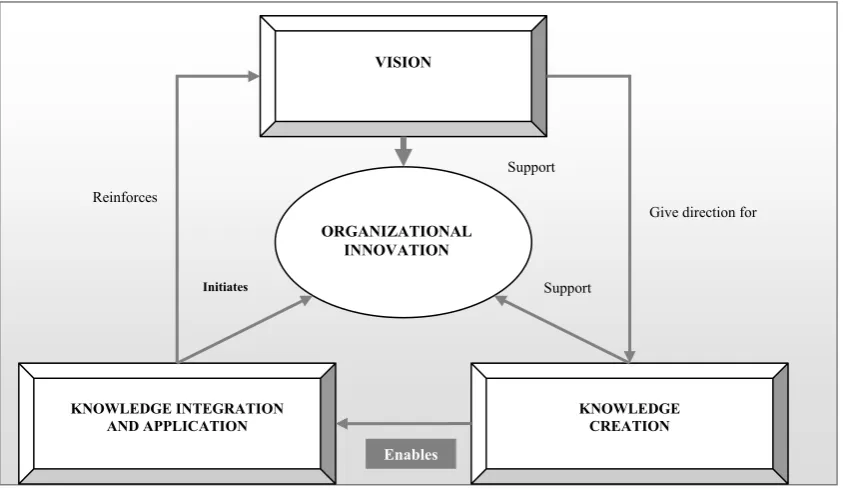
The more the future is unknown and unpredictable, the more organizations have to trust, in creative initiatives and employees creating the desired future. Thus, the organizations that seek to be innovative have to follow organization’s vision first of all.
VISION
ORGANIZATIONAL INNOVATION
Figure 2. Vision, knowledge and organization’s innovations
Source: Johannessen, J.A., Olsen, B. and Olaisen, J. (1999). Aspects of Innovation Theory Based on Knowledge-Management.
International Journal of Information Management(19), 121-139.
KNOWLEDGE INTEGRATION AND APPLICATION
KNOWLEDGE CREATION Reinforces
Support
Support Initiates
Give direction for
As Figure 2 shows, the vision of an organization gives the direction for knowledge creation, which, in its turn, supports innovations within an organization as well as enables knowledge integration and its application; and, referring to Johannessen, Olsen and Olaisen (1999), innovations depend on the vision of an organization, knowledge creation, as well as knowledge integration and its application. Vision can be understood not only as relation between organization’s activity and the desired future, relation between reality and possibilities, but also the vision is frequently defined as the field of sight. In order to assure organization’s success and innovativeness, not only application of experience and possessed organizational knowledge but also creation of new knowledge is important; thus in knowledge-based organizations the value emerges from cooperation of employees. The knowledge, which can be transferred to others, is acquired and shared by means of formal teaching
systems. However, in order the knowledge, which is necessary for innovation development, to be created, the process to understand the knowledge, which is hardly transferred to others, has to be assured first of all.
Further speaking about the creation of innovativeness and competitiveness within an organization, it is observed that, in order for an innovative climate to be created within an organization, creativity should be developed within it; employees of an organization should learn to control creativity but not to deny it. As Saeida, Nejati et al. (2007) state, organizations should encourage and face creativity as well as support new ideas by creating the environment where employees would feel free to express their ideas and would share their knowledge; and, though most valuable knowledge is in the minds of employees, it has to be transferred into operations, so that a company could be open for innovations.
Creativity Invention Innovation Diffusion Adoption
Figure 3. The process of creation and change of innovations
Source: Saeida, S., Nejati, M., Nejati, M. (2007). Measuring Knowledge Management Processes. Proceedings of the 13th Asia
Pacific Management Conference, Melbourne, Australia, 551-555.
Thus, in the process of innovation creation, creativity is changed into ingenuity and invention, the first presentation and implementation of which is an innovation, after which development and application follow. So the creation of innovation is based on initiative, development and implementation by treating innovations and competitiveness as the function depending on knowledge management; especially if the conditions necessary in modern business environment are created.
Beside the term of knowledge management, which is defined as the process during which organizations create a value by using knowledge-based asset, the second concept – management of innovations – management of innovations, by identifying abilities to make the process of innovation creation effective due to knowledge and knowledge-based asset. Management of innovations became one of the essential functions of an organization together with technological innovations as the basic support for modern organizations. Innovations within an organization mean changes in the markets. Drucker (2004) speaks about organizations – leaders of innovations; he equates innovations and changes. In order for an organization to become a leader of changes, one of the conditions – is purposefully oriented policy of innovations. Thus beside knowledge management, the process of creation of value-added of an organization by using knowledge-based asset, one more concept – management of innovations – emerges. It involves the ability to effectively organize the process of innovation creation by using knowledge. Innovation managers face rather high requirements of the knowledge of higher
education, technique, economics and psychology. As Sung (2006) states, if knowledge management is the source of competitive advantages of an organization, most organizations strive to ascertain how knowledge-based innovations enable organizations to acquire long-term competitive advantages in modern knowledge economics.
Drucker (2004) notices that innovation – is not a genial thought, but it is intensive work, which has to be organised so that it would become the component of every organization’s unit and every level of management system. Knowledge innovations are understood as creation, development, sharing and application of new ideas in goods and services suitable for selling, which lead to organization’s success, vitality of economics and society progress. Thus, for modern organizations, which are in constant fight with the rest of competitors and strive to distinguish in the market saturated with innovations, such divergence from competitors mostly depends on the use of knowledge-based assets as well as knowledge, innovation management and its integration practice.
Figure 4. Knowledge innovations as the tool of competitiveness
Source: Lee Sung, A. G. (2006). A strategic management framework for leveraging knowledge innovation. International Journal of The Computer, the Internet and Management 14(3), 32-49.
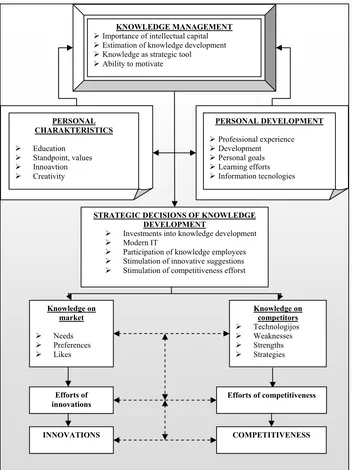
Figure 5. The conceptual model of the influence of knowledge management upon competitiveness and innovations Source: Carneiro, A. (2000). How does knowledge management influence innovation and competitiveness? Journal of Knowledge Management,
4(2), 87-98. PERSONAL
CHARAKTERISTICS
¾ Education
¾ Standpoint, values ¾ Innoavtion ¾ Creativity
PERSONAL DEVELOPMENT
¾Professional experience ¾Development ¾Personal goals ¾Learning efforts ¾Information tecnologies KNOWLEDGE MANAGEMENT
¾Importance of intellectual capital ¾Estimation of knowledge development ¾Knowledge as strategic tool
¾Ability to motivate
STRATEGIC DECISIONS OF KNOWLEDGE DEVELOPMENT
¾ Investments into knowledge development
¾ Modern IT
¾ Participation of knowledge employees ¾ Stimulation of innovative suggestions ¾ Stimulation of competitiveness efforst
Knowledge on competitors ¾ Technologijos
¾ Weaknesses
¾ Strengths ¾ Strategies
COMPETITIVENESS Efforts of
innovations Knowledge on
market
¾ Needs
¾ Preferences
¾ Likes
INNOVATIONS
Efforts of competitiveness
COMPETETIVE ADVANTAGE
KNOWLEDGE ASSETS
INNOVATION
MANAGEMENT MANAGEMENT KNOWLEDGE Strategic
Management of Knowledege
Figure 5 suggests a conceptual model of knowledge management. This conceptual model interprets the cohesion among knowledge management, innovations and competitiveness. The model shows the integrated process of knowledge development and its influence upon the fields where the efforts of management have to be concentrated; it points out that innovations and competitiveness can be the function of knowledge management (Carneiro, 2000). In summary, such competitive advantages of an organization in modern market as development of thought and creative powers leading to innovations, which can in the case of success be treated as pursued changes, should be mentioned. As people’s intellect is the main source of innovations, management of people, knowledge and innovations or changes is closely related, and its integration ensures the advantage. Management inputs are directed to systemically integrate intellectual capital, psychological characteristics and motives of an individual, his / her knowledge about the market, an organization, and technologies and by developing the activity of mind.
Conclusions
The use and development of workforce’s intellectual powers, dissemination of a product and its usage obligates organizations to refuse traditional ways of management, moreover to turn back to possibilities and knowledge of an individual as well as to develop the philosophy of management based humanistic values. A role of a leader within an organization is universally accepted as the impellent in the innovative process by stating that, in order to assure success and innovativeness of an organization, the application of not only experience and possessed organizational knowledge is important; however, organizations that follow the knowledge philosophy in the creating new knowledge cooperation of employees presuppose value. Interception of new ideas, creativity is based not on competition but on cooperation philosophy that is transfused with the culture that creates a premise for employees to share knowledge, to complement one another by transferring this to operations in seeking for a company to become open for innovations. This viewpoint requires subtle balance between corporate-teamwork and individuality; thus, peculiar requirements have to be applied by executives of the lowest levels, who proximately work creating people, in order to get ready to help in releasing creative potential as well as to train such managers. This means that first of all the entire process of specialist training has to be based on humanistic knowledge philosophy.
Reactions and changes of the environment reveal the value of knowledge employees. Inovativeness as ability and continuous readiness to re-organize, not only to react but also to initiate changes, creates value-added of an organization in markets. Education, viewpoints,
values, internal need for innovations, creativity freedom of thinking are the values that could be attributed to a knowledge employee; in addition, it is the objective in the organizations’ transformation by implementing essential changes. These changes have to be oriented to sustainable development of the system, whose component is personality. Personal experience is an information source and a learning situation; however, learning being organized has not only to be based on knowledge assimilation, development of abilities to find new knowledge but also on the development of skills to extend one’s own competence.
The thought that ability to effectively apply knowledge it is one of the main guarantees of successful activity of an organization has become the axiom. Knowledge as philosophy, necessary for solving problems by using theoretical knowledge, is acquired through teaching, experience that is created from knowledge and acquired activities as well as behaviour that create possibilities for innovations. Philosophy of knowledge based on humanistic values becomes the basis for organization’s cultural transformations that makes premises for strengthening organization’s advantage, eliminating internal inefficiencies, and developing the practice of effective decision-making processes.
It is evident that the profits attained by an organization depend on the input into innovations, technologies and ideas that provide advantages against competitors, financial and managerial investments into knowledge processes as well as knowledge employees. The system of human resource management has to be oriented to intellectual capital as the main contribution into sustainable development of an organization. In order to achieve this goal, executives of different levels must consciously organize, motivate, control knowledge and create it. Philosophy of knowledge forms strong culture of an organization, in which knowledge sharing and open access of information is being stimulated. Information sharing is one of the tools of a creative material. Managers of different levels must realize that intellectual capital is a shifting resource and strategic advantage; thus, the main objectives are to develop efficient strategies based on knowledge philosophy, to integrate new inputs, professional experience, skills, interactive abilities in order to achieve value-added for competitiveness of an organization. Development of knowledge and innovations is a systematic, integrated and planned method assuring improvement of the effectiveness of intellectual capital of an organization. Though recently it has been a lot spoken about knowledge management, innovations, innovativeness, it is necessary to emphasise the gap between a scientific thought, accumulated potential and practice, seeking for the approach, and closer feedback.
References
Atkociuniene, Z., Janiuniene, E., Matkeviciene, R., Pranaitis, R., Stonkiene, M. (2009). Informacijos ir ziniu vadyba verslo organizacijoje. Monografija. Vilnius: Vilniaus universiteto leidykla.
Augustinaitis, A. (2004). Informacinė mokslų integracija. Informacijos mokslai/Information Sciences(2), 9-21.
Bakanauskas, A., Kvedaravicius, J., Lydeka, Z., Pacesa, N., Zakarevicius, P., Zukauskas, P. (2008). Ziniu visuomenes formavimas: patirtis, problemos, perspektyvos. Monografija. Kaunas: Vytauto Didziojo universiteto leidykla. Baroniene, L. (2008). Teorines prielaidos inovacines aplinkos kurimui. Vadybos mokslas ir studijos – kaimo verslu ir
ju infrastrukturos pletrai, 13(2), 23-30.
Bieliunas, M. (2000). Ziniu vadybos praktinis taikymas: pokyciai, kuriuos lemia ekonomikos tendencijos. Informacijos mokslai/Information sciences(14), 46-56.
Bivainis, J., & Morkvenas, R. (2008). Darbuotojų žinių potencialo vertinimas. Verslas: teorija ir praktika/Business: Theory and Practice 9(2), 105-115.
Carneiro, A. (2000). How does knowledge management influence innovation and competitiveness? Journal of Knowledge Management, 4(2), 87-98.
Davenport, T. H., Prusak, L. (1998). Working Knowledge: How Organizations Manage What They Know. Boston, MA: Harvard Business School Press.
Drucker, P. E. (1993). Post-capitalist Society. New York: HarperCollins.
Du Plessis, M. (2007). The role of knowledge management in innovation. Journal of Knowledge Management, 11(4), 1367-3270.
Du Plessis, M., (2005). Drivers of knowledge management in the corporate environment. International Journal of Information Management 25(3), 193-202.
Egbu, C., Botterill, K., Bates, M. (2001). The influence of knowledge management and intellectual capital on organisational innovations. Proceedings of the 17th Annual Conference of the Association of Researchers in Construction Management (ARCOM). University of Salford, September 5-7, 2, 547 - 556.
Gallupe, B. (2001) Knowledge management systems: surveying the landscape. International Journal of Management reviews 3(1), 61-77.
Girdauskiene, L. (2007). Ziniu organizacijos valdymo ypatumai: kulturos ir organizacines strukturos itaka siekiant efektyviai perduoti zinias. Informacijos ir zinių vadybos apreptys siuolaikineje organizacijoje: zinių ekonomikos issukiai (konferencijos medziaga). Vilnius: Vilniaus universiteto leidykla.
Girdauskiene, L., & Savaneviciene, A. (2007). Influence of Knowledge Culture on Effective Knowledge Transfer. Inzinerine Ekonomika-Engineering Economics(4), 36-43.
Grundey, D., & Varnas, D. (2006). Human capital creation, accumulation and management in Lithuania: The case of national and foreign capital enterprises. Transformations in Business & Economics(2), 81-105.
Gudauskas, R. (2004). Valstybės ziniu ekonomikos politika: ziniu vadyba ir antrepreneryste. Informacijos mokslai-Information sciences(31), 18-34.
Halawi, L. A., Aronson, J. E., McCarthy, R. V. (2005). Resource-Based View of Knowledge Management for Competitive Advantage. The Electronic Journal of Knowledge Management 3(2).
Hung, R., Lok, P., Ya-Hui Lien, B., Wu, Chi-Min (2008). Factors influencing organizational knowledge transfer: implication for corporate performance. Journal of Knowledge Management 12(3), 84-100.
Johannessen, J. A., Olsen, B. & Olaisen, J. (1999). Aspects of innovation theory based on knowledge-management. International Journal of Information Management(19), 121-139.
Kaminska, T. (2009). The ICT Usage as an Attribute of the Knowledge-Based Economy – Poland’s Case. Transformations in Business & Economics,9(3), 166-183.
Karlof, B., & Lovingsson, F. H. (2005). The A–Z of Management Concepts and Models. Thorogood Publishing. Kazlauskaite, R., & Buciuniene, I. (2008). The Role of Human Resources and their Management in the Establishment
of Sustainable Competitive Advantage. Inzinerine Ekonomika-Engineering Economics(5), 78-84.
Lee Sung, A. G. (2006). A strategic management framework for leveraging knowledge innovation. International Journal of The Computer, the Internet and Management 14(3), 32-49.
Liao, C., Chuang, S. H. (2006). Exploring the Role of KM for Enhancing Firm`s Innovation and Perfomance, in: Proceedings of the 39th Annual Hawaii International Conference, Track 7.
Liepe, Z., & Sakalas, A. (2008). The Three-loop Learning Model Appliance in New Product Development. Inzinerine Ekonomika-EngineeringEconomics(3), 73-80.
Lobanova, L. (2009). Zmogiskuju istekliu vadybos verte ziniomis grindziamoje visuomeneje. Verslas: teorija ir praktika/Business: Theory and Practice 10(3) , 233-246.
Melnikas, B. (2008). The Knowledge-Based Economy in the European Union: Innovations, Networking and Transformation Strategies. Transformations in Business & Economics 7(3), 170-192.
Nonaka, I., Takeuchi, H. (1995). The Knowledge-Creating Company: How Japanese Companies Create the Dynamics of Innovation. New York: Oxford University Press.
North, K., & Hornung, T. (2002). The benefits of knowledge management – results of the German award „Knowledge Manager 2002“. [interaktyvus]. [ziūrėta 2010 m. liepos 29 d.]. Prieiga per interneta: <http://www.jucs.org/jucs_9_6/the_benefits_of_knowledge/North_K.html>.
Probst, G., Rayb, S., & Romhardt, K. (2006). Ziniu vadyba: sėkmes komponentai. Vilnius: Knygiai.
Prusak, L. (2001). Where did knowledge management come from? IBM Systems Journal 40(4), 1002-1007.
Quinn, J. B. (1992). The Intelligent Enterprise: A Knowledge and Service Based Paradigm for Industry. New York: Free Press.
Roberts, J. (2006). Moderni firma. Vilnius: Vaga.
Rowley, J. (1994). Organising Knowledge. Aldershot: Gower.
Rowley, J. (2000). Knowledge organization for a new millennium: principles and processes. Journal of Knowledge Management 4(5), 217-223.
Saeida, S., Nejati, M., Nejati, M. (2007). Measuring Knowledge Management processes. Proceedings of the 13th Asia Pacific Management Conference, Melbourne, Australia, 551-555.
Sakalas, A., & Venskus, R. (2007). Interaction of Learning Organization and Organizational structure. Inzinerine Ekonomika-Engineering Economics(3), 65-70.
Sedziuviene, N., Vveinhardt, J.(2009).The Paradigm of Knowledge Management in Higher Educational Institutions. Inzinerine Ekonomika-Engineering Economics(5), 79-90.
Spender, J. C. (2000). Book review of „tacit knowledge in organizations“ by Philippe Baumard. Akademy of Management review, 25(2), 443-446.
Stankeviciene, J., Sedziuviene, N., Vveinhardt, J., & Mitkuviene, D. (2007). Data Management in Modern Organization: the Aspect of Project Designing. Inzinerine Ekonomika-Engineering Economics(1), 91-102.
Sveiby, K. E. (1997). The New Organizational Wealth: Managing and Measuring Knowledge-Based Assets. Berrett Koehler, San Francisco, CA. The chapter on measuring intangibles is available on-line: http://www.sveiby.com/articles/MeasureIntangibleAssets.html
Zalieckaitė, L., Mikalauskienė, A. (2007). Organizacijos žinių struktūrų ir jų vadybos prieigų analizė. Informacijos mokslai-Information sciences(41), 42-57.
Zalioji knyga. Kodel Jusu verslas imlus zinioms ir kokias galimybes tai atveria? [interaktyvus]. [ziureta 2010 m. liepos 11 d.]. Prieiga per internetą: www.zeft.lt
Игнатъева, Е. Ю. (2008) Менеджмент знанийвуправлении качеством образователъного процесса ввысшей
школе. ВеликийНовгород: ИНО-Центр.
Милнер, Б. З. (2003). Управлениезнаниями. Москва: ИНФРА-М.
Natalija Šedžiuvienė, Jolita Vveinhardt
Konkurencingumas ir inovacijos: žinių vadybos vaidmuo žinių organizacijoje
Santrauka
Nors žinių vadyba ir jos vaidmuo mokslinėje literatūroje nėra galutinai ir neginčijamai ištirta, sutariama, jog naujų žinių kūrimas, inovacijos, žinių atnaujinimas, dirbančių žmonių kūrybiškumas yra pagrindinė visuomenės varomoji galia bei produktyvumo ir konkurencingumo kūrėja, kartu žinių vadybos esme įvardijant ne objektus, o intelektualųjį kapitalą, konkurencinį pranašumą ir inovacijas. Naujoje pasaulio ekonomikoje kūrybiškumas ir žinios tampa svarbiais gamybos veiksniais, greta kapitalo darbo jėgos ir žemės bei gamtos išteklių. Žinių reikšmė plėtrai tikriausiai didės ir žinios, turbūt nulems skirtumą tarp klestėjimo ir skurdo (Lietuva. Žinių ekonomikos plėtra, 2003). Problema ta, kad Lietuvos organizacijos skiria nepakankamai dėmesio žinių vadybai, todėl neišnaudodamos savo žmogiškojo potencialo, nesugeba adekvačiai konkuruoti rinkoje su progresyviai orientuotomis, inovatyviomis kompanijomis. Todėl šiuo straipsniu siekiama atkreipti dėmesį, kaip inovacijos, konkurencingumas ir strateginės žinių vadybos santykis susijęs su žmogaus verte ir aukštesniu kompetencijos lygmeniu, siekiant išlikti ir konkuruoti besikuriančioje žinių
visuomenėje. Įvairias žinių valdymo problemas nagrinėja nemažai užsienio (Quinn, 1992; Drucker, 1993; Rowley, 1994; Nonaka, Takeuchi, 1995; Sveiby, 1997; Davenport, Prusak, 1998; Rowley, 2000; Malhotra, 2000; Gallupe, 2001; Carneiro, 2000; Halawi, Aronson ir kt., 2005; Du Plessis, 2007; Hung, Lok ir kt., 2008; Kaminska, 2009 ir kt.) ir lietuvių autorių (Bieliunas, 2000; Jucevicius, 2000; Gudauskas, 2004; Grundey, Varnas, 2006; Sakalas, Venskus, 2007; Girdauskiene, 2007; Stankeviciene J., Sedziuviene ir kt., 2007; Girdauskiene, Savaneviciene, 2007; Kazlauskaite, Buciuniene, 2008; Liepe, Sakalas, 2008; Melnikas, 2008; Bivainis, Morkvėnas, 2008; Lobanova, 2009; Sedziuvienė, Vveinhardt, 2009 ir kt.). Šio straipsnio tikslas – išanalizuoti žinių vadybos vaidmenį inovacijų ir konkurencingumo kūrimo procese. Tikslui įgyvendinti iškelti tokie uždaviniai: apibūdinti žinių vadybos vaidmenį žinių organizacijoje; pristatyti organizacijos žinių vaidmenį konkurencingumo kūrimo procese; išanalizuoti žinių
vadybos ir inovacijų ryšį šiuolaikinėje organizacijoje. Straipsnis parengtas taikant literatūros analizės, sintezės metodus.
Būtina pripažinti, jog tai: vystantis ir modernėjant organizacijų valdymui žinių vertė tendencingai didėja, o svarbiausias organizacijos turtas −
kapitalas. Žinių darbuotojų vertę atskleidžia aplinkos reakcijos ir pokyčiai. Inovacingumas kaip gebėjimas ir nuolatinis pasirengimas reorganizuotis, ne tik reaguoti, bet ir inicijuoti pokyčius kuria pridėtinę organizacijos vertę rinkose. Išsimokslinimas, požiūriai, vertybės vidinis novacijų poreikis, kūrybiškumas, mąstymo laisvė yra vertybės, taikytinos žinių darbuotojui, kartu – tai yra užduotis transformuotis pačioms organizacijoms,
įgyvendinant esminius pokyčius. Šie pokyčiai turi būti orientuoti į darnų sistemos, kurios sudėtinė dalis yra asmenybė, vystymąsi. Asmeninė patirtis yra informacijos šaltinis ir mokymosi situacija, tačiau organizuojamas mokomasis ne tik privalo būti grįstas žiniųįsisavinimu, gebėjimų atrasti naujas žinias plėtojimui, bet ir įgūdžių vystyti savo kompetenciją formavimu. Mintis, jog mokėjimas efektyviai pritaikyti žinias – tai vienas iš pagrindinių organizacijos sėkmingos veiklos garantų. Žinija kaip filosofija, būtina problemos spręsti problemas taikant teorines žinias, įgyjamas maokantis, remiantis patirtimi – kuriamą iš žinių ir įgytų veiklų, ir elgsena, sudarančią galimybes inovacijoms. Humanistinėmis vertybėmis grindžiama žinijos filosofija tampa organizacijos kultūrinių transformacijų pagrindu, sudarančiu prielaidas organizacijos konkurenciniam pranašumui stiprinti, vidiniams neefektyvumams šalinti, efektyvių sprendimų priėmimo procesų praktikai plėtoti. Žmogiškųjų išteklių valdymo sistema turi būti orientuota į intelektinį kapitalą kaip pagrindinį indėlįį organizacijos darnų vystymąsi. Siekdamas šio tikslo, įvairių lygių vadovaujantis personalas privalo sąmoningai organizuoti, motyvuoti, kontroliuoti žinias ir jas kurti. Žinijos filosofija formuoja stiprią organizacijos kultūrą, kurioje skatinamas dalijimasis žiniomis ir atvira informacijos prieiga. Informacijos dalijimasis yra vienas iš kūrybinės medžiagos priemonių. Įvairių lygių vadovai privalo įsisąmoninti, kad intelektinis kapitalas yra atsinaujinantis resursas ir strateginis pranašumas, todėl pagrindinės užduotys yra plėtoti veiksmingas, žinių filosofija grįstas strategijas, integruoti naujas pastangas, profesinę patirtį, įgūdžius, interaktyvius gebėjimus siekiant sukurti pridėtinę vertę įmonės konkurencingumui. Žinių ir inovacijų vystymas yra sisteminis, integruotas ir suplanuotas metodas, užtikrinantis intelektualinio įmonės kapitalo efektyvumo gerinimą.
Raktažodžiai: žinių vadyba, konkurencingumas, inovacijos, žinių organizacija.