Biogeosciences, 10, 719–731, 2013 www.biogeosciences.net/10/719/2013/ doi:10.5194/bg-10-719-2013
© Author(s) 2013. CC Attribution 3.0 License.
EGU Journal Logos (RGB)
Advances in
Geosciences
Open Access
Natural Hazards
and Earth System
Sciences
Open Access
Annales
Geophysicae
Open Access
Nonlinear Processes
in Geophysics
Open Access
Atmospheric
Chemistry
and Physics
Open Access
Atmospheric
Chemistry
and Physics
Open Access
Discussions
Atmospheric
Measurement
Techniques
Open Access
Atmospheric
Measurement
Techniques
Open Access
Discussions
Biogeosciences
Open Access Open Access
Biogeosciences
DiscussionsClimate
of the Past
Open Access Open Access
Climate
of the Past
Discussions
Earth System
Dynamics
Open Access Open Access
Earth System
Dynamics
Discussions
Geoscientific
Instrumentation
Methods and
Data Systems
Open Access
Geoscientific
Instrumentation
Methods and
Data Systems
Open Access
Discussions
Geoscientific
Model Development
Open Access Open Access
Geoscientific
Model Development
DiscussionsHydrology and
Earth System
Sciences
Open Access
Hydrology and
Earth System
Sciences
Open Access
Discussions
Ocean Science
Open Access Open Access
Ocean Science
Discussions
Solid Earth
Open Access Open Access
Solid Earth
DiscussionsThe Cryosphere
Open Access Open Access
The Cryosphere
Discussions
Natural Hazards
and Earth System
Sciences
Open Access
Discussions
Arctic microbial community dynamics
influenced by elevated CO
2
levels
C. P. D. Brussaard1, A. A. M. Noordeloos1, H. Witte1, M. C. J. Collenteur1, K. Schulz2, A. Ludwig2, and U. Riebesell2
1Department of Biological Oceanography, NIOZ - Royal Netherlands Institute for Sea Research, PO Box 59, 1790 AB Den
Burg, Texel, The Netherlands
2Helmholtz Centre for Ocean Research (GEOMAR), Kiel, Germany
Correspondence to: C. P. D. Brussaard ([email protected])
Received: 10 August 2012 – Published in Biogeosciences Discuss.: 12 September 2012 Revised: 21 December 2012 – Accepted: 2 January 2013 – Published: 1 February 2013
Abstract. The Arctic Ocean ecosystem is particularly vul-nerable to ocean acidification (OA) related alterations due to the relatively high CO2solubility and low carbonate
satura-tion states of its cold surface waters. Thus far, however, there is only little known about the consequences of OA on the base of the food web. In a mesocosm CO2-enrichment
exper-iment (overall CO2levels ranged from∼180 to 1100 µatm)
in Kongsfjorden off Svalbard, we studied the consequences of OA on a natural pelagic microbial community. OA dis-tinctly affected the composition and growth of the Arctic phytoplankton community, i.e. the picoeukaryotic photoau-totrophs and to a lesser extent the nanophytoplankton thrived. A shift towards the smallest phytoplankton as a result of OA will have direct consequences for the structure and function-ing of the pelagic food web and thus for the biogeochem-ical cycles. Besides being grazed, the dominant pico- and nanophytoplankton groups were found prone to viral lysis, thereby shunting the carbon accumulation in living organ-isms into the dissolved pools of organic carbon and subse-quently affecting the efficiency of the biological pump in these Arctic waters.
1 Introduction
The increase ofpCO2in the surface ocean (ocean
acidifica-tion, OA) profoundly affects the seawater carbonate system through well-known chemical reactions, lowering the pH, in-creasing the concentration of bicarbonate ions, dein-creasing the availability of carbonate ions and lowering the saturation state of the major shell-forming carbonate minerals. Whereas
surface water pH values were still 8.2 just prior to the indus-trial era, they are 8.11 at present and anticipated to reach 7.8 in the year 2100 (The Royal Society, 2005). This corresponds to CO2levels of 380 µatm at present to a projected high of at
least 750 µatm by the end of this century.
Changes in carbonate chemistry can be expected to di-rectly affect phytoplankton photosynthesis and subsequently growth because of their dependence on CO2supply. Not all
algal groups will be equally affected, as certain groups (most notably diatoms) have developed CO2-concentrating
mech-anisms (CCMs). However, algal species differ in CCM ef-ficiency (Rost et al., 2008). Non-calcifying phytoplankton show, as expected, a range of responses, varying from no ef-fect on growth to stimulating or adverse efef-fect on growth or primary production (Riebesell and Tortell, 2011). Only a few studies have reported on OA-induced changes of phytoplank-ton community composition (Tortell et al., 2002, Engel et al., 2008; Meakin and Wyman, 2011; Feng et al., 2009), and the ecological consequences of OA on natural phytoplankton dy-namics are still understudied.
Furthermore, a major gap in our understanding concerns the transfer of responses from the organism to the commu-nity and ecosystem levels. Rose et al. (2009) recently showed that climate change variables (temperature andpCO2) did
720 C. P. D. Brussaard et al.: Arctic microbial community dynamics
(e.g. temperature increase, light availability, nutrient limita-tion). Potential restructuring of the phytoplankton commu-nity (classes, species and cell size; Falkowski et al., 1998; Boyd and Doney, 2002) as a result of ocean acidification will have direct consequences for grazer communities and organic carbon flow. It may also influence the dominance of grazing over other loss processes such as viral lysis, and con-sequently the cycling of energy and biogeochemically rele-vant elements, the ratio of production and respiration of the ocean and the efficiency of the biological pump (Brussaard et al., 1996, 2008; Ruardij et al., 2005; Suttle, 2007). Phy-toplankton that are consumed by grazers are channeled to higher trophic levels, whereas viral lysis directly forces the food web towards a more regenerative pathway (Brussaard et al., 2005; Suttle, 2007).
OA and other global climate change-related impacts are most striking in both polar regions, where temperatures and acidities are changing at more than twice the global average (Hoegh-Guldberg and Bruno, 2010). The cold Arctic surface waters allow relatively high CO2solubility, making this area
particularly vulnerable to OA. The present study is part of a collaborative mesocosm CO2-enrichment experiment
per-formed in Kongsfjorden off Svalbard, summer 2010, within the framework of the European Project on Ocean Acidifica-tion (EPOCA). We present here the microbial community dy-namics under the influence of elevatedpCO2levels and
dis-cuss the consequences for the functioning of the pelagic food web.
2 Material and methods
2.1 Study site and experimental set-up
The study was conducted in Kongsfjorden (78◦560200N, 11◦530600E), near Ny- ˚Alesund, Svalbard, between 31 May and 7 July 2010 (dayt−7 tot30, wheret0 is the day after the first CO2addition). Nine large mesocosms of approximately
50 m3 (15 m below sea level) were moored in the fjord in sets of 3. The experimental set-up, carbon chemistry dynam-ics and nutrient concentrations throughout the experiment are described in detail by Riebesell et al. (2013), Bellerby et al. (2013) and Schulz et al. (2013). In short, the meso-cosms were filled with fjord water (inorganic nutrient con-centrations<0.1, 0.09, 0.2 and 0.7 µM for nitrate, phosphate, silicate and ammonium, respectively) and screened through a 3 mm mesh to eliminate larger organisms on the 1 of June (t−6). The mesocosms were open to the atmosphere but cov-ered with transparent hoods to minimize input of rain and bird droppings. Two of the mesocosms received no CO2
ad-dition but were treated otherwise the same, representing the present day carbonate chemistry of the fjord (∼185 µatm at the start of the experiment). The addition of CO2was gradual
between dayt−1 andt4 by pumping CO2-enriched seawater
through a dispersal device which was lowered to about 13 m
depth and gently pulled up several times, resulting in an even distribution throughout the water column. The other 7 meso-cosms were enriched with CO2over a period of several days
(t−1 tot4) in varying amounts, resulting in a range of ini-tialpCO2levels from∼270 to∼1420 µatm (corresponding
to pHT values of 8.18 to 7.51). Two weeks into the
experi-ment (t13), inorganic nutrients were added to the originally nutrient-poor water in order to stimulate primary production (5 µM nitrate, 0.3 µM phosphate and 2.5 µM silicate for all mesocosms, to simulate the upwelling of deeper, nutrient-rich water to the nutrient-depleted surface water). The one month experiment showed 4 phases: phase 0 represents the period from closing of the mesocosms to the end of the CO2
manipulations (t−7 tot3), phase 1 corresponds to the period after CO2manipulation until the addition of inorganic
nutri-ents (t4 tot12), phase 2 stands for the period after nutrient addition and until the second chlorophyll minimum (t13 to
t21; Schulz et al., 2013), and phase 3 includes the final pe-riod until the end of the experiment (t22 tot30). Throughout this study the data are presented using 3 colors (blue, grey and red), representing low, intermediate and highpCO2
ad-ditions. The lowpCO2addition group contains mesocosms
3, 7 and 2; the intermediate group consists of mesocosms 4, 8 and 1; and the highpCO2 addition group is made up of
mesocosms 6, 5 and 9.
Collective sampling was performed daily in the morning using an integrated water sample (0–12 m). From this wa-ter subsamples were obtained for counting phytoplankton, heterotrophic prokaryotes (HP) and viruses. Besides this, we sampled 2–3 times per week for the microzooplankton graz-ing incubations usgraz-ing a gentle vacuum-driven pump system. Samples were protected against daylight by black plastic bags. In the laboratory the samples were maintained and pro-cessed (for grazing assay and counting) at in situ temperature and dimmed light. The abundances of phytoplankton were determined on fresh samples. HP and viruses were fixed for 30 min at 7◦C with glutaraldehyde (25 %, EM-grade) at a final concentration of 0.5 % before snap freezing in liquid nitrogen and storage at−80◦C until analysis.
2.2 Microbial abundances
C. P. D. Brussaard et al.: Arctic microbial community dynamics 721
polycarbonate 47 mm diameter filters (10, 8, 5, 3, 2, 1, 0.8, 0.4 µm) according to Veldhuis and Kraay (2004). Cell sizes of the different clusters ranged between 0.8–2, 2–3, 3–8, 8– 10, 5–8 and 3–5 µm diameter for picophytoplankton I, II, and nanophytoplankton I, II, III, and IV, respectively. Assuming the cells to be spherical and containing 0.2 pg C µm−3 (Cu-velier, 2010), cellular carbon was calculated based on the av-erage cell diameters (1.3, 3, 5, 10, 7 and 4 µm, respectively). Estimated cellular carbon contents were 0.18, 2.8, 13.1, 104, 35.8 and 6.7 pg C cell−1for the 6 phytoplankton clusters, re-spectively (Veldhuis and Kraay, 2004). Net growth and loss rates of phytoplankton were derived from exponential regres-sion analysis of the cell abundances.
The abundances of heterotrophic prokaryotes and viruses were determined from fixed, frozen samples according to Marie et al. (1999) and Brussaard (2004), respectively. In short, thawed samples were diluted with Tris-EDTA buffer (10 mM Tris-HCl and 1 mM EDTA, pH 8) and stained with the green fluorescent nucleic acid-specific dye SYBR-Green I (Molecular Probes, Invitrogen Inc.), for a final concentra-tion of 1×10⁻⁴(HP) or 0.5×10⁻⁴(viruses) of the commer-cial stock, in the dark at room temperature for 15 and 10 min, respectively. HP and viruses were discriminated in bivariate scatter plots of green fluorescence versus side scatter. Final counts were corrected for a blank consisting of TE-buffer and SYBR-Green I prepared and analysed in an identical manner to the samples. Two HP clusters (HDNA – high DNA flu-orescent – and LDNA – low DNA fluflu-orescent) and 5 viral groups (V1–V5) were distinguished.
2.3 Microzooplankton grazing
Microzooplankton grazing of phytoplankton was determined using the dilution method of Landry and Hassett (1982). In short, whole seawater samples were sieved through a 200 µm mesh to remove mesozooplankton, after which the sample was combined with 0.45 µm filtered seawater (0.45 µm Sarto-pore capsule filter, containing a 0.8 µm pre-filter) over a dilu-tion series of 20, 40, 70 and 100 % to create a gradient in mi-crozooplankton grazing pressure. All treatments were set up in triplicate in clear 1.2 L polycarbonate bottles. The bottles were incubated at in situ temperature and natural light. Sub-samples were taken at 0 and 24 h, and phytoplankton abun-dance was enumerated immediately by FCM. Phytoplankton growth rates were plotted against the level of dilution, and model 1 regression analysis was performed to obtain the ac-tual microzooplankton grazing rate (slope) and apparent phtoplankton growth rate in the absence of grazing (intercept y-axis). All seawater handling was performed at in situ temper-ature and under dim light conditions using Nitrile gloves. For logistical reasons we could only handle two dilution assays at a time. We choose to sample mesocosm 3, representing present timepCO2level, as reference for mesocosm 8
(in-termediatepCO2levels) and mesocosm 5 (high pCO2
lev-els), which each were sampled alternately.
Microzooplank-ton grazing on nanophytoplankMicrozooplank-ton II-IV failed due to the low whole water abundances (<200 mL−1).
2.4 Statistics
For the statistical tests we used SYSTAT version 13.00.05 (SYSTAT Software, Inc. 2009, San Jose, CA). The hypothe-sis that there was no difference in growth rates of microbes in diverse time frames during the mesocosm experiment was tested using one-way ANOVA. Testing overall differences in standing stock of diverse flow cytometric clusters during dif-ferent time periods was performed using ANOVA with the square root-transformed abundances as the dependent vari-able, mesocosm as factor, and the sampling day as covariate. To test the specified hypothesis, contrasts in the post hoc hy-pothesis tests were used. The grazing rates were calculated in Excel, including the standard error of the grazing rates (i.e. standard error of the estimated slope of the regression line).
P values indicate if the grazing rates differ significantly from
zero.
3 Results
3.1 Phytoplankton abundances and net growth
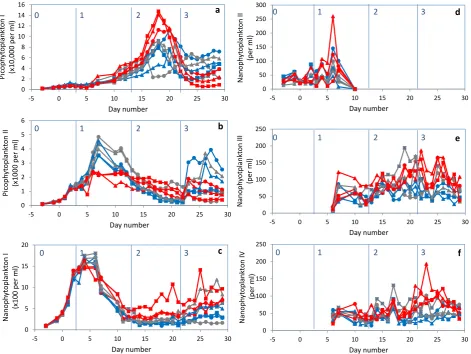
The abundance of each phytoplankton cluster is presented in Fig. 1. Total phytoplankton abundance was strongly domi-nated by picophytoplankton I (Fig. 1a), generally making up more than 90 % of the total count, except fort1 tot11 when their share declined to 60 % due to a bloom of nanophy-toplankton (Fig. 1c). Picophynanophy-toplankton I showed a steady increase until t18, after which the bloom declined sharply (Fig.1a). The net growth rates during phase 1, derived from the standing stock and calculated using the natural logarithm, were on average 0.14±0.03, 0.15±0.03 and 0.17±0.02 for the low, intermediate and high pCO2 mesocosms,
re-spectively. During phase 2, after inorganic nutrient addi-tion, the net growth rates of the picophytoplankton I were slightly higher, ranging from 0.14 to 0.24 d−1(no significant correlation with pCO2, however). Highest net peak
abun-dances, i.e. 1.1–1.5×10⁵cells mL−1, were recorded for the highpCO2mesocosms 5, 6, and 9 (ANOVA,p <0.000).
Pi-cophytoplankton II increased untilt7 at a net growth rate be-tween 0.30 and 0.38 d−1(Fig. 1b). The highest abundances of 3.5–4.9×10³cells mL−1 during phase 1 were observed for the intermediate and low pCO2 mesocosms (ANOVA,
p <0.000).
Nanophytoplankton I increased steeply from the start of the experiment, growing at net growth rates between 0.51 and 0.55 d−1(with the exception of mesocosm 4 showing a growth rate of 0.42 d−1), and peaked att4–6 with maximum abundances between 1.6 and 1.8×10³cells mL−1(Fig. 1c). A second increase was found during the last week of the experiment with highest abundances typically in the higher
722 C. P. D. Brussaard et al.: Arctic microbial community dynamics
0 1 2 3 4 5 6
-5 0 5 10 15 20 25 30
Pic
oph
yt
opla
nk
to
n
II
(x
1000 pe
r
ml)
Day number
b
0 5 10 15 20
-5 0 5 10 15 20 25 30
N
ano
ph
yt
opla
nk
to
n
I
(x
100 pe
r ml)
Day number
[image:4.595.63.535.62.416.2]c Figure 1
0 2 4 6 8 10 12 14 16
-5 0 5 10 15 20 25 30
Pic
oph
yt
opla
nk
to
n
I
(x
10,
000
pe
r ml)
Day number
a
0 1 2 3
0 1 2 3
0 1 2 3
0 50 100 150 200 250
-5 0 5 10 15 20 25 30
N
ano
ph
yo
tpla
nk
to
n
III
(pe
r ml)
Day number
e
0 50 100 150 200 250 300
-5 0 5 10 15 20 25 30
N
ano
ph
yt
opla
nk
to
n
II
(pe
r ml)
Day number
d
0 50 100 150 200 250
-5 0 5 10 15 20 25 30
N
ano
ph
yt
opla
nk
to
n
IV
(p
er
ml)
Day number
f
0 1 2 3
0 1 2 3
0 1 2 3
Fig. 1. Temporal dynamics of depth-integrated (0.3–12 m) picophytoplankton cluster I (a), picophytoplankton cluster II (b), nanophytoplank-ton I (c), nanophytoplanknanophytoplank-ton II (d), nanophytoplanknanophytoplank-ton III (e) and nanophytoplanknanophytoplank-ton IV (f). Only eukaryotic photosynthetic organisms were detected. Low CO2treatments are blue, intermediate CO2treatments are grey, and high CO2treatments are red colored. In order of low,
intermediate and highpCO2mesocosms, the circles represent mesocosms M3, M4 and M6; triangles M7, M8 and M5; and squares M2, M1 and M9, respectively.
low numbers (generally below 150 cells mL−1)and could no
longer be detected in either the mesocosms or the natural fjord water fromt10 onwards (Fig. 1d). Around the same time (t6), a new phytoplankton population, nanophytoplank-ton III, appeared that was undetectable until then (Fig. 1e). It remained present throughout the duration of the experi-ment at a rather stable concentration (<150 cells mL−1), with significantly higher algal numbers for the highpCO2
meso-cosms during phase 2 and 3 (ANOVA,p <0.000). Nanophy-toplankton IV showed similar algal concentrations, with sig-nificantly higher abundances during phase 3 in the high
pCO2addition mesocosms (Fig. 1f; ANOVA,p <0.000).
Figure 2 shows the phytoplankton (<20 µm) cellular car-bon (algal POC). The first maximum att5 is due to the peak in nanophytoplankton around that time (Fig. 2a). Despite their relatively low numbers, their larger size results in al-gal POC concentrations similar to or higher than that of the
more abundant (up to 70-fold higher cell abundances) but very small picoeukaryotic algae that are responsible for the second maximum of algal POC (Fig. 2b).
3.2 pCO2-related phytoplankton trends
As expected, all mesocosms resembled each other for micro-bial abundances during the initial phase 0 (t−7 tot3). Shortly after completing CO2additions (att7; phase 1), the standing
stock of picophytoplankton II in the three highpCO2
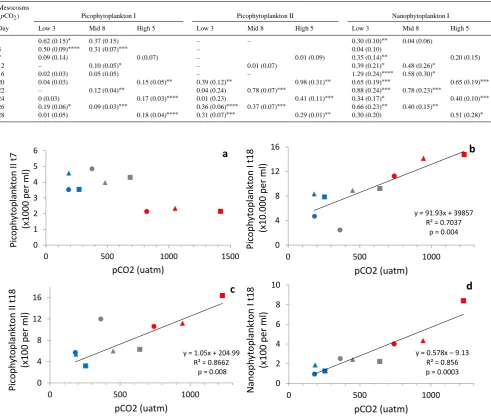
meso-cosms, 5, 6 and 9, showed a negative response (Fig. 3a). This response was, however, not maintained and even reversed af-ter nutrients were added att13. It has to be noted that pico-phytoplankton II was made up by 3 subpopulations that were hard to separate. A weak positive correlation withpCO2
C. P. D. Brussaard et al.: Arctic microbial community dynamics 723 Figure 2
0 10 20 30 40 50 60
-5 0 5 10 15 20 25 30
N
ano
-a
lg
al
PO
C (
ng
pe
r ml)
Day number
a
0 10 20 30 40 50 60
-5 0 5 10 15 20 25 30
P
ico
-a
lg
al
PO
C (
ng
pe
r ml)
Day number
b
0 1 2 3
[image:5.595.50.286.65.295.2]0 1 2 3
Fig. 2. Temporal development of algal particular organic carbon (POC) for total nanophytoplankton ((a) Nano-algal POC) and pico-phytoplankton ((b); Pico-algal POC). For color and symbol coding, see Fig. 1.
picophytoplankton II became dominated by one of those sub-populations. Interestingly, the peak abundances of picophy-toplankton I at t18 correlated strongly and positively with
pCO2(Fig. 3b). Net growth rates untilt18 were on average
0.15–0.20 d−1 (no significant trend with pCO
2 observed).
However, a statistically significant and positive relationship withpCO2 was found for the cell abundances of
picophy-toplankton II and nanophypicophy-toplankton I (Fig. 3c and d;p= 0.008). Nanophytoplankton III and IV furthermore showed positive correlations withpCO2 only until 600 µatm (r2 of
0.903 and 0.610, respectively), however, the low cell abun-dances (<150 mL−1)caution for over-interpretation (higher statistical error). Notwithstanding, the positive correlation between phytoplankton standing stock andpCO2 levels at t18 is clearly illustrated by total algal POC (Fig. 4).
Within phase 1 of the experiment (t4 tot13), the net loss rates during the decline of the nanophytoplankton I peak (t6 tot13) were negatively correlated withpCO2, i.e. lower net
loss rates at higher pCO2 levels (from −0.15 d−1 at high pCO2 to −0.3 d−1 at lowpCO2; Fig. 5a). During the
de-cline of the picophytoplankton II bloom (t7 tot22) the high-estpCO2mesocosms also showed reduced net loss rates (on
average−0.10±0.04 d−1as compared to−0.19±0.03 d−1 for the other mesocosms; Fig. 5b). In contrast, the net loss rates after the bloom of picophytoplankton I (t18–26) show a positive correlation withpCO2when excluding mesocosm
4, which had already declined before that period (on average −0.32±0.1 d−1for the mesocosms withpCO2≥600 µatm
and−0.19±0.07 d−1forpCO
2≤600 µatm; Fig. 5c). At the
end of the experiment (t27), the picophytoplankton I show a negative correlation withpCO2, however, we argue below
that at this stage into the experiment such a correlation is the indirect effect of viral lysis and grazing dynamics.
3.3 Phytoplankton viruses and microzooplankton grazing
The viral community could be discriminated into 5 distinct clusters, of which two (V4 and V5) are considered most likely algal viruses (Fig. 6; Brussaard and Mart´ınez Mart´ınez, 2008). The abundance of viruses V4 started to increase upon the development of the nanophytoplankton I bloom and showed its strongest increase concomitantly with the decline of this phytoplankton group (Figs. 1c and 6a). Moreover, V5 increased sharply the moment the bloom of picophytoplank-ton I declined (t18; Figs. 1a and 6b), indicating a regulating role of viruses on the dynamics of also this phytoplankton population.
Microzooplankton grazing rates (Table 1) showed high grazing on picophytoplankton I during the first days of the experiment (phase 0; around 0.45±0.14 d−1). Grazing rates dropped after phase 0 down to 0.1–0.2 d−1. No correlation withpCO2was observed. For unknown reasons, the dilution
assay during the first half of the experiment (phase 0 and 1) did not provide good grazing data for the picophytoplankton II. During the second half of the experiment (phase 2 and 3), grazing on picophytoplankton II was substantial (on average 0.39±0.30 d−1), and although grazing rates seem somewhat higher at highpCO2, the low number of grazing experiments
does not validate a statistically significant conclusion. Micro-zooplankton grazing on nanophytoplankton I was on average 0.44±0.36 d−1throughout the experiment, with high rates during phase 2 (0.81±0.26 d−1vs. 0.28±0.40 d−1for other phases).
3.4 HP and viral dynamics
The abundance of HP in all mesocosms dropped abruptly during the first week (by 1.5×10⁶mL−1; Fig. 7a), which was fully due to the decline in the high nucleic acid (HDNA) HP population. The % HDNA HP dropped from around 80 to 40–55 % att7 (Fig. 7b). Viruses increased in abundance around 1×10⁷mL−1(Fig. 8a). The concomitant decline of HP and increase in viruses resulted in a steeply increasing total virus to prokaryote ratio (VPR), from 25 up to 150 (Fig. 8b). Aftert7 the total HP community increased steadily again (Fig. 7a). The % HDNA HP also increased again up to a maximum of 70 % at t14 (Fig. 7b), after which it de-creased steadily, resulting in an equal contribution of HDNA and LDNA HP towards the end of the experiment (phase 3). HP net growth rates, derived fromt5 to the end of the experi-ment, correlated negatively topCO2, which consequently
724 C. P. D. Brussaard et al.: Arctic microbial community dynamics
Table 1. Microzooplankton grazing rates on phytoplankton (d−1)for 3 mesocosms representing low, intermediate (mid) and highpCO2
lev-els. Mesocosm M3 (low, i.e. present timepCO2) was sampled as reference to mesocosm M5 and M8. Failed assays for specific
phytoplank-ton clusters are indicated by –. Standard error between parentheses. Statistical significance indicated by∗p=0.1–0.05;∗∗p=0.05–0.01; ∗∗∗p=0.01–0.001; and∗∗∗∗p=0.001–0.
Mesocosms
(pCO2) Picophytoplankton I Picophytoplankton II Nanophytoplankton I
Day Low 3 Mid 8 High 5 Low 3 Mid 8 High 5 Low 3 Mid 8 High 5 1 0.62 (0.15)∗ 0.37 (0.15) – – 0.30 (0.10)∗∗ 0.04 (0.06)
3 0.50 (0.09)∗∗∗∗ 0.31 (0.07)∗∗∗ – 0.04 (0.10)
7 0.09 (0.14) 0 (0.07) – 0.01 (0.09) 0.35 (0.14)∗∗ 0.20 (0.15) 12 – 0.10 (0.05)∗ – 0.01 (0.07) 0.39 (0.21)∗ 0.48 (0.26)∗
16 0.02 (0.03) 0.05 (0.05) – – 1.29 (0.24)∗∗∗∗ 0.58 (0.30)∗
20 0.04 (0.03) 0.15 (0.05)∗∗ 0.39 (0.12)∗∗ 0.98 (0.31)∗∗ 0.65 (0.19)∗∗∗ 0.65 (0.19)∗∗∗ 22 – 0.12 (0.04)∗∗ 0.04 (0.24) 0.78 (0.07)∗∗∗ 0.88 (0.24)∗∗∗ 0.78 (0.23)∗∗∗
24 0 (0.03) 0.17 (0.03)∗∗∗∗ 0.01 (0.23) 0.41 (0.11)∗∗∗ 0.34 (0.17)∗ 0.40 (0.10)∗∗∗
26 0.19 (0.06)∗ 0.09 (0.03)∗∗∗ 0.36 (0.06)∗∗∗∗ 0.37 (0.07)∗∗∗ 0.66 (0.23)∗∗ 0.40 (0.15)∗∗
[image:6.595.55.547.116.534.2]28 0.01 (0.05) 0.18 (0.04)∗∗∗∗ 0.31 (0.07)∗∗∗ 0.29 (0.01)∗∗ 0.30 (0.20) 0.51 (0.28)∗
Figure 3
0 1 2 3 4 5 60 500 1000 1500
Pic oph yt opla nk to n II t7 (x 1000 pe r ml) pCO2 (uatm)
a
y = 91.93x + 39857 R² = 0.7037
p = 0.004
0 4 8 12 16
0 500 1000
Pic oph yt opla nk to n I t1 8 (x 10.000 pe r ml) pCO2 (uatm)
b
y = 1.05x + 204.99 R² = 0.8662
p = 0.008
0 4 8 12 16
0 500 1000
Pic oph yt opla nk to n II t1 8 (x 100 pe r ml) pCO2 (uatm)
c
Figure 3
0 1 2 3 4 5 60 500 1000 1500
Pic oph yt opla nk to n II t7 (x 1000 pe r ml) pCO2 (uatm)
a
y = 91.93x + 39857 R² = 0.7037
p = 0.004
0 4 8 12 16
0 500 1000
Pic oph yt opla nk to n I t1 8 (x 10.000 pe r ml) pCO2 (uatm)
b
y = 1.05x + 204.99 R² = 0.8662
p = 0.008
0 4 8 12 16
0 500 1000
Pic oph yt opla nk to n II t1 8 (x 100 pe r ml) pCO2 (uatm)
c
Figure 3
0 1 2 3 4 5 60 500 1000 1500
Pic oph yt opla nk to n II t7 (x 1000 pe r ml) pCO2 (uatm)
a
y = 91.93x + 39857 R² = 0.7037
p = 0.004
0 4 8 12 16
0 500 1000
Pic oph yt opla nk to n I t1 8 (x 10.000 pe r ml) pCO2 (uatm)
b
y = 1.05x + 204.99 R² = 0.8662
p = 0.008
0 4 8 12 16
0 500 1000
Pic oph yt opla nk to n II t1 8 (x 100 pe r ml) pCO2 (uatm)
c
y = 0.578x – 9.13 R² = 0.856 p = 0.0003
0 2 4 6 8 10
0 500 1000
N ano ph yt opla nk to n I t 18 (x 100 pe r ml) pCO2 (uatm)
d
Fig. 3. Phytoplankton cell abundance versus actualpCO2for picophytoplankton II ont7 (a), picophytoplankton I ont18 (b), picophyto-plankton II ont18 (c), and nanophytoplankton I ont18 (d). For (b–d) the CO2concentrations plotted were the averages oft8 tot18. For
color and symbol coding, see Fig. 1. Linear regression statistics provided in plots.
andpCO2levels (Fig. 7c). No such trend was found for virus
abundances. However, the slopes of the linear regression of viruses versus HP per mesocosm plotted againstpCO2
lev-els resulted in a linear correlation (Fig. 8c), which suggests a stronger impact of viruses on HP dynamics at higherpCO2.
4 Discussion
The Arctic Ocean ecosystem is particularly vulnerable to OA related alterations due to the relatively high CO2 solubility
and low carbonate saturation states of its cold surface waters. Thus far, however, there is only little known about the conse-quences of OA on the base of the food web. In a mesocosm CO2-enrichment experiment (overall CO2levels ranged from
C. P. D. Brussaard et al.: Arctic microbial community dynamics
Figure 4
725y = 0.027x + 10.99 R² = 0.932 p = 0.00002 0
10 20 30 40 50
0 500 1000
To
ta
l a
lg
al
PO
C
t1
8
(pg
pe
r
ml)
pCO2 (uatm)
Fig. 4. Total algal POC versuspCO2. The CO2concentrations plot-ted were the averages oft8 tot18. For color and symbol coding, see Fig. 1. Linear regression statistics provided in plots.
community. Overall, our results show that elevated CO2
stim-ulated the growth of the smallest size range of primary pro-ducers, thereby substantially affecting the structure and func-tioning of the pelagic food web in the future.
4.1 Phase 0
The initial phase of the experiment showed an increase in standing stock of the phytoplankton clusters picophytoplank-ton II (2–3 µm diameter) and nanophytoplankpicophytoplank-ton I (3–8 µm diameter). For nanophytoplankton I the gross growth rate based on the net growth rates and grazing rate (dominant loss factor) compares well with the 0.87 d−1gross growth rate
ob-tained by13C-uptake for a phytoplankton group that included nanophytoplankton (De Kluijver et al., 2013). Inorganic nu-trients were depleted due to the spring bloom preceding our experiment, and thus, the smaller-sized phytoplankton had a competitive advantage by growing on remineralised ammonia and inorganic phosphate (Schulz et al., 2013). Furthermore, utilization of organic nutrients and mixotro-phy may also have allowed growth by these mixotro-phytoplankton groups (Schulz et al., 2013). Light microscopy data showed that nano-sized (around 5 µm cell diameter, thus potentially belonging to nanophytoplankton I) Pseudopedinella sp., a known mixotroph, peaked around t4 (A. Stuhr, personal communication, 2012). Another mixotroph chrysophyte, i.e.
Ochromonas sp., also developed during phase 0 and into
phase 1 (A. Stuhr, personal communication, 2012). However, expressed in organic carbon, these chrysophytes were not the dominant nanoeukayotes. Phytoplankton pigment analy-sis showed dominance of Prasinophyceae and Haptophyceae (Schulz et al., 2013), which are known to consist largely of pico- and nanophytoplankton, respectively. Members of Prasinophyceae have been found to be the most abundant pi-cophytoplankton (Zhu et al., 2005), although recently Cu-velier et al. (2010) found that picoprymnesiophytes (Hap-tophyceae) may also contribute to global picophytoplankton
Figure 5
A
y = 0.0001x – 0.306R² = 0.740 p = 0.003
-0,35
-0,25
-0,15
-0,05
0
500
1000
Na
no
ph
yt
op
la
nk
to
n
I
t6
-t1
3
(p
er
d
ay)
pCO2 (uatm)
a
y = 0.0002x – 0.241 R² = 0.6614
p = 0.008
-0,25
-0,15
-0,05
0
500
1000
Pic
oph
yt
opla
nk
to
n
II
t7
-t
22
(pe
r da
y)
pCO2 (uatm)
y = -0.0003x – 0.116 R² = 0.5857
p = 0.027
-0,5
-0,4
-0,3
-0,2
-0,1
0
0
500
1000
Pic
oph
yt
opla
nk
to
n
I
t1
8-t26
(pe
r da
y)
pCO2 (uatm)
[image:7.595.52.282.66.212.2]c
Fig. 5. Specific growth rates determined from the net phytoplankton abundances versuspCO2. Nanophytoplankton I from t6–t13 (a),
[image:7.595.312.542.80.609.2]726 C. P. D. Brussaard et al.: Arctic microbial community dynamics
Figure 6
0 5 10 15 20 25
0 5 10 15 20 25 30
Virus
po
pula
tio
n
V4
(x
100,
000 pe
r
ml)
Day number
0 5 10 15 20 25
0 5 10 15 20 25 30
Virus
po
pula
tio
n
V5
(x
millio
n
pe
r ml)
Day number
b
a
1
2
3
1
2
3
Fig. 6. Temporal dynamics of virus cluster V4, indicative of larger algal viruses infecting nanophytoplankton I (a), and V5, most likely infecting picophytoplankton I (b). For color and symbol coding, see Fig. 1. Note the different y-axis scales.
biomass. Recently, dominance of picophytoplankton has also been shown in the perennially cold ocean in the Canadian Arctic during summer (>70 % of total cell count; Tremblay et al., 2009). Additionally, some diatoms were still present, but these were typically larger than detectable by the flow cytometer used in this study (Schulz et al., 2013).
We noted a clear decline in the HP standing stock during the period of CO2 manipulations (of
0.2×10⁵HP mL−1d−1) that matched the decline in HP production (Motegi et al., 2013) and was likely due to viral lysis. Virus-mediated mortality rates were higher than throughout the rest of the experiment, i.e. 90 % of standing stock lysed d−1 vs. 23 % d−1, whereas grazing by heterotrophic nanoflagellates accounted for about one third of the mortality of the standing stock (W. Weinbauer, personal communication, 2012). The estimated burst size was on average 7 viruses per lysed bacterium cell (estimated from the net loss of HP and net production of viruses), which may seem somewhat low (see review by Parada et al., 2006), but Middelboe et al. (2002) have observed similar burst sizes in Arctic water during summer and Boras et al. (2010) have reported a burst size of 1–59 viruses per bacterium in north Svalbard during summer. Interestingly, specifically the HDNA HP were affected. Phage proliferation has been
found to depend on host metabolism (e.g. HP host generation times; see review by Weinbauer, 2004), and HDNA HP have been reported to represent the metabolically active members of the microbial community (Lebaron et al., 2001). However, some contrasting studies did show that LDNA HP can also be an active part of the microbial population (Zubkov et al., 2001; Brussaard et al., 2005; Wang et al., 2009). Preferential grazing on HDNA HP has been implied (Gasol et al., 1999; Vaqu´e, 2001), although cell size instead of metabolic activity might have been the underlying reason. Still, the selective loss of HDNA HP due to viral lysis has not been, to our knowledge, yet reported.
4.2 Phase 1
This phase is the only period in which the sole effect of the CO2 treatment could be determined as nutrients were not
added yet (t13). Phase 1 was dominated in algal POC by nanophytoplankton, peaking aroundt5. The study by Schulz et al. (2013) showed that the Haptophyceae was the prin-cipal algal class. Although no obvious correlation between the peak abundances andpCO2 was recorded, we did find
a significant negative correlation of the net loss rates (ob-tained from the decline in net abundances) withpCO2. The
relatively high net loss rates for nanophytoplankton I in the low CO2mesocosms (0.30 d−1as compared to 0.20 d−1for
the high CO2mesocosms) corresponded well with the higher
microzooplankton grazing rates found at the low CO2level
(0.35 d−1vs. 0.20 d−1at highpCO2). OA has been reported not to affect microzooplankton abundance or grazing activ-ity (Suffrian et al., 2008), however in contrast to our study, neither phytoplankton composition nor succession differed between their CO2treatments (Riebesell et al., 2007). Still,
OA during the present study did not significantly affect the diversity of the protozooplankton (ciliates and heterotrophic dinoflagellates), indicating to a high tolerance of this Arc-tic protozooplankton community to changes in pCO2/pH
(Aberle et al., 2013). Although grazing on nanophytoplank-ton I matched the net loss rates, viral lysis also accounted for substantial loss (based on increase of virus V4 and con-current decline of nanophytoplankton I), which implies that the nanophytoplankton still grew but that the higher loss rates resulted in the decline of the algal bloom. De Klui-jver et al. (2013) indeed still recorded13C utilization by the nanophytoplankton duringt5 tot10.
C. P. D. Brussaard et al.: Arctic microbial community dynamics 727
Figure 7
0 1 2 3 4 5 6 7
-5 0 5 10 15 20 25 30
HP
(
x millio
n
pe
r ml)
Day number
a
0 10 20 30 40 50 60 70 80 90
-5 0 5 10 15 20 25 30
HDN
A
-HP
(%
of
tot
al
)
Day number
b
0
1
2
3
y = -1643.9x + 6E+06 R² = 0.753
p = 0.003
3 4 4 5 5 6 6 7
0 500 1000
HP
t28
(x
millio
n
pe
r ml)
pCO2 (uatm)
c
[image:9.595.317.543.66.475.2]0
1
2
3
Fig. 7. Temporal development of heterotrophic prokaryotes HP (a) and HDNA HP (b). The abundance of HP att28 versuspCO2
(av-erage oft8 tot27) is plotted in (c). For color and symbol coding, see Fig. 1. For (c), the linear regression statistics are provided in plot.
400–1000 for Emiliania huxleyi (see review by Brussaard and Mart´ınez Mart´ınez, 2008).
The utilization of the organic matter released by viral lysis of the HP (phase 0) and the nanophytoplankton (phase 1) re-sulted in a steady increase in HP abundance aftert5. Based on half of the nanophytoplankton lost due to viral lysis, a HP carbon conversion of 12 fg C cell−1(Fukuda et al., 1998), a HP growth efficiency of 30 % (Motegi et al., 2013) and taking 50 % mortality of the heterotrophic HP into account (Motegi et al., 2013), we estimated that the cellular carbon released by viral lysis (about 30 µg C L−1)sustained about a third of the gross HP carbon demand during phase 2. Extracellular enzyme activities and bacterial protein production indeed
in-Figure 8
0 5 10 15 20 25
0 5 10 15 20 25 30
To
ta
l v
irus
es
(x
millio
n
pe
r ml)
Day number
a
0 25 50 75 100 125 150 175
0 5 10 15 20 25 30
Virus
:
ba
ct
eria
ra
tio
Day number
b
y = 0.0072x + 17.2 R² = 0.834 p = 0.0006
0 5 10 15 20 25 30
0 500 1000 1500
Slo
pe
v
irus
es
v
s.
HP
pCO2 (uatm)
c
1 2 3
1 2 3
Fig. 8. Temporal dynamics of total viruses (a) and the virus to HP ratio (b). Furthermore, the slope of viruses versus HP, thus repre-senting the average number of viruses per HP, for each mesocosm is plotted versus the concurrentpCO2(averaged overt8 tot27) in
(c). For color and symbol coding, see Fig. 1. For (c), the linear re-gression statistics are provided in plot.
creased already during phase 0 and peaked duringt5 tot10 (Piontek et al., 2013), concomitantly with the virally induced decline in nanophytoplankton I.
The abundance of picophytoplankton II peaked att7 but was significantly (ANOVA p <0.000) lower for the high CO2 mesocosms (∼650–1100 µatm). It is unclear whether
these algae became negatively affected in their growth at the higher future CO2levels or the loss rates for the highpCO2
mesocosms were enhanced (grazing estimates on picophyto-plankton II during this phase failed for the lowpCO2
728 C. P. D. Brussaard et al.: Arctic microbial community dynamics
abundances of large picophytoplankton under high pCO2
(750 µatm) than in the present day CO2enclosure. Still,
pico-phytoplankton II formed a complex cluster with 2–3 subpop-ulations that could not be separated from each other. A shift to one subpopulation in response to elevatedpCO2may also
have been responsible for the obtained results.
During phase 1 the abundances of the small-sized pico-phytoplankton I (average 1.2 µm cell diameter) increased steadily at 0.15±0.03 d−1 (not significantly different from each other). Correcting for grazing loss, the gross growth rates were overall 0.1 d−1higher. Already prior to nutrient addition, a weak positive correlation between abundance and
pCO2emerged, suggesting that elevated CO2stimulated the
growth of these very small-sized phytoplankton (0.8–2 µm). The trend developed strongly into phase 2 (see Sect. 4.3), emphasizing that elevated CO2stimulates growth and
nutri-ent utilization (Schulz et al., 2013) leading to enhanced pro-duction of the smallest size range of primary producers.
4.3 Phase 2
Phase 2 represents the initial period upon the addition of inor-ganic nutrients, allowing for potential growth of larger-sized phytoplankton. Elevated CO2 in combination with nutrient
addition stimulated the growth of the smaller-sized phyto-plankton, as shown by the positive correlation of algal POC att18 withpCO2. These results were supported by the higher
uptake rates of the added inorganic nutrients for the high-estpCO2mesocosms (Schulz et al., 2013). Interestingly, the
prevailing group of algae during this period was still the pi-cophytoplankton (particularly cluster I) and to a lesser extent the nanophytoplankton. Algal pigment analysis and light mi-croscopic screening indicated that Prasinophyceae was the dominant algal class, and larger-sized phytoplankton like di-atoms were largely absent still (Schulz et al., 2013).
Our results clearly show that the very small-sized pico-phytoplankton became dominant under increased CO2
lev-els, indicating that this group does not or still inefficiently applies carbon concentrating mechanisms (CCMs). Diffu-sion of CO2 is typically not expected to limit
photosyn-thesis in the very small-sized phytoplankton (Giordano et al., 2005), although CCMs were identified for the pico-phytoplankter Micromonas pusilla (Worden et al., 2009). Yet, despite their small size (and thus large surface to vol-ume ratio) their diffusive CO2uptake seems insufficient and
their CO2sensitive photosynthesis benefitted from elevated pCO2. Only a small response to OA (e.g. 10 %; The Royal
Society, 2005 and references therein) can still result in dom-inance over time under the assumptions that the loss fac-tors (grazing, viral lysis) do not show direct responses to elevatedpCO2and other growth variables are not limiting
the growth. We found no evidence that grazing or viral ly-sis rates were directly affected by elevated CO2 levels, and
nutrients and irradiance were non-limiting at the time. The higher abundances of picophytoplankton I at highpCO2
re-sulted thus from somewhat enhanced growth rates. Paulino et al. (2008) reported an increased abundance of picophy-toplankton in a high CO2mesocosm; however, this was
to-wards the end of the experiment when all nutrients were de-pleted. During another Norwegian fjord mesocosm experi-ment, still nutrient-replete, the total number of small-sized picophytoplankton did not change under increased pCO2
(750 µatm; Hopkins et al., 2010; Newbold et al., 2012). The abundances based on quantitative PCR of specifically the pi-cophytoplankter Micromonas pusilla, nevertheless, enhanced significantly (Meakin and Wyman, 2011). A similar trend was observed a few years earlier at the same location, time of the year and experimental set-up, this time based on a
M. pusilla-like flow cytometric signature (Engel et al., 2008).
Meakin and Wyman (2011) showed that the picophytoplank-ter Bathycoccus (also belonging to the Prasinophyceae) was not affected by the increased CO2concentrations. Although
we have no knowledge of the actual species that are repre-sented by our flow cytometric clusters, our data show (1) the dominance of the picoeukaryotic phytoplankton in polar wa-ters and (2) the potential ecological importance this group will have in future oceans.
High grazing pressure kept the abundances of nanophy-toplankton I under control during phase 2 (on average 0.81±0.26 d−1). Our data suggest that grazing was not af-fected by pCO2 (a relationship with pCO2 could not be
tested for shortage of grazing rates in the high CO2
meso-cosms) and viral lysis was not a substantial loss factor at the time, implying that the higher standing stock of the nanophy-toplankton I under elevated CO2 was also due to higher
growth rates (as for the picophytoplankton I).
For the picoeukayotes I viral lysis was the dominant loss factor (0.2–0.3 d−1while grazing<0.1 d−1), with the
steep-est increase of virus population V observed for the highsteep-est
pCO2 mesocosms (in agreement with the strongest decline
of picophytoplankton I at these CO2levels). Estimated burst
sizes ranged between 119 and 245 (derived from the net in-crease in V5 abundance and net decline in algal host abun-dance), matching the published values for prasinophyte pi-cophytopankton host-virus model systems (e.g. 72–360 for
Micromonas pusilla; Waters and Chan, 1982; Baudoux et al.,
2008). The resultant release of cellular organic carbon due to viral lysis of the picophytoplankton I increased with CO2
level, i.e. 7, 10 and 20 µg C L−1for the low, intermediate and highpCO2mesocosms. Based on the HP net growth rate of
0.2×10⁵ cells mL−1d−1, a growth efficiency of 30 % and
low mortality (Motegi et al., 2013), viral lysis accounted for 15 to 42 % of the gross HP C demand.
4.4 Phase 3
Despite the enhanced release of the lysing algal cells in the highest pCO2 mesocosms that continued into phase 3, the
HP standing stock was significantly lower at elevated CO2
C. P. D. Brussaard et al.: Arctic microbial community dynamics 729
due to higher viral lysis rates as a result of higher VPR and therefore encounter rate.
During this last phase of the experiment, picophytoplank-ton were still most abundant but the biomass share of the nanophytoplankton became more important, equaling pico-phytoplankton. Schulz et al. (2013) showed that the Hap-tophyceae, containing many nanoeukaryotic phytoplankton species, increased in abundance during this phase. The same authors showed, furthermore, that larger-sized photoau-totrophs such as the Dinophyceae became an important group and were positively correlated to elevated CO2. In contrast,
the growth of diatoms and Chlorophyceae was reduced at el-evated CO2, most likely due to diminished nutrient
availabil-ity (inorganic nutrients became depleted during the second half of Phase 3). Species in these phytoplankton classes of-ten have efficient CCMs that allow for optimal photosynthe-sis and growth at ambient (and past) CO2concentrations and,
therefore, are not (or only minimally) affected by increased CO2levels (Giordano et al., 2005; Engel et al., 2008; Rost et
al., 2008).
5 Conclusions
The most prominent finding of our study is the evident im-pact of OA on the composition and growth of the Arctic phytoplankton community, i.e. the picoeukaryotic photoau-totrophs and to a lesser extent the nanophytoplankton pros-pered. This mesocosm experiment took into account at least 4 of the 7 future research recommendations stated by Rost et al. (2008), namely it mimicked the environmental condi-tions as closely as possible, was community based (micro-bial food web), involved the interactive effects of multiple environmental variables in combination with CO2, and tried
to unravel the underlying mechanisms for the observed re-sponses by taking into account loss factors such as grazing and viral lysis. These aspects in combination with our focus on the smaller-sized phytoplankton contributed largely to a more detailed and inclusive understanding of ecological re-sponses to changes in CO2.
A shift towards the smallest phytoplankton as a result of OA will have direct consequences for the structure and functioning of the pelagic food web and thus for the bio-geochemical cycles. Due to the very small cell size, one or two additional trophic levels of smaller grazers are evi-dent, which will, as compared to the more traditional food chain (large phytoplankton, suspension-feeding zooplankton and fish), result in reduced transfer of matter and energy to higher predators and increased importance of the microbial food web. Furthermore, the dominant pico- and nanophy-toplankton groups were found prone to viral lysis, thereby shunting the carbon that enters the biological pool via photo-synthesis from carbon accumulation in living organisms into the dissolved pools of organic carbon (Suttle, 2007). Micro-bial communities incorporate these pools, thereby converting
much of it to CO2again by respiration and subsequently
in-fluencing the efficiency of the biological pump (Brussaard et al., 2008).
The here discussed ecological changes by OA do not stand alone as global climate change impacts the polar waters also through temperature rise, shift in wind, precipitation and circulation (Schofield et al., 2010). Phytoplankton growth-relevant factors such as light, pCO2, temperature, nutrient
availability and salinity are all under change due to global warming. The increment in surface water temperature will reduce the solubility of CO2in the Arctic seawater, and the
mean cell size of the phytoplankton community (Daufresne et al., 2009). Moreover, increased surface water temperature and glacier and sea-ice melt will strengthen vertical stratifica-tion, which in the Canadian Arctic waters has been reported to stimulate picophytoplankton and reduce nanophytoplank-ton abundance (Li et al., 2009). Thus, in the global climate-driven changing Arctic Ocean, the smallest phytoplankton are expected to flourish as a general result of OA that is fur-ther reinforced in summer by increased temperature-imposed vertical stratification.
Acknowledgements. This work is a contribution to the “European
Project on Ocean Acidification” (EPOCA), which received funding from the European Community’s Seventh Framework Programme (FP7/2007-2013) under grant agreement no. 211384. The research leading to these results has also received funding from the European Union Seventh Framework Program (FP7/2007-2-13) under grant agreement no. 228224, MESOAQUA. We gratefully acknowledge the logistical support of Greenpeace International for its assistance with the transport of the mesocosm facility from Kiel to Ny- ˚Alesund and back to Kiel. We also thank the captains and crews of M/V ESPERANZA of Greenpeace and R/V Viking
Explorer of the University Centre in Svalbard (UNIS) for assistance
during mesocosm transport and during deployment and recovery in Kongsfjorden. We thank the staff of the French–German Arctic Research Base at Ny- ˚Alesund (AWIPEV), in particular Marcus Schumacher, for on-site logistical support. We are indebted to Richard Bellerby for providing DIC data, Sebastian Krug for general support and Jan Czerny for his advice on the sampling of the mesocosms for phytoplankton losses. We finally thank Maarten van Loon for arranging accommodation at the Dutch Station.
Edited by: T. F. Thingstad
References
Aberle, N., Schul, K. G., Stuhr, A., Ludwig, A., and Riebesell, U.: High tolerance of protozooplankton to ocean acidification in an Arctic coastal plankton community, Biogeosciences, accepted, 2013.
Baudoux, A.-C. and Brussaard, C. P. D.: Influence of irradiance on viral-algal host interactions, J. Phycol., 44, 902–908, 2008. Bellerby, R. G. J., Silyakova, A., Nondal, G., Slagstad, D.,
730 C. P. D. Brussaard et al.: Arctic microbial community dynamics
evolution during the EPOCA Arctic pelagic ecosystem experi-ment in the context of simulated future Arctic ocean acidifica-tion, Biogeosciences, in review, 2013.
Boras, J. M., Montserrat Sala, M., Arrieta, J. M., Sa, E. L., Felipe, J., Agusti, S., Duarte, C. M., and Vaque, D.: Effect of ice melting on bacterial carbon fluxes channeled by viruses and protists in the Arctic Ocean, Polar Biol., 1695–1707, 2010.
Boyd, P. W. and Doney, S. C.: Modelling regional responses by ma-rine pelagic ecosystems to global climate change, Geophys. Res. Lett., 29, 1806, doi:10.1029/2001GL014130, 2002.
Brussaard, C. P. D.: Optimization of procedures for counting viruses by flow cytometry, Appl. Environ. Microbiol., 70, 1506–1513, 2004.
Brussaard, C. P. D. and Mart´ınez Mart´ınez, J.: Algal bloom viruses, Plant Viruses, 2, 1–13, 2008.
Brussaard, C. P. D., Gast, G. J., Van Duyl, F. C., and Riegman, R.: Impact of phytoplankton bloom magnitude on pelagic microbial food web, Mar. Ecol. Prog. Ser., 144, 211–221, 1996.
Brussaard, C. P. D., Mari, X., Van Bleijswijk, J. D. L., and Veldhuis, M. J. W.: A mesocosm study of Phaeocystis globosa population dynamics, II. Significance for the microbial community, Harmful Algae, 4, 875–893, 2005.
Brussaard, C. P. D., Wilhelm, S. W, Thingstad, F., Weinbauer, M. G., Bratbak, G., Heldal, M., Kimmance, S. A., Middelboe, M., Nagasaki, K., Paul, J. H., Schroeder, D. C., Suttle, C. A., Vaqu´e, D., and Wommack, K. E.: Global-scale processes with a nanoscale drive: the role of marine viruses, ISME J., 2, 575–578, 2008.
Cuvelier, M. J., Allenc, A. E., Monier, A., McCrow, J. P., Messi´e, M., Tringe, S. G., Woyke, T., Welsh, R. M., Ishoey, T., Lee, J., Binder, B. J., DuPont, C. L., Latasa, M., Guigand, C., Buck. K. R., Hilton, J., Thiagarajan, M., Caler, E., Read, B., Lasken, R. S., Chavez, F. P., and Worden, A. Z.: Targeted metagenomics and ecology of globally important uncultured eukaryotic phytoplank-ton, P. Natl. Acad. Sci., 107, 14679–14684, 2010.
Daufresne, M., Lengfellner, K., and Sommer, U.: Global warming benefits the small in aquatic ecosystems, P. Natl. Acad. Sci., 106, 12788–12793, 2009.
De Kluijver, A., Soetaert, A., Czerny, J., Schulz, K. G., Boxhammer, T., Riebesell, U., and Middelburg, J.J.: A 13C labelling study on carbon fluxes in Arctic plankton communities under elevated CO2levels, Biogeosciences, accepted, 2013.
Engel, A., Schulz, K. G., Riebesell, U., Bellerby, R., Delille, B., and Schartau, M.: Effects of CO2on particle size distribution and phytoplankton abundance during a mesocosm bloom experiment (PeECE II), Biogeosciences, 5, 509–521, doi:10.5194/bg-5-509-2008, 2008.
Falkowski, P. G., Barber, R. T., and Smetacek, V.: Biogeochemical Controls and Feedbacks on Ocean Primary Production, Science, 281, 200–206, 1998.
Feng, Y., Hare, C. E., Leblanc, K., Rose, J. M., Zhang, Y, DiTullio, G. R., Lee, P. A., Wilhelm, S. W., Rowe, J. M., Sun, J., Nem-cek, N., Gueguen, C., Passow, U., Benner, I., Brown, C., and Hutchins, D. A.: Effects of increasedpCO2and temperature on
the North Atlantic spring bloom. I. The phytoplankton commu-nity and biogeochemical response, Mar. Ecol.-Prog. Ser., 388, 13–25, 2009.
Fukuda, R., Ogawa, H., Nagata, T., and Koike, I.: Direct determina-tion of carbon and nitrogen contents of natural bacterial
assem-blages in marine environments, Appl. Enivon. Microbiol., 64, 3352–3358, 1998.
Gasol, J. M., Zweifel, U. L., Peters, F., Fuhrman, J. A., and Hagstr¨om, ˚A.: Significance of size and nucleic acid content het-erogeneity as measured by flow cytometry in natural planktonic bacteria, Appl. Environ. Microbiol., 65, 4475–4483, 1999. Giordano, M., Beardall, J., and Raven, J. A.: CO2 concentrating
mechanisms in algae: mechanisms, environmental modulation, and evolution, Annu. Rev. Plant Biol., 56, 99–131, 2005. Hoegh-Guldberg, O. and Bruno, J. F.: The Impact of Climate
Change on the World’s Marine Ecosystems, Science, 328, 1523– 1528, 2010.
Hopkins, F. E., Turner, S. M., Nightingale, P. D., Steinke, M., Bakker, D., and Liss, P. S.: Ocean acidification and marine trace gas emissions, Proc. Natl. Acad. Sci. USA, 107, 760–765, 2010. Landry, M. R. and Hassett, R. P.: Estimating the grazing impact of
marine micrzooplankton, Mar. Biol., 67, 283–288, 1982. Lebaron, P., Servais, P., Agogu´e, H., Courties, C., and Joux, F.: Does
the high nucleic acid content of individual bacterial cells allow us to discriminate between active cells and inactive cells in aquatic systems?, Appl. Environ. Microbiol., 67, 1775–1782, 2001. Li, W. K. W., McLaughlin, F. A., Lovejoy, C., and Carmack, E. C.:
Smallest algae thrive as the Arctic Ocean freshens, Science, 326, 5952, doi:10.1126/science.1179798, 2009.
Marie, D., Brussaard, C. P. D., Partensky, F., and Vaulot, D.: Enu-meration of phytoplankton, bacteria and viruses in marine sam-ples, in: Current protocols in cytometry, edited by: Robinson, J. P., Darzynkiewicz, Z., Dean, P. N., Rabinovitch, P. S., Stewart, C. C., Tanke, H. J., and Wheeless, L. L., John Wiley and Sons, 11.11.11–11.11.15, 1999.
Meakin, N. G. and Wyman, M.: Rapid shifts in picoeukaryote com-munity structure in response to ocean acidification, ISME J., 5, 1397–1405, 2011.
Middelboe, M., Nielsen, T. G., and Bjørnsen, P. K.: Viral and bacte-rial production in the North Water: in situ measurements, batch-culture experiments and characterization and distribution of a virus-host system, Deep-Sea Res. II, 49, 5063–5079, 2002. Motegi, C., Tanaka, T., Piontek, J, Brussaard, C. P. D., Gattuso, J.
P., and Weinbauer, M. G.: Effect of CO2enrichment on bacterial
production and respiration and on bacterial carbon metabolism in Arctic waters, Biogeosciences, in review, 2013.
Newbold, L. K., Oliver, A. E., Booth, T., Tiwari, B., DeSantis, T., Maguire, M., Andersen, G., Van der Gast, C. J., and Whiteley, A. S.: The response of marine picoplankton to ocean acidifica-tion, Environ. Microbiol., 14, 2293–2307, doi:10.1111/j.1462-2920.2012.02762.x, 2012.
Parada, V., Herndl, G. J., and Weinbauer, M. G.: Viral burst size of heterotrophic prokaryotes in aquatic systems, J. Mar. Biol. Ass. UK, 86, 613–621, 2006.
Paulino, A. I., Egge, J. K., and Larsen, A.: Effects of increased at-mospheric CO2on small and intermediate sized osmotrophs dur-ing a nutrient induced phytoplankton bloom, Biogeosciences, 5, 739–748, doi:10.5194/bg-5-739-2008, 2008.
Piontek, J., Borchard, C., Sperling, M., Schulz, K.G., Riebesell, U., and Engel, A.: Response of bacterioplankton activity in an Arctic fjord system to elevatedpCO2: results from a mesocosm
pertur-bation study, Biogeosciences, in press, 2013.
C. P. D. Brussaard et al.: Arctic microbial community dynamics 731
Oxford University Press, Oxford, UK, 99–121, 2011.
Riebesell, U., Schulz, K. G., Bellerby, R. G. J., Botros, M.,Fritsche, P., Meyerhofer, M., Neill, C., Nondal, G., Oschlies, A., Wohlers, J., and Zollner, E.: Enhanced biological carbon consumption in a high CO2ocean, Nature, 450, 545–549, 2007.
Riebesell, U., Czerny, J., von Br¨ockel, K., Boxhammer, T., B¨udenbender, J., Deckelnick, M., Fischer, M., Hoffmann, D., Krug, S.A., Lentz, U., Ludwig, A., Muche, R., and Schulz, K. G.: Technical Note: A mobile sea-going mesocosm system: New opportunities for ocean change research, Biogeosciences, in re-view, 2013.
Rose, J. M., Feng, Y., Gobler, C. J., Gutierrez, R., Hare, C. E., Leblanc, K., and Hutchins, D. A.: Effects of increasedpCO2
and temperature on the North Atlantic spring bloom, II. Micro-zooplankton abundance and grazing, Mar. Ecol. Prog. Ser., 388, 27–40, 2009.
Rost, B., Zondervan, I., and Wolf-Gladrow, D.: Sensitivity of phyto-plankton to future changes in ocean carbonate chemistry: current knowledge, contradictions and research directions, Mar. Ecol. Prog. Ser., 373, 227–237, 2008.
Ruardij, P., Veldhuis, M. J. W., and Brussaard, C. P. D.: Modelling the development and termination of a Phaeocystis bloom, Harm-ful Algae, 4, 941–963, 2005.
Schofield, O., Ducklow, H. W., Martinson, D. G., Meredith, M. P., Moline, M. A., and Fraser, W. R.: How Do Polar Marine Ecosys-tems Respond to Rapid Climate Change?, Science, 328, 1520– 1523, 2010.
Schulz, K. G., Bellerby, R. G. J., Brussaard, C. P. D., B¨udenbender, J., Czerny, J., Engel, A., Fischer, M., Koch-Klavsen, S., Krug, S. A., Lischka, S., Ludwig, A., Meyerh¨ofer, M., Nondal, G., Silyakova, A., Stuhr, A., and Riebesell, U.: Temporal biomass dynamics of an Arctic plankton bloom in response to increasing levels of atmospheric carbon dioxide, Biogeosciences, 10, 161– 180, doi:10.5194/bg-10-161-2013, 2013.
Suffrian, K., Simonelli, P., Nejstgaard, J. C., Putzeys, S., Carotenuto, Y., and Antia, A. N.: Microzooplankton grazing and phytoplankton growth in marine mesocosms with increased CO2
levels, Biogeosciences, 5, 1145–1156, doi:10.5194/bg-5-1145-2008, 2008.
Suttle, C. A.: Marine viruses – major players in the global ecosys-tem, Nat. Rev. Microbiol., 5, 801–812, 2007.
The Royal Society: Ocean acidification due to increasing atmo-spheric carbon dioxide, Policy Document 12/05, Roy. Soc. Rep. 12, Royal Society, London, 2005.
Tortell, P. D., DiTullio, G. R., Sigman, D. M., and Morel, F. M. M.: CO2effects on taxonomic composition and nutrient utilization in
an Equatorial Pacific phytoplankton assemblage, Mar Ecol. Prog. Ser., 23, 37–43, 2002.
Tremblay, G., Belzile, C., Gosselin, M., Poulin, M., Roy, S., and Tremblay, J.-E.: Late summer phytoplankton distribution along a 3500 km transect in Canadian Arctic waters: strong numeri-cal dominance by picoeukaryotes, Aquat. Micr. Ecol., 54, 55–70, 2009.
Vaqu´e, D., Casamayor, E. O., and Gasol, J. M.: Dynamics of whole community bacterial production and grazing losses in seawater incubations as related to the changes in the proportions of bac-teria wit different DNA content, Aquat. Microb. Ecol., 25, 163– 177, 2001.
Veldhuis, M. J. W. and Kraay, G. W.: Phytoplankton in the subtrop-ical Atlantic Ocean: Towards a better assessment of biomass and composition, Deep-Sea Res., 51, 507–530, 2004.
Wang, Y., Hammes, F., Boon, N., Chami, M., and Egli, T.: Isolation and characterization of low nucleic acid (LNA)-content bacteria, ISME J., 3, 889–902, 2009.
Waters, R. E. and Chan, A. T.: Micromonas pusilla virus: the virus growth cycle and associated physiological events within thehost cells; host range mutation, J. Gen. Virol., 63, 199–206, 1982. Weinbauer, M. G.: Ecology of prokaryotic viruses, FEMS
Micro-biol. Rev., 28, 127–181, 2004.
Worden, A. Z., Lee, J.-H., Mock, T., Rouz´e, P., Simmons, M. P., Aerts, A. L., Allen, A. E., Cuvelier, M. L., Derelle, E., Ev-erett, M. V., Foulon, E., Grimwood, J., Gundlach, H., Henris-sat, B., Napoli, C., McDonald, S. M., Parker, M. S., Rombauts, S., Salamov, A., Von Dassow, P., Badger, J. H., Coutinho, P. M., Demir, E., Dubchak, I., Gentemann, C., Eikrem, W., Gready, J. E., John, U., Lanier, W., Lindquist, E. A., Lucas, S., Mayer, K. F. X., Moreau, H., Not, F., Otillar, R., Panaud, O., Pangilinan, J., Paulsen,I., Piegu, B., Poliakov, A., Robbens, S., Schmutz, J., Toulza, E., Wyss, T., Zelensky, A., Zhou,K., Armbrust, E. V., Bhattacharya, D., Goodenough, U. W., Van de Peer, Y., and Grigoriev, I. V. : Green Evolution and Dynamic Adaptations Re-vealed by Genomes of the Marine Picoeukaryotes Micromonas, Science, 324, 268–272, 2009.
Zhu, F., Massana, R., Not, F., Marie, D., and Vaulot, D.: Mapping of picoeucaryotes in marine ecosystems with quantitative PCR of the 18S rRNA gene, FEMS Microb. Ecol., 52, 79–92, 2005. Zubkov, M. V., Fuchs, B. M., Burkhill, P. H., and Amann, R.: