COMPARATIVE ANALYSIS OF MACHINE LEARNING
AND LEXICON BASED TECHNIQUE IN ENHANCING
THE EFFICACY OF ‘SENTIMENT ANALYSIS’
Akshat Khapra
ABSTRACT
In Recent era, many people tell their feeling about the product on social media like Facebook and twitter. These feelings must be analysed to get the accurate result of a product quality, which helps other user to decide about the particular product. As we know there is huge quantity of reviews available in social media which is not easily analysed, for that Hadoop is better technology to analyse and give accurate as well as faster result. Now a day, word sentiment lies under two category i.e. machine learning and semantic comprehension. machine learning work better on trained dataset but semantic comprehension works of any type of data. Comprehensive technique uses tree data with systematic way for traversal data approach. this data work at high rate of hash function. Sentiment analysis requires huge amount of data to analyse completly.so in Hadoop like pig and hive provides such base to analyse it.
I. INTRODUCTION
Fig.1: Sentimental analysis
The opinion starts inside remarks, input or evaluates give helpful pointers to numerous divergent purposes. These sentiments can be classified either into two classifications: positive and negative; or into a n-point measure, e.g., exceptionally average, great, adequate, terrible, extremely awful. It's likewise a few points of interest like the capacity to adjust and make prepared models for explicit purposes and settings and more extensive term inclusion. It's likewise Lexicon/learning advantageous interaction, the discovery and measurement of notion at the impression level and the lesser affectability to changes in the point area. Some downside of nostalgic is low appropriateness to new information since it is vital the accessibility of marked information that could be exorbitant or even restrictive. A limited digit of words in the lexicons and the gathering of a fixed conclusion direction score two words and Noisy surveys.
II. RELATED WORK
Tri Doan et.al (2016) present a variant of online random forests to perform sentiment analysis on customers’ reviews. Our model is able to achieve accuracy similar to offline methods and comparable to other online models. Oscar Araque et.al (2016) describe a hybrid model consisting of a word embedding’s model used in conjunction with semantic similarity measures in order to develop an aspect classifier module. Second, we extend the context detection algorithm by Mukherjee et al. to improve its performance.
III. SENTIMENTAL ANALYSIS PROCESS
A graphical depiction of the procedures is including in supposition examination is nitty gritty in Figure 2 underneath.
A. Data collection
given, kind of jargon utilized, the setting of composing, slangs and lingua varieties are only a couple of models.
Fig.2: Sentiment analysis process
B. Text preparation
Content readiness includes cleaning the separated information before the investigation is executed. As a rule, content readiness includes distinguishing and dispensing with logical substance from the content dataset, and any data that can uncover the personalities of commentators including analyst name, analyst area, survey date. In the figuring, some other substance that isn't esteemed applicable to the region of study is additionally expelled from the composed informational collection, for example incorporates stop words or words that are not pertinent to the course of the examination.
C. Sentiment detection
The third step is Opinion mining. Conclusion location requires assessing and extricating surveys and feelings from the printed dataset by the utilization of computational undertakings. Each sentence is analysed for subjectivity. Just sentences with abstract articulations are saved in the dataset. Sentences that pass on certainties and target correspondence are disposed of from further seven examinations. Conclusion location is done at various levels either single term, phrases, total sentences or complete record with regularly utilized systems.
D. Sentiment classification
The fourth stage is extremity arrangement which orders each abstract sentence in the content dataset into characterization gatherings. For the most part these gatherings are spoken to on two outrageous focuses on a continuum (positive, negative; great, terrible; like-hate). In any case, order can likewise include numerous focuses like the star evaluations utilized by inns, eateries, and retailers.
E. Presentation of output
IV. SENTIMENT ANALYSIS TECHNIQUES
Sentiment Analysis can be performed in three ways: -
a) Sentiment Analysis based on supervised Machine learning method.
b) Sentiment Analysis by using Lexicon based Technique.
c) Sentiment Analysis by combining the above two approaches.
A. Supervised Machine learning based Techniques
In Supervised Machine learning strategies, two sorts of informational collections are required: preparing informational index and test informational collection. A programmed classifier learns the characterization truth of the archive from the preparation set and the exactness in arrangement can be assessed utilizing the test set.
Fig.3: Supervised learning summary
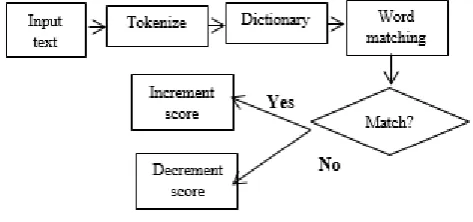
B. Lexicon Based Technique
Fig. 4: Lexicon Technique
C. Hybrid Techniques
In Hybrid Techniques the two blends of AI and vocabulary base methodologies ate castoff. Analysts have demonstrated that this blend gives an improved presentation of grouping. Minas et al. proposed a thought level assumption examination framework, called pSenti, which is created by consolidating dictionary based and learning-based methodologies. The primary advantage of their half and half approach utilizing a dictionary/learning beneficial interaction is to locate the best of together universes security just as coherence from a painstakingly arranged vocabulary, and the high precision from an incredible managed learning calculation.
Fig.5: lexicon Technique
V. CONCLUSION
In this paper, it discussed about full sentimental process then we discuss about its techniques use in sentimental process mainly three types of techniques are used in this paper:
1) Sentiment Analysis based on supervised Machine Learning technique.
2) Sentiment Analysis by using Lexicon based Technique.
3) Sentiment Analysis by combining the above two approaches.