Designing an Energy Efficient Network Using
Integration of KSOM, ANN and Data Fusion
Techniques
*
Pooja Singh
1, Vikas Pareek
2, Anil K Ahlawat
31
Dept. of Computer Science & I.T., Amity School Of Engineering & Technology, Affiliated by GGISPU, Delhi. India. *
Reaserch Scholar at Banasthali Vidhyapith, Rajsthan
2
Dept. of Computer Science & I.T., Mahatma Gandhi Central University, Motihari. Bihar, India.
3Dept. of Computer Science, Krishna Institute of Engineering and Technology, Ghaziabad, India.
Abstract—Energy in a wireless sensor network (WSN) is rendered as the major constraint that affects the overall feasibility and performance of a network. With the dynamic and demanding requirements of diverse applications, the need for an energy efficient network persists. Therefore, in this paper proposes a mechanism named “Artificial Intelligent Energy Aware Routing Protocol (AIEARP)” for optimizing the energy consumption in WSN through the integration of artificial neural networks (ANN) and Kohonen self-organizing map (KSOM) techniques. The clusters are formed and re-located after iteration for effective distribution of energy and reduction of energy depletion at individual nodes. Furthermore, back propagation algorithm is used as a supervised learning method for optimizing the approach and reducing the loss function. The simulation results show the effectiveness of the proposed, AIEARP energy efficient network.
Keywords—Wireless sensor network, AIEARP, artificial neural network, Kohonen self-organizing map, Data Fusion.
1.
Introduction
Wireless sensor networks have emerged as an indicator of information age that placates the needs of broad-ranging environmental sensing applications such as precision agriculture, video surveillance and vehicle monitoring etc. The functionality of such network is dependent on the sensor nodes, which are small, lightweight and cheap electronic devices capable of performing computational and sensing operations [1, 2]. These nodes, deployed in an environment where human accessibility is minimum, instigates the continuous monitoring of the surrounding to gather the relevant data for the purposes of executing further processing [3]. The type of data gathered from the atmosphere may pertain to humidity, temperature, vibrations, sound, pressure etc. The hardware configuration of the sensor nodes comprises of processors, one or more sensors, transceivers, memory and power supply, where a single node can perform the functions of data gathering, data aggregation and data communication or transmission [4].
One of the major challenges intercepted by WSN is the limited battery or power supply inculcated within the sensor nodes, which fuels the degradation of network energy and lifetime [3, 5, 6]. This limitation of energy is the most prominent drawback of networks as without energy, the dead nodes are unable to perform there functions and may lead to the failure of application. The diverse applications require the continuous and uninterrupted monitoring of the surroundings, even in harsh environments, thus requiring
operable nodes for a longer period of time. Therefore, optimizing the energy efficiency of nodes has been a top priority for which, various routing techniques have been developed to reduce the overhead of the network [7]. Clustering is one such methodology that aims at reducing the energy consumption of the network by segregating the wireless sensor network into clusters comprising of individual nodes. In a cluster, a node is appointed as a cluster head (CH) (based on some criteria), which receives data from all the nodes within the respective cluster, aggregates the data and transmits it to the base station. Such a mechanism saves the energy of data aggregation or fusion on all the nodes, as now only the CH performs this functionality for a limited span after which a new CH is elected [8, 9]. The other nodes are only required to sense the data and transmit it via single-hop or multi-single-hop to the concerned cluster head.
Several researchers have devised routing algorithms and inventive methods for effective communication among the wireless networks comprising of nodes and multiple clusters. In the recent times, artificial intelligence and new networks have been largely investigated to be incorporated in wireless sensor networks for developing energy efficient methods [3]. The branch of artificial neural networks deals with the generation of algorithms for executing intricate mapping between input and output through classification. Such algorithms provide additional advantages of data robustness, easier computations and distributed data storage, auto classification of sensor data and high fault tolerance. Moreover, the artificial neural networks are integrated in clustering algorithms to provide enhanced computation with low communication costs and energy reduction [10]. Another inspiration of blending these two networks together is the aided advantage of similar architecture, where neurons equates to sensor nodes and connections to radio links. Nonetheless, the depletion of energy of the sensor nodes in a network persists and presents a cause of concern that needs rigorous investigation. With the boost of technology and dynamic demands of diverse application, it is imperative to sustain the network lifetime for exploiting the true benefits of wireless technology [11].
huge possible applications. Particularly, wide research work has been dedicated to giving energy efficient and effective routing algorithms for data collection. The main goal and objective of sensor routing algorithms is then to mutually examine the network topology and data structure to offer the optimal strategy for data collection with at least energy as possible. During the collection of information (data) there is possibility to use redundancy and wireless network reducing their power and processing time is become high with fault tolerance among the sensors. Due to above problematic conditions the current progress in Wireless Sensor Network has taken to various new protocols formed especially for sensor networks in where the energy awareness is a necessary deliberation.
In the current research, the major aim is to design and develop an inventive network based on neural network approaches such as self-organizing mapping and data fusion techniques for energy optimization at nodes. Since ANN (Artificial Neural Networks) that is an energy proficient process of Wireless Sensor Network owing to their easy calculation of parallel distribution, scattered storage, and robustness of data, sensor nodes auto arrangement and sensor reading. Dimensionality decrease and sensor data forecast derived from neural network algorithms results lead to decreased costs of communication and energy preservation. Whereas Data fusion could be utilized to decrease the amount of data and information flowing and the energy spent at the time of processing, sensing, and communication operations in the network. Data fusion or aggregation is a practice of combining data from numerous undependable sources (sensor nodes) to remove helpful and dependable information. The algorithm utilizes application-based knowledge in making decision of routing. Such techniques lead to contribution in research area as a novel prospective and by using ANN and data fusion here design a novel technique to integrate data fusion technique to enhance the consumption of energy known as Artificial Intelligent Energy Aware Routing Protocol (AIEARP).
This research article inculcates the back propagation algorithm method in which ANN is used for the training and optimization of the network by reducing the loss function. The main function of this technique is to find out best input’s corresponding to the outputs classifying the odes and the best profit of this method is that it upgrades the weights of the hidden layers of the network. This paper is organized into several sections, wherein the second section refers to the problem definition that explores the shortcomings of WSN and energy-related constraints and elaborates the existing literature related to the current study context. The description of the proposed methodology and technique, the AIEARP is presented in the next section. The forth section demonstrates the performance of the proposed network “AIEARP” along with its simulation results. Lastly, the sixth section elaborates on the conclusion of the study, and recommendations and future work respectively.
2.
Related Work
Energy in wireless sensor networks is a parameter that has instigated extensive investigations from researchers across the world. The emphasis is laid on energy efficiency as WSN is marred with low capacity of energy saving while higher level of energy consumption, which depletes the network
lifetime at a fast pace. The sensor nodes are equipped with a limited power capacity that presents a further challenge of either changing the battery or recharging it. The energy of sensor nodes is required to perform the functions of on-board processing, data aggregation, data sensing and data transmission [12]. The major source of energy consumption arises from the wireless transmission of data among the nodes, which devours more energy as compared to the other operations of sensing and data processing [13]. As nodes are placed far from each other (it can be more than 100 meters), transmitting data over such distance consumes high energy. The causes that leads to high wastage of energy during data transmission or communication within the nodes are collision, overhearing and idle listening [13]. Firstly, as data is transmitted through radio links, the possibility of two or more nodes transmitting data at the same time is high, which results in collision. Due to collision, the data by the collided nodes would be re-transmitted, thus increasing energy consumption. Secondly, the nodes in the network are listening in order to receive the data packets directed to them and in some cases they pick the packets that were not directed at them. This leads to the unintentional usage of energy. Lastly, routing update and synchronization packets leads to more energy consumption that reduces the network bandwidth [14]. Another reason of energy depletion is data aggregation that requires high processing to remove the redundant data. Efficient data aggregation is necessary for reducing energy consumption, as an effective aggregation mechanism will reduce the amount of data to be transmitted to the base station, thus leading to high energy saving [15]. The problem of high energy consumption and node failure is worsened in the applications, where the nodes are disregarded, such as underground coal mining applications. In such cases, the recharging and exchange of batteries are unfeasible and costly, thus the success of the application is dependent on the network lifetime. Therefore, plummeting the energy use and consumption is a top priority as the life of battery is projected to show no increase in the forthcoming future. Irrespective of the abundant research observed in this field, the existing schemes have offered little reprieve from this concern and found to be with various flaws that needs effective attention [16]. In this regards, an energy efficient network must be developed to address the aforementioned challenges for the purpose of increasing the utility of WSN in related applications.
In [17], the authors have proposed an energy aware multipath on-demand routing EOMR protocol for multihop CRANs. The proposed EOMR protocol uses the integration of network and new path discovery to establish communications for heterogeneous environment dynamically. EOMR protocol also balanced the load & thus throughput is increases which lead to maximum life span of the network and less delay to end to end in the network.
Energy based clustering protocol with self-organizing map (EBC-S) [19] is a new protocol generated to maximize the energy at nodes. The proposed technique forms appropriate clusters through multi-parameter selection, increases coordination between nodes while saving energy. The nodes with higher energy are taken as the weights of SOM map units, which attract the nodes with low energy. On this basis energy efficient clusters arte formed that increases the lifetime of the network, in comparison to the existing LEACH protocols.
The structure of clustering and data aggregation is an essential means to attain an energy efficient wireless sensor network. In [16], the authors have developed an energy efficient data aggregator election (EEDAE) algorithm that incorporates the domain of artificial intelligence in augmenting the energy level of nodes. This algorithm emphasizes on selecting a data aggregator that gathers the data from all the nodes and aggregates the data within a cluster, by which the transmission of energy can be reduced to minimum. It adopts a nondeterministic approach and intra-phase and inter-intra-phase clustering with focus on attaining high packet-delivery ratio, low delay, and minimum overhead and energy depletion. Further work can be done where delay can be reduced by dropping the service requests of the application.
An energy efficient multi-hop hierarchical routing protocol based on self-organizing map (EMHRS) [7] is developed with the incorporation artificial intelligent algorithm for multi-hop communication in clusters. The nodes that have low energy are selected as the intermediate nodes for next hop, where the distribution of energy within the network is performed to balance the energy consumption. The algorithm also addresses the QoS-driven routing to improve the overall network performance.
In [20], the authors have proposed a technique to perform effective data aggregation for reducing the overall energy consumption of the network. The proposed technique is based upon the Kohonen Self-Organizing Map Neural Network (KSOM-NN) for clustering and classification of the nodes. The methodology of clustering is dependent on the distance between the nodes and the environment, wherein the nearest neighboring node and intermediate nodes can decide whether to sense the surroundings directly or receive sensed data from the neighboring nodes. Therefore the techniques are distance based for both data sensing from environment and its aggregation.
Julie and Selvi [21] have proposed a neuro-fuzzy energy aware clustering approach (NFEACS) that emphasizes on segregating the network into energy efficient clusters and their respective cluster heads. The approach is formed by utilizing two components, a fuzzy subsystem and a neural network system, wherein the latter offers training set and receiving signal strength to determine the energy level required for the selection of CH. The fuzzy system is used to formulate the structure of the cluster that works in the best interest of gaining energy efficiency in the entire network. In [22], the authors focus on recovery process in WSN after a fault detection process during the transmission of data. Therefore, authors proposed a Distributed Fault-Tolerant Algorithm (DFTA) to repair the fault node, considering the parameter like Packet delivery ratio, control and memory overhead and fault recovery delay.
The existing methods is concerned about fuzzy, SOM, K-mean clusters whereas the proposed method is included the data fusion technique with neural network for better results and high performance. The proposed scheme AIEARP is found to be effective when compared with the existing protocols in this domain.
3.
Proposed Method
Here proposed the novel idea of the current research is to optimize the energy consumption and performance of the network with the inclusion of Data Fusion, Artificial Neural Networks and KMOS algorithms. An energy efficient wireless network is created, where the KSOM technique is used for mapping the nodes in a network and the ANN is used for classifying the nodes. The classification of the nodes is dependent on their availability, and the routing is executed as per the energy available on the nodes. The proposed methodology constitutes of several rounds, wherein a cluster of nodes is formulated in each round, followed by data transmission phase.
Node Localization and Allocation
i. Scaling of the Network – the scaling of the network deals with the boundary formation of the network. Assigning regions around the network is allocated to place its sensor nodes on the areas occupied. The primary work is used for the manipulation of the framework which eases the user to set their boundary for their manipulations to be carried on.
ii. Random Allocation of the Nodes – the classification of the nodes depends upon the availability and the routing is executed as the energy is available on the nodes. The proposed methodology is made up of no. of rounds and with each round the cluster of nodes is formulated after that the data transmission follows. The formulation of the clusters is based on random clustering. Cluster is made up of several nodes and one cluster head is selected among them randomly and occupies a fixed position in the network.
Figure 1: Clusters in WSN
KSOM Mapping technique
a.KSOM Self Organisation Mapping
Kohonen Self organising Map consists of two layers one is the input layer and other is the output layer, both are connected with each other in a two dimensional grids. This network consists of the same number of nodes as the size of the input declared by the user. These input parameters are extracted from the sensor nodes. Let us now consider the size of the parameter as n and m are the binary bits taken by each parameter, then the input no will be: \V\ =mXn. Therefore the output layer shares the organised relationship with the input patterns which are themselves classified by the output layer. They organise themselves from a random starting point and exhibits a natural relationship between the patterns organising the topological map. According to the input patterns found (different patterns) the outer layer is selected. The input layer will remain the same as the Output layer.
Let the input layer of the network will be framed as I = (I1, I2….I\V\ ) ( 1)
Let the output layer of the network will be framed as
O = (O1, O2….Oq) (2)
Whenever, the communication of the data takes place from the network’s input cluster arrangement then, the Euclidean distance value of a sensor node in the outer layer is Dj. The Euclidian distance of ach node in the network is monitored and calculated, the formation of the clusters takes place according to the distance measured from the sensor nodes.
(3)
In a two dimensional map set of input samples is need to organise nodes, x (t) = [Residual Chi (t), Euclidian distance Density Chi (t)]. The values have to be normalised as the variables applied are of two different types, so we have n4 dimensions with D matrix. By putting V’ = (2), we get a value v within the range of (0, 1) using the normalization min-max equation, as a result the values of dataset D = (
[D1,D1(max)],[ D2, D2(max)],[ D3,
D3(max)],[D4,D4(max)] [D5, D5 (max)], where D denotes input vectors of KSOM, D4 denotes energy levels of CH
receivers, D3 denotes the distance between CH emitters and receivers, D2 denotes distance between the sink and the CH receiver, D1 denotes CH receiver’s density. The max values of each denote D4 means the energy remained of the CH receiver’s maximum energy in the network space. D3 max among the network space, it is the maximum value between CH emitter and receiver’s distance. D2 max is the maximum value for distance between the Sink and the CH receivers. D1 max is the value maximum for the density of the CH receivers in the network space. The selection of cluster heads is equivalent to the region of the network space for the determination of the weight matrix is done by BS. For the KSOM technique from the CHs which are selected four variables are needed for their application as a weight vectors. The four variables are as follows: CH receiver’s remaining energy, CH density, Distances between the CH receiver and the Sink, and between the CH emitter’s and the receiver. Depending on the value of the lower Eucledian distance measurement which itself depends upon the consumption of energy from the node through this Eucledian the mapping of the network from the output takes place.
b. Random Allocation of Clusters – as discussed that KSOM is used for clustering as it generates the input data dimension and views clusters into maps. It is an excellent component for clustering of WSN as it has a capability to diminish multi-dimensional input data dimension and view clusters into map. The energy consumption of the nodes has to be estimated first along with the availability of functioning nodes for the re-location of the clusters. This information is assisted in cluster formulation and also provides effective routing mechanism to transmit the collected data from the nodes to the CH. The KSOM technique ensures the preservation of the tropical structure of nodes while protecting the data carried by nodes along with the determination of the no. of clusters in the network.
Figure 2: KSOM Structure Topology
In the figure above the X is the input layer, Y is the output layer and D1 to D16 is the Eucledian distance.
Classification Phase using artificial neural network
method used is Feed Forward Back Propagation Neural Network classifier (FFBNN). The neural network consists of n input nodes, l hidden nodes and k output nodes and is a 3-layered standard classifier. If there are two hidden layers which are being used then the function of the first hidden layer is the association of the each pair in a unit and the function of the second layer is considered to be the real hidden layer after the input data is classified in the first hidden layer. Here, the association rules are the input layers, HUa hidden units and the output unit is f. the figure below
exhibits the structure of FFBNN classifier:
Figure 3: Structure of FFBNN classifier i.e. Neural Network hidden layer
i. Function Steps of NN
The weight of each and every neuron is set apart from the input layer’s neuron.
1) The NN is produced with the help of the attributes
which are extracted: the input
unit
A
1,
A
2,
A
3,
A
4,
A
5
, the hidden unitsHU
a and the output unit as agef
.2) The proposed Bias function for the input layer is calculated as follows,
) ( .... ) ( ) ( ) ( ' 5 ) ( ' 3 ) ( ' 2 ) ( ' 0 1 ) ( ' ' ' 1 '
' A n w A n w A n w A n w
X n n n
H n n NH
(4)By the following equation the calculation of the activation function of the output layer takes place:
Xe
X
Active
1
1
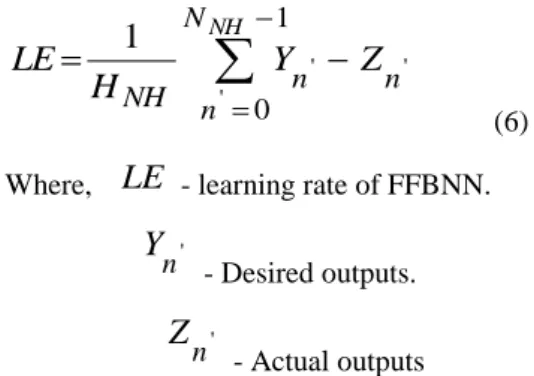
(5)3) Below is the identification of the learning error:
' ' ' 1 0
1
n N n n NHZ
Y
H
LE
NH
(6)
Where,
LE
- learning rate of FFBNN.
Y
n' - Desired outputs.
Z
n' - Actual outputsii. Learning Algorithm – for the minimization of the error the Back Propagation Algorithm used.
The learning algorithm is used as back propagation algorithm in the feed forward NN. It is an overview of the delta rule and a supervised learning technique. The dataset of the output is required for various inputs for a training set to be produced. This algorithm is used for feed forward network. The basic need of the learning algorithm is that the neurons using the activation function should be differentiable.
iii. Back propagation Algorithm Steps for FFBNN
1) The random choice of weights is assigned to weights of the hidden layer and the output layers of neurons. 2) In FFBNN the calculation of the functions i.e. proposed bias and the activation are performed using the Eqn. (7) and (8).
3) The weights are updated as the Back Propagation Error is found for each node as follows,
) ( ) ( )
(n'
w
n'w
n'w
(7)
4) Given below is the change in weight
) ( ) ( ) ( '
.
'.
BP nn
X
E
w
(8)
Where,
- Learning Rate, which normally ranges from 0.2 to 0.5.E
(BP) - BP Error.5) The process is repeated using (2) and (3) steps, until the BP error gets minimized. i.e.
0
.
1
.
) (BP
E
6) For performing the testing phase FFBNN is well trained if the minimum value obtained.
The purpose of this technique is to find the function that identifies the best inputs corresponding to the outputs thus classifying the nodes. The main benefit of the back propagation algorithm is that it can upgrade weights of the hidden layer in the network. Using the attributes the association rules are tested, classification of defects is carried out which categorizes the entire defects are generated from the classifier. Therefore FFBNN classifier is considered to be well trained.
Data Fusion Algorithm – this is the data fusion technique used to aggregate the data obtained from all the nodes and then residue energy on the nodes is calculated and extracted. For the calculation of the residue energy left with the H N 2
w
w22 2 1 5 f2 N N 2 H w 2 N 2 Hw
2NH1available nodes (non-dead nodes) after time T, the following equation is used:
(9)
Here, the net consumed energy is E Here, the net consumed energy is E (e, T) and the initial energy at node is Eo. With this information, routing of data is done in such a way that the node with higher energy in a cluster passes on the data to the cluster head of the network. The same is repeated for the succeeding rounds and by calculating the energy consumption on each node and determining the number of dead nodes. The total energy consumption (Eelec) is calculated by:
(10)
Here, Etx is the transmission power and Erx is the receiving cost. The sum of the energy on all the nodes and thus network energy is determined, which is efficient through this mechanism as the nodes are able to sustain their energy for a longer range of time.
FIGURE 4: FLOW DIAGRAM FROM THE PROPOSED
4.
Simulation Results
The current research utilizes the software MATLAB to implement the proposed methodology, where KSOM and ANN are used for energy efficiency in wireless sensor networks. MATLAB is a model-based design environment for developing and simulating mathematical models and systems. For implementing the proposed mechanism for efficient wireless network, 100 nodes are placed randomly in the network of area (x=100, y=100).
TABLE I. SIMULATION PARAMETERS
Parameters Values
Number of nodes 100
Number of iterations/rounds 150
Initial energy 0.01nJ
ETX (transmission power) 50*0.000000001
ERX (receiving cost) 50*0.000000001
Efs 10 pJ/bit/m2
Emp 0.0013 pJ / bit / m4
Data aggregation energy
(EDA)
5 nJ/bit/signal
In the first round, random clustering is done, wherein different clusters are made randomly, and one cluster head is fixed at the position of (100, 50). Figure 2 shows the structure of the wireless sensor network with 100 nodes and (100, 100) area.
Fig 5: Wireless sensor network
The network topology after iteration and cluster formulation is represented in figure 3. The mapping of nodes is performed after each iteration so that the nodes will be changing according to the iteration count (i.e. according to the usage of the node in similar operation).
Fig 6: Network after cluster formation
Node Initialization and
Localization
Data Fusion With Dead
Node Collection
Classification of nodes
Based on Energy
Consumption from
Each node
The energy consumption and residue energy of each node is calculated after each iteration to determine the number of dead nodes and assist in the routing mechanism as per the energy level of nodes. This is further utilized for the re-formulation of the clusters. Figure 4 and 5 represents the average energy of the nodes or energy depletion at nodes at different number of rounds or iterations.
Fig 7: Average energy of nodes at round 76
Fig 8: Average energy of nodes at round 130 The dead nodes are then detected, because of continuous data transmission of data in the network and also the parameters like energy and cluster heads are measured with the help of artificial neural networks. The ANN extracts such information from the network that is used for the purposes of network routing. As seen in Figure 6, with the implementation of the current method, the number of dead nodes after 150 iterations in a network is 22, which shows the energy efficiency of the network.
Fig 9: Dead nodes in the network after 150 iterations
FIG.10:PACKET TRANSFEREN TO CH AT EACH ITERATION
This graph represents the packets transferen to the cluster head after ititerations and the number have been calculated accordingly and updated on the graph and plotted accordingly.
Fig 11: Calculation of the nodes and their average.
This graph above gives an idea on the minimum distance calculation in the nodes and their average. Due to presence of dead nodes the distance between the nodes will be varying accordingly and the plot have been made on that basis. This tells that the iterations will be varying according to the dead nodes and at last iterations due to presence of many dead nodes the distance is increased.
From the results obtained and the results mentioned in the literature studies the proposed research method is found to be more efficient in ways of energy consumption.
5.
Conclusions
This paper presents Artificial Intelligent Energy Aware Routing Protocol (AIEARP) a new approach of optimizing the energy efficiency of a wireless sensor network by applying the integration of Artificial Neural Networks (ANN) and Kohonen Self Organizing Map (KSOM). While ANN is used for classification of nodes and evaluation of energy consumption parameters, the KMOS technique is used for effective re-location of clusters in a network and their effective mapping. The simulation of the approach is performed and executed via MATLAB software. The results have revealed the effectiveness of the proposed methodology as the number of dead nodes in the network is low after 150 iterations. Also the network with energy efficient nodes has dead nodes of 1.3518 while the number of nodes to be considered is 100 which is very less possibility for dead node no. compare to another mechanism whereas the cluster head value of a network with energy efficient node is 11.
techniques to facilitate a more effective energy efficient wireless sensor network.
References
[1] C. Buratti, A. Conti, D. Dardari and R. Verdone, "An Overview on Wireless Sensor Networks Technology and Evolution", Journal of Sensors, vol. 9, pp. 6869-6896, 2009.
[2] S. Gond and N. Gupta, "Energy Efficient Deployment Techniques for Wireless Sensor Networks", International Journal of Advanced Research in Computer Science and Software Engineering, vol. 2, no. 7, pp. 257-262, 2012.
[3] N. Enami, R. Moghadam and K. Dadashtabar, "Neural Network Based Energy Efficiency In Wireless Sensor Networks: A Survey", International Journal of Computer Science & Engineering Survey (IJCSES), vol. 1, no. 1, pp. 39-55, 2010.
[4] S. Sharma, D. Sethi and P. Bhattacharya, "Artificial Neural Network based Cluster Head Selection in Wireless Sensor Network", International Journal of Computer Applications, vol. 119, no. 4, pp. 34-41, 2015.
[5] R. Rathna and A. Sivasubramanian, "Improving Energy Efficiency In Wireless Sensor Networks Through Scheduling And Routing", International Journal Of Advanced Smart Sensor Network Systems ( IJASSN ), vol. 2, no. 1, pp. 21-27, 2012.
[6] Z. Rezaei and Mobininejad, S. "Energy Saving in Wireless Sensor Networks", International Journal of Computer Science & Engineering Survey, vol. 3, no. 1, pp. 23-37, 2012.
[7] S. Amri and M. Kaddachi, "SOM Based Energy-Efficient Multi-hop Hierarchical Routing Protocol for Wireless Sensor Networks", NNGT Int. J. of Artificial Intelligence, vol. 1, 2014.
[8] V. Kumar, S. Jain and S. Tiwari, "Energy Efficient Clustering Algorithms in Wireless Sensor Networks: A Survey", IJCSI International Journal of Computer Science Issues, vol. 8, no. 5, 2011.
[9] N. Dimokas, D. Katsaros and Y. Manolopoulos, "Node Clustering in Wireless Sensor Networks by Considering Structural Characteristics of the Network Graph", IEEE International Conference on Information Technology, 2007.
[10] Kulakov, A., Davcev, D., Trajkovski, G, (2005) “Application
of wavelet neural-networks in wireless sensor networks”, Sixth International Conference on Software Engineering, Artificial Intelligence, Networking and Parallel/Distributed Computing and First ACIS International Workshop on Self-Assembling Wireless Networks (SNPD/SAWN'05), pp.262— 267
[11] J. Nimbalkar, "Use of Neural Network in WSNs: A survey",
International Journal of advancement in electronics and computer engineering (IJAECE), vol. 1, no. 3, pp. 93-98, 2012.
[12] T. Rault, A. Bouabdallah and Y. Challal, "Energy efficiency in
wireless sensor networks: A top-down survey", Computer Networks, vol. 67, pp. 104-122, 2014.
[13] Q.Gao, D.J.Holding, Y. Peng and K.J.Blow, “Energy
Efficiency Design Challenge in Sensor Networks”, London Communications Symposium 2002.
[14] A. Savvides, C.C. Han and M. Srivastava, “Dynamic
fine-grained localization in ad-hoc networks of sensors,” MobiCom2001, Rome, Italy, pp. 166-179, July 2001
[15] N.S. Patil and P.R. Patil, “Data Aggregation in Wireless
Sensor Networks”, IEEE International Conference on Computational Intelligence and Computing Research, 2010.
[16] C. Subashree and S. Thangalakshmi, "Energy Efficient
Aggregation In Wireless Sensor Networks Using Artificial Intelligence Based Aggregator Election", International Refereed Journal of Engineering and Science (IRJES), vol. 5, no. 3, pp. 08-16, 2016.
[17] S. M. Kamruzzaman, Xavier Fernando and Mohammad
Jaseemuddin “Energy Aware Multipath Routing Protocol for Cognitive Radio Ad Hoc Networks”, International Journal of Communication Networks and Information Security (IJCNIS), Vol. 8, No. 3, December 2016.
[18] N. Kumar Kamila, S. Dhal and B. Nayak, "Neural Network
Enabled WSN Management for Energy Efficient Routing Mechanism", Indian Journal of Science and Technology, vol. 9, no. 26, 2016.
[19] F. Ahmadnezhad and A. Rezaee, "Increasing the lifetime of
wireless sensor networks by Self-Organizing Map algorithm", International Journal of Computer Networks and Communications Security, vol. 3, no. 4, pp. 156–163, 2015.
[20] K. Veena and V. Kumar, "Energy Efficiency Analysis for
Distance based Data aggregationin Wireless Sensor Networks", International Journal of Computational Intelligence and Information Security, vol. 3, no. 7, 2012.
[21] E. Julie and S. Selvi, "Development of Energy Efficient
Clustering Protocol in Wireless Sensor Network Using Neuro-Fuzzy Approach", Scientific World Journal, 2016.
[22] Chafiq Titouna, Mourad Gueroui, Makhlouf Aliouat, Ado