Concepts, design and implementation
of Reverse Logistics Systems for sustainable
supply chains in Brazil
Henrique Luiz Corrêa
Rollins College [email protected]
Lucia Helena Xavier
Fundação Joaquim Nabuco [email protected]
ABSTRACT: There is growing social pressure for organizations to reduce their rates of consumption of nonrenewable natural resources and in parallel, to also reduce the release of production and
post-consumption waste to landfills, water bodies and air, thereby causing damage to the environment. To respond to the pressure it is necessary that organizations’ operations prioritize the “3R” goals: Reduce, Reuse and Recycle.
In this context, the so called reverse logistics flows have grown in importance in the study of supply chains. Examples are the components and materials that are collected after they are consumed or used. Instead of being sent to the landfill companies use reverse logistics to transport them back in supply chains to be reused or, recycled and reincorporated as secondary input material for new production.
This article aims, through the review of related legislation in Brazil, relevant literature and a number
of Brazilian and international case studies to develop a basic framework to be used in the development and implementation of reverse logistics systems (RLS).
Keywords: Reverse logistics, closed loop supply chain, sustainability, Brazil
Sustainable development: a brief history
How to consider environmental issues related
to production without negatively impacting the
economic performance of organizations? That was the main issue that permeated discussions about
the environment throughout the 1970s and 1980s
when the concept of sustainable development was
proposed (Brundtland Report, 1988). The notion
of sustainable development suggests a more balanced approach between economic growth and environmental conservation. Innovative environmental management tools have since
been developed and proposed to support better
environmental assessment and management to be
used by companies, governments and NGO’s.
With increasing pressure from organized society for
a more sustainable and responsible environmental
management some companies resented the lack of internal capabilities and guidelines to make their logistics function to become more environmentally responsible. Also, they lacked mechanisms that allowed them to have some kind of influence on the behavior of other members of their supply chains in order to obtain better environmental management and performance of their supply chain as a whole. In the ‘90s, partly in response to such shortage of capabilities and guidance, international certification procedures such as those of the ISO 14000 were developed. They address various aspects of environmental management, by offering practical tools for businesses and organizations seeking to identify and manage their environmental impacts and continually improve their environmental performance. (http://www.iso.org/iso/iso14000 ISO official website, accessed September 14, 2012).
Many companies around the world were guided by the ISO 14000 series standards to adjust their own operations. The ISO 14000 standards were also
used as guidelines when such companies required
their supply chain partners (such as suppliers and customers) to also do their part in regard to sustainability efforts. This caused an increase in
the demand on companies to adapt the traditional
financial and market-driven criteria towards more environmentally friendly ones when making
decisions. Exporting companies had to adapt their products and processes to legal environmental
requirements, not only of their own countries but also to the ones of the countries with which they
traded their products and services.
The logistics – environment interaction
In the United States in the 90s, the establishment of
legal environment-related limits such as maximum emissions for certain modes of transportation in some states can be considered an important milestone in the interaction between logistics and the environment.
Bowman (1995) mentions large companies such as Du Pont and Santa Fe Railway as pioneers in
the development of strategies and techniques for
security and environmental preservation in the
transport of dangerous goods and in air emissions.
The Protocols of Montreal in the 80s (http://www. epa.gov/ozone/intpol/, accessed April 9, 2013) and Kyoto in the 90s (http://www.kyotoprotocol.com/, accessed April 9, 2013) were instrumental in setting
more comprehensive targets of limits for atmospheric
emissions, including by logistic operations. Management goals were then established within
organizations considering the need for reducing
Greenhouse Gases (GHGs) atmospheric emissions. Organizations of the signatory countries had to adapt by refocusing management goals and allocating / managing resources in a more environmentally efficient way. However, it was the Basel Convention in the 90s (http://www.basel.int/TheConvention/ Overview/TextoftheConvention/tabid/1275/ Default.aspx accessed April 09, 2013) – of which Brazil is a signatory – that established standards
for the most important interface between logistics and environmental considerations through the
establishment of limitations to the trans boundary (across country borders) movement of hazardous
waste.
The aforementioned protocols have had important impact on organizational management and have
also influenced public policy in many countries.
Some developed countries complied with their agreed emission limits by promoting the migration of industrial parks to other countries where the legal and regulatory requirements established no or less
stringent restrictions on air emissions. Through
this mechanism, many polluting manufacturing
operations of multinational companies have been relocated to developing countries.
The Basel Agreement also had an impact on
international trade policies of signatory countries,
waste came to be regulated and limited. The central objective of the Basel agreement was to establish limits on the migration of waste from developed countries to developing countries which however
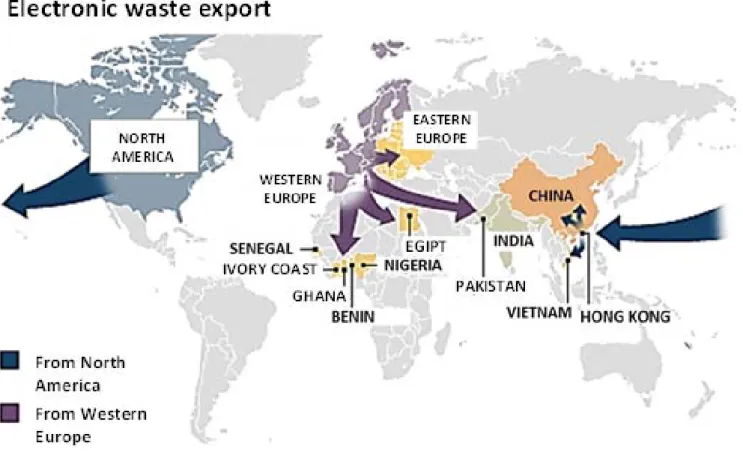
still occurs today. Countries in Africa and Asia, for
example, are still the main destination of waste of
electrical and electronic equipment (WEEE), as
illustrated in Figure 1.
Figure 1 Exports of electronics waste in the world.
Source: modified from Greenpeace and Basel Action Network (BAN) apud Greenfudge (2010).
Part of this waste is characterized as “hazardous waste” due to the potential for environmental contamination by toxic materials therefore requiring environmentally appropriate disposal. The shipping
of such waste to countries where legislation does
not appropriately regulate disposal is actually a
mechanism to transfer the damage, as contemplated in the Basel Agreement.
De Brito and Dekker (2003) propose a framework
where post-consumer products should as much as possible be allocated into repair, refurbishing and
remanufacturing rather than sent to landfill disposal. Reverse logistics would thus be a key competence in supply chains.
The regulation of reverse logistics in Brazil
In Brazil specific environmental laws have significantly impacted production systems in
different industries. Below some of these regulatory mechanisms are briefly discussed.
Aspects of environmental regulation in Brazil
During the 1980s and the first half of the 1990s, the National Environment Policy, instituted by Law No. 6938 of 1981 became the main regulatory framework
to deal with environmental management in the
country.
The law, passed during the military government
was a modern and innovative instrument as compared to environmental standards then in force
environmental protection and sustainability).
Brazil’s Constitution of 1988 included specific articles about environmental protection (Articles 23 and 225) by assigning to municipalities, states and federal government responsibility to protect the environment, combat pollution in any of its forms and preserve the forests, fauna and flora of the country as well as to preserve and restore the essential ecological processes and bio-diversity.
The National Policy of Water Resources established by Law No. 9433 of 1997 regulated the granting and charging for the use of water resources by
private enterprise, as well as on compensation for municipalities when companies exploit their other environmental resources.
Through this law, mechanisms for managing water
resources were defined and also were mechanisms
for the prevention of pollution from the discharge
of sewage and waste (liquid or gas) in water bodies. Law No. 9605 of 1998, known as the Environmental Crimes Act regulates the penalties and fines (normally proportional to the damage) to account for
environmental impacts and considers individuals as being responsible for the environmental impact
of industrial activity. For example, the manager of an industrial enterprise can be personally held responsible and criminally charged for impacts resulting from the environmentally inappropriate management of company activities.
By Law No. 11445 of 2007 guidelines and Policy on National Sanitation were instituted. By
contemplating processes inherent to solid waste
management and also by specifying social control as the mechanism for action, this law is directly
related to reverse logistics. Its regulations regarding the inclusion of associations and cooperatives of
pickers of recyclable materials in the process of
waste management on a large scale represented an
important milestone. Also through Law 11445 the National Movement of Recyclable Materials (MNCR) found legitimacy to act through associations and cooperatives of pickers.
The role and work of pickers still appear in Decree 5940 of 2006 which regulates the management of recyclable materials in federal offices and buildings.
According to this decree, such materials should be dealt with through associations and cooperatives
of pickers as a means to favor social inclusion. This aspect is taken into Law 12305 of 2010 as discussed
later in this article.
Regulation of “reverse logistics” in Brazil
The main piece of legislation that defines the concept and implementation of reverse logistics systems in Brazil is Law No. 12305 of 2010 that establishes the National Policy on Solid Waste (PNRS). In this law,
producers, importers and traders are considered as co-responsible for environmental impacts from production, transportation, consumption
and disposal of products. The letter of PNRS starts by altering the Environmental Crimes Law, emphasizing the accountability and assignment of fines and penalties for environmental damage caused by improper solid, liquid or gaseous waste
management.
Efficient environmental management avoids both
the abuse of natural resources and environmental degradation. Environmental management is a
necessity from the perspective of maintaining and improving quality of life today, but also because only an eco-efficient use of resources today will be able to preserve its potential use by future generations.
For almost two decades the bill on PNRS remained
under discussion in congress before being approved
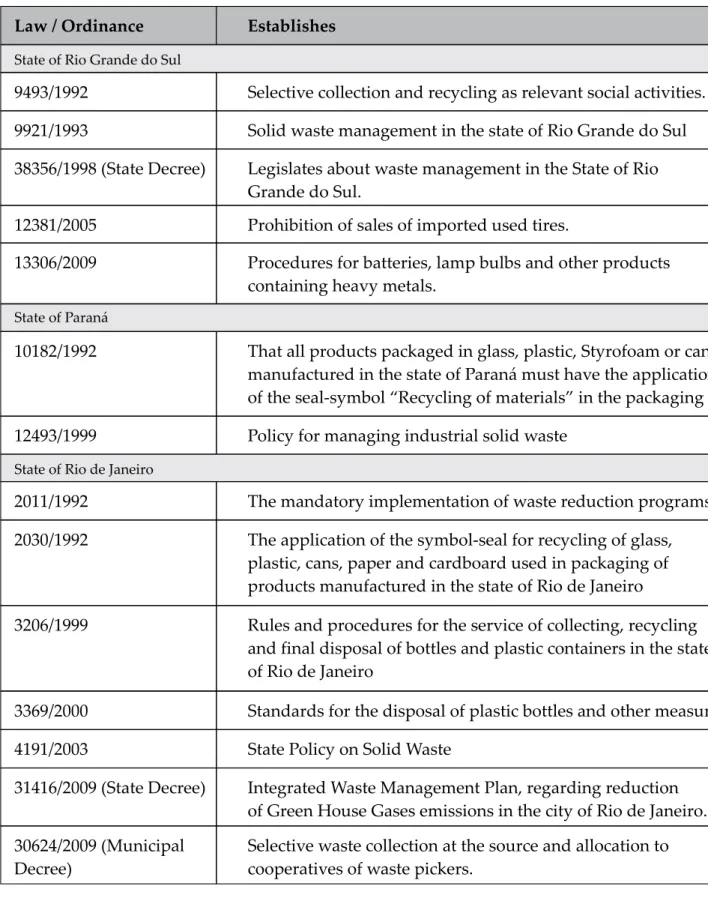
in 2010. Throughout this period many states and municipalities have developed their own regulatory mechanisms. Probably the more local initiatives to pass state and city-level specific regulations for
waste management even before the establishment of
a national policy through federal legislation was the result of increased market pressure and of greater environmental awareness by local communities.
Many states and municipalities in Brazil have
regulations about solid waste management but few
mention the concept of reverse logistics. Some of
these are now being adapted to the requirements of
The National Policy on Solid Waste (PNRS) defines reverse logistics as:
“Instrument of economic and social development characterized by a set of
actions, procedures and means to facilitate
the collection and recovery of solid waste
from the business sector to reuse it in their
own (or other) production cycles, or for environmentally appropriate disposal” (Law No. 12305 of 2010)
The disposal of solid waste may therefore include alternatives with or without reuse. “Environmentally
appropriate disposal” should be interpreted as alternatives including reuse, recycling, composting, energy recovery or other forms of disposal provided that they are authorized by the competent government bodies, such as those that make up the National Environmental System (SISNAMA). Final
disposal although also interpreted as a possible destination, is restricted to un-usable residues, i.e. it
refers to that category of waste that is not capable of
being reused or reprocessed for reuse.
Another important aspect related to PNRS is the
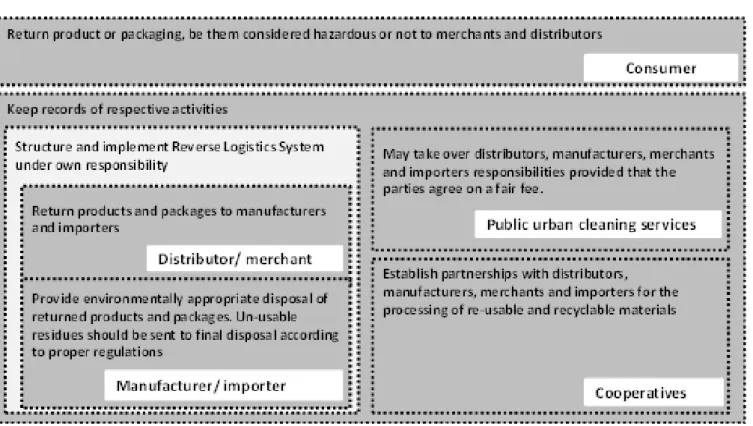
establishment of industry agreements between participants of reverse logistics systems of prioritized areas as described in the law, as presented in Table
2.
Figure 2 Responsibilities of participants in reverse logistics, according to Article No. 33 of PNRS.
Currently, the Brazilian legal framework prescribes different working groups within industries to act on specific categories of waste management. While the packaging of lubricating oil and lamp bulbs already have a specific CONAMA resolution (that has force of law) that sets environmental limits and standards, other types of waste such as other types of packaging and electronics do not. Those responsible for the RLS of CONAMA-regulated types of waste were induced (by government regulation) to organize themselves
in less time and as a consequence achieved results
sooner. This illustrates the importance of specific
regulations for the consolidation of reverse logistics
systems in different industries within the country.
Introduction to reverse logistics systems
The regulation of waste management in Brazil
(discussed in the previous section) has fostered
the organization of processes and the execution of activities that either did not happen before or if
they did, it was in an independent and voluntary way. With the development of the National Policy on Solid Waste (Law No. 12305 of 2010) and other regulatory documents that were originated from it the necessity of designing and implementing reverse logistics systems became more pressing.
The fundamentals of reverse logistics systems have developed from bodies of knowledge that had already been well established such as traditional
logistics, environmental management and waste management.
The design and implementation of RLS, besides requiring the mastery of concepts and tools of
traditional logistics management also require
specific knowledge about materials management, processes for allocation of waste to different destinations (reuse, remanufacturing, recycling and incineration) and disposal (landfill) and it requires certain manpower skills and availability of specific
infrastructure.
Through federal legislation, in Brazil waste now should be managed as goods to be reinserted in
supply chains whenever possible. This is virtuous
both from the viewpoint of reducing the rate of consumption of nonrenewable resources and also of reducing polluting waste disposal in the environment.
The reverse channel (through which reverse flows pass) actors need to be recognized as providing
value adding activities to the chains to ensure not
only technical but also economic viability (and sustainability) of the whole process.
More than simply “reversing” direct logistic flows, reverse logistics systems require the reorganization of parts of the supply chain, the appropriate
management of warehousing and transportation
in reverse flows, the potential establishment of
new businesses and the integrated management
of reverse and closed-loop supply chains so as to ensure efficiency and effectiveness of the processes
involved.
Reverse logistics complexity
Reverse logistics is complex, among other reasons,
because of the diversity of areas it encompasses. Most of these areas are regulated in Brazil, although these regulations are not always consistent with
each another. In our review, we found no references
in the literature that pointed to a systemic solution for managing reverse logistics systems in Brazil.
We then reviewed national and international experiences as a reference for building a basic
framework for the design and implementation of reverse logistics systems.
However, it became clear through the analysis of these cases that reverse logistics systems of some types of waste in developing countries have important specifics as compared to those found in
developed countries.
Examples are the greater limitation of resources
and perhaps most importantly, the presence – guaranteed by law – of pickers of recyclable materials as an integral part of the system. This last factor (the pickers) is important and certainly contributes to the achievement of socio-environmental solutions (by helping both the social problem of lack of access to a minimum income by disadvantaged populations
and the environmental problem of polluting waste
disposal). However, the presence of pickers is also a factor that adds further complexity to the system. The proposed approach to reverse logistics systems
presented in the next sections of this paper is
based on the study of successful domestic and
international real cases and well established concepts in the literature on direct logistics, environmental management and sustainable businesses. We hope it contributes with practitioners, researchers and students who are interested in the design
by providing a conceptually robust yet practical framework that includes tools and concepts that can be adapted to different industries. Below some operational definitions adopted in this paper are
presented.
Supply chain management
Supply chain management is the integrated
management of the main business processes involved with the operation of facilities and the
physical, financial and information flows from the
original producers of basic raw materials through
to the final allocation/disposal of post-consumption
products in the production of goods, services
and information so that value is added to all – intermediate and final – supply chain customers and to other legitimate and relevant stakeholders in the chain (shareholders, employees, managers, community, government) (Corrêa, 2010).
Logistics
A significant part of supply chain management is logistics. According to the Council of Supply Chain Management Professionals (CSCMP) former Council of Logistics Management, logistics can be defined as:
“Logistics management is that part of supply
chain management that plans, implements,
and controls the efficient, effective forward and reverses flow and storage of goods,
services and related information between the point of origin and the point of
consumption in order to meet customers’
requirements. […] Logistics management
activities typically include inbound and
outbound transportation management,
fleet management, warehousing, materials handling, order fulfillment, logistics network design, inventory management, supply/
demand planning, and management of third
party logistics services providers.” (www. cscmp.org, accessed April 12, 2013)
Logistics and supply “networks”
In a more recent conception, logistics management
is addressed in the context, not of supply “chains” but of supply “networks” which in fact are
interdependent, interconnected and sometimes
integrated supply chains.
Networks, despite the increased complexity,
have the potential to help achieve higher levels of
efficiency by allowing consolidation of flows, greater economies of scale and integration of different supply chains.
Additionally, in recent decades managers and researchers came to realize that materials in supply chains do not only flow significantly in one direction (from the extraction of basic raw materials toward the consumer) but substantial volumes of material also flow in the reverse direction (from consumption back to production), mainly supporting activities of
commercial returns, reuse, remanufacturing and
recycling.
Reverse Logistics
The reverse flows go against direct flows – from the point of consumption back. Examples are materials
and components of products or processes that, after being produced or consumed, are collected and
transported back in supply networks to be reused or, recycled and reintroduced either in the same supply chain (such as in the case of aluminum cans collected after use and sent for recycling and turning into new aluminum cans) or other chains (such as in PET soda plastic bottles that are collected after use, recycled and used, for example, in the production of textile fibers).
Another example is the commercial return of
products that flow in the reverse direction (upstream)
to undergo cleaning, repair, remanufacture or
other process to be eventually sent downstream to
consumers.
Because they are flows that travel in the reverse direction of direct logistic flows in supply chains,
the part of logistics that manages resources and
processes relating to reverse flows is called “reverse logistics”.
Closed loop supply chains
As the reverse flows normally seek the reinsertion of used materials back into production systems for reprocessing and resale, often these systems are also called “closed loop” supply chains (Guide e van Wassenhove, 2002). The closed loop supply chains
therefore are those composed of direct and reverse
reuse or reprocessing for reuse.
Sustainability and the Triple Bottom Line (TBL or 3BL)
Pressures from markets and organized society (NGOs and government) have caused the concept of environmental sustainability to be incorporated
as an important component of organizational management.
This led resource and logistic processes management to be adapted with the aim to reduce the
“environmental footprint” generated by production systems. Initiatives in this direction include the
greater use of concepts such as reduced resource
use, reuse, recycling and better ways to dispose non-reusable/ non-recyclable waste. The reuse and
recycling processes are usually integral parts of reverse logistics and closed-loop supply chains.
The Triple Bottom Line
When the goal of sustainability is introduced in
the business environment, a relevant concept to
be considered is the Triple Bottom Line (TBL or 3BL), a reference to the line that represents the final result in company financial statements. According to this notion, the production system’s social,
environmental and economic requirements should be managed in conjunction and in an integrated
way (Elkington, 1997). TBL can also be understood
as the balance between organization performance
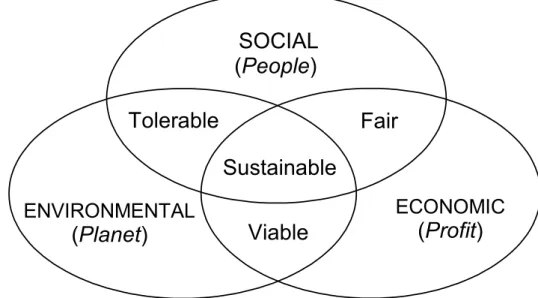
categories in relation to three “Ps”: People, Profit and Planet. See Figure 3.
Sustainable
Fair
Viable
Tolerable
ENVIRONMENTAL
(
Planet
)
SOCIAL
(
People
)
ECONOMIC
(
Profit
)
Figure 3 The triple bottom line and interactions
While the traditional focus of business is almost
exclusively financial gain and competitive advantage in the marketplace, according to the notion of TBL they must also prioritize social responsibility
and environmental preservation in addition to
economic prosperity. The interactions between the
social, environmental and economic spheres result
in different aspects of sustainability. While the
interface between the economic and social spheres prioritizes job creation and income that favor social aspects, the intersection between the economic and environmental spheres stresses environmental
actions that are economically viable. In the
interaction between the social and environmental
spheres social activities are encouraged that do not
impact the environment in an intolerably damaging way. Finally, the intersection of the three spheres represents sustainability in a broader sense.
Sustainability as a source of competitive advantage
Besides doing good for the world the use of more
sustainable practices by organizations has also gradually been perceived as a potential source of
strategic competitive advantage.
The reason is threefold. First, there is increasing
relation to the potential damage that production, use and disposal of products and services can cause to the environment. Companies that have their image associated with more sustainable practices tend to
be preferred by these consumers in their choice of
supplier.
Second, a growing number of consumers also seem to be paying attention to the impact that manufacturers of products they consume have in society. The Brazilian successful cosmetics manufacturing Natura (visit for e.g. http://scf. natura.net/NaturaESociedade/) and the coffee giant Starbucks (visit for e.g. http://www.starbucks.com/ responsibility) are two examples. The initiatives that they have in place to reduce the environmental
impact of their operations and to promote fair trade
with the communities they purchase their raw material from are as emphasized in their marketing efforts and message as the quality of their products.
This indicates how much some companies value
the message of being a sustainable company as a
potential source of competitive advantage.
Third, sustainability efforts can be cost effective because in many instances the use of recycled material in production is less costly than the use of virgin raw material. Recycling aluminum for e.g. can save 95% of the energy needed to make aluminum from bauxite ore. (http://www.aluminum.org/AM/ Template.cfm?Section=2012&CONTENTID=33554 &TEMPLATE=/CM/ContentDisplay.cfm, accessed April 12, 2013).
Considering that electricity alone is generally
accepted as representing about a third of the cost of aluminum, considerable savings can be obtained
from investing in sustainability efforts related to closing the loop in aluminum supply chains. With lower costs, a company can pass on part of the benefit to customers by lowering prices thereby
gaining competitive advantage.
Several companies now include in their annual reports aspects such as emissions, water and energy
consumption and, environmental impact as metrics
for assessing the organization’s environmental
performance. Companies set targets for the
reduction or mitigation of negative impacts (such as the impact of emissions) and, on the other hand, seek the reinforcement of positive impacts (such as job creation and improved quality of life).
The pursuit of sustainability can occur through
prevention, mitigation of impacts (economic, social and environmental) or the practice of compensatory measures. An example of compensatory measures is the trading of carbon quotas by criteria established by the Clean Development Mechanism – CDM (see http://unfccc.int/kyoto_protocol/mechanisms/ clean_development_mechanism/items/2718.php accessed April 03, 2013 for details).
Bio-logical and industrio-logical systems and,
sustainability
Unruh (2008) proposes an interesting approach that he calls ‘Biosphere Rules’, for the treatment of natural resources by production systems. According to the author, production systems should adopt a bio-logical approach (according to which resources and structures of different ecosystems are used to support life in its different dimensions), in contrast to
the usual industrio-logical approach to production.
The latter assumes you can freely use a wide range of synthetic materials to be processed in production processes – which is not necessarily sustainable.
The author proposes three basic rules to support a bio-logical approach that would lead to more
sustainable production systems:
• Rule 1. Using a parsimonious palette
Surprisingly, despite the existence of more than 100 chemical elements in the periodic table, Nature uses basically four – carbon, hydrogen, oxygen and nitrogen – to produce all living things. The parsimony in resource usage in natural systems promotes recycling, in contrast to the use of a wide variety of materials and low potential recyclability of most products produced in industrial systems.
• Rule 2. Cycle up from standardization
The ‘standardization’ in biological systems ensures that raw materials are always available to organisms,
with no need for complex processes of screening or sorting. In Nature, from the death of an organism
the biosphere recovers materials and efficiently and constantly reinserts them in other processes, for the same original use or better. This is called up-cycling. The down-cycling instead destroys (at least part of) the original value, as sometimes it occurs with the reduction in quality of products produced from recycled material. The biosphere has no down-cycling processes, but industrial systems do. The biosphere also uses ‘planned’ biological obsolescence for the execution of recycling processes.
death of older ones. Thus, the productive potential
of newer and healthy organisms ensures ongoing system efficiency.
• Rule 3. Exploration of the power of “platforms” From the simplest organisms, the biosphere has
been undergoing a continuous evolutionary process that makes organisms more complex and at the same time, more efficient and adapted to the environment in which they operate. In other words, the basic
design of organisms undergoes constant adaptation
in order to adjust to adversity or facilities that the
environment provides. The design is the platform
for building the biodiversity that we see today. Similarly to bio-logical systems, industrio-logical systems have also explored the power of platforms.
In this respect there is an analogy with the computerized systems – platforms (systems) that
have a wide operating range of applications in a constant process of adaptation.
Circular Economy
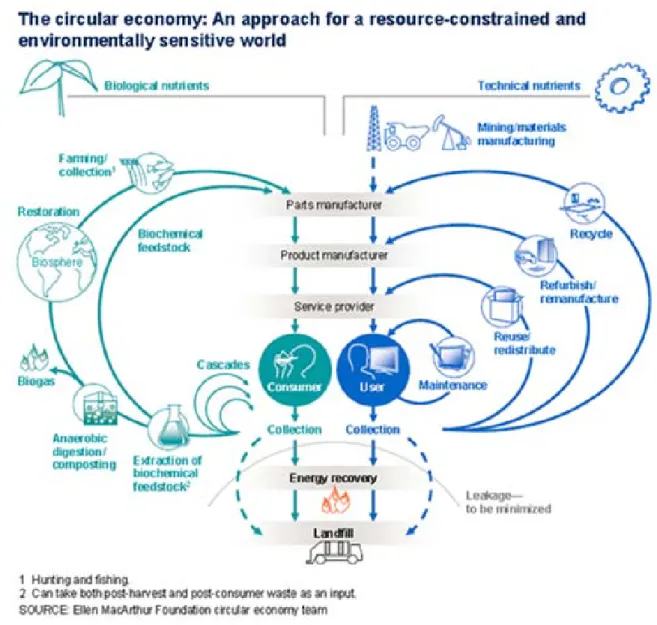
Somewhat similarly (in the sense that this approach also uses a natural analogy – here ecology – for treating industrial cycles), the Ellen MacArthur Foundation proposes the concept of “circular economy”.
The principle of circular economy (see Figure 4) is guided by the concept of Industrial Ecology (Erkman, 1997) and comprises the interaction of different agents on different systems.
Figure 4 The Circular Economy
Environmental footprint
The mitigation of environmental impacts is one of the
main aspects to be managed in the search for better sustainability practices. From the identification
of current and potential environmental damage resulting from production as well as from the
measurement of ecological footprints (harmful
effects to Nature) of products and processes, it is possible to trigger actions to reduce uncertainty and increase efficiency in the management of sustainable
production processes.
Figure 5 illustrates the various flows – direct, reverse and closed-loop that many contemporary
companies have to manage.
Figure 5 Direct, reverse flows and closed-loop supply chains. (Xavier and Corrêa, 2013, adapted from Corrêa, 2010)
The direct and reverse flows in logistics
Production systems start from obtaining raw
material to be processed. Raw materials can be
classified as natural (wood, water, minerals), compound (composites, fibers and pellets), solid metallic (ferrous and nonferrous) and solid non-metallic (ceramic, polymer and semiconductor). Natural resources can be classified as renewable and non-renewable. The concept of sustainability
depends to a great extent on prioritizing the use
of renewable resources and recycling waste, by-products, co-products and secondary materials.
Below some definitions used in this study in relation
to materials and products are presented.
• Raw materials/components: any substance
from which a product is manufactured and of
which it is necessarily a part. They normally come originally from Nature having or not gone through subsequent processing. They can be classified as
renewable and non-renewable.
• Co-products or secondary products: they
necessarily result from the production process
of the main product. Although not a part of the
the supply chain of biodiesel for instance glycerin
and pie are examples of co-products of biodiesel
that can be used as input in the chemical industry and as animal feed respectively. According to ISO 14044 2009, co-products are two or more products resulting from the same elementary process or production system.
• Byproducts: also resulting from the
production process of the main product but with
significantly lower market value. In the case of beef production from cattle, bones, horns and hooves would byproducts.
• Intermediate products: products of one
production process that are subsequently applied to (and ends up being a part of) another product of another process. The tires that will subsequently
be assembled in new cars, for instance constitute an
intermediate product of the automotive industry.
• Waste, emissions or effluents: undesirable
products from production processes that in most cases result in and require cost mitigation actions.
In specific cases these however can be avoided or
can even be turned into a source of revenue for
the production process if they can be (possibly processed and/or) sold.
• Secondary raw material: waste (solid, liquid or gaseous) material recovered through recycling.
During the production stages, reverse logistics can
be used in the process of reusing byproducts and
co-products. While in the post-consumption stages reverse logistics is used in the processing of products
and/ or its parts for potential reuse as secondary raw
materials.
The role of waste pickers in RLS
In Brazil, the work of pickers of recyclable materials has found significant support through public policies that were recently established by the government.
However, despite being a recognized profession that is fundamental to waste management in Brazil,
there are still relatively few qualified picking professionals in some specific segments of recycling.
The picking activity
The implementation of waste management
systems or more specifically recyclable materials
management programs in Brazil includes laws that favor the active participation and organization of
waste material pickers through the establishment of
associations and cooperatives.
According to a World Bank report (Hoornweg and Bhada-Tata, 2012), globally the recycling industry uses labor from more than two million pickers working informally. The (Brazilian) National Movement of Recyclable Materials (MNCR) is a social movement that independently defends the interests of pickers and focuses on enabling the control of the recycling chain by workers (see http:// www.mncr.org.br, accessed April 14, 2013) for details). The MNCR estimates that 800 thousand pickers were operating in Brazil in 2013, of which 65000 are MNCR-affiliated pickers.
In research published in 2011, IBGE (Brazilian Institute of Geography and Statistics) found that about 30% of the 5,565 Brazilian municipalities recognize the participation of waste pickers in
waste sorting through associations and cooperatives
(http://saladeimprensa.ibge.gov.br/en/noticias?v iew=noticia&id=1&busca=1&idnoticia=2260). In addition, 5% of the municipalities recognize the participation of independent pickers.
The presence of large numbers of pickers of recyclable
materials is characteristic of developing countries
but rarely observed in developed countries. Pickers however already used the reverse logistics ‘logic’
even before the term was coined, before the area
started to be more widely studied in academia and certainly before governments started to articulate their regulatory mechanisms.
Law No. 11445 of 2007 establishing the National Sanitation Policy (PNSB) is the first regulatory
instrument in Brazil to support the activities of
those pickers who work through legally constituted
associations and cooperatives.
This law amends official government bidding mechanisms favoring pickers associations and cooperatives, by waiving the need for them to take
part in the formal government bidding process
regarding recycling. In its Article 57 that law amends Law No. 8666 of 1993 which lays down the rules for
procurement and administrative contracts under
“in contracting the collection, processing and marketing of recyclable or reusable urban
solid waste in areas with selective garbage
collection system, done by associations or cooperatives formed exclusively by low
income individuals who are recognized
by the government as pickers of recyclable
materials using equipment compatible with the applicable technical, environmental and
public health standards.” (Law No. 8666 of 1993, section XXVIII, Section 24).
Importantly, both PNSB and Decree No. 5940 of 2006 (which regulates the disposal of recyclable materials by federal offices) and PNRS emphasize the management of recyclable materials by cooperatives or associations of pickers.
During the 90s and the 2000s Brazilians were proud of the fact that the country occupied the first place in the world ranking of percentage of collection and recycling of aluminum cans after consumption.
However, the finding that the leadership in recycling
cans was a result of unfavorable social factors led
to a reanalysis of the path taken. While in countries like the U.S. and Japan recycling occurs for reasons
more related to environmental awareness, cultural
aspects or more advanced and efficient recycling technology, in countries like Brazil high recycling rates in the last decade primarily reflect unfavorable social and economic condition of a significant
portion of the population.
The percentage of recycled aluminum cans in Brazil today is even more impressive, with many pickers
organized in associations and cooperatives where
they work under better conditions and therefore they are more capable of performing their tasks
according to basic good practices of industrial organization.
Nearly 97% of aluminum cans consumed in the country today is recycled, more than in countries such as Japan, Argentina, United States and European countries (see Figure 6).
Unlike developed countries, some countries in Latin
America, Asia and Africa have available low cost
manpower for the activity of picking recyclables. However, despite the activity of picking to be legally regulated in Brazil, many picking workers are still not formally recognized and don’t have the
minimum infrastructure, training and protective equipment.
The unsanitary conditions in which a large portion of these workers operate lead to the frequent
occurrence of diseases and as a consequence to
declined productivity.
According to data from the Brazilian Aluminum
Association (Abal), per capita consumption of aluminum in Brazil was 5.0 kg/inhab.year in 2007,
considering the total estimated amount for all applications, such as equipment and components,
artifacts, construction and packaging.
This figure is quite impressive, considering that the average total waste disposal per capita (aluminum and others) is approximately 380 kg/inhab.year, of which about 340 kg/inhab.year are collected, according to data from the “Overview of Solid Waste in Brazil” (ABRELPE, 2011).
Integration with producers, even indirectly, may represent significant gains for both pickers and producers alike. One example is the interaction with industries like Tetrapak (http://campaign.tetrapak. com/lifeofapackage/br/na, accessed April 10, 2013).
Picking activity in the developing world
In India, the National Environmental Policy, established in 2006 recognizes the informal sector and encourages the collection and recycling of
waste.
In China mechanisms for licensing pickers have been developed (Chaolin, 2012), but this does not appear to have been effective since as a result only 80 pickers joined the licensing in the country in the following year.
Different countries are experimenting with alternative ways of working of pickers in managing
their solid waste. The model of social organization such as the one adopted in Brazil requires the
maturation of the related regulatory mechanisms, as well as being sure about its suitability to the local
practice of recyclable materials trading.
Cooperatives of picker for solid waste recycling
Some studies have studied different aspects of the formation of cooperatives of pickers of recyclable materials (Vieitez and Dal Ri, 2000; Novaes, 2004). In this regard, Dias (2009) studies cooperative networks in the cities of São Paulo and Belo Horizonte, in Brazil. Dias’ study sought to analyze cooperatives
as a solution to social exclusion and concludes that
recycling in large scale in Brazil was only made possible as the waste collection and sorting tasks proved feasible and cost effective. The author argues that from start these were tasks performed by people
whose low labor cost compensated the cost with
needed facilities and technology investments in the rising recycling industry.
Environmental aspects of vulnerability and low qualifications of those who work in cooperatives and associations end up indirectly impacting the
cost of production in this segment. Assuming that
markets are formed from economic interest and
social relations, cooperatives acting in an integrated manner have the potential of increasing economic gains and in parallel, meeting social demands.
Pulverized sources of recyclable materials
By organizing in networks picker cooperatives
gain economies of scale and enable the access to
recyclable material in volumes and frequency that are compatible with the dynamics of the industrial
world production lines and volumes.
Generally cooperatives work with a mix of waste
materials that in certain cases is not even all
converted into secondary raw material. Part of the volume received is still sent to landfills for lack
of minimum volumes that would be of interest to
the recycling industry. It may not be economically viable for the recycling industry to provide and pay
for the transport to collect small amounts of input from a large number of cooperatives.
So agreements (in most cases, informal) were developed in which the industry actors stipulate
minimum volumes for the purchase and transport of post-consumption material.
Similarly to most companies the ones that operate in reverse chains with recycling or refurbishing
the supply of inputs (in this case, waste) has some degree of predictability for production planning
purposes.
In this aspect, the cooperatives of pickers operating in networks prove advantageous for all members
of the chain. Waste management from a massive
organization of waste pickers working in cooperative networks has the potential to foster profitable supply chains in the recycling industry.
The design of reverse logistics systems
As discussed above, reverse logistics is not restricted to issues related to environmental management nor is limited to waste management. The construction
of a reverse logistics system requires continuous
improvement and learning about different aspects related to three main aspects:
• Setting up collaborative production systems;
• Compliance of reverse channels to legal and
normative frameworks and,
• Monitoring and traceability of material
flows involved.
Reverse logistics involves a broader approach than
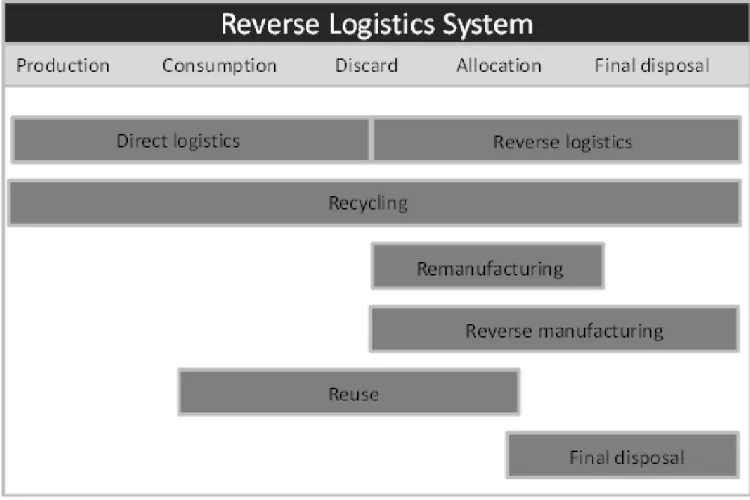
the mere activity of transportation of waste from the post-consumption stage. Similarly to direct logistics it comprises logistics operations (transport, storage) but in the “reverse” direction. Some well-known concepts apply to reverse logistics, as suggested in Figure 7.
The possibilities for the treatment and allocation of materials and post-consumption products
increasingly include actions that prioritize the reuse, recycle, refurbishment and reinsertion of materials back in supply chains. Figure 7 shows
the relationship between the allocation alternatives
and the reverse logistics system. While recycling may be present from the direct logistics activities
through to reverse logistics operations, reuse and remanufacturing occur in the post-consumption and
are more linked to the reverse logistics operations.
The reverse logistics system encompasses both
direct logistics activities such as transportation
and storage of the product after production (stage at which there may already be the need to return materials) and reverse logistics activities (starting with the use) leading to the alternatives for allocation of products after use: reuse, remanufacturing, recycling, incineration and landfill final disposal.
In the alternatives of incineration and landfill there is the extinction of the possibility of subsequent use of any physical ‘output’ although there is usually the possibility of energy recovery from incineration.
Remanufacturing is an alternative that restores the original properties of parts and products for the purpose of reinserting them into stages of
manufacturing / assembly (of remanufactured parts) or consumption (remanufactured finished products).
Recycling uses process and technological
innovations to allow the reinsertion of materials into the manufacturing stage.
Reuse does not necessarily include
commercialization; there is often a social component
in the reuse of products and materials. Reusable parts and products are reinserted into the consumption stage of the chain.
The RLS’s should be an integral part of the business
model of manufacturing and service companies that decide to design and implement them.
As in most cases companies are already operating but see themselves in need to implement their RLS
at a certain point in time, it seems plausible that
in these cases they start the RLS design process by analyzing the company’s business model and strategy, with an emphasis on logistics processes already in place.
The problem of obtaining material inputs in reverse logistics systems
Reverse logistics has specifics in relation to direct
logistics. An important one is how to obtain inputs for its processes.
In direct logistics obtaining material inputs is a
predictable process that depends only upon the amount and type of products to be processed. Material is “pulled” from suppliers based on the
process needs to meet demand.
In reverse logistics, processing is mainly “pushed” by the availability (which is much less predictable than the availability of “virgin” raw material supplied by vendors) of post-consumption and post-production recyclable products.
In other words, the uncertainty about the availability
of material inputs is greater in reverse chains, where
one cannot predict with accuracy and advance the amount of material to be received within a specified period and as required by the specific production
process.
The greater uncertainty directly impacts (by in-creasing) reverse logistics operational costs relative
to traditional logistics.
Reverse logistics systems aim to reduce the uncertainty of such availability of inputs, increase
the scale and hence reduce the production costs of reverse logistics and reverse production. Economies
of scale are achieved through industry agreements
that allow for transportation load consolidation and cooperative resource management and logistics operations.
A conceptual framework for the development of RLS
Reverse logistics systems encompass direct and
reverse logistics activities and can be understood
as a collaborative arrangement that is strongly influenced by legal and normative mechanisms
related to waste management.
Step 1. Identification of the motivation for developing RLS
The most obvious motivation of companies
for the implementation of a RLS is compliance
to legal requirements. In Brazil, these
requirements are established by the National Solid Waste Policy (PNRS). In Latin American countries in general, motivation, beyond legal compliance, may include the possibility
of generating income for individuals in
poverty. For this reason, the main regulatory
instruments of such countries contemplate
and support the pickers’ role in such systems.
In developed countries on the other hand,
economic or market aspects and/or public
environmental awareness are more often
considered as motivators (in conjunction with legal requirements). According to Cline et al. (2012) in the United States the RLS consolidation occurs primarily for economic
reasons.
The identification of the motivation for the implementation of the organization RLS will
guide the next steps.
Step 2. Preliminary market analysis
Market data collection and analysis
represent fundamental activities in business management. The same goes for the design
and implementation of RLS. After the identification and analysis of motivation (Step 1) mechanisms should be identified for data collection. Such data will generate information both about the availability (volume, quality and reliability) of
post-production and post-consumption material as
well as about the market for its reprocessing and reinsertion into the supply chain of origin
or in another chain.
Step 3. Acquisition of knowledge
This step should be about compiling information that will both allow the
characterization of the RLS and subsidize
future strategic and operational decisions.
Such information should consider:
• Specifics of environmental
regulations;
• Industry;
• Types of materials and products
involved in the process;
• Frequency, regularity and volumes
of waste generated;
• Technological options for potential minimization, recycling, reuse and recovery;
• Identification of (and mapping out)
the supply network components (carriers, producers, recyclers, among others).
Step 4. System characterization
RLS’s can be classified according to:
• Speed of the product cycle;
• Volumes generated;
• Potential for recyclability of waste;
• Degree of vertical integration versus
outsourcing activities;
• Relative location of the consumer
markets of recovered materials;
• Degree of the supply network
consolidation and economies of scale and,
• Location and relative distance of the
units involved.
The characterization of the SLR will drive
design and implementation decisions.
Step 5. Selection of the basic framework (reference model) This step comes from the need for specific answers for each analyzed issue. The basic
reference model proposed in the following sections of this article is based on the concept
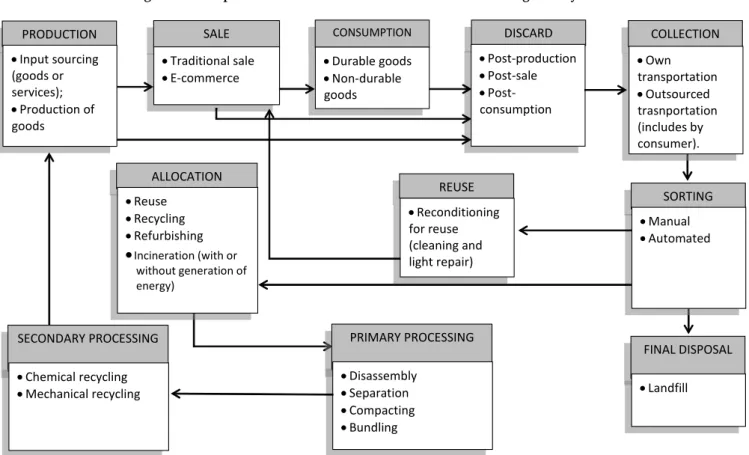
of LCA (Life Cycle Analysis, see http://acv. ibict.br accessed April 12, 2013) because from our analysis this is perhaps the most versatile and easily applicable model found in the current literature. Figure 9 shows a schematic of our proposed framework for the design and implementation of RLS.
Step 6. Implementation
Actions shall be implemented in accordance
with the criteria described by the basic selected reference model. Our research work used three successful case studies: Correios (Brazilian postal services), TGestiona and the pesticide package RLS in Brazil to analyze the key aspects for the design and management of RLS (for details see Xavier and Corrêa, 2013. For space limitations, the case studies are not presented in this article). Aspects of the implementation process of RLS are also
PRODUCTION
•Input sourcing (goods or services);
•Production of goods
COLLECTION
•Own transportation
•Outsourced trasnportation (includes by consumer). SALE
•Traditional sale
•E-commerce
DISCARD
•Post-production
•Post-sale
• Post-consumption
ALLOCATION
•Reuse
•Recycling
•Refurbishing
•Incineration (with or without generation of energy)
SORTING
•Manual
•Automated REUSE
•Reconditioning for reuse (cleaning and light repair)
CONSUMPTION
•Durable goods
•Non-durable goods
SECONDARY PROCESSING
•Chemical recycling
•Mechanical recycling
PRIMARY PROCESSING
•Disassembly
•Separation
•Compacting
•Bundling
FINAL DISPOSAL
•Landfill
Figure 9 Conceptual framework (reference model) for reverse logistics systems
Our framework consists of a generic representation of steps that are applicable to RLS development in different industries. Specifics on the type of material
processed, available resources and approaches should then be considered for the adoption of a
specific RLS design.
According to the specific supply chain being analyzed, some aspects can be adjusted or removed
from the model as needed.
It is noteworthy that, as with all logistics operations, between each step shown in Figure 8 transport,
storage and transshipment should be considered as needed.
The implementation of reverse logistics systems
According to article 21 of PNRS, reverse logistics (systems) can be implemented by three instruments: industry agreements, regulations and terms of
engagement. Below is a proposed roadmap for the
implementation of the RLS from the basic design
described above.
Product design for the environment
Waste management and RLS development should actually start in the product design stage. The
creative use of new materials, the design of the product itself and the interaction between the product and the environment and, with consumers should also be evaluated from the perspective of
sustainability.
The design of an RLS without considering this step can result in a system that is only capable of
dealing with the consequences and not the causes of problems, emphasizing correction rather than prevention.
One example comes from Coca-Cola. The company has recently developed two types of packaging for
their products.
The first was a promotional packaging in PET resin
produced in opaque gold and red colors and sold in the Christmas period.
companies – they considered the pigments as being
contaminants to conventional PET resin derived from petroleum.
The second type was the so called plantbottle, a soft drink container produced with 22.5% resin derived from sugar cane, 25% recycled PET resin with the
remainder being virgin PET resin. The longer term
goal in developing the plantbottle according to the company is to achieve oil independence in making their packaging. Unlike the Christmas bottle, plantbottles are transparent and recyclable along with conventional PET packaging (Stoklosa, 2011). While in the first case the product design negatively impacted the reverse chain in social and environmental terms, in the second the package
has a much greater potential for the achievement of
sustainability.
The same reasoning applied to product design can be applied to production process design with the goal of providing economic, environmental and
social benefits to the reverse logistics system. See McDonough and Baumgart (2002) for a reference
about designing products and processes for
sustainability.
Discard
Disposal starts from the definition of the product “end of life”. End of life here does not necessarily
mean the extinction of all product functionalities.
A product may still be functional but it may be
considered obsolete for not having the same performance as a new product, for example.
For the prediction of life span and disposal volumes it is important to understand the product
consumption patterns. More predictability will allow
the management of post-consumption products and materials to be more in line with the requirements
of reverse logistics in terms of capacity, location of units, process planning and as a result, efficiency. Identifying consumption patterns for instance allows the identification of types of products and materials consumed in a particular region or country. This in turn allows better decisions in terms of the location of collection and recycling units that will meet the RLS needs.
The life span of a product is defined by estimating their ability to maintain functionality over time.
This is related to the behavior of the material during use and varies with the composition of the product, where, how and under what conditions it is being used and a range of other variables related to a greater or lesser extent to the degradation of its components.
Moreover, a product may still exhibit its functionalities and yet be discarded to be replaced by another for reasons of fashion or technical
obsolescence.
The disposal phase of post-consumption products
and materials is today one of the main challenges of reverse logistics systems. It is at this stage that the process presents most difficulties in specific
industries such as pharmaceutical, electronics and
lamp bulb where consumers tend to keep post-consumption materials or improperly dispose them,
impairing the subsequent steps of collection and allocation.
Collection
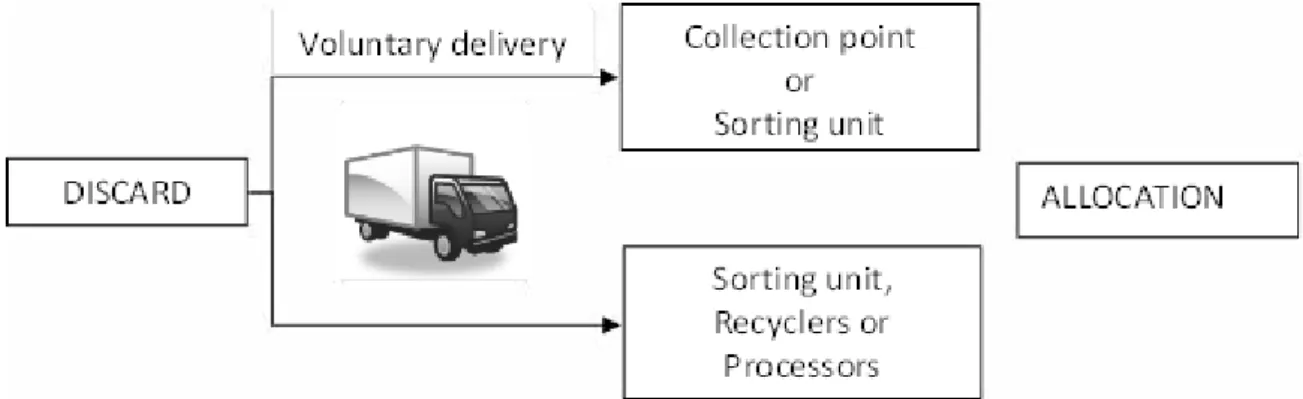
Collection can be performed by using own transport modes (under the responsibility of sorting units, recyclers or manufacturers) or third parties (including the delivery of the product by the consumer to delivery points), as shown in Figure 10.
Delivery can also be done by the consumer directly to recycling companies or producers (processors),
but these categories represent an exception and higher cost as compared to other alternatives.
While direct logistics distribution flows from one or a few companies to many consumers (1 to n) in reverse logistics exactly the opposite (n to 1) occurs: many consumers must return their products to one or a few companies – for this reason, the unit cost of returning post-consumption items is relatively high. Collection systems also vary according to specific aspects such as distance, type of material to be transported and type of processing required. Some ways to define collection systems are:
• By type of material: practiced in segments such as the recycling of PET and aluminum. Such type allows the extraction of value from consolidation of large volumes of the same material;
• By product brand: practiced by some
companies that choose to protect the brand and/ or data. Although more expensive, this category of collection provides greater security for
manufacturers that choose to protect their brands.
Generally, it is used with products having high value density or relevant information to be protected;
• By consortium of companies: different
companies in the same segment, through
associations, cooperatives, NGOs jointly realize
the collection of post-consumption products and
materials. This method applies to the packaging of pesticides and lubricating oil for instance;
• Simple type: it consists in collecting various types of materials or products simultaneously followed by sorting. Material may be received or
collected in pre-established sites. It is the most
common form among picker cooperatives of recyclable materials that, in turn, are suppliers of recyclers;
• Second party: performed by recyclers and producers using their own fleet of vehicles. They
collect post-consumption materials or products
from sorting cooperatives’ or associations’ recycling
units.
Sorting
It involves assessment of products in terms of
functionality and classification into allocation alternatives such as “reconditioning/reuse”, “recycling” and “remanufacturing”. Products with features that are missing or faulty are evaluated for
possible replacement of parts or components and
sent for potential remanufacturing or repair. Fully
functional products that do not require repair are
only checked, cleaned, cosmetically touched, re-packaged and routed back for sale.
Maintenance or Repair
Technical maintenance or repair in order to restore
product features. Often the commercialization of
products after repair is done in partnership with the producers of the original product, including
product warranty.
Primary Processing
It basically consists in the steps of disassembly,
sorting, compaction and bundling of material. This step aims at adding value to materials and parts for
forwarding to the recycling steps.
Secondary Processing
It involves chemical (for recovering raw materials) or mechanical (fractioning, grinding or reduction of parts or materials for use as input material) recycling processes. In Brazil, this step cannot be performed by associations and cooperatives of pickers since they
do not have the environmental permit for treatment
of waste, effluents and emissions possibly resulting
from this process.
Reinsertion in the supply chain
Reinsertion can occur in the original supply chain as input material (such as aluminum cans, which can be indefinitely made into other aluminum cans) or other supply chains (such as the insertion of used conventional plastic bottles into the textile products supply chain). The amount of residues disposed in landfills should be as small as possible since it is the only portion that is not amenable to reuse and only results in mitigation costs to the system and damage
to the environment.
Monitoring and tracking
Shamsuzzoha and Helo (2011) define monitoring
as the collection and management of real-time information on the processing and distribution of
a particular product and tracking as collecting and retaining information about the history of the life cycle of processed and distributed product, as well
as of its components.
Monitoring in reverse logistics can mean managing
the movement of collection vehicles in real time in
in turn, is not intended to monitor movement in
real time, but to retrospectively retrieve data about
routes followed and responsibilities in cases of failure in the transportation process e.g. due to theft or accident.
In reverse logistics systems monitoring is important as it allows follow up of cargo collection and payment
of post-consumption products and materials.
Unlike direct logistics, reverse logistics has no strict requirements as to delivery times. Rather, they have
requirements as to collection volumes.
Because of shipping and processing costs recyclers
are more concerned with receiving minimum
volumes than setting deadlines. On the other hand,
the originators of post-consumption products
and materials seek to reduce their costs through the elimination of costly storage i.e. intermediate storage points to which material is sent frequently
and in smaller volumes.
Monitoring tends to be more relevant for products
in the food and pharmaceuticals industries. These
are required by law to comply with standards in relation to the risk of contamination. Monitoring is also important to materials with high value density.
At each step of the process the product, its origin and
destination in the value chain must be identified. It is a fundamental activity in the management of global supply chains with products distributed in several countries. The identification of the composition
of raw materials in products has become a usual
requirement in international negotiations, especially
in the food sector.
Tracking enables the assignment of responsibility along the supply chain, increasing thereby the reliability of the whole process.
Final remarks
This work does not intend to be definitive or
generalizable to one hundred percent of the
situations. However, it tries to make a contribution
to the evolution of this promising, exciting and
relatively new knowledge area: reverse logistics systems in Brazil.
Through literature review, review of related
Brazilian legislation, analyses of 3 of the few Brazilian (relatively) mature cases and a number of international cases, we organized the key
concepts involved and went ahead to propose a
simple yet robust and practical framework that
can be an interesting starting point for students and professionals interested in the design and
implementation of reverse logistics systems that
are consistent with applicable law so that the
resulting RLS can contribute to increase the levels of sustainability of supply chains in Brazil.
In order to achieve a stage of full development,
reverse logistics systems in Brazil as a knowledge field still has a long way to go. It is still in its infancy if compared to the more mature older sister – direct logistics. Our contribution aims to accelerate this evolution process so that the benefits of attaining
the stage of full development can be achieved more
quickly. For more details on the concepts and the
model presented here please see Xavier and Corrêa
(2013).
REFERENCES
ABAL (2008). Relatório de Sustentabilidade da Indústria do Alumínio – 2007. 3ª edition. São Paulo. Available in: http://www.abal.org.br/ servicos/biblioteca/rel_sustentabilidade_0607. asp. Acessed September 14, 2012. (in Portuguese).
ABRALATAS (2011). Indices da reciclagem da lata de alumínio para bebidas 1991-2011. Available: http://www.abralatas.org.br/common/ html/grafico5.html. Acessed September 14, 2012. (in Portuguese).
ABRELPE (2011). Panorama de Resíduos Sólidos no Brasil. Available: http://www.abrelpe.org.
br/Panorama/panorama2011.pdf. Accessed
September 14, 2012. (in Portuguese).
BOWMAN, R. J. (1995) Green logistics. Distribution, Vol 94, no 6.
CASTELLS, M. (1999) A sociedade em rede. São Paulo: Paz e Terra. (in Portuguese).
CHAOLIN, D., (2012) Want China Times.
Available: http://www.wantchinatimes.com/
news-subclass-cnt.aspx?id=20121006000006&c id=1103. Accessed December 15, 2012.