Marco O. O. Pellegrini1,2,3, Robert B. Faden3
1 Universidade de São Paulo, Departamento de Botânica, Rua do Matão 277, CEP 05508-900, São Paulo, SP, Brazil 2 Jardim Botânico do Rio de Janeiro, Rua Pacheco Leão 915, CEP 22460-030, Rio de Janeiro, RJ, Brazil 3 Smithsonian Institution, NMNH, Department of Botany, MRC 166, P.O. Box 37012, Washington D.C. 20013-7012, USA
Corresponding author:Marco O. O. Pellegrini ([email protected])
Academic editor:Peter Boyce | Received 30 April 2017 | Accepted 6 July 2017 | Published 13 July 2017
Citation: Pellegrini MOO, Faden RB (2017) Recircumscription and taxonomic revision of Siderasis, with comments on the systematics of subtribe Dichorisandrinae (Commelinaceae). PhytoKeys 83: 1–41. https://doi.org/10.3897/ phytokeys.83.13490
Abstract
A new circumscription and a total of six microendemic species, four of them new to science, are herein presented for Siderasis, based on field and herbaria studies, and cultivated material. We provide an identi-fication key to the species and a distribution map, description, comments, conservation assessment, and illustration for each species. Also, we present an emended key to the genera of subtribe Dichorisandrinae, and comments on the morphology and systematics of the subtribe.
Keywords
Atlantic Forest, Brazil, Commelinales, Neotropical flora, spiderwort, Tradescantieae
Introduction
Siderasis Raf.is currently applied to a small genus of neotropical Commelinaceae, com-prising only two microendemic species, restricted to the Atlantic Forest of Southeastern Brazil (Pellegrini 2017).Itwas originally described by Rafinesque (1836), together with several other small genera, in order to better organize the many species misplaced in
Commelina L. and Tradescantia L. Rafinesque (1836) mentioned a possible affinity be-tween Siderasis, Callisia Loefl. and Etheosanthes Raf. (= Belosynapsis Hassk.), and consid-ered Siderasis not at all similar to Tradescantia; but gave no explanation for any of these statements. He also considered T. fuscata Lodd. a synonym of his newly described S. acaulis Raf., which was characterized by its rusty hirsute indumentum covering the en-tire plant, short stems, flowers emerging from the roots, petals basally connate, dimor-phic stamens varying from four to six, and gynoecium 2–3-locular [sic]. After Rafin-esque’s publication, Siderasis was completely overlooked by all Commelinaceae special-ists for the next 120 years (Moore 1956). In the meantime, Hasskarl (1869) described the new genus Pyrrheima Hassk. following his discussions with Schlechtendal during the Botany Meeting in Amsterdam in April of 1865. Hasskarl and Schlechtendal be-lieved that Pyrrheima diverged greatly from Tradescantia and Tinantia Scheidw. due to its non-tubular perianth, six equal and fertile stamens, and lunate anther sacs, and thus merited distinct generic status. Clarke (1881), in his monograph for Commelinaceae, accepted Pyrrheima, including only P. loddigesii Hassk., and reducing P. minus Hassk. to a variety of it. Brückner (1930), noticing that P. loddigesii was an unnecessary replace-ment name for T. fuscata, made the new combination P. fuscata (Lodd.) G.Brückn., but was unsure if Siderasis and Pyrrheima were indeed congeneric. This was later confirmed by Moore (1956), when he merged the two by transferring P. fuscata to Siderasis.
After further period of neglect, the genus was placed in subtribe Dichorisandrinae (Faden and Hunt 1991), along with its sister-genus Dichorisandra J.C.Mikan, Cochli-ostema Lem., Geogenanthus Ule, and Plowmanianthus Faden & C.R.Hardy (Faden and Hunt 1991; Hardy 2001; Evans et al. 2003; Hardy and Faden 2004). However, reso-lution of the relationships within the group remains elusive. While it appears certain that Siderasis is proximally related to Dichorisandra, the subtribe as a whole has been recovered as paraphyletic in most molecular and morphological phylogenies to date. Two separate clades are recovered with one containing Dichorisandra and Siderasis (i.e. subtribe Dichorisandrinae s.s), while the remaining three genera (Geogenanthus and
Cochliostema+Plowmanianthus) are recovered as one of the early-diverging clades in tribe Tradescantieae (Hardy 2001; Evans et al. 2003; Wade et al. 2006; Zuiderveen et al. 2011; Hertweck and Pires 2014; Pellegrini 2017; Pellegrini et al., in prep.). Sid-erasis has hitherto been characterized by the rusty to bright red hirsute indumentum covering the entire plant (except the petals and androecium), its ebracteolate cincinni, filaments three to four times longer than the anthers, anthers with rimose dehiscence (Hardy and Faden 2004), and exarillate seeds (Faden 1998).
Methods
The description of the species, phenology and illustrations were based on herbaria (A, ALCB, B, BHCB, BHZB, BM, BOTU, BRIT, C, CAL, CEPEC, CESJ, CGE, CNMT, CVRD, ESA, F, FCAB, FLOR, FURB, G, GUA, HAMAB, HAS, HB, HBR, HRB, HRCB, HSTM, HUEFS, HUFSJ, HURB, IAC, ICN, INPA, K, L, MBM, MBML, MG, MO, MY, NY, P, PMSP, PORT, R, RB, RFA, RFFP, SP, SPF, U, UEC, UPCB, US, and WAG; herbaria acronyms according to Thiers, continuously updated), spirit, fresh, and cultivated material. Specimens of Siderasis albofasciata M.Pell., S. almeidae
M.Pell. & Faden sp. nov., and S. fuscata were kept in cultivation at the greenhouse of the Jardim Botânico do Rio de Janeiro, in order to observe, photograph, and analyze fresh flowers, fruits, and seeds as well as other phenological data. Fresh specimens, field notes, photographs, and specimens for cultivation were gathered during several field trips across the Brazilian Atlantic Forest, from the states of Sergipe to Rio Grande do Sul, between 2008–2016. Field data and description of S. medusoides M.Pell. & Faden sp. nov., and S. zorzanellii M.Pell. & Faden sp. nov. were complemented with notes, photographs and spirit samples kindly provided by the collectors. Fertile specimens were deposited in RB, and whenever possible duplicates were sent to US. Indumentum and shape terminology follows Radford et al. (1974); the inflorescence and general morphology terminology follows Weberling (1965, 1989) and Panigo et al. (2011); the fruit terminology follows Spjut (1994); and the seed terminology follows Faden (1991). The conservation assessments followed the recommendations of "IUCN Red List Categories and Criteria, Version 3.1" (IUCN 2001). GeoCAT (Bachman et al. 2011) was used for calculating the Extent of Occurrence (EOO) and the Area of Oc-currence (AOO). The distribution of the species is based on herbaria materials, field data, and literature. The classification of vegetation patterns follows IBGE (2012).
Results
morphology of the newly described species, especially the two climbing species, Sid-erasis is recircumscribed below. The genus can be distinguished from the remaining Dichorisandrinae s.l. based on floral morphology, especially androecium and micro-stigmatic morphology. An updated identification key for the genera of Dichorisandri-nae s.l. is presented, along with comments on the morphology of Siderasis compared to the remaining genera of the subtribe.
Emended key to the genera of Dichorisandrinae s.l. (modified from Hardy and
Faden 2004)
1. Petals with glabrous margins, rarely ciliate with non-moniliform hairs; fila-ments glabrous, anther sacs not appressed to each other (if appressed, anther sacs not semicircular); capsules thick-walled; seeds arillate ...2
– Petals with margins fringed with moniliform hairs; filaments bearded with moniliform hairs, rarely glabrous, anther sacs appressed to each other; cap-sules thin-walled; seeds exarillate ...3
2. Stamens 5–6, staminodes sometimes present; anthers basifixed, anthers sacs parallel, elongate, 3 to 4 times longer than the filaments, connectives in-conspicuous, dehiscence poricidal or introrsely rimose, but functionally pori-cidal; stigmatic papillae multicellular, completely concealing the stylar canal ... Dichorisandra J.C.Mikan (Fig. 1D–L)
– Stamens 6, staminodes absent; anthers dorsifixed, anther sacs divergent, semi-circular, 3 to 4 times shorter than the filaments, connectives expanded, dehis-cence extrorsely rimose; stigmatic papillae unicellular, restricted to margins of the stigma and leaving the stylar canal evident ... ...Siderasis Raf. emend. M.Pell. & Faden (Fig. 1A–C)
3. Dracaenoid herbs; roots with terminal tubers; shoots determinate; inflores-cences borne at the lower nodes below the leaves; pedicel with glandular hairs, stamens 5–6, all fertile, stigmas never fringed with moniliform hairs ... ...Geogenanthus Ule (Fig. 1N)
– Rosette herbs; roots without terminal tubers; shoots indeterminate; inflores-cences borne among the leaves; pedicels with eglandular hairs, fertile stamens 3, on the upper half of the flower, staminodes 3 (sometimes microscopic), on the lower half of the flower, stigmas commonly marginally fringed with moniliform hairs ...4
4. Tank-forming or creeping rosettes, epiphytes, rarely terrestrial; inflorescence a many-branched thyrse, with alternate or verticillate cincinni, cincinni bracts showy; fertile anthers spirally-coiled, hidden within a hood-like structure; testa smooth, sticky when hydrated ...Cochliostema Lem. (Fig. 1M)
Figure 1. Floral morphology of subtribe Dichorisandrinae s.l.A–CSiderasis Raf. emend M.Pell. & Faden:
AS. fuscata (Lodd.) H.E.Moore BS. albofasciata M.Pell. CS. zorzanellii M.Pell. & Faden. D–L Dichorisan-dra J.C.Mikan: DD. acaulis Cogn. E D. hexandra (Aubl.) C.B.Clarke F D. thyrsiflora J.C.Mikan G D. paranaënsis D.Maia et al. H D. nana Aona & M.C.E.Amaral I D. incurva Mart. J D. penduliflora Kunth
K D. sagittata Aona & M.C.E.Amaral L D. radicalis Nees & Mart. MCochliostema odoratissimum Lem.
N Geogenanthus rhizanthus (Ule) G.Brückn. OPlowmanianthus panamensis Faden & C.R.Hardy. Photo-graphs A–B, D–G, J by M.O.O. Pellegrini, C by J.P.F. Zorzanelli, H by V. Bittrich, I by G.H. Shimizu, K
Siderasis Raf., Fl. Tellur. 3: 67. 1837, emend. M.Pell. & Faden
Pyrrheima Hassk., Flora 52: 366. 1869, nom. illeg.Type species (designated here). P. loddigesii Hassk., nom. illeg. [≡S. fuscata (Lodd.) H.E.Moore].
Type species.Siderasis acaulis Raf. [≡S. fuscata (Lodd.) H.E.Moore].
that cover almost the entire plant, but especially the leaves. However, only S. fuscata
possesses the aforementioned hairs, and all of the remaining species possess leaf blades covered by hyaline to light brown, rarely rusty hairs.
Habitat, distribution and ecology. Siderasis is endemic to the Atlantic Forest domain in coastal Brazil, occurring in the states of Bahia, Espírito Santo, and Rio de Janeiro (Fig. 2). More specifically, Siderasis is restricted to the Central Corridor of the Atlantic Forest, growing in remnants of semideciduous forests associated with inselbergs, between 90–1350 m above sea level. The genus is composed exclusively by microendemic species distributed in very small and fragmented subpopulations, sus-ceptible to deforestation and illegal collection of specimens for ornamental purposes.
Biogeography. Since most phylogenies for Commelinaceae corroborate the para-phyly of Dichorisandrinae (Evans et al. 2000, 2003; Hardy 2001; Wade et al. 2006; Zuiderveen et al. 2011; Hertweck and Pires 2014; Pellegrini et al., in prep.), we can hypothesize on the independent diversification of these lineages from a biogeographical point of view. The clade composed by Cochliostema, Geogenanthus, and Plowmanianthus
is consistently recovered as the second lineage to diverge in tribe Tradescantieae, fol-lowing the diversion of subtribe Streptoliriinae (Evans et al. 2003; Wade et al. 2006; Zuiderveen et al. 2011; Hertweck and Pires 2014; Pellegrini et al., in prep.). The ances-tor of this lineage probably originated in the Amazon Basin, and posteriorly diversi-fied in the Guyana Shield, northern Andes, and Central America reaching Costa Rica (Hardy 2001; Hardy and Faden 2004). On the other hand, the clade composed by
Dichorisandra and Siderasis is recovered as the third lineage to diverge in Tradescantieae (Evans et al. 2003; Wade et al. 2006; Zuiderveen et al. 2011; Hertweck and Pires 2014; Pellegrini et al., in prep.). The ancestor of this clade probably originated and diversified in the Atlantic Forest domain, since it is the center of diversity of both genera. Subse-quently, the ancestors of various Dichorisandra lineages might have dispersed, more than once, diversifying in the Amazon Basin through gallery forests in the Cerrado domain.
Figure 2. Distribution map of Siderasis Raf. emend. M.Pell. & Faden. Blue circles–S. albofasciata; Blue triangles–S. almeidae; Red circles–S. fuscata; Red triangles–S. medusoides; Blue square–S. spectabilis;
Red Square–S. zorzanellii; BA– state of Bahia; ES– estate of Espírito Santo; RJ– estate of Rio de Janeiro.
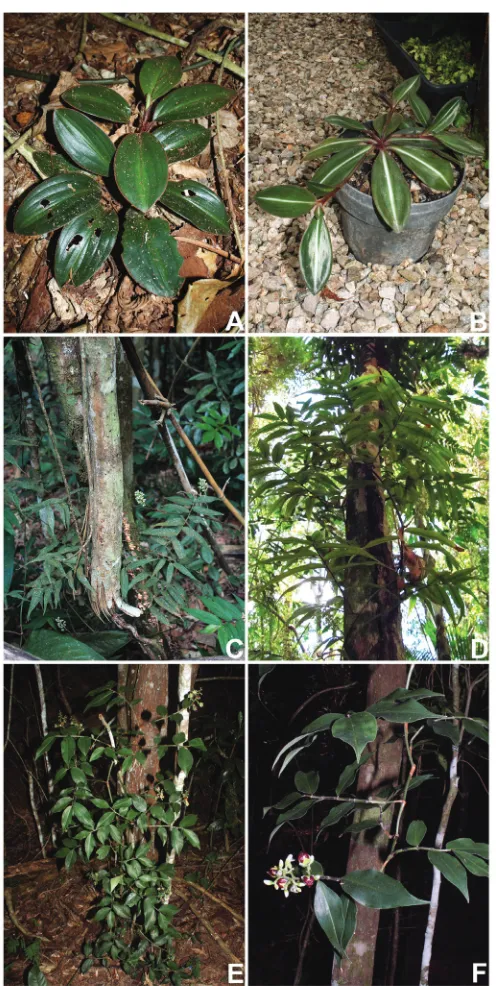
Figure 3. Growth forms in Dichorisandrinae s.s. A–DSiderasis Raf. emend. M.Pell. & Faden: A rosette habit of S. fuscata (Lodd.) H.E.Moore B rosette habit with flagelliform-shoots of S. albofasciata M.Pell.
C habit of an immature, still prostrate, individual of S. zorzanellii M.Pell. & Faden. D habit of a mature individual of S. zorzanellii spirally ascending a tree. E–FDichorisandrahexandra (Aubl.) C.B.Clarke: E
velutinum Read (Hardy 2001). In Geogenanthus, the plants always possess a dracaenoid habit, with leaves congested at the apex (Hardy 2001). In Plowmanianthus, the plants are always rosette herbs with very short stems (Hardy and Faden 2004).
Considerable variation in leaf morphology occurs in Siderasis, with leaves ranging from: (1) sessile to subpetiolate (Fig. 3B–D); (2) truly petiolate, as in S. fuscata (Fig. 3A, 8C). Truly petiolate leaves are extremely rare in Commelinaceae, being recorded only in a handful of species restricted to the peculiar-looking subtribe Streptoliriinae, mostly comprised of vining plants (Pellegrini and Faden, pers. observ.). Phyllotaxy in
Siderasis can range from distichous to spirally-alternate, the arrangement being cor-related to symmetry of the leaf blades.
Inflorescence morphology. In all Dichorisandra and two species of Siderasis (i.e.
S. spectabilis and S. zorzanellii), the main florescence is a many-branched, peduncu-late, terminal or axillary thyrse with alternate cincinni, each cincinnus being multi-flowered. In the remaining species of Siderasis (i.e. S. albofasciata, S. almeidae, S. fuscata
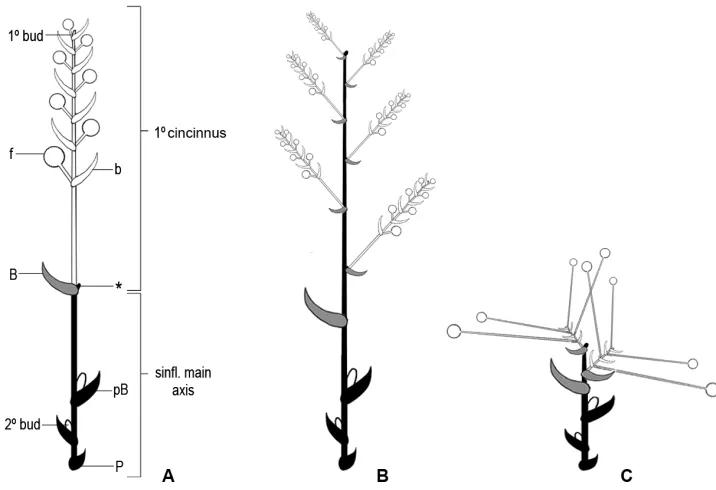
and S. medusoides), the main florescence is composed of a thyrse reduced to a solitary cincinnus, as described in Pellegrini (2017; Fig. 4A). These reduced thyrsi are arranged into a synflorescence that may contain up to seven coflorescences. The center of the mature Siderasis rosette may contain several terminal or apparently terminal synflo-rescences. In Dichorisandra and the two climbing species of Siderasis, the main axis of the inflorescence is usually well developed, thus producing a typical looking thyrse (Fig. 4B). Nevertheless, the inflorescences may also be extremely reduced in some spe-cies (i.e. D. acaulis group), due to the shortening of the inflorescence’s internodes (Pellegrini and Almeida 2016). The cincinni are also very short (i.e. sessile to subses-sile), being enclosed by the leaf sheaths and not obvious at first glance (Pellegrini and Almeida 2016). The flowers are peculiarly long-pedicellate, giving the impression that all flowers emerge directly from the apex of the stems (Pellegrini and Almeida 2016; Fig. 4C). Despite the extreme reduction and superficial similarity, this inflorescence pattern differs from the one found in the rosette species of Siderasis, since it still is a many-branched thyrse. In Plowmanianthus the main florescence is also reduced to a solitary cincinnus. Nonetheless, coflorescences only develop after the main florescence has failed to develop or set fruit, and the cincinni from the primary and secondary thyrsi are morphologically distinct (Hardy and Faden 2004). In Geogenanthus the in-florescences are always born at the base of the plant, near the ground. Aside from that, the main florescence is a pedunculate, fascicle-like thyrse, with (1–)2–4–several alternate cincinni (Hardy 2001). Finally, in Cochliostema the main florescence is a many-branched, pedunculate, axillary thyrse, with alternate to verticillate cincinni, each cincinnus being multi-flowered and subtended by showy and cucullate spatha-ceous bracts (Hardy and Stevenson 2000; Hardy 2001).
Figure 4. Inflorescence architecture in Dichorisandrinae s.s. A diagram of the basic Siderasis Raf. emend M.Pell. & Faden inflorescence type, consisting of a thyrse reduced to a solitary cincinnus B diagram of the basic Dichorisandra inflorescence type (also characteristic of S. spectabilis and S. zorzanellii), consisting of a many-branched thyrse with alternate, many-flowered cincinni C diagram of the basic D. acaulis spe-cies group inflorescence type, where the main florescence axis and cincinni axis are greatly reduced, and the pedicels are peculiarly elongated. P = prophyll; pB = peduncle bract on main synflorescence axis; * = aborted or dormant apex of main inflorescence axis (usually not observed); B = cincinnus bract; b = brac-teole; f = flower; 1°bud = bud terminating cincinnus; 2°bud = bud in axil of peduncle bract with potential to develop into a secondary thyrse (coflorescence); Modified from Pellegrini (2017).
upwards, and possess poricidal anthers. In the D. incurva (Fig. 1I), D. penduliflora (Fig. 1J), D. leucophthalmos (Fig. 1K),and D. radicalis groups (Fig. 1L), the androecium is composed of five stamens (generally with an upper staminode; notice the filiform staminode in Fig. 1L), rarely six fertile stamens, curved upwards, and with introrsely rimose anthers. In the D. incurva and D. leucophthalmos groups, the anthers are always yellow (Figs. 1I, K), while in the D. penduliflora and D. radicalis groups, the anthers are white, generally with the anther sacs partially to totally colored in blue, pink or purple (Figs. 1J, L). The remaining genera of Dichorisandrinae possess strongly zygomorphic flowers, especially due to the position and/or number of stamens: (1) 5–6 dimorphic, free and fertile stamens in Geogenanthus (Hardy 2001; Fig. 1N); (2) 3 stamens in the upper side of the flower, fused in a hood-like structure, and 3 lower staminodes (the middle one microscopic) in Cochliostema (Hardy 2001; Fig. 1M); (3) and 3 free to par-tially fused stamens in the upper side of the flower, and 3 lower staminodes (generally all of them microscopic) in Plowmanianthus (Hardy and Faden 2004; Fig. 1O).
Androecium and gynoecium morphology. The anthers in Siderasis are dorsi-fixed, with extrorsely rimose dehiscence, two times wider than long, three to four times shorter than the filaments, with semicircular, divergent anthers sacs, and expanded connectives (Fig. 1A–C). In Dichorisandra the anthers are basifixed, with poricidal or introrsely rimose (but functionally poricidal) dehiscence, three to four times longer than wide, and three to four times longer than the filaments, rarely equal to the fila-ments, with elongate, parallel anther sacs, and inconspicuous connectives (Aona 2008; Figs. 1D–L). In Cochliostema, Geogenanthus and Plowmanianthus the anthers vary from dorsifixed to basifixed, with extrorsely rimose dehiscence, as wide as long to two times shorter than the filaments, with semicircular to spirally-coiled, appressed anther sacs, and inconspicuous connectives (Hardy and Stevenson 2000; Hardy 2001; Hardy and Faden 2004; Figs. 1M–O).
The gynoecium is fairly homogeneous in Dichorisandrinae s.l., with all genera hav-ing sessile, 3-locular ovaries, with all locules fertile, ovules hemianatropous, biseriate to partially uniseriate, style terminal, straight or bent at the apex, stigma annular-truncate to annular-capitate, peripherally ciliate with moniliform hairs (i.e. Cochliostema and
Plowmanianthus) or not (i.e. Dichorisandra, Geogenanthus and Siderasis). In Sidera-sis, the stigmatic papillae are unicellular, and restricted to the margins of the stigma, leaving the stylar canal evident (Owens and Kimmins 1981). On the other hand, in
Dichorisandra, the stigmatic papillae are multicellular, and evenly distributed on the stigma, completely concealing the stylar canal (Owens and Kimmins 1981).
The seeds in both genera are very similar in gross morphology, varying in shape from obconic to ellipsoid to quadrangular; in ornamentation from foveolate to scrobicu-late to rugose, with a semiscrobicu-lateral to semidorsal embryotega, and with a C-shaped hilum. In Cochliostema, Geogenanthus and Plowmanianthus the capsules are thin-walled, 3-locular, 3-valvar, and with exarillate seeds. In Cochliostema the capsules are narrowly cylindrical, and the seeds vary from subcylindrical to narrowly oblongoid, with a smooth testa that becomes sticky when hydrated, semidorsal embryotega, and a linear hilum with curved edges. In Geogenanthus and Plowmanianthus the capsules are fusiform to ellipsoid, the seeds range from reniform to ellipsoid, with rugose to foveolate, farinose testa, lateral embryotega, and a C-shaped hilum (Hardy 2001; Hardy and Faden 2004).
In Dichorisandra and Siderasis capsule and seed morphology differences may have great taxonomic potential. In Dichorisandra, many of the aforementioned species groups display characteristic capsule and seed morphology, as exemplified in the D. acaulis group by Pellegrini and Almeida (2016). In the D. thyrsiflora group, capsule morphology can easily differentiate most known species, based on shape, coloration, texture and pubescence (Pellegrini, pers. observ.). In Siderasis, capsule morphology shows a similar potential, with the fruits of S. zorzanellii being completely deviant in shape, texture and pubescence from the remaining species. Unfortunately, since the fruits of S. spectabilis are still unknown, it is impossible to know if this change in capsule morphology is correlated to the change in habit from rosette to vining herbs.
Siderasis fuscata possesses unique seed morphology, being the only known species with an inconspicuous and hyaline aril, testa light gray to gray, and foveolate. Field expedi-tions focused on collecting fruit and seed samples of all species of Siderasis could be of great taxonomic value. It is possible that most, if not all, presently accepted species could be differentiated based exclusively on fruit and seed morphology.
Reproductive biology. Little is known regarding the floral biology of subtribe Dichorisandrinae, although this subtribe possesses the greatest range in inflorescence architecture and floral patterns in the family. In Siderasis the anthers are always ex-trorsely rimose, but apart from the floral specialization (i.e. zygomorphic, bisexual
Figure 5. Aril morphology in Dichorisandrinae s.s. A–B Dichorisandra J.C.Mikan: A D. thyrsiflora
J.C.Mikan B D. hexandra (Aubl.) C.B.Clarke. C–DSiderasis Raf. emend. M.Pell. & Faden: CS. fuscata
or staminate flowers, and unequal and sigmoid stamens) in the two climbing species and the petals with margins ciliated with non-moniliform hairs, a character unique in the family, in S. spectabilis, the flowers are relatively unspecialized. Dichorisandra
possesses a wide variation in flower morphology and androecium arrangement. Its flowers can range from actinomorphic to zygomorphic, the stamens can vary from (5–)6, sometimes with the upper stamen reduced to a staminode in some species. The filaments can be either straight, slightly sigmoid or slightly twisted depending on their position in the flower, while the anthers can be introrsely rimose and func-tionally poricidal or truly poricidal (Aona 2008; Fig. 1D–L). On the other hand, in
Cochliostema, Geogenanthus and Plowmanianthus, the flowers are highly specialized, being zygomorphic (in all genera), scented (in Cochliostema), with a high frequency of cleistogamous flowers (in Plowmanianthus), petals and stigma fringed with monili-form hairs (fringed petals in all genera, stigma fringed exclusively in Cochliostema and
Plowmanianthus), filaments bearded with moniliform hairs (in all genera), function-ally poricidal androecium (in Cochliostema, due to the hood-like structure enclosing the anthers), and curved to spirally-coiled anthers (in all genera) (Hardy and Ste-venson 2000; Hardy 2001; Hardy and Faden 2004; Fig. 1M–O). Only three species of Dichorisandra have had their reproductive biology investigated, presenting typical buzz-pollination, performed by bumblebees (Apidae) and/or sweatbees (Halictidae) (D. thyrsiflora, Boaventura and Matthes 1987; D. hexandra and D. incurva, Sigrist and Sazima 2015). Information regarding flower visitation in Cochliostema, Geogenanthus, and Plowmanianthus is completely lacking from the available literature. During our field studies and while observing the Siderasis specimens grown at the greenhouse of Jardim Botânico do Rio de Janeiro, the first author has observed flowers of S. albofas-ciata, S. almeidae, and S. fuscata being visited by stingless honey bees (Apidae, tribe Meliponini). Siderasis medusoides was not seen in the field, but high-resolution pho-tographs sent by one of the collectors clearly show several small ants walking around the flowers and cincinni (Fig. 9C). The bees might either represent pollen robbers or potential pollinators, but the presence of the ants is hard to explain, since nectaries are unknown for Commelinaceae (Faden 1992, 1998). Further studies on the reproduc-tive biology of Siderasis are clearly needed.
translucent, thick arils (Fig. 5C–D), being most probably dispersed by animals similar to the ones dispersing the seeds of the species in the D. acaulis group.
From a phylogenetic point of view, it seems that vector-mediated seed dispersal has evolved several times in the family: (1) arillate seeds are recorded for Dichorisandra and
Siderasis in Dichorisandrinae, Amischotolype Hassk., Coleotrype C.B.Clarke and Poran-dra Hong in Coleotrypinae (Pellegrini 2017), and Spatholirion Ridl. in Streptoliriinae (Thitimetharoch 2004); (2) appendaged seeds are recorded for at least two separate lineages in tribe Commelineae (i.e. some species of Commelina L. and Murdannia
Royle; Pellegrini et al. 2016); (3) truly fleshy fruits are known only from Palisota Rchb.
ex Endl. (Faden 1998); (4) in Tradescantia zanonia (L.) Sw. the fleshy sepals cover the indehiscent fruit at post-anthesis, producing a sweet and atro-vinaceous berry-like fruit, dispersed by birds (Pellegrini, obs. pers.); (5) in Pollia Thunb. the fruits are dry, crustaceous and indehiscent, and due to their vibrant colors (metallic blue to shiny black) mimic real berries (Faden 1978); (6) in some Commelina (i.e. the species origi-nally placed under Phaeosphaerion Hassk. and Commelinopsis Pichon) the fruits are morphologically similar to those of Pollia, being also crustaceous, but either dehiscent or indehiscent (Faden and Hunt 1987); (7) and sticky capsules covered by a mixture of hook and minute glandular hairs, in Rhopalephora Hassk. (Pellegrini et al., in prep.). Nonetheless, further investigations are needed to better understand the ecology and evolution of vector-mediated seed dispersal in Commelinaceae.
Key to the species of Siderasis
1. Vining herbs; aerial stems spirally-twining, densely branched; leaves dis-tichously-alternate, blades ±asymmetric at base; main florescence a many-branched thyrse, with alternate cincinni; flowers bisexual or staminate, zy-gomorphic, stamens unequal, curved upwards, filaments sigmoid, stigma annular-capitate; embryotega semidorsal ...2
– Rosette herbs; aerial stems inconspicuous or trailing, unbranched; leaves spirally-alternate, blades symmetric at base; main florescence reduced to a solitary cincinnus; flowers always bisexual, actinomorphic, stamens equal, directed towards the center of the flower, filaments straight, stigma annular-truncate; embryotega semilateral ...3
ciliate with non-moniliform hairs; northern montane Rio de Janeiro state .... ...Siderasis spectabilis M.Pell. & Faden (Fig. 10–11)
– Inflorescences axillary in older primary branches and/or terminal in the sec-ondary branches; flowers 0.7–0.9 cm diameter, petals white, margins gla-brous; southern montane Espírito Santo state ... ...Siderasis zorzanellii M.Pell. & Faden (Fig. 1C, 3B–C & 12)
3. Leaves petiolate, indumentum bright red to red, hirsute on both sides; brac-teoles absent; capsules ellipsoid to fusiform, greenish brown with 3 atro-vina-ceous stripes; seeds grey to light grey, testa foveolate, aril hyaline and incon-spicuous; coastal Rio de Janeiro state ... ...Siderasis fuscata (Lodd.) M.E.Moore (Fig. 1A & 8)
– Leaves sessile to subpetiolate, indumentum rusty to light brown to hyaline, adaxially hispid, abaxially hispid to lanate; bracteoles present; capsules ob-longoid to broadly obob-longoid to subglobose, green; seeds medium to dark brown, testa rugose, aril cream-colored, slightly translucent and thick; Bahia and Espírito Santo states ...4
4. Rosettes forming flagelliform-shoots; leaves adaxially dark green with a thin white to silvery line along the midvein; flowers pedicellate, petals with white proximal third, anthers purple to bluish purple; capsules with elongated pedi-cels up to 7.2 mm long; central montane Espírito Santo state ... ...Siderasis albofasciata M.Pell. (Fig. 1B & 6)
– Rosettes not forming flagelliform-shoots; leaves adaxially uniformly green to dark green; flowers sessile, petals evenly colored, anthers white; capsules with elongated pedicels shorter than 2.2 mm long ...5
5. Aerial stems with elongate internodes; leaves covered with light brown to rusty hairs, midvein shallowly canaliculate; cincinni compact, straight; sepals fleshy, internally lilac to purple, petals rhomboid to broadly obtrullate, ovary densely lanate; southern Bahia state ... ...Siderasis almeidae M.Pell. & Faden (Fig. 7)
– Aerial stems with inconspicuous internodes; leaves covered with hyaline hairs, midvein deeply canaliculate; cincinni elongated, tangled; sepals membranous, internally light green, petals obovate to spatulate, ovary hispid; northern low-land Espírito Santo state ...Siderasis medusoides M.Pell. & Faden (Fig. 9)
1. Siderasis albofasciata M.Pell., Nordic J. Bot. 35(1): 30. 2017.
Figs 1B, 2, 6
Type. BRAZIL. Espírito Santo: Santa Teresa, Alto do Julião, Fazenda Novo Triunfo, property of Mrs. Florinda, gallery forest with rocky formations, above the dam, fl., fr., 18 Apr 2013, M.O.O. Pellegrini et al. 337(holotype: RB barcode RB00813532!; isotype: US!).
hispid, hairs light brown to hyaline; blade (4.5–4.8–)10–15.8 × (3.1–3.5–)4.4–7.2 cm, elliptic to obovate, rarely lanceolate, succulent, adaxially dark green, with a thin white stripe along the midvein, hispid, hairs light brown to hyaline, abaxially vina-ceous to atro-vinavina-ceous, lanate, hairs light brown, base slightly subcordate to cuneate, vinaceous, margins vinaceous, slightly revolute, apex acute, straight to curved down-wards; midvein adaxially inconspicuous, slightly impressed, abaxially prominent, ob-tuse, secondary veins 3–5, inconspicuous in both faces, becoming more evident when dry. Synflorescence composed of a solitary main florescence with 1–2 coflorescences. Main florescence (inflorescence) reduced to a solitary pedunculate cincinnus, termi-nal or apparently so; basal bract 11.3–13.4 × 4.8–7.8 mm, triangular, slightly cymbi-form, amplexicaulous, vinaceous, hispid, hairs rusty, opaque at the base and margins; inflorescence main axis 2.1–4.4 cm long, vinaceous, densely hispid, hairs rusty to brown; cincinni bract 3.3–6 × 2.2–4.6 mm, triangular, amplexicaulous, vinaceous, hispid, hairs rusty; cincinni (3–)5–8-flowered, peduncles 0.8–1.6 cm long, vinaceous, densely hispid, hairs rusty to brown, reflexed in fruit; bracteoles 2.9–4.4 × 2.8–3.2 mm, broadly ovate to depressed ovate, sessile, revolute, vinaceous to pinkish purple, sparsely hispid, hairs rusty, apex rounded to truncate. Flowers bisexual, actinomor-phic, 2.3–2.8 cm diameter, pedicellate; pedicel 1–7.2 mm long, white to light green, hispid, hairs rusty, reflexed and slightly elongate in fruit; floral buds 0.7–1.6 × 0.3–0.6 cm, ellipsoid to narrowly obovoid, light green, apex obtuse; sepals 0.9–1.1 × 0.4–0.7 cm, narrowly ovate to elliptic, membranous, white to light green on both sides, exter-nally sparsely hispid, hairs hyaline to rusty, rusty in fruit, interexter-nally glabrous, margin hyaline, apex obtuse, slightly purple; petals 1.3–1.6 × 1–1.2 cm, broadly ovate to broadly elliptic, bluish lilac to bluish purple, proximal third white, base cuneate, mar-gin entire, apex obtuse to rounded, sometimes irregularly lacerated; stamens equal, filaments 5–7.1 mm long, straight, white, terminal third purple to bluish purple, an-thers 1.5–2.2 × 1.3–2 mm, anther sacs purple to bluish purple, connectives quadran-gular, purple; ovary 1.5–2 × 1.5–2 mm, globose, white, densely hispid, hairs hyaline, style 4.1–6.3 mm long, straight, white, terminal third purple to bluish purple; stigma annular-truncate, purple to bluish purple, papillate. Capsules 1–1.3 × 0.7–0.9 cm, subglobose to broadly oblongoid in outline, smooth, green, when mature light brown, hispid, hairs rusty. Seeds 3.3–5.2 × 2.4–2.9 mm, obconic to ellipsoid, medium to dark brown, testa rugose; hilum approximately ½ the length of the seed; embryotega semilateral; aril cream-colored, slightly translucent, thick.
understory of evergreen forests, in shady areas with shallow and rocky soil, with great leaf-litter accumulation.
Phenology. It blooms from November to February. This species was collected in fruit in April, when mature and immature capsules were seen.
Conservation status. According to Pellegrini (2017), S. albofasciata should be considered as Critically Endangered [CR, B1ac(ii, iii, iv)+B2ab(ii, iii, iv)+C2a(i)].
Affinities. Siderasis albofasciata is similar to S. fuscata due to its leaves being of a different color along the midvein of the adaxial side, abaxially vinaceous, and inflores-cences covered with rusty hairs. However, S. albofasciata can be readily differentiated by its sessile to subpetiolate leaves covered by hyaline to light brown indumentum (vs. petiolate leaves with bright red to red indumentum, in S. fuscata), a well-defined white stripe along the midvein on the adaxial side of the blade (vs. sometimes blotched silver to metallic light green), main axis of the synflorescence elongate (vs. inconspicuous), bracteoles present (vs. bracteoles absent), cincinni (3–)5–8-flowered [vs. 1–3(–4)-flow-ered], anthers purple, filaments and style apically purple (vs. androecium and gynoe-cium completely white), testa brown and rugose (vs. grey to light grey and foveolate), and aril cream-colored, thick and slightly hyaline (vs. aril colorless and inconspicuous). It is also similar to S. almeidae and S. medusoides due to the leaf blades adaxially hispid, abaxially lanate, and presence of bracteoles in the cincinni. Siderasis albofasciata can be easily differentiated from all the accepted species in the genus by the peculiar colora-tion pattern in its androecium and gynoecium.
Furthermore, S. albofasciata produces unique axillary flagelliform-shoots after its flowering period. Each flagelliform-shoot is homologous to a daughter ramet, consist-ing of an extremely elongate stem, that may or not develop leaf blades (sometimes the blades are very reduced or absent), and a terminal rosette that roots after it touches the soil. This clonal propagation strategy gives this species a chandelier appearance, similar to many epiphytic bromeliads. This clonal propagation strategy is unique within sub-tribe Dichorisandrinae (Pellegrini 2017).
2. Siderasis almeidae M.Pell. & Faden, sp. nov. urn:lsid:ipni.org:names:77164153-1
Figs 2, 7
Figure 7.Siderasis almeidae M.Pell. & Faden. A habit, showing a fertile rosette B detail of the elon-gated aerial stem, showing the rusty internodes and leaf-sheaths C detail of the lanate indumentum on the abaxial side of the leaf blade D detail of the hispid indumentum on the adaxial side of the leaf blade
Specimens seen (paratypes). BRAZIL. Bahia: Itamarajú, ca. 2 km da Estrada BR-101 ao S de Itamarajú, fl., 5 Apr 1971, T.S. Santos 1559 (CEPEC, K); Fazenda Pau Brasil, ca. 5 km ao NW de Itamarajú, 17°1’ S 39°33’ W, fl., fr., 19 Sep 1978, S.A. Mori et al. 10730 (CEPEC, K, NY, RB, US); fl., 31 Oct 1979, L.A. Mattos Silva & H.S. Brito 692 (CEPEC, K, US). Prado, rod. BA-001, a 61 km ao N de Alcobaça, fl., 19 Mar 1978, S.A. Mori et al. 9739 (CEPEC, RB); km 21 of road from Itamarajú to Prado, forest on N side near logging operation, fl., 9 Feb 1993, J.A. Kallunki & J.R. Pirani 474 (NY, SPF).
Etymology. The epithet honors Brazilian botanist Rafael Felipe de Almeida, a prominent specialist in Malpighiaceae, contributor in the studies of Commelinaceae, husband of the first author, and co-collector of the holotype, for his unmeasurable sup-port in the field and in my research.
Distribution and habitat. Siderasis almeidae is confined to the municipalities of Itamarajú and Prado, Bahia (Fig. 2). It occurs in the “mata higrófila” vegetation with emerging rocky formations, in shady and moist areas. In the type locality, the subpopu-lations were found growing in great accumusubpopu-lations of leaf litter, among dense clusters of Marantaceae. The area is greatly disturbed, and within private property.
Phenology. It was found in bloom from September to April, beginning to fruit in September, but mature fruits are unknown.
Conservation status. Siderasis almeidae has considerably narrow EOO (ca. 180.390 km2) and AOO (ca. 2800 km2). Most of the known collections were made in
the type locality, in a small forest patch inside a private cattle farm. None of the known subpopulations is protected by a conservation unit, and the southern region of Bahia has few undisturbed areas of Atlantic Forest, being subjected to ongoing deforesta-tion, cattle breeding, and several crops. The subpopulations of S. almeidae are small to medium-sized (with ca. 20 individuals), but mainly composed of clonal individuals. Thus, following the IUCN (2001) criteria, we suggest S. almeidae to be considered Critically Endangered [CR, A2abcd+B2ab(i, ii, iii, iv, v)+C1].
Affinities. Siderasis almeidae is similar to S. fuscata due to their rusty indumen-tum covering the leaf blades, inflorescences and sepals, lilac to purple petals, and white anthers. It is also similar to S. albofasciata due to its sessile to subpetiolate leaves, present bracteoles, and purple filaments and style. Furthermore, S. almeidae
is similar to S. medusoides, due to their sessile flowers, purple filaments and style, and white anthers.
3. Siderasis fuscata (Lodd.) H.E.Moore, Baileya 4: 28. 1956.
Figs 1A, 2, 8
Pyrrheima fuscatum (Lodd.) Backer, Handb. Fl. Java 3: 37. 1924.
Pyrrheima loddigesii var. minus (Hassk.) C.B.Clarke in Candolle & Candolle, Monogr. Phan. 3: 272. 1881.
374. 1820. Epitype (designated by Pellegrini 2017). BRAZIL. Rio de Janeiro. Rio de Janeiro, Floresta da Tijuca, FEEMA, Parque Nacional da Tijuca, fl., fr., 7 Nov 2012, M.O.O. Pellegrini 217 (RB barcode RB01093071!).
en-Figure 8.Siderasis fuscata (Lodd.) H.E.Moore. A habit, showing a mature rosette and green leaves B
detail of leaf with a silvery blotch along the midvein C detail of the canaliculate petiole, showing the rusty hairs D detail of the bright-red hirsute indumentum E upper view of a fertile rosette, showing many lilac flowers open at the same time F front view of a pale-lilac flower, showing the lacerated petals and completely white androecium and gynoecium G detail of the androecium and the gynoecium H detail of a mature capsule, showing the atro-vinaceous longitudinal stripes I detail of an open capsule, showing the biseriate to partially uniseriate, inconspicuously arillate seeds, with grey foveolate testa. Photographs by M.O.O. Pellegrini.
glo-grey to light glo-grey, testa foveolate, ventral face slightly cleft on the side towards the embryotega; hilum longer than ½ the length of the seed; embryotega semilateral; aril hyaline, inconspicuous.
Specimens examined. BRAZIL. Rio de Janeiro: Niterói, Itaipu, P.E. Serra da Tiririca, Alto Mourão, fl., 15 Jan 1982, V.F. Ferreira et al. 2104 (RB); divisa entre os municípios de Niterói e Maricá, entre Itacoatiara e Itaipuaçu, Alto Mourão, fl., 11 Sep 2007, A.A.M. Barros & M. Pontes 3127 (RFFP). Rio de Janeiro, s.loc., fl., s.dat., Mr. Boag s.n. (K barcode K001190685); s.loc., fl., s.dat., Mrs. Graham s.n. (K barcode K001190684); s.loc., fl., 1816–1821, A. Saint-Hilaire A/683 (P); s.loc., fl., fr., 1832, Riedel s.n. (P barcodes P01730357, P01730358); Corcovado, fl., fr., 1831–1833, C. Gaudichaud 337 (P 3 ex); fl., Jul 1837, G. Gardner 847 (K barcode K001190683); Cova da Onça, fl., 15 Aug 1861, A.M. Glaziou 527 (NY, P); fl., 17 Aug 1869, A.M. Glaziou 4285 (P 2 ex); fl., Jul 1878, J. Miers 3534 (K, P); fl., fr., 5 Dec 1889, P. Schwacke 6699 (RB); fl., 5 May 1892, A. Ducke s.n. (RB 64); Tijuca, rio Trapichei-ros (Fábrica da Cheetos), fl., Nov 1925, J.S. Kuhlmann s.n. (RB 19282, U barcode U1210766); fl., fr., 4 Mar 1943, A.P. Duarte & C.T. Rizzini 8 (RB); fl., 6 Nov 1944, P. Occhioni 50 (RB); Parque Natural da Tijuca, Matas do Pai Ricardo, fl., 29 Oct 1975, D.S. Araújo et al. 883 (GUA); fl., 30 Oct 2013, M.O.O. Pellegrini 404 (RB); fl., 15 Nov 2013, L.S.B. Calazans & R.T. Valadares 234 (RB); road to Vista Chinesa, next to the Biological Station, fl., 18 Aug 1960, C. Angeli 230 (GUA); Setor das Paineiras, next to Pedra do Beijo, fl., 15 Nov 1965, J.P.P. Carauta 286 (GUA); road to Vista Chinesa, fl., fr., 31 Oct 1969, J.P.P. Carauta 923 (GUA); Santa Cruz, fl., 6 Jul 1972, E. Lagasa s.n. (HB 71875); Pedra da Gávea, fl., 13 Jul 1966, D. Sucre 1304c (HB, RB); Alto da Boa Vista, Morro Queimado, next to the FEEMA building, fl., 26 Oct 2000, F. Pinheiro et al. 557 (HB); Estrada da Guanabara, Parque Lage, 25 Jan 1968, fl., D. Sucre 2161 (RB); Reserva Florestal do Jardim Botânico, fl., 19 Jan 1969, D. Sucre & P.J.J. Braga 4472 (RB); fl., 22 Dec 1971, D. Sucre 8152 (RB); Matas da Lagoinha, fl., 18 September 1946, P. Occhioni 692 (RB); fl., 6 Mar 1978, V.F. Ferreira et al. 256 (RB); fl., 11 Nov 1946, P. Occhioni 781 (RFA); brook trail between Paineiras and Jar-dim Botânico, fl., 4 Dec 1928, L.B. Smith s.n. (US barcode US1540545).
Specimens examined (cultivated).ENGLAND. Greater London: London, Roy-al Botanic Gardens, Kew, cultivated at the Nepenthes House, Kew, fl., 1908, s. leg. s.n. (K); fl., fr., Jun 1879, N.L. Brown s.n. (K); fl., 1967, Mason 458/61 (K); fl., 9 Jul 1974, Jodrell Laboratory s.n. (K 458-61-45801).
Distribution and habitat. Siderasis fuscata is endemic to the municipalities of Rio de Janeiro (with several localities inside Floresta da Tijuca) and Niterói (with just one locality, Alto Mourão), in the Rio de Janeiro state (Fig. 2). It occurs in the vegetation on hillsides (mata de encosta) near the littoral, in shady areas with shallow and rocky soil.
Phenology. It blooms from August to May and fruits from January to May, al-though fructification seems to be an uncommon event since few fruiting specimens were seen or collected.
Common name. “violeta-silvestre”, “orelha-de-urso”, “pelo-de-urso”, “ trapoeraba-peluda”, “brown spiderwort”, “bear ears”.
Conservation status. Siderasis fuscata is one of the few Commelinaceae included in the Lista da Flora Brasileira Ameaçada de Extinção (List of the Threatened Brazilian Flora; Fundação Biodiversitas 2009) and in the Lista Oficial das Espécies da Flora Bra-sileira Ameaçadas de Extinção (Official List of the Threatened Species of the Brazilian Flora; MMA 2008), at both lists classified as Data Deficient (DD). In the recently published Commelinaceae chapter of the Livro Vermelho da Flora do Brasil (Red Book of the Brazilian Flora; Aona-Pinheiro et al. 2013), S. fuscata is classified as Endangered (EN) by the authors, based on existing published data.
The subpopulation from Niterói is disjunct from the others in Rio de Janeiro, due to the urban area of both cities. It possesses a considerably small EOO (ca. 7000 km²), with the population being severely fragmented. Despite all the extant subpopulations be-ing inside conservation units (i.e. Parque Nacional da Tijuca and Parque Estadual Serra da Tiririca), they are considerably small, composed mainly of clonal individuals, with no more than 30 mature individuals. Only a small number of fertile individuals can be found during the flowering season in each population, and very few fruits are produced. All these areas are extremely susceptible to real-estatedevelopment, deforestation, and have many invasive species, with areas like Parque Estadual Serra da Tiririca being especially affected by human-related forest fires. The subpopulations from Pedra da Gávea and Corcovado are probably extinct, or nearly so, since no recent collection in either areas is known by the authors. A total of 250 mature individuals is estimated for the overall population, based on our field observations. Added to the above factors, S. fuscata is appreciated as an ornamen-tal plant all over the world due to its exotic foliage and beautiful flowers, so the few known extant subpopulations are also a target of illegal collection for exotic plant growers from all over the world. Thus, following the IUCN criteria (2001), we suggest S. fuscata be consid-ered Critically Endangconsid-ered [CR, A2abcde+B1ab(i,ii,iii,iv,v)+B2a(i, ii)+ C2a(i)+D2].
to its membranous leaves, elongate and tangled cincinni, small flowers, and purple to dark blue and elliptic to narrowly obovate or spatulate petals.
Type. BRAZIL. Espírito Santo: Marilândia, perímetro urbano, na Estrada para São Pedro, fragment de floresta junto a uma serraria de madeira, a ca. 100 m do portão da serraria, em encosta de morro, 19°24'30.5"S 40°32'1.8"W, fl., fr., 20 Jan 2011, P. Fiaschi et al. 3489 (holotype: SPF barcode SPF200900!; isotype: MBML barcode MBML42135!).
Figure 9.Siderasis medusoides M.Pell. & Faden. A habit, showing a fertile rosette B detail of the synflo-rescence, showing the elongated and tangled cincinni C front view of a flower, showing small ants near the flower center D detail of the capsule. Photographs by P. Fiaschi.
priedade de Deoclécio Lorenccini, 19°21’ 7” S 40°30’ 51” W, fl., fr., 22 Mar 2007, V. Demuner et al. 3429 (HERB, MBML); propriedade de Sônia e Reinaldo Bautz, 19°20’ 8” S 40°32’ 8” W, fl., 10 Dec 2007, V. Demuner et al. 4682 (MBML). Santa Leopol-dina, Colina Verde (Morro do Agudo), propriedade de Israel Elias Ramos, trilha da casa, 20°6’ 12” S 40°26’ 34” W, fl fr., 13 Mar 2007, V. Demuner et al. 3118 (MBML).
Etymology. The epithet alludes to the extremely elongated cincinni, common in mature individuals of this species, due to their resemblance to the snakes that com-posed the hair of Medusa, one of the three Gorgon sisters from Greek mythology.
Distribution and habitat. Siderasis medusoides is known from the municipalities of Marilândia and Santa Leopoldina, in the state of Espírito Santo (Fig. 2). It grows in lowland Atlantic Forest, in shady and moist areas with great leaf litter accumulation, 90–550 m above the sea level.
Phenology. It blooms from December to March and fruits between January and March.
Conservation status. Siderasis medusoides possesses narrow EOO (ca. 11037 km2) and
AOO (ca. 2000 km2), and based solely on distribution data should be treated as
Endan-gered (EN). Nonetheless, it is known from only five collections in three different localities. They were made within urban areas, and these localities have suffered greatly with direct anthropic influence and deforestation in recent years. We have made several attempts to recollect S. medusoides, but they were all unsuccessful. Thus, we suggest that S. medusoides
be considered Critically Endangered [CR, A2abcd+B2ab(i, ii, iii, iv)+C1+C2b+D2].
5. Siderasis spectabilis M.Pell. & Faden, sp. nov. urn:lsid:ipni.org:names:77164155-1
Figs 2, 10, 11
Diagnosis. Very distinctive due to its vining habit, distichously-alternate leaves, blades asymmetric at base, main florescence a many-branched thyrse, with alternate cincinni, flowers zygomorphic, bisexual or staminate, stamens unequal, curved upwards, sig-moid filaments, and capsules globose and shallowly foveolate. It can be differentiated from S. zorzanellii by its membranous and velutine leaves, inflorescences always ter-minal in the secondary branches, petals dark mauve to vinaceous, rarely light pink or white, with margins ciliate with non-moniliform hairs.
Type. Brazil. Rio de Janeiro: Santa Maria Madalena, morro atrás do Horto Santos Lima (sede do Parque Estadual do Desengano), fl., 19 Jan 1957, L.E. Mello-Filho 1172 (holotype: R barcode R000103716!; isotypes: RB!, SPF!, US!).
floral buds 3.5–4.4 × 2.4–3.8 mm, broadly ellipsoid to broadly obovoid, vinaceous to dark vinaceous, apex truncate; sepals 4.8–5.2 × 2–2.6 mm, narrowly ovate to elliptic, cymbiform, unequal, the uppermost external, broader and shorter than the others, fleshy, vinaceous to dark vinaceous, externally sparsely minutely velutine, hairs hyaline to light brown, internally glabrous, margin hyaline, glabrous to sparsely minutely velu-tine, hairs hyaline, apex obtuse, slightly purple; petals 5.1–6.3 × 2.8–3.6 mm, trullate to obovate, the lowermost narrower than the others, dark mauve to vinaceous, rarely light pink or white, base cuneate, margin entire, ciliate with dark mauve, eglandular, non-moniliform, uniseriate hairs, apex obtuse to rounded; stamens 6, unequal, the anterior longer than the posterior ones, curved upwards, filaments 1.8–4.6 mm long, sigmoid, white, terminal third dark mauve, anthers 1.2–1.4 × 0.8–1 mm, anther sacs dark mauve, connectives quadrangular in the shorter stamens and rectangular in the longer, dark mauve to purple; ovary 1.7–1.9 × 1–1.4 mm, ellipsoid to broadly ellip-soid, white, velutine, hairs hyaline, style 3.2–4 mm long, curved upward at the apex, white to pink, terminal third dark mauve; stigma annular-capitate, mauve to pink, papillate. Capsules and Seeds unknown.
Specimens seen (paratypes). BRAZIL. Rio de Janeiro: Santa Maria Madalena, morro atrás do Horto Santos Lima (sede do Parque Estadual do Desengano), fl., 19 Jan 1957, L.E. Mello-Filho 1162 (R, RB, US); fl., 19 Jan 1957, L.E. Mello-Filho 1171 (R, RB, US).
Etymology. The epithet means “admirable, remarkable, spectacular”, in allusion to its distinctive growth form, small flowers with a peculiar coloration, and the unique petal margins ciliate with non-moniliform hairs.
Distribution and habitat. Siderasis spectabilis is confined to the type locality, in the native vegetation of the Horto Santos Lima (currently the headquarters of the De-sengano State Park), in Santa Maria Madalena, state of Rio de Janeiro (Fig. 2). Nothing is known about this species habitat, since the original labels give no information on the area and all field expeditions to recollect this plant have been unsuccessful.
Phenology. Since all known collections were done on the same day, S. spectabilis
is only known to bloom during January. Fruits and seeds are unknown for this species.
Conservation status. Due to the complete lack of information on the distribu-tion, ecology and lack of any collections aside from the type specimens, according to the criteria proposed by IUCN (2001), S. spectabilis should be considered Data Defi-cient (DD), until new collections and data become available.
Figure 11. Line drawings of Siderasis spectabilis M.Pell. & Faden. A bracteole B front view of a bisexual flower, showing the petals ciliate with non-moniliform hairs C detail of the petal margin, showing the non-moniliform hairs D lower stamen, showing the rectangular anther connective E upper stamen, show-ing the quadrangular anther connective F Detail of the gynoecium, showing the velutine ovary and bent style. Line drawings by M.O.O. Pellegrini.
minal in the secondary branches (vs. axillary in the primary branches or terminal in the secondary branches, in S. zorzanellii), and petals dark mauve to vinaceous, rarely light pink or white, and margins ciliate with non-moniliform hairs (vs. white and glabrous margins). All studied specimens were in excellent condition, and color of most organs could be easily described. Regarding color pattern in the androecium and gynoecium,
S. spectabilis is similar to S. albofasciata. These are the only two species in the genus to present the upper third of filaments and style, and the anthers in the same color as the petals, contrasting greatly with the white base of filaments and style, and the white ovary of other species. Nevertheless, both species can be easily differentiated using veg-etative or reproductive characters. One specimen (L.E. Mello-Filho 1171) is peculiar in being the only specimen with light-colored flowers. In the label, it is described by the collector as possessing white flowers. Nonetheless, while analyzing the duplicates avail-able at R, RB, SPF and US, we noticed that a few flowers possessed pale pink pigment (particularly noticeable in the petals and stamens). We believe that these specimens might represent albino or semialbino individuals, and thus merit no taxonomic status, especially since they were collected at the same place and date as the remaining dark-flowered specimens.
flower buds broadly ellipsoid to broadly obovoid, with truncate apex (vs. ellipsoid, with acute apex), sepals fleshy (vs. membranous), petals dark mauve to vinaceous, rarely light pink or white, with margins ciliate with non-moniliform hairs (vs. white with glabrous margins), stamens 6, anthers dorsifixed, 3 to 4 times shorter than the filaments, dehis-cent by extrorse slits, and anther sacs divergent, semicircular, and expanded connectives (vs. stamens 6 or 5 + the upper one modified into a staminode, anthers basifixed, 3 to 4 times longer than the filaments, dehiscent by introrse slits, but functionally poricidal, anthers sacs parallel, elongate, and inconspicuous connectives). All these floral char-acters can be easily observed with the dissection of mature flower buds in herbarium specimens. The floral morphology of D. incurva is illustrated in Fig. 1I.
6. Siderasis zorzanellii M.Pell. & Faden, sp. nov. urn:lsid:ipni.org:names:77164156-1
Figs 1A, 2, 3B–C, 12
Diagnosis. Similar to S. spectabilis due to its vining habit, distichously-alternate leaves, blades asymmetric at base, main florescence a many-branched thyrse, with alternate cincinni, flowers bisexual or staminate, zygomorphic, stamens unequal, curved up-wards and sigmoid filaments. It can be differentiated from by its chartaceous and sparsely velutine leaves, inflorescences axillary in the primary branches or terminal in the secondary branches, and petals white with glabrous margins.
Type. Brazil. Espírito Santo: Iúna, Serra do Valentim, ao lado do transecto 1, 20.4989°S, 41.4725°W, fl., 27 Mar 2014, J.P.F. Zorzanelli 969 (holotype: RB!; iso-type: VIES!).
velutine, setose only at base, apex acuminate to caudate, hairs hyaline; cincinni 14–19 per thyrse, (1–)2–5-flowered, peduncles 1.2–5.3 mm long, white to pink, minutely velu-tine, hairs hyaline, erect in fruit; bracteoles ovate to broadly ovate, flat, 1–1.7 × 0.8–1.3 mm, vinaceous to brown, minutely velutine, base rounded, margin hyaline, ciliate, apex hyaline, acute to obtuse, hairs hyaline. Flowers bisexual or staminate, zygomorphic, 0.7– 0.9 cm diameter, pedicellate; pedicel 1.2–2.8 mm long, white, minutely velutine, hairs hyaline, patent and slightly elongate in fruit; floral buds 3.6–4.9 × 2.2–4.1 mm, broadly obovoid to subglobose, white, apex truncate to rounded, green; sepals 3.6–4 × 1.5–2.1 mm, narrowly ovate to elliptic, cymbiform, unequal, the uppermost external, broader and shorter than the others, fleshy, white, externally minutely velutine, hairs hyaline, internally glabrous, margin hyaline, glabrous to sparsely velutine, hairs hyaline, apex ob-tuse, green; petals 3.7–4.5 × 2.7–3.4 mm, trullate to obovate, the lowermost narrower than the others, white, base cuneate, margin entire, glabrous, apex obtuse to rounded; stamens 6, unequal, the anterior longer than the posterior, curved upwards, filaments 1.3–4.2 mm long, sigmoid, white, anthers 0.7–0.9 × 0.7–1 mm, anther sacs white, con-nectives quadrangular in the shorter stamens and rectangular in the longer, white; ovary 1.5–1.7 × 1.1–1.2 mm, ellipsoid, white, velutine, hairs hyaline, style 2.7–3.2 mm long, curved upward at the apex, white; stigma annular-capitate, papillate, white. Capsules 0.9–1.3 × 0.8–1.2 cm, subglobose to globose, green, sparsely reticulate, sparsely velutine, hairs hyaline. Seeds 3.6–3.9 × 2.9–3.2 mm, obconic to ellipsoid, medium to dark brown, testa scrobiculate; hilum longer than ½ the length of the seed; embryotega semidorsal; aril cream-colored, slightly translucent, thick.
Specimens seen (paratypes). BRAZIL.Espírito Santo: Iúna, Serra do Valentim, trilha do Sr. Aristides, próximo à borda da mata, fl., 27 Jan 2012, J.P.F. Zorzanelli et al. 328 (VIES); floresta do Sr. Aristides, próximo à borda da vegetação, antes da primeira subida íngreme da trilha, fl., 15 Dec 2015, J.P.F. Zorzanelli 1391 (RB, VIES); floresta do Sr. Aristides, próximo ao início do zigue-zague da trilha, 20°21’ 56” S 41°28’ 26” W, fr., 31 Mar 2016, J.P.F. Zorzanelli 1505 (RB, VIES).
Etymology. The epithet honors the collector of the type specimens, João Paulo Fernandes Zorzanelli, Brazilian botanist and dear friend of the authors. JPFZ is an ac-tive and prominent collector in the state of Espírito Santo, with collections currently focused on Serra do Valentim, the type locality of S. zorzanellii.
an EOO of ca. 7.779 km and an AOO of ca. 300 km. The subpopulations are small, with no more than 10 mature individuals each. Unlike for the rosette species in the genus, it is still uncertain if the two climbing species reproduce vegetatively through cloning. Flowering seems to be frequent, although fruits have been collected only once. Thus, following the recommendations from IUCN (2001), S. zorzanellii
should be considered Critically Endangered [CR, A2abde+B1ab(iii, iv, v)+ B2ab(iii, iv, v)+C2a(ii)+D1+D2].
Affinities. Siderasis zorzanellii is morphologically similar to S. spectabilis. Never-theless, both species can be differentiated based on consistency of the leaf blades (chart-aceous in S. zorzanellii vs. membranous in S. spectabilis), density of their pubescence (sparsely minutely velutine vs. minutely velutine), position of the inflorescences (ter-minal in the secondary branches or axillary in the older nodes of the primary branches
vs. exclusively terminal in the primary branches), floral morphology (flowers 0.7–0.9 cm diameter, petals white, margins glabrous vs. flowers 1–1.3 cm diameter, petals dark mauve to vinaceous, rarely light pink or white, margins ciliate with non-moniliform hairs), and by their disjunct distribution (southern montane Espírito Santo state vs.
northern montane Rio de Janeiro state).
Final remarks
accepted by us are easily diagnosed by a unique and constant combination of mor-phological character states. Furthermore, each species can be easily separated based on their geographical distribution, since they are microendemics, with non-overlapping distribution areas (Fig. 2).
As indicated by several systematic studies in Commelinaceae (Evans et al. 2000, 2003; Hardy 2001; Wade et al. 2006; Zuiderveen et al. 2011; Hertweck and Pires 2014) and by the morphological evidence presented here and by Pellegrini (2017), the need to recircumscribe subtribe Dichorisandrinae is pressing. Aside from the cytologi-cal character of x=19 large chromosomes described by Jones and Jopling (1972) and hypothesized by Faden and Hunt (1991), no macro or micromorphological synapo-morphies were found so far for subtribe Dichorisandrinae in its current circumscrip-tion. On the other hand, if subtribe Dichorisandrinae is recircumscribed to exclusively contain Dichorisandra and Siderasis, Dichorisandrinae s.s. can be easily morphologi-cally characterized by its thick-walled capsules, the biseriate to partially uniseriate aril-late seeds, semidorsal to semiaril-lateral embryotega, and C-shaped hilum. The lineage composed by Geogenanthus(Cochliostema+Plowmanianthus) needs to be formally rec-ognized as a subtribe, and can be easily circumscribed by its petals with marginally fringed with moniliform hairs, and anthers sacs curved to spirally-coiled and appressed to each other. Phylogenetic studies using both nuclear and chloroplast sequences seem promising in elucidating phylogenetic incongruences in Commelinaceae (e.g. Burns et al. 2011). However, most phylogenetic in the family so far completely disregard morphological data, with the exception of Evans et al. (2000, 2003). Studies focus-ing on the systematics and recircumscription of Dichorisandrinae are currently befocus-ing conducted, combining morphological and molecular data (Pellegrini et al., in prep.), and should shed some light on the evolution of the reproductive biology in the family.
Acknowledgments
(Commelinaceae) endemic from Bahia State, Brazil. Brittonia 68(1): 61–73. https://doi. org/10.1007/s12228-015-9397-x
Aona-Pinheiro LYS, Pellegrini MOO, Valente ASM, Maurenza D, Kutschenko DC, Reis Júnior JS, Abreu MB (2013) Commelinaceae. In: Martinelli G, Moraes MA (Eds) Livro Vermelho da Flora do Brasil. Andrea Jakobsson Estúdio, Instituto de Pesquisas Jardim Botânico do Rio de Janeiro, Rio de Janeiro, 454–457.
Bachman S, Moat J, Hill AW, Torre J, Scott B (2011) Supporting Red List threat assessments with GeoCAT: geospatial conservation assessment tool. In: Smith V, Penev L (Eds) e-Infra-structures for data publishing in biodiversity science. ZooKeys 150: 117–126. https://doi. org/10.3897/zookeys.150.2109
Barreto RC (1997) Levantamento das espécies de Commelinaceae R.Br. nativas do Brasil. PhD Thesis, Instituto de Biociências, Universidade de São Paulo, São Paulo.
Boaventura YMS, Matthes LAF (1987) Aspectos da biologia da reprodução em plantas ornamen-tais cultivadas no estado de São Paulo I: Dichorisandra thyrsiflora J.C.Mikan (Commelinaceae). Acta Botânica Brasílica 1(2): 189–199. https://doi.org/10.1590/S0102-33061987000200007 Brückner G (1930) Commelinaceae. In: Engler HGA, Prantl KAE (Eds) Die natürlichen
Pflanzenfamilien (Ed. 2). Engelmann, Leipzig, 159–181.
Burns JH, Faden RB, Steppan SJ (2011). Phylogenetic Studies in the Commelinaceae subfam-ily Commelinoideae inferred from nuclear ribosomal and chloroplast DNA sequences. Systematic Botany 36(2): 268–276. https://doi.org/10.1600/036364411X569471 Clarke CB (1881) Commelinaceae. In: De Candolle ALPP, De Candolle ACP (Eds)
Mon-ographiae Phanerogamarum, vol. 3. Sumptibus G. Masson, Paris, 113–324. [t. I–VIII] Evans TM, Faden RB, Simpson MG, Sytsma KJ (2000) Phylogenetic relationships in the
Com-melinaceae: I. A cladistic analysis of morphological data. Systematic Botany 25: 668–691. https://doi.org/10.2307/2666727
Evans TM, Sytsma KJ, Faden RB, Givnish TJ (2003) Phylogenetic relationships in the Com-melinaceae: II. A cladistic analysis of rbcL sequences and morphology. Systematic Botany 28: 270–292.
Faden RB (1978) Pollia Thunb. (Commelinaceae): The first generic record from the New World. Annals of the Missouri Botanical Garden 65(2): 676–680. https://doi.org/10.2307/2398866 Faden RB (1991) The morphology and taxonomy of Aneilema R.Brown (Commelinaceae).
Smithsonian Contributions to Botany 76. Washington, DC, 181 pp.
Faden RB (1998) Commelinaceae. In: Kubitzki K (Ed.) The families and genera of vascular plants, vol. 4. Springer Verlag. Berlin, 109–128. https://doi.org/10.1007/978-3-662-03531-3_12 Faden RB, Hunt DR (1987) Reunion of Phaeosphaerion and Commelinopsis with Commelina
(Commelinaceae). Annals of the Missouri Botanical Garden 74(1): 121–122. https://doi. org/10.2307/2399267
Faden RB, Hunt DR (1991) The Classification of the Commelinaceae. Taxon 40(1): 19–31. https://doi.org/10.2307/1222918
Fleming TH, Estrada A (1993) Frugivory and seed dispersal: Ecological and evolutionary aspects. Kluwer Academic Publishers, Dordrecht, 392 pp. https://doi.org/10.1007/978-94-011-1749-4
Hardy CR, Stevenson DW (2000) Development of the gametophytes, flower, and floral vascu-lature in Cochliostema odoratissimum (Commelinaceae). Botanical Journal of the Linnean Society 134: 131–157. https://doi.org/10.1111/j.1095-8339.2000.tb02348.x
Hardy CR (2001) Systematics of Cochliostema, Geogenanthus, and an undescribed genus in the spiderwort family, Commelinaceae. PhD Thesis, Cornell University, Ithaca, New York. Hardy CR, Faden RB (2004) Plowmanianthus, a new genus of Commelinaceae with five
new species from Tropical America. Systematic Botany 29(2): 316–333. https://doi. org/10.1600/036364404774195511
Hasskarl JC (1869) Ueber Pyrrheima Hasskl., eine nueu Gattung der Commelinaceae. Flora 52: 366–368.
Hertweck KL, Pires JC (2014) Systematics and evolution of inflorescence structure in the Tradescantia alliance (Commelinaceae). Systematic Botany 39(1): 105–116. https://doi. org/10.1600/036364414X677991
IBGE [Instituto Brasileiro de Geografia e Estatística] (2012) Manual Técnico da vegetação Brasileira: sistema fitogeográfico, inventário das formações florestais e campestres, técnicas e manejo de coleções botânicas, procedimentos para mapeamentos, ed. 2, vol. 1. IBGE, Rio de Janeiro, 272 pp.
IUCN (2001) The IUCN red list of threatened species, version 2010.4. IUCN Red List Unit, Cambridge, UK. http://www.iucnredlist.org/ [accessed: 3.27.2017]
Jones K, Jopling C (1972) Chromosomes and the classification of the Commelinaceae. Botanical Journal of the Linnean Society 64: 129–162. https://doi.org/10.1111/j.1095-8339.1972. tb00929.x
Loddiges CL (1820) The Botanical Cabinet: consisting of coloured delineations of plants from all countries. 4: t. 374.
Moore HE (1956). Siderasis fuscata. Baileya 4: 28–30.
Owens SJ, Kimmins FM (1981) Stigma morphology in Commelinaceae. Annals of Botany 47(6): 771–783. https://doi.org/10.1093/oxfordjournals.aob.a086076
Panigo E, Ramos J, Lucero L, Perreta M, Vegetti A (2011) The inflorescence in Commelinace-ae. Flora 206(4): 294–299. ttps://doi.org/10.1016/j.flora.2010.07.003
nnia Royle (Commelinaceae). PhytoKeys 74: 35–78. https://doi.org/10.3897/phytok-eys.74.9835
Rafinesque CS (1836[1837]) Flora Telluriana, vol. 3. H. Probasco, Philadelphia, 135 pp. Sigrist MR, Sazima M (2015) Phenology, reproductive biology and diversity of buzzing bees
of sympatric Dichorisandra species (Commelinaceae): breeding system and performance of pollinators. Plant Systematics and Evolution 301(3): 1005–1015. https://doi.org/10.1007/ s00606-014-1131-8
Spjut RW (1994) A systematic treatment of fruit types. The New York Botanical Garden, New York, USA, 1–181.
Thiers B (continually updated) Index Herbariorum: A global directory of public herbaria and associated staff. New York Botanical Gardens’ Virtual Herbarium. http://sweetgun.nybg. org/ih/ [accessed: 2.12.2017]
Thitimetharoch T (2004) Taxonomic studies of the family Commelinaceae in Thailand. PhD thesis, Khon Kaen University, India.
Wade DW, Evans TM, Faden RB (2006) Subtribal relationships in tribe Tradescantieae (Com-melinaceae) based on molecular and morphological data. Aliso 22(1): 520–526. https:// doi.org/10.5642/aliso.20062201.40
Weberling F (1965) Typology of inflorescences. Botanical Journal of the Linnean Society 59: 15–221. https://doi.org/10.1111/j.1095-8339.1965.tb00058.x
Weberling F (1989) Morphology of flowers and inflorescences. Cambridge University Press, Cambridge, 348 pp.