University of Huddersfield Repository
Elliott, Hilary
THE PLACE FROM WHICH I SEE: a practiceled investigation into the role of vision in understanding solo performance improvisation as a form of composition.
Original Citation
Elliott, Hilary (2013) THE PLACE FROM WHICH I SEE: a practiceled investigation into the role of vision in understanding solo performance improvisation as a form of composition. Doctoral thesis, University of Huddersfield.
This version is available at http://eprints.hud.ac.uk/id/eprint/18063/
The University Repository is a digital collection of the research output of the University, available on Open Access. Copyright and Moral Rights for the items on this site are retained by the individual author and/or other copyright owners. Users may access full items free of charge; copies of full text items generally can be reproduced, displayed or performed and given to third parties in any format or medium for personal research or study, educational or notforprofit purposes without prior permission or charge, provided:
• The authors, title and full bibliographic details is credited in any copy;
• A hyperlink and/or URL is included for the original metadata page; and • The content is not changed in any way.
For more information, including our policy and submission procedure, please contact the Repository Team at: [email protected].
THE PLACE FROM WHICH I SEE:
a practice-led investigation into the role of vision in understanding
solo performance improvisation as a form of composition.
Hilary Elliott
A thesis submitted to the University of Huddersfield in partial fulfilment of the requirements for the degree of Doctor of Philosophy
ABSTRACT
The Place From Which I See is a practice-led investigation into performance improvisation in which I have asked the question: ‘What is the role of vision in understanding solo performance improvisation as a form of composition?’ The research is encompassed and presented in two different, but interwoven, modalities, which function as a total thesis. These are: (1) a written thesis, which is divided into the four main chapters outlined in the Introduction and (2) a sharing of studio-based investigations and performances - included on the accompanying DVD - and a live performance. This sharing of practical work is designed to illuminate how the practice has functioned as a methodology for research and as a means of embodying and making public the research outcomes. Together, it is intended that these different articulations form a clear and useful prism through which the practical and theoretical terrain of the project can be distilled.
In this thesis I argue that working pragmatically and creatively with vision within the specificity of the immediate space and situation of performance can function as an
efficacious means of understanding solo improvised performance as a form of composition, and the research offers five strategies that collectively function as a template of approaches for generating and shaping improvisational material. The strategies have been developed through instigating a practice/theory feedback loop with the phenomenology and artistic paradigm offered by French philosopher Maurice Merleau-Ponty. I introduce his model of painterly composition as a particular rubric of what I call vision/action responsiveness against which I situate my own compositional approaches. I also outline five of the key ideas that infuse both this rubric and his phenomenology more generally - the significance of the entwining of a ‘questioning’ vision with movement; the chiasm; the visible; the
‘invisible’ and the ‘I can’ - and illuminate the way in which the practice has been developed and refined through a pragmatic interaction with these ideas. The thesis also outlines how these aspectsof the phenomenological discourse have been re-framed through this
TABLE OF CONTENTS
Acknowledgements 8
INTRODUCTION
FOCUSSING IN: Practice & Merleau-Ponty
9
I.1 Questioning the Space 9
I.2 Responding to the Environment 11
I.3 Merleau-Ponty 17
I.4 Other treatments of Merleau-Ponty 23
I.5 Further Framings
(1) Conceptual Links
(2) Methodological Links
(3) Compositional Strategies
(4) Approaches to the use of vision in improvisation
25
25
26
28
31
I.6 The chapters 34
CHAPTER ONE
WAYS OF SEEING: Audiences, Immediate Writings and the
Practice/Theory feedback loop
35
1.1 The Studio Practice 35
1.2 Immediate Writings 38
1.4 Phenomenological Writing 43
1.5 Developing the strategies and talking back to the theoretical discourse
46
1.6 Public Performances 58
CHAPTER TWO
TELESCOPIC VIEWS: Tracking and Mapping Performance
Improvisation
61
2.1 Locating the Practice 61
2.2 A short and partial autobiography 61
2.3 Al Wunder 63
2.4 Cecil Street 66
2.5 Performing Improvisation 67
2.6 Examples of a purposeful use of vision in improvisational
performance 69
2.7 Moving beyond Vision 81
2.8 Further understandings of composition and amalgams of movement and words
86
2.9 Summary 91
CHAPTER THREE
CHIASMIC CONNECTIONS: Composing the Exchange of Theory
and Practice
93
3.1 The significance of the entwining of a ‘questioning’ vision with movement
93
3.2 Tactility 95
3.4 Seeing/Seen – the audience 101
3.5 Adapting the chiasm 104
3.6 The Visible and The Invisible 107
3.7 I can 111
3.8 Summary 114
CHAPTER FOUR
PUTTING ON CREATIVE SPECTACLES: Five Compositional
Strategies
116
Strategy One
Seeing and responding to the performance space 119
4.1 Vision/action responsiveness 119
4.2 Vision/movement responsiveness 121
4.3 Vision/text responsiveness 123
4.4 The audience 123
4.5 Timing 125
4.6 Contrasting Model: Contact Improvisation 127
Strategy Two
Shifting vision towards a direct involvement with the audience
129
4.7 Background 129
4.8 Energy Vectors 130
4.9 Being watched 132
4.10 Contrasting Model of direct looking: Contact Improvisation 135
Strategy Three
Shifting vision away from a direct involvement with the audience or other external stimuli
Final Word Count: 62,964
4.11 Withdrawing vision 136
4.12 Allowing emotions, images and associations to emerge 139
4.13 Negotiating the ‘I can’ 142
4.14 Instigating reflective pauses 143
4.15 Additional uses of the pause 144
4.16 Aparallel model of intervening in one’s own flow: Inhibition 145
Strategy Four
Inhabiting an imaginative landscape
148
4.17 Making Worlds 148
4.18 Parallel and contrasting models of the imagination:
Keith Johnstone and Stephen Nachmanovitch
153
Strategy Five
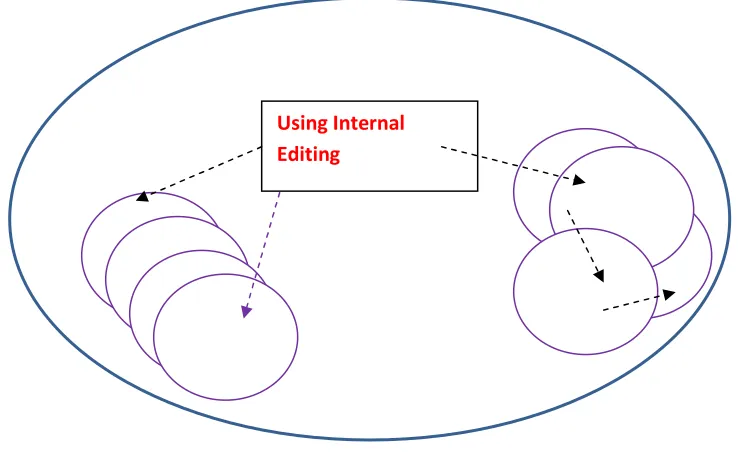
Using internal editing
157
4.19 Appraising what is seen 157
4.20 Multiple Choice 158
4.21 Parallel models of choice-making: Julyen Hamilton and
Yvonne Rainer
162
4.22 Summary 165
CONCLUSION
RE-LEARNING TO SEE
167
Kaleidoscopic Strategies 168
Looking Ahead 169
Vision/world responsiveness 171
BIBLIOGRAPHY 173
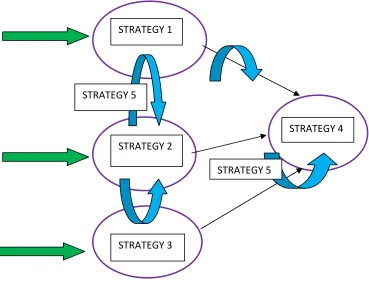
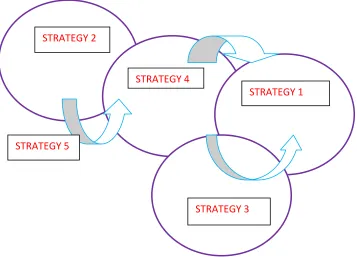
Diagrams
FIGURE 1:
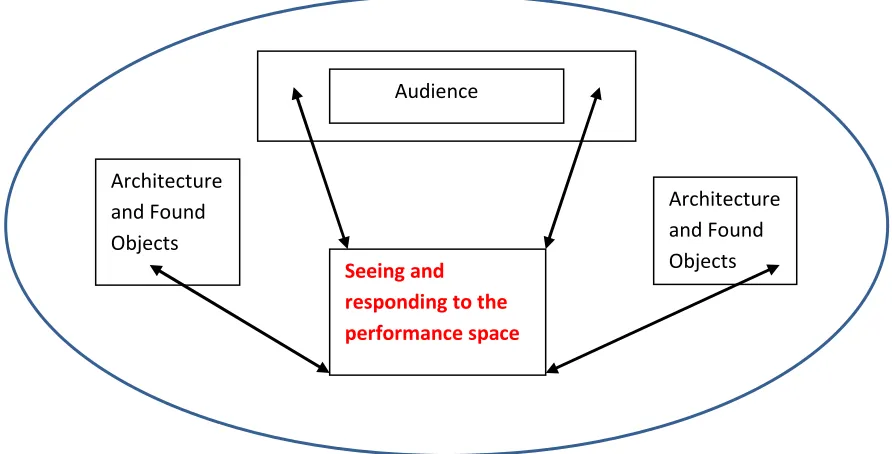
Strategy 1: Seeing and Responding to the Performance Space 48
FIGURE 2:
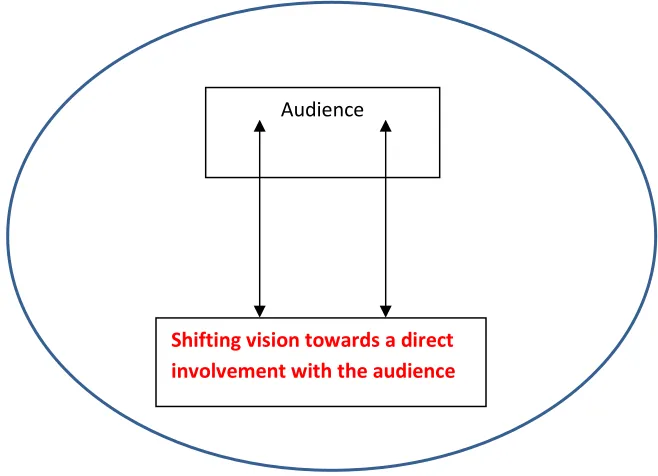
Strategy 2: Shifting vision towards a direct involvement with the audience 49
FIGURE 3:
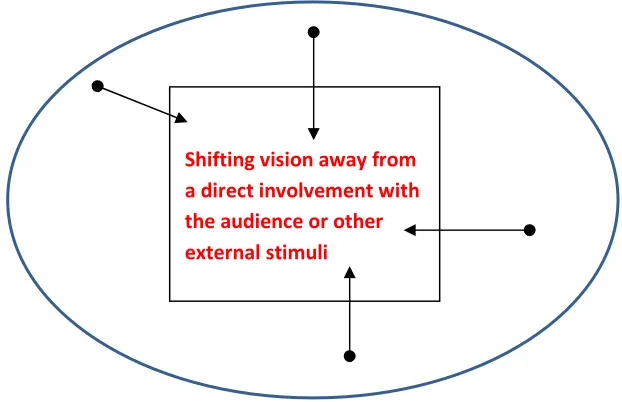
Strategy 3: Shifting vision away from a direct involvement with the audience 52 or other external stimuli
FIGURE 4:
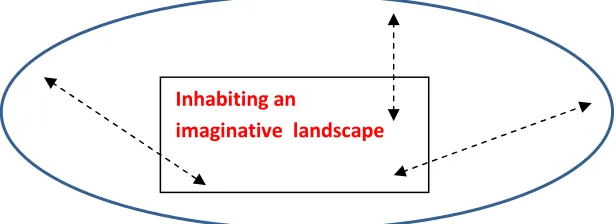
Strategy 4: Inhabiting an imaginative landscape 54
FIGURE 5:
Strategy 5: Using internal editing 56
FIGURE 6:
A basic configuration of the strategies 57
FIGURE 7:
ACKNOWLEDGEMENTS
Heartfelt thanks go to Vida Midgelow for steering me into richly complex territory and offering golden words when most needed. Also to the incomparable Andrew Morrish for his wit, intelligence and warmth. I am deeply grateful for the crystal clear eye of Deborah Middleton; the invaluable DVD-making skills of Eilon Morris; patient helpfulness of Dave Wainwright and support of Zoe Johnson in the library who made sourcing materials
enjoyable and productive. Also thanks to Paul Ward and Dan McIntyre for their invaluable assistance at School level.
Special thanks to Mutti and Phran who have patiently listened over the years and given me sparks of confidence and energy at surprising times.
To my long-suffering fiancé Gerald, who has endured as I have stumbled my way through this astonishing experience - there would be no thesis without you. I will happily be there for you as you glide through yours (and you can have the study).
INTRODUCTION
FOCUSSING IN
Practice & Merleau-Ponty
I.1 Questioning the Space
I begin with a description of an exemplary piece of solo improvisation, grounded in a
purposeful use of vision and illustrative of a finely honed compositional sensibility. It occurs in the film The Usual Suspects. Early in the film we see a detective borrow a colleague’s office in order to interrogate a small-time criminal called Verbal Klint. The film’s narrative unfolds through a series of episodes relayed by Klint, and involves the exploits of a
fantastically terrifying crime lord, complete with unexplained deaths and inter-criminal machinations. When we first see Klint in this office, he is sitting silently, extremely composed, looking around him - his eyes linger on a cigarette box and they scan the back walls which are covered with pieces of paper. Early on in his interrogation he requests coffee and mentions, nonchalantly, that he was once in a barbershop quartet. At the end of the first interrogation scene we see him looking at the bottom of the detective’s coffee cup. The camera focuses on his eyes.
In the next scene, we again become aware of his eye movements. Seemingly succumbing to interrogative pressure, he confesses the name of a key player in the criminal matrix - a lawyer, ‘Kobayashi’. Not long after this there is another long, lingering shot on the bottom of the detective’s coffee cups as he drinks. The plot accelerates and plays with our
perceptions, though we don’t know this at the time. Only retrospectively do we realize that the version of events we see, the version relayed through Klint’s tale, is a sophisticated lie. What is dramatically revealed in the final three minutes of the film through the shocked and disbelieving eyes of the detective is the suddenly obvious link between Klint’s immediate environment and the details of his story.
talking inanely about once being in a barbershop quartet, in Skokie Illinois. Now the detective scans faster, half remembered pieces of dialogue suddenly cohering with what he is seeing; a random name on a list matches the name of one of the central crime figures of Klint’s narrative; a picture matches a description he gave.
His coffee mug has fallen to the floor and smashed (the nicely cinematic mode of signalling his discovery of the truth). As we follow his eyes downwards, we see the inscription
‘Kobayashi’ on its broken base. The detective realizes that Klint’s entire story has been concocted from a string of randomly placed words and images, suddenly visible to him in all their improvisatory significance.
Verbal Klint is, admittedly, a fictional improviser, but he illustrates the generative capabilities of the performer who uses his vision as a compositional tool very nicely. He doesn’t move from his chair as his eyes scan the office but, to introduce a Merleau-Pontian formulation that has been key to my own research, his fabrications are the result of
I.2 Responding to the Environment
I began to research solo improvisation as composition after several years of work in duet and ensemble formats.1 In this context, I am defining composition as the generation and shaping of material, a two-fold process that involves both the genesis and selection and arrangement of material and is also inclusive of the generative and structural challenges of making longer-form pieces over twenty minutes in length. The earlier work - based on a dialogic relationship of ‘give and take’ between performers - had instilled an interest in, and trained a tendency towards, a pragmatics of relationality and responsiveness.2 The challenge of this doctorate, then, was to find ways in which I could generate and structure performance material as a soloist, beginning with the perhaps paradoxical acknowledgement that despite the absence of co-performers, I was nonetheless interested in relationality as a creative starting-point and generative device. I frequently worked alone in the studio, but in developing the methodology of this project, I worked alongside research collaborator Andrew Morrish, who functioned as a generic audience and more specifically as second-person perspective and with whom I developed the practice of the ‘Immediate Writings’ - an initial instance of which is on p.14. All these methodological details are described in full in
1Some of my work in this period was duetting work with co-performer John Britton and some with
improvising drummer Eilon Morris. At times we collaborated as a trio. Many of these performances were held as part of an ongoing series, Spontaneous Combustion, including Spontaneous Combustion #37 @ Berlin ADA
Studio, June 2007; Spontaneous Combustion #38 @ National University of Mexico, as part of the research project 'Writing the Body and Dancing the Mind', March 2008 and Spontaneous Combustion #39 @ University of Huddersfield, as part of the research project 'The Week of Speakers', June 2009.
2 All the duet and trio improvisations stemmed from the relationship we established through mutual watching, listening and responding - a kind of back-and-forth inter-activeness. The responsiveness to each other also meant that when working with the musician, the music did not function simply as a kind of illustration or underpinning of the dancing or story-telling, but at times would seed the development of movement or text and at times would be the lead ‘voice’ in the ensemble.
Another example of improvisation as a performance form in which musicians and dancers worked as equals can be seen in the partnership of Judith Dunn and trumpeter Bill Dixon (Dunn danced with the Merce Cunningham Company and was an early member of Judson Dance Theatre, a dance collective that formed in New York in 1962and whose work is extensively tracked by dance academic Sally Banes - see footnote 23). In this partnership, music ‘was not an accompaniment to the dance, and dancing wasn’t just an exploration of the music. The idea that they were both running parallel and interacting was a key element to their work’ (Susan Sgorbati quoted in Goldman, 2010: 65). Further examples of partnerships between dancers and musicians can be found in Danielle Goldman’s book, IWant to Be Ready Improvised Dance as a Practice of Freedom (Goldman, 2010), including the work of Dianne McIntyre, who set up an ensemble of
African-American dancers and musicians in 1972 called ‘Sounds in Motion’. McIntyre developed a sense of cross-identification whereby ‘the dance actually was the music...the dancer’s body became a musical instrument’ (Goldman, 2010: 79). Susan Foster also discusses ‘Sounds in Motion’ in her book Dances That Describe Themselves: The Improvised Choreography of Richard Bull (Foster, 2002). She notes that ‘McIntyre identified
the next chapter, but at this point I want to note that the Immediate Writings, which are peppered throughout this written thesis (most liberally in chapter four) are intended to reflect the variegated registers through and with which my solo improvisations were transcribed into written form. At times the writings are quite factual (‘an episodic structure of little blurts of direct address narrative’ – see p.14) or descriptive (‘break with these clawed hands and spins, turns and travels’ – see p.14). They include musings, moments of questioning and wondering that fed into the longer-term process of analysing, articulating, making explicit and progressing my knowledge (‘the texture and material feels as if it is fuelled by the drive to improvise in relation to something’ – see p.14). At times the writings capture something of the experience of doing an improvisation (‘the concepts from the day’s writing and thinking swimming around my head – I am not very ‘in’ my body…’ – see p.39). Often, however, these writings don’t yield ‘experiential insights into what it feels like to perform’ (Nelson, 2006: 110), nor do they function as analyses of something that is seen or
experienced, but sit instead as playful, interpretive pieces of poetic expression (‘disruption is in the air’; ‘look at it, look at it, look at it!’ – see p.40). Taken in their totality, then, these writings signal the space and time between each studio improvisation - the first moment of response, reflection or thinking in words by both doer and watcher. Their inclusion in this thesis also illuminates a process of re-reading and selection, as after each studio session I transposed the writings as they were written by hand (inclusive of punctuation, spelling errors, neologisms and lay-out) onto computerised word documents, which I later inserted into this thesis. When it came to choosing particular pieces of writings from the wealth of samples that I had, I made selections based on reverberations between the Immediate Writings and my analysis or argument in the main body of the text. Each sample of writing thus includes a word, phrase or train of thought that obliquely and poetically or directly and quite factually ripples outwards to the discussions that immediately precede or follow it.
Working in a (usually familiar) studio, then, the solo task was initially one of fathoming what I could work ‘in relation’ to. I was aware that I could choose to use recorded music, work with pre-determined props or enter the space with a particular choreographic agenda, all of which could readily facilitate a spirit and pragmatics of responsiveness. I was
interested, however, in keeping the research terrain even more sparse, if you like, stripping it of even these pre-determined features, so the improvisations that formed the spine of the research were all ‘totally improvised’, a development of American Al Wunder’s definition of un-premeditated inventions - un-scored in the sense that I did not draw a set of ‘very clear parameters’ to circumscribe and narrow the field of exploration (Wunder, 2006: 12) - and further extended so that even musical intervention was not included (Wunder, 2006: v).3 The task of working in this ‘totally improvised’ way reinforced the desire for relationality and responsiveness but without any pre-determined immediate hooks (such as music), it became evident that creative impetus needed to be found from within the givens of the immediate environment and in my inhabitation of that immediate environment. This imperative to inhabit the immediate context in a way that felt relational and generative led me to the discovery that if I extended my vision outwards into the space as I moved, I became more consciously aware of the physical environment. I then further explored how shifting the reach and direction of vision enhanced or minimised the sense of relationality (shifting between close-up and longer reaches, and directing vision to different parts of the space, for instance) and the correlation between where my vision was directed and the generation of improvised material.
3Wunder studied and danced with Alwin Nikolas in New York in the 1960s, before gradually developing his
The texture and material feels as if it is fuelled by the drive
to improvise in relation to something
after the morning’s 3 has become 2.
The body feels responsive once it notices the floor
Clawed hands
See ‘gold’ up on the truss – the colour sparks the image of gold teeth
An episodic structure of little blurts of direct address narrative, thematically connected
Break with these clawed hands and spins, turns and travels in order to loosen the
impulse that I have to force out material – I am trying to whirr my way out of a forced
verbal text
The little bits just are
(Immediate Writings, 27/6/09)
Arms arc through the space, spreading energy everywhere. The shapes made from the
folding arms close to the torso become more interesting and your vision is drawn into
this.
A fixed point high in the corner of the studio attracts your vision. The arm movements
continue in relationship to this fixed visual focus.
Words are drawn from this – we see the landscape marked out by the image of a
golden grinning mouth. The talking shifts through e-bay to dentistry, and is
highlighted by energetic shifts that move you through the space. Turning is a big part
of this. The source image, connected to your image seems very real, but when I look, I
cannot see what provided it.
(Andrew Morrish, Immediate Writings, 27/06/09)
Early practice (such as that captured in the Immediate Writings above) thus determined the foundational concerns of the research - the role of vision in establishing a sense of
improvisation, as vision is largely considered within duet and ensemble training contexts rather than in performative and, further, solo performative contexts. On the margins of this general trend, there are a number of solo practitioners who, significantly, do explicitly attend to vision as a communicative or generative tool within performance and I examine their methodological and aesthetic approaches in chapter two in order to both progress and contextualise my argument that vision can function as an efficacious means of
understanding solo performance improvisation as a form of composition.
I was immersed in practical enquiry when I began to investigate potential theoretical
perspectives on the research. Because it would ‘meet’ an emergent practice, I was interested in a theoretical view which could not only offer a lens through which to examine the
practice, but could also intersect with it in pragmatically useful ways and contribute to a refinement of its articulation (in practice and in writing). At this stage - because of the ‘before’ and ‘after’ relationship between the practice and theory - it did not seem to me that any theoretical discourse itself could be challenged by the particularities of the research direction, only that it might supply a useful frame and tool for articulating the nuances of a practice. One of the most interesting discoveries of the research stemmed from the
subsequent realisation that in utilising particular phenomenological ideas in certain practical ways, those ideas themselves would at times be challenged and usefully enhanced.
In terms of a theoretical perspective that could supply a framework for my investigations and could also pragmatically intersect with them in relevant and enriching ways, I turned to the phenomenology of Merleau-Ponty (1908-61).4 Before elaborating on the specific reasons behind this choice, it is worth noting that phenomenology as a philosophical current does not cohere into an agreed method or set of ideas about experience, consciousness or knowledge. Although its origins are widely traced back to the work of Edmund Husserl (1859-1938), whose approach I briefly touch on below, the philosophers who identified with the practice of phenomenology after this time were and are:
4
Merleau-Ponty (1908-1961) studied philosophy at the École Normale Supérieure. His major text, The
Phenomenology ofPerception, was published in 1945 whilst his last, the incomplete The Visible and the Invisible, was published posthumously in 1964. In addition to receiving the chair of child psychology at the
extraordinarily diverse in their interests, in their interpretation of the central issues of phenomenology, in their application of what they understood to be the
phenomenological method, and in their development of what they took to be the phenomenological programme for the future of philosophy.
(Moran, 2000: 3)
Within this loose collective of agendas that philosopher Dermot Moran rightly points to, I was interested in a discourse that could speak to the very particular concerns of this research - relationality and responsiveness as operational principles, the generative capacities of a purposeful use of vision and the core questions of artistic composition and, further, solo artistic composition. My interest in Merleau-Ponty was initially piqued by his discourse on vision - a highly significant correlation with this research - but by following this initial spark with in-depth, very close readings of his works, I found points of intersection with the wider web of concerns in my work. The choice to then focus on this single philosophical voice stemmed from the fact that his complex discourse seemed to offer sufficient avenues for both practical and theoretical engagement with the specific nuances of my research and I wanted to focus on returning and re-returning to a single set of (vast) ideas. This
practice/theory feedback loop made evident that there was generally a very neat ‘fit’ if you like between the direction of my practical research and Merleau-Ponty’s phenomenological discourse - I enumerate shortly on how he speaks to all of the specific concerns outlined above - but also at times his ideas were quite alien to what I was experiencing and
I.3 Merleau-Ponty
Merleau-Ponty’s philosophy is founded on the primacy of bodily, perceptual experience - what he called ‘incarnate subjectivity’ or ‘^’ (‘life world’) - in the creation of meaning (Merleau-Ponty, 1968: 167).5 In placing subjective, phenomenal experiencing at the centre of his theorising - ‘phenomenal’ here meaning embodied perception, our experience of the world as lived - Merleau-Ponty challenged the ‘thinking which looks on from above’
(Merleau-Ponty, 1964a: 160) which in his view characterised the scientific approach, and re-oriented meaning-making instead towards the world as it is experienced by the individual. Whereas science ‘manipulates things and gives up living in them’ (Merleau-Ponty, 1964a: 159), Merleau-Ponty placed ‘what I live through’ (Merleau-Ponty, 1962: xvii) and the ‘actual body I call mine’ at the centre of his philosophising (Merleau-Ponty, 1964a: 160). ‘I can seek no light concerning the world’, he says in his last work The Visible and the
Invisible, ‘except by consulting, by making explicit, my frequenting of the world, of
comprehending it from within’ (Merleau-Ponty, 1968: 32).6 This emphasis on the perceiving subject and her direct encounters with the environment aligns with both my own research position as a reflexive examiner, experiencing and appraising my own work ‘from within’ (although in my case, as explained later, I also built an intersubjectivity into the
methodology of the work) and my interest in relationality and responsiveness as generative starting points for acts of improvisation.
Merleau-Ponty’s work was also a shift away from the original Husserlian project, in which Husserl set about clarifying the essence of ‘consciousness itself’ (Moran, 2000: 145). It is beyond the scope of this thesis to examine Husserl’s ideas in full, but here I note that his phenomenological project was characterised by the ‘suspension’ or ‘bracketing’ of everyday concerns and all ‘‘world-positing’ intentional acts which assumed the existence of the world’ (Moran, 2000: 2). This meant that ‘all scientific, philosophical, cultural, and everyday assumptions had to be put aside’ if there was to be a genuine phenomenological insight into the essence of cognition and consciousness (Moran, 2000: 11). Moran
characterises Husserl’s approach as an ‘absolute insistence on the necessity of bracketing the
5
Moran notes that the term Lebenswelt ‘first shows up’ in the draft manuscripts associated with Husserl’s
Ideas II and was also used by Martin Heidegger (1889-1976) in a lecture series in 1919 (Moran, 2013: 114).
6Merleau-Ponty’s orientation was historically a challenge to the philosophical notion of Cartesian mind-body
actual world in order to proceed phenomenologically’ (Moran, 2000: 78); his aim was to return to a ‘transcendental standpoint, to uncover a new transcendental domain of
experience’ (Moran, 2000: 147). By contrast, Merleau-Ponty’s phenomenology was clearly a movement away from this emphasis on cognitive acts and a non-physical transcendental realm and towards the ‘world’ as phenomenally experienced by the individual. Later I return to the idea of ‘bracketing’ one’s assumptions as it relates to some forms of
phenomenological writing, but for now point out that in its general search for ‘essences’, particularly an essential conceptual foundation of knowledge, this transcendental
phenomenology was evidently alien to the direction and intention of my own research agenda.
It could at this point be argued that Merleau-Ponty’s positing of incarnate subjectivity as the locus of experience and knowledge is loosely characteristic of post-Husserlian
phenomenological research in general. Despite the diversity of approaches within
phenomenology identified earlier, there is a general theme - what academic Stanton Garner classifies as a ‘mutually entailing set of aims’ - that loosely unites contemporary
phenomenological researchers. These are:
to direct attention from the world as it is conceived by the abstracting, ‘scientific’ gaze (the objective world) to the world as it appears or discloses itself to the perceiving subject (the phenomenal world); to pursue the thing as it is given to consciousness in direct experience; to return perception to the fullness of its encounter with its environment.
(Garner, 1994: 2)
Very broadly, phenomenology’s interest in the experience and insights of the ‘perceiving subject’ can be deemed to be a widely shared theme; covering discourses as diverse as Merleau-Ponty’s Lebenswelt; Martin Heidegger’s formulation of Dasein in which individuals are ‘thrown’ into the world (Moran, 2000: 242) and even Jean-Paul Sartre’s rubric of a radical freedom, to identify just three threads.7 Here, however, I return to the specific nuances embedded in Merleau-Ponty’s versioning of the perceiving subject to highlight the details of what he offered my research.
7
Heidegger published his major work Sein Und Zeit (Being and Time) in 1927. Sartre (1905-1980) published
his major philosophical work, Being and Nothingness in 1943. Both authors are extensively treated in Dermot
Highly significant is Merleau-Ponty’s idiosyncratic discourse on vision and the confluence of visual perceptual experience and the movements of the body, which shifted his discourse into a particular register. He stresses a foundational correlation between vision and
movement in everyday activity but beyond this he also creates a paradigm of what I call vision/action responsiveness based in the compositional activity of the painter. His philosophy is propelled by a reliance (arguably, as I address later, an over-reliance) on an embodied vision as the means of experiencing the world. It is ‘true that the world is what we see’, he says (Merleau-Ponty, 1968: 4, original italics) and, of equal import, ‘I have only to see something to know how to reach it and deal with it’ (Merleau-Ponty, 1964a: 162). For the painter, the eyes are ‘computers of the world which have the gift of the visible’
(Merleau-Ponty, 1964a: 165); his is the eye that questions the world, that ‘sees the world’ and then ‘through the offices of an agile hand’ turns that world into paintings (Merleau-Ponty, 1964a: 165). Here then is both a general discourse on the entwinement of vision and movement and a model of solo artistic composition grounded in an active relationship with the environment that gave me a relevant, detailed discourse - a pragmatic and attitudinal way of being - that I could use as a provocation of my own emergent practice. Dermot Moran points out that Merleau-Ponty produced ‘the most detailed example of the manner in which phenomenology can interact with the sciences and the arts’ (Moran, 2000: 434) and he himself commented that ‘if we make it our goal to reach the concrete, then in certain respects we must put art above science because it achieves an expression of the concrete man which science does not attempt’ (Merleau-Ponty, 1964d: 36). His was thus a
phenomenological voice that was also profoundly interested in artistic expression, and his focus on a solo compositional activity, grounded in a purposeful use of vision, chimed very clearly with my own concerns.8
On this note, it is also because Merleau-Ponty confines his own model of vision/action composition to the actions of the painter that his ideas invite a wider application. The painter is deemed to possess a ‘secret science’ (Merleau-Ponty, 1964a: 161) which enables him to both access and then transmit onto canvas the qualities and properties of the visible world around him. The reasons behind this privileged position are explained later on p.94 as part of
8
Two of Merleau-Ponty’s early essays concern the novel and cinema - Metaphysics and the Novel (1945) and
The Film and the New Psychology (1947). Hisfirst essay on painting, Cezanne’s Doubt, was published in 1945
and his late work Eyeand Mind was originally published in 1961 (Merleau-Ponty, 1964a). It is in this latter
the discussion of Merleau-Ponty’s ontology, but because the painter’s work is rooted in a combined action of seeing and moving, his ideas take on wider significance when extended beyond painting to other creative processes that also place an embodied vision at the centre of compositional action. Although positioned within particular ontological strictures, the corporeal activities of the painter are rooted in a ‘questioning’ vision; his role is to ‘grasp and project what is seen in him’ (Merleau-Ponty, 1964a: 167). These dynamic descriptions place vision and the ‘expressive operation of the body’ at the centre of an artistic paradigm in which ‘the smallest perception’ is ‘amplified into painting and art’ (Merleau-Ponty, 1964b: 70). Whilst not sharing the ontological connotations of the painter’s activities, this research does extend the rubric of ‘art’ into solo improvisational processes and challenges the notion that it is only the painter whose compositional activities can be fruitfully grounded in a vision/action model of responsiveness.9 As I discuss further in chapter one, Merleau-Ponty’s interest in the lived immediacy of experience - the ‘incarnate subjectivity’ that grounds his phenomenology - also lends itself to expressive modes that share that very incarnate subjectivity as it is experienced and shaped into compositional form, as is the case in this practice.
Merleau-Ponty’s interest in vision/action responsiveness also chimes in another way with the direction of my practical experiments, in that he takes the specific facticity of our bodies into account when constructing his phenomenology of perception. ‘What if our eyes were made in such a way as to prevent our seeing any part of our body…?’ he asks in his essay on painting Eye and Mind (Merleau-Ponty, 1964a: 163) anticipating some of his later
discussions on the way in which the realisation that we can both see ourselves and
simultaneously be seen by ourselves then ripples out into an entire meaning-system based on this reciprocity between subjectivity and objectivity (these ideas are discussed in full in chapter three). He also considers what it would be like if, like certain animals, ‘we had lateral eyes with no cross blending of visual fields’ (Merleau-Ponty, 1964a: 163). His answer is that there ‘would be no humanity’ (Merleau-Ponty, 1964a: 163). Our entire
9
Academic and dancer Susan Kozel - who I refer to again later in the Introduction - also extends Merleau-Ponty’s model of the painter to include dancers in general in her doctoral thesis (Kozel, 1994). Whilst I acknowledge the common impulse here, Kozel’s interest is in a philosophical re-examination of Merleau-Ponty’s discourse through dance and in supplying dance with a new philosophical framework, but without testing or giving body to the philosophy in a practical context. Dance remains as ‘a poetic image’ in her work because it ‘does not take place as a bodily phenomenon’ (Kozel, 1994: 298). I also refer later to her text –
Closer: Performance, Technologies, Phenomenology (Kozel, 2007) - in which Merleau-Ponty’s ideas are
phenomenological experiencing of the world would be radically different. I would ‘see’ the world in an entirely different way and therefore the world would afford me very different possibilities for experience and action. This interest in what our corporeal facticity enables by way of movement responsiveness finds an analogous expression in my practice, as I am literally using my eyes (where they are) rather than expanding into terrain in which I use an imaginative construct of vision - working as if I had eyes at the back of my head for instance - or conceiving of the eyes in a metaphorical sense.10
Before giving an introductory example of how Merleau-Ponty’s specific discourse on vision/action responsiveness functions as a pragmatic provocation in the space, I also want to note that Merleau-Ponty’s general use of language (albeit in translation) is often richly imagistic, metaphorical and elliptical - indeed he has been criticised for ‘letting poetic speech have a voice in his philosophy’ (Sheets-Johnstone, 1998: 312). In this research, however, this ‘poetic’ tendency was another reason that I explicitly utilised and worked with his concepts. It is appealing and useful for the very reason that it allows me to engage with evocative keys of expression - to engage, in other words, with an artistic sensibility as much as with a philosopher. This poetic voice is usually dynamically suggestive, notoriously difficult to pin down to a static or unitary meaning, but redolent with action, movement and, when applied to acts of composition, textures of experience that give me a very clear set of markers against which I can situate my own compositional paradigm. To give a brief example here, a dynamic correlation between vision and movement is alluded to when he says that ‘my movements and the movements of my eyes make the world vibrate’ (Merleau-Ponty, 1968: 7). This poeticised turn of phrase led me to attend to the motional quality at the heart of the relationship that he is talking about - his core formulation of the chiasmic
exchange - as well as to the ontological connotations of the idea. The chiasm represents a moment of exchange or overlap between an individual and the world (and within an individual himself) and it begins by opening oneself to one’s surroundings through one’s
10
vision, extending one’s body into the surrounding world through the act of looking. Here the (poetic) consequence of this embodied vision is that the world begins to ‘vibrate’.11
Similarly, the relationship between an individual’s body and the world is described elsewhere as ‘a relation that is one of embrace’ (Merleau-Ponty, 1968: 271), a poetically condensed description that distils the movement towards one another of two distinctive but related identities. This ‘embrace’ is the ‘me other exchange’ of the chiasm (Merleau-Ponty, 1968: 215) and suggests the blurring of boundaries, the merging of the roles of
perceiving/perceived and touching/touched, that is again core to both a philosophical understanding of the chiasmic exchange and to its dynamic motional quality.12
To return now to an example of the specific relationship between vision and action in Merleau-Ponty’s discourse and the way in which it infiltrated my practical research, he states in The Phenomenology of Perception that a meaningful connection with the world ‘does not occur in the natural transactions between my sight and the world’, but rather ‘it is the reply to a certain kind of questioning on the part of my gaze...’ (Merleau-Ponty, 1962: 226).13 Experimenting with a ‘questioning’ vision became a useful pragmatic tool in the studio - scanning the space to see what it contained for instance - and a way of exploring links between this kind of attitudinal approach - adopting the assumption that there would be something in the space that would ‘reply’ to my look - and its compositional efficaciousness (‘questioning’ the space often yielded something that functioned as a creative spur but it sometimes didn’t - a point I pick up on again in relation to the development of an alternative compositional avenue). The idea of visually ‘questioning’ the space thus intersected with the practice’s initial findings, which were that in directing my vision externally, reaching it into the things of the space, I could establish a sense of relationality for myself. This process of bringing the theoretical discourse as an attitudinal and pragmatic way of being into the space
11
The chiasm is variously described (and translated) as a ‘me other exchange’ (Merleau-Ponty, 1968: 215); an ‘overlapping or encroachment’ (Merleau-Ponty, 1968: 123); ‘encroachment, infringement’ (Merleau-Ponty, 1968: 134); ‘the intentional encroachment’ (Merleau-Ponty, 1968: 239); ‘reversibility’ (Merleau-Ponty, 1968: 263 & 264) and ‘Ineinander’ (Merleau-Ponty, 1968: 268) - German for ‘into one another’. Merleau-Ponty’s use of the term is a linguistic theft from physiology - the optic chiasm is the site in the brain where one set of nerve fibres from each eye crosses over and joins with the non-crossing nerve fibres from the other eye, forming two optic tracts, each with information from both eyes. I elaborate on the chiasm’s ontological connotations in chapter three.
12
Merleau-Ponty makes his poetic inclinations explicit when he exclaims in Signs that the ‘expression of the
world’ ‘must be poetry’ (Merleau-Ponty, 1964b: 52).
- a process I describe as one of ‘encroachment’ after one of Merleau-Ponty’s terms for the chiasmic exchange - is outlined further in chapter one. The process also entailed a return to the theory between the practice sessions, developing the feedback loop in which the practice would be refined by pragmatically investigating the theoretical discourse and would itself also begin to talk to and enhance that discourse, particularly the vision/action rubric of composition.
I.4 Other treatments of Merleau-Ponty
I am cognizant that Merleau-Ponty has been treated in earlier studies, most noticeably in movement/dance but also in theatre, so this doctorate engages with a number of academic writers who offer a range of points of view on several of his key philosophical ideas. I outline and intersect with their arguments as part of the enunciation of the particular direction of this research.
One of Merleau-Ponty’s most articulate proponents - philosopher and dancer Susan Kozel - offers a close reading of some of his ideas in the fairly recently published Closer:
Performance, Technologies, Phenomenology (Kozel, 2007). I acknowledge a commonality of interest in the key idea of the chiasmic exchange, but I illustrate in chapter three that Kozel’s adaptation of it, grounded in her explorations of digital technologies, is quite different from mine. She also pursues ontological readings of the concept of the ‘invisible’ (summarised on p.110) whilst I pursue one of Merleau-Ponty’s alternative formulations of the invisible as it relates to the ‘visible’ and the act of perception. Kozel’s other major influence is ‘flesh’ which I discuss on pp.99-100 but which is not directly applicable to this study. In general, I have found Closer: Performance, Technologies, Phenomenology to be an extremely interesting and influential text in itself, and an excellent example of the ways in which some of Merleau-Ponty’s complex ideas can be flexibly and usefully adapted to a number of very different contemporary performance forms.14
A contrasting voice is supplied by one of Merleau-Ponty’s most ardent detractors, dance academic Maxine Sheets-Johnstone, in The Primacy of Movement (Sheets-Johnstone, 1998). She contests Merleau-Ponty’s reliance on vision as integral to movement expression, so opens up a useful line of discussion on the absence of a valuing of kinaesthetic awareness in his work. In chapter threeI speak to both her own paradigm of the body in which
kinaesthesia (and touch) are the ‘bedrock of our experience of ourselves and of the world’ (Sheets-Johnstone, 1998: 297) and Merleau-Ponty’s position in which vision is integral to movement expression. In chapter five I also talk to her model of ‘the essential character of a dance improvisation as it is experienced by a dancer’ (Sheets-Johnstone, 1998: 486) by noting points of both convergence with and divergence from my own (non-essentialist) strategic approaches.
I also refer briefly to a third dance academic, Sondra Fraleigh, when discussing different forms of studio-based writing on p.43. Fraleigh includes Merleau-Ponty in her creation of a descriptive aesthetics of dance and her major text, Dance and the Lived Body: A Descriptive Aesthetics (Fraleigh, 1987), captures phenomenology’s interest in the ‘lived body’ in its very title, exploring both the subjective experiencing of dance and the communicative or inter-subjective intent that imbues it in its aesthetic form.15
This bias towards dance/movement voices in my thesis is indicative of the way in which Merleau-Ponty’s ideas readily lend themselves to somatic practice - to gaining knowledge and insight through the phenomenal (lived) body - but it is also indicative of the origins of my own improvisational work in movement-based explorations (I trace my improvisational training in chapter two). It is also important to place a theatrical voice in the mix, however, in part because my own practice smudges the boundaries between disciplines, drawing on movement and words and exploring the creation of imaginative fictions as well as corporeal improvisations. Stanton Garner’s Bodied Spaces: Phenomenology and Performance in Contemporary Drama (Garner, 1994) utilises Merleau-Ponty’s interest in corporeality and the facticity of the body in his analysis of the works of Samuel Beckett, opening up a useful
15 An impulse towards intersubjectivity is in Sondra Fraleigh’s work the definition of what makes dance - both
choreographed and improvised - an art, or an aesthetic mode of expression. ‘If I dance only for myself’, she says, ‘I am not brought into a dynamic intersubjective relation with the other. I am simply bound up in my own subjectivity’ (Fraleigh, 1987: 59). ‘Dance is not completed as art until it enters an intersubjective field’
play of difference between my adaptation of Merleau-Ponty’s phenomenology and his own. Garner offers a formulation of theatrical space as ‘phenomenal space’ that is ‘perceived and inhabited’ by both actor and audience (Garner, 1994: 3) and grounds this understanding within the dramatic text and the possibilities for action that inhere within the text. To this primarily theoretical understanding, I add my own lived experience of ‘phenomenal space’ from the perspective of both improviser and audience, drawing on Garner’s notion of the ‘embodied eye’ of spectatorship (Garner, 1994: 4) on p.79 and expanding on his discussion of ‘spectatorial power’ (Garner, 1994: 48) in the seeing/seen section of chapter three, p.103.16
I.5 Further Framings
I now propose to contextualise this research beyond its Merleau-Pontian framing,
introducing key texts and figures that are relevant to my research for significant conceptual, methodological and aesthetic reasons. The delimitation of literature that follows points ahead to chapter two,which relates the nuances of this practice to the aesthetics and philosophies of a range of other practitioners and it also enables me to further pinpoint the rationale of my own approach and topic. As part of this contextualisation I also note a range of other discourses that have been used to illuminate improvisatory practices and indicate how my work sits in relation to these alternative framings.
(1) Conceptual Links
The dance-oriented companion to improvisation Taken By Surprise: A Dance Improvisation Reader (Cooper Albright and Gere, 2003), is primarily oriented towards encouraging its readers to ‘think and talk about improvisation’ (Cooper Albright and Gere, 2003: xiii). The collection of essays explores a range of themes from the work of individual practitioners, approaches to performance improvisation (Contact Improvisation, tap dancing, flamenco) and manifestations of improvisation in everyday life. The primary relevance of this volume
16
A final addition to this survey of other treatments of Merleau-Ponty is Australian improviser Shaun McLeod, who refers to Merleau-Ponty’s discourse of embodied subjectivity in order to view dance as ‘a way of
knowing’ (McLeod, 2008: 17) in Chamber: Dance Improvisation, Masculine Embodiment, and Subjectivity,
his account ofhis work Chamber (McLeod, 2008). As mentioned earlier, my position as a reflexive researcher
to my work lies in the principle underpinning all the essays, namely that improvisation is ‘susceptible to careful articulation’ and that the ‘careful articulation of the improvisational moment by no means renders it any less valuable, or any less capable of surprise’ (Cooper Albright and Gere, 2003: xiv). This understanding coheres in a very basic way with a primary motivation behind my doctoral research - to undertake ‘careful articulation’ of my own emergent approach and contribute to both professional and academic contexts clarity and understanding of a particular practice.
American dance improviser Kent De Spain’s writings are also geared around an
understanding that movement improvisation is amenable to articulation and analysis, and further, to precise categorisation.17 An early article ‘Dance Improvisation: Creating Chaos’ (De Spain, 1993) draws on chaos theory in order to view improvisational dance as a dynamical system or ‘kind of strange attractor’ that never repeats exactly but that
nonetheless operates within certain tendencies (De Spain, 1993: 25). De Spain proposes that the individual tendencies of any improviser can therefore be tracked, analysed and
categorised, a proposition that he then tests in his doctoralthesis, Solo Movement
Improvisation: Constructing Understanding Through Lived Somatic Experience (De Spain, 1997). In a broad sense my research follows on from the kind of in-depth analysis of improvisational experience pioneered by De Spain, although I employ a very different methodology (addressed below), and have chosen to translate my generative approaches into strategies - into tools that allow me to become more attuned to the links between my visual attentiveness and my compositional actions - rather than broad categories of experience.18
(2) Methodological Links
Kent De Spain’s approach to capturing improvisational experiences in his doctoral thesis serves as a significant methodology against which I developed my own approach. Drawing on the theory of ‘flow’ in the work of psychologist Mihaly Csikszentmihalyi, De Spain followed Csikszentmihalyi’s model in which research participants were interrupted by pagers at various intervals during their day and requested to write down their state of mind
17
De Spain is a multidisciplinary artist, improviser and teacher who has conducted extensive research into processes of movement improvisation.
18De Spain’s categories of experience include ‘attending to some aspect of the external environment; direct
at the time of the pager’s signal.19 De Spain set up an audiotape during studio sessions, which interrupted the improviser at random intervals with a pre-recorded request to ‘report what you are experiencing now’ or ‘report now’ (De Spain, 1997: 124). The participants in his sessions had been briefed beforehand on what to expect, and were also encouraged to ‘report on any aspect of how you are working improvisationally (what you are working with) or on any aspect of how you are experiencing what you are doing in any way that you are experiencing it’ (De Spain, 1997: 124). The methodology aimed at discovering the nature of improvisation ‘as experienced by improvisers’ (De Spain, 1997: 118). The essence of that experience as communicated through the language of the verbal reports determined De Spain’s interpretation of the data and, combined with additional focus groups and interviews, led him to create categories of activity or experience within solo improvisation. This methodology is explained in full in his thesis and is also discussed in his article ‘The Cutting Edge of Awareness: Reports from the Inside of Improvisation’ (De Spain, 2003).
This methodological approach was extremely useful in building appreciation of what De Spain calls ‘some fundamental organizing concepts’ shared by the study’s participants (De Spain, 1997: 287) but he also acknowledges that the act of translating improvisatory experiences into verbal reports ‘can be difficult, if not impossible’ for the participants (De Spain, 1997: 289). Key differences in my methodology were that I wanted to find a way of capturing salient features of improvisational experience after the event, rather than during, thereby avoiding the necessity for the improviser to interrupt the ‘flow’ of what they were doing and instantaneously verbally report what they were experiencing. I also wanted to track what was experienced or noticed by both the improviser and the watcher. The desire to not interrupt the ‘flow’ of an improvisation whilst in progress influenced my decision to use ‘Immediate Writings’ - fully documented in chapter one - as a means of capturing (but also not capturing) aspects of the improvisations. As will be explained, I also did not attempt to create categories of experience out of these writings, but used them in the studio as
19
Csikszentmihalyi has researched topics related to flow - a state of complete absorption in an activity - for over twenty years. His texts include Flow: The Psychology of Optimal Experience (1990); The Evolving Self
(1994); Creativity: Flow and the Psychology of Discovery and Invention (1996) and Finding Flow: The Psychology of Engagement With Everyday Life (1998). His approach was called the Experience Sampling
Method. The pager was activated about eight times a day for a week; at each signal the participant was asked to ‘write down how they feel and what they are thinking about whenever the pager signals’ (Csikszentmihalyi, 1990: 4). The data collected from this process functions as a ‘running record, a written film clip of his or her life’ and forms the basis of Csikszentmihalyi’s conclusions in Flow: ThePsychology of Optimal Experience
springboards to discussion and now in this written thesis as a means of loosely re-tracing what was experienced of the improvisations by both improviser and watcher.
Related more generally to my methodological approach, is Al Wunder’s The Wonder of Improvisation (Wunder, 2006), as it introduces a concept of ‘totally improvised’ to the field of improvisatory discourse that is both relevant and, as mentioned earlier on p.13, able to be extended in my own work. Although there are some other examples of improvisational work which are characterised as ‘totally improvised’ - see footnote 20 - my research is
underpinned by a very particular understanding of the term so that neither music, notions of character, thematic ideas or specific choreographic agendas are imported into the
performance context as the seeds or building blocks of improvised compositions. Building on the conceptual foundations supplied by Wunder, then, my research contributes to the existing literature in dance, drama and hybrid improvisational performance a set of strategic approaches for solo composition within a ‘totally improvised’ paradigm.20
(3) Compositional Strategies
The bilingual compendium of interviews,Nouvelles de Danse (Benoit, 1997), is premised on the point of view that it is ‘impossible to dissociate improvisation from composition’
(Benoit, 1997: 9) and features dancers experienced in performance improvisation talking informally about their practices. Proceeding as ‘a series of conversations’ (Benoit, 1997: 7),
20Very different understandings of ‘totally improvised’ occur in Frost and Yarrow’s account of Theatre
Machine - formed in 1967 with Keith Johnstone as director - in their text Improvisation in drama (Frost and
Yarrow, 2007)and in the work of London-based Improbable Theatre. Frost and Yarrow classify Theatre Machine as the ‘only professional company to present performances which have been ‘totally improvised – though in recent years work by The Improbables has come close’ (Frost and Yarrow, 2007: 81). For Theatre Machine, ‘totally improvised’ meant that there was scope for the performers to access a number of pre-determined characters and some sections of a show ‘may be familiar to them or quite fully rehearsed’ (Frost and Yarrow, 2007: 81). Johnstone himself describes Theatre Machine as ‘the only pure improvisation group I knew’ and ‘like a jazzed-up drama class’ (Johnstone, 1981: 27) in his text Impro: Improvisation and the Theatre (Johnstone, 1981). Johnstone doesn’t discuss Theatre Machine in depth and it is beyond the scope of
this thesis to analyse his approaches to using improvisation to foster spontaneity and release the imagination in students, which is the main focus of his text. I do, however, discuss his technique of ‘Reincorporation’(p.82) and elaborate on his comments on theimagination (p.153) as part of the contextualisation of my own practice.
In the case of Improbable Theatre, for whom Keith Johnstone is a major influence and to whom co-Artistic director Phelim McDermott credits his initial interest in improvisation (Svich, 2001), there are a range of approaches to improvisation for and in performance, with some work labelled as ‘totally improvised’
the text is a useful prompt for considering improvisation and composition as simultaneous, entwined activities, but leaves a lot of room for more in-depth analyses of particular artists, strategies and approaches. In the case of dancer Julyen Hamilton, for instance, whose treatment of improvisation as ‘a way of composing’ (Benoit, 1997: 199) explicitly aligns his general approach with mine, further explication of the nuances of his approach are needed.21 Some of these are supplied in his own earlier DVD of improvisation (Hamilton, 1994) and other reflective accounts such as a more recent interview in the American journal Contact Quarterly (Stark Smith, 2011).22 In these accounts a particular discourse of ‘making pieces’ and following a ‘line’ of enquiry is enunciated, which functions as a significant reference point for my analysis of our respective approaches to generating and structuring material in chapter two. Also touched on in the Benoit text is dance artist Yvonne Rainer, whose own book, Work 1961-73 (Rainer, 1974), also gives more detailed accounts of her performance work in that period and outlines the operational principles driving her aesthetic at the time.23 Work 1961-73 includes a lively and provocative statement on approaches to improvised performance - Some Thoughts on Improvisation - which is of direct relevance to this research and which I analyse in depth in relation to the use of vision and attitudes towards choice-making.24
21
Hamilton was born in 1954 in England, trained at The Place in London in the 1970s and now lives in Spain. He performs and teaches widely throughout Europe.
22
Contact Quarterly was founded in 1975 as a forum for discussing Contact Improvisation but now presents writings on a range of improvised performance practices.
23Born in 1934 in California, Yvonne Rainer was one of the original members of Judson Dance Theatre
(1962-4), a collective of performers who grew out of a choreography class held by musician Robert Dunn, who had studied with John Cage. The class was held between 1960 and 1962 at the Merce Cunningham dance studio in the Living Theatre building in New York City. The work of Judson Dance Theatre has been extensively covered by Sally Banes in Terpsichore in Sneakers: Post-Modern Dance (Banes, 1977); Greenwich Village 1963: Avant-Garde Performance and the Effervescent Body (Banes, 1993a); Democracy’s Body: Judson Dance Theater, 1962 – 1964 (Banes, 1993b) and in ‘Choreographic Methods of the Judson Dance Theater’
(Banes, 2001). One of Rainer’s pieces, Continuous Project-Altered Daily (CP-AD) was also foundational to the
emergence of The Grand Union (1970-76), ‘one of the most brilliant projects of the postmodern dance’ (Banes, 2001: 359). CP-AD existed as a performance frame, which stipulated some tasks and actions but left it up to
the performers to choose the order and manner of execution. Rainer describes it as‘constructed of
interchangeable units of material, some very elaborate and requiring the whole group, other units being solos that could be done at any time, or duets and trios (Rainer, 1974: 125). Susan Foster gives a useful overview of the ‘noncohesive roughness’ (Foster, 2002: 82) of the Grand Union in Dances That Describe Themselves: The Improvised Choreography of Richard Bull (Foster, 2002: pp. 79-84 and pp. 186-190) although her text
primarily concentrates on Richard Bull’s choreographic practices within the context of artistic experiments and social shifts in America in the 1960s and 1970s.
The Improvisation Game: Discovering the secrets of improvised performance (Johnston, 2006) is Chris Johnston’s overview of primarily drama-based performance and teaching practices in the UK and America.25 The text is a mix of historical contextualisation and a more practically oriented selection of conversations with drama, dance and music artists, games, exercises and reflections on how to generate and structure both solo and group improvised performances. Despite the hybrid nature of the book, the section on Johnston’s approach to solo performance improvisation is a useful account of a parallel aesthetic, against which I situate my own generative approaches. Similarly, musician Stephen Nachmanovitch - whose improvisational practice and life are framed through Buddhist philosophy - outlines his approach to composition in his text Free Play (Nachmanovitch, 1990) and in a number of on-line articles.26 At first glance Nachmanovitch might be regarded as an incongruous inclusion in a selection of relevant literature and practitioners, but my research has thrown up several striking points of linguistic and ontological
convergence with the tenor and temper of Merleau-Ponty’s phenomenology; points of connectivity which enable me to clarify and situate my own compositional approaches in relation to the philosophical agenda that permeates Nachmanovitch’s procedures.
There are two other practitioners who are relevant to my research for aesthetic reasons. Australian improviser Peter Trotman is scarcely featured in the existing literature, but I discuss him on pp.88-91 in order to deepen my analysis of the use of movement and words as stylistic compositional signatures in my own research.27 The Australian journal Proximity - similar in scope and aims to Contact Quarterly - serves as the primary source of the
extremely minimal written reflection on Trotman’s work but my understanding of his compositional strategies primarily stems from the studies I undertook with him throughout 25
Johnston trained at the Drama Centre, London, before working in small-scale theatre as a director and writer. He has run his own company, Fluxx, since 1998 and has also written about community-based drama practices in House of Games: Making Theatre From Everyday Life (Johnson, 1998).
26 Nachmanovitch was born in 1950 in the US. He has a Ph.D. in the History of Consciousness and in the
1970s was a pioneer in free improvisation on violin, viola and electric violin. He teaches and lectures widely in the United States and abroad on creativity and the spiritual underpinnings of art.
27
2003 and 2004 and the links I have made between the pedagogical ideas infusing his
exercises, the subjective experience of ‘performing’ them in class, and watching his own on-going solo performances.
Absent from the literature on improvisation is Nigel Charnock, who was best known - and documented - as a founding member of UK physical theatre company DV8 but who had been exploring improvisation for several years. With the exception of his own blog and various reviews of his performances, Charnock’s improvisational work is undocumented, but his inclusion in my selection of related performance practitioners in chapter two adds a significant improvisatory presence to the existing discourse - analysed and positioned in relation to my own research trajectory - but more resonant now, I think, in light of his untimely death in August 2012.28
(4) Approaches to the use of vision in improvisation
Melinda Buckwalter’s recently published Composing while dancing: An Improviser’s Companion (Buckwalter, 2010) includes a small section on ‘The Eyes’. It is the only broad-based companion or manual that does so, and the section serves as a useful introduction to the way in which vision functions in the training practices and pedagogical approaches of a number of improviser/teachers. The text includes an outline of the workshopping practices of Katie Duck, for instance, a veteran improviser/teacher who has a particular interest in collaborative dance and music improvisational practices. When exploring vision she asks her students to play with the correlations between different lengths of gaze and movement choices. She also encourages her students to look each other directly in the eye, invoking what she calls ‘biology’ - a kind of hormonal rush - by ‘eyeballing’ each other and eliciting a sense of interpersonal interest and excitement (Buckwalter, 2010: 120). The use of the eyes in performance is briefly alluded to in relation to eliciting a ‘rush’ that ‘pulls the
audience in and gets them involved in the exchange empathetically’ (Buckwalter, 2010: 120)
28
Charnock trained at the Royal Welsh College of Music and Drama and the London School of Contemporary Dance. He was a founding member of DV8 Physical Theatre Company in the UK in 1986, with whom he co-devised and performed My Sex, Our Dance (1986). He also performed in various other DV8 works such as Dead Dreams of Monochrome Men (1988) and Strange Fish (1992) (DV8, n.d.). In 1995 he formed his own
company, Nigel Charnock and Company, through which he made a series of set solo shows including Original Sin (1993) and Human Being (1997),before developing the shows that involved a degree of improvisation - the
solo Frank (2002) and a quartet, Stupid Men (2006) (Nigel Charnock and Company, n.d.). He also worked as a
but in keeping with the book’s flavour as a companionable provocation for experimentation, the use of vision in and for composition and performance is not treated in depth.29
In ‘Before Your Eyes: Seeds of a Dance Practice’ (Nelson, 2004), Lisa Nelson documents her work with video.30 It is an interesting account of how she used video in a process of ‘reverse-engineering’ the ‘composition’ of her movement and the ‘composition’ of her seeing (Nelson, 2004: 20). Her investigations into composition, framed as a ‘dialogue’ between her attention and her physicality (Nelson, 2004: 24), position her linguistically and, more broadly, aesthetically close to my own research although the emphasis in this article is on how her use of video functioned as a means of re-training and re-experiencing both her attentiveness and her dancing. From this studio research, Nelson then developed the ‘Tuning Scores’, an ensemble training methodology that engages strategically with vision and
kinaesthesia in order to make explicit individual decision-making processes. This score is discussed in Nouvelles de Danse, Composing while dancing and in a number of other non-academic contexts and although it is a training tool, it serves as a rare example of a methodological approach to improvisation in which the activity of observing something (from both inside and outside) is exploited with compositional intent. I discuss the score on pp.70-72.
American improviser Barbara Dilley has also created an ensemble training methodology based on the use of vision, sketched in ‘Two Streams/Many Ways’ in Contact Quarterly
29Duck’s experiments in using vision as a means of creating interpersonal interest and excitement are useful as
general points of reference for my own work, but the ‘core’ of her improvisatory research is the ‘practical dialogue between dancers and musicians’ (Buckwalter, 2010: 113). This interest led her to establish the Magpie Music Dance Company in Amsterdam in 1995, now an umbrella organisation designed to support a range of projects.
There are other brief mentions in the text of the image-based explorations of eye depth in the teaching practices of Nancy Topf, a pioneer of developments in anatomical release technique (Buckwalter, 2010: 200) and an exercise with Indonesian performer Prapto in which students ‘make windows’ with parts of their bodies in order to alter their perspectives (Buckwalter, 2010: 127). The text also illustrates one eye exercise -
‘Big/Small’ which experiments with shifting the size and scale of an image from an observer’s perspective - from improviser Nina Martin’s ‘Articulating the Solo Body’ work. Martin is an American improviser whose training work for solo dancers concentrates on developing personal vocabulary whilst her ‘Ensemble Thinking’ structures ‘help improvisers read what is going on in the dance space’ (Buckwalter, 2010: 194).
30