LINK-UTILITY-BASED IMPROVED BACKOFF
COOPERATIVE MAC PROTOCOL WITH FAIR
SCHEDULING FOR MANET
1R.MANIKANDAN, 2Dr.K.SELVAKUMAR
1
Assistant Professor, Department of Computer Science and Engineering, Annamalai University.
2Associate Professor, Department of Computer Science and Engineering,
Annamalai University.
E-mail: [email protected]
ABSTRACT
In this paper, we propose a Link-Utility-Based Improved Backoff Cooperative MAC Protocol for MANET with fair scheduling algorithm. In this fair scheduling algorithm, a priority queue is used to fairly allocate the resources. The priority queue consists of number of slots allocated for each flow, optimal transmission rate of flow and optimal transmission power of flow. We implement the new improved link-utility function that uses the optimal transmission rate and optimal transmission power.After getting the input priority queue, the fair scheduling algorithm is applied. This fair scheduling algorithm thus fairly allocates the resources to the nodes. Simulation results show that the proposed algorithm improves the throughput and fairness of the flows.
Keywords: Link Utitlity, Scheduling, MANET, MAC Simulation
1.INTRODUCTION
1.1 MANET
MANET (Mobile Ad Hoc NETworks) is a self-governing system and a collection of various cooperative mobile terminals. Such networks are multihop, self-organizing and self-configuring network. Since the last decade the MANET’s have been under the focus of the research community. It supports a variety of services and forms an Infrastructure less networks on the fly. The applications which are based on MANET depend on a huge number of factors, with honesty being one of the primary challenges to be met. Initially, MANETs was proposed for emergency situations like emergency medical facilitates, military conflicts, natural disasters etc. Despite the existence of well-known security mechanisms, additional vulnerabilities and features pertinent to this new networking paradigm might render such traditional solutions inapplicable. [1][2][3][4]
Nonappearance of fixed infrastructure is the single most important feature of MANET and this feature that differentiates from the other networks. No part of the network is dedicated to support individually any specific network functionality, with routing (topology discovery, data forwarding) being the most prominent example. Additional
examples of functions that cannot rely on a central service, and which are also of high relevance to this work, are naming services, certification authorities (CA), directory and other administrative services. In MANET the designing of routing protocol depends on various factors like resource constraint, mobility, bandwidth, hidden and exposed terminal problems etc. For the stable topology, adaptive frequent, fully distributed, loop free and minimum number of collisions we will configure the routing protocol. [1][2]
are randomly spread and frequently move in the whole network, which causes more difficulty in packet delivery and group maintenance. [3][4]
1.2 Channel conditions in MANET
Channel condition is referred to quality of the channel. Local and end-to-end channel conditions are two channel conditions in the MANET. The difference between local and end-to-end channels are wireless LANs. When we consider the distinctive characteristics of local and end-to-end channel information, their difference can be easily understood. With respect to the packet delivery, we can classify four key categories such as frequency (monitoring the frequency of the channel state), accuracy (correctness of the measurements that represent the channel state), granularity (representation of channel state), and measured-time (measured-time at which the monitoring of channel state is carried out). [5][7]
The parameters that are used to represent the local channel information are Received signal strength, signal-to noise values, queue-length, burst-error mode, packet losses, single hop delay and link lifetime. Whereas, parameters that could possibly represent the end-to-end channel conditions are path lifetime, end-to-end packet delay and queue-length at every node. [6]
1.3 Fair scheduling based on the Channel
Fairness means when the resources are unable to satisfy demand, they should be divided fairly between the clients of the networks and this is an important property of a computer network. A great research has been done to provide the fairest of MAC layer and to provide quite good MAC layer fairness.
Scheduling algorithms determine which packet is served next among the packets in the queue(s). The scheduler is positioned between the routing agent and above the MAC layer. All nodes use the same scheduling algorithm. If the scheduling is not done properly then we will get these types of issues like Network transmission delay increasing and packets losing, nodes should delay or forbid the construction of new route passing through them when their load level is high. [4][5][6]
A fair scheduling said to the appropriate fair scheduling algorithm then that must have the following properties
• The algorithm must increase the overall network throughput.
• The algorithm must distribute the network layer resources between different flows fairly according to the desired fir criterion.
• Building priority queues to serve incoming flows according to their priority.
• Fair action in giving services to incoming flows into one priority queue.
• Being Stable in high load situation and acceptable total network delay
So many algorithms have proposed to solve this problem in the network layer. In those algorithms, some of them are to increase the total network throughput and to decrease the network delay. These methods just try to improve their criteria and do not mention the fairness. In some specific algorithms, authors looking for a mechanism to distribute resources between all the incoming flows in order to guarantee the same throughput for all of them. We believe that fairness is not only the same throughput for all clients, but also the fairing is the same satisfaction for all clients. [5][6][7]
When accessing a shared wireless channel fairness is an important issue. It is possible to allocate bandwidth in proportion to the weights of the packet flows sharing the channel when we use the fair scheduling. A fully distributed algorithm for fair scheduling in a wireless LAN is presented where the algorithm can be implemented without using a centralized coordinator to arbitrate medium access.
1.4 Proposed Solution
In our previous work [15], a Link-Utility-Based Improved Backoff Cooperative MAC Protocol is proposed for MANET. In this MAC protocol, when nodes along the transmitting path lie in the different transmission region, then cooperative transmission is invoked by the corresponding node. Cooperative paths are selected by finding link utility value, which is computed in terms of transmission type, rate, power, link lifetime and bandwidth. Our LIBC-MAC makes use of cooperative communication and avails three kinds of transmission namely CT1, CT2 and the direct path between source and destination. When nodes along transmitting path lie in the different transmission region, then cooperative transmission is invoked by the corresponding node.
In the scheduling algorithm, a priority queue of flows is used. The priority will be assigned to the flows based on optimal transmission rate, optimal transmission power [12] and the number of slots allocated at each flow. The priority queue is input for the algorithm. The flows are ordered by which has optimal values of transmission rate, transmission power and number of slots. By applying this algorithm, the resources can be allocated fairly to the nodes.
2.LITERATUREREVIEW
Sridhar K N et al., [8] have proposed a Channel aware Scheduling for Mobile Ad hoc networks called CaSMA. Their scheduling mechanism considered both the congestion state and end-to-end path duration. Their proposed CaSMA is complimentary to packet scheduling scheme that utilizes only local channel information. During the path setup, the estimates of the path lifetimes are collected and stored. This path lifetime value is used as a parameter to represent the end-to-end channel condition. During packet scheduling, CaSMA selects packets, which has high probability of reaching the destination, and takes into account the cost of a link break by giving priority to flows that have a longer normalized (with path residual lifetime) backlog queue.
Rekha Patil et al., [10] have proposed a scheme for improving the performance of the network by adopting a cross layer based fair scheduling algorithm. They have utilized a Network layer scheduling technique, where it is based on the link information obtained by the MAC layer. Forwarding of the packets may even be scheduled at the application layer by utilizing this information. Higher priority is given to the paths that suffer from high data loss. However, this technique does not consider the bandwidth as a metric or a parameter for scheduling the resources.
Dang-Quang Bui et al., [11] have proposed a proportional quasi fairness optimization framework for wireless ad hoc networks. Their proposed framework guarantees fairness of the cumulative data rates. Their Proportionally quasi-Fair Scheduling (PFS) scheme was designed for cellular networks which are concerned with the allocation of the base station transmitter time in time varying mobile communications with many users who are transmitting data. Although PFS has been thoroughly investigated in cellular networks (single hop wireless networks SHWNs), there has been less research on wireless ad hoc networks (WAHNs).
Bin Wang et al., [12] have proposed two heuristic scheduling schemes. Initially, an optimal scheduling problem is formulated with an objective to achieve proportional fairness (PF) of the long-term average transmission rates among different links. In their first scheme, transmission priorities of the links are determined by their potential contributions to a utility function, assuming there is no co-channel interference within the network. In their second scheme, the transmission priorities are derived from both the objective utility function and interference to the primary network.
Dimitrios J. Vergados et al., [13] have proposed a per-flow joint routing/scheduling algorithm. They have designed their algorithm in way it does routing the flows and avoids congested areas with limited availability. Their algorithm that has the following characteristics: 1) the routing algorithm avoids congested areas, that have limited availability, and 2) the scheduling algorithm assigns slots to flows, instead of links or nodes, and fairness is considered to the extent that it does not cause underutilization.
3. FAIR SCHEDULING IN
LINK-UTILITY-BASED IMPROVED BACKOFF
COOPERATIVEMAC
3.1 Overview
In this paper we propose a fair scheduling algorithm in Link-Utility-Based Improved Backoff Cooperative MAC Protocol. We implement the new improved link-utility function that uses the rate vector, power vector instead of transmission rate and transmission power. The link utility cost is estimated based on which the best link is determined. In this algorithm, a priority queue is made up of the number of slots allocated for each flow, optimal transmission rate of flow and optimal transmission power of flow. We pop the flow from the priority queue that is allocated the small number of slots. This is performed to offer fairness during scheduling. The priority queue is input for the algorithm. The flows are ordered by the optimal values of transmission rate, transmission power and number of slots. After getting the input priority queue, we will apply the joint per flow-scheduling routing algorithm [13].
3.2 Improved Link Utility Function
function that uses the rate vector, power vector instead of transmission rate and transmission power. Our previous link utility function is given by
LU (T, R, P, LL, BW) = U – C (1) In the above link utility equation, U and C denote
utility and cost function respectively. The attributes T, R, P, LL and BW stands for transmission type, rate, power, Link lifetime and Bandwidth. In this work, link utility function (LU) is enhanced by adding optimal transmission power and transmission rate. We will calculate the transmission rate vector and transmission power vector from the following sections.
In this paper, we use the optimal transmission rate instead of transmission rate and optimal transmission power instead transmission power. These two are making huge difference to the utility function. The transmission rate is an amount of transmission that is used in link. The transmission rate is always changing because it is dependent on the link and the time. The transmission rate for a link is changing according to the time so here we are using the transmission rate vector. By using the transmission rate vector all the transmission rate values of link can be discovered at all times. We can get the optimal transmission rate by using that transmission rate vector.
Another attribute is optimal transmission power. The transmission power is the amount of power that is consumed in transmission by link. The transmission power differ from link to link and for every link transmission power is changing based on the time. To maintain optimal transmission power we should maintain all the transmission power of link at different link. Here we are using the transmission power vector and in that we will maintain link transmission power at all times. Using that transmission power vector we will get the optimal transmission power.
3.2.1 Calculation of Optimal Transmission rate (r)
The rate vector is the transmission rate of link at time slot t and we will select the optimal transmission rate from the rate vector. We will calculate the Transmission rate by using the following equation
ϑ
∗ ∗ ∗ =
D S
D S s i
I Gl MP SSB R
, , D
(2) In equation (2), SSB is the spread spectrum bandwidth,
ϑ
is the power of the backgroundadditive white Gaussian noise (AWGN),
D
is aminimum signal-to-interference plus noise ratio (SINR). MPs is the maximum transmission of
power of source and GlS,D is the link gain from
source(s) to destination(d) at link i. i=1,2,3….N. N is the total number of links. IS,D is the total
interference from source to destination at link i. the total interference is calculated bu following formula
∑
=
∗
=
n
i
D S i
D
S
P
t
Gl
I
1
,
,
(
)
(3) Total interference value used to support power allocation during scheduling. In equation (3), Pi is
the transmission power rate at link i. Interference is caused during transmissions.
The rate vector [12] is in following format
R(t) = [R1(t), R2(t), R3(t), R4(t),…….., RN (t)] (4)
In equation (4), t is time slot and R (t) is Rate vector. R1(t), R2(t), R3(t), R4(t),…….., RN (t) is the
transmission rate of all links at time slot t. R1 (t) is
the transmission rate of link1 at particular time slot t. In the same way we will find the all links transmission rates and keep the all values in the transmission rate vector. By using following equation we will find the optimal value of the transmission rate vector
∑
=
=
ni
i
t
R
r
1
)
(
(5) In equation (5), r is the optimal transmission rate. We will select the optimal value of the transmission rate vector at particular time slot t. This value is used in an improved link utility function and fair scheduling algorithm.
3.2.2 Calculation of Optimal Transmission Power (p)
P (t) is the transmission power vector and it contains the transmission power value of a link at a time slot t. The transmission power vector [12] is
P(t) = [P1(t), P2(t), P3(t), P4(t),…….., PN(t)] (6)
In equation (6), P(t) is the transmission power vector and t is the time slot. P1(t) is the transmission
power of link at particular time slot t. We will get the all transmission power of all the links and kept in the transmission power vector. We calculate the optimal values for the following equation
∑
=
=
ni
i
t
P
p
1
)
(
In equation (7), p is the optimal value of transmission power vector. We check the all the values of transmission power vector and select the optimal value.
In our previous work [15], the transmission rate and power cannot change according to the time. In this paper we are using the optimal transmission rate and optimal transmission power instead of transmission rate and transmission power. The new improved link utility function is updated according to time so that we will get the link utilization of a link at all the time. Based on that link utilization we will tell that link is utilized properly. The new improved link utility function is defined as
LU (T, r, p, LL, BW) = U – C (8) In equation (6), r is the optimal value of transmission rate vector and using the equation (5). p is the optimal value of transmission power vector and using the equation (7).
3.3 Fair Scheduling Algorithm
In fair scheduling mechanism, we apply the joint per flow scheduling algorithm [13].
3.3.1 Priority Queue
[image:5.612.316.527.94.430.2]Priority queue is for selecting the flows based on the priority. Here the priority is assigned for flows which contain less number of slots, optimal transmission rate of flow and optimal transmission power of flow. All the flows are queued based on the priority. The flows are entered into the queue based on the priority which they have.
TABLE 1 Priority Queue
F1 F2 F3 F4 ………. ……… …..….
3.3.1.1 Process for Flow Selection
First we select the best link for the flow which is selected based on the link utility function given by (8). The selected link will be assigned to the flows. The flow will be selected based on the three values which are a number of slots allocated for each flow, transmission rate and transmission. The flows will be queued based on their priorities. After getting the input priority queue we will apply the fair scheduling algorithm. We will get the optimal transmission rate value from (3) and the optimal transmission power value from (5).
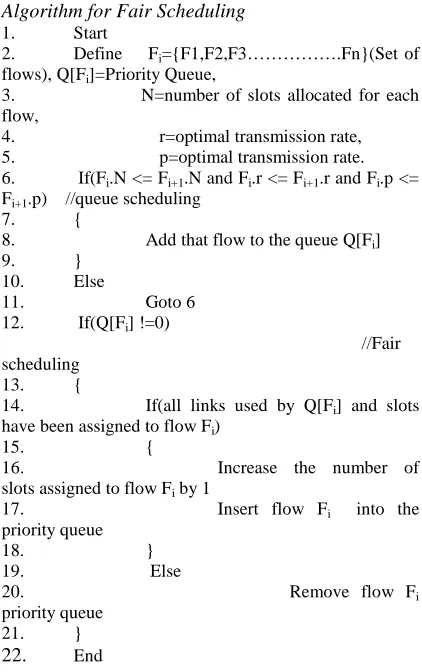
Algorithm for Fair Scheduling
1. Start
2. Define Fi={F1,F2,F3……….Fn}(Set of flows), Q[Fi]=Priority Queue,
3. N=number of slots allocated for each flow,
4. r=optimal transmission rate, 5. p=optimal transmission rate. 6. If(Fi.N <= Fi+1.N and Fi.r <= Fi+1.r and Fi.p <= Fi+1.p) //queue scheduling
7. {
8. Add that flow to the queue Q[Fi]
9. }
10. Else
11. Goto 6
12. If(Q[Fi] !=0)
//Fair scheduling
13. {
14. If(all links used by Q[Fi] and slots have been assigned to flow Fi)
15. {
16. Increase the number of
slots assigned to flow Fi by 1
17. Insert flow Fi into the priority queue
18. }
19. Else
20. Remove flow Fi
priority queue
21. }
22. End
After getting the input priority queue we will apply the fair scheduling algorithm. Each time we pop the flow with the fewest allocated number of slots (for fairness).
In fair scheduling the first requirement is a check is done for all links that the flow uses, to determine all the links of the flows slots have been assigned without conflicts. If the check succeeds, one extra slot for every link of the flow is assigned and flow is inserted into the priority queue once again. If the adding is not feasible, then the flow is removed from the priority queue and no additional slots can be allocated to the flow. The process is repeated until the priority queue is empty. The algorithm results in fair allocations and more slots allocated to flows that use less congested areas. The main advantage of this method is
• By using this algorithm we can achieve the optimal throughput while keeping good fairness.
• No conflicting transmissions
4.SIMULATIONRESULTS
4.1 Simulation Parameters
We evaluate our Link-utility based Improved Backoff Cooperative MAC protocol with Fair Scheduling (LIBCFS-MAC) through NS-2 [14]. We use a bounded region of 1000 x 1000 sqm, in which we place nodes using a uniform distribution. The number of nodes is 50. We assign the power levels of the nodes such that the transmission range as 250 meters . In our simulation, the channel capacity of mobile hosts is set to the same value: 2 Mbps. We use the distributed coordination function (DCF) of IEEE 802.11 for wireless LANs as the MAC layer protocol. The simulated traffic is Constant Bit Rate (CBR).
The following table summarizes the simulation parameters used
No. of Nodes 50.
Area Size 1000 X 1000
Mac 802.11
Simulation Time 50 sec
Traffic Source CBR
Packet Size 500
Transmit Power 0.660 w
Receiving Power 0.395 w
Idle Power 0.035 w
Initial Energy 5.1 J
Transmission Rate 250m
Routing Protocol AODV
Flows 2, 4, 6 and 8.
Rate 50,100,150,200 and 250 Kb.
4.2 Performance Metrics
We compare the performance of our LIBCFS-MAC protocol with Joint Per-Flow Scheduling (JFFS) [13]. We evaluate mainly the performance according to the following metrics:
Average Packet Delivery Ratio: It is the ratio of the number .of packets received successfully and the total number of packets transmitted.
Average Energy Consumption: The average energy consumed by the nodes in receiving and sending the packets.
End-to-End-Delay: It is the amount of time taken by the packet to reach the destination.
Throughput: It is the average number of bits received during the communication process
Fairness: It is the fair share of bandwidth of individual flows from the total allocated bandwidth.
A. Based on Flows
In order to analyze the effect of network contention and interference, we increase the number of connections in this experiment. The number of CBR traffic flows is varied as 2, 4, 6 and 8.
Number of Flows Vs Throughput
0 0.2 0.4 0.6
2 4 6 8
Flow s
T
h
ro
u
g
h
p
u
t
(M
b
/s
)
[image:6.612.319.524.178.296.2]LIBCFSMAC JPFS
Figure 1: Flows Vs Received Bandwidth
Number of Flows Vs Delay
0 0.5 1 1.5
2 4 6 8
Flow s
D
e
la
y
(S
e
c
)
[image:6.612.311.525.219.745.2]LIBCFSMAC JPFS
Figure 2: Flows Vs Delay
Number of Flows Vs DeliveryRatio
0 0.5 1 1.5
2 4 6 8
Flow s
De
li
v
e
ry
Ra
ti
o
LIBCFSMAC JPFS
Figure 3: Flows Vs DeliveryRatio
Number of Flows Vs Energy Consumption
0 10 20
2 4 6 8
Flow s
E
n
e
rg
y
(J
)
LIBCFSMAC JPFS
[image:6.612.97.298.333.488.2]Number of Flows Vs Fairness
0 0.05 0.1 0.15 0.2 0.25
2 4 6 8
Flow s
F
a
ir
n
e
s
s
(
M
b
/s
)
LIBCFSMAC JPFS
Figure 5: Flows Vs Fairness
From figure 1, we can see that the received bandwidth of our proposed LIBCFSMAC is higher than the existing TDMA approach.
From figure 2, we can see that the delay of our proposed LIBCFSMAC is less than the existing TDMA approach.
From figure 3, we can see that the delivery ratio of our proposed LIBCFSMAC is higher than the existing TDMA approach.
From figure 4, we can see that the energy consumption of our proposed LIBCFSMAC is less than the existing TDMA approach.
From figure 5, we can see that the Fairness of our proposed LIBCFSMAC is higher than the existing TDMA approach.
B. Based on Rate
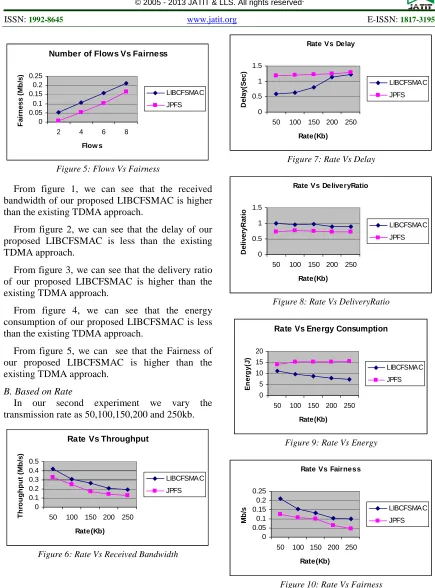
In our second experiment we vary the transmission rate as 50,100,150,200 and 250kb.
Rate Vs Throughput
0 0.1 0.2 0.3 0.4 0.5
50 100 150 200 250
Rate(Kb)
T
h
ro
u
g
h
p
u
t
(M
b
/s
)
[image:7.612.90.525.62.650.2]LIBCFSMAC JPFS
Figure 6: Rate Vs Received Bandwidth
Rate Vs Delay
0 0.5 1 1.5
50 100 150 200 250
Rate(Kb)
D
e
la
y
(S
e
c
)
LIBCFSMAC JPFS
Figure 7: Rate Vs Delay
Rate Vs DeliveryRatio
0 0.5 1 1.5
50 100 150 200 250
Rate(Kb)
D
e
li
v
e
ry
Ra
ti
o
LIBCFSMAC JPFS
Figure 8: Rate Vs DeliveryRatio
Rate Vs Energy Consumption
0 5 10 15 20
50 100 150 200 250
Rate(Kb)
E
n
e
rg
y
(J
)
[image:7.612.95.299.490.607.2]LIBCFSMAC JPFS
Figure 9: Rate Vs Energy
Rate Vs Fairness
0 0.05 0.1 0.15 0.2 0.25
50 100 150 200 250
Rate(Kb)
M
b
/s LIBCFSMAC
JPFS
Figure 10: Rate Vs Fairness
From figure 6, we can see that the received bandwidth of our proposed LIBCFSMAC is higher than the existing TDMA approach.
From figure 8, we can see that the delivery ratio of our proposed LIBCFSMAC is higher than the existing TDMA approach.
From figure 9, we can see that the energy consumption of our proposed LIBCFSMAC is less than the existing TDMA approach.
From figure 10, we can see that the Fairness of our proposed LIBCFSMAC is higher than the existing TDMA approach.
5.CONCLUSION
In this paper, we have proposed a fair scheduling algorithm in Link-Utility-Based Improved Backoff Cooperative MAC Protocol. In fair scheduling algorithm we have used a priority queue to fairly allocate the resources. The priority queue is made up of the number of slots allocated for each flow, optimal transmission rate of flow and optimal transmission power of flow. The main advantage of this paper is no conflicting transmissions, A few number of unallocated slots and by using this algorithm we can achieve the optimal throughput while keeping good fairness.
REFERENCES
[1] Panagiotis Papadimitratos and Zygmunt J. Haas, “Secure Routing for Mobile Ad hoc Networks”, In Proceedings of the SCS Communication Networks and Distributed Systems Modeling and Simulation Conference (CNDS 2002), San Antonio, TX, January 27-31, 2002.
[2] Umang Singh, “Secure Routing Protocols In Mobile Adhoc Networks-A Survey And Taxanomy”, International Journal of Reviews in Computing, 30th September 2011.
[3] R. Vennila and V. Duraisamy, “QoS Based Clustering Technique for Multicast Security in MANET”, European Journal of Scientific Research, Vol.81 No.1, pp.33-46, 2012.
[4] M. Nagaratna, V. Kamakshi Prasad and Raghavendra Rao, “Performance Evaluation of Mesh - Based Multicast Routing Protocols in MANET’s”, International Journal of Advanced Computer Science and Applications, Vol. 2, No. 7, 2011.
[5] P.Priakanth and Dr.P.Thangaraj, “Energy and Channel Aware MAC Protocol to Achieve Fairness in Multi-Hop Mobile Adhoc Networks”, IJCSNS International Journal of
Computer Science and Network Security, VOL.8 No.4, April 2008.
[6] Naouel Ben Salem and Jean-Pierre Hubaux, “A Fair Scheduling for Wireless Mesh Networks”, Laboratory of Computer Communications and Applications (LCA) , Switzerland.
[7] Hamidreza Salarian and Pejman Khadivi, “Fair Data Flows Scheduling Schema for Multihop Wireless Ad Hoc Networks”, IEEE, 2010. [8] Sridhar K N and Mun Choon Chan,
“Channel-aware Packet Scheduling for MANETs”, IEEE, 2008.
[9] Juan José Jaramillo and R. Srikant, “Optimal Scheduling for Fair Resource Allocation in Ad Hoc Networks With Elastic and Inelastic Traffic”, IEEE/ACM TRANSACTIONS ON NETWORKING, VOL. 19, NO. 4, AUGUST 2011.
[10] Rekha Patil, A. Damodaram and Rupam Das, “Cross layer Fair scheduling for MANET with 802.11 CDMA Channels”, IEEE, 2009.
[11] Dang-Quang Bui and Won-Joo Hwang, “Proportionally Quasi-Fair Scheduling Optimization inWireless Ad Hoc Networks”, 26th IEEE International Conference on Advanced Information Networking and Applications, 2012.
[12] Bin Wang and Dongmei Zhao, “Scheduling for Long Term Proportional Fairness in a Cognitive Wireless Network with Spectrum Underlay”, IEEE Transactions On Wireless Communications, Vol. 9, No. 3, March 2010. [13] Dimitrios J. Vergados, Aggeliki Sgora,
Dimitrios D. Vergados and Periklis Chatzimisios, “Joint Per-Flow Scheduling and Routing in Wireless Multihop Networks”, IEEE, 2011.
[14] Network Simulator:
http:///www.isi.edu/nsnam/ns