EFFICIENT HIGH PERFORMANCE MODIFIED STRAIGHT LINE
ROUTING
FOR WIRELESS SENSOR NETWORKS
1Dr.R.KANTHAVEL, 2 R.DHAYA, 3S.VIMAL
1 Prof., Department of ECE , Velammal Engineering College, Chennai, Tamilnadu,India
2
Ass Prof , Department of CSE, Velammal Engineering College, Chennai, Tamilnadu,India
3
Asst. Prof., Department of IT, National Engineering College, Kovilpatti, Tamilnadu,India
E-mail: , [email protected] , [email protected], [email protected]
ABSTRACT
The advancements in communication and embedded technology have created more chances to design energy-efficient wireless network. On the other hand, Wireless Sensor Network plays an important role in surveillance applications includes military applications such as battlefield surveillance, industrial and consumer applications, process monitoring and control, machine health monitoring, and so on. In that the sensor nodes have to be reliable and to be more specific, the protocols should be energy efficient through the best routing with the knowledge of the neighbor nodes in the sensor network. Since in surveillance environment, where all nodes must be easily contacted with each other at any cost without delayed time, large over head and packet loss due to minimum available energy. In this paper, an energy efficient protocol named High Power Energy Aware Routing (HPEAR) has been proposed to increase the life time of the WSN in the congestive environment. The performance of the proposed protocol has also been compared with the existing routing protocols. The simulation results show that the proposed HPEAR is efficiently adapting routes to the nodes with the available power to make the network in to an intelligent one without compromising the Quality of Service.
Keywords: Wireless Sensor Networks (WSN), High Power Energy Aware Routing protocol (HPEAR), Base station(BS)
1.
INTRODUCTIONA Wireless Sensor Network (WSN) is composed of a large number of low cost and low power sensor nodes capable of sensing, computation and communication to achieve complex information gathering and distribution tasks. Each sensor node communicates with its neighbor nodes through the in-built wireless module. A sensor node comprises a sensing unit, a processing unit, a transceiver unit and a power unit. The life time of sensor node is mainly dependent on the power supply from the finite battery source. So, a basic requirement for sensor nodes is to be able to survive with a small finite source of energy for attaining different tasks.
Already many authors put their efforts to utilize the available energy of the sensor nodes using different
routing protocols in order to extend the life time of the network but resulted with the demerits of high time delay, the difficulty in identifying receiver node by sending messages to all nodes in the network that consumes more energy and the load balancing in routing. To overcome the existing shortcomings, it is high requirement to propose a suitable protocol, which is to increase the nodes life time that could lead better reliability and Quality of Service.
2.
PROPOPSED WORKchooses the minimum distance path to reduce routing time from any source node to destination node by distributing energy loads among nodes. The proposed work is divided into three modules namely Identification of Base station, minimum path determination between source to destination, and Comparison with the existing routing protocol.
2.1 Identification of Base Station
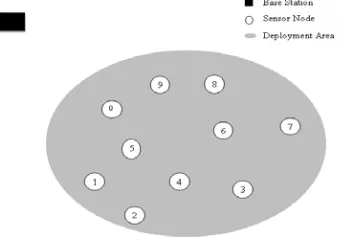
[image:2.612.318.523.242.382.2]The proposed WSN with 10 sensor nodes is shown in Figure 1. Initially, it is assumed that all the nodes in the network have the same power level and so that the task is to find the shortest path to reach the base station from the destination node could be realized.
Figure 1: Proposed Wireless Sensor Network
The number of transmitting and receiving operation for each message to be sent is based on the power level of the nodes. The power category of nodes fall into three levels namely High, Medium and Low. Each node has two identifiers called Power Identifier (PI) and Distance Identifier (DI). PI represents the battery level of the nodes and DI represents the distance between the node and the Base Station. Initially, the base station sends a broadcast message to all sensor nodes in the network in order to determine the location of each node by calculating time needed for each message to reach sensor nodes. This calculated time will be stored in data table of each node and reported back to the base station using special control messages.
2.1.1 Algorithm for Identification of Base Station
The proposed algorithm is illustrated in the Figure 2. Identifying the base station is done by finding the shortest path distance and highest power level.
STEP 1: Store nodes details in appropriate list depending upon power level.
STEP 2: Store the first node details in final list as high, medium, low (or) null.
STEP 3: Find least base distance for each node. STEP 4: Return least base distance.
STEP 5: Display the Base Station.
2.1.2 Determination of Minimum Path
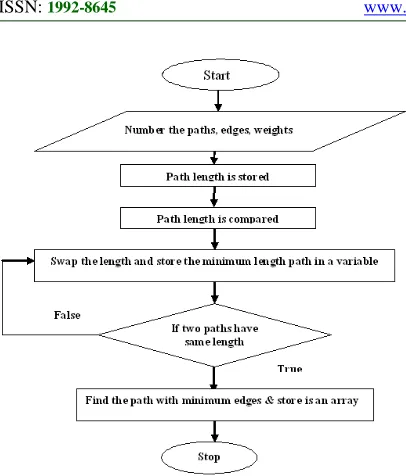
Figure 2 illustrates the minimum path routing method. The Base Station sends a broadcast message to all sensor nodes in the network in order to determine the location of each node.
[image:2.612.104.277.292.411.2].
Figure 2: Minimum Path Routing Algorithm
The source node sends the packet data to the destination node through the shortest path. The shortest path is calculated based on the location of each node. For that Path length is stored and compared by the source node with the available paths. After identifying the Shortest Path in terms of minimum distance, the information is sent through the shortest path from source to receiver.
2.1.2.1 Algorithm for Identification of Minimum
Path
Step 1: Identifying no of path, edges and weights.
Step 2: Path length is stored and compared with source nodes.
Step 3: Swap the length and store the minimum path.
Step 4: If the two paths have same length then go to step3.
Figure 3: Flow Graph For Minimum Path Determination
In Figure 3 , Initially the path lengths are stored and compared. Store the minimum length path in a variable. Find the path with minimum edges and stored is an array. Then print the minimum path.
3. EXPERIMENTAL WORKS AND OUTPUT
The minimum paths between source and destination have been found. Energy usage, average route length and packet delivery ratio have also been calculated.
The Figure 4 shows the proposed WSN,
which has 13 nodes, out of which, node 8 acts as source node, node 11 acts a destination node and remaining nodes are the intermediate nodes as router nodes.
Figure 4: Network Structure Of The Proposed System
Packet Delivery Ratio (PDR):The packet delivery
ratio(PDR) represents the ratio between the number of data packets that are sent by the source and the number of data packets that are received by the receiver.
example:
The source node number=10
Packet delivery ratio =10/10=1 (PDR is 1 because the sensor nodes do not send control packet)
Packet Life Time of Path(PLTP): Packet Life
Time of Path =N*1/n+1
N Number of multiple paths.
n number of nodes.
Average Delay: Average delay time between the
moment a data packet is sent by a data source and the moment the receiver receives the data packet. Average Delay Time =Packet Receiving time –Packet Sending time.
The Figure 5 shows that the source node 8
[image:3.612.93.517.486.700.2]starts to identify the neighbor node for identify the Receiver Node. The source node creates the path by sending the message to its neighbor node 0.
Figure 5: Source Node Starts To Identify The Event Path
source also extend it event path for identify the Intersection point.
Figure 6.: Receiver Node Starts To Identify The Query Path
After identifying the base station, the source
[image:4.612.329.516.263.372.2]node starts identifying the shortest path from the source node to destination node. The source node considers all possible paths and calculates the base distance to select the path at minimum distance. Finally, the data transfer through the shortest path as 8 -> 0 -> 2 -> 5 -> 11 which is shown in Figure 7.
Figure 7: Packet Data Transfer From Node 8 To Node 11
Once, the data reaches the destination node through the minimum shortest path, where the node participated in the routing is only in the on state. So the energy of the remaining non-participated nodes
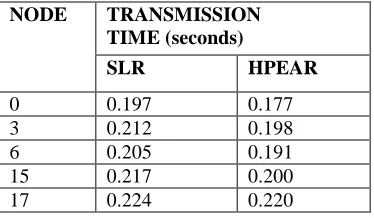
was retained and saved for their turn to be used. Thus the shortest path is identified using the proposed protocol which enhances the life time of the network in a hostile environment. The Figure 9 shows the comparison of transmission time between the proposed and the existing algorithm. It is identified that the transmission time for the data to be sent from the source node to the destination node of the proposed system is less than the existing system.
Table 1: Data Transmission Time For Every Node (SLR Protocol)
NODE TRANSMISSION
TIME (seconds)
SLR HPEAR
0 0.197 0.177
3 0.212 0.198
6 0.205 0.191
15 0.217 0.200
17 0.224 0.220
The Table 1 shows the transmission time of the existing and the proposed shortest path routing protocol calculated from different nodes level. It is found that the transmission time of the HPEAR is very less than the existing shortest path protocol.
Table 2: Total Power Consumed By Number Of Nodes (SLR Protocol) And The Proposed One
PATH DISTANCE
POWER CONSUMED (Jules)
SLR protocol
HPEAR
protocol
5 0.675 0.688
6 0.695 0.704
7 0.777 0.791
8 0.840 0.870
9 0.879 0.908
[image:4.612.93.312.449.664.2]Table 3: Comparative Analysis Of Power Consumption Using Proposed And Existing Shortest Path Algorithm
Path distance POWER CONSUMED
(Jules) SLR protocol
HPEAR protocol
5 0.6880 0.0130
6 0.7046 0.0089
7 0.7913 0.0140
8 0.8702 0.0296
9 0.9083 0.0288
10 0.9794 0.0100
4. CONCLUSION
Since energy efficiency is a major design consideration for routing protocols in WSNs,the High Power Short Distance Routing (HPEAR) has been proposed to increase the life time of the WSN. The results show that HPEAR can increase the lifetime of the network many folds when compared to conventional routing protocol. Furthermore, HPEAR can easily adapt the selection of routes based on the available energy in the network. If the information is send through the shortest path means, the power consumption may be reduced and it is well proved that the life time of the sensor network has been increased. The implemented protocol also has been compared with the existing shortest path algorithm and it is observed that the proposed algorithm performs better in terms of power consumption. And it also provides reliability in a hostile environment with less transmission time. With the proposed algorithm, it is ensured that the WSN can be sustained for a longer time in an environment for surveillance applications. The results are also so encouraging that the proposed method determines the optimum route that consumes less power for the entire routing process.
REFERENCES:
[1] Roch Guerin[2002], “Computing Shortest path for any Number of Hops: theory and experimental evaluation,” in SODA ’02: Proceedings of the fifth annual ACM-SIAM
symposium on Discrete algorithms.Philadelphia, PA, USA: Society
for Industrial and Applied Mathematics, pp. 516–525,June 2002.
[2] Shigang Chen[2004], “Two Techniques for Fast
Computation of Constraing Shortest Paths”
WMCSA '04. Second IEEEWorkshop on,
25-26,
pp. 90 – 100,Feb 2004.
[3] Yuan Li, Wei Ye, and John Heidemann,[2005] “Energy and Latency Control in Low Duty Cycle MAC Protocols”,Wireless Communications and Networking Conference, pp.676 -682,2005.
[4] Huifang Chen,Hiroshi Mingno and Tadanori Mizuno [2006], “An Energy –Aware Routing Scheme With Node Relay Willingness In Wireless Sensor Networks,” Proc. Int’l Symp. World of Wireless, Mobile and Multimedia Networks (WoWMoM),pp. 125-133, 2006.
[5] Mohamed F.Mokbel[2007], “A Delay
Constraint Shortest Path Algorithm For Multicast Routing for Wireless sensor Networks,” Proc. on the HICSS ’07,
pp. 660-770, , Jan, 2007.
[6] Petar Momilovic [2007], “Scalability of Routing Tables in Wireless Sensor networks”,IEEE journal on Selected Areas in
communication,vol.23,no.4,pp.1262-1270,april.2007.
[7] K.Bairaktaris[2008], “Adaptive Probabilistic Secure Routing In Wireless Sensor Networks,” Proc. 33rd Hawaii Int’l Conf. System Sciences, pp. 4-7, 2008
[8] Selcuk Okdem[2009], “Routing in wireless Sensor Networks Using Ant-Colony OPtimization,” J. Sys. Architecture, vol. 46,pp. 919-930, 2009.
[9] Yun Wang,Yoon Kah Leow and Jun Yin [2009], “Is Straight Line Path Always the Best for Intrusion detection in Wireless Sensor Networks 2009”,Sensor 2009,vol.8,pp.564-571.
[10] Ru Huang,Zhihua Chen and Guanghui
Xu[2010], “Energy Aware Routing Algorithm in Wireless Sensor Networks Using
Prediction- mode”,Ad Hoc
Networking.,vol.2,no.4,pp.433-459,2010. [11] Haibo Zhang and Hong Shen[2010], “Energy
Efficient Beaconless Geographic Routing in wireless sensor networks,vol.21,no.6,pp.6-28,June 2010.
[12] D.Baghyalakshmi,Jemimah Ebenezer and
S.A.V.Satyamurty [2010] “Low Latency and
Energy Efficient Routing Protocol For Wireless Sensor Networks”,volume 8 ,pp.179-188,2010.