ISSN: 1992-8645 www.jatit.org E-ISSN: 1817-3195
ENHANCED ROUTING BASED ON GRAPH SPLIT FOR
MULTISERVICE WSNS
JIHED KHASKHOUSSI1, RIDHA OUNI2, ABDELLATIF MTIBAA3
1
PhD Student, EμE Laboratory, Faculty of Sciences of Monastir, Tunisia
2
Asstt Prof, College of Computer and Information Sciences (CCIS), King Saud University (KSU), KSA
3
Prof, EμE Laboratory, Faculty of Sciences of Monastir, Tunisia
E-mail: [email protected] , [email protected], [email protected]
ABSTRACT
The wireless sensors networks (WSN) was developed, in the beginning, for the low bit rate application with low costs and limited resources. Today due to recent advances in electronics devices, it becomes easy to deploy it in many new fields. The medical wireless sensors networks are a new paradigm rising future application to supervise, alert and even cure patients. Medical applications have real severed constraints in terms of packets delivery ratio and End-to-End Delay in an organized network. Power consumption conservation is important but stills a secondary interest because devices for medical uses are always accessible. In this work, we propose a novel protocol called Enhanced-Splitted-MPR-CDS based on older protocols versions investigated, simulated and enhanced. We aim by the Enhanced-Splitted-MPR-CDS to have an organized network topology involving a very small number of active elements to reduce the End-to-End delay and to reduce the network power consumption while considering a medical multiservice WSN.
Keywords
:
MPR-CDS, GS-MPR-CDS, EnGS-MPR-CDS, ECG, PDR.1. INTRODUCTION
A wireless sensor network (WSN) is an interconnected set of sensor nodes that monitor and collect information about the environment and transmit the collected data to the sink node which saves, analyzes and interprets data. Each individual node consists of one or more sensors, a radio transceiver, a microprocessor and a small battery. During the last decade, it has drawn extensive attention due to the wide range of promising applications, such as environmental monitoring, industrial sensing and diagnostics, battlefield surveillance, target tracking, search and rescue, and disaster relief.
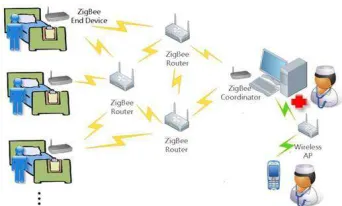
The medical WSN is considered as a new paradigm for supporting remote clinical health care. It allows facilitating preliminary and periodically health diagnostics through the data history of the patients. This paradigm was successfully employed in several pilot studies and commercial applications. It’s composed of many devices (nodes) scattered on the patient body as bracelets. These devices are equipped with physical sensors
[image:1.612.330.501.505.608.2]responsible for measuring target metrics. They collaborate together to send data to one or multiple sinks (doctors and medical staff) for diagnostic and intervention if necessary as shown in figure 1.
Figure 1: Medical Wsn Based On ZigBee Nodes.
ISSN: 1992-8645 www.jatit.org E-ISSN: 1817-3195 In broadcasting problem, one host needs to send a
particular message to the entire network. Broadcasting is applied for publication of services, alarming and other operations. In a straightforward solution to broadcasting, hosts only need to blindly relay packets at least once to their neighborhood. However, this leads to the well-known broadcast storm problem as redundancy and collisions [2,11]. Self-organization protocols are proposed in literature trying to avoid these problems by choosing active and connected nodes set charged of broadcasting and routing.
The concept of multipoint relays [3,4,9]consists of reducing the number of duplicated re-transmissions when forwarding a broadcasted packet. This technique restricts the number of re-transmitters to a small set of nodes, instead of all neighbors, like in pure flooding. This set is kept small as much as possible by efficiently selecting the neighbors which cover (in terms of one-hop radio range) the same network region as the complete set of neighbors does. This small subset of neighbors is called relays for a given network node. The technique of multipoint relays (or MPRs) provides an adequate solution to reduce flooding of broadcast messages in the network, while attaining the same goal of transferring the message to every node in the network with a high probability.
Many works try to minimize the number of dominating nodes in order to reduce the number of retransmission [5,6,7,9]. The problem of transmission cost is critical in the area of WSN because nodes are energy-constrained. Moreover, the minimum connected set is an NP-complete problem [1].
In the present work, we propose an approach to enhance and evaluate a medical WSN [14,15,16] in terms of packet delivery rate, end-to-end delay and network life-time. This approach is based on the application of threes techniques presented as a solution for the power consumption constraint: the graph split, the MPR-CDS and the rules for the Enhanced-MPR-CDS.
As these techniques was presented and evaluated separately, the novelty in this paper is the merge of these different techniques together to obtain an organized network with the best set of relays. We use the resulted network to evaluate a medical WSN where patients are equipped by three sensors and where packets have three different sizes to enable the simulation of the multiservice criteria ignoring the packet priority. Indoor environment and mesh network with low and limited mobility
nodes constraints are assumed to describe the medical WSN.
In this works we aim to evaluate the network power consumption, the network life time, the average packet delay for a multiservice network. We aim to evaluate it by only considering the power consumed by the radio of the motes or nodes and ignoring the power of the processor, LEDs and sensors. Also, we avoid the problem of the network synchronization and we evaluate a single value of the transmission power.
The paper is organized as follows. Section 2 presents and analyzes the MPR-CDS (Connected Dominating Set) protocol. While, Section 3, develops the enhanced network split approach and presents the simulation process and results. Finally, Section 4 concludes the paper.
2. RELATEDWORKS
A good wireless self-organizing protocol must
possess the following primary
attributes [23]: energy efficiency, scalability and adaptability to changes. Attributes such as latency, throughput, and bandwidth utilization are not of primary concern.
There are many work on MPR based CDS construction for efficient broadcasting in WSNs. In [8], the authors proposed the MPR-CDS algorithm where every node v starts by calculating its source dependent MPR and then decides if it belongs to the MPR-CDS or not according to the following simple rules:
• Rule 1: Node u ∈ MPR-CDS if v has the smallest ID in its 1-hop neighborhood.
• Rule 2: Node v ∈MPR-CDS if v ∈ w's MPR where w's ID is the smallest in v's 1-hop neighborhood.
However, the work done in [23] concluded that most of nodes added by rule1 are useless. As result, rule 2 does not have effect in those cases. Consequently, [23] modified rule 1 in its EMPR algorithm as follows:
• Rule 1: node v ∈ MPR-CDS if v has the smallest ID in its 1-hop neighborhood and v has at least two unconnected neighbors.
ISSN: 1992-8645 www.jatit.org E-ISSN: 1817-3195 In another side, [5] suggested that the node
degree is well evaluated based on the CDS size rather than the node ID. This work proposed two rules for node organization based on the degree:
• Rule 1: node v ∈MPR-CDS if v has the largest node degree among all its one-hop neighbors and v has two unconnected neighbors.
• Rule 2: node v ∈ MPR-CDS if v has been selected as an MPR and its selector has the largest node degree among its one-hop neighbors.
In [4], the authors provided extensions to create smaller CDS using complete 2-hop information to cover each node’s 2-hop neighbor set. They extend the coverage aspect proving a constant local approximation ratio compared with a logarithmic local ratio in the original MPR.
[24] proposed a distributed algorithm for energy efficient stable MPR based CDS construction to extend the lifetime of ad hoc wireless networks by considering energy and node’s velocities. This work implemented route discovery protocol using the CDS nodes to relay route request packets.
Qayyum et al. proposed multipoint relays (MPR) [10, 20] to optimize the relay sets. This method requires nodes have the knowledge of the network topology within 2-hop coverage. The nodes include the 1-hop neighbors in a greedy fashion to be the MPR that can reach the largest 2-hop neighborhood, until every node in the network can be reached by the MPR. The protocol has been improved in [21].
In [22], a tree based data collection scheme (TBDCS) is proposed using vertex covers approach for covering nodes. Both MPR and TBDCS use neighbor knowledge based on the child set to identify the relay set. However, this work ignores the links between the siblings.
3. WSN SELF-ORGANIZATION
PROTOCOLS
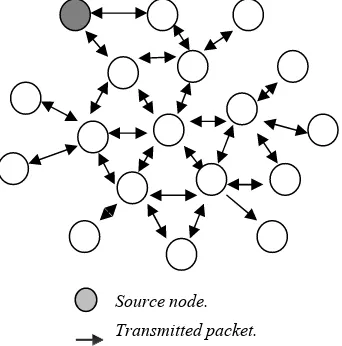
Primitive network is based on blind flooding as shown on Fig.2. A packet is retransmitted by all the intermediate nodes in order to broadcast it in the network. It is simple, easy to implement, and gives a high probability that each node, which is not isolated from the network, will receive the broadcasted message. However, it consumes a large amount of bandwidth due to many un-useful redundant retransmissions.
Many techniques are described in the literature to reduce traffic flooding in WSNs. But, each technique is developed for a target application and characterized by its own advantages and disadvantages. Here, we will discuss the “multipoint relaying” mechanisms as possible solutions. These mechanisms are based on neighbor knowledge.
[image:3.612.317.488.337.510.2]The neighbor knowledge process uses HELLO message defined by Mobile ad hoc Network (MANET) [6]. These messages are broadcasted to all neighbors at regular time intervals [6]. They contain information about the neighbors and the link state. Each input has an associated timeout, a guard time and the type of link: asymmetric or symmetric. After two rounds of beacons HELLO messages, the entire network nodes have the lists of their 1-hop and 2-hop neighbors needed to calculate the relays nodes.
Figure 2: Flooding In WSN.
A sample of HELLO process is described in Fig.3 Where node “A” sends his first message (empty). Then node “C” sends his first message (empty). When node “B” receives the above messages it adds node “A” and node “C” as 1-hop neighbors. The first node “B” HELLO message contains A and C. When node “A” receives the message from “B” it adds B as 1-hop neighbor and C as 2-hop neighbor. Also node “C” will adds node “B” as 1-hop neighbor and node “A” as 2-hop neighbor. In this Sample one HELLO round is needed to complete the neighbors lists while a second round is necessary for other complex and dense networks.
ISSN: 1992-8645 www.jatit.org E-ISSN: 1817-3195
Figure 3: HELLO Process.
Adjih et al. proposed a novel extension of the MPR to construct a small CDS source independent using two simples rules based on the node ID and the greedy algorithm [8]. In the present work, the node is selected into the dominating set of the network if:
• It has the greatest degree (degree of a node is the number of its direct neighbors) than all its neighbors.
• It is a multipoint relay selected by its neighbor with the largest degree.
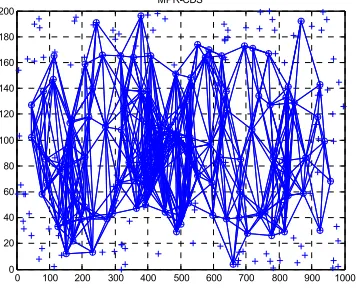
The multipoint relays are selected using the greedy algorithm. Nodes with highest degrees calculate their relays and call them to join the CDS at the third round of HELLO messages. Figure 4 shows an MPR-CDS application for a random topology generated by MATLAB of 200 elements (nodes) on a surface of 1000 by 200 units. The radio coverage is fixed to 80. This topology is kept on the following Sections to compare the deployed protocols.
0 100 200 300 400 500 600 700 800 900 1000 0
20 40 60 80 100 120 140 160 180 200
MPR-CDS
Figure 4: MPR-CDS WSN Self-Organized Where Lines Are The Links Between Relays.
4. ENHANCEDNETWORKSPLIT
4.1.Graph Splitting
We assume that during HELLO message process, nodes are able to calculate their ranks defined as follow:
Definition: The rank of node u, rank(u), is the
minimum number of hops between source node and node u.
The source node has the rank zero. HELLO packet contains the number of hops between the node and the source. The nodes will receive many values of hops numbers and they have to take the minimum. The MaxRnk is the greatest rank in the network [13].
[image:4.612.319.517.398.508.2]We split the global graph G into two sub-graphs G1 and G2as shown in Figure 5. For each node u:
Figure 5: Graph decomposition Concept.
Applying the MPR-CDS technique on G1 (CDS1) and G2 (CDS2). The CDSs are connected while the global CDS for the graph G is not connected. We propose to create a new sub-graph Gi (CDSi) in the interface of G1 and G2 to connect the CDSs. The global CDS becomes:
Figure 6 shows the application of the splitting of the same topology used on the network of Figure 4 where the number of relays is reduced.
Rank =
Rank = Rank =
Rank = m+1 Rank = n G1
G2
Gi
A
1B
3C
2Hello (Empty) Hello (Empty)
Hello (A, C) Hello (A, C)
1-hop: A,C
Ø
1-hop: B 2-hop: A
[image:4.612.109.287.544.688.2]ISSN: 1992-8645 www.jatit.org E-ISSN: 1817-3195
0 100 200 300 400 500 600 700 800 900 1000 0
20 40 60 80 100 120 140 160 180 200
[image:5.612.91.309.73.255.2]MPR-CDS Graph Split
Figure 6: MPR-CDS Graph Split WSN self-Organized Where Lines Are The Links Between Relays.
4.2.Enhanced Graph Split
Aiming to minimize redundancy, authors in [12] presents new rules to apply with the MPR-CDS protocol. The new protocol is called Enh-MPR-CDS (Enhanced-MPR-Enh-MPR-CDS) [12].
Idea:
Relays surrounded by a large number of relays may be a source of redundancy.
Therefore, all dominants satisfying the following rules could be outdated from the dominant set:
• Rule 1: Dc > 0.79(simulation result [12]).
• Rule 2: min (cardm(ni)) > 1 (ni dominant
neighbor of node i ). Where:
- Card(i) is the number of node’s i
neighbors.
- Cardm(i) is the number of node i
neighbor’s which are dominant.
- .
The Enh-MPR-CDS protocol was compared to the MPR-CDS. Results confirm that a significant amount of dominants may be removed while the connectivity is still guaranteed.
Figure 7 illustrates the application of the proposed rules on the same network topology of
Figure 4 and Figure 5 showing a reduction of the number of relays.
0 100 200 300 400 500 600 700 800 900 1000 0
20 40 60 80 100 120 140 160 180 200
Enhanced-MPR-CDS Graph Split
Figure 7: Enhanced MPR-CDS Graph Split WSN Self-Organized Where Lines Are The Links Between Relays.
5. SIMULATION AND RESULTS ANALYSIS
5.1.Simulation environment
The simulation is a very important step to improve the ability and the efficiency of our proposal. CASTALIA [17] is one of the best tools capable of modeling and evaluating new protocols for wireless sensors networks.
In this work, the network topology includes 100 nodes or patients with three packets sizes for each node to enable the multiservice concepts. These packets have the same priority order (First IN - First OUT). We wrote a new application to support the behavior of the MPR-CDS, the Split-MPR-CDS and the enhanced organized network where only relays or dominants nodes can forward packets.
Simulation process implantation is described as follow:
• Ranking: to support this step a new field is added to the HELLO packet. This field contains the rank of each node. Sink node initiate the HELLO process with rank 0.
• Network Organization: nodes with greatest numbers of neighbors become dominants and they calculate relay’s (informed at 3rd HELLO round). Dominants satisfying the rules of Section 3.2 are eliminated from the dominant set.
[image:5.612.330.519.107.284.2]ISSN: 1992-8645 www.jatit.org E-ISSN: 1817-3195 (1 of 3 sizes configured). Dominants forward
received packet once.
[image:6.612.320.516.73.253.2]The simulation study was carried out to evaluate the performance of the network based on the packet delivery ratio, the end-to-end delay and the network life time with the parameters of Table 1.
Table 1: Simulation Parameters
Parameter Value
Area 1000*500
Topology Random
TxOutputPower 0
packetHeaderOverhead 5
Packet size (byte) 1 / 3 / 400
5.2.Simulation Analysis
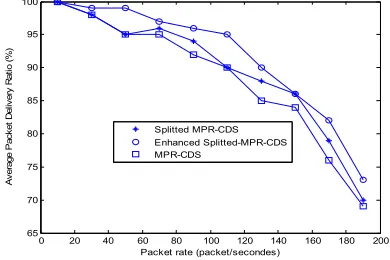
Figure 8 illustrates the ratio of the number of delivered data packet to the destination. The Enhanced Splitted-MPR-CDS has a higher packet delivery ratio (PDR) than that of Splitted-MPR-CDS or MPR-Splitted-MPR-CDS. Thus, this proves that the PDR is performed with the decrease of the number of forwarding nodes (Dominated Set or relays).
0 20 40 60 80 100 120 140 160 180 200
65 70 75 80 85 90 95 100
Packet rate (packet/secondes)
A v e ra g e P a c k e t D e liv e ry R a ti o ( % ) Splitted MPR-CDS Enhanced Splitted-MPR-CDS MPR-CDS
Figure 8: Average Packet Delivery Ratio For MPR-CDS, Splitted-MPR-CDS And Enhanced Splitted-MPR-CDS.
Figure 9 shows the average time taken by a data packet to reach destination. The average time also called end-to-end delay includes the delay caused by the queue in data packet transmission. The lowest values are given by the Enhanced splitted network compared to Splitted-MPR-CDS and MPR-CDS. The difference is due to the variation (decrease) of the number of links since the dominated set is performed.
5 10 15 20 25 30 35 40 45 50 0 0.5 1 1.5 2 2.5 3 3.5
Packet rate (packets/seconde)
[image:6.612.325.506.428.560.2]A v e ra g e E n d -T o -E n d D e la y ( s e c o n d s ) Splitted-MPR-CDS Enhanced Splitted-MPR-CDS MPR-CDS
Figure 9: Average End-to-End Delay For MPR-CDS,Splitted- MPR-CDS And Enhanced
Splitted-MPR-CDS.
The number of nodes alive for each round of data transmission is observed for the different protocols to evaluate the lifetime of the network. Figure 10 shows the performance of Enhanced Splitted-MPR-CDS compared to Splitted-Splitted-MPR-CDS and MPR-CDS. It is observed that the Enhanced CDS outperforms Splitted-MPR-CDS and MPR-Splitted-MPR-CDS due to reduced power dissipation of individual node throughout the network.
0 1000 2000 3000 4000 5000 6000 7000 8000 9000 0 10 20 30 40 50 60 70 80
Number of rounds
R e s id u a l E n e rg y ( J ) Splitted-MPR-CDS Enhanced Splitted-MPR-CDS MPR-CDS
Figure 10: Network Life Time For MPR-CDS, Splitted- MPR-CDS And Enhanced Splitted-MPR-CDS.
6. CONCLUSIONS
In this paper, we have investigated the concept of splitting the network topology into three graphs and we have added new rules to the selected set obtained aiming to remove more elements. Results proof the decrease of the number of dominant selected which minimize the number of re-transmitted packet in the network each cycle.
[image:6.612.98.293.434.564.2]ISSN: 1992-8645 www.jatit.org E-ISSN: 1817-3195 end-to-end delay were investigated and was
accepted to support the multiservice constraints. Simulation results proved that the optimization of the number of relays increase the network life compared to the MPR-CDS and the Splitted-MPR-CDS due to the reduction of the number of transmitted and listened copy of packets. Also, it reduces the end-to-end delay and increases the average packet delivery ratio when the number of involved dominant in the packet delivery process was reduced.
Without considering the synchronization problems and the power consumption of the components of the network nodes, results confirm that the splitting of the network have a direct effect on the power consumption. We also can use these results, in future works, to deploy many other self-organization protocols to more enhance the power consumption and the network life time. Protocol choice will be based on the network area: for example we can some protocols for the outdoor area and some others for the indoor part when we have a network deployed in double area at the same time.
REFRENCES:
[1] Rahim Kacimi, “Technique de conservation d’énergie pour les réseaux de capteurs sans fils”, PhD thesis, Polytechnic of toulouse, 2010.
[2] Ozan K.Tonguz, N. Wisitpongphan, Jayendra S. Parikh, F. Bai, P. Mudalige, and Varsha K. Sadekar, “On the broadcast storm problem in ad hoc wireless networks”, Broadband Communications, Network and Systems, 2006. [3] Karel Heurtefeux and Fabrice Valois, “self-organization protocols: behavior during the sensor networks life”, The 18th Annual IEEE International Symposium on Personal, Indoor and Mobile Radio Communications, 2007. [4] Jie Wu, Wei Lou and Fei Dai, “Extended
Multipoint relays to determine connected dominating sets in MANET’s”, IEEE transaction on computer, vol. 55, NO. 3 March 2006.
[5] Xiao chen and Jian Shen, “Reducing connected dominating set size with multipoint relays in ad hoc wireless networks”, Proceed. Of the 7thinternational Symposium on parallel architecture, algorithms and networks, 2004. [6] Rajiv Misra, “On self-stabilization of
multipoint relays for connected dominating set in ad hoc networks”, IEEE region 10 conference, TENCON 2009.
[7] Yongsheng Fu, Xinyu Wang, Wei Shi and Shanping Li, “Connectivity based greedy algorithm with multipoint relaying for mobile ad hoc networks”, The 4th international conference on mobile ad-hoc and sensor network, 2008.
[8] Cedric Adjih, philipe Jacquet and Laurent Viennot, “Computing connected dominated sets with multipoint relays”, Ad Hoc and Sensor Wireless Networks, vol. 1, no. 1-2, 2005, pp. 27–39.
[9] T.Claussen, P.Jacquet, C. Adjih, A. Laouiti, P. Minet,P. Muhlethaler,A. Quayyam and L. Viennot, “Optimized link state routing protocol (OLSR)”, RFC 3626, Oct. 2003, Network Working Group.
[10]C. Bettestetter, “On the minimum node degree and connectivity of a wireless multi-hop network”, in Proc. ACM MobiHoc, Lausanne, Switzerland, Jun. 2002.
[11]S. Crisostomo, J.Barros and C. Bettstetter, “Flooding the network: Multipoint relays versus network coding”, Circuits and Systems for Communications, 2008.
[12] Jihed Khaskhoussi, Ridha Ouni,” Enhanced-MPR-CDS approach for self-organization and routing in WSNs”, 1st Taibah University International Conference on Computing and Information Technology Madinah Al-Munawwarah, Saudi Arabia, 12-14 March 2012.
[13] Ridha OUNI, “Graph splitting based self-organization approach for energy and routing optimization”, International Journal of Digital Information and Wireless Communications (IJDIWC) 1(3), 2012, pp 738-744.
[14] Janani.K, V.R.Sarma Dhulipala and R.M.Chandrasekaran, “A WSN based framework for humain health monitoring “, Devices and Communications (ICDeCom), Feb. 2011, pp 1-5.
[15] H.Furtado and R.Trobec, “Application of Wireless Sensors in Medicine”, MIPRO, Croatia, May 2011, pp 257-261.
[16] Sofia N. R. and R. Ahmad, “Surveying the Wireless Body Area Network in the realm of Wireless Communication”, Information Assurance and Security (IAS), 7th International Conference on, 2011, pp 58-61. [17] Rastegarnia, A. ; Solouk, V., “Performance
ISSN: 1992-8645 www.jatit.org E-ISSN: 1817-3195 [18] Xiaohua Xu, Xiang-Yang Li and Min Song,
“Distributed scheduling for real-time data collection in Wireless sensor networks”, Global communication Conference (GLOBECOM), 2013, pp 426-431.
[19] Celada-Funes, E.Alonso-Roman, D.Asensio-Marco, C. ; Beferull-Lozano, B.“a reliable CSMA protocol for high performance broadcast communication in a WSN”, Global communication Conference (GLOBECOM), 2014, pp 473-479.
[20] A. Qayyum, L. Viennot, and A. Laouiti, “Multipoint relaying for flooding broadcast messages in mobile wireless networks,” HICSS ’02: Proceedings of the 35th Annual Hawaii International Conference on System Sciences (HICSS’02), vol. 9, 2002, pp. 298-307.
[21] F. Ingelrest and D. Simplot-Ryl, “Maximizing the probability of delivery of multipoint relay broadcast protocol in wireless ad hoc networks with a realistic physical layer,” ArXiv Computer Science e-prints, January 2007.
[22] H. Li, H. Yu, and A. Liu, “A tree based data collection scheme for wireless sensor network,” ICNICONSMCL ’06: Proceedings of the International Conference on Networking, International Conference on Systems and International Conference on Mobile Communications and Learning Technologies (ICNICONSMCL’06), 2006, pp. 119–123.
[23] J.Wu & W. Lou, “Extended Multipoint Relays to Determine Connected Dominating Sets inMANETs”, IEEE Transaction on Computers, vol. 55, 2006, pp. 334-347. [24] Ramalakshmi R, Radhakrishnan S, Improving