Full Length Research Article
NATURE INSPIRED METAHEURISTIC ALGORITHMS-A COMPARATIVE REVIEW
*
Rajesh Kumar Sahoo, Deeptimanta Ojha and Satyabrata Dash
Department of Computer SC. and Engineering, A.B.I.T, Odisha, India
ARTICLE INFO ABSTRACT
Many metaheuristic algorithms are used for solving different optimization problems efficiently. From these metaheuristic algorithms, nature-inspired optimization algorithms are widely used to find better solutions and their best results. In this paper, five types of metaheuristic algorithms such as Particle swarm optimization (PSO) algorithm, Bee colony optimization (BCO) algorithm, Bat algorithm (BA), Cuckoo search (CS), Firefly algorithms (FA) were used as the basis for comparison. Particle swarm optimization algorithm is based on the interactions between social insect, swarms. The Bee colony optimization algorithm is influenced by the foraging behavior of honey bees. Cuckoo search uses brooding parasitism of cuckoo species and bat algorithm is inspired by the echolocation of microbats. Firefly algorithm is emphasized by the flashing behavior of swarming firefly.
Copyright©2016, Rajesh Kumar Sahoo et al. This is an open access article distributed under the Creative Commons Attribution License, which permits unrestricted use, distribution, and reproduction in any medium, provided the original work is properly cited.
INTRODUCTION
Optimization is a process to take best values of different parameters of the specific problem under specified conditions, i.e. generally it automatically finds the different parameter values which enable an objective function to generate the maximum or minimum value. An optimization algorithm is a procedure which is executed iteratively by comparing various solutions till an optimum or a satisfactory solution is found. Metaheuristic algorithms are considered to be the most efficient algorithms to solve the optimization problems because of their easy implementation and gives better results. Nature inspired algorithms are widely used to find the best solutions for various optimization problems. In this paper a
comparative study of Nature inspired metaheuristic
optimization algorithms is presented based on the objective
function (Iztok Fister et al., 2013; Yang, 2011). In this paper
our aim is to compare five types of nature inspired metaheuristic algorithms such as Particle swarm optimization (PSO) algorithm, bee colony optimization (BCO) algorithm, bat algorithm (BA),cuckoo search(CS),Firefly algorithms(FA). Section1 describes the brief introduction.
*Corresponding author: Rajesh Kumar Sahoo,
Department of Computer SC. and Engineering, A.B.I.T, Odisha, India.
Section 2 explains the various Nature inspired metaheuristic algorithms with their pseudo-code. Comparison of these algorithms is done in Section 3. Section 4 finally concludes the paper.
NATURE INSPIRED ALGORITHMS
Particle swarm optimization (PSO)
The PSO that is proposed by Eberhart and Kennedy in 1995. PSO is a meta-heuristic algorithm inspired by the group behavior of animals like bird flocks or fish schools. In PSO algorithms, the population P={p1,…,pn} of the feasible solutions is often called a swarm. The feasible solutions p1,…,pn are called particles.
For solving practical problems, the number of particles is usually chosen between 10 and 50.At the beginning of this algorithm, the particle positions are randomly initialized, and the velocities are set to 0, or to small random values. Parameters w(inertia weight) usually decreasing from around 0.9 to around 0.4 during the computation and c1,c2 (acceleration coefficients) usually between 0 and 4 (Kennedy and Eberhart, 1995; Wikipedia;http:// en. Wikipedia .org/wiki/ Swarm_intelligence).
ISSN: 2230-9926
International Journal of Development Research
Vol. 06, Issue, 07, pp.8427-8432, July,2016
International Journal of
DEVELOPMENT RESEARCH
Article History:
Received 15th April, 2016 Received in revised form 26th May, 2016
Accepted 14th June, 2016
Published online 31st July, 2016
Key Words:
Metaheuristic,
Particle Swarm Optimization Algorithm, Bee Colony Optimization Algorithm, Bat Algorithm,
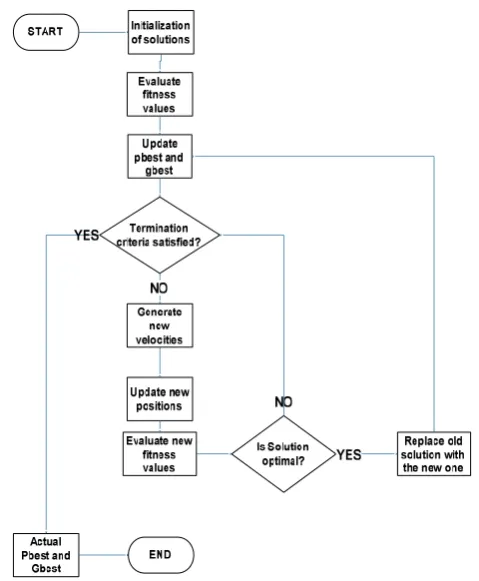
The flow chart of Particle Swarm Optimization is depicted in Fig. 1.
Fig.1. Flow chart of Paticle Swarm Optimization (PSO)
A. Pseudo code of PSO
Initialize the number of generation t=0.
Initialize a swarm population size.
Initialize the swarm position 'x' and velocity 'v'
Evaluate the initial fitness function value 'fx'
Find the local best pbest and global best gbest Initialize different PSO parameters, i.e., c1, c2, w
While (t<Max_Iteration)
Update velocity v1 by using the following equation
v1=w*v+c1* (best-x) *rand () +c2* (gbest-x) *rand ();
Update position
x1=x+v1
Check the boundary conditions
Evaluate the new fitness function
Update current local best pest and the global best best Generation (t) =Generation (t) +1
End While
Select the solution with best fitness function value
ARTIFICAIL BEE COLONY OPTIMIZATION
Artificial Bee Colony (ABC) is a meta-heuristic algorithm
introduced by Karaboga in 2005
(http://www.scholarpedia.org/article/Artificial_bee_colony_al gorithm; Karaboga, 2005). This algorithm simulates the foraging behavior of honey bees. Bee Colony Optimization (BCO) is an optimization tool which provides a population based search procedure, where the bees locate the food source positions (http://www.scholarpedia.org/article/ Artificial_ bee_
colony_algorithm; http://en.wikipedia.org/wiki/Bee). The
colony of bees in ABC algorithm comprises of three groups of
bees: employed bees, onlookers and scouts bees
(http://www.scholarpedia.org/article/Artificial_bee_colony_al gorithm). Employed bees forage in search of their food source and return to hive .Onlooker bees decide their food source depending upon the dances of employed bees. A nectar source is selected through a nest mate whose food source has already discovered. After collecting the nectar the bees return to their hive to a food store bee. After relinquishing the food, the bee is having one of the alternatives with a certain probability (a) abandon the food source and act as an uncommitted follower, (b) Without enlisting the nest mates, continue to forage at the food source or (c) enlist the nest mates by dancing before the return to the food source. It is also noted that not all bees start foraging simultaneously (http://en.wikipedia.org/wiki/Bee; Karaboga, 2005).
The flow chart of Artificial Bee Colony is depicted in Fig. 1.
B. Pseudo code of BCO
Initialize the number of generation t=0.
Initialize population size.
Evaluate its fitness function value 'fx'.
Find the initial best solution
While generation (t) <500 do
//Employed Bee Phase
Produce new candidate solution Check the boundary conditions Evaluate its fitness value If (fitness (n) >fitness (old)) Then replace the old solution //Probability Calculation Phase
Calculate the probability of occurrence of each solution P
//Onlooker Bee Phase If P>Rand ()
Produce new candidate solution Check the boundary conditions Evaluate its fitness value If (fines's (n) >fitness (old)) Then replace the old solution Memorize the best solution Generation (k) =Generation (k) +1 End While
Select the best solution having the best fitness value
FIREFLY ALGORITHM
The Firefly algorithm was introduced by Dr. X.S. Yang at Cambridge University in 2008.This algorithm was inspired by the mating or flashing behavior of fireflies. The behaviors of fireflies or lightning bugs belong to a family of insects which are capable to produce natural light to attract a mate or prey. The intensity (I) of the flashes, decrease as the distance (r) increase and thus most fireflies can communicate only up to several hundred meters. In the implementation of the algorithm, the flashing light which is associated with the objective function to be optimized (Sankalp Arora and Satvir Singh, 2013).
In firefly algorithm, there are three idealized rules:
A firefly will be attracted by other fireflies without
considering their gender.
Attractiveness of fireflies is directly proportional to the
brightness and the two factors like attractiveness and brightness reduces as the distance among the fireflies’ increases.
A less bright firefly will move towards the brighter
firefly. All the fireflies randomly move towards the brightness.
The objective function determines the brightness of a
firefly (Yang, 2009) (Sankalp Arora and Satvir Singh, 2013).
The flow chart of Firefly Algorithm is depicted in Fig. 1.
Fig.1. Flow chart of Firefly Algorithm
The pseudo code of the Firefly algorithm can be
C. Pseudo code of FIREFLY
Initialize the number of generation t=0.
Initialize fire flies population size.
Generate initial solutions
Evaluate the initial Light Intensities value 'I' Find the initial best solution
Define light absorption coefficient γ
Initialize different Firefly parameters i.e.β0,α.
While generation (t) <500 do For i=1 to n fireflies For j=1 to n fireflies
If Intensity (j) >Intensity (I) Evaluate distance r.
Update new solution with the help of following equation
xnew=x(i)+β0*e-γr*(x(j)-x(i)+min_val*α*(rand-0.5)
Check the boundary conditions Evaluate the new fitness function End if
End for End for
Update current best solution Generation (t)=Generation(t)+1 End While
CUCKOO SEARCH (CS) ALGORITHM
The Cuckoo Search (CS) a metaheuristic algorithm which is population based, where each pattern corresponds to a nest and each individual attribute of the pattern corresponds to the egg of the bird (Sankalp Arora and Satvir Singh, 2013). This algorithm is based on the brooding characteristics of the cuckoo bird through their species where they lay their eggs in the nest of host birds. Host birds either throw their eggs away or destroy their nests if they find that eggs do not belong to them. Some cuckoo species like Tapera have evolved in such a way that female parasitic cuckoos are often specialized in the mimicry in colors and pattern of the eggs of a few chosen host species (Yang and Deb, 2009).
CS is based on three idealized rules:
Each cuckoo lays one egg at a time, and dumps its egg
in a randomly chosen nest;
The best nests with high quality of eggs will carry over
to the next generation;
The number of available host nest is fixed and the egg
laid by a cuckoo is discovered by the host bird with a
probability Pa€ (0,1). In this case the host bird can
either throw the egg away or abandon the nest so as to build a completely new nest in a new location.
The host can discover an alien egg with a probability. The egg in a nest represents a solution while the cuckoo's egg represents a new solution. The main aim is to achieve better solutions by employing a new better egg, which is from cuckoo to replace not so good solutions in the nest (Nitesh Sureja, 2012; Sankalp Arora and Satvir Singh, 2013).
The flow chart of Cuckoo Search is depicted in Fig. 1.
Fig.1. Flow chart of Cuckoo Search
D. Pseudo code of CUCKOO search
Initialize the number of generation t=0. Initialize population size.
Evaluate its fitness function value 'fx' Find the initial best solution While generation(t)<500 do for i=1 to no_of_cuckoo
Get a cuckoo randomly by Levy flights Calculate different parameters
Produce new solution
Check the boundary conditions Evaluate its fitness value If (fines's (n)>fitness(old)) Then replace the old solution
Calculate probability of occurrence of each solution Abandon a fraction of worst nest having probability < pa Build new nest at new location via Levy Flights
Check the boundary conditions
Rank the solution and find out the current best End for
Generation (k) =Generation (k) +1 End While
Select the best solution having the best fitness value
BAT ALGORITHM(BA)
Bat-inspired algorithm is a metaheuristic search optimization algorithm. It was introduced by X.S Yang in 2010. This algorithm is based on the echolocation behavior of bats with loudness and varying pulse emission (Sankalp Arora and Satvir Singh, 2013). The characteristics of bat’s echolocation can be summarized as:
Bat use echolocation to sense the distance and have a magical mechanism to differentiate between prey and barrier even in the darkness. To search prey, they fly randomly with velocity vi, at position xi with fixed frequency fmin, loudness A0 and wavelength λ. Loudness varies between A0 (maximum value) to Amin (minimum value). Frequency ranges between fmin and fmax and wavelength ranges between λmin and λmax.
When bats start to search for food or prey, they will produce pulses with maximum loudness. As they approach the prey, the loudness decreases. As soon as the bat finds the prey, the loudness becomes the minimum possible value (usually zero), in order to avoid the loss of prey. Similarly, as the bat goes closer to the prey, the pulse emission rate gets increased. Once they find the prey, the pulse emission rate becomes the maximum possible value (Yang, 2010). Each bat is assigned a starting position which is the initial solution.
The pulse rate and the loudness are defined randomly. Every bat will move from local solutions to global best solutions afterevery iteration. The values of pulse emission and loudness are updated if a bat finds a better solution after moving. This process is continued till the termination criteria is satisfied. The solution which achieved is the final best solution
The flow chart of Bat Algorithm is depicted in Fig. 1.
E. Pseudocode of BAT Algorithm
Initialize the number of generation t=0. Initialize population size.
Evaluate its fitness function value 'fx' Find the initial best solution
While generation (t) <500 do
Generate new solution by adjusting frequency and updating Velocities and its position
If Rand> pulse rate r
Generate a local solution around the best solution Check the boundary conditions
Evaluate its fitness value
If (fines's (n) >fitness (old) and Rand <A) Then replace the old solution
End if
Rank the solution and find out the current best Generation (k) =Generation (k) +1
End While
Select the best solution having the best fitness value
COMPARATIVE ANALYSIS OF VARIOUS NATURE INSPIRED ALGORITHMS
We have presented a comparative review of five metaheuristic natures inspired algorithms by considering the case study,that is withdrawal operation of an ATM.
The following table is represented through this case study, year of development and factors defined by the objective functions with results.
Conclusion
Some of the algorithms, like PSO, BCO, Firefly, cuckoo and Bat have been analyzed based on some parameters. We reviewed various research papers from various authors and have drawn a conclusion that these algorithms have the ability to solve various optimization problems. From the comparison of PSO, BCO, Firefly, cuckoo and Bat optimization algorithm, it is clear that BCO and Firefly algorithms are the most efficient optimization algorithms as well as the favorable optimization tool. In future we analyze more such algorithms using different parameters for automated test case generations.
REFERENCES
Homayun Afrabandpey, Meysam Ghaffari, Abdolreza Mirzaei, Mehran Safayani, 2014. “A Novel Bat Algorithm Based on Chaos for Optimization Tasks,”pp. 4799-3351, 2014. Iztok Fister Jr., Xin-She Yang, Janez Brest and Dusan Fister,”
2013. A Brief Review of Nature-Inspired Algorithms for Optimization,” Elektrotehniski vestnik 80(3):1-7,English Edition.
Karaboga, D. 2005. “An Idea Based on Honey Bee Swarm for Numerical Optimization,” Technical Report-TR06, Erciyes University, Computer Engineering Department, Turkey, 2005.
Kennedy, J. and Eberhart, R. 1995. "Particle Swarm
Optimization".Proceedings of IEEE International
Conference on Neural Networks.IV. pp. 1942–1948. Nitesh Sureja, 2012. ”New inspiration in nature – A survey,”
International journal of computer applications and information technology, pp.21-24.
Nitesh Sureja, 2012. ”New inspiration in nature – A survey,”
International journal of computer applications and information technology, pp.21-24.
Sankalp Arora, Satvir Singh, 2013. “A Conceptual Comparison of Firefly Algorithm,Bat Algorithm and Cuckoo Search,”pp. 978-1-4799-1375.
Sankalp Arora, Satvir Singh, 2013. “A Conceptual Comparison of Firefly Algorithm, Bat Algorithm and Cuckoo Search,”pp. 978-1-4799-1375.
Scholarpedia;http://www.scholarpedia.org/article/Artificial_be e_colony_algorithm. Wikipedia; http://en.wikipedia.org/wiki/Bee Wikipedia;http://en.wikipedia.org/wiki/Swarm_intelligence. Initialization of bat population Evaluate fitness values Termination criteria satisfied?
Generate new solutions by adjusting frequency
and velocity Select the best solution NO Best Solution YES END START
Is pulse rate > rand(0,1)
Generate local solution around best solution
Generate a new solution by flying randomly
Is Loudness > rand(0,1) and new fitness >
[image:5.595.37.553.80.179.2]old fitness Evaluate its fitness value Accept new solution Find the current best solution
Table 1. A comarative review of different natural meta heuristic algorithms
Algorithm A year of development Developed by Based on Objective function defined by Results
PSO 1995 Ebehart &
Kennedy
Behavior of animals like bird flocks or fish schools
Position, velocity, weight & acceleration coefficients
Good
BCO 2005 Karaboga Foraging behavior of honey bees Fixed number of regions within a search space at one time
Better
Firefly 2008 X.S. Yang Flashing behavior of firefly Light Intensity (Brightness) & attractiveness
Better
Cuckoo search 2009 X.S. Yang & suash Deb
Brood parasitism of cuckoo Colour of eggs Not so Good
Yang, X. S. 2009. Firefly algorithms for multimodal optimization, Stochastic Algorithms: Foundations and Applications (SAGA 2009, Lecture Notes in Computer Sciences, Vol. 5792, 2009)169-178.
Yang, X.S. 2010. “A new Metaheuristic bat- Inspired
Algorithm”, Studies in computational Intelligence,
Springer Berlin, 284, Springer, 65- 74.
Yang, X.S. 2011. ”Nature-inspired metaheuristic algorithms”, Luniver Press.
Yang, X.S. and Deb, S. 2009. “Cuckoo search via L´evy flights”, in: Proc. Of World Congress on Nature &
Biologically Inspired Computing (NaBIC2009),
December2009, India. IEEE Publications, USA, pp.210-214.