International Journal for Research in Applied Science & Engineering Technology (IJRASET)
ISSN: 2321-9653; IC Value: 45.98; SJ Impact Factor:6.887 Volume 5 Issue VIII, July 2017- Available at www.ijraset.com
1569
©IJRASET (UGC Approved Journal): All Rights are ReservedDesign of Wavelet based Fractal Image
Compression for Improving Compression Ratio
Ku.Pallavi C. Raut1, Associate Prof. Prashant R. Indurkar2, Associate Prof. Anant W. Hingnikar3 1
M.Tech Student, 2,3Associate professor, Department of Electronics and Telecommunication B.D.C.O.E, Wardha, Maharashtra, India
Abstract: Fractal Image Compression is one of the most widely approved image compression approaches for its high compression ratio and quality of retrieved images. We can used different types of transform with fractal image compression to improve the compression ratio. In this paper, we propose an interdisciplinary approach by using Grover’s QSA to improve the compression ratio. In particular, both domain blocks and range blocks are represented as quantum state then Grover’s QSA is employed to search the most similar domain block for each range block under the criterion of maximizing quantum fidelity between these two kinds of quantum states.
Keywords: Fractal image compression, compression ratio, Grover’s QSA, quantum state etc.
I. INTRODUCTION
The aim of an image compression technique is to reduce redundancy of the image data in order to be able to store or transmit data in an efficient form. This results in the reduction of file size and allows more images to be stored in a given amount of disk or memory space. Image compression techniques are categorized into two main types namely Lossless and lossy. Lossless compression such as Huffman coding, Arithmetic coding, Run Length coding, Entropy Encoding, and Lempel-Ziv algorithm allow the original image to be reconstructed exactly from the compressed image with low compression rate. On the other hand, lossy image compression can't be reconstructed exactly from the compressed image. There is some degradation on image quality.
Compression ratio, quality of retrieved images and time complexity are the most important indicators for evaluating performances of image compression algorithm. Fractal Image Compression has generated much interest due to its promise of high compression ratios and also the advantages of very fast decompression. It is one of the lossy compression technique used in digital images. As the name indicates it is mainly based on the fractals. This approach is good for natural images and textures. In fractal coding, the image is divided into two sub-blocks with different size. One is called Range block (R) and the other is Domain block (D). R blocks do not overlap mutually covering the entire image while D blocks can overlap mutually and the length is twice of R blocks. We attempt to apply Grover’s QSA to FIC to improve the compression ratio. In particular, we represent both of domain blocks and range blocks as quantum states, then Grover’s QSA is used to search the most similar domain block for each range block. Experimental results are consistent with theoretical analyses which show that the proposed QAFIC can improve the compression ratio and maintain quality of retrieved images.
II. MODULE
Fractal Image Compression is the most advanced compression method and mostly used compression method to improve the compression ratio. We proposed the wavelet based fractal image compression to improve the compression ratio. So the first model is the fractal image compression.
III.TECHNIQUES
The proposed Quantum-Accelerated Fractal Image Compression which is briefly illustrated in Fig. 1 consists of three key steps first is partition and transformation second is quantum representation of classical image and search optimal fractal code with Grover’s QSA.
A. Partition and Transformation
Firstly, a given input image is partitioned into two kinds of pools of square blocks one is the range pool which is filled with non-overlapping range blocks and the other one is the domain pool which is filled with non-overlapping domain blocks. All domain blocks are contracted into the same size with range blocks by a spatial contraction such as averaging
B. Quantum Representation of Classical Image
To make the Grover’s QSA effective in FIC, we represent both domain block and range block as quantum states.
C. Search Optimal Fractal Code with Grover’s QSA
[image:3.612.67.543.172.388.2]Based on previous preparations, the best matching domain block for each range block can be searched by Grover’s QSA. In quantum scenario, the proximity of two states are measured by their quantum fidelity. In the proposed QAFIC, the best matching domain block for each range block is determined by maximizing their quantum fidelity.
Fig. 1. A brief illustration of the proposed QAFIC
IV.EXPERIMENTALRESULT
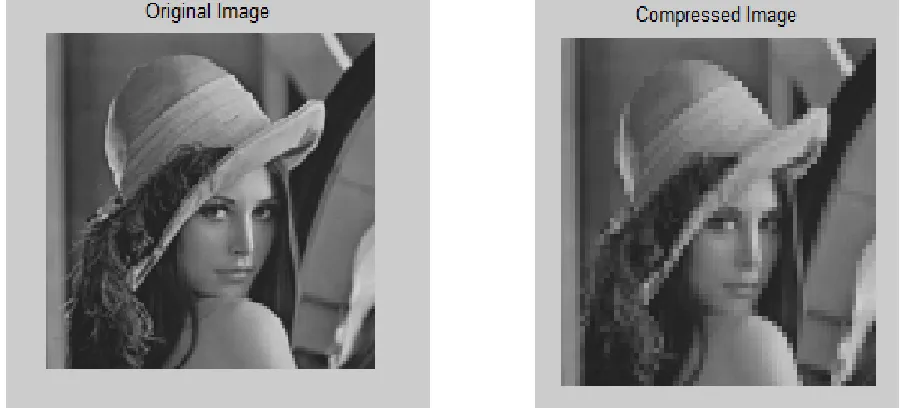
The experimental results by using this technique are far better than earlier methods. The proposed QAFIC method is passed to improve the compression ratio with maintaining the good quality of retrieved images. Compression ratio (CR), quality of retrieved images, and time complexity are the most important indicators for evaluating performances of image compression algorithms. By using this method, we get compression ratio equls to 75 for 512*512 size image with good quality of retrieved image.
[image:3.612.81.531.504.708.2]
International Journal for Research in Applied Science & Engineering Technology (IJRASET)
ISSN: 2321-9653; IC Value: 45.98; SJ Impact Factor:6.887 Volume 5 Issue VIII, July 2017- Available at www.ijraset.com
[image:4.612.155.457.93.339.2]1571
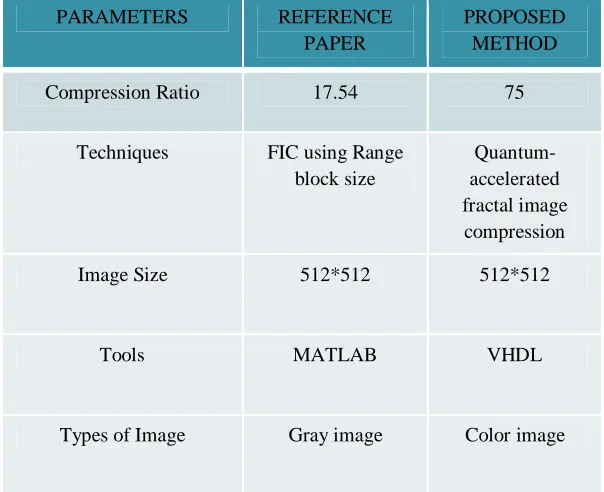
©IJRASET (UGC Approved Journal): All Rights are ReservedTable 1- comparison of existing method with proposed method
PARAMETERS REFERENCE
PAPER
PROPOSED METHOD
Compression Ratio 17.54 75
Techniques FIC using Range
block size
Quantum-accelerated fractal image
compression
Image Size 512*512 512*512
Tools MATLAB VHDL
Types of Image Gray image Color image
From this table we conclude that the compression ratio of fractal image compression is high as compared to existing methods.
V. ACKNOWLEDGMENT
We would like to thanks Mr. A. W. Hingnikar, Associate Professor, Electronics and telecommunication department, B.D.C.O.E. for his valuable suggestion. We would thanks to our college for providing facilities which help us in our work. We also express thanks to our parents, friends and colleagues.
VI.CONCLUSION
Fractal image compression coding is a very attractive research area whose main characteristics is obtaining high compression ratio with good decoding image quality. Our proposal provides a new way to solve acceleration problems. Experimental results are also consistent with the theoretical deductions. Therefore the proposed QAFIC is more powerful than the other state-of-the-art FIC approaches in maintaining quality of retrieved images.
REFERENCES
[1] Utpal Nandi, Jyotsna Kumar Mandal, et.al. “Fractal Image Compression with Adaptive Quadtree Partitioning Scheme”, International Conference on Signal,
Image processing and Pattern recognition (SIPP-2015), vol. 3, no.6, pp. 289–296, 2015, Chennai, India.
[2] Jianji Wang and Nanning Zheng, "A Novel Fractal Image Compression Scheme with Block Classification and Sorting Based on Pearson's Correlation
Coefficient ", IEEE transactions on image processing, vol. 22, no. 9, September 2013
[3] R.E.Chaudhari and S.B.Dhok , "Wavelet Transformed Based Fast Fractal Image Compression", Proceedings of iEEE international Conference on Circuits, Systems, Communication and information Technology Applications ,Mumbai, India, pp.6S-69, April 2014.
[4] F. Verdoja and M. Grangetto, “Fast Superpixel-based Hierarchical Approach to Image Segmentation,” in International Conference on Image Analysis and
Processing 2015 (ICIAP15), Genoa, Italy, Sept. 2015.
[5] I. Daribo, D. Florencio, and G. Cheung, “Arbitrarily shaped motion prediction for depth video coding using arithmetic edge coding,” Image Processing, IEEE
Transactions on, vol. 23, no. 11, pp. 4696–4708, Nov 2014.
[6] C. Zhang and D. Florˆencio, “Analyzing the optimality of predictive transform coding using graph-based models,” Signal Processing Letters, IEEE, vol. 20, no.
1, pp. 106–109, 2013
[7] C. Fu and Z. Zhu, “A DCT-based fractal image compression method,” in Proc. Int. Workshop Chaos-Fractals Theories and Applications (IWCFTA), Nov.
2009, pp. 439–443.
[8] L. K. Grover, “A fast quantum mechanical algorithm for database search,” in Proc. 28th ACM Symp. Theory of Computing (STOC), May 1996, pp. 212–219.
[9] J. A. Jones, M. Mosca, and R. H. Hansen, “Implementation of a quantum search algorithm on a quantum computer,” Nature, vol. 393, no. 6683, pp. 344–346,
May 1998
[10] P. Botsinis, S. X. Ng, and L. Hanzo, “Quantum search algorithm quantum wireless, and a low-complexity maximum likelihood iterati quantum multi- detector