Middle and Secondary Education Dissertations Department of Middle and Secondary Education
8-13-2019
The Intersection of Young Children's Play Activities
and Multimodal Practices for Social Purposes
Rebecca Rohloff Clough
Follow this and additional works at:https://scholarworks.gsu.edu/mse_diss
This Dissertation is brought to you for free and open access by the Department of Middle and Secondary Education at ScholarWorks @ Georgia State University. It has been accepted for inclusion in Middle and Secondary Education Dissertations by an authorized administrator of ScholarWorks @ Georgia State University. For more information, please [email protected].
Recommended Citation
Clough, Rebecca Rohloff, "The Intersection of Young Children's Play Activities and Multimodal Practices for Social Purposes." Dissertation, Georgia State University, 2019.
ACCEPTANCE
This dissertation, THE INTERSECTION OF YOUNG CHILDREN’S PLAY ACTIVITIES AND MULTIMODAL PRACTICES FOR SOCIAL PURPOSES, by REBECCA I. R. CLOUGH, was prepared under the direction of the candidate’s Dissertation Advisory
Committee. It is accepted by the committee members in partial fulfillment of the requirements for the degree, Doctor of Philosophy, in the College of Education and Human Development, Georgia State University.
The Dissertation Advisory Committee and the student’s Department Chairperson, as
representatives of the faculty, certify that this dissertation has met all standards of excellence and
scholarship as determined by the faculty.
_________________________________ Peggy Albers, Ph.D.
Committee Chair
_________________________________ Teri Holbrook, Ph.D.
Committee Member
_________________________________ Gary Bingham, Ph.D.
Committee Member
_________________________________ Laura May, Ph.D.
Committee Member
_________________________________ Date
_________________________________ Gertrude Tinker Sachs, Ph.D.
Chairperson, Department of Middle and Secondary Education
_________________________________ Paul A. Alberto, Ph.D.
AUTHOR’S STATEMENT
By presenting this dissertation as a partial fulfillment of the requirements for the advanced
degree from Georgia State University, I agree that the library of Georgia State University shall
make it available for inspection and circulation in accordance with its regulations governing
materials of this type. I agree that permission to quote, to copy from, or to publish this
dissertation may be granted by the professor under whose direction it was written, by the College
of Education and Human Development’s Director of Graduate Studies, or by me. Such quoting,
copying, or publishing must be solely for scholarly purposes and will not involve potential
financial gain. It is understood that any copying from or publication of this dissertation which
involves potential financial gain will not be allowed without my written permission.
NOTICE TO BORROWERS
All dissertations deposited in the Georgia State University library must be used in accordance
with the stipulations prescribed by the author in the preceding statement. The author of this
dissertation is:
Rebecca Irene Rohloff Clough Middle and Secondary Education
College of Education and Human Development Georgia State University
The director of this dissertation is:
Dr. Peggy Albers
Department of Middle and Secondary Education College of Education and Human Development
CURRICULUM VITAE
Rebecca Irene Rohloff Clough
HONORS, AWARDS, AND DISTINCTIONS
2017 Outstanding Ph.D. Student Award in Language and Literacy—Department of Middle and Secondary Education, College of Education and Human Development, Georgia State University
2013 Student Services and Support Fellowship (D. Fox, P.I.)—Department of Middle and Secondary Education, College of Education and Human Development, Georgia State University ($20,000)
PUBLICATIONS
Rohloff, R., & May, L. (2017). Considering hybridity through Jason Chinn’s Coral Reefs and
Redwoods.Journal of Children’s Literature, 43(2), 17-26. [peer-reviewed; national] Barria, R. R. (2015). Additional resources [Sidebar]. Language Arts, 93(2), 158-159. SCHOLARLY PRESENTATIONS
Gerde, H. K., Rohloff, R., & Bingham, G. E. (2019, April). Examinations of preschool teachers’ writing supports: Attention to type, frequency, and quality of experience. In D. Rowe
(Chair) Instructional supports for emergent writing in preschool classrooms. A
symposium presented at the annual meeting of the American Education Research Association, Toronto, ON.
Bingham, G. E., Quinn, M. F., Barria, R., & Gerde, H.K. (2018, November). Examining the nature, quality, and frequency of early writing supports in preschool classrooms. Paper presentation at the 68th Annual Literacy Research Association Conference, Indian Wells, California.
Clough, R. R., & May, L. (2017, March). Considering hybridity of informational texts through Jason Chin's Coral Reefs and Redwoods. Presentation at the 27th Annual KSU
Conference on Literature for Children and Young Adults, Kennesaw, Georgia.
Tortorelli, L., & Barria, R. R. (2016, December). Ready, set, write: Expectations of the
Common Core State Standards for kindergarten writing. Presentation at the 66th Annual
Literacy Research Association Conference, Nashville, Tennessee.
Flint, A. S., Turnbull, S., & Barria, R. R. (2016, December). “In the computer, you can go delete, delete, delete:” Composing Multimodal Texts in Elementary Classrooms.
Presentation at the 66th Annual Literacy Research Association Conference, Nashville,
May, L., Bingham, G., Crisp, T., Barria, R. R., Gultekin, M., Pickens, M., & Turnbull, S. (2016,
December). The hybrid nature of science trade books: A sensible approach to a false
dichotomy of informational texts. Presentation at the 66th Annual Literacy Research
Association Conference, Nashville, Tennessee.
Barria, R. R., Flint, A. S., & Turnbull, S. (2016, November). Understanding and assessing students' digital compositions. Presentation at the 106th Annual National Council Teachers of English Convention, Atlanta, Georgia.
Barria, R. R., & May, L. (2016, July). The relationship between words and images in two award-winning science picturebooks. Presentation at the 27th Annual Literacies for All
Institute, St. Louis, Missouri.
Flint, A. S., Turnbull, S., & Barria, R. R. (2016, July.) Digital storytelling: Affordances and constraints of multimodal composition. Presentation at the 27th Annual Literacies for All
Institute, St. Louis, Missouri.
Flint, A. S., May, L., Albers, P., Dooley, C., Holbrook, T., & Barria, R. R. (2015, October).
Language Arts: Five years in a time of change. Presentation at the 105th Annual National Council Teachers of English Convention, Minneapolis, Minnesota.
Angay-Crowder, T., Pace, C., Brown, D., Barria, R. R., & Tinker-Sachs, G. (2015, July).
Organizing for social change: How do literacy doctoral students take action in leading and transforming professional development opportunities? Presentation at the 26th
Annual Literacies for All Institute, Decatur, Georgia.
Flint, A. S., Turnbull, S., Barria, R. R., Golden, M. & Gentry, J. (2015, July). Digital stories and student voices. Presentation at the 26th Annual Literacies for All Institute, Decatur,
Georgia.
Barria, R. R. (2015, February). Writing the IRB research protocol [Webinar]. In Global Conversations in Doctoral Preparation Web Seminar Series. Retrieved from
https://www.youtube.com/watch?v=xVhwqgGtrKc
Barria, R. R. (2015, February). Verbal and nonverbal discourse in the classroom: A case study of one preschool student. Poster presentation at the 27th Annual Ethnographic and
Qualitative Research Conference, Las Vegas, Nevada.
Barria, R. R. (2014, December). Intertextuality in preschool writing: How a preschool student uses references to prior texts for enhanced agency. Presentation at the 35th Annual
THE INTERSECTION OF YOUNG CHILDREN’S PLAY ACTIVITIES AND MULTIMODAL PRACTICES FOR SOCIAL PURPOSES
by
REBECCA IRENE ROHLOFF CLOUGH
Under the Direction of Dr. Peggy Albers
ABSTRACT
This qualitative study examined how children’s play activities and multimodal practices
intersected for social purposes. Mediated Discourse Analysis (Scollon, 2001) informed the
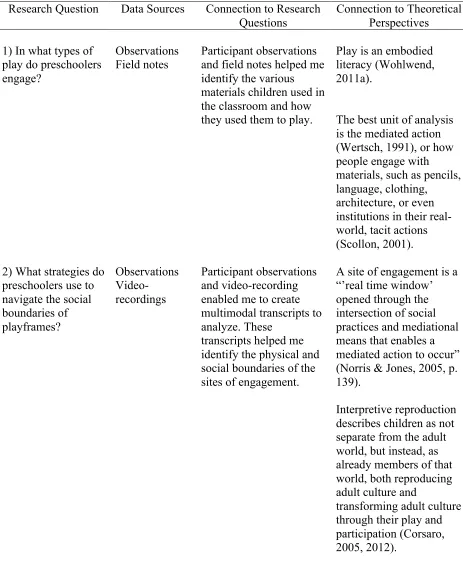
theory and methodology. Four questions guided the study: 1) In what types of play do
preschoolers engage? 2) What strategies do preschoolers use to navigate the social boundaries of
playframes? 3) What are the various modes and resources preschoolers use to engage in
playframes and how do they use them? 4) What social positionings do preschoolers take on and
resist in playframes? Participants included two co-teachers and twelve of the children in their
pre-kindergarten classroom. Data was collected over a five-month period using participant
observations and field notes. Analysis focused on multimodal discourse that took place during
free play time. Four findings emerged from the study: 1) Six types of play emerged across
playframes; 2) Children used entry, invitation, sustainment, and protection strategies in their
playframes; 3) Children used various modes and resources, including their bodies, props, and
alphabetic print, to enact character roles and social roles; and 4) Children moved fluidly within
focused on the social dynamics of young children’s classroom play experiences and argues for an
extended conceptualization of multimodal literacy as analyzed in young children’s play.
THE INTERSECTION OF YOUNG CHILDREN’S PLAY ACTIVITIES AND MULTIMODAL PRACTICES FOR SOCIAL PURPOSES
By
REBECCA IRENE ROHLOFF CLOUGH
A Dissertation
Presented in Partial Fulfillment of Requirements for the
Degree of
Doctor of Philosophy
in
Teaching and Learning
in
The Department of Middle and Secondary Education
in
the College of Education and Human Development Georgia State University
Copyright by
DEDICATION
This dissertation is dedicated to my father, Danny Lynn Rohloff, who passed away
during my first semester as a doctoral student. At the age of seventeen, he dropped out of high
school and enlisted in the United States Marine Corps, shortly thereafter serving two tours in the
Vietnam War. After his passing, for the first time, I read his letters home from Vietnam, which
revealed a young man’s introspection about his education and the origin of his lifelong
proclamation to his children and grandchildren: “Do good in school.” My father, who went on to
earn his G.E.D. and Associates degree, instilled in me courage, grit, a strong work ethic, and the
ACKNOWLEDGEMENTS
I am grateful to everyone who has helped me through this process. First of all, I would
like to thank my committee, Dr. Peggy Albers, Dr. Laura May, Dr. Teri Holbrook, and Dr. Gary
Bingham. Over the course of my time in this doctoral program, you have guided me and
challenged me, and whenever I most needed it, provided me with the encouragement I needed to
keep going. You have shaped my life in ways you may not even recognize. I would especially
like to thank my advisor, Dr. Peggy Albers. Peggy, thank you for your expertise, insight, and
thorough feedback on my work and for provoking me to always dig deeper. Thank you, also, for
reminding me I am not a future scholar, but a scholar. I am grateful for the professional and
personal relationship we have built over the years, and I look forward to more engaging talks
over your kitchen table in years to come.
I cannot express enough my gratitude for my family for their love and support. Audrey
and Anthony, your childhood has been marked by my PhD journey, which has become our
journey. You spent many school holidays at the GSU campus, attending doctoral seminars or
research team meetings, while your friends were off playing. You inspired me to work hard, but
also to slow down and find balance. Neil, thank you for believing in me and the value of this
pursuit. You married me midway through my studies but jumped right into the fray as my
supportive partner. Your homecooked meals and words of encouragement kept me nourished
many days as I wrote late into the evenings. I would also like to thank my mother, Annette
Thompson. Mama, thank you for more than once driving two states over on short notice to take
care of my children so I could attend professional conferences and write my comprehensive
exams. And Alex, my step-son, thank you for your enthusiasm and interest in my educational
Lastly, I would like to thank the participants, Ms. Ashley and Ms. Nettie, as well as the
children in their classroom and their parents. I am grateful that you not only opened your
TABLE OF CONTENTS
LIST OF TABLES ... vi
LIST OF FIGURES ... vii
CHAPTER 1 ... 1
INTRODUCTION ... 1
Play is at Risk ... 2
The Importance of Play ... 4
Research Phenomenon ... 6
Overview of the Study Design ... 10
Contribution to the Field ... 12
Theoretical Framework: Mediated Discourse Analysis ... 13
Discourse as social action. ... 14
Communication as necessary for social action ... 15
Communicated meanings derived from shared histories ... 15
Epistemological Orientation ... 17
Significance ... 18
CHAPTER 2 ... 20
REVIEW OF THE LITERATURE ... 20
Conceptualization of Young Children’s Play ... 21
Play and Children’s Social Worlds ... 32
Social Heirarchies during Play ... 36
Young Children’s Reading and Writing Development ... 43
Multimodal Literacy ... 54
Classroom Materials ... 62
Play and Literacy Connections ... 65
CHAPTER 3 ... 69
METHODOLOGY ... 69
Qualitative Methodology: Mediated Discourse Analysis ... 69
Research Setting and Context ... 74
Recruitment of Participants ... 75
Participants ... 76
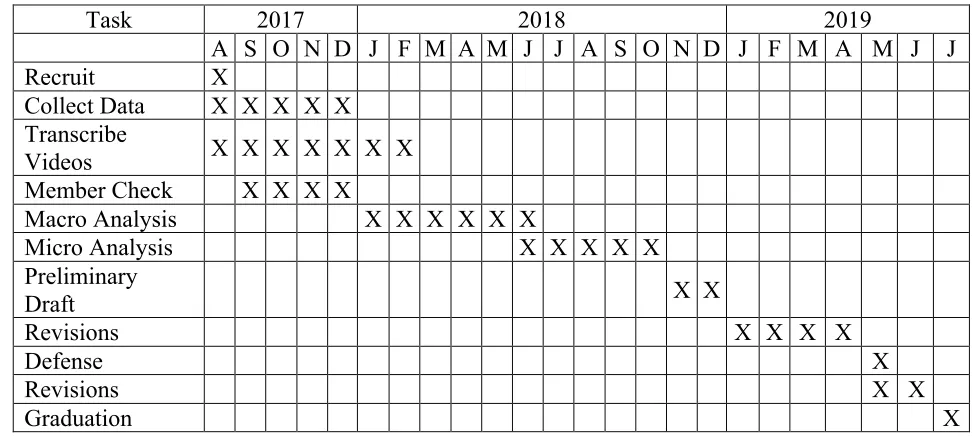
Study Procedures and Timeframe ... 79
Data Collection and Management ... 82
Data Analysis ... 89
Standards of Quality ... 104
Writing up the Study ... 106
CHAPTER 4 ... 107
FINDINGS ... 107
Descriptive Findings of Classroom Context ... 109
Types of Play in which Children Engaged ... 120
Strategies Children Used to Navigate the Social Boundaries of Playframes ... 129
Modes and Resources Used by Children to Engage in Play ... 136
Social Positionings Enacted by Children During Play ... 139
Play Types, Strategies, Modes/Resources and Social Positionings: ... 144
A Micro-analysis of the Free Play of Two Focal Participants ... 144
Playframe 1: Sam’s Shadow Puppets ... 148
Playframe 2: Nora’s Restaurant ... 161
Summary of Ideas ... 175
CHAPTER 5 ... 177
DISCUSSION ... 177
Categorizing Young Children’s Play to Iluminate Purposes for Play ... 179
How Children Use Strategies to Navigate Playframes ... 185
Modes and Resources Produce Social Positionings ... 188
Social Positionings as Negotiated ... 193
Implications for Practice ... 195
Implications for Research ... 203
Reflections on an Education Approach to Early Childhood Education ... 206
References ... 209
Appendix A ... 228
Appendix B ... 230
LIST OF TABLES
Table Page
1. Play Action Categories as Defined by Rowe and Neitzel (2010)………. 26
2. Children’s Access and Withdrawal Strategies Identified by Corsaro (1979, 2005)…. 34 3. Social Contracts as Defined by Rowe (2008) ……….………. 51
4. Linkages between Child’s Interest Orientations, Play, and Writing Purposes………. 67
5. Timeframe for the Study……….……….. 80
6. Data Collection and Connection to RQs Adopted from Bloomberg and Volpe (2008).. 88
7. Macro-Analysis Coding Methods and Rationales………. 97
8. Examples of Macro-Analysis Coding……… 98
9. Sample Coding Table using MDA………. 101
10.Teacher Strategies for Managing Children’s Behaviors and Bodies………. 117
11.Types of Play Engaged in by Children………... 120
12.Strategies for Navigating Social Boundaries of Playframes……….. 129
13.Access Strategies Unique to this Study……….. 133
14.Protection Strategies Unique to this Study………. 134
15.The Cardboard Box as a Resource for Sam’s Meaning-Making……… 145
16.Shifts in the Shadow Puppet Site of Engagement ……….. 149
17.Materials Used by Nora to Enact Character Roles………. 157
LIST OF FIGURES
Figure Page
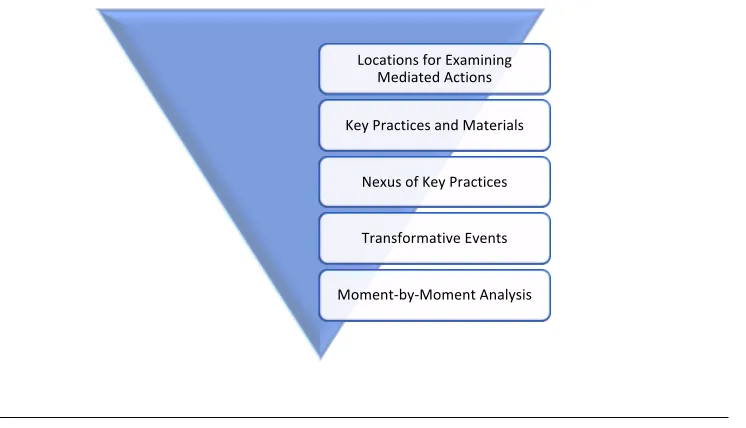
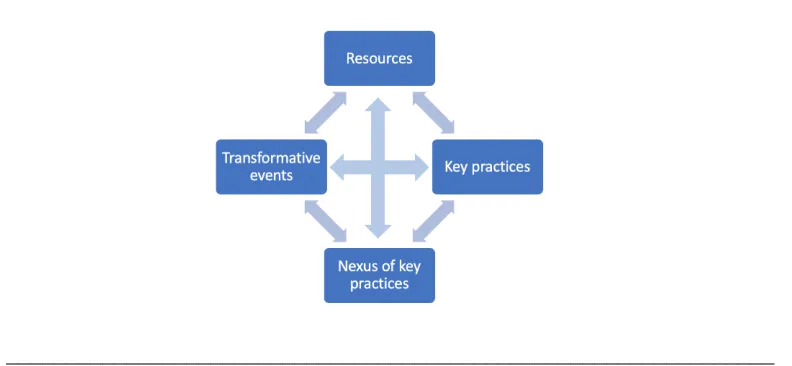
1. Mediated Discourse Analysis Adapted from Wohlwend (2009)……… 72
2. Recursive Process of Analysis Based on Wohlwend’s (2009) MDA Filter……… 74
3. Steps in Data Analysis……… 92
4. Post-observation Analysis Process………. 93
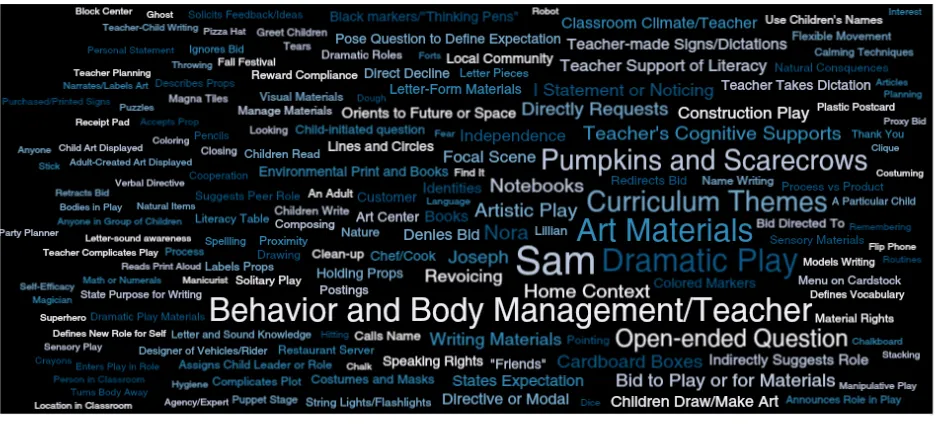
5. Code Cloud………. 99
6. Sensory Table with Pumpkin……….. 113
7. Literacy Table with Puzzles……… 114
8. Joseph’s Geometric Shapes………. 122
9. Beading and Bracelet Making………. 123
10.Art Table……….. 125
11.Joseph Works with Letter Tiles………... 127
12.Masks Decorated by the Children……… 141
13.Decorating the Scarecrow’s Shirt……… 142
14.Nora’s Recording of Food Order……….. 159
15.Sam’s Office Building………. 182
CHAPTER 1
INTRODUCTION
Play is children’s work. This sentiment has been expressed by a multitude of influential early childhood scholars, such as John Dewey and Maria Montessori, as well as by Fred Rogers,
the decades-long host of the popular children’s program, Mister Roger’s Neighborhood. Play as
children’s work forms the foundation of the Reggio Emilia approach to early childhood
education, which originated in post-World War II Italy. Reggio Emilia is an approach to early
childhood education that positions young children as “powerful, active, competent protagonists
of their own growth” (Edwards, 2012, p. 150). Within Reggio Emilia schools, educators
stimulate children’s learning through a playful, project-based curriculum (Edwards, 2012).
Moreover, children’s intellectual development is supported through a focus on symbolic
representation (Edwards, Gandini, & Forman, 2012). In other words, children are encouraged to
express themselves through a variety of modes and mediums, including spoken language, written
language, painting, clay sculpture, music, shadow play, and dramatic play. Reggio Emilia has
gained popularity in the United States since the release of a 1991 Newsweek article touting the northern Italian school as one of the top ten in the world (Kantrowitz & Wingert, 1991).
I was first drawn to the Reggio Emilia approach more than a decade ago as a mother
looking for a preschool home for my young daughter. I selected a Reggio Emilia-inspired
preschool based in part on buzz phrases: play-based, emergent curriculum, and child-centered
(Edwards, Gandini, & Forman, 2012). Although my professional background was in secondary
education, my understanding of inquiry-based learning for adolescents led me to believe that a
this decision as an educational professional within the context of a broader accountability
culture.
As a secondary teacher, I had over the years experienced a shift in the field towards
high-stakes testing and standards, and then, as a mother of a preschooler, wondered about the
consequences of this culture on early childhood education. The decision to enroll my daughter in
a play-based preschool proved positive for my family, and she, along with her younger brother,
were well-served by Reggio Emilia-inspired programs. Eventually, I joined the teaching staff at
my son’s preschool and began the second stage of my professional career, this time focusing on
early childhood education. Later, as a doctoral student exploring research interests, I kept coming
back to the concept of the play-based curriculum and my curiosity about children’s social and
learning experiences in such contexts. After proposing a research topic and securing the
necessary permissions, I entered a Reggio Emilia-inspired preschool, not as a parent or teacher,
but as a researcher.
Play is at Risk
In the United States, play in early childhood learning settings is at risk. Play has been
marginalized in schools to the point that young children’s play appears subversive in those
settings (Genishi & Dyson, 2014). A once-mainstay in the early grades, recess is no longer an
integral part of every child’s school day. For example, a bill passed in Georgia only recently
required elementary schools to schedule daily recess, but the bill not only failed to mandate a
duration for unstructured play, but also allowed structured physical education programs to
replace recess (Tagami, 2018). The shift over the decades towards structured academics and
away from play in early childhood settings impacts children. Strauss (2015; 2018) argued that a
used stronger language. In a recent Atlantic article that examined the tension between academic learning and developmentally appropriate practices that include play, Christakis argued that “the
new preschool is crushing [emphasis added] children” (n.p.). This sentiment has been expressed
elsewhere. In a recent Washington Post article, Strauss (2018) argued that children are being shuffled between activities at an alarming rate, with an average of 13 or 14 transitions per day in
the typical kindergarten schedule, leaving little room for extended periods of child-driven inquiry
and play experiences.
This shift towards academics in early childhood is framed by several key moments in
early childhood education reform. In 2010, the National Governors Association Center for Best
Practices (NGA) and the Council of Chief State School Officers (CCSSO) released the Common
Core State Standards (CCSS) which outlined learning goals for K-12 students for the end of each
grade in language arts and mathematics, and was subsequently adopted by most states. In 2013,
President Obama, in his State of the Union address, proposed “working with states to make
high-quality preschool available to every single child in America” (n.p.), thereby raising the question
about the characteristics of a high-quality preschool. In 2012, the state of Georgia, which Obama
referenced in his 2013 speech, instituted Quality Rated, a tiered rating system designed to
improve the quality of early childhood learning and care (Ogbu, 2014). In 2011, the U.S.
Department of Health and Human Services (2017) announced the first recipients of the Race to
the Top Early Learning Challenge, a competitive grant program for states designed to improve
outcomes for early childhood education that included an emphasis on developing common
standards across the state and measuring outcomes to determine children’s kindergarten
readiness. Since the release of the CCSS and the inception of Race to the Top, nearly all fifty
result of a standards-based educational climate that emphasizes kindergarten readiness, early
childhood educators have shifted their focus and teaching practices towards skills and assessment
and away from play (Brown, 2011; Pyle & Bigelow, 2015). The time period from three years old
to seven years old marks a transitional period for children from preschool to formal education,
and, as a result, play has been implicated during this period due to the assumption that children
need less play in order to become school ready (Wood, 2014).
The Importance of Play
Play and learning do not need to be dichotomized. Play is important to children’s early
learning experiences (Vygotsky, 1978), as is the quality of children’s play (Broadhead & Burt,
2012; Stagnitti & Lewis, 2015). When children are supported in their play, many varied benefits
emerge. Play provides a supportive context for the development of creative thinking and problem
solving (Robson & Rowe, 2012; Whitebread, Coltman, Jameson, & Lander, 2009). Play also
supports children’s socio-emotional development, including perspective-taking, empathy,
reflection, and emotional regulation (Ashiabi, 2007), and also benefits children’s sense of self
(Wood, 2014). Importantly, play supports the development of children’s academic skills,
including math and literacy skills, particularly when an adult supports their play. In line with this
view, the National Association for the Education of Young Children ([NAEYC], 2009) described
the developmental appropriateness of play and the benefits of incorporating play into the
preschool curriculum.
Play-based classrooms have been shown to better benefit children than
academically-oriented classrooms. In a longitudinal study examining how children’s preschool experience
related to later academic achievement, Marcon (2001) found that children who had attended
attended child-initiated classes. Marcon postulated that introducing formative learning
experiences too early inhibited children’s academic growth. Likewise, Whitebread et al. (2009)
argued against formal education before the ages of four or five and for playful pedagogies during
that time period. Broadhead and Burt (2012) argued that young children not only need to play,
but need challenging play; during the transitional period from ages three to seven, children need
play that challenges them towards “social and symbolic complexity” (p. 153).
Play provides academic benefits for young children, including the development of math
and literacy skills, as well as creative thinking. Children engage with patterns and shapes during
play, as well as enumeration and magnitudes, among other mathematical concepts. Block play
and puzzle play has been shown to support geometry learning, numbering, and patterning, while
game play has been shown to support number development and counting (Wager & Parks, 2014).
Symbolic play, meanwhile, is related to developing phonological awareness (Bergen & Mauer,
2000), which is an important predictor for later reading ability. Pretend play, in which children
use verbal and nonverbal modes to depict events, facilitates narrative recall and retelling
(Stagnitti & Lewis, 2015) and is associated with children’s abilities to provide more complex
narratives (Kim, 1999). Likewise, Weisber, Zosh, Hirsh-Pasek, and Golinkoff (2013) argued that
play promotes children’s development of language skills, especially when adults not only guide
play but prioritize children’s interests and follow their lead. Play supports creative thinking and
problem solving (Robson & Rowe, 2012; Whitebread et al., 2009). Robson and Rowe’s (2012)
analysis of the pretend play episodes of two- and three-year-olds showed high levels of
hypothesizing and imagining, and pretend play episodes shared by peers showed even higher
Play also crosses classroom contexts. Genishi and Dyson (2014) documented children in
one classroom who regularly engaged in an outdoor game of chase called Pine Cone Wars.
When snow on the playground one day prevented physical, gross motor play, the children
continued the game indoors with the use of manipulatives. Soon after, the game carried over into
the young children’s drawings, where they used stick figures to represent people and buildings.
Later, the Pine Cone Wars play theme appeared in their emerging alphabetic writings and
contributed to the children’s increased use of details in their writings. Genishi and Dyson’s study
illustrated how children’s play activities can move across time and contexts, including into
traditional academic subjects, such as writing.
Research Phenomenon
Play, like literacy, is a social practice (Street, 1984) couched in a particular context.
Weisberg et al. (2013) define play according to three characteristics: 1) Play has no clear purpose
or objective; 2) play is often exaggerated; and 3) play is joyful and voluntary (p. 41). They also
consider the “locus of control” (p. 42), or who determines the direction of the play, the child or
adult. For the purpose of this study, I focused on child-directed play or what Wood (2014) calls
free play. Free play is marked by children’s ability to select their own activities, playmates, themes, and learning. Definitions of play are varied, however, so the literature review will
present additional conceptualizations of play.
This study extends previous research by exploring the nature of children’s play,
specifically examining how children’s play activities and multimodal practices intersected for
social purposes. Play has been conceptualized in the literature in many ways (e.g., Broadhead &
Burt, 2012; Hughes, 2002; Marsh, Plowman, Yamada-Rice, Bishop, & Scott, 2016; Neitzel,
sociability. This study, which drew from multimodal perspectives (Hodge & Kress, 1988; Kress
& van Leeuwen, 1996), conceptualized children’s play through a slightly different lens by
focusing on how children used materials during play. Previous research has also examined the
benefits of play, including how play supports the development of academic skills,
socio-emotional skills, and executive function, which includes regulating thoughts and behaviors (e.g.,
Ashiabi, 2007; Robson & Rowe, 2012; Whitebread et al., 2009). Research has suggested that
adult supports for children’s play provide improved benefits (Bodrova, 2008; Cohen & Uhry,
2011), but it is not clear how exactly educators can support children’s play when the nature of
children’s play is not well understood.
Children use various modes and resources during play to construct and interpret texts. For
this reason, Wohlwend (2011a) argued that children’s play practices are embodied literacy
practices. In line with Wohlwend (2011a), this study considers the multimodal resources, such as
alphabetic print, props, and body language, that preschoolers use for meaning-making purposes
while engaged in play, including dramatic play. While engaged in play, children use resources to
build shared meaning allowing their pretend worlds—their social worlds—to be read as texts
they are co-authoring. When young children set the stage for dramatic play (e.g., moving
furniture around, selecting items to include in the space), they use multiple processes necessary
for conventional writing, such as “planning, classification, design, and display” (Kress, 1997, p.
98). Additionally, children engaged in dramatic play draw on narrative skills as they work
together to clarify roles, plot lines, or the meanings of their concrete tools (Bomer, 2003), such as
a deciding whether a stick should represent a magic wand or a unicorn. Preschool classrooms
that provide young children with opportunities to play, an inherently multimodal process, sets the
children who may not have been able to fluently read and write with alphabetic signs, a
multimodal perspective positioned preschoolers as already literate, using the modes and
resources available to them to interpret and construct meaning. Data was collected in a preschool
in which teachers used a play-based curriculum and attended to the physical environment by
providing the children with materials with the intention to foster multiple possibilities for
meaning.
Young children’s play practices are tethered to D/discourses (Gee, 2013). Big D
Discourse functions as an “identity kit,” while little d discourse refers to language, which allows
people to say things, but also to do things and to be things (Gee, 2013). Gee explained the
concept of an identity kit as the Discourse of a particular role, which includes how we dress, talk,
carry ourselves, and often write in order to be recognized in that role by others. For example, the
identity kit of a Starbucks barista may include a green apron, the gesture of smiling, the act of
writing names on cups, and detailed knowledge about coffee types and preparation. In a
preschool classroom setting, uttering the words, “abracadabra” may be a part of a child’s identity
kit. This kit may allow a young child to become a powerful wizard, but enacting this identity
requires more than verbal language. To persuade others to accept the enacted wizard identity, the
child may use the nonverbal mode to layer meaning. For examples, while saying “abracadabra,”
the child might carry a stick as a magic wand and address interlocutors with a serious glare.
Gee’s (2013) concept of an identity kit influenced how I approached this study. In other words, I considered not only the children’s words and actions as they played, but also what social roles
they were enacting. I considered how the modes and resources they used fashioned a particular
social identity. Modal systems, including language and gestures, are tied to notions of “embodied
encouraging others to act or adopt certain perspectives. In other words, modal systems have no
meaning outside of social and personal contexts. Therefore, I also considered the social context
in which the children played.
Educational contexts, including preschools, are not value-neutral settings, but arenas
where various groups compete for power (Marsh, 2006). Discourses, which are identity kits
valued by different communities, have benefits and liabilities that vary depending on the context
(Gee, 2011). Different contexts can constrain children by perpetuating dominant Discourses,
such as stereotyped roles of gender, but children can challenge these norms. For example, in
Wohlwend’s (2011b) study of kindergarteners, she observed that a group of girls engaged in
dramatic play struggled with the tension between an accurate reenactment of Disney princess
characters and their desire to perform more empowered roles. For these girls, play ultimately
served as a transformative tool, altering the meaning of the princesses from “damsels in distress”
to “self-rescuing princesses” (Wohlwend, 2011b, p. 16).
Corsaro (2012) described transformative power of play as “plying the frame” (p. 499).
That is, dramatic play is not a mere imitation of adult roles, but an elaboration of roles and
challenging of roles. Play allows children to address their own concerns, which often deal with
issues of status and power, such as when a child engaged in pretend play as an ice cream shop
customer deliberately orders a flavor they know the shopkeeper does not have, creating a
disequilibrium that children must work to balance (Corsaro, 2005; 2012). Corsaro’s (2012)
concept of plying the frame influenced my consideration of the social dynamics in the classroom.
For example, I did not assume by default that children were imitating adult roles during dramatic
play, but instead considered the possibility that they were elaborating and challenging these roles
resources. In Wohlwend’s (2011b) study of kindergarteners, a rocking chair, typically reserved
for the teacher, at times functioned instead as the author’s chair during the children’s free play; during those times, the children would sit in the chair to share their writings and drawings with
the class. However, she noted that calling on classmates took prominence over listening to their
feedback. In this case, the children used the chair to mediate their ability to enact a teacher-like
role and nominate speakers, an act that carries great weight in a classroom (Cazden, 2001).
“Norms for talk tell which members can talk, when, and about what” (Lee, 2013, p. 281), and it
is the teacher who typically facilitates the creation of these norms. The use of the chair in
Wohlwend’s study, however, allowed the children to upend these norms, at least momentarily.
Wohlwend’s conceptualization of the author’s chair as a tool for the children to reposition
themselves into roles of authority also influenced how I approached this study. For example, I
considered how the children might have used play as a vehicle for trying on new identity kits
(Gee, 2013), such as teacher-like roles. This study builds on Corsaro (2005; 2012) and
Wohlwend’s (2011a, 2011b) work and other past research by examining how children use play
activities and available resources to participate in classroom communities and challenge social
hierarchies.
Overview of the Study Design
This qualitative study, which used the tools of Mediated Discourse Analysis (Scollon,
2001), examined how young children’s play activities and multimodal practices intersected for
social purposes. Specifically, this study was guided by four questions: 1) In what types of play
do preschoolers engage? 2) What strategies do preschoolers use to navigate the social boundaries
of playframes? 3) What modes and resources do children use to engage in playframes and how
This study builds on previous work, focused on children’s literacy practices, in an urban,
Reggio Emilia-inspired preschool (Edwards et al., 2012) in the urban Southeast from May 2014
–December 2015. Within the data collected during this 18-month period, I analyzed broader
trends in the video data collected from three classrooms through participant observations. I found
that a) the nonverbal discourse between a teacher and child changed as the preschooler wrestled
with emerging alphabet literacy skills, taking on a more-teacher-like role; and b) that
preschoolers communicated with each other through their written and visual texts during
morning meeting for social purposes, even though the teacher controlled the seating arrangement
and nominated speakers. As part of this previous work, I examined the multimodal discourse of
one three-year-old student as he elicited help from his teacher in writing his name on his artwork,
and the multimodal nature of the children’s communication with peers during morning meeting.
Two findings emerged from my analysis of the collected data. First, as the child began to
direct the teacher in his intentions for her to write his name, the teacher’s stance changed: She
moved from a standing to squatting to kneeling position. I found that the teacher’s nonverbal
discourse, including open-palm movements and questioning gaze, deemphasized her authority as
the child began to enact an increasingly agentic role. I also argued that this nonverbal discourse
mediated the child’s emerging alphabetic awareness by providing him with an increased sense of
agency. Second, I examined the literary elements and genres preschoolers used during morning
meeting time as they shared the writing and drawings they were currently composing. Even
though the teacher assigned seats and nominated speakers, the children used depictions of a tiger
in multiple modes (e.g., verbal, visual, gestural) in order to not only communicate with each
findings influenced how I approached the current study design and the theoretical lens for my
dissertation research.
This current study was designed and based upon findings from this previous work in this
same preschool in two distinct ways. First, I wanted to more closely understand child-child
interactions as they engaged in play, what types of play emerged, and how these play frames
illuminated the social positionings of the children. Second, I wanted to study more closely the
role of multimodality in how children worked with, interpreted, and produced meaning through
their embodied actions and class materials. To accomplish this, I examined the play of two focal
children and six distinct play frames, and other children involved in these play frames. The study
was conducted in one classroom that was shared by two co-teachers. Data was collected between
August 2017 and December 2017. During this time frame, I conducted ten observations, many of
which were video recorded, each at least one hour in length in accordance with teacher
preferences and curricular schedules. Analysis focused on the nature of the multimodal discourse
and took place as children engaged in free play. Within the data collected in this study, I chose
two subsets of data for microanalysis in order to gain a more nuanced understanding of peer
interactions.
Contribution to the Field
This study contributes to the discussion in research around preschool children and play in
several ways. First, much of the previous research on preschool education focused on children’s
academic skills, such as letter-sound awareness. This research studied the social context of
young children’s academic development and their play experiences, an area underrepresented
within the overall body of early childhood education research. Second, as researchers have
storyline, character, and movement (Bomer, 2003; Kress, 1997; Wohlwend, 2011a). Play is not
value-neutral. Through play, children socially position themselves or others and conform to or
resist various Discourses, such as gender stereotypes (Wohlwend 2011a, 2011b). The actions of
children engaged in play is always linked to social capital and may have ramifications outside
the classroom and in broader social institutions (Corsaro, 2005). Thus, this study examined how
preschoolers’ play activities and multimodal practices intersected for social purposes, with
attention paid to power relationships and identities enacted. Third, previous research on
children’s play practices has focused on older children, especially concerning how Discourses
(Gee, 2011) emerge. This study focused on the pre-kindergarten age group. Focus on a younger
population is important because children begin enacting and internalizing Discourses before they
can read and write by traditional measures (Heath, 1983). Fourth, play is inherently multimodal,
so this study works from the stance that children are already actively literate. They often
forefront modes other than the alphabetic, and that from traditional print-based perspectives,
these same children may be considered only later emerging into literacy. Thus, this study
broadens understandings of how young children actively make meaning by examining the
multimodal resources that preschoolers draw upon during play.
Theoretical Framework: Mediated Discourse Analysis
This qualitative study is located in Mediated Discourse Analysis (MDA), a theory that
focuses on discourse in action, rather than as action (Scollon, 2001). MDA views real-time social action as inherently discursive, both producing and reproducing social structures such as
traditional gender roles. Significantly, MDA uses mediated action, rather than only transcripts of
utensils, a child’s body, dolls, costumes, or even the arrangement of furniture in a classroom.
Cultural tools are always value-laden, embedded with histories that enable or constrain its users.
For example, a Barbie doll historicizes the idyllic female form, a form that has for decades
provided a basis for how young children understand female beauty. Likewise, young girls learn
how to perform as females through play with cultural tools such as dolls (Wohlwend, 2011a).
Yet, as Wohlwend has shown, play with cultural tools can not only function to assimilate
children into Discourses, but also function as a form of resistance. Language is a cultural tool,
but not the only cultural tool; thus, MDA places actions with non-linguistic tools on par with verbal discourse. MDA focuses on mediated action, such as children engaging with props in
play, because it is in these moments that Discourses are instantiated as social action.
This theory is guided by three main tenets (Scollon, 2001):
a) discourse as social action,
b) communication as necessary for social action, and
c) communicated meanings derived from shared histories.
Discourse as social action. Discourse is a type of social action. People bring with them
historical and cultural understandings of language and literacy and play that are value-laden and
not necessarily shared by others (Street, 1984). Because discourse is a type of social action, the
best unit of analysis is the mediated action (Wertsch, 1991), or how people engage with cultural
tools, such as pencils, language, clothing, architecture, or even institutions, in their real-world,
tacit actions associated with these tools (Scollon, 2001). Consider, for example, how people
engage with the discourse of academic standards. Norris and Jones (2005) argued that meaning is
not inherent in discourse, but rather, meaning arises out of how we use discourse. Additionally,
or outsiders, to various social groups, as well as offer opportunities to negotiate new positions
(Scollon, 2001). Thus, preschool standards are not meaningful outside of social contexts; rather,
within the context of classroom settings, for example, academic standards are used to categorize
children as proficient or not, and therefore, as insiders or outsiders to accepted ways of “doing
school” within those contexts.
Communication as necessary for social action. “To be social an action must be
communicated” (Scollon, 2001, p. 7). According to Scollon, cultural tools, including language
and material items, mediate the production of shared meanings, and the multiple cultural tools
involved in mediated action are related to each other and to their sites of engagement. For
example, academic standards, a cultural tool used by administrators and districts, are used to
categorize children as proficient or not. This practice becomes a social action when results of
assessments based on those standards are communicated via individual scores reports or school
grade reports. Cultural tools in a preschool classroom include props in a dramatic play center,
writing utensils, furniture, and language. Cultural tools in a mediated action do not carry equal
weight; some tools may become more salient than others in varying contexts and help shape
individual and social systems. For example, within an arts-based summer program, cultural tools
such as academic standards may carry less weight than cultural tools such as dance or music.
Communicated meanings derived from shared histories. The nature of
interdiscursivity positions multiple histories in relation to each other, so that histories may align
or stand in tension with one other (Scollon, 2001). For example, educational discourse is
interdiscursive with business discourse when college students are conceptualized as customers or
clients (Scollon & Scollon, 2003). These histories are also intertextual, borrowing from past texts
students as customers borrows from the discourse of advertisements and company branding,
which is manifested in the college recruitment materials that position prospective students as
consumers and diplomas as products.
From the perspective of MDA, “it is the constellation of linked practices which makes for
the uniqueness of the site of engagement and identities thus produced, not necessarily the
specific practices and actions themselves” (Scollon, 2001, p. 5). For example, when the action of
handing a cup of coffee to another person in a Starbucks coffee shop intersects with other
practices and actions, such as operating a cash register and verbally stating a price, it becomes a
transaction and produces barista and customer identities. The action of handing a cup of coffee
across a counter top alone does not produce these identities. As a result, MDA is sometimes
referred to as nexus analysis. In other words, MDA examines the links between multiple
intersecting practices and actions in order to understand the identities produced.
MDA as a theoretical and critical framework is apt for this study because it allows the
researcher to move beyond a focus on isolated actions to the nexus of multiple simultaneous
practices and how that nexus produces identity and power relations. In a preschool classroom,
linked practices, such as handing, singing, dressing, and drawing, produce the identities of the
children working with various cultural tools in any given moment, and these identities are not
value-neutral. The intersection of shared practices may both bind and exclude group
membership. Thus, the purpose of MDA is to illuminate power relationships and how even the
smallest actions, such the actions of preschoolers engaged in dramatic play, can affect the
broader Discourse community and social institutions.
Drawing from MDA, sociolinguistics (Gee, 2011; 2013), and social semiotics (Hodge &
expansive view of literacy allows me to view preschool children not as pre-literate, but as
already literate, using the multimodal tools available to them (e.g. voice inflection, gestures,
crayons) to construct and interpret meaning. Literacy is more than a cognitive skill; it is a social
practice (Street, 1998). As such, “literacy is something people do in particular social contexts, rather than something individuals acquire” (Serafini, 2014, p. 19; italics in original). Moreover, literacy is dependent on social context so that one may be considered literate in one context, but
not in another. For example, one may be considered highly literate in a Shakespearean literature
classroom, but not in a hip-hop recording studio, and vice-versa. There are different types of
literacies that serve different purposes, tied to various identities and actions. In this study, I used
the terms reading and writing to refer to meaning-making specifically with alphabetic signs,
while using literacy more broadly as the social practice of meaning making with various modes
and resources.
Epistemological Orientation
Meaning is neither objective nor subjective; we do not discover meaning or create
meaning, but rather, “we construct meaning” from the world and its objects (Crotty, 1998, p. 44).
As a researcher holding this view on the nature of knowledge, my epistemological standpoint for
this project is constructionism. Constructionism is “the view that all knowledge, and therefore all
meaningful reality as such, is contingent upon human practices, being constructed in and out of
interaction between human beings and their world, and developed and transmitted within an
essentially social context” (Crotty, 1998, p. 42). The social construction of knowledge played an
important role in this study, which examined how children’s play activities and multimodal
According to constructionism, meaning is couched in culture, and therefore, set within
historical and social perspectives. “Our culture brings things into view for us and endows them
with meaning and, by the same token, leads us to ignore other things” (Crotty, 1998, p. 54). This
study questioned the Western, academic conceptualization of early childhood education and
children’s play and literacy. As a constructionist researcher, I did not seek to discover a true
definition or create a new definition of play or literacy. Rather, I was responding to “an invitation
to reinterpretation” (Crotty, 1998, p. 51). According to constructionism, “there is no true or valid
interpretation. There are useful interpretations” (Crotty, 1998, p. 47). Therefore, I hope that the
meanings I have fashioned out of observations of children in their preschool classroom will
prove useful to educators and our culture at large.
Additionally, because I was interested in examining children’s play activities and the
resources and modes they used to mediate meaning, I found Vygotsky’s theories helpful.
Vygotsky (2016) argued that play is not only an activity that children engage in, but that play,
and particularly imaginary play, is central to children’s development. He went on to describe
“the movement in the field of meaning” (p. 17) in children’s imaginative play. In other words,
actions and objects stand in for other actions and objects during children’s play. This symbolic
play carries with it messages that serve to include some and exclude others, and engages children
in role play that convey community and societal values.
Significance
Kindergarten readiness is often seen as the end-goal for children’s preschool experiences,
and the focus is often on children’s academic preparation, such as the acquisition of knowledge
about letters, numbers, shapes, and colors. Although these skills are important, this focus has
an essential element of children’s academic development, and in fact, a playful approach
supports learning in core content areas by exceeding expectations outlined in the Common Core
State Standards (Wohlwend & Peppler, 2015). Understanding play practices as multimodal
literacy practices reprioritizes play in a narrow curricular environment that has become
increasingly skills-based and assessment driven (Wohlwend, 2008). Play has been shown to
support social and emotional awareness, which are important indicators for future academic
performance, as well as facilitate deeper understanding of scientific concepts and literary text
structures. When preschool educators understand the benefits of play and how play enables
children to interpret and construct meaning with various semiotic signs, they can reprioritize play
in the curriculum by providing time and materials to facilitate deep play. Additionally, when
parents and policy makers understand play as a contributor to kindergarten readiness, they may
be more likely to support preschool programs that center play in the curriculum, rather than
CHAPTER 2
REVIEW OF THE LITERATURE
“In play a child is always above his average age, above his daily behavior; in play it is as though he were a head taller than himself.” (Vygotsky, 2016, p. 18).
The literature review situates this study within a broader context of early childhood
education, considering what has already been learned about children’s play and literacy as well
as opportunities for future exploration (Boote & Beile, 2005, 2006). The research presented in
this chapter includes work that focused on the early childhood age group, defined by NAEYC
(2009) as birth through age eight. Because this study included participants from a pre-K
classroom, the literature review is weighted towards research that focused on the three- to
five-year-old age group. This age range also marks the transitional period for young children from
pre-kindergarten to formal educational settings. The literature review justifies the importance of
this study and its design by explaining how this study builds on past research. It is divided into
five main themes.
Each section of the literature review builds on the prior section in order to expand how
children’s play and literacy is defined and understood. The first section, conceptualizations of
young children’s play, describes young children’s play and its importance in learning. Various
frameworks for describing children’s play are presented, along with a focus on terminology used
to describe dramatic play. Second, play and children’s social world examine the social dynamics
of young children’s play, including how children protect their play from disruption. The third
section, young children’s reading and writing development, describes how children draw from
multiple cueing systems to form and test hypotheses about print that changes over time. Fourth,
such as images, sounds, and gestures. I present the research of several scholars who examined
how children use different semiotic modes for meaning-making purposes. This section also
examines the connections between classroom materials, children’s play activities, and
multimodal literacy practices. The fifth section, play and literacy connections, explores the
relationship between play and literacy, ultimately arguing that play is a type of multimodal
literacy (Wohlwend, 2011a). These areas of research in early childhood education allowed me to
better view the preschool-aged participants in this study as agentic meaning-makers and literate
actors.
Conceptualization of Young Children’s Play
Play has often been called young children’s work. Fred Rogers, the longtime host of the
children’s program, Mister Roger’s Neighborhood, said, “Play is often talked about as if it were a relief from serious learning. But for children, play is serious learning.” (Moore, 2014, n.p.).
Children actively make sense of the world before formal instruction (Short & Harste, 1996, p.
12), and they do so in part through various forms of play. For very young children, there is no
clear distinction between play and learning (Einarsdottir, 2011). Over time, however, children do
begin to distinguish play from work, and they do so based on perceptions of freedom, choice,
control, affect, and materials (Howard, 2010). Play in school contexts has been conceptualized
by the adults in those settings in many ways—as a break from learning, as an add-on to learning,
and as a vehicle for learning. Play has been defined in terms of its driving force, such as
child-initiated, adult-guided, or curriculum-driven play (Wood, 2014); in terms of children’s interest
orientations, such as conceptual, procedural, creative, or social interest orientations (Neitzel,
Alexander, & Johnson, 2008); along a social continuum (Broadhead, 2001); according to activity
(Marsh et al., 2016). This section of the literature review explores each of these
conceptualizations of play and their relationship to young children’s academic learning.
Johnson (2014) outlined three guiding orientations to the play and curriculum interface:
1) segregation; 2) juxtaposition; and 3) integration models. In the segregation model, play is separate from education and used to provide breaks from learning, such as a recess. In the
juxtaposition model, play times and learning times are separate, but balanced, and may be aligned via themes. For example, concepts about sea life may be taught during learning times in
order to support children’s play time activities with ocean themes and materials. In the
integration model, teachable moments are infused into play. In this case, play may be valued as a context for delivering curriculum, and teachers might interrupt play for teacher-determined
goals, such as asking children engaged in grocery store play to categorize food props.
Wood (2014) considered how play and pedagogy are positioned in relation to each other
and defined three modes of young children’s play. In Wood’s case, the categories were based on
the driving-force behind the play: 1) child-initiated; 2) adult-guided; and 3)
technicist/policy-driven play. Child-initiated play reveals children’s interests and needs, which then influence teachers’ curricular planning and implementation in order to expand and extend children’s
learning. Significantly, in child-initiated play, children have the opportunity to select their own
activities, play partners, themes, and learning. Additionally, child-initiated play allows for
children to not only explore materials and concepts, but also explore a sense of self. Adult-guided play overlaps with child-initiated play when teachers consider curricular goals but are responsive to children’s goals and interests. In this mode, teachers link children’s play activities to
learning goals. This type of play privileges outcomes that can be assessed by teachers, while
subordinating children’s constructed meanings and intentions.
Teacher’s beliefs about the play-pedagogy interface impacts how they structure their
classrooms. Pyle and Bigelow (2015) conducted an observational and interview study in order to
examine teacher’s approaches to incorporating play into their kindergarten classrooms. They
found that teachers’ belief about play and learning fell into one of three profiles: “(a) play as
peripheral to learning, (b) play as a vehicle for social and emotional development, and (c) play as
a vehicle for academic learning” (p. 388). They also found that teachers supported and
participated in play in ways that aligned with their thinking about play and learning. The teacher
who saw play as peripheral to learning, for example, used play time to withdraw individual
students for direct instruction, while the teacher who saw play as a tool for social and emotional
development would join in the children’s play and model problem solving strategies. In both
instances, play was child-led. In the third classroom, the teacher modeled play and
co-constructed play contexts with the children; she used play to introduce and extend academic
concepts to the children. The children also perceived play in different ways in the context of each
classroom, reflecting the teacher’s orientations to the play-pedagogy interface.
Neitzel et al. (2008) defined play in terms of children’s interest orientations. In their
longitudinal study, they examined the activities of 109 four-year-olds at home and their later
pursuits in the kindergarten classroom. They defined four interest orientations: 1) conceptual; 2)
procedural; 3) creative; and 4) social. Children who reflected a conceptual interest orientation
interacted with materials with a focus on concepts and their properties. These children might
seek out information on topics, such as dinosaurs or outer space, and engage in activities in
often focused on skill acquisition and participated in structured activities. For example, these
children enjoyed puzzles, games, and literacy, but during literacy activities, children focused on
the processes involved in learning to read and write, rather than the content. Children who
reflected a creative interest orientation enjoyed activities such as enacting character roles and engaging in artistic endeavors. These children focused on the transformational nature of
materials and concepts. Likewise, engagement with literacy was focused less on the reading and
writing processes and more on imagination and symbolic representation. Children who reflected
a social interest orientation enjoyed dramatic play. For these children, dramatic play offered the opportunity for role-play and the enactment of roles that imitate, practice, and test structures and
rules of society. Neitzel et al. found that children’s interest orientations were important because
they not only influenced what activities children chose during play in this study, but also how
they focused their attention and understanding of materials, actions, and interactions.
Broadhead (2001) defined play in terms of children’s sociability and cooperation.
Broadhead’s study charted the language and actions of four- and five-year-olds in English
primary schools engaged in play using a tool developed and refined for this study called the
Social Play Continuum. The continuum includes four levels: 1) associative play; 2) social play;
3) highly social play; and 4) cooperative play. Associative play is marked by little regard to proximity to peers, un-sustained eye contact, and little discourse. During social play, children may speak, but discourse is not always related to the play activity. Children may maintain
proximity to children engaged in associative play and periodically return to associative play, at
which point altercations requiring teacher mediation may become evident. Highly social play is
marked by more cohesive social groups in which children share ideas that extend play themes,
location and sustain play until the completion of a shared goal. During cooperative play, children
engage in dialogue related to the play theme, demonstrate high levels of concentration, and
resolve altercations within the play. As children progress along the continuum from associative
play to cooperative play, they seek out adult interactions less and interact more with peers. Also,
Broadhead argued that as children progress along the continuum, “children’s play becomes more
interactive, more challenging and potentially more satisfying where there are opportunities to
build sequences of reciprocal action” (p. 30). While cooperative play may appear noisier and
more chaotic, children in cooperative play engage in problem solving, joint goal setting and
achieving, and rich language interactions (Broadhead and Burt, 2012). In order to progress along
the continuum, children need time—time to become familiar with each other and their resources
(Broadhead, Howard, & Wood, 2010).
Smith and Pellegrini (2008) described five play types: locomotor play, social play, object
play, language play, and pretend play. Locomotor play pertains to physical play that focuses on gross motor skills. Social play pertains to children playing with parents, caregivers, or other children and facilitates children’s acquisition of social scripts. Smith and Pellegrini include
rough-and-tumble play, which can look like actual fighting, in this category of play due to the social nature of the physical play. Object play pertains to children’s play with materials and can
involve physical manipulation of materials or pretend play. In language play children engage in
repetition, humorous language, and laughter. Pretend play occurs when children use an object to
represent something else, such as pretending a stick is a horse. When pretend play includes a
social component in which children engage in role play and narrative development, Smith and
Pellegrini consider this type of pretend play sociodramatic play. Although Smith and Pellegrini
While play type categories, such as dramatic play or construction play, pertain to what
children play, play action categories pertain to how children play. In their study of two- and three-year-olds, Rowe and Neitzel (2010) identified ten play action categories: 1) functional; 2)
operational; 3) investigative; 4) transformative; 5) compositional; 6) relational; 7) enactment; 8)
informational; 9) idea generation; and 10) skill practice. Table 1 describes these ten categories,
which are not mutually exclusive, since children may engage in more than one action type during
play. Additionally, each of these play actions reflect children’s particular interest orientations:
conceptual, procedural, creative, or social (Neitzel et al., 2008). Rowe and Neitzel (2010) found
that the most common play actions observed by the children in their study were functional,
investigative, and enactment.
Table 1
Play Action Categories as Defined by Rowe and Neitzel (2010)
Play Action Categories Description
Functional Exploration of conventional use of objects and mimicking real-world
uses of objects
Operational Exploring relations such as sequencing, sorting and categorizing, and
balancing; attention to regularities or exceptionalities; and defining features of objects
Investigative Exploring physical attributes or mechanical properties of an object, and
what an object can do and how
Transformative Use of objects to represent another object and creating new uses for
objects
Compositional Combination of materials, assembly of structures, and puzzle building
Relational Focus on maintaining interpersonal connections and being with