An Efficient Energy, Coverage and Connectivity (Ec
2
)
Algorithm for Wireless Sensor Networks
ABSTRACT
As wireless sensor networks (WSNs) continue to attract more and more researchers attention, new ideas for applications are continually being developed, many of which involve consistent coverage with good network connectivity of a given region of interest. One of the important challenges of the wireless sensor networks is problem of having coverage while keeping connectivity. These are two closely related and also very essential prerequisites. They are also very important measurements of Quality of Service (QoS) for wireless sensor networks. Rather than considering sensing coverage and networking connectivity as two separate sub problems, the proposed protocol attempts to integrate them in a single algorithm. Each and every sensor node has a priority assigned to it, in the proposed distributed algorithm. This paper presents the design and analysis of novel algorithm Efficient Energy, Coverage and Connectivity (ECC/ EC2) Algorithm that can dynamically configure a wireless sensor network to result in ensured degrees of coverage and connectivity. This algorithm is simulated using NS2 and compared against integrated CCP with SPAN [5] algorithm and also with Distributed Probabilistic Coverage-preserving Configuration Protocol (DPCCP)[6] with SPAN protocol in the literature and show that it activates lesser number of sensor nodes, consumes much lesser energy and enhances the network lifetime considerably.
Keywords
Coverage, Connectivity ,energy conservation, power nodes , power control
1.
INTRODUCTION
More recently, research and developments in wireless communication technologies coupled with the continuing drop in the cost of silicon and emerging technologies such as Very Large Scale Integration (VLSI), i.e. miniaturization and Micro Electro Mechanism System (MEMS)-based sensors are enabling the development of completely new set of large embedded systems that are networked and distributed [2].This wireless sensor network (WSN) is a collection of a large number of tiny motes each with sensing (collection of surrounding information), processing and wireless communication (transmission of the report data to a sink node/base station) capability. A tiny device by itself has severe resource problems, such as limited memory, battery energy, signal processing, and computation and transmitting capabilities; hence it can sense only a small area of interest the environment. But, a group of sensors coordinating with neighbouring sensor nodes can perform a much bigger applications effectively & efficiently. In wireless sensor
networks, there are some important prerequisites. They are (a.) Sufficient Sensing Coverage (b.) Sufficient Network Connectivity and (c.) Energy utilization.
Sensing is one of the prime responsibilities of a wireless sensor network. To operate efficiently, a sensor network must provide satisfactorily sensing coverage and also network connectivity. By satisfactorily sensor network connectivity, sensor devices can communicate for data fusion and reporting to base station (BS). Sensing coverage characterizes the monitoring standard set by a sensor network in a desired region of interest. The coverage requirement for a wireless sensor network depends on the types of applications and also on the number of faults that it can tolerate.
The coverage issue is to study and solve how to make sure that the coverage range meets the expected application requirements. The connectivity issue concentrates on how to ensure that all the active wireless sensor nodes are able to communicate with each other. The Connected Coverage (CC) is the integration of coverage issues and also connectivity issues.
A wide range of applications have been envisioned using WSNs [2], such as temperature and environmental conditions monitoring, security surveillance in military and battle-fields, industrial diagnosis, gas leakage detection, wildlife habitat monitoring, under water applications, fire detection, object tracking, distant health care and even monitoring of other planets such as Mars..
In most of these applications the environment could be hostile (such as a volcano crater); the replacement of these batteries /energy sources in nodes may not be possible once they are deployed. This will remain untouched for a long time without any battery replacement. So, the development of power-saving algorithm for the establishment of these sensor networks can prolong their lifetimes, which are very essential. Our main goals are:
To turn on only minimum set of sensor nodes, controlling the density to avoid packets collisions, which may lead for packets loss and intern for retransmission and intern indirectly reducing some problems like radio interference, congestion .
To ensure that this available number of active nodes can cover the region of interest (ROI);
To guarantee, that the message can flow outside, that is, the active sensor nodes are connected;
D.G.Anand
Sri Krishna Institute of Technology Bangalore,India
H.G. Chandrakanth
2
Sri Krishna Institute of Technology Bangalore,India
M.N.Giriprasad
3
To enhance the energy saving and thereby to increase the network lifetime.
The rest of the paper is organized as follows. The related work is studied in Section 2. In Section 3 Problem definition & discussions on connected coverage mathematical model are discussed. In Section 4 Performance Evaluation & Simulation result are presented. Lastly in Section 5, it is a concluded.
2. RELATED WORK
Tian et al. in paper [10], presented a node-scheduling scheme, which can reduce system overall power consumption, therefore enhancing network system lifetime, by turning off some redundant sensor nodes. Their coverage-based off duty eligibility rule and back off-coverage-based node-scheduling algorithm ensures that the original sensing coverage is maintained after turning off redundant nodes. They implemented their algorithm in NS-2 as an extension of the LEACH protocol. Then they compared the energy consumption of LEACH with and without the extension and analyzed the effectiveness of their scheme in terms of energy saving. Simulation results proved that their scheme can preserve the system coverage to the maximum extent. In addition, after the node-scheduling protocol turns off some of the sensor nodes, certain redundancy is still guaranteed. Normally, this method requires good number of working sensors. Moreover, the authors address only the coverage issues without touching the network connectivity problem.
In [13], the author proposed a hybrid approach to study sensor coverage by using a Voronoi diagrams. They provide protocol to determine sensor coverage quality with worst case runtime estimations for different sensor network models and coverage criteria in 2-D or 3-D. In this paper the author did not taken care of deployment connectivity and the according trade-offs.
In [15], authors presents SPAN, a power saving algorithm for multihop wireless sensor network that minimizes energy consumption without diminishing the capacity or network connectivity. This algorithm SPAN builds on the observation that when a desired area of interest of a shared channel WSNs has enough density of nodes, only a small number of them need be on at any time to forward movements for active connection. It is a randomized with distributed algorithm in which sensor nodes make local decisions on whether the nodes should sleep or actively participate in the process. A node that opts to stay awake and maintain sensor network connectivity is known as coordinators. A non-coordinator sensor node elects itself as a coordinator if any two of its neighbors cannot communicate with each other. The non-coordinator sensor node broadcasts locally, its willingness of being a coordinator, delayed by an interval that gives the residual power of a sensor node. The information required for coordinator election is exchanged mutually among neighbors through HELLO messages SPAN integrates effectively with protocol 802.11 when works in conjunction with the 802.11 power saving mode, SPAN improves system lifetime with communication latency.
In [11],authors proposes an Integer Linear Programming (ILP) mathematical formulation to model the Density, Coverage and Connectivity Control Problem (DCCCP) in flat Sensor Networks subject to nodes failures and a Hybrid algorithm as an alternative to solve it. This Hybrid protocol uses a Global On-Demand (GOD) algorithm that rebuilds all the network when required and also Local Online Algorithm
(LOA) that tries to restore locally the coverage and connectivity when failures occur. The authors compared the hybrid approach to the optimal solution obtained by solving the ILP model, to a GOD Periodic approach, that rebuilds all the network in pre-defined time, and to a Pure LOA approach that works locally each & every time a failure occurs. Results show that the combination of the global and local approaches gives better results once it benefits from the advantages of both methods, but it can be further improved to reach still improvised results when compared to the optimal solution. However, spreading the solutions generated by this algorithm can be very expensive in terms of energy, time and sensor network load.
In [12], the author presented the problem to improve networks lifetime (in terms of rounds) while preserving both target coverage and connectivity. This not only gives satisfied quality of service (QoS) in sensors networks, but also presents more options to changes the design a power efficient sensor scheduling. They studied and presented the Connected Set Covers (CSC) problem, used to solve the connected target coverage problem. Later they proposed a Three Phase Iterative algorithm to solve the CSC problem named TPICSC.The algorithm does not put any condition on the wireless network configuration (for instance, the number or distribution of the target points) or on the wireless sensor nodes (number of sensors /sensing and transmission ranges). The author analysed and showed that the proposed algorithm has polynomial time complexity in worst case. But it has a long runtime and therefore is not feasible for large scenarios.
In [3], Author proposed that the recent research result that significant energy savings achieved by dynamic management of node duty cycles in sensor networks with high node density. In this method, this explores the problem of energy conservation while maintaining both desired sensing coverage and network connectivity in wireless sensor networks. Some of the sensor device are scheduled to sleep (or enter a power saving mode) while the remaining active nodes provide service without disturbing the network functionality. The primary objective is to reduce the number of sensor nodes that remain active mode, while still achieving acceptable quality of service for applications. In particular, maintaining sufficient communication coverage and network connectivity with the active nodes is a critical requirement in sensor networks. They provided a geometric analysis that 1) proves sensing coverage implies network connectivity when the sensing range is no more than half of the communication range; and 2) quantify the relationship between the degree of coverage and connectivity. They developed the Coverage Configuration Protocol (CCP) that can achieve various degrees of sensing coverage requested by applications. This flexibility allows the sensor network to self-configure for a good range of applications and dynamic environments. The authors also integrated CCP with the SPAN to provide both coverage and connectivity guarantees when the sensing range is higher than half of the communication range. Simulation results shows that CCP and CCP+SPAN+2Hop can effectively configure the sensor network to result both requested sensing coverage degrees and efficient communication capacity under various ratios of sensing ranges as desired by the geometric analysis.
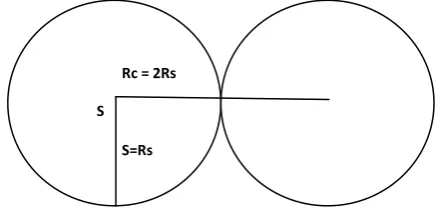
communication ranges are not less than twice of their sensing ranges (Rc ≥ 2Rs). Apart from that, they showed that the desired network connectivity of boundary sensing nodes and interior nodes are equal to the degree of coverage and twice the degree of coverage, respectively. Each deployed tiny node runs the k-coverage eligibility algorithm to determine the targeting coverage of a sensor network by observing at how intersection points between sensors‟ sensing ranges are covered by their neighbors. For the case when Rc < 2Rs, Coverage Configuration Protocol does not guarantee network connectivity. But, the authors integrated CCP with SPAN [5] to provide sensing coverage and along with network communication connectivity.
[image:3.595.62.280.279.388.2]Tian Ying, Zhang Shu-Fang and Wang Ying ,presented [6] ,which differs from existing protocols in four key ways: (1) Initially, they proposed a distributed probabilistic coverage-preserving configuration protocol (DPCCP) based on NP
Figure 1: The relation between Sensing Range ‘Rs’ and
Communication Range ‘Rc’
probabilistic detection model; (2) then, a simplified algorithm on coverage check is developed using Voronoi diagram; (3) after that by taking care of the network connectivity, authors integrated DPCCP with SPAN to ensure both probabilistic sensing coverage and network connectivity; (4) To evaluate the coverage percentage of their algorithm, they presented an algorithm. Simulation results shows that distributed probabilistic coverage-preserving configuration protocol DPCCP+SPAN can effectively reduce the number of active sensors and prolong the network lifetime on the precondition of probabilistic coverage-preserving and network connectivity. The authors also presented an approximate algorithm to evaluate the coverage percentage of their proposed algorithm. Simulation results showed that their protocol out performs CCP+SPAN presented in [5], which can effectively prolong network lifetime on the precondition of probabilistic coverage preserving and network connectivity.
In [7], the authors considered and emphasized on the target coverage and connectivity issues in wireless sensor networks (WSNs) with multiple sensing units. They reduced the problem to a connected set cover problem and further formulated it as integer programming constraints. Two distributed schemes, Remaining Energy First Scheme (REFS) and Energy Efficient First Scheme (EEFS), are presented to solve the sensing coverage and network connectivity issues. Both REFS and EEFS have similar inclination that the network lifetime improves with the increase of the number of sensors, but reduces with the increase of the number of targets. However, the performance of EEFS is better when compared with REFS.
In paper [8], Meenakshi Bansal, Iqbal Singh, Parvinder S. Sandhu present an ILP formulation and protocols to solve the Coverage and Connectivity Control Problem (CCCP) in Wireless Sensor Networks subject to sensor node failures due to mechanical related problems or when battery dries out of energy. They present an algorithm which has full data base of the sensor network and so can build up good routing topologies using the available active sensor nodes. However, spreading the solutions generated by this algorithm can be costly in terms of power, time. Thus, they also proposed a local protocol, which is called every time a sensor node failure occurs and solves the problem considering only the failed neighbourhood sensor node. By integrating both of these protocols the authors build a hybrid approach which results from the best features of each one of them. In this paper, based on the issue of wireless sensor networks coverage control, authors have addressed the k-(Connected) Coverage Set issues in wireless sensor networks with the intension of reducing the total energy consumption while obtaining k coverage for reliability.
In duty-cycled wireless sensor networks (WSNs) for stochastic coverage monitoring, existing efforts are mainly concentrated on efficient energy scheduling of nodes to ensure the coverage, neglecting another crucial issue of connectivity. The connectivity issue is extremely challenging in the duty-cycled wireless sensor networks due to the fact that the link connections between sensor nodes are transient thus unstable. In paper [16], author proposed a new kind of network topology, partitioned synchronous network, to jointly address the coverage and connectivity problem. They analyzed the coverage and connectivity performances of partitioned synchronous network and compared them with those of existing asynchronous network and then author performed extensive simulations to demonstrate that the proposed partitioned synchronous network has a better connectivity result than that of asynchronous network, while sensing coverage performances of two types of networks are close.
One of the challenges of the wireless sensor networks is issue of having coverage along with network connectivity. In paper [17], authors have presented a method in which we can cover a set of discrete targets in a field considering the k-angle coverage. In k-angled coverage, it is ensured that any target in the area should at least be covered by k sensor in a way that the peripheral (boundary) area of such targets is monitored by the sensors. Using this method, in each round, a set of sensor nodes is selected in a way that they can cover all targets along with network connectivity. Then each sensor of this group minimizes its communication range as much as the network in not disconnected. This method may also use the sensors that are incapable of separating data of their targets. The results prove that in comparison with similar methods, the proposed method uses reduced energy and it can also improve the accuracy of the submitted data. The proposed algorithm is a distributed algorithm which is performed in the sensor nodes locally and is able to be implemented in the wide area networks having larger numbers of nodes. The presented approach of this paper, tries to eliminate some issues in Cardie method.
3. PROBLEM: Design Goals
In order to extend the whole wireless sensor network lifetime and also to maintain the connected area coverage problem, we present an energy-efficient Connected Coverage Preserving Protocol to select the group of active sensor nodes.
Rc = 2Rs S
Definition
1:
A deployment pattern is called fully optimal if it employs the minimum number of sensors nodes to produce the given sensor coverage and network connectivity requirement, among all patterns.Definition 2:
If any sensor node in network is among the communication range of one active node, then the network is said to be covered.Definition 3
:
Connected Neighbouring Sensors: Two sensor situated at points u and v are said to be connected with neighbours, if1. D(u) ∩ D(v) ≠ ϕ , i.e. their sensing convex disc intersect and
2. d (u,v) ≤ Rc , where Rc denotes coverage range
Definition 4
:
Boundary sensor node: It is a sensor node whose sensing circle intersects with the boundary of the desired convex sensor deployment region of interest (ROI) is „A‟. i.e., all boundary sensor nodes are located within sensing range „Rs‟ distance to the boundary. All the remaining sensornodes in region A are interior sensors.
Definition 5
: Region of Interest (ROI): It is a sub-area of the sensing area of the Wireless Sensor Node that needs to be monitored all the time.Definition 6
: Duty cycling: It is defined as one of the most widely used mechanisms for efficient energy MAC protocols in wireless sensor networks. A duty cycling MAC protocol applies suitable sleep / wake up mechanisms for power saving. Authors in [15] investigated that sleep mode power consumption is very less compared with idle mode power consumption. Whenever there is no need for transmission, the sensing node is put to sleep mode. It is confirmed that one way towards lesser energy conservation is to sleep (turn off) all unwanted motes (e.g., transceiver).Assumption Done
We assume that each and every node knows its location information in terms of coordinates. We assume a heterogeneous network with powerful
nodes uniformly distributed in a ratio.
Algorithm Steps
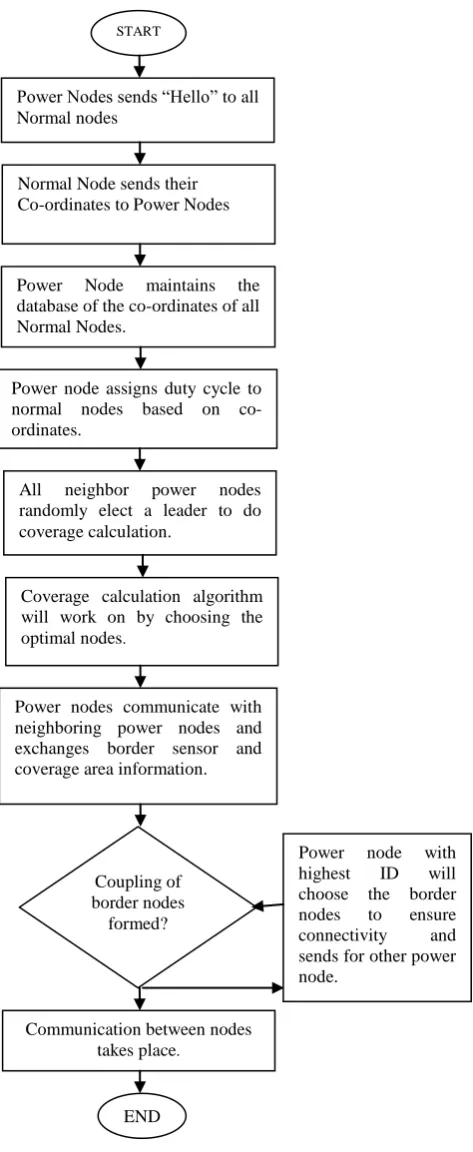
Each Power node will Query the Normal Nodes to send its location information. A node can be reached by two powerful nodes but it always replies only to the first Power node.
Each Normal Node sends its location information (x, y) to the power node.
The power node maintain the data base of (X, Y) and broadcasts this to all power nodes neighboring. The neighbor power nodes randomly elect a leader to do coverage calculation for particular Set (X, Y). Say which node has highest ID will do the coverage calculation.
Coverage Calculation algorithm will work by choosing the optimal nodes to cover the area using (X, Y) points and switch on schedule.
Power node will send the Border Sensor and coverage area information to all power nodes.
Two Power Nodes will determine if they are properly connected via the normal nodes else the node with higher id will choose the border node to ensure connectivity and sends the chosen node to the other power node. This is covered in the connectivity ensured algorithm.
Once connectivity ensured algorithm runs between all the power nodes, then whole network wide connectivity is ensured.
Due to this step we know the optimal nodes to ensure connectivity and coverage.
The use of Power nodes
A power node runs the coverage and connectivity algorithm to ensure optical nodes to be active and their duty cycle. But once this operation is complete how can they be used. If a power nodes can formed a network to sink, then it can used a backplane for sending any urgent messages to sink.
Power nodes can sleep and wake up after some configured period of time and query the sensors, In case some sensors have drained in particular area, it can change the duty cycle of the nodes in that area, or it can even enable the sensors in intersection area of two squares.
In this paper, we assumed that nodes know their location. But for some networks when it is not known, we can make it known as following.
Power nodes can be equipped with GPS, so they know location; they can broadcast their locations to the normal sensor nodes. Sensor nodes can easily find their own location by triangulation.
The flow chart (Figure 2.) of the proposed Efficient Energy, Coverage and Connectivity (ECC/ EC2) Algorithm is presented below.
4. SIMULATION PARAMETERS
Figure. 2. Proposed ECC Algorithm flow chart
The following table 1 summarizes the simulation parameters used
No. of Nodes 50,100,150 and 200
Area Size 1000 X 1000
MAC Protocol 802.11
Simulation Time 50 sec
Traffic Source CBR
Packet Size 512
Transmit Power 0.360W
Receiving Power 0.395W
Idle Power 0.335W
Transmission Range 250,300,350 and 400
Routing Protocol AODV
Performance Evaluation
During experimentation, our proposed Efficient Energy, Coverage and Connectivity (ECC/ EC2) protocols performance is compared with both CCP + SPAN and also with DPCCP+SPAN [14].In this evaluation; the experimentation is focused mainly on average energy consumption and connected Coverage of sensor.
[image:5.595.319.545.430.573.2]Experiment 1
: In experiment 1, we vary the no. of sensor nodes as 300,400,500 and 600 and measure the average energy consumption. Figure 2. illustrates the general trend of the number of active nodes .With the growth of the number of deployed nodes, the numbers of active nodes experience a sharp increase in CCP+SPAN and followed by a comparatively steady and marginal rise in DPCCP+SPAN. But our proposed Efficient Energy, Coverage and Connectivity (ECC) employed for the proposed work is minimum and it results in minimum energy consumption.The transmission range is fixed as 250m.Figure 2. Performance: Total Nodes vs. Number of Active Nodes
Experiment 2
: In experiment 2, we focused on the connected sensor node coverage range vs. energy cost in terms of active nodes.Fig.3 shows the results of coverage sensor nodes, for different network ranges.
Power node assigns duty cycle to normal nodes based on co-ordinates.
All neighbor power nodes randomly elect a leader to do coverage calculation.
Coupling of border nodes
formed?
Power node with highest ID will choose the border nodes to ensure connectivity and sends for other power node.
Coverage calculation algorithm will work on by choosing the optimal nodes.
END
Communication between nodes takes place.
Normal Node sends their Co-ordinates to Power Nodes
Power Node maintains the database of the co-ordinates of all Normal Nodes.
Power Nodes sends “Hello” to all Normal nodes
Power nodes communicate with neighboring power nodes and exchanges border sensor and coverage area information.
[image:5.595.54.275.711.767.2]Figure 3. Energy cost vs. Communication Range.
[image:6.595.321.542.223.349.2]Experiment 3:
In this experiment 3, we changed the transmission range as 15,20,25,30 and noted number of active node. From Fig. 4, we noted that, no. of active nodes are reduced as the transmission range is increased and in turn the energy consumption is significantly reduced in our algorithm EC2, when compared with both CCP + SPAN and also with DPCCP+SPAN. In other words, nodes in network with proposed Efficient Energy, Coverage and Connectivity (ECC/ EC2) protocols have a considerably long survival-cycle.Figure 4. System Life Time: No. of Active Nodes vs. Range
Experiment 4
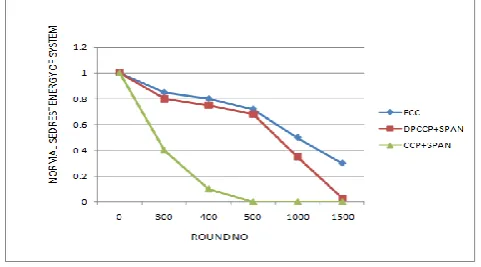
: In this evaluation, the results of system lifetime are measured. Fig.5 shows the sensor coverage results for different sensor network sizes for changed to different round. In this experiment, normalised rest energy vs. system lifetime is checked and noted that from the proposed algorithm, the rest energy is more compared with the other CCP+SPAN and DPCCP+SPAN algorithm.Figure 5.System Normalised rest energy: Normalised rest energy vs. Round No.
Experiment
5. In the beginning stage, where the power of each node is sufficient, the network coverage keepssteady. A higher and a higher level of sensing coverage are always with a higher value of η. Then, the figure 6. Shows a slight fall in the sensing coverage after a long steady process due to energy consumption. But finally, the network sensing coverage degrades dramatically as the energy consumption is aggravated. In contrary to the beginning stage, a higher value of η will result in a lower sensing coverage level. The reason is that more and more active nodes are required to maintain a greater level of network sensing coverage (denoted by a higher value of η), and sensor nodes will consume energy faster until their failures. Thus, it is noted that it is impossible to maintain a greater level of network sensing coverage by more active nodes. Accordingly, there is an essential relation between sensing coverage guarantee and network lifetime.
Figure 6.Coverage Percentage vs. Round Number
5. CONCLUSION & FUTURE WORK
In this paper work, we presented Efficient Energy, Coverage and Connectivity (ECC/EC2) protocols‟, a randomized algorithm which is run locally at a sensor node to govern its operation. We presented recent energy-efficient connected coverage issues proposed in literature, their formulations and assumptions as well as solutions proposed. Sensor coverage, connectivity and energy are the three important elements for QoS in applications with WSNs. This proposed Efficient Energy, Coverage and Connectivity (ECC/EC2) algorithm is simulated using NS2 and compared against integrated CCP with SPAN [5] algorithm and also with Distributed Probabilistic Coverage-preserving Configuration Protocol (DPCCP) [6] with SPAN [5] protocol and showed that our presented results in significant reduction of energy, with strongly connected coverage. Most recent works on the sensor connected coverage problem are still limited to theoretical study. In future, more and more research work will be concentrated on distributed and localized solutions for practical deployment.
6.
REFERENCES
[1] T.Ying, Z.Shu-Fang W.Ying” A Distributed Protocol for Ensuring Both Probabilistic Coverage and Connectivity of High Density Wireless Sensor Networks” IEEE Communications Society, WCNC 2008 proceedings,2008, pp.2069-2075.
[2] I.F. Akyildiz, W. Su, Y. Sankara subramaniam, E. Cayirci, “Wireless sensor networks: A survey, Computer Networks” 38 (2) (2002), pp.393–422.
[image:6.595.53.293.339.478.2] [image:6.595.54.295.574.707.2][4] X.Wang, G.Xing, Y.Zhang, C.Lu, R.Pless and C.Gill,”Integrated Coverage and Connectivity Configuration in Wireless Sensor Networks,” in ACM International Conference on Embedded Networked Sensor Systems (SenSys), pp.28-39, 2003.
[5] Benjie Chen, Kyle Jamieson, Hari Balakrishnan, and Robert Morris” Span: An Energy Efficient Coordination Algorithm for Topology Maintenance in Ad Hoc Wireless Networks” in International Conference on Mobile Computing and networking (MobiCom),Rome,Italy,July 2001
[6]Tian Ying, Zhang Shu-Fang and Wang Ying” A Distributed Protocol for Ensuring Both Probabilistic Coverage and Connectivity of High Density Wireless Sensor Networks” IEEE Communications Society, WCNC proceedings, 2008, pp. 2069-2075
[7]Kuei-Ping Shih, Hung-Chang Chen, and Bo-Jun Liu” Integrating Target Coverage and Connectivity for Wireless Heterogeneous Sensor Networks with Multiple Sensing Units” IEEE, ICON proceedings, 2007, pp. 419-424
[8]Meenakshi Bansal, Iqbal Singh, Parvinder S. Sandhu “Coverage and Connectivity Problem in Sensor Networks” World Academy of Science, Engineering and Technology 73, 2011, pp. 842-845.
[9] Network Simulator: www.isi.edu/nsnam/ns
[10] D. Tian and N. D. Georganas. A coverage-preserving node scheduling scheme for large wireless sensor networks. In First ACM International Workshop on Wireless Sensor Networks and Applications, Georgia, GA, 2002.
[11].F.P. Quintao, F.G. Nakamura, and G. R. Mateus.” Model and Algorithms for the Density, Coverage and Connectivity Control Problem in Flat WSNs” 2007
[12]Mohammad ali Jamali, Navid Bakhshivand, Mohammad Easmaeilpour, Davood Salami”An Energy-Efficient Algorithm for connected target coverage problem in wireless sensor networks” 3rd IEEE International Conference Computer Scienec & Information Technology (ICCSIT) on 9-11 July 2010,pp-249-254
[13] A. M. C. So and Y. Ye, In Proceedings of the 1st Workshop on Internet and Network Economics (WINE 2005). Hong Kong: s-lncs, 2005, pp.584–593.
[14] Tian Ying, Zhang Shu-Fang and Wang Ying “A Distributed Protocol for Ensuring Both Probabilistic Coverage and Connectivity of High Density Wireless Sensor Networks” IEEE Communications Society, WCNC 2008 proceedings, pp 2061-2074
[15]M. J. Miller and N. H. Vaidya, “Power save mechanisms for multi-hop wireless networks,” in Proceedings of the 1st International Conference on Broadband Networks , October 2004, pp. 518–526.
[16].Shibo He, Jiming Chen and Youxian Sun” Coverage and Connectivity in Duty-Cycled Wireless Sensor Networks for Event Monitoring” Parallel and Distributed Systems, IEEE Transactions March 2012, V. 23 Issue: 3 pp. 475 – 482.
[17].S.Omid Melli “K-Target Coverage & Connectivity in Wireless Sensor Network Considering the angle coverage” , 3rd International Conference on Computer Research and Development (ICCRD), March 2011 ,pp. 168 – 173.
7. AUTHORS PROFILE
D. G. Anand is native of Madikeri, Karnataka, India. He
received his B.E Degree from AIT, Chikamagalore, Mysore University and ME from UVCE Bangalore University, Bangalore and currently he is persuing his PhD from Jawaharlal Nehru Technological University Anantapur, Andra Pradesh.
Presently he is serving as Professor and HOD in the department of ECE at Sri Krishna Institute Of Technology, Bangalore. His areas of interest are wireless communication, sensor networks.
Dr. H. G. Chandrakanth is native of Bangalore, Karnataka,
India. He received B.E Degree from UVCE, Bangalore University, Bangalore, India in 1991, MSEE from Southern Illinois University Carbondale, USA in 1994 and PhD from Southern Illinois University Carbondale, USA in 1998. Presently he is working as Principal at Sri Krishna Institute Of Technology, Bangalore. His research areas are Wireless Communications, Wireless Sensor Network and Mobile Communication. He is a member of IEEE, ISTE.
Dr.M.N.Giri Prasad is native of Hindupur town of