Ant based Multiple Cluster Tree Routing for 802.15.4
Sensor Networks
S.G.Santhi
Assistant Professor
Department of Computer Science & Engineering
Faculty of Engineering & Technology, Annamalai
University
K.Venkatachalapathy, PhD.
Associate Professor
Department of Computer Science & Engineering
Faculty of Engineering & Technology, Annamalai
University
ABSTRACT
In IEEE 802.15.4 sensor networks, the non-optimal selection of routes, congestion and uneven traffic distribution in tree routing can cause performance degradation. Also the imbalance in the workload can result in hotspot problems and the energy depletion of the nodes. In this paper we propose an ant based multiple cluster tree routing for 802.15.4 sensor networks. In this approach, a node is randomly selected among the available nodes as the PAN coordinator. The PAN coordinator utilizes the swarm intelligence based ant colony optimization technique to select the nodes within the transmission range for cluster formation which corresponds to the trees. In order to achieve the diverse topologies of different trees, a proper parent is selected based on the link quality index. Further, each node selects the tree with minimum cost as the main routing tree adaptable to fault free multimedia traffic. Finally a QoS based routing is utilized for cluster based multi tree topology using ant agents. By simulations results, we show that proposed approach is efficient in terms of routing.
Keywords
Wireless Sensor Networks, IEEE 802.15.4, PAN coordinator, Multiple Cluster.
1. INTRODUCTION
1.1 IEEE 802.15.4 Networks
The wireless network with minimum data rate, reduced energy consumption and minimum cost is formed by IEEE 802.15.4 standard. The distinctive characteristics of the standard makes it more approving module for wireless sensor networks and remote monitoring applications. The physical layer and medium access control layer of data link layer are the lowermost layers of the protocol which is defined by the standard. [1] It offers a minimum power, economic and a consistent protocol for wireless connectivity among low-cost, permanent and moveable devices. These devices can figure out into a sensor network or wireless personal area network (WPAN) [2]. The network holds two categories of the devices such as full function devices (FFD) and reduced function devices (RFD). FFD functions as a router. It is capable of linking to other FFD and RFD devices. RFD has capability to link with FFD devices. [3] IEEE 802.15.4 is utilized to interlink minimum cost sensors, actuators and processing devices in the wireless manner. The several applications of 802.15.4 devices includes industrial control, environmental and health monitoring, home automation, entertainment and toys, security, location, and asset tracking, emergency and disaster response[4].
The most hopeful minimum span wireless communication technology corresponds to Bluetooth which is depended on time-division multiple access (TDMA) and frequency hopping spread spectrum (FHSS). The main features such as interference
flexibility and power efficiency are possessed by this network that is required by the wireless sensor networks [5]. The ultimatum of portability of mobile connections has resulted in the recurrent raise of attention for Bluetooth wireless personal area network (WPAN) technology. It offers new personal communication prospects and services. [7] In relation to Bluetooth, several communication services can be offered by various WPAN frameworks. It can be interlinked to facilitate allocation of information. In addition, it permits communications with the physical environment. The devices which utilize Bluetooth become piconets. It performs the communication in slave-master-slave prototype. A piconet possesses one master device and seven active slave devices. [7] The merit of setting up Bluetooth is that the individual channel are utilized by all the sensor nodes in the radio range for preventing the interference and fight for a shared channel. Also the minimum power feature of Bluetooth permits the radio to penetrate the power saving mode when there is lack of dynamic communication. The problem of Bluetooth based sensor network lies in maintaining effective scatternet configuration and in performing routing for a multi-hop network. The simultaneous route discovery performed by the multiple sources can result in complexity. [5].
1.2
ZigBee Routing
A minimum cost, reduced power consumption based on IEEE 802.15.4 standard for a wireless personal area networks (WPANs) is termed as ZigBee. [3] This technology is defined using three categories of devices such as zigbee coordinator, zigbee routers, and zigbee end devices. The FFD is capable of functioning as zigbee coordinator as well as zigbee router whereas the RFD can functions merely as a zigbee end devices. The routing can be performed by the zigbee coordinator and routers and not by the zigbee end devices since it depends on the respective zigbee parent routers for routing purpose. [6] The process of selecting the paths in the network to forward the network traffic is termed as routing. There exist two routing schemes in zigbee networks namely mesh routing and tree routing. The mesh routing is analogous to adhoc on demand vector (AODV) routing and tree routing scheme is analogous to cluster tree routing algorithm. In zigbee mesh routing, a route request (RREQ) are transmitted on-demand during the transmission of data to a destination of unrevealed path. The routes construction depends on the route response i.e. route reply from intermediate and destination nodes. In case no routes are identified, a route error (RRER) message is send to the user [6]
During this situation, the source node just sends the packet downwards to its descendant or else it sends the packet upwards to its parent node. In case the parent or descendant node gets this packet, they will choose the next hop node as per the destination address in the similar way [3]. The process of upholding end-to-end routing becomes more demanding due to recurrent modulation in the network topology which is caused by the node failures, mobility and various other factors [6].
1.3 Issues in Zigbee Routing
Since node heterogeneities should be considered for designing an efficient routing scheme for zigbee network, it cannot utilize the conventional MANET routing schemes. [6]
The issue corresponding to 802.15.4 star networks based on single and multi-hop networks includes hidden terminal problem (HTP). There is a possibility of packet collision at the receiver node since the multiple out of range nodes presumes free channel and commences time overlapping transmission of packet.
As 802.15.4 does not offer any mechanism for a coordinated and energy efficient FFD-to-FFD packet transmission, FFDs should be held in on conditions during the realization of communication through CSMA-CA which minimizes the functioning duration of the node [8].
Since the nodes in the cluster-tree network has a necessity to keep all the information of its descendant nodes, the nodes should tolerate severe memory overhead. [7]
The routing paths are not enhanced with regards to routing metrics such as hop count and bandwidth in the HERA routing algorithm.
A blind flooding is utilized to broadcast RREQ in AODV [9]. In case of large networks, heavy traffic is generated that results in broadcast storm problem. The flooding can also result in extreme redundancy, conflict and collision.
1.4 Proposed Work
The ease and the limited use of resources makes tree routing one of the most favorite for zigbee routing. The network life time and the performance are badly affected by the non-optimal selection of routes, congestion and uneven traffic distribution in tree routing. The imbalance in the workload can cause hotspot problems and the energy depletion of the nodes which are the routers of the network.
A node in the cluster tree network records all of its descendant nodes. Hence there are many nodes which bear a heavy memory overhead. It may also have longer routing paths.
In this paper, we propose to develop a cluster based tree formation with alternate trees and a Qos based routing protocol.
2. RELATED WORKS
H. Fariborzi and M.Moghavvemi [1] proposed energy aware multi-tree routing (EAMTR) protocol for wireless sensor networks. It stabilizes the capacity of data gathering and declines the hotspot and single point failure issues for high-density sink-type networks. In this approach, multiple trees are created in the initialization phase. Further the node chooses the minimum congested route to the root node with respect to the network traffic.
M. Al-Harbawi et al [3] proposed an improved Tree Routing (ImpTR) protocol for zigbee network. This protocol finds the shortest path to the sink node based on the neighbor table as an alternative to utilize the tree topology. If the path to the destination through neighbor node is shorter than the path through PAN coordinator, the packets are forwarded to the neighbor node.
Francesca Cuomo et al [4] proposed hierarchical routing algorithm (HERA) where the route packets from sensor node to sink depending on the parent-child relationships is established by the IEEE 802.15.4 topology formation procedure. HERA utilizes the information swapped at the time of formation of the network and topology update phase which prevents additional routing message and related overhead.
Yuh-Shyan Chen and Tsung-Hung Lin [7] proposed an integrated interpiconet scheduling approach that provides QoS assurance of Bluetooth scatternets in WPANs. Also they proposed a time slot leasing based scheme to offer extra slave-to-slave QoS communication capability for minimizing the workload of master nodes as well as missing rate of QoS requests.
Xianghua Xu et al [9] analyzed two routing algorithms of Zigbee routing protocol and their enhancements are made as per shortages and inefficiencies. The tree-based hierarchical routing minimizes the routing hops and energy consumption. In zigbee AODV routing algorithm, they take spanning tree network into consideration which makes routing in efficient manner and prevents broadcasting storm problem. All nodes are grouped into logical clusters in an effective way. The nodes in the same cluster share the routing table. It minimizes the time of broadcasting routing discovery packets effectively.
Bogdan Pavkovi´c et al [12] have presented a scheme that permits coexistence of two structures in emerging IP enabled wireless sensor networks such routing protocol for low power and lossy networks (RPL) routing and IEEE 802.15.4 MAC. They modified the existing cluster-tree operation to support RPL Destination Oriented Directed Acyclic Graph. This is to assist nodes in following their multiple parents and using them for traffic forwarding if necessary. Their reliability approach does not explore the method of accommodating more traffic loads with more advanced multi-path routing schemes or by adapting the parameters of ieee 802.15.4.
Olfa Gaddour et al [13] have proposed Z-cast, a multicast routing mechanism to guarantee efficient communication among sensor nodes. Their technique assures the multicast message transmission from group member to all other group members which is turn minimizes number of transmitted packets. They achieved this by discarding the message in the leafs which is devoid of group members.
Yu-Kai Huang et al [14] have presented an adoptive-parent based framework for a ZigBee cluster-tree network to increase bandwidth utilization without generating any extra message exchange. They modeled the process as a vertex-constraint maximum flow problem, and developed a distributed algorithm that is fully compatible with the ZigBee standard to optimize the throughput in the framework.
relay time intervals among coordinators, their approach also assured end-to-end delay.
3. ANT BASED MULTIPLE CLUSTER
TREE ROUTING
The proposed ant based multiple cluster tree routing protocol involves four phases
Phase 1: Cluster based tree formation
Phase 2: Construction of multiple tree topologies. Phase 3: Optimal tree selection
Phase 4: QoS based routing
3.1 Selection of Nodes
The selection of nodes is performed using swarm intelligence technique based on ant colony optimization (ACO) in a proactive manner. The forward ant agent (FA) establishes the pheromone track to the source node, while backward ant agent (BA) establishes the pheromone track to the destination node. The steps involved in the selection of nodes are as follows.
1) The FA is launched in PAN coordinator (Pco) and it
traverses through all nodes within its transmission range.
2) FA on reaching every node updates its header with the information about the node (shown in Figure 1). 3) With the gathered information, FA reaches the end
node (D) within the transmission range.
4) When FA reaches D, D generates BA and transfers all the information of FA into BA. The BA takes the same path as that of its corresponding FA, but in the reverse direction.
5) The BA updates the header field at the neighboring nodes for all the entries related to the FAs destination node.
6) The BA upon reaching the Pco delivers the status of
all the nodes. The Pco then selects the nodes within its
transmission range.
Node ID Sequence number
Node
address Distance
Figure 1. Header field of the ant agent
3.2 Computing Tree Identification Bits (TIB)
A part of 16 bit MAC short address is used as tree identification bits (TIB). The number of TIB is found as per the size and density of the network and the formula to compute TIB is as follows.
)]
1000
250
(
[log
2a
z
a
z
TIB
(1)where z is the total number of nodes a is the network area in m2
The most significant bits of tree identification bits (TIB) denote the number of trees. [1]
3.3 Phase 1: Cluster based Tree Formation
The steps involved in the cluster based tree formation are as follows.
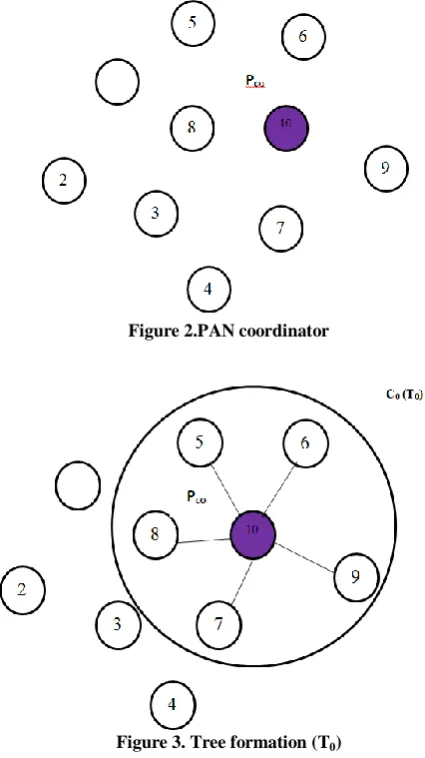
1) Initially, a single node is chosen as the personal area network (PAN) coordinator from all the deployed
nodes in the network. It is represented as Pco. (shown
in Figure 2 )
2) Pco proactively searches the nodes within its
transmission range using ant colony optimization technique (ACO) (described in section 3.1)
3) Once the nodes are found, Pco exchanges its
parameters such as nodes ID, address, sequence number and distance of location with the nodes. 4) The selected nodes get connected with Pco through a
tree-link.
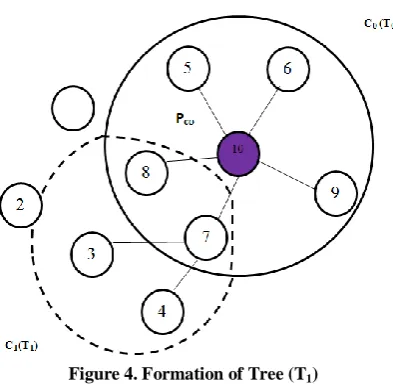
5) The first cluster (C0) is build with Pco as the cluster
head (CH) (shown in Figure 3) This represents tree (T0) with Pco as root node and nodes connected to Pco
as the leaf node.
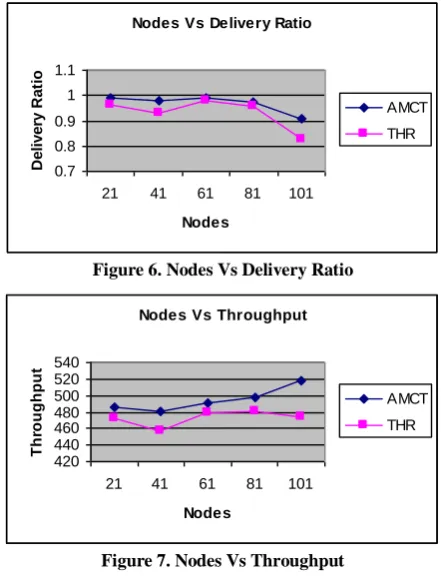
6) Similarly, the leaf nodes of T0 start searching the new
nodes using the ant agents. If the nodes are found, the leaf nodes get linked to it through a tree link and it becomes the new cluster head C1. (shown in Figure
4). This represents the tree (T1) with C1 as root node.
7) The above process is repeated till no new nodes are available in the neighborhood.
[image:3.595.65.289.299.548.2]The diagrammatic representation of the cluster based tree formation is as follows.
Figure 2.PAN coordinator
[image:3.595.311.524.364.743.2]Figure 4. Formation of Tree (T1)
Figure 2 shows that node 10 is chosen as PAN coordinator (Pco). Figure 3 shows the tree (T0) with Pco as root node and
nodes 5, 6, 7, 8, 9 as the leaf nodes. Figure 4 shows the tree (T1)
with node 7 as root node and nodes 3, 4, 8 as the leaf nodes.
3.4 Phase 2: Construction of the Multiple
Tree Topologies
The multiple tree topologies is build using TIB (computed in section 3.2). After the tree formation, root node starts assigning the addresses to each node. Thus there are 2TIB trees and each node is assigned with maximum of 2TIB address.
The diverse topologies of the different trees can be achieved by following condition
If any node receives multiple association responses from its root nodes
Then
The node with maximum Lq is selected as root node.
End if
(Lq is the link quality index which is defined by the IEEE
802.15.4 standard).
3.5 Phase 3: Optimal Tree Selection
The process of selecting the optimal tree progresses from root node to leaf node in the individual manner starting from the first level of the node. Every node progressively selects the tree with minimum cost (Cmin) as main routing tree. Cmin refers to the sum
of node cost(C) of all nodes from the sink to the corresponding node lower than the other trees. C is the counter which gets incremented on selecting any tree as routing tree for any node in the network.
The above procedure balances the network traffic and reduces the expected congestion in the links.
3.6 Phase 4: QoS Based Routing
The cluster based multi-tree topology is formed with QoS based routing. It is performed using the ant colony optimization (ACO) for selecting the shortest path with good link quality, thus preventing the route failures. The steps involved in the QoS based routing are follows.
1) The source node creates FA with source address and broadcasts it to its parent node in the primary cluster-tree through the leaf nodes.
2) When a leaf node receives FA, it verifies the destination address of FA. If the destination address of FA is not similar, then the leaf node adds its own address, sequence number and distance and broadcasts it to other leaf nodes.
3) In case a leaf node receives a duplicate FA i.e. route record of FA includes the address of present node, the FA is discarded. Otherwise step 2 is executed. 4) When FA reaches the parent node (destination), BA is
created and information gathered in FA is transferred to BA.
5) BA traverses in the same path but in the opposite path to FA and updates the header field at all the leaf nodes.
6) When BA reaches the source node, it delivers the node details and the source initiates the route discovery by choosing the shortest distance towards the destination.
3.7 Overall Algorithm
The entire steps involved in cluster based tree formation, multiple tree topology construction, optimal tree selection and QoS based routing are summarized in the following algorithm.
Step 1
The nodes are deployed in the network and one of them is chosen as PAN coordinator. (Pco)
Step 2
Pco searches the nodes within its transmission range using ant
colony optimization (ACO) technique.
Step 3
The selected nodes get connected to Pco through tree link. Thus
a cluster is formed with Pco as cluster head which denotes the
tree formation with Pco as root node and linked nodes as leaf
nodes.
Step 4
The leaf nodes in the previously formed cluster starts searching the nodes using the ant agents and the clusters are formed with these leaf nodes as cluster heads. The process of tree formation is repeated till no leaf nodes are left in the network.
Step 5
After the tree formation, root node of each tree starts assigning the addresses to each node.
Step 6
When any node receives multiple association responses from its root nodes, the node with maximum link quality index is chosen as root node for achieving the diverse topologies of the different trees.
Step 7
From different trees, the node selects the tree with minimum cost (Cmin) as main routing tree.
Step 8
A QoS based routing is used for cluster based multi tree topology. It is performed by ant agents to select the shortest path with good link quality.
4. SIMULATION RESULTS
4.1. Simulation Setup
network which is deployed in an area of 50 X 50 m is considered. The IEEE 802.15.4 MAC layer is used for a reliable and single hop communication among the devices, providing access to the physical channel for all types of transmissions and appropriate security mechanisms. The IEEE 802.15.4 specification supports two PHY options based on direct sequence spread spectrum (DSSS), which allows the use of low-cost digital IC realizations. The PHY adopts the same basic frame structure for low-duty-cycle low-power operation, except that the two PHYs adopt different frequency bands: low-band (868/915 MHz) and high band (2.4 GHz). The PHY layer uses a common frame structure, containing a 32-bit preamble, a frame length.
[image:5.595.314.535.74.363.2]The simulated traffic is CBR with UDP source and sink. Table 1 summarizes the simulation parameters used.
Table 1. Simulation Parameters
No. of Nodes 21,41,61,81 and 101 Area Size 50 X 50
Mac IEEE 802.15.4 Simulation Time 25 sec Transmission Range 12m
Routing Protocol AMCT Traffic Source CBR
Packet Size 80 bytes
4.2. Performance Metrics
The performance of AMCT is compared with the Tree-based Hierarchical Routing (THR) protocol [9]. The performance is evaluated mainly, according to the following metrics.
Average end-to-end Delay: The end-to-end-delay is averaged over all surviving data packets from the sources to the destinations.
Average Packet Delivery Ratio: It is the ratio of the number .of packets received successfully and the total number of packets transmitted.
Throughput: It is the number of packets successfully received by the receiver.
The simulation results are presented in the next section.
4.3 Results
A. Based on Nodes
Nodes Vs Delay
0 5 10 15 20
21 41 61 81 101
Nodes
D
e
la
y
(S
e
c
)
[image:5.595.72.264.245.341.2]AMCT THR
Figure 5. Nodes Vs Delay
Nodes Vs Delivery Ratio
0.7 0.8 0.9 1 1.1
21 41 61 81 101
Nodes
D
e
li
v
e
ry
R
a
ti
o
AMCT THR
Figure 6. Nodes Vs Delivery Ratio
Nodes Vs Throughput
420 440 460 480 500 520 540
21 41 61 81 101
Nodes
T
h
ro
u
g
h
p
u
t
AMCT THR
Figure 7. Nodes Vs Throughput
From the figure 5, we can see that the average end-to-end delay of the proposed AMCT protocol is less than the existing THR protocol.
From the figure 6, we can see that the packet delivery ratio of the proposed AMCT protocol is higher than the existing THR protocol.
From the figure 7, we can see that the throughput of the proposed AMCT protocol is higher than the existing THR protocol.
5. CONCLUSION
In this paper we have proposed an ant based multiple cluster tree routing for 802.15.4 sensor networks. In this approach, a node is randomly selected among the available nodes as the PAN coordinator. The PAN coordinator utilizes the swarm intelligence based ant colony optimization technique to select the nodes within the transmission range for cluster formation which corresponds to the trees. After the tree formation, root node of each tree starts assigning the addresses to each node. When any node receives multiple association responses from its root nodes, the node with maximum link quality index is chosen as root node for achieving the diverse topologies of the different trees. From different trees, the node selects the tree with minimum cost as main routing tree as per fault-free requirement of multimedia traffic applications. Then a QoS based routing is utilized for cluster based multi tree topology using ant agents. By simulations results, we show that proposed approach achieves more throughput and packet delivery ratio with reduced delay, while increasing the network size. As a future work, we wish to include power efficient scheduling technique along with the cluster based routing.
6. REFERENCES
[image:5.595.56.282.563.688.2][2] Gurjit Kaur, Kiran Ahuja, “Qos Measurement of Zigbee Home Automation Network using Various Routing Protocols”, International Journal of Computer Applications, Volume 13– No.2, pp.25-30,Jan 2011. [3] M. Al-Harbawi, M. F. A. Rasid, N. K. Noordin, “Improved
Tree Routing (ImpTR) Protocol for ZigBee Network”, IJCSNS International Journal of Computer Sci 146 ence and Network Security, VOL.9 No.10,pp.146-152, Oct.2009.
[4] Francesca Cuomo, Sara Della Luna, Ugo Monaco, Tommaso Melodia, “Routing in ZigBee: benefits from exploiting the IEEE 802.15.4 association tree”, pp. 3271-3276, 2007.
[5] Xin Zhang, George F. Riley, “An On-Demand Bluetooth Scatternet Formation and Routing Protocol for Wireless Sensor Networks”, Proceedings of the Sixth International Conference on Software Engineering, Artificial Intelligence, Networking and Parallel/Distributed Computing and First ACIS International Workshop on Self-Assembling Wireless Networks, 2005.
[6] Nia-Chiang Liang, Ping-Chieh Chen, Tony Sun, Guang Yang, Ling-Jyh Chen, and Mario Gerla, “Impact of Node Heterogeneity in ZigBee Mesh Network Routing”, IEEE International Conference on Systems, Man and Cybernetics, (SMC), pp 187 – 191, 2006.
[7] Yuh-Shyan Chen and Tsung-Hung Lin, “A time-slot leasing-based QoS routing protocol over Bluetooth WPANs”, Int. J. Ad Hoc and Ubiquitous Computing, Vol. 2, No. 1/2, 2007.
[8] A.G.Ruzzelli1, A. Schoofs , G.M.P. O’Hare, M. Aoun, and P. van der Stok, “Coordinated Sleeping for Beaconless 802.15.4-based Multi hop Networks” 1st International Conference on Sensor Systems and Software, 2009. [9] Xianghua Xu, Daomin Yuan, Jian Wan, “An Enhanced
Routing Protocol for ZigBee/IEEE 802.15.4 Wireless Networks”, Second International Conference on Future Generation Communication and Networking,pp.294-298,2008.
[10] Hsien-Kai Hsin, En-Jui Chang, Chih-Hao Chao, and An-Yeu Wu, “Regional ACO-based Routing for Load-Balancing in NoC Systems”, Second World Congress on Nature and Biologically Inspired Computing (NaBIC), pp 370 - 376 2010.
[11] Rajeshwar Singh, Dharmendra K Singh, Lalan Kumar, “Performance Evaluation of ACO Based on Demand Routing Algorithm for Mobile Ad Hoc Networks”, International Journal of Engineering Science and Technology, Vol. 3, No. 3,pp.1809-1815,Mar 2011
[12] Bogdan Pavkovi, Fabrice Theoleyre, and Andrzej Duda, “Multipath Opportunistic RPL Routing over IEEE 802.15.4”, Proceeding of the 14th ACM international conference on Modeling, analysis and simulation of wireless and mobile systems (MSWiM), pp 179-186, 2011. [13] Olfa Gaddour, Anis Koubaa, Omar Cheikhrouhou,
Mohamed Abid, “ Z-Cast: A Multicast Routing Mechanism in ZigBee Cluster-Tree Wireless Sensor Networks”, Proceeding of the 2010 IEEE 30th International Conference on Distributed Computing Systems Workshops (ICDCSW), pp 171-179, 2010. [14] Yu-Kai Huang, Ai-Chun Pang¤y, Pi-Cheng Hsiu¤¤,
Weihua Zhuangz, and Pangfeng Liu, “Distributed Throughput Optimization for ZigBee Cluster-Tree Networks”, IEEE transaction on parallel and distributed systems, pp 513-520, 2012.
[15] Gerard Chalhoub and Michel Misson, “Cluster-tree based energy efficient protocol for wireless sensor networks”, International conference on Networking, Sensing and Control (ICNSC), pp 664-669, 2010.
[16] Network Simulator, http://www.isi.edu/nsnam/ns
7. AUTHOR’S PROFILE
S.G.Santhi obtained her Bachelor’s degree in Computer Science & Engineering from Mookambigai College of Engineering,Bharathidasan University, Tamilnadu, India in 1992.Then she obtained her Master’s degree in Computer Science & Engineering from Annamalai University, Tamilnadu, India in 2005.She is currently working as an Assistant Professor in the Department of Computer Science & Engineering, Faculty of Engineering & Technology, Annamalai University. She is having 12 years and 11 months of experience in teaching. She has published more than 10 Research papers in International & National Conferences. Her field of interest includes Computer Networks. She is a life member in various professional bodies like ISTE, CSI. Etc.,