http://dx.doi.org/10.4236/ampc.2015.56022
Electrical, Structural and Morphological
Properties of Sb-Doped Bi-Based
Superconductors
Ghazala Y. Hermiz, Amal K. Jassim, Saad F. Oboudi
Department of Physics, College of Science, University of Baghdad, Baghdad, Iraq Email: [email protected]
Received 14 May 2015; accepted 22 June 2015; published 26 June 2015
Copyright © 2015 by authors and Scientific Research Publishing Inc.
This work is licensed under the Creative Commons Attribution International License (CC BY). http://creativecommons.org/licenses/by/4.0/
Abstract
In this paper, samples of antimony doped Bi-based superconductor with stoichiometric composi-tion Bi1.7Pb0.2Sb0.1Sr2Ca2Ca3O10 were prepared by a solid state reaction method. The effect of
sin-tering time on the superconducting properties was studied; all samples were sintered in air at
850˚C for different sintering time (80, 100, 120, 140, and 160) h. X-ray diffraction (XRD) and sca
n-ning electron microscopy (SEM) measurements were performed for determination of the crystal
structure and surface morphology of samples, respectively. All samples showed an orthorhombic structure with two phases, high-Tc phase (2223) and low-Tcphase (2212) in addition to an impure
phase. It has been observed that the critical temperature and the high-Tc phase increases and
ap-pears to be the dominant phase when the sintering time is increased to 140 h, while with increa
s-ing sinters-ing time to 160 h, both Tcand the high phase started to decrease. (SEM) results show that
increasing sintering time enhances the growing of superconducting phase unidirectional and suppresses the high phase intrusion which leads to the production of nearly single Bi-2223 phase with higher Tc.
Keywords
(Bi,Pb) Superconductors, Sb Substitution, Sintering Time
1. Introduction
based system has layered structure and according to their compositions, it has three different phases: Bi-(2201), Bi-(2212), and Bi-(2223) [3] [4]. The Bi-2223 phase seems to dominate in all the three systems in spite of the fact that single-phase formation is very difficult. However, it has been reported that Pb doping at Bi-sites pro-motes the formation of single Bi-2223 phase and leads to higher Tc values by inducing a partially melted liquid phase, which eases the diffusion of elements that improve the connectivity between regions of the 2223 structure, and promotes the formation of a Bi-2223 nearly single-phase sample. On the other hand, it increases their criti-cal current density [5] [6].
The superconducting properties of BiSrCaCuO compounds can be controlled by the addition or substitution of impurity atoms with different ionic radius and different bonding characters that produces atomic level crystal defects, lattice strains, non-superconducting inclusions and other structural defects. These inhomogeneties can improve Tc. For successful results different receipts can be found in the literature [7]-[10]. Partial replacement of Bi by Pb (x ≤ 0.3) and Sb (y ≤ 0.2) doping produces materials of high Tc phase purity [11], with Antimony playing an important role in accelerating the formation of the phase with higher superconductive transition in the Bi-system.
The role of Antimony appeared to be the enhancement of low-Tc to high Tc phase reaction beyond that achieva-ble by lead incorporation alone [12]. The enhancement of Tc(0) by Sb-content in Bi1.7Tl0.3−xSbxPb0.4Sr2Ca2Cu3Oy system is also reported by Iqbal et al. [13]. The presence of antimony, as Sb2O3, is believed to make the system more reactive, enhances the kinetics of the reaction and hence promotes the high-Tc phase [14]. Antimony addi-tion has been stated to be effective in preventing Pb from evaporating during calcinaaddi-tions, and produces stabili-zation in the formation of Bi-2223 phase [12] [15] [16]. This work is aimed to investigate the sintering time ef-fect on the superconducting properties of Bi1.7Pb0.2Sb0.1Sr2Ca2Ca3O10 compound.
2. Materials and Methods
Bi1.7Pb0.2Sb0.1Sr2Ca2Ca3O10 samples were prepared by a standard solid state reaction method. The stoichiometric amounts of high purity powders (99.999%) of Bi2O3, Pb3O4, Sb2O3, Sr(NO3)2, CaO, and CuO were used as starting materials. The powders of precursor were mixed together by using agate mortar. The mixture homoge-nization takes place by adding a sufficient quantity of 2-propanol to form a paste during the process of grinding for about 1 h. The mixture was grounded to a fine powder and then calcined in air by using a tube furnace at 800˚C for 30 h with a rate of 2˚C/min. The mixture then pressed into pellets by using hydraulic press type (SPECAC) under pressure of 0.7 GPa. Five sets of samples were sintered at 850˚C for 80, 100, 120, 140, and 160 h in order to study the effect of sintering time on the superconducting properties of the prepared samples. In this work all samples were subjected to gross structural characterization by X-ray diffraction (XRD) (Philips, with CuKalpha source). A computer program was used to calculate the lattice parameters, based on Cohen’s least square method. Resistance-temperature data were obtained by using four point probe DC method at tem-perature range (77 - 300) K to determine the critical temtem-perature (Tc). Scanning electron microscopy (SEM) was performed by (JEOL JSEM-5910).
3. Results and Discussion
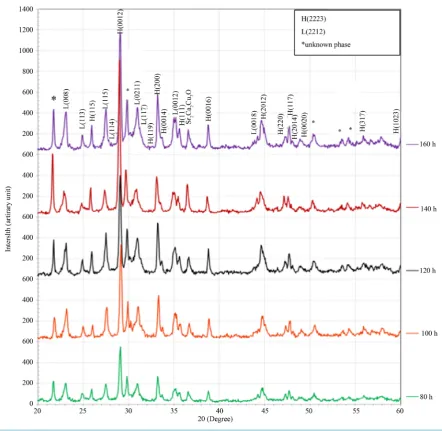
Figure 1. XRD patterns of Bi1.7Pb0.2Sb0.1Sr2Ca2Ca3O10 sintered for (80, 100, 120, 140 and 160) h.
Table 1. Lattice parameter, volume of the unit cell, critical temperature and percentage volume fraction of Bi-(2223) and Bi-
(2212) phases in Bi1.7Pb0.2Sb0.1Sr2Ca2Ca3O10 samples at different sintering time.
Volume fraction of phases formed (%) Tc
c/a V(Å)3
c(Å) b(Å)
a(Å) ts(h)
Bi-2212 phase Bi-2223 phase
43.9 56.1
<77 6.878
1.083 37.081
5.418 5.391
80
43.3 56.7
<77 6.888
1.079 37.120
5.394 5.389
100
37.9 62.1
84 6.892
1.078 37.139
5.387 5.388
120
17.4 82.6
110 6.895
1.084 37.148
5.417 5.387
140
35.8 64.2
<77 6.881
1.078 37.091
5.397 5.390
160
phase, and this leads to an increase in the Tc value. Such result was also obtained by Kocabas [19].
(
)
(
)
(
)
otherI 2223
Bi (2223)% 100
I 2223 I 2212 I
− = ×
+
∑
+∑
∑
∑
(1)(
)
(
)
(
)
otherI 2212
Bi (2212)% 100
I 2223 I 2212 I
− = ×
+ +
∑
∑
∑
∑
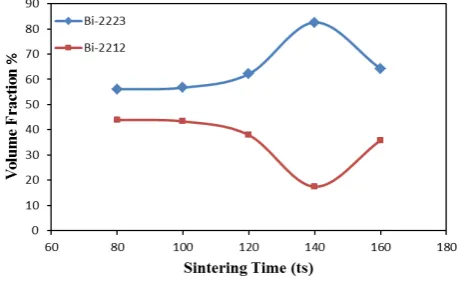
(2)where: I (2223), I (2212) and Iother are the intensities of Bi-2223 and Bi-2212 and other phases respectively. The volume fractions of the phases and lattice parameters a, b, c and c/a for all samples are given in Table 1. This Table indicates that an increase of the sintering time from 120 to 140 h. change the structural parameters. The deformation in the c-axis adjusts the amount of charge transfer from Bi-O layer to Cu-O layer sheet will tend to improve the critical temperature Tc. Increasing sintering time resulted in an increase in the volume fraction of Bi-2223 phase to 82.6% for the sample sintered for 140 h. Also, a decrease in the peaks intensities of the 2212 phase was obtained. On the other hand, a decrease in the volume fraction of the high phase and the critical tem-perature Tc was obtained with increasing sintering time to 160 h.
The percent volume fraction of the 2223 and 2212 phases as a function of sintering temperature were calcu-lated from the XRD patterns of the Bi1.7Pb0.2Sb0.1Sr2Ca2Ca3O10 samples and are shown in Figure 2.
[image:4.595.183.420.351.492.2]The electrical resistivity versus temperature plots at different sintering time is shown in Figure 3. All samples show that the resistivity decreases linearly with temperature in the normal state. Furthermore, all samples dis-played a metallic character above onset temperature. It can be observed from the plots that prolonged sintering time up to a certain maximum time could improve the critical temperature (Tc) of stoichiometry composition. It is clear that the transition temperature increases from 84 K to 110 K with the increase of the sintering time from
Figure 2. The volume fraction of Bi-(2223) and Bi-(2212) phases in
[image:4.595.171.436.526.697.2]Bi1.7Pb0.2Sb0.1Sr2Ca2Ca3O10 samples at different sintering time.
Figure 3. Temperature dependence of resistivity for Bi1.7Pb0.2Sb0.1Sr2Ca2Ca3O10
sintered for (80, 100, 120, 140 and 160) h. 0
30 60 90 120 150
0 50 100 150 200 250 300
ρ(
Ω.
cm)
T(K) ts=80h
ts=100h
ts=120h
ts=140h
120 to 140 h, which is related to the increasing of (2223) phase volume fraction. The increase in the Tc value is mainly due to the strong link and increasing of the contact areas between grains, which have higher alignment along the c-axis as inferred from both XRD and SEM analyses. Such result was also obtained by Mizauno et al.
[21]. They suggested that long sintering time will give a chance to insert extra layers of Cu-O2 and Ca planes into the perovskite layers of the low-Tc phase. Furthermore, it seems that the Sb is replaced in the Pb site in the sample structure, and the role of Pb is very important in the stability and in the enhanced percentage of Bi-2223 phase. This result is confirmed by Shoushtari et al. [22]. On the other hand, when the samples sintered for 160 h the resistivity decreases slowly (as it behaves like a superconductor) but does not become zero, even at the boil-ing point of liquid nitrogen. The reduction of the critical temperature can be due to either the crack formation as a result of excessive mechanical deformation or due to amorphous phase formation during the sintering process.
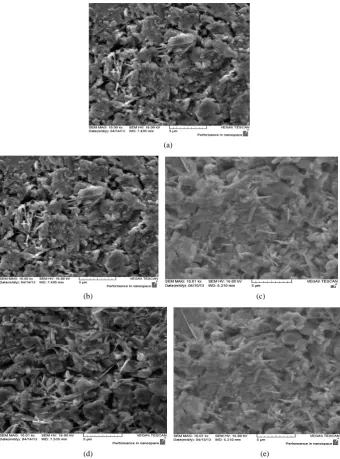
The surface morphology for the prepared samples is shown in Figures 4(a)-(e). The grains of all samples are randomly plate-like grains and their size is found to increase with increasing sintering time. The occurrence of
(a)
(b) (c)
[image:5.595.129.470.234.694.2](d) (e)
Figure 4. SEM images for Bi1.7Pb0.2Sb0.1Sr2Ca2Ca3O10 samples with different sintering time:
grains with plate-like structure is a signature of the Bi-2223 phase formation from the Bi-2212 matrix mostly due to the prolonged sintering process [23]. Samples sintered for 80 and 100 h show a small amount of sphere- like grains, which could be due to the Sr2Ca2Cu7O solid particles that are randomly distributed over the phase plates [24]. Obviously, it can be noticed that the surface morphology of the sample sintered for 140 h reveals that it is more homogenous and have more pronounced alignment of its crystallites with c-axis. In addition, the plate-like grains were aligned to make denser and conductive sample. Such result was mentioned by Govea-Al- caide et al. [25]. Also, from Figure 4(e) a presence of bright areas with a small amounts of grains can be ob-served due to a possible melting of the synthesized material during the sintering process. It can be seen that the increase of sintering time to more than 140 h leads to the formation of a liquid phase that acts as insulating lay-ers around the superconductor grains, which increases the resistance of grain boundaries and leads to a decrease in the transition temperature Tc as indicated by Guilmeau et al. [26].
4. Conclusion
The effect of sintering time on the phase formation and superconducting properties were investigated. Results revealed that prolonged sintering time up to a certain maximum time could improve the critical temperature of stoichiometry composition and increase the high-Tc (2223) phase. A remarkable increase in the critical temper-ature from 84 to 110 K was obtained with increasing sintering tempertemper-ature from 120 to 140 h. Our results also show that samples sintered for 140 h had the highest critical temperature Tc = 110 K and highest volume fraction of Bi(Pb)-(2223) high-Tc phase 82.6%. On the other hand, increasing sintering temperature to 160 h decreases the critical temperature and the volume fraction of the high Tc phase.
References
[1] Yi, H.P., Han, Z., Zhang, J.S., Liu, T., Li, M.Y., Fang, J., Liu, Q. and Zheng, Y.K. (2004) Research Status of the Man-ufacturing Technology and Application Properties of Bi-2223/Ag Tapes at Innost. Physica C, 412-414, 1073-1078.
http://dx.doi.org/10.1016/j.physc.2004.01.114
[2] Arndt, T.J., Aubele, A., Fisher, B., Krauth, H., Sailer, B. and Szulczyk, A. (2002) Bi-2223 Tapes for Applications at High Temperatures and/or High Fields Designs, Long Length Processing and Properties. Physica C, 372-376, 887-890.
http://dx.doi.org/10.1016/S0921-4534(02)00928-0
[3] Gul, I.H., Amin, F., Abbasi, A.Z., Anis-ur-Rehman, M. and Maqsood, A. (2006) Effect of Ag2CO3 Addition on the
Morphology and Physical Properties of Bi-Based (2223) High-Tc Superconductors. Physica C, 449, 139-147. http://dx.doi.org/10.1016/j.physc.2006.08.004
[4] Truccato, M., Cagliero, S., Agostino, A., Panetta, M. and Rinaudo, G. (2006) Electrical Study of an Unusual Phase Transformation in a Bi2Sr2Ca2Cu3O10+x Whisker at Room Temperature. Superconductor Science and Technology, 19,
1003-1009.http://dx.doi.org/10.1088/0953-2048/19/10/003
[5] Takano, M., Takana, T., Oda, K., Kitaguchi, H., Miura, Y., Ikeda, Y., Tomii, Y. and Mazaki, H. (1988) High-Tc Phase Promoted and Stabilized in the Bi, Pb-Sr-Ca-Cu-O System. Japanese Journal of Applied Physics, 27, L1041-L1043.
http://dx.doi.org/10.1143/JJAP.27.L1041
[6] Ekin, J.W., Salama, K. and Selvamanickam, V. (1991) High Transport Current Density up to 30 T in Bulk YBa2Cu3Ox
and the Critical Angle Effect. Applied Physics Letters, 59, 360-364. http://dx.doi.org/10.1063/1.105595
[7] Guilmeau, E., Andrzejewski, B. and Noudem, J.G. (2003) The Effect of MgO Addition on the Formation and the Su-perconducting Properties of the Bi2223 Phase. Physica C, 387, 382-390.
http://dx.doi.org/10.1016/S0921-4534(02)02360-2
[8] Gul, I.H., Rehman, M.A., Ali, M. and Maqsood, A. (2005) Effect of Vanadium and Barium on the Bi-Based (2223) Superconductors. Physica C, 432, 71-80. http://dx.doi.org/10.1016/j.physc.2005.07.013
[9] Aksan, M.A. and Yakyncy, M.E. (2004) Synthesis and Characterization of Er-Substituted Bi-2223 High-Tc Glass-Ce- ramic Superconductors. Journal of Alloys and Compounds, 385, 33-43. http://dx.doi.org/10.1016/j.jallcom.2004.04.135
[10] Coskun, A., Ekicibil, A., Ozcelik, B. and Kyymaç, K. (2005) Effects of Annealing Time on the Magnetic Properties of a Bi1.7Pb0.29Gd0.01Sr2Ca3Cu4O12+y Superconductor Prepared by the Melt-Quenching Method. Chinese Journal of Phys-ics, 43, 372.
[11] Siddiqi, S.A., Akhtar, B. and Ghauri, I.M. (2003) The Effect of 5% Sb Doping on High Tc Superconductivity in (Bi,Pb)2Sr2Ca2Cu3Oy Compound. Modern Physics Letters B, 17, 199-208.
http://dx.doi.org/10.1142/S0217984903005081
Materials. Materials Science and Engineering: B, 135, 166-171. http://dx.doi.org/10.1016/j.mseb.2006.08.060
[13] Iqbal, M.J. and Mehmood, R. (2009) Improvement in High-Tc Phase Formationin (Thallium-Antimony) Doped Bis-muth-Based Superconducting Materials. Journal of Alloys and Compounds, 477, 386-390.
http://dx.doi.org/10.1016/j.jallcom.2008.10.006
[14] Fruth, V., Popa, M., Ianculescu, A., Stir, M., Preda, S. and Aldica, G. (2004) High-Tc Phase Obtained in the Pb/Sb Doped Bi-Sr-Ca-Cu-O System. Journal of the European Ceramic Society, 24, 1827-1830.
http://dx.doi.org/10.1016/S0955-2219(03)00449-7
[15] Popov, A.G., Olevsky, F.M., Melnikov, V.S. and Pan, V.M. (1992) The Superconductivity of the Sb-Doped Bi-Pb-Sr- Ca-Cu-O Compound. Superconductor Science and Technology, 5, 654-657.
http://dx.doi.org/10.1088/0953-2048/5/11/010
[16] Liu, R.Y., Naito, H., Okuda, M., Nakahigashi, K., Takigawa, Y., Matsushita, T. and Kurosawa, K. (1992) Effects of Sb and Pb Doping on the High-Tc Phase-Formation in Bi-Sr-Ca-Cu-O Superconductors. Superconductor Science and Technology, 5, 482-488.http://dx.doi.org/10.1088/0953-2048/5/8/005
[17] Tanaka, Y., Fukutomi, M., Asano, T. and Maeda, H. (1988) Effects of Synthesis Conditions on the Properties of a Su-perconducting Bi-Sr-Ca-Cu-O System. Japanese Journal of Applied Physics, 27, L548.
http://dx.doi.org/10.1143/JJAP.27.L548
[18] Saleh, S.A. (2006) Studies on Sintering Effect on the Structural and Transport Properties of (2223) Phase. Physica C,
444, 40-44. http://dx.doi.org/10.1016/j.physc.2006.05.101
[19] Kocabas, K. (1998) Effect of Sintering Time On Sb Added BiPbSrCaCuO Superconducting Ceramics. Turkish Journal of Physics, 22, 437-440.
[20] Zargar Shoushtari, M. and Mousavi Ghahfarokhi, S.E. (2011) A Study of the Magnetic Properties of
Bi1.64−xPb0.36CdxSr2Ca2Cu3OySuperconductor. Journal of Superconductivity and Novel Magnetism, 24, 1505-1511. http://dx.doi.org/10.1007/s10948-010-0899-1
[21] Mizauno, Y., Sawa, A., Obara, H., Umeda, M. and Yamasaki, H. (1997) Field Sweep Rate Dependence of Magnetiza-tion and E-J Characteristics in YBa2Cu3O7 Films. Physica C, 282, 2255-2256.
[22] Zargar Shoushtari, M., Mousavi Ghahfarokhi, S.E. and Farbod, M. (2008) The Effect of Cd Doping on Bi-Based Su-perconductor. Journal of Applied Sciences, 8, 2613-2618. http://dx.doi.org/10.3923/jas.2008.2613.2618
[23] Muné, P., Govea-Alcaide, E. and Jardim, R.F. (2003) Influence of the Compacting Pressure on the Dependence of the Critical Current with Magnetic Field in Polycrystalline (Bi-Pb)2Sr2Ca2Cu3Ox Superconductors. Physica C, 384, 491-
500. http://dx.doi.org/10.1016/S0921-4534(02)02060-9
[24] Ben Azzouz, F., M’chirgui, A., Yangui, B., Boulesteixand, C. and Ben Salem, M. (2001) Synthesis, Microstructural Evolutionand the Role of Substantial Addition of PbO during the Final Processing of (Bi,Pb)-2223 Superconductors.
Physica C, 356, 83-96. http://dx.doi.org/10.1016/S0921-4534(01)00124-1
[25] Govea-Alcaide, E., Jardim, R.F. and Muné, P. (2005) Correlation between Normal and Superconducting Transport Properties of Bi1.65Pb0.35Sr2Ca2Cu3O10+δ Ceramic Samples. Physica C, 423, 152.
http://dx.doi.org/10.1016/j.physc.2005.04.009
[26] Guilmeau, E., Andrzejewski, B. and Desgardin, G. (2002) The Effect of Bi-2201 Phase on the Intergranular Critical Field and Current Density in Bi2223 Superconductors. Physica C, 377, 304-312.