Devidas S.Narute, Suresh B.Sirsath
Department of Biopharmaceutics, Government College of Pharmacy, Karad 415124(M.S.) India.
ABSTRACT
The main objective of the research work is to improve the solubility and dissolution rate of olmesartan medoxomil by solid dispersion with carriers like PVPK30,PEG6000 and sodium lauryl sulfate.The solid dispersion were prepared by kneading method. The prepared solid dispersion were characterized by Fourier Transform Infrared Spectroscopy (FTIR), X-RayDiffraction (XRD) and Differential Scanning Calorimetry (DSC). The FTIR and XRD spectra of olmesartan/carriers solid complexes showed that olmesartan medoxomil could form complex with carriers in solid state. The XRD spectra of olmesartan/ carriers solid complexes indicated olmesartan medoxomil existed in amorphous state, this could be explained the fact that the aqueous solubility of olmesartan medoxomil was increased. From the prepared solid dispersion, orally disintegrating tablets were formulated by using various superdisintegrants like sodium starch glycolate and croscarmellose sodium in various concentrations (5-15%).Prepared tablets were evaluated for physical parameters and drug release by invitro dissolution studies. Dissolution studies showed fast release of olmesartan medoxomil in tablets containing a high level of crosscarmellose sodium. Complexation of olmesartan medoxomil with carriers significantly improved the solubility of the drug and improved the mechanical properties of tablets produced by direct compression.
Key words:- Olmesartan Medoxomil Carriers, Sodium Starch Glycolate, Croscarmellose Sodium, Orally Disintegrating Tablets.
Article Received on 12 March 2014,
Revised on 05 April 2014, Accepted on 28 April 2014
*Correspondence for
Author
Ashok M. Khandekar
Department of
INTRODUCTION
by preparing solid dispersion with carriers.The solid dispersion were characterized by x-ray diffractometry (XRD), differential scanning colorimetry (DSC), fourier transform infrared spectroscopy (FTIR) and by dissolution studies. Further these solid dispersion are used for the formulation of orally disintegrating tablets using sodium starch glycolate(SSG) and crosscaremellose sodium (CCS) as superdisintegrants.
MATERIALS AND METHODS
Olmesartan Medoxomil (OLM) was a gift sample from Lupin pharma Pvt Ltd, Pune, Sodium starch glycolate (SSG), Croscarmellosesodium(CCS), Microcrystalline cellulose, PVPK30,PEG6000 and sodium lauryl sulfate were gift samples obtained from Sankalp Pharma Pvt Ltd, Karad. All the chemicals were of analytical grade purchased from Loba Chemie, Mumbai, India. Distilled water was used throughout the experiment.
Preparation of solid dispersion of olmesertan medoximil
olmesertan medoximil solid dispersions were prepared by kneading methods using drug:PVP K30,drug:PEG 6000 and drug:sodium lauryl sulfate in proportion viz. 1:0.5, 1:1 and 1:2 ethanol: water(1:1) was selected as common solvent for solid dispersion. The product then was dried at 40°Cfor 24 hours and the resultant solids were pulverized and then sieved through 100 # and stored in desiccators overnight 16.
Saturation Solubility Studies
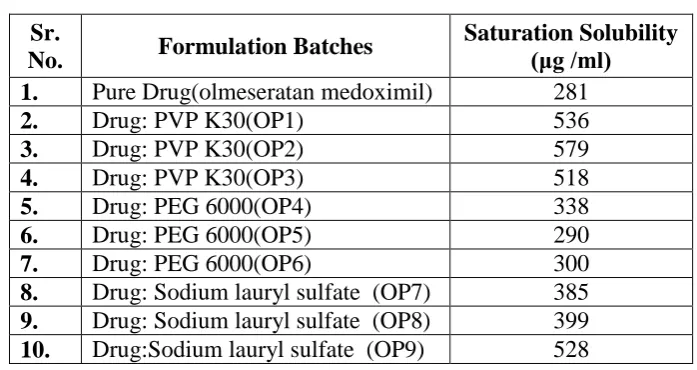
was determined in triplicate (n=3). The results obtained from saturation solubility studies were statistically analyzed. The saturation solubility studies were shown in Table.1
Table .1: Saturation solubility of olmesertan medoxiil Sr.
No. Formulation Batches
Saturation Solubility (μg /ml) 1. Pure Drug(olmeseratan medoximil) 281
2. Drug: PVP K30(OP1) 536
3. Drug: PVP K30(OP2) 579
4. Drug: PVP K30(OP3) 518
5. Drug: PEG 6000(OP4) 338
6. Drug: PEG 6000(OP5) 290
7. Drug: PEG 6000(OP6) 300
8. Drug: Sodium lauryl sulfate (OP7) 385 9. Drug: Sodium lauryl sulfate (OP8) 399 10. Drug:Sodium lauryl sulfate (OP9) 528 Estimation of Drug Content for Inclusion Complexes
Solid dispersion of olmesartan equivalent to 20mg was weighed and transferred into a 100ml volumetric flask. To this small quantity of methanol was added to dissolve. It was shaken occasionally for about 15 minutes and the volume was made up to 100ml by adding 6.8 pH buffer. The solution was filtered by using a Whatman filter paper with a pore size 0.45 μm. The filtrate was subsequently diluted with 6.8 pH buffer and the absorbance was measured at 256nm using 6.8 pH buffer as blank. This test was repeated six times (N=6).
In Vitro Dissolution Studies for Solid dispersion
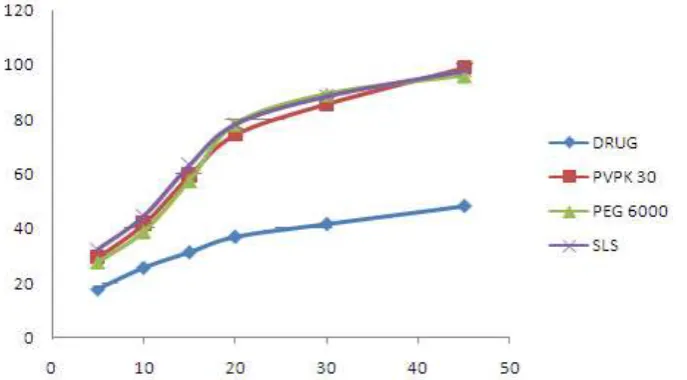
Fig. 1: Dissolution Profiles of Prepared solid dispersion by kneading Methods In Comparison With Pure Drug.
Characterization of Inclusion Complexes FTIR Spectral Analysis
Infrared spectra of pure drug, PVPK30,PEG6000 ,sodium lauryl sulfate and its solid dispersion were recorded by KBr pellet method using Fourier Transform Infrared Spectrophotometer (BRUKER 8400S). A base line correction was made using dried potassium bromide and then spectra of dried mixtures of drug and solid dispersion with potassium bromide were recorded. The Samples were prepared by KBr pellet press method. The scanning range was 400 to4000 cm-1 . The spectra 1 were shown in Figures 2.
[image:5.595.131.475.74.264.2][B]
[C]
[E]
[F]
[G]
Differential Scanning Colorimetry (DSC)
The DSC studies were performed for pure drug, PVPK30, PEG6000 and sodium lauryl sulfate and its solid dispersion were carried out in an open aluminum pans at 10° C/min heating range. The temperature range used was30–300°C.The thermograms were shown in Figures3.
[A]
[B]
[D]
[E]
[G]
Figure.3:-DSC patterns of pure olmesartan medoximil, polymer and solid dispersion A: Olmesartan medoxomil, B: PVPK30, C: PEG6000, D: Sodium Lauryl Sulfate, E:Olmesertan medoxomil + PVPK30 (1:1), F: Olmesartan medoxomil +PEG6000 (1:0.5), G: Olmesartan medoxomil + Sodium Lauryl Sulfate (1:2)
X-Ray Powder Diffraction
The XRPD data of pure olmesartan medoxomil,PVPK30, PEG6000,sodium lauryl sulfate and prepared solid dispersion were recorded on a Philips Analytical X-ray-PW 3710 ( Phillips, Almedo, The Netherlands) diffractometer with tube anode Cr over the interval 10-70°/2Ө under following set of conditions: The generator tension (voltage): 40 kV and generator current: 30 mA. The XRPD were shown in Figures4.
Position [2Ө] [B]
Position [2Ө] [C]
Position [2Ө] [E]
Position [2Ө] [F]
[image:12.595.126.479.59.662.2]Position [2Ө] [G]
Table 2.
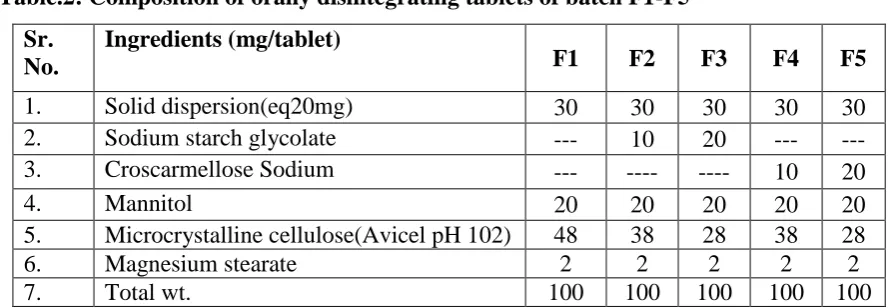
Table.2: Composition of orally disintegrating tablets of batch F1-F5 Sr.
No.
Ingredients (mg/tablet)
F1 F2 F3 F4 F5
1. Solid dispersion(eq20mg) 30 30 30 30 30
2. Sodium starch glycolate --- 10 20 --- ---
3. Croscarmellose Sodium --- ---- ---- 10 20
4. Mannitol 20 20 20 20 20
5. Microcrystalline cellulose(Avicel pH 102) 48 38 28 38 28
6. Magnesium stearate 2 2 2 2 2
7. Total wt. 100 100 100 100 100
Table.3: Composition of orally disintegrating tablets of batch F6-F10 Sr.
No.
Ingredients (mg/tablet)
F6 F7 F8 F9 F10
1. Solid dispersion(eq20mg) 40 40 40 40 40
2. Sodium starch glycolate --- 10 20 --- ---
3. Croscarmellose Sodium --- --- ---- 10 20
4. Mannitol 20 20 20 20 20
5. Microcrystalline cellulose(Avicel pH 102) 38 28 18 28 18
6. Magnesium stearate 2 2 2 2 2
7. Total wt. 100 100 100 100 100
Table.4: Composition of orally disintegrating tablets of batch F11-F15
Sr.No Ingredients (mg/tablet) F11 F12 F13 F14 F15
1. Solid dispersion(eq20mg) 60 60 60 60 60
2. Sodium starch glycolate --- 10 20 --- ---- 3. Croscarmellose Sodium --- ---- ---- 10 20
4. Mannitol 20 20 10 20 10
5. Microcrystalline cellulose(Avicel pH 102) 18 08 08 08 08
6. Magnesium stearate 2 2 2 2 2
Evaluation of Tablets
Physical parameters such as weight variation, hardness, friability and disintegration were evaluated for prepared tablets. The prepared orally disintegrating tablets were further evaluated for physical parameters like drug content and in-vitro dissolution studies and their results were shown in Tables 3 & 4. Disintegration time of orally disintegrating tablets were carried out by the method given by Gohel et al. for this a Petri dish was filled with 10 ml of water and the tablet was carefully placed in the center of petri dish and the time taken for the tablet to completely disintegrate in to fine particles was noted 17.
Table.5: Physical parameter of orally disintegrating tablets of batch F1-F5
Blend Parameters Formulation Batches
F1 F2 F3 F4 F5
Bulk Density(gm/ml) 0.46 0.472 0.465 0.498 0.471 Tapped Density(gm/ml) 0.571 0.583 0.573 0.593 0.581 Hausner’s Ratio 1.24 1.23 1.22 1.19 1.23 Carr’s(%) Compressibility Index 19.30 19.05 18.32 16.66 19.08 Angle of Repose 39.10 38.33 37.78 36.58 38.42 Tablet Parameters
Weight Variation(mg) ±2 ±2 ±2 ±2 ±2
Thickness (mm) 5.27 5.26 5.29 5.24 5.26
Friability (%) 0.37 0.35 0.29 0.30 0.37
Drug Content 101.23 98.51 97.89 99.07 99.56 Disintegration Time (sec) 35 40 44 53 55
Hardness (kg/cm3) 4.5 4.0 5.0 3.5 4.0
Table.6: Physical parameter of orally disintegrating tablets of batch F6-F10
Blend Parameters Formulation Batches
F6 F7 F8 F9 F10
Bulk Density(gm/ml) 0.452 0.476 0.455 0.478 0.490 Tapped Density(gm/ml) 0.574 0.588 0.594 0.584 0.592
Hausner’s Ratio 1.25 1.23 1.32 1.22 1.20
Carr’s(%) Compressibility Index 20.12 19.06 23.51 18.30 17.30 Angle of Repose 40.29 38.35 43.11 38.47 36.22 Tablet Parameters
Weight Variation(mg) ±2 ±2 ±2 ±2 ±2
Thickness (mm) 5.25 5.23 5.25 5.30 5.28
Friability (%) 0.49 0.39 0.56 0.34 0.27
Drug Content 102.59 101.84 99.39 98.92 99.54 Disintegration Time (sec) 45 48 50 36 45
18.19 18.49 18.11 19.03 17.24 Angle of Repose 37.20 37.80 37.49 38.20 36.21
Tablet Parameters
Weight Variation(mg) ±2 ±2 ±2 ±2 ±2
Thickness (mm) 5.24 5.25 5.24 5.22 5.25
Friability (%) 0.30 0.30 0.34 0.28 0.25
Drug Content 101.13 98.79 101.67 98.57 99.69
Disintegration Time (sec) 45 58 60 30 35 Hardness (kg/cm3) 4.4 3.5 4.0 5.0 5.1
In vitro Dissolution Studies of orally disintegrating tablets
Dissolution studies on each tablet formulation were performed in a calibrated 8 station dissolution test apparatus (LABINDIA8000) equipped with paddles (USP apparatus II method) employing 900 ml of 6.8 pH buffer as a dissolution medium. The paddles were operated at 50 rpm and temperature was maintained at 37° C ± 1° C throughout the experiment.
Time (Mins)
Figure.5:-Dissolution study of formulation Batches F1-F3
Time (Mins)
Figure.6:-Dissolution study of formulation Batches F4-F5
Time (Mins)
Figure.8:-Dissolution study of formulation Batches F9-F10
Time (Mins)
Figure.9:-Dissolution study of formulation Batches F11-F13
Time (Mins)
Table.8:- In vitro Dissolution study of formulations Formulation
code/Time in min
Cumulative % Drug Release
F 1 F 2 F 3 F 4 F 5 F 6 F 7 F 8 F 9
0 0 0 0 0 0 0 0 0 0
5 17.81 20.06 29.06 20.06 36.93 18.18 20.06 29.43 18.18 10 25.65 27.88 34.12 27.56 44.43 27.56 25.65 34.12 25.65 15 27.56 36.93 40.65 36.93 57.85 38.80 36.93 41.62 38.81 20 38.81 41.62 44.43 63.18 76.31 48.15 57.65 63.18 63.18 30 57.65 63.18 69.75 81.93 89.40 63.18 74.43 76.31 78.18 45 78.18 81.93 85.66 89.43 98.60 79.12 82.81 87.56 90.37
Table.9:- In vitro Dissolution study of formulations Formulation
code/Time in min
Cumulative % Drug Release
F 10 F 11 F12 F13 F14 F15
0 0 0 0 0 0 0
5 38.81 21.93 20.06 23.81 20.08 27.56 10 44.43 27.56 38.81 44.43 27.56 41.66 15 55.68 48.15 55.08 57.56 41.62 63.18 20 70.68 63.18 63.18 74.43 63.18 74.43 30 85.68 74.43 76.31 82.87 83.81 90.87 45 98.81 80.06 83.81 88.50 91.31 99.99
RESULTS
Saturation Solubility
1,647 cm-1 (H-O-H bending) and 1,035 cm-1 (C-O-C). PVPK30 showed characteristic broad band at 3454cm-1(O-H, stretch, broad), 1666 cm-1 (C=O) owing to its oxygen functionalities. It was found that there were no considerable changes in the IR peaks of the agglomerates when compared to pure olmesartan Medoximil. In the FTIR study, the breakdown of the intermolecular hydrogen bond between the crystalline drug molecule and formation of hydrogen bond between the drug and the polymers might be related to the slight shift of the absorption band. However FTIR spectra of agglomerates showed that no changes have occurred in chemical structure. The strong interaction between drug and carrier, often leads to identifiable changes in the IR profile of the drug but the results of IR spectra indicated an absence of any well-defined interaction between olmesartan and PVPK30,PEG6000 and Sodium Lauryl Sulfate.
Differential Scanning Calorimetry(DSC)
The DSC thermograms of Olmesartan medoxomi , PVPK 30, PEG6000, Sodium lauryl sulfate and its solid dispersion are shown in Fig.3. The sharp melting point peak of pure Olmesartan medoxomil appeared at 185.40oC, whereas no such peak was observed in solid dispersion prepared with PVPK 30, PEG 4000 and Sodium lauryl sulfate suggesting that Olmesartan medoximil may be molecularly dispersed and in amorphous form.
X-Ray Diffraction Study
were appeared while some of them were disappeared when compared to diffractogram of pure olmesartan Medoximil. The formation of different polymorphic form was stated on the basis of changes in intensity of peaks in diffractograms of polymer indicating different rearrangement of molecules. Thus the agglomerates exhibited spectra with different peak positions (patterns) from their respective host and guest crystals which depicted that different internal structure might have formed with significant modification in crystals habit.
In –Vitro Release profiles of orally disintegrating tablets
The dissolution studies of orally disintegrating tablets were performed in pH 6.8 buffer by using USP-II paddle method. The drug release from all the tablet formulations were found to release the drug at a faster rate than compared to pure drug. It was found that the tablet formulation F15 with 15% CCS showed the rapid drug Release. when compared to the pure drug and other formulations. The drug release of tablet formulation in the presence of various Superdisintegrants were in the order of CCS >SSG. The rate of drug release of tablet formulations was found to be linear with Hixson-Crowell order rate constant. The R2 values of all tablet formulations were in the range of 0.772 to 0.988. Hence suitable as orally disintegrating tablets.
DISCUSSION
formulations as orally disintegrating tablets. Tablet formulations were further evaluated for physical parameters. All the tablet formulations were found to be stable within the I.P specified limits for weight uniformity, friability and drug content. The results indicated that tablets containing high concentration of Superdisintegrants i.e F15(CCS 15%) get softened and absorb more atmospheric moisture. The dissolution profiles were shown in Figure 5-10. The drug release of tablet formulations in the presence of various superdisintegrants were in the order of CCS>SSG. The rate of drug release of tablet formulations was found to be linear with Hixson-Crowell rate constant. The r2 values of all tablet formulations were in the range of 0.772 to 0.988.
CONCLUSION
The present study has shown that it is possible to increase the solubility and dissolution rate of poorly soluble drug olmesartan medoxomil by preparing it as solid dispersion with carriers. The solid dispersion exhibited faster dissolution characteristics as compared to that of pure drug. This was due to solubilizing effect of the complexing agent. It was found that the solid dispersion prepared by the kneading method release the drug rapidly than the pure drug. The orally disintegrating tablets of olmesartan prepared with 15% crosscarmellose sodium (F15) as superdisintegrant showed rapid drug release when compared to pure drug and other tablet formulations.
ACKNOWLEDGEMENTS
REFERENCES
1. Valleri, M., P. Mura, F. Maestrelli, M. Cirri and R. Ballerini, 2004. Development and evaluation of glyburide fast dissolving tablets using solid dispersion technique. Drug Dev. Ind Pharm., 30: 525-534.
2. Kuno, Y., M. Kojima, S. Ando and H. Nakagami, 2003. Preparation of inter oral rapid disintegrating tablets by a novel method involving phase transition of sugar alcohol. Glasgow, Scotland, UK. Controlled release society 30th Annual Meeting Proceedings, pp: 649.
3. Mizumoto, T., Y. Masuda, T. Yamamoto, E. Yonemochi and K. Terada, 2005. Formulation design of novel fast disintegrating tablet. Int. J. Pharm., 306: 83-90.
4. Seager, H., 1998. Drug delivery products and the Zydis fast dissolving dosage forms. J. Pharm. Pharmacol., 50: 350-382.
5. Chang, R.K., X. Guo, B.A. Burnside and R.A. Cough, 2000. Fast dissolving tablets. Pharm Tech, 24: 52-58.
6. Dobetti, L., 2001. Fast-melting tablets: Developments and technologies. 2 Pharma. Tech, pp: 44-50.
7. Explotab (SSG), 1995. Technical Information Bulletin: Patterson, Edward Mendell Company Inc., pp: 1-4.
8. Explotab (SSG), 1996. Product Information: Patterson, Edward Mendell Company Inc., pp: 1-7.
9. Bhupendra, G.P. and V.P. Dipesh, 2010. Comparative study of efficiency of different superdisintegrant for fast dissolve tablet of domperidone. Journal of Pharmacy Research, 1: 151-155.
10. John, E.B. and L.A. Larry, 1988. Disintegrating agents in hard gelatin capsules. Part I: Mechanism of action, Drug Dev Ind. Pharm., 14: 29-41.
11. Rawat, S. and S.K. Jain, 2004. Solubility enhancement of celecoxib using β-cyclodextrin inclusion complexes. Eur J Pharm Sci Biopharm, 57: 263-267.
12. Loftson, T. and M.E. Brewster, 1996. Pharmaceutical applications of cyclodextrins.1. Drug solubilization and stabilization. J. Pharm. Sci., 85: 1017-1025.
13. Connors, K.A., 1997. The stability of cyclodextrin complexes in solution. Chem Rev., 97: 1325-1357.