A Self-Learning Framework For Validation of Runtime
Adaptation in Service-Oriented Systems
Leah Mutanu
October 2017
Thesis submitted for the degree of Doctor of Philosophy at Lancaster University
School of Computing and Communications InfoLab21, South Drive
Lancaster University Lancaster LA1 4WA
2
Abstract
3
Declaration
This thesis is my own work and has not been submitted in any form for the award of a higher degree elsewhere. The work has been carried out under the supervision of Dr. Gerald Kotonya of the school of computing and communications at Lancaster University.
4
Acknowledgements
5
Related Publications
Mutanu, L. & Kotonya, G. (2016). “Consumer-Centred Validation for Runtime Adaptation in Service-Oriented System,” Proceedings of 9th IEEE International Conference on Service-Oriented Computing and Applications (SOCA), Macau, pp. 16-23.
Mutanu, L. & Kotonya, G. (2017a). “A Self-Learning Approach For Validation of Runtime Adaptation in Service-Oriented Systems,” Journal of Service-Oriented Computing and Applications, Springer2017(accepted for publication)
6
Contents
Chapter 1 ... 11
1 Introduction ... 14
1.1 Problem Statement ... 14
1.2 Key Challenges ... 16
1.3 Objectives ... 17
1.4 Contributions ... 19
1.5 Thesis Structure ... 20
Chapter 2 ... 22
2 Self-Adaptation Approaches in Service-Oriented Systems ... 22
2.1 Factors Affecting Runtime Adaptation ... 22
2.2 Adaptation Trigger (What) ... 24
2.3 Application Context (Where) ... 28
2.4 Adaptation Models (When and How) ... 30
2.3.1 Static Adaptation ... 30
2.3.2 Dynamic Adaptation ... 32
2.3.3 Adaptation Strategy - Reactive versus Predictive ... 33
2.3.4 Model implementation ... 34
2.5 Summary ... 38
Chapter 3 ... 41
3 Software System Validation ... 41
3.1 Validation in Autonomic Systems... 41
7
3.1.1 Techniques ... 43
(i) Formal methods ... 43
(ii) Model-based ... 45
(iii) Machine-Learning ... 46
(iv) Machine-Learning in Service-Oriented System Adaptation ... 51
3.1.2 Involvement – Online vs. Offline validation ... 53
3.1.3 Control mechanism ... 54
3.1.4 Strategy ... 56
3.3 Summary ... 60
Chapter 4 ... 62
4 Theory and Design and Implementation ... 62
4.1. Theory and Design ... 62
4.1.1. Application context ... 63
4.1.2. Sensor ... 64
4.1.3. Adaptation ... 65
4.1.4. Supporting Negotiation ... 66
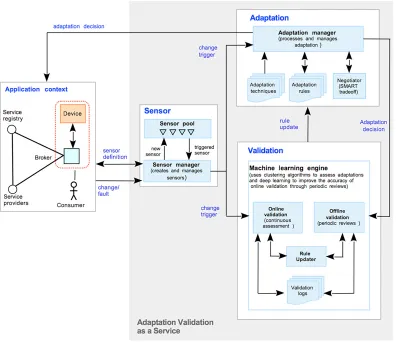
4.1.5. Validation ... 70
4.2. Prototype Implementation ... 74
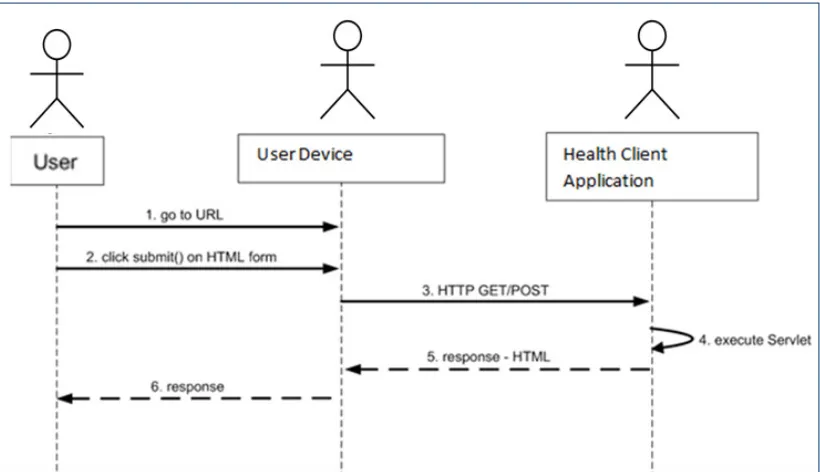
4.2.1 The Client Application ... 75
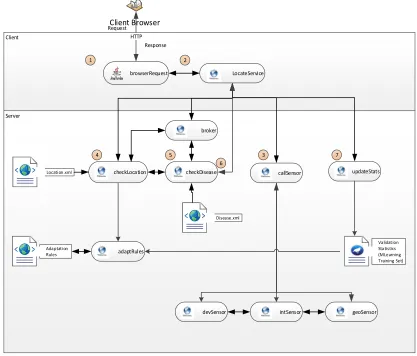
4.2.2 The Server Application ... 76
4.2.3 Web server ... 78
4.2.4 Knowledge base ... 78
4.3. Machine Learning Tools ... 85
4.3.1 EM Clustering Algorithm ... 85
8
4.4. Summary ... 88
Chapter 5 ... 90
5. Evaluation... 90
5.1 Evaluation Techniques ... 90
5.1.1. Evaluation Justification ... 91
5.2 Case Study Overview ... 93
5.3 Experiment 1 – Impact of Validation on Runtime Adaptation ... 95
5.1.2. Predefined Adaptation Rules ... 98
5.1.3. Changing Adaptation Rules ... 99
5.4 Experiment 2 - Managing Overlapping and Conflicting Change Triggers ... 101
5.3.1. Trigger Negotiation ... 104
5.5 Experiment 3 – Assessing Framework Accuracy ... 107
5.4.1. Measuring System Stability ... 107
5.4.2. Accuracy of the Validation Framework ... 108
5.6 Experiment 4 – Improving Framework Accuracy... 109
5.5.1. Neural Network Training ... 110
5.5.2. Neural Network Accuracy ... 116
5.7 Experiment 5 –Mitigating System Resource Demands... 124
5.6.1. EM Clustering Performance ... 124
5.6.2. Deep learning Performance... 125
5.8 Summary ... 127
Chapter 6 ... 130
6. Conclusion ... 130
6.1 Objectives Revisited ... 130
9
6.3 Reflection ... 135
6.3.1 Approach limitations ... 135
6.3.2 Lessons Learnt ... 136
6.4 Final Remarks ... 137
Appendix A ... 138
A. System Reconfiguration ... 138
A.1 Workflow Reconfiguration... 138
A.2 selecting alternative Service Providers... 139
A.3 Binding Provider Interface ... 140
Appendix B ... 142
B. Using the Neural Network ... 142
B.1 Normalizing the Data... 142
Appendix C ... 143
C. Automating the validation component ... 143
C.1 EM Clustering Implementation ... 143
C.2 Visualizing decision making and the learning process ... 146
Appendix D ... 148
D. SMART Aggregate values for different adaptation Techniques... 148
10
List of Figures
Figure 2.1. Dynamic physical system ... 22
Figure 2.2. Dynamic software system ... 23
Figure 2.3. Adaptation Dimensions ... 24
Figure 2.4. Triggers for runtime software adaptation ... 26
Figure 2.5. How adaptation impacts the system ... 28
Figure 2.6. Interaction between heterogeneous devices in a smart home (Adapted from Romero et al. (Romero et al., 2013)) ... 29
Figure 2.7. Design time adaptation of a trust-aware application. Source (Moyano et al., 2013) ... 31
Figure 2.8. Runtime self-adaptation. Source (Psaier et al,. 2010) ... 33
Figure 2.9. A pluggable approach to self-adaptation. Source (Garlan et al., 2001) ... 35
Figure 3.1 MAPE Architectural Model for Autonomic Computing ... 41
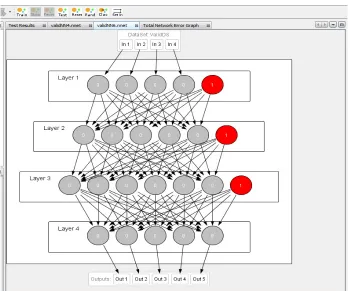
Figure 3.2 Artificial Neural Network Architecture ... 49
Figure 4.1 Self-validating runtime adaptation framework ... 63
Figure 4.2 Snippet of adaptation techniques ... 66
Figure 4.3 Adaptation validation ... 72
Figure 4.4 User Interaction with the Client Application ... 75
Figure 4.5 SOA Application System Workflow ... 77
Figure 4.6 Example of trigger specification and threshold values ... 79
Figure 4.7 Change Meta-Model ... 80
Figure 4.8 SAX Parser for the trigger specification ... 81
Figure 4.9 Self-Configuring Adaptation Rules ... 83
Figure 4.10 Self-optimizing Adaptation Rules ... 84
11
Figure 4.12 Validation Web Service Request and Response ... 87
Figure 4.13 Neuroph Studio Artificial Neural Network Architecture ... 88
Figure 5.1 Interest in Information on Typhoid Disease ... 94
Figure 5.2 Access of health related information using Internet services ... 97
Figure 5.3 Web Service request and response ... 98
Figure 5.4 Verifying output of the validation framework ... 99
Figure 5.5 How validation statistics influence adaptation rules ... 100
Figure 5.6 Adaptation based on geo location trigger ... 102
Figure 5.7 System properties returned from different devices ... 103
Figure 5.8 Accepts/Rejects options of suggested service ... 104
Figure 5.9 New rules generated from negotiated decisions ... 105
Figure 5.10 Evaluating the validation output using Weka ... 106
Figure 5.11 Framework Accuracy ... 108
Figure 5.12 Total Mean Square Error Rates ... 111
Figure 5.13 Training by varying learning and momentum rates ... 114
Figure 5.14 Training by varying the hidden layers and nodes ... 115
Figure 5.15 ANN Architecture... 116
Figure 5.16 Exact Data in Training Set ... 118
Figure 5.17 Approximate Data in Training Set ... 120
Figure 5.18 Visualization of emerging clusters ... 121
Figure 5.19 No Data in Training Set ... 123
Figure 5.20 Deep learning total network error graph ... 126
Figure 5.21 Deep learning performance ... 127
12
Figure A.2 Evaluating performance of different workflow patterns ... 139
Figure A.3 Multiple triggers on a distributed system ... 140
Figure B.1 Normalized Input Variables ... 143
Figure C.1 visualization of decision making process using Decision Trees... 146
Figure C.2 visualization of the learning process using clustering ... 147
Figure D.1 SMART Aggregate Values for a given Attribute ... 150
13
List of Tables
Table 2.1. Summary of adaptation approaches ... 36
Table 3.1. Current self-validation approaches for service-oriented systems ... 58
Table 5.1. Testing the learning algorithms ... 124
14
Chapter 1
1
Introduction
1.1
Problem Statement
Service-Oriented Architecture (SOA) provides the conceptual framework for realizing service-oriented systems (SOS’s) by supporting dynamic composition and reconfiguration of software systems from networked software services (Erl, 2008). Service-Oriented Computing (SOC) is the computing paradigm that utilizes services as fundamental elements for developing applications/solutions. Services are self-describing, platform-agnostic computational elements that support rapid, low-cost composition of distributed applications, (Papazoglou, 2003). They are offered by service providers who procure the service implementations, supply the service descriptions, and provide related technical and business support. The design and deployment of SOS’s is underpinned by standard service description languages, messaging and transport protocols. The main motivations for service-oriented architecture (SOA) are agility, flexibility, reuse, ease of integration and reduced development costs (Rosen et al., 2008). However, as more business organizations adopt SOA solutions, the need to ensure that the systems can adapt quickly and effectively to changes in their operating environment becomes an increasingly important research problem. One way to address the problem is by providing support for dynamic adaptation.
15 A growing consensus amongst researchers is that runtime adaptation in SOA should incorporate a validation element (Papazoglou et al., 2007) (Cardellini et al., 2009). In their research roadmap for self-adaptive systems, Lemos et al. (Lemos et al., 2013) emphasize the need for feedback control in the life cycle of self-adaptive systems and the need to perform traditional design-time validation and verification at runtime. In another survey, Salehie et al. (Salehie, et al., 2009) note that testing and assurance are probably the least focused phases in the engineering of self-adaptive software. Papazoglou et al. (Papazoglou et al., 2007) echo this view. They note that the bulk of research in adaptive service-oriented systems has focused largely on dynamic compositions.
The nature and quality of adaptation in service-oriented systems is influenced by a number of factors. These include; system changes (i.e. change triggers), the nature of the application and the logical area where it executes (i.e. application context), and the approach used to reconfigure the system in a particular change context (i.e. adaptation model) and the effectiveness of the adaptation (i.e. validation). However, the dynamic nature of service-oriented systems means these factors are constantly changing, which makes it difficult to specify adequate adaptation rules a priori. This is further complicated by the likelihood of overlapping or conflicting change requests. These changeable factors underscore a number of important points.
16
1.2
Key Challenges
A number of research initiatives are investigating effective ways to improve on runtime adaptation in service-oriented systems. These initiatives are however inadequate for addressing the issues identified in Section 1.1 for the following reasons:
• Static adaptation rules. Current approaches for supporting runtime adaptation in
service-oriented systems are based on rules that reconfigure systems based on fixed decision points which do not take into account the dynamic nature of the factors that influence adaptation (Salehie, et al., 2009) (Lemos et al., 2013). Indeed, Di Nitto et al. (Di Nitto et al., 2008) attribute the dynamic nature of software to the fact that requirements cannot be fully gathered upfront and cannot be “frozen”. Thus while various studies have been conducted to address the challenge of adapting software to address the ever changing requirements, currently, no single solutions to this problem exists. Existing research revolves around the “local” adaptation of specific cases. Di Nitto et al. highlight the need for research to devise technologies and methods to enable crosscutting adaptations.
• Poor support for validation. Current approaches for supporting runtime adaptation in
service-oriented systems offer poor support for validation (Cardellini et al., 2009) (Lemos et al., 2013). Like most autonomic systems, runtime adaptation in service-oriented systems is based on IBM’s Monitoring, Analysis, Planning, and Execution model (MAPE) (IBM,
2006). However, MAPE does not support validation. The lack of mechanisms for validating adaptation make it difficult to gauge the appropriateness and effectiveness of adaptation decisions, and limit our understanding of the nature of problems for which they are suited. Validation provides an avenue for adaptation rules to evolve and remain relevant because the factors that influence adaptation are constantly changing (Mutanu & Kotonya, 2016). Validating adaptation goes beyond verifying that the adaptation conforms to its operational specification. Validation is concerned with verifying the acceptability of an adaptation (Sommerville, 2016), often from the point of view of the system user, i.e. “is it the right adaptation for the problem?” as opposed to “is it specified right?” Validation assesses the effectiveness of an adaptation.
• Poor support for diversity. Current approaches for runtime adaptation are built around
17 applications they support. This limits their extensibility, portability and the quality of adaptation they offer.For example Cubo et al. (Cubo et al, 2008) and Tanaka and Ishida (Tanaka et al, 2008) describe approaches that are concerned with specific application contexts. Swaminathan (Swaminathan et al, 2008) and Cardellini (Cardellini et al, 2009) propose models that promote context variability, however the author provides no information about the implementation or evaluation of the models. There is no evidence that the approaches support diversity.
• Poor support for proactive adaptation. Most approaches to adaptation in service-oriented
systems are reactive (Gomaa, et al., 2014) (Weyns et al., 2016). They recompose the system as a reaction to change rather than anticipate change. While reactive adaptation has the advantage of requiring only a small set of recent system conditions to select an adaptation, allowing for a timely decision, it has a number of limitations. First, reactive adaptation is based largely on static system properties and conditions that do not take into account previous aspects of system behaviour that may inform better adaptation selection. Secondly, reactive adaption lags behind current system conditions, which may be short-lived or change as the adaptation is being carried out resulting in unnecessary adaptations that may impact system quality. Lastly, the inability to anticipate change makes it difficult to address disruptive system changes such as service and quality failures in a timely manner.
These key challenges represent the gaps in the runtime adaptation of service oriented systems.
1.3
Objectives
From the gaps identified in section 1.2 several research questions were raised that formed the basis for the research objectives. The key research questions were:
• How can the effectiveness of current runtime adaptation frameworks be validated? The
growing research interest in dynamic software adaptation meant that there were various adaptation approaches and the need to find out whether these approaches were satisfying consumer needs had not been addressed.
• What is the best way to address multiple conflicting triggers? Runtime adaptation is triggered
18 can give rise to conflicting solutions, which call for a different adaptation approach. In many cases however adaptation approaches focused on single triggers rendering them inadequate in practical situations.
• Can an adaptation technique be updated at runtime if it is no longer valid? Changes in the
user’s environment call for changes in the adaptation rules indicating that they cannot be static but must evolve in order to remain relevant. To achieve the vision of autonomic computing this process cannot be static but should occur at runtime. Machine learning techniques can be used to ensure that the adaptive system has the ability to evolve following changes in the users requirements.
• How can the increased resource constrains be mitigated? The addition of runtime validation
and self-learning components exert constraints on system resources such as reduced system performance and increased memory requirements. If these constraints are not managed they can counter the benefits of validating runtime adaptation.
From these research questions the objectives of this research were drawn. The general objective of this work is to address the challenges outlined in section 1.2. In particular, the primary goal of this research is to develop and evaluate a pluggable, self-learning validation framework for supporting runtime adaptation in service-oriented systems. The specific research objectives of this work included:
• Provide a runtime solution that supports user-centred validation in self-adaptive
service-oriented systems.
• Provide runtime support for detecting and resolving multiple conflicting adaptation
requirements.
• Providing self-learning mechanisms to support and improve the predictive accuracy of
runtime adaptation.
• Providing strategy for mitigating runtime resource demands resulting from self-learning
19
1.4
Contributions
The solution proposed by this research is a consumer-centred framework that uses model-based clustering to assess the efficacy of runtime adaptation and to refine adaptation rules. In addition the solution incorporates deep learning to provide offline validation through periodic reviews of online adaptation decisions. The aim is to compliment online validation by improving the long-term accuracy of adaptation decisions.
The first contribution of this thesis is the development of a citizen observatory portal that can be used as an early warning system by providing information on infectious disease outbreaks (Mutanu and Kotonya, 2016). Many developing countries take a reactive approach to risk mitigation, which can have disastrous consequences if the problem is discovered late. This is particularly a major concern with infectious diseases. A proactive approach that detects the spread of such diseases before they are considered an outbreak would reduce the risks associated with disease outbreaks by allowing for better control planning. The case study was selected because it presented a scenario for adaptation that would be ideal for assessing the framework’s ability to self-validate and modify adaptation rules at runtime. Because health information needs vary over time the system needs to adapt to identify the users present requirements. Additionally the type of devices owned by the users, the users’ financial ability, and the users’ external environment also influence the choice of web services selected to supply the information. Pre-defined adaptation rules developed to represent these relationships, need to evolve over time. The evolution is triggered by a set of multiple environmental triggers whose relationship is based on complex behavioral rules that cannot be predefined. The challenge is to ensure that adaptation rules evolved to reflect this change in user interests. The framework achieved this evolution through a user-centred self-learning process that continuously updated the adaptation rules. Whenever a change in the users’ needs was detected the system learned and the systems adaptation behavior was observed to change accordingly by providing relevant health information or selecting suitable services.
service-20 oriented systems to examine 29 adaptation approaches intended to support service-oriented systems. The review highlights a number of gaps in relation to how well the factors are supported. Most of the approaches reviewed focused on specific problem areas with specific triggers, and were embedded in the application rather than pluggable. There was generally no support for validation and limited support for proactive adaptation.
The third contribution of this thesis is a pluggable, self-learning validation framework for runtime adaptation in service-oriented systems (Mutanu & Kotonya, 2017b). The adaptation component of the framework is pluggable and independent of the sensor component. This allows it to be ported to different applications and to mine different sensors as the need arises. Subsequently the framework is generic. Because consumer needs are always changing the adaptation component needs to constantly evolve. To address this need the framework incorporates an independent validation component, which evaluates and updates the adaptation component dynamically to keep it relevant.
The final contribution of this thesis is a prototype that was developed to show how the framework could be implemented. The prototype was designed using Java web services and XML-based rule description language, which allowed for the adaptation rules to be defined and annotated. To perform validation the prototype made use of two different machine-learning algorithms and showed how different algorithms can be used to improve on the accuracy and efficiency of self-validation. The prototype was evaluated on a healthcare support system (Namuye & Mutanu, 2014). Data was collected from both simulated and real life environments for testing purposes.
1.5
Thesis Structure
This thesis begins by presenting a background of the research and outlining the problem that inspired the research in Chapter 1. This chapter also identified four specific objectives that the research set out to fulfill and the key contributions to research in this area. Finally the chapter describes the structure of the thesis by explaining the content of each chapter in the thesis report.
21 of the dimensions, which include the adaptation triggers, context, and models. A representative review of literature that informed the dimensions of adaptation is presented.
Chapter 3 of the thesis describes self-validation of autonomic systems based on a representative review of current work in this area. The review revealed that the requirements for validation start with a decision on when to conduct it i.e. involvement analysis. This is followed by the choice of a technique for detecting the problem and analyzing the extend of the problem. Finally a control mechanisms and a validation strategy is employed to outline how validation will occur. The control mechanism is described as either a feedback or a feed forward approach. The strategy is either a reactive or proactive approach. The details of each of these requirements are discussed in the chapter.
Chapter 4 starts with a description of the design and implementation of the consumer-centred self-validating framework for runtime adaptation of service oriented systems. The various components in the framework architecture are described namely the application context, sensor component, adaptation component, and validation component. A description of the implemented prototype follows with the client and server application components outlined. The web server used and knowledge-base developed are discussed. Finally the machine learning tools integrated with the application are explained.
Chapter 5 describes the evaluation of the proposed framework. It begins by giving an overview of the case study used to evaluate the framework. Various experiments set up to test the ability of the framework to answer the research questions outlined in chapter 1 are explained. The experiments accessed how well the framework dealt with multiple conflicting triggers. Further the accuracy of the framework and its impact on the system resources is evaluated. A discussion of the results is also presented.
22
Chapter 2
2
Self-Adaptation Approaches in Service-Oriented Systems
2.1
Factors Affecting Runtime Adaptation
Most of the work on self-adapting software systems takes inspiration from control theory and machine learning, (Filieri et al., 2015). Control theory splits the world into a controller and a plant. The controller is responsible for sending signals to the plant, according to a control law, so that the output of the plant follows a reference (the expected ideal output). Figure 2.1 shows the control loop for a typical dynamic physical system (Muller et al., 2013). Although it is difficult to anticipate when and how change occurs in software systems, it is possible to control when and how adaptation should react to change. Mining the rich experiences of control engineering to the dynamic adaptation of self-adaptive systems provides great promise for software engineering (Cheng et al., 2009).
Figure 2.1. Dynamic physical system
23
Figure 2.2. Dynamic software system
The nature and quality of adaptation in service-oriented systems is influenced by system changes (i.e. change triggers), the nature of the application and the logical area where it executes (i.e. application context), and the strategy used to reconfigure the system in a particular change context (i.e. adaptation model) and the effectiveness of the adaptation (i.e. validation). Together, these factors, represent the what, where, when and how, and right of runtime adaptation. This chapter examines the first three factors i.e. what, where, when and how. Chapter 3 will examine importance of validation and how it can be used to improve relevancy and accuracy of adaptation i.e. the right of adaptation. It is important to mention that the factors that influence adaptation are not static, but constantly change making it difficult to specify adequate adaptation rules in advance. The problem is further compounded by competing adaptation requests. This means that the rules used to inform adaptation decisions cannot be static and must constantly evolve to remain relevant, which underscores the importance of validation in runtime adaptation.
24 Most approaches that support runtime adaptation are based on rules that reconfigure systems based on fixed decision points (Papazoglou et al., 2007) (Salehie et al., 2009). This also means that
most adaptations in service-oriented systems are the result of responses to change rather than anticipated changes. Lastly, most adaptation approaches are embedded as part of the application making it difficult to provide portable and scalable validation.
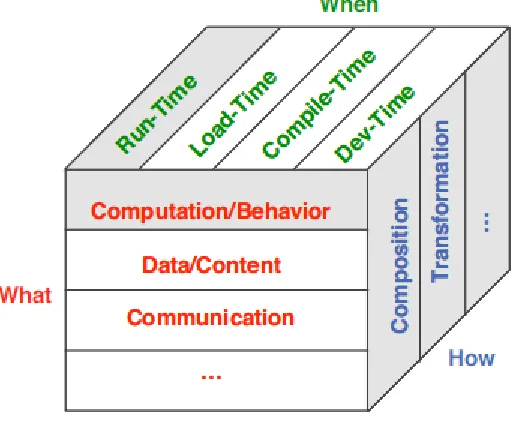
[image:24.612.185.441.372.583.2]Hirschfeld et al. (Hirschfeld et al., 2004) suggest that runtime adaptation in service-oriented systems should address the what, when, and how of adaptation (Figure 2.3). The what distinguishes between the basic properties of the system’s computation, state, and communication. The when addresses the time when adaptations can be made operational in the system during software development i.e. at development time, compile-time, load-time, or runtime. The how studies tools and techniques that allow for adaptations to become effective. However, a recent review of the state of runtime adaptation in service-oriented systems reveal that there are other important factors (dimensions) (Mutanu & Kotonya, 2017). These are examined next.
Figure 2.3. Adaptation Dimensions
2.2
Adaptation Trigger (What)
25
• Business Environment Trigger. Changes in the business environment that the system supports
may trigger adaptation. This may be caused by changes in user requirements, business rules or platform. Zeng et al. (Zeng et al., 2003) describe an adaptation approach that accepts changes in user requirements and business rules on the fly and composes services to address them. Similarly Cubo et al. (Cubo et al., 2008) describe an approach that uses changes in the system context and platform to trigger adaptation. Smart cities are advancing towards an instrumented, integrated, and intelligent living space, where Internet of Things (IoT), mobile technologies and next generation networks are expected to play a key role. Alti et al. (Alti et al., 2016) describe a situation where a diabetic person needs to monitor his or her health. He or she uses an intelligent environment, which includes smart devices, sensors (glucose meter, weight scale, video camera) and services. This intelligent environment specifies an ambient system that allows him or her to live safely and to identify urgent situations. For example, the situation of “diabetic coma or too high temperature” is deduced by referencing the average glucose level and the temperature level in the profile.
• Service Provision Trigger. Failures in provided services, for example, incompabilities that
26
• Runtime Environment Trigger. Changes in runtime system can also trigger adaptation.
Interacting services may impose dependability as well as structural constraints on each other (e.g. performance, availability, cost and interface requirements). Dustdar et al. (Dustdar et al., 2009) describe a self-adaptation technique for managing the runtime integration of diverse requirements arising from interacting services, such as time, performance and cost. Swaminathan et al. (Swaminathan et al., 2008) propose an adaptation approach based on self-healing as a means for addressing runtime system errors. Runtime resource contentions between services in the orchestration platform can result in significant falls in service quality. This emergent quality of service is difficult to anticipate before system composition, as resource demands are often dynamic and influenced by many factors. This is particularly true of service-oriented embedded systems. Newman proposes a resource-aware framework that combines resource monitoring with dynamic service orchestration to provide a runtime architecture that mediates resource contentions in embedded service-oriented systems (Newman et al, 2012).
Figure 2.4. Triggers for runtime software adaptation Service Provision
Trigger
(e.g. service quality)
Business Environment
Trigger (e.g. geo-location)
Runtime Environment
Trigger
(e.g. memory restriction) e.g. user income - Influences
location, quality of service and type of device
e.g. industrial location & Speed Requirement
e.g. mobile device & urban location
27 It is worth noting that adaptation triggers are not mutually exclusive; there is often significant overlap between them as shown in Figure 2.4. For example a user can access health information the service from a location where a certain disease is prevalent. Information about that disease should therefore be availed automatically based on the user’s geo-location. A similar scenario would apply where a user is trying to access a travel assistant. The user’s environment acts as the source of the trigger. Alternatively a user could be using a mobile device which has limited memory resources as compared to a personal computer. In this case the user’s runtime environment then acts at the source of the trigger. A service provision trigger will arise from the quality of service required by the user. For example a user accessing the application to conduct a business transaction such as online banking will require the service to be always available and very reliable. Triggers can also invoke other triggers and therefore overlap. For example a user accessing the application from an urban, industrial, or affluent geographic location will often require services of high reputation and may not have devices with resource constrains. The geographic location then invokes the runtime and quality of service triggers. A change or failure may be the symptom of an unseen change or failure. Effective adaptation must address the real cause rather than the symptom. Taiani (Taiani, 2009) describes this as a key challenge in adaptive fault tolerant computing. Moyano et al. (Moyano et al., 2013) describe a system that monitors service failure and runtime environment triggers. These are changes in hardware and firmware, including the unpredictable arrival or disappearance of devices and software component. For example, a low memory trigger may be the result of an SLA violation or runtime environment resource failure. The resolution to the problem might involve replacing the service with a more efficient alternative or optimizing the runtime environment, or both. It is important that the adaptation process is not only able to find a good fit for the problem, but the right fit.
28
Figure 2.5. How adaptation impacts the system
2.3
Application Context (Where)
Application context defines nature of the application and the logical area where it executes and often includes service consumers and service providers (See Figure 4.1). In service-oriented computing (SOC), service providers publish reusable services, and service consumers subscribe them. However, there are potential service mismatch and service fault problems in using 3rd party services, which can affect service quality (La et al., 2011). Cubo et al. (Cubo et al., 2008) discuss the importance of creating adaptive systems sensitive to their application context (i.e. location, identity, time and activity). Cubo’s work focuses on in-car software systems. While these factors are important for this application domain, other factors may need to be considered for other domains. Tanaka and Ishida (Tanaka et al., 2008) identify input language and target language as the context for a language translation application.
29 event correlation and abstraction, event hierarchies and relationships between events using causality, membership, and timing. In their work several heterogeneous devices (sensors, mobile devices, etc.) that generate isolated events are used to obtain valuable information and to make decisions accordingly.
A few approaches, including Swaminathan et al. (Swaminathan et al., 2008), Cardellini et al. (Cardellini et al., 2009), and Zeng et al. (Zeng et al., 2003) propose generic application contexts, but they only provide sketchy implementation details. Some approaches promote context variability. For example, Swaminathan et al. describe a context-independent, self-configuring, self-healing model for web services. However, the author provides no information about the implementation or evaluation of the model. Huang et al. (Huang et al., 2004) describe an approach for developing self-configuring services using service-specific knowledge. They evaluate their approach on three different systems (i.e. a video streaming service, an interactive search service, and a video-conference service). However, it is evident from their discussion that the context needs to be known before the application is deployed. Generic systems and implementation details appear to be conflicting goals from this perspective as illustrated in Table 2.1. For example researchers who provided adequate implementation details such as Ivanovic et al. (Ivanovic et al., 2010) and Fu et al. (Fu et al., 2001) were very specific on the type of system used while those who were more generic in their approach such as Cardellini et al. (Cardellini et al., 2009) and André et al. (André et al., 2010) provided little or no implementation details.
30
2.4
Adaptation Models (When and How)
An adaptation model shows when the adaptation process is carried out and how the model is implemented in relation to the systems it manages. A decision on when to conduct adaptation is arrived at depending on when the adaptation requirements are known as well as the availability of the requirements for adaptation. If the requirements are known before the system is running then adaptation can take place at design time, for instance introducing support for a new network communication protocol, or adding new attributes to a data model. However if the requirements are only known after the system has started executing then adaptation will take place at runtime. This is the typical situation in ubiquitous and mobile computing scenarios (Canal et al, 2007). The availability of the requirements for adaptation, such as system resources can also determine when to conduct adaptation. For example if the resources are available online then dynamic adaptation can be conducted, otherwise it can be pushed to a later time when they will be available. Gilani (Gilani et al., 2007) states that the support for adaptation is required statically, where the applications could be taken offline and adapted, and dynamically where going offline is not an available option. An adaptation model may be implemented to carry out adaptation at design time or at runtime. Further the adaptation module may be implemented as an intrinsic part of the system it manages or as a pluggable component that monitors change and effects re-composition from outside the system. The adaptation could also occur before a change trigger (predictive) or after a change trigger. A review of current adaptation models is discussed next.
2.3.1 Static Adaptation
31
• MetaJava adaptation. Golm et al. (Golm et al., 1997) describe a MetaJava system as an
extended Java interpreter that allows structural and behavioral reflection. Reflection in this context refers to the capability of a computational system to “reason about and act upon itself.
• Load-time adaptation. Duncan et al. (Duncan et al., 1999) describe this as a
code-transformation technique that allows a wide range of changes to programs and languages running on a virtual machine without sacrificing the benefits of portability.
• Binary component adaptation. Keller et al. (Keller et al., 1998) describe this as a mechanism
that modifies existing components (such as Java class files) to the specific needs of a programmer.
In service-oriented systems, static adaptation has been used to overcome compatibility issues, for example, by authoring multiple content and service versions targeted at a specific delivery environment statically (Lei et al., 2001). While these adaptation techniques have made software more reusable hence more adaptable, they are unsuitable for managing runtime change.
The goal of static adaptation is to provide developers with a framework to build self-adaptive applications. The trust-aware application by Moyano et al. (Moyano et al., 2013) shown in Figure 2.7 is typical of this approach. At design-time, the developer uses the trust API that encapsulates some of the trust-related concepts by means of annotations (e.g. reputation value) from which code is generated for a trust aware self-adaptive system at compile time. This follows the binary component adaptation approach described by Keller et al. (Keller et al., 1998)
32
2.3.2 Dynamic Adaptation
As mentioned earlier, the increasing demand for systems that can adapt quickly and effectively to their changing environment has fuelled the need for better runtime adaptation. One of the major challenges identified in the SOA research challenges roadmap (Papazoglou et al., 2007) is the need for services to equip themselves with adaptive capabilities without compromising operational and financial efficiencies. Papazoglou et al. (Papazoglou et al., 2007) identify the key techniques that can be used to achieve runtime adaptation as self-configuring, self-healing, and self-optimizing techniques.
• Self-Configuring is the automatic re-composition of services to adapt to changes in the
service environment.
• Self-Optimizing is the automatic re-composition of services to improve quality of a service. • Self-Healing is the automatic re-composition of services to address a service failure.
Most runtime adaptation approaches reviewed in Table 2.1 focus on only one of the above techniques, which often limits the effectiveness of the approach. The problem of focusing on a single technique is well illustrated with the example of a service-oriented inventory system. A fault detected in a service of the system may require that re-composition takes places to fix the error through self-healing. During re-composition the adaptation process may need to check for an alternative service, which may require adaptation in the system through self-reconfiguration. Lastly, the adaptation process may need to apply self-optimization as part of self-reconfiguration to avoid compromising the system quality.
33
Figure 2.8. Runtime self-adaptation. Source (Psaier et al,. 2010)
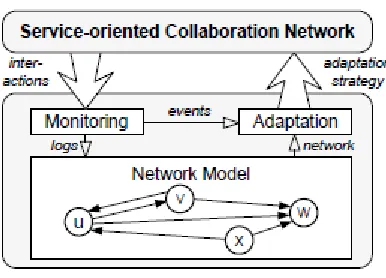
An example of Dynamic adaptation model can be seen in the self-healing framework proposed by Li et al. (Li et al., 2013). In the framework an extractor gets the system fault information through a monitoring process. This information is then passed on to a case-based reasoner, which produces a solution through an analysis and planning process. Finally the solution is passed on to the business process for execution. A case without a solution is viewed as a new fault.
It is worth noting that current research initiatives on adaptation of service-oriented systems focus on dynamic rather than static adaptation however the importance of static adaptation cannot be ignored. For any system to be fully adaptable it requires some aspect of dynamic and static adaptation. Parraa et al. (Parraa et al., 2011) propose an approach that unifies adaptation at design and at runtime based on Aspect Oriented Modeling.
2.3.3 Adaptation Strategy - Reactive versus Predictive
Reactive adaptation controls adapt the system according to the users’ situation. The system perceives its environment through sensors and reacts to changes as they occur. However, when adaptation occurs as a result of anticipated change, it’s called predictive adaptation. An ideal predictive approach does not take into account the reactions of the system under control, but only the environment under which it operates. The control of the environment is not pegged on observing the reactions of the user. As a result such an approach should offer quick response and high performance with few sensors required. Šerbedžija. (Šerbedžija., 2012) describe a reactive approach as a feedback loop while a predictive approach as a feed forward loop.
34 without measuring e.g. the effects of changing the lighting in a room must be completely known under all conditions – which may be too farfetched. A more practical approach would therefore be creating a feedback control system that measures and reasons. Therefore Šerbedžija recommends a predictive approach where satisfying an average user goals are needed, while a reactive approach can be used where a system has to meet more personal user needs through a self-tuning and self-correcting strategy.
In their event-driven quality of service prediction approach, Zeng et al. (Zeng et al., 2003) point out that most adaptation approaches focus on monitoring Quality of Service (QoS) constraints and as such cannot provide early warning to prevent QoS degradation. They describe a model that makes use of data mining and prediction scoring to anticipate change. However, they provide only limited information on its evaluation. Tanaka and Ishida (Tanaka et al., 2008) propose a different model of prediction that focuses on predicting the executability of services (i.e. if a message request will cause execution failure). However, they also provide limited detail on the implementation and evaluation of their approach. Wang et al. (Wang et al., 2010) proposes a predictability model based on the Q-Learning algorithm using the Markov Decision Processes. They explain that human oriented services are rarely predictable. They point out that many service properties keep changing in a manner that prior knowledge of these changes may not be available. Instead they suggest incorporating reinforced learning in adaptation techniques to ensure that adaptation techniques remain relevant. Their model uses a decision process that maximizes the expected sum of rewards. While predictive adaptation shows some promise, there is very little research on them and even less information on their evaluation.
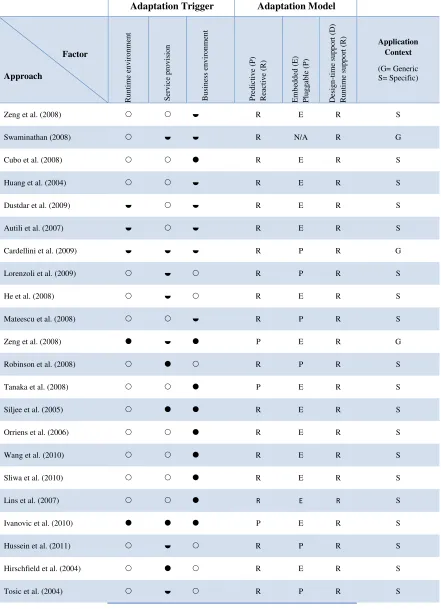
Table 2.1 summarizes the findings from the review conducted on 29 approaches to the dynamic adaptation of service-oriented systems. While the survey conducted is by no means exhaustive, it gives an insight into the state of runtime adaptation of service-oriented systems, and specifically on the factors that influence adaptation.
2.3.4 Model implementation
35 module is plugged on to legacy systems in Figure 2.10. In the figure an external model is used to monitor and modify a system dynamically.
Figure 2.9. A pluggable approach to self-adaptation. Source (Garlan et al., 2001)
36
Table 2.1. Summary of adaptation approaches
Adaptation Trigger Adaptation Model
Factor Approach R un ti m e en vi ro nm en t S er vi ce p ro vi si on B us in es s en vi ro nm en t P re di ct iv e (P ) R ea ct iv e (R ) E m be dd ed ( E ) P lu gg ab le ( P ) D es ig n-ti m e su pp or t ( D ) R un ti m e su pp or t ( R ) Application Context (G= Generic S= Specific)
Zeng et al. (2008) R E R S
Swaminathan (2008) R N/A R G
Cubo et al. (2008) R E R S
Huang et al. (2004) R E R S
Dustdar et al. (2009) R E R S
Autili et al. (2007) R E R S
Cardellini et al. (2009) R P R G
Lorenzoli et al. (2009) R P R S
He et al. (2008) R E R S
Mateescu et al. (2008) R P R S
Zeng et al. (2008) P E R G
Robinson et al. (2008) R P R S
Tanaka et al. (2008) P E R S
Siljee et al. (2005) R E R S
Orriens et al. (2006) R E R S
Wang et al. (2010) R E R S
Sliwa et al. (2010) R E R S
Lins et al. (2007) R E R S
Ivanovic et al. (2010) P E R S
Hussein et al. (2011) R P R S
Hirschfield et al. (2004) R E R S
37
Adaptation Trigger Adaptation Model
Factor Approach R un ti m e en vi ro nm en t S er vi ce p ro vi si on B us in es s en vi ro nm en t P re di ct iv e (P ) R ea ct iv e (R ) E m be dd ed ( E ) P lu gg ab le ( P ) D es ig n-ti m e su pp or t ( D ) R un ti m e su pp or t ( R ) Application Context (G= Generic S= Specific)
Maurer et al. (2010) R P R S
Romero et al. (2013) R P R S
Li et al. (2013) R P R S
Newman et al. (2012) R P R S
Motahari-Nezhad et al. (2012) R E R S
Cugola et al. (2012) R E R S
Andre et al. (2010) R P R G
Key
- Supported - Weakly Supported
- Not Supported N/A- Not Available
38 knowledge to anticipate change and trigger adaptation. However, the approach has only been evaluated on a limited case study.
Most the approaches surveyed have limited support for system quality and service fault triggers. However they provide strong support for business environment triggers. Of the approaches surveyed only Zeng et al. (Zeng et al., 2008) provides a detailed discussion of the adaptation techniques used to address quality of service issues that arise from interacting services (i.e. system concerns). They provide a detailed discussion of the prediction of quality of service. Dustdar (Dustdar et al., 2009), Autili (Autili et al., 2007), and Cardellini (Cardellini et al., 2009), discuss the importance of service failure and changes in system quality as triggers for adaptation, but give little detail of how their approaches support these. Cardellini (Cardellini et al., 2009), Lorenzoli (Lorenzoli et al., 2006), He (He et al., 2008), Zeng (Zeng et al., 2008) and Valetto (Valetto, 2002) discuss how service failure is supported in their different approaches using limited examples. Robinson et al. (Robinson et al., 2008) and Siljee et al. (Siljee et al., 2005) provide more detailed discussions and more involved case studies.
Most of the approaches surveyed provide strong support for dynamic adaptation, which is not surprising as they are intended to support runtime change. However, most of them are implemented as part of the application they manage (i.e. embedded) rather than pluggable. Pluggable approaches include (Cardellini et al., 2009), (Lorenzoli et al., 2006),(Nallur et al., 2009), (Mateescu et al., 2008), (Tanaka et al., 2008), and (Lins et al., 2007). The approach proposed by Swaminathan (Swaminathan et al., 2008) does not provide adequate implementation details, so it is unclear how it is implemented (i.e. as a pluggable or embedded solution).
2.5
Summary
This chapter has examined factors that influence the dynamic adaptation of Service Oriented Systems with a view of shedding light on what an effective adaptation technique calls for. It sought to identify what causes adaptation, where adaptation takes place, and how adaptation is modeled. To answer these questions an extensive survey was conducted on current research in the system adaptation of service-oriented systems.
39 environment, the runtime environment, or the service itself. Business triggers included triggers external to the application such as the geographic location, while triggers from the service itself such as failure affected the quality of the service. Runtime triggers originated from the service platform and included triggers such as memory or CPU resource constraints. It is noted that triggers are not mutually exclusive but often overlap. Majority of the work addressed the external environment triggers ignoring the runtime and internal environment. An effective self-adaptive application therefore should be able to deal with multiple overlapping triggers that may sometimes conflict. Very little research work focused on providing a generic solution that can work in any application context. Most of the work that gave adequate implementation details focused on a specific application context. The research that gave generic solutions provided little or no implementation details.
The survey also revealed that different software adaptation models exist. Static adaptation models conducted adaptation during the design or maintenance of the software while dynamic adaptation models performed adaptation at runtime. Only a few of the dynamic adaptation models from the survey incorporated elements of static adaptation, which can enhance dynamic adaptation. Embedded adaptation models implemented the adaptation module as part of the application while pluggable models implemented it as a separate model. A pluggable model presented the benefit of portability for a more generic approach. A predictive adaptation model called for adaptation before the adaptation trigger was detected by the application while a reactive model invoked adaptation only after the adaptation trigger was detected. The predictive approach called for learning and would be ideal for an early warning system where disasters risks needed to be avoided. Very few of the adaptation approaches reviewed were based on pluggable or predictive schemes.
The findings of this survey can be summarized as follows:
•Triggers for software adaptation originate from the users business environment, the
runtime environment, or the service provision environment. Most of the research focused on business environment triggers
•Most of the work on dynamic adaptation of service oriented systems that provided
40
•Solutions presented in existing literature were either pluggable or embedded with the
majority focusing on pluggable approaches. This limited their portability.
•Finally dynamic adaptation is either reactive or predictive. Most of the research is reactive
with adaptation taking place after triggers have occurred. This made it difficult to prevent catastrophic results.
41
Chapter 3
3
Software System Validation
3.1
Validation in Autonomic Systems
Sommerville (Sommerville, 2016) defines Software Validation as building the right product based on the users product acceptance. In their research roadmap for self-adaptive systems, Lemos et al. (Lemos et al., 2013) emphasize the need for feedback control in the life cycle of self-adaptive systems and the need to perform traditional design-time validation and verification at runtime. In another survey, Salehie et al. (Salehi et al., 2009) note that testing and assurance are probably the least focused phases in the engineering of self-adaptive software. Papazoglou et al. (Papazoglou et al., 2007) echo this view.
Most autonomic systems are underpinned by the IBM Monitoring, Analysis, Planning, and Execution model (MAPE). Figure 3.1 illustrates the MAPE cycle. However, while the model is evident in many self-adaptive frameworks for service-oriented systems, it does not provide support for validating runtime adaptation.
Figure3.1 MAPE Architectural Model for Autonomic Computing
42 adaptive aircraft controllers. In their work they explain how an estimate of the expected aircraft handling quality provides a kind of feedback that can be directly assessed by the pilot. The validation information from the pilot can be used to refine and improve the adaptability of the aircraft. Cheng et al. (Cheng et al., 2009) point out that while the goal of self-validation is simple, achieving it is not. Traditional verification and validation methods, static or dynamic, rely on stable descriptions of software models and properties. However, runtime system properties, system functionality, and the business needs served are dynamic and prone to change, making them difficult to predict in advance. For verification and validation methods to be effective they need to align themselves with business changing goals and requirements as well as variable system functionality. A partial example of this can be seen in the work of Calinescu et al. (Calinescu et al., 2011) who propose formal verification techniques such as quantitative verification and model checking to support the multiple stages of the MAPE autonomic computing loop. Their work focuses on using a mathematically-based technique for establishing the correctness, performance and reliability of systems that exhibit stochastic behavior. Their assertion that software must adapt continuously, to respond to changes in application objectives and in the environment in which it is embedded is a key underpinning of my research. Their work however looks at software verification, which is concerned with how well the system conforms to its specification (Sommerville, 2016). Software verification assesses whether we are building the product correctly. The primary focus of my research is validation, which is concerned with checking that the system meets the user’s actual needs.
3.2
Validation in Service-oriented Systems
43
3.1.1 Techniques
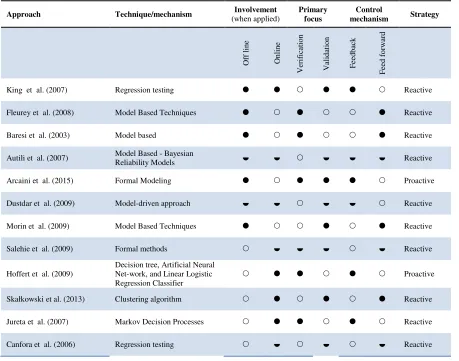
A survey of current research in adaptive service-oriented systems reveals that various verification and validation techniques are used to support adaptation. These include formal methods, model-based, and machine-learning techniques. The next section discusses a number of techniques and some of the challenges faced.
(i) Formal methods
Salehie et al. (Salehi et al., 2009) suggest that formal methods can be used for verification and validation of self-adaptive software to ensure its correct functionality, and to understand its behavior. Weyns et al. (Weyns et al., 2012) state that formal methods set out to show that a system has some desired properties by proving that a model of that system satisfies those properties. However, Lemos et al. (Lemos et al., 2013) state that formal methods can be too expensive to be executed regularly at run-time when the system adapts, due to their time and space complexity.
Arcaini et al. (Arcaini et al., 2015) model and validate a distributed self-adaptive service-oriented application. They design a traffic monitoring system with a number of intelligent cameras along a road and apply a formal modeling approach for self-validation. Each camera is endowed with a data processing unit and a communication unit to interact with other cameras. Cameras have to collaborate to observe larger phenomena such as traffic jams and aggregate the monitored data. The need for self-adaptation is triggered by changes in the surrounding environment, namely the congestion and by the failures of other cameras. They note that over-specification is a challenge with the formal approach due to the rigidity of the formalisms Timed Automata. They avoided over-specification through separation of concerns (by focusing on one adaptation activity at a time), which can be a challenge given that adaptation activities are not mutually exclusive.
44 refining the set of requirements that allow them to ensure that the modeled service architecture faithfully represents the dynamic service behavior. However, it is important to mention that their focus is on verification rather validation.
The use of formal methods can also be seen in the work of Fiadeiro et al.(Fiadeiro et al., 2011) who set out to develop models through which designers can validate properties of composite services. Assembly and binding techniques such as the ones provided by Service Component Architecture can then be used to put together heterogeneous service components. They define a mathematical model of computation and an associated logic for service-oriented systems which preserves correctness. In their work semantics of service modules are defined after which they formulate a property of correctness that guarantees that services programmed and assembled (as specified in a module) provide the business functionality advertised by that module. However, the model does not take into account shifting user requirements, the changeability of services and unpredictable runtime environments that are continously evolving.
45 (ii) Model-based
In this approach models check the behavior of a self-adaptive system during design and are later used to test the implementation during and after development. Gomaa et al. (Gomaa et al., 2014) use patterns to model how the components that make up an architecture pattern cooperate to change the software configuration at run-time. They propose a model-based run-time adaptation pattern for distributed hierarchical service coordination in service-oriented systems, in which multiple service coordinators are organized in a distributed hierarchical configuration. Their work extends research in SOA systems by validating dynamic software adaptation pattern for distributed hierarchical service coordination. The model makes use of a validation component to check if the adaptation took place as expected i.e. transitioning from Processing to Passive to Quiescent states and then back to Processing state, during adaptation. They apply various change management scenarios to validate their model. Their work however does not explain what happens when an adaptation model does not behave as expected. User environments differ and as a result an adaptation model needs to be adaptive in nature to cater for changes in user requirement.
Based on formal interpretations of UML Models as graphs and graph transformation systems, Baresi et al.(Baresi et al., 2003), posit that the consistency between platform and application can be validated using model based approaches. In order to reason about planned or unanticipated reconfigurations of architectures, they use graph transformation rules to capture the dynamic aspects of architectural styles. As a case study they make use of the reference architecture for a supply chain management system that involves a consumer component, a retailer service, a warehouse service, a shipping service, and a manufacturer service. Their model of the architectural style supports the architect when deciding whether the style is suitable for his application. The model is used to reason about possible reconfigurations results in order to check if all required configurations of the application are reachable.
46 workloads change. They make use of a model based approach to self-adaptive resource allocation in virtualized environments based on online architecture-level performance models. This way they proactively adapt the system to the new workload conditions avoiding SLA violations or inefficient resource usage. A case study of a car dealer that places a large order with an automobile manufacturer is used to test the developed model. The results demonstrate that architecture-level performance models can be used effectively at runtime to validate self-adaptiveness.
Fleurey et al. (Fleurey et al., 2008) combine model driven and aspect oriented techniques when validating dynamic adaptation. They posit that a model driven approach avoids enumerating all possible configurations statically. A base model which contains the common functionalities and a set of variant models which capture the variability of the adaptive application is used. The actual configurations of the application are built at runtime by selecting and composing the appropriate variants. They simulate changes to test their validation component. Their work however looks at validating adaptation rules at design-time. Calinescu et al. (Calinescu et al., 2011) advocate for the use of both modeling techniques and mathematically based techniques to plan the adaptation steps necessary to identify requirement violations at runtime. They however point out model learning as a key challenge of their work. In their discussion on the use of models at runtime for self-assurance, Cheng et al. (Cheng et al., 2009) highlight some key challenges with the approach. A key issue in this approach is to keep the run-time models synchronized with the changing system. They recommend the use of probability distribution functions, the attribute value ranges, or using the analysis of historical attribute values. More advanced and predictive models of adaptation are needed for systems that could fail to satisfy their requirements due to side effects of change. (iii) Machine-Learning
47 examples of data provided and efficient algorithms are used to solve optimization problems as well as represent and evaluate generalized models.
Machine learning algorithms essentially fall under two groups categorized based on the desired outcome of the algorithm according to Ayodele (Ayodele, 2010).
• Supervised learning - Supervised learning algorithms make predictions based on a set of
examples. Classifiers, Decision trees, Neural Networks, and regression are some examples of supervised learning
• Unsupervised learning - Here labeled examples are not available. The goal is to organize the
data in some way or to describe its structure. This can mean grouping it into clusters using algorithms such as k-mean clustering or Expectation-maximization (EM) clustering.
This research embedded a machine learning element in the framework to assess and update the adaptation decisions. Experiments are conducted that involve both a supervised and unsupervised approach to machine learning.
For the unsupervised approach EM clustering is considered because it provides better optimization than distance-based or hard membership algorithms, such as k-Means. EM easily accommodates categorical and continuous data fields making it the most effective technique available for proper probabilistic clustering. Decision logs record change triggers received and the adaptation decision made. If the decision made is inadequate, this is detected as the system almost immediately triggers another request for adaptation. EM clustering is performed in two steps (Kim et al., 2012):
•Expectation – Firstly the initial mixture model parameter estimates are input. A single iteration
provides new parameter estimates that do not decrease the log likelihood of the model. The
expected value of the log likelihood function, is given as:
Q(θ|θ(t)) = Ez|x,θ(t) [log L(θ; X; Z], (3.1) Where Q is the conditional distribution of Z given X under the current estimate of θ(t).
•Maximization– Secondly the process is repeated until the log likelihood of the mixture model,
at the previous iteration, is sufficiently close (Maximised) to that of the current model. The
parameter that maximizes this quantity is obtained as:
48 Clustering algorithms analyze the data to find groups of maximum commonality. For example, if the framework establishes that at time tn adaptation technique A1 was the acceptable decision for
adaptation trigger X. Then at time tn+1the acceptable adaptation technique for the same trigger was
A2, the framework changes the adaptation rules accordingly. In this case decision logs act as
adaptation triggers.
Experiments with EM clustering however show some gaps that are typical of natural data. This is the motivation behind using alternative algorithms that improve the machine learning process. In order to reinforce unsupervised learning, a supervised learning approach can be used such as neural network classification. Roohi (Roohi, 2013) point out that most of the problems that prop up in all the fields of human operations pertain to organizing objects or data in different categories or classes. The challenge therefore is to assign an object or data item to a class based on a number of observed attributes (features) related to that object. According to Cybenko (Cybenko, 1989) and Hornik et al. (Hornik et al., 1989) artificial neural networks are a good classification option as they have been able to approximate any function with good accuracy. Artificial neural networks, being nonlinear models, can be used to model any real world complex process. While neural networks have been around for a long time, having been developed in the 1950s, they have only become more successful in recent years due to the availability of inexpensive, parallel hardware (Graphic Processing Units and computer clusters) and massive amounts of data.