E
ffi
cient Binding, Protection, and Self-Release of dsRNA in Soil by
Linear and Star Cationic Polymers
Richard Whit
fi
eld,
†Athina Anastasaki,
*
,†Nghia P. Truong,
‡Alexander B. Cook,
†Marta Omedes-Pujol,
§Vanessa Loczenski Rose,
§Tuan A. H. Nguyen,
∥James A. Burns,
§Se
́
bastien Perrier,
†,‡,⊥Thomas P. Davis,
†,‡and David M. Haddleton
*
,†,‡†Chemistry Department, University of Warwick, Library Road, CV4 7AL, Coventry, U.K.
‡ARC Centre of Excellence in Convergent Bio-Nano Science and Technology, Monash Institute of Pharmaceutical Sciences,
Monash University (Parkville Campus), 399 Royal Parade, Parkville, Victoria 3152, Australia
§Formulation Technology Group, Syngenta, Jealotts Hill international Research Centre, Bracknell, Berkshire RG42 6EY, U.K.
∥School of Chemical Engineering, The University of Queensland, Brisbane, QLD 4072, Australia ⊥Warwick Medical School, University of Warwick, Coventry CV4 7AL, U.K.
*
S Supporting InformationABSTRACT: Double stranded RNA (dsRNA) exhibits severe degradation within 3 days in live soil, limiting its potential application in crop protection. Herein we report the efficient binding, protection, and self-release of dsRNA in live soil through the usage of a cationic polymer. Soil stability assays show that linear poly(2-(dimethylamino)ethyl acrylate) can delay the degradation of dsRNA by up to 1 week while the star shaped analogue showed an increased stabilization of dsRNA by up to 3 weeks. Thus, the architecture of the polymer can significantly affect the lifetime of dsRNA in soil. In addition, the hydrolysis and dsRNA binding and release profiles of these polymers were carefully
evaluated and discussed. Importantly, hydrolysis could occur independently of environmental conditions (e.g., different pH, different temperature) showing the potential for many opportunities in agrochemicals where protection and subsequent self-release of dsRNA in live soil is required.
R
NA interference (RNAi) is a naturally occurring process, where double stranded RNA (dsRNA) can regulate protein expression.1−3The use of dsRNA in the agrochemical industry is desirable as selected pests can be specifically targeted, while eliminating the detrimental effects of existing chemical pesticides on nontarget species.4 This technique is advantageous as an alternative method of chemical control to help mitigate the development of resistance by natural selection and also minimizes potential environmental impact associated with current pest control methods.5 However, the effectiveness of RNAi is limited by the very short lifetime of dsRNA which is susceptible to degradation under environ-mental conditions, with numerous pathways reported.6 Ribonucleases (RNases), for example are enzymes which degrade RNA into smaller fragments, and are not only found within the environment, but also in the air, dust and on surfaces. This inherent instability and short half-life of dsRNA when in contact with these enzymes represents a serious challenge in applying RNAi to agrochemicals. Although most of the reports focus on delivering dsRNA to insects through microinjection into the hemolymph or feeding,5,7,8 RNAi has also been shown to be effective in knocking down insect genes in plants, with delivery on to the surface of a leaf prior to insect feeding, or through in vivo dsRNA production within the chloroplast.9−11Nevertheless, all these methods arechalleng-ing for the application to large scale agrochemicals.5,12 A potential alternative route for delivering dsRNA to the plant could be via soil, followed by uptake through the roots, or ingestion by a pest. It has been illustrated that root cells can absorb dsRNA and RNAi can be triggered;13,14 however, applying this process to soil creates additional challenges as soil contains many chemicals (salts, minerals and nutrients), enzymes and living (micro)organisms, which can interact and vastly increase the rate of degradation of RNA.15−17A method of protecting dsRNA and increasing lifetime in soil would be highly desirable, yet no efforts on stabilizing dsRNA in soil have been reported.
Cationic polymers have been extensively employed to protect RNA and DNA from degradation with numerous natural and synthetic examples18,19including amine function-a l i z e d p o l y s function-a c c h function-a r i d e s ,2 0 p o l y (L- l y s i n e ) ,2 1 p o l y -(amidoamines),2 2 poly(amino-co-ester)s,2 3,2 4 poly-((dimethylamino)ethyl methacrylate) (PDMAEMA),25 and poly(ethylene imines).26 Although these polymers can efficiently bind to RNA they are however incapable of release due to the very high positive charge density. Release must
Received: June 2, 2018 Accepted: July 9, 2018 Published: July 12, 2018
Letter
pubs.acs.org/macroletters Cite This:ACS Macro Lett.2018, 7, 909−915
Downloaded by 137.205.202.98 at 04:57:58:931 on June 12, 2019
occur to allow the dsRNA to become available so to trigger RNAi.27 Considerable efforts have been directed at over-coming this problem, in particular, poly(2-(dimethylamino)-ethyl acrylate) (PDMAEA) has been reported as having a self-catalyzed hydrolysis property, with autodegradation to poly-(acrylic acid) and 2-(dimethylamino)ethanol when in aqueous solution.28−30 In addition, PDMAEA has a high transfection efficiency into HeLa cells when complexed with RNA, can facilitate complete release of RNA and exhibits very low
toxicity.27,31−33We thus envisaged that PDMAEA could be a good candidate to protect the dsRNA in soil and delay degradation prior to release.
[image:2.625.62.565.100.629.2]Herein we study for the first time the use of a cationic polymer to increase the lifetime of dsRNA in soil. The effect of t h e p o l y m e r b a c k b o n e ( p o l y ( a c r y l a t e ) v s p o l y -(methacrylate)),34 polymer architecture (linear vs star), and the soil environment (pH and tempera-ture) on the rate of hydrolysis is thoroughly investigated and discussed.
The controlled polymerization of DMAEA is reported to be challenging by all reversible deactivation radical polymerization (RDRP) methods reported to date, mainly due to the high reactivity of the tertiary amine functionality that leads to a large extent of termination and side reactions.35 In order to circumvent this, the polymerizations of DMAEA are usually stopped at low conversions (∼30%) followed by purification and storage of the materials in IPA prior to further use. Under previously reported conditions, the Cu(0)-mediated RDRP36 of both linear and star PDMAEA were attempted aiming for molecular weights in the range of 5000−6000 g mol−1.37,38
It is noted that high molecular weight analogues were not targeted as low molecular weight polymers (<10000 g mol−1) have been widely reported to exhibit enhanced solubility when complexed to genetic material and possess much lower toxicity.27As such, well-defined linear (Mn = 5600 g mol−1, Đ = 1.18) and star PDMAEA (Mn = 6200 g mol−1, Đ = 1.14) were obtained exhibiting good agreement between the theoretical and experimental values and narrow molecular weight distributions (Figures S1−S3 andTable S1). We also aimed to synthesize the polymethacrylate ((poly(2-(dimethylamino)ethyl
metha-crylate) PDMAEMA) analogue of PDMAEA, as it is a nonhydrolyzable in aqueous solution so could be utilized as a negative control. However, under identical conditions, the synthesis of PDMAEMA was unsuccessful as evident by the significant broadening of the molecular weight distributions (Figure S4andTable S2). In order to circumvent this, methyl α-phenylacetate (MBPA) and N,N,N′,N″,N″ -pentamethyldie-thylenetriamine (PMDETA) were instead utilized as the initiator and ligand respectively (as opposed to ethyl-α -bromoisobutyrate (EBiB) and tris[2-(dimethylamino)ethyl]-amine (Me6Tren) that were used for the linear acrylate polymers).39 With this optimization, well-defined linear PDMAEMA with low dispersity was obtained (Mn = 6000 g mol−1,Đ= 1.06). Importantly, this polymerization reached full monomer conversion (>99% conversion by1H NMR) without compromising the molecular weight distribution (Figure S5 andTable S3). To the best of our knowledge, this is thefirst report of controlled polymerization of DMAEMA via Cu(0)-wire RDRP.
[image:3.625.163.461.69.470.2]All polymers (linear PDMAEA, linear PDMAEMA, star PDMAEA) were subsequently dissolved into aqueous
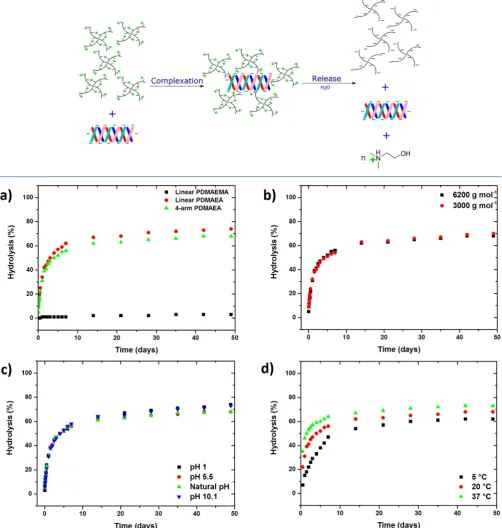
solutions and the extent of the hydrolysis measured via H NMR over 50 days.40This prolonged time frame is necessary for potential soil applications and previous hydrolysis studies are limited to less than 10 days. The nature of the polymer backbone was initially investigated (methacrylate versus acrylate) with PDMAEMA showing negligible hydrolysis, if any, over the whole-time. (Schemes 1, S1, and S2) This is consistent with previous studies that report the methacrylate analogue to be nonhydrolyzable.41In contrast, upon switching from the polymethacrylate to the polyacrylate analogue (linear PDMAEA), hydrolysis occurred rapidly with 11% of the polymer being hydrolyzed within 30 min, followed by a noticeable reduction in the degradation percentage with 25% of hydrolysis in 12 h and 50% in 3 days. The rate of hydrolysis was further decreased reaching 74% over the total period of 50 days. The hydrolysis study was then repeated for the star PDMAEA demonstrating also rapid hydrolysis with a slightly lower degradation percentage than for the linear analogue (Figure 1a andTables S4 and S5). It is noted that although the architecture seems to have only a small effect on the rate of hydrolysis, the linear polymers reproducibly hydrolyze slightly faster than the star polymers, possibly due to the greater density of cationic nitrogen moieties at the core of the star polymer that are less accessible to water molecules. In order to study the effect of small variations on the molecular weight within these materials, a lower molecular weight star polymer was also synthesized and tested (Mn = 3200 g mol−1, D = 1.12). This experiment revealed a similar rate of hydrolysis when compared to the higher molecular weight star polymer (63% versus 62%). (Figure 1b and Table S6) Thus, changing the molecular weight or the architecture has limited effect on the rate of hydrolysis. This advantage allows the synthesis of PDMAEA with variable molecular weight from batch to batch, while maintaining the reproducible hydrolysis property that is needed for quality control.
The effect of the pH on the hydrolysis was subsequently investigated using star PDMAEA as a model polymer as all polymers, except the PDMAEMA, exhibit comparable hydrolysis rates (Figure 1c and Table S7). The pH of soil can vary significantly depending on the area and the environment with typical values being between 3 and 10.42 However, in the presence of acid rain and/or inorganic fertilizers even lower pH can be observed in the field.43 Initially, hydrolysis studies were carried out at natural pH (7.2) and also at pH’s 5.5 and 10.1 (the boundaries of physiological pH range). Near identical hydrolysis profiles were observed at all three pHs, demonstrating similar behavior independent of environmental conditions. These results are in agreement with values previously reported for linear PDMAEA.28,29With lower
pH being common in soil, a further hydrolysis study was carried out at pH∼1.5. Interestingly, a near identical rate of hydrolysis was observed and thus confirming that the rate of hydrolysis is not affected by pH changes (pH 1.5−10.1).
Another factor of importance is the effect of temperature on the degree of hydrolysis, with significant variations within different countries or different seasons. Hence, the hydrolysis at three different temperatures was tested (8, 20, and 37 °C) (Figure 1d and Table S8). The rate of hydrolysis slightly increased upon increasing the temperature, however, the difference in hydrolysis rate between 8 and 37°C was only 4% at the end of the 50th day, thus showing relatively similar characteristics under significant temperature changes.
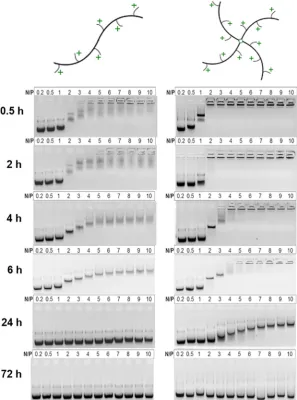
To be applicable as a pesticide, dsRNA must bind and subsequently be released into the soil, so it can be absorbed by the plant root. With previous studies limited to the effect of a few polymer properties and environmental factors on the strength of complexation, we further investigated the effect of architecture on the rate of release utilizing gel electrophoresis assays (Figures 2 and S6).44−47 Polymer/dsRNA complexes (both linear and star) were incubated in RNase free water at increasing N+/P− ratios (0.2−10). Then, 0.5 h after incubation, the dsRNA remains loaded within the pockets of the gel (the top band inFigures 2and S6), indicating strong complexation between all polymers (linear PDMAEA, linear PDMAEMA, star PDMAEA) and dsRNA at an N+/P−ratio of 2 or greater. In comparison to the linear polymer, the star PDMAEA illustrated much more complete binding, as shown by dark top band and no smearing inFigure 2(right). At lower N+/P− ratios full binding did not take place as there were insufficient positive charges to bind all of the dsRNA, illustrated by the free dsRNA migrating through the gel. We next examined the ability of these complexes to release dsRNA, as only free dsRNA can be active and most complexes cannot self-release the dsRNA. As expected, the non-hydrolyzable PDMAEMA exhibited no release of dsRNA even after 21 days as no noticeable change in the gel electrophoresis assay was observed (Figure S6).
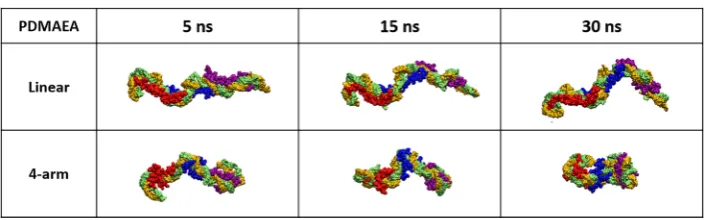
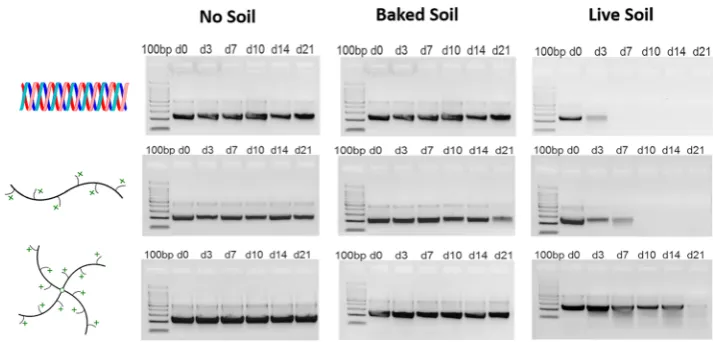
[image:4.625.136.495.66.176.2]polymer was evident. Detailed binding and conformation changes of dsRNA-PDMAEA complexation were subsequently investigated using all-atom molecular dynamics (MD) simulation (Figure 3). Previous reports have shown that the presence of cationic functionalized nanoparticles result in significant bending of DNA.48However, there is currently no comprehensive study on the binding of cationic polymers of different architecture to dsDNA. In our simulation, both linear and star PDMAEA (DP40) are strongly bound to the dsDNA and had a profound impact on DNA conformation. The star polymer, however, is more effective in bending and wrapping on the dsDNA, thus a more compact DNA/polymers complex is formed in comparison with the linear one. This is consistent with the gel electrophoresis data, as there is a lower surface area that can potentially come into contact with water or RNases, so better protection and slower release are illustrated. Another important observation from the gel electrophoresis data, was that the N+/P−ratio has a significant effect on the rate of release with increasing the amount of polymer resulting in a much slower rate. Full release of dsRNA is a desired attribute for cationic polymers and is illustrated for all N+/P− ratios of both the linear and the star PDMAEA. These polymers are therefore potentially good candidates for soil stability studies, so polyplexes formed from both the linear and star cationic polymers (N+/P−ratios of 5) were subsequently investigated (Figure 4). Soil stability assays were conducted by adding samples of polyplex to either live soil or baked soil, with samples incubated for up to 21 days. At each selected time point, TRI Reagent (a mixture of phenol and guanidine thiocyanate) was added which inhibits any RNase activity, preventing subsequent degradation of dsRNA. This also facilitates the extraction of dsRNA from the soil and importantly separation from DNA and proteins. On the addition of chloroform followed by centrifugation, three phases are formed: an aqueous phase containing RNA, an interphase containing DNA, and an organic phase containing proteins.49 Subsequent enrichment utilizing a lithium chloride procedure allowed for analysis via gel electrophoresis (Materials and Methods in the Supporting Information).50 Initially, some important control experiments were conducted. In the absence of soil (RNase free solution) the naked dsRNA, the linear PDMAEA/dsRNA complex and the star PDMAEA/dsRNA complex showed no degradation of dsRNA (Figure 4). This is
to be expected as in the absence of soil there are no bacteria or enzymes to facilitate degradation. In contrast, when the naked dsRNA was tested in live soil, the intensity of the dsRNA band was greatly reduced after 3 days (Figure 4), suggesting severe degradation of dsRNA. Conversely, when the linear PDMAEA was complexed to the dsRNA in the live soil, distinct bands could be observed after 3 and 7 days, thus clearly showing that complexation to linear PDMAEA was delaying the degradation of dsRNA in soil for around 4 days. However, after 10 days, the dsRNA was completely degraded. Remarkably, when the star PDMAEA was complexed to the dsRNA in live soil the degradation was further delayed with a strong band being observed even after 14days while a much weaker band could still be observed even after 21 days. A further control experiment was undertaken, with the naked dsRNA, the linear PDMAEA/dsRNA complex and the star PDMAEA/dsRNA complex being tested in prebaked soil (240 °C). Having stopped the activity of bacteria and enzymes, no degradation took place confirming that indeed these organisms/enzymes are the only factor responsible for the live soil degradation. As such, it can be concluded that both linear and star PDMAEA can efficiently protect from dsRNA from degradation and extend the lifetime, but importantly the star/dsRNA complex exhibits significantly longer protection when compared to the linear analogue.
[image:5.625.133.490.66.237.2]In summary, we have identified PDMAEA as a successful polymer for the effective binding and self-release of dsRNA in soil. Both linear and star PDMAEA were successfully synthesized via Cu(0)-RDRP, and the hydrolysis profile of these materials was demonstrated to be independent of environmental conditions thus highlighting the robustness of these candidates. Interestingly the architecture was shown to have a significant effect on binding and release, with the star showing a much slower release rate in comparison to the linear polymer. When applied to soil, star PDMAEA protected dsRNA, illustrating a significantly greater stabilization time of 3 weeks compared to naked dsRNA, which degraded after 3 days. The enhanced stability of dsRNA in soil by complexation to these polymers, followed by a unique self-release mechanism creates many new opportunities for using RNA interference in agrochemical applications.
ORCID
Richard Whitfield: 0000-0003-4787-2060
Nghia P. Truong:0000-0001-9900-2644
Alexander B. Cook:0000-0002-5005-1039
Tuan A. H. Nguyen:0000-0002-3024-2081
Sebastien Perrier:́ 0000-0001-5055-9046
Thomas P. Davis:0000-0003-2581-4986
David M. Haddleton:0000-0002-4965-0827
Notes
The authors declare no competingfinancial interest.
■
ACKNOWLEDGMENTSFinancial support by the University of Warwick, the Australian Research Council Centre of Excellence in Convergent BioNano Science and Technology (Project Number CE140100036), and Syngenta are gratefully acknowledged. A.A acknowledges the European Union for a global Marie Curie Fellowship. N.P.T. acknowledges the award of a DECRA Fellowship from the Australian Research Council (DE180100076). T.A.H.N acknowledges an Early Career Researcher Grant (UQECR1720169) and the University of Queensland’s Research Computing Centre (RCC) for its support in this research. S.P. acknowledges the Royal Society for a Wolfson Merit Award (WM130055).
■
REFERENCES(1) Hannon, G. J. RNA Interference. Nature 2002, 418 (6894), 244−251.
(2) Pecot, C. V.; Calin, G. A.; Coleman, R. L.; Lopez-Berestein, G.; Sood, A. K. RNA Interference in the Clinic: Challenges and Future Directions.Nat. Rev. Cancer2011,11(1), 59−67.
(3) Fire, A.; Xu, S.; Montgomery, M. K.; Kostas, S. A.; Driver, S. E.; Mello, C. C. Potent and Specific Genetic Interference by Double-Stranded RNA in Caenorhabditis Elegans.Nature1998,391(6669), 806−811.
(4) Ghormade, V.; Deshpande, M. V.; Paknikar, K. M. Perspectives for Nano-Biotechnology Enabled Protection and Nutrition of Plants.
Biotechnol. Adv.2011,29(6), 792−803.
(5) Huvenne, H.; Smagghe, G. Mechanisms of dsRNA Uptake in Insects and Potential of RNAi for Pest Control: A Review.J. Insect Physiol.2010,56(3), 227−235.
(6) Gary, D. J.; Puri, N.; Won, Y.-Y. Polymer-based siRNA Delivery: Perspectives on the Fundamental and Phenomenological Distinctions From Polymer-Based DNA Delivery.J. Controlled Release2007,121
(1), 64−73.
(7) Baum, J. A.; Bogaert, T.; Clinton, W.; Heck, G. R.; Feldmann, P.; Ilagan, O.; Johnson, S.; Plaetinck, G.; Munyikwa, T.; Pleau, M.; et al. Control of Coleopteran Insect Pests Through RNA Interference.Nat. Biotechnol.2007,25(11), 1322−1326.
approach for plant defence against piercing-sucking and stem-borer insect pests.Plant, Cell Environ.2015,38(11), 2277−2285.
(14) Joga, M. R.; Zotti, M. J.; Smagghe, G.; Christiaens, O. RNAi Efficiency, Systemic Properties, and Novel Delivery Methods for Pest Insect Control: What We Know So Far.Front. Physiol.2016,7, 1−14. (15) Garbeva, P.; Van Veen, J.; Van Elsas, J. Microbial Diversity in Soil: Selection of Microbial Populations by Plant and Soil Type and Implications for Disease Suppressiveness. Annu. Rev. Phytopathol.
2004,42, 243−270.
(16) Lauber, C. L.; Strickland, M. S.; Bradford, M. A.; Fierer, N. The Influence of Soil Properties on the Structure of Bacterial and Fungal Communities Across Land-Use Types.Soil Biol. Biochem. 2008, 40
(9), 2407−2415.
(17) Das, S. K.; Varma, A. Role of Enzymes in Maintaining Soil Health.Soil Biol.2010,22, 25−42.
(18) Pack, D. W.; Hoffman, A. S.; Pun, S.; Stayton, P. S. Design and Development of Polymers for Gene Delivery.Nat. Rev. Drug Discovery
2005,4(7), 581−593.
(19) Loczenski Rose, V.; Shubber, S.; Sajeesh, S.; Spain, S. G.; Puri, S.; Allen, S.; Lee, D.-K.; Winkler, G. S.; Mantovani, G. Phosphonium Polymethacrylates for Short Interfering RNA Delivery: Effect of Polymer and RNA Structural Parameters on Polyplex Assembly and Gene Knockdown.Biomacromolecules2015,16(11), 3480−3490.
(20) Cohen, J. L.; Schubert, S.; Wich, P. R.; Cui, L.; Cohen, J. A.; Mynar, J. L.; Frechet, J. M. Acid-Degradable Cationic Dextrań Particles for the Delivery of siRNA Therapeutics.Bioconjugate Chem.
2011,22(6), 1056−1065.
(21) Hartono, S. B.; Gu, W.; Kleitz, F.; Liu, J.; He, L.; Middelberg, A. P.; Yu, C.; Lu, G. Q.; Qiao, S. Z. Poly-L-Lysine Functionalized Large Pore Cubic Mesostructured Silica Nanoparticles as Biocompat-ible Carriers for Gene Delivery.ACS Nano2012,6(3), 2104−2117. (22) Esfand, R.; Tomalia, D. A. Poly (amidoamine)(PAMAM) Dendrimers: from Biomimicry to Drug Delivery and Biomedical Applications.Drug Discovery Today2001,6(8), 427−436.
(23) Lim, Y.-b.; Kim, S.-M.; Lee, Y.; Lee, W.-k.; Yang, T.-g.; Lee, M.-j.; Suh, H.; Park, J.-S. Cationic Hyperbranched Poly (amino ester): a Novel Class of DNA Condensing Molecule with Cationic Surface, Biodegradable Three-Dimensional Structure, and Tertiary Amine Groups in the Interior.J. Am. Chem. Soc.2001,123(10), 2460−2461. (24) Lynn, D. M.; Langer, R. Degradable Poly (β-amino esters): Synthesis, Characterization, and Self-Assembly with Plasmid DNA.J. Am. Chem. Soc.2000,122(44), 10761−10768.
(25) Zhao, X.; Pan, F.; Zhang, Z.; Grant, C.; Ma, Y.; Armes, S. P.; Tang, Y.; Lewis, A. L.; Waigh, T.; Lu, J. R. Nanostructure of Polyplexes Formed Between Cationic Diblock Copolymer and Antisense Oligodeoxynucleotide and its Influence on Cell Trans-fection Efficiency.Biomacromolecules2007,8(11), 3493−3502.
(27) Truong, N. P.; Jia, Z.; Burgess, M.; Payne, L.; McMillan, N. A.; Monteiro, M. J. Self-Catalyzed Degradable Cationic Polymer for Release of DNA.Biomacromolecules2011,12(10), 3540−3548.
(28) Truong, N. P.; Jia, Z.; Burges, M.; McMillan, N. A.; Monteiro, M. J. Self-Catalyzed Degradation of Linear Cationic Poly(2-dimethylaminoethyl acrylate) in Water. Biomacromolecules 2011,12
(5), 1876−1882.
(29) Truong, N. P.; Gu, W.; Prasadam, I.; Jia, Z.; Crawford, R.; Xiao, Y.; Monteiro, M. J. An Influenza Virus-Inspired Polymer System for the Timed Release of siRNA.Nat. Commun.2013,4, 1902.
(30) Rolph, M. S.; Pitto-Barry, A.; O’Reilly, R. The Hydrolytic Behavior of N, N′-(dimethylamino) thyl acrylate-Functionalized Polymeric Stars.Polym. Chem.2017,8, 5060−5070.
(31) Tran, N. T.; Jia, Z.; Truong, N. P.; Cooper, M. A.; Monteiro, M. J. Fine Tuning the Disassembly Time of Thermoresponsive Polymer Nanoparticles. Biomacromolecules 2013, 14 (10), 3463− 3471.
(32) Tran, N. T.; Truong, N. P.; Gu, W.; Jia, Z.; Cooper, M. A.; Monteiro, M. J. Timed-Release Polymer Nanoparticles. Biomacromo-lecules2013,14(2), 495−502.
(33) Hartono, S. B.; Phuoc, N. T.; Yu, M.; Jia, Z.; Monteiro, M. J.; Qiao, S.; Yu, C. Functionalized Large Pore Mesoporous Silica Nanoparticles for Gene Delivery Featuring Controlled Release and Co-delivery.J. Mater. Chem. B2014,2(6), 718−726.
(34) Engelis, N. G.; Anastasaki, A.; Whitfield, R.; Jones, G. R.; Liarou, E.; Nikolaou, V.; Nurumbetov, G.; Haddleton, D. M. Sequence-Controlled Methacrylic Multiblock Copolymers: Expanding the Scope of Sulfur-Free RAFT.Macromolecules2018,51(2), 336− 342.
(35) Zeng, F.; Shen, Y.; Zhu, S. Atom-Transfer Radical Polymer-ization of 2-(N, N-Dimethylamino) ethyl Acrylate.Macromol. Rapid Commun.2002,23(18), 1113−1117.
(36) Anastasaki, A.; Nikolaou, V.; Nurumbetov, G.; Wilson, P.; Kempe, K.; Quinn, J. F.; Davis, T. P.; Whittaker, M. R.; Haddleton, D. M. Cu (0)-Mediated Living Radical Polymerization: A Versatile Tool for Materials Synthesis.Chem. Rev.2016,116(3), 835−877.
(37) Tanaka, J.; Gleinich, A. S.; Zhang, Q.; Whitfield, R.; Kempe, K.; Haddleton, D. M.; Davis, D. M.; Perrier, S.; Mitchell, D. A.; Wilson, P. Specific and Differential Binding ofN-Acetylgalactosamine Glycopol-ymers to the Human Macrophage GalactoseLectin and Asialoglyco-protein Receptor.Biomacromolecules2017,18(5), 1624−1633.
(38) Whitfield, R.; Anastasaki, A.; Truong, N. P.; Wilson, P.; Kempe, K.; Burns, J. A.; Davis, T. P.; Haddleton, D. M. Well-defined PDMAEA stars via Cu (0)-mediated Reversible Deactivation Radical Polymerization.Macromolecules2016,49(23), 8914−8924.
(39) Whitfield, R.; Anastasaki, A.; Nikolaou, V.; Jones, G. R.; Engelis, N. G.; Discekici, E. H.; Fleischmann, C.; Willenbacher, J.; Hawker, C. J.; Haddleton, D. M. Universal Conditions for the Controlled Polymerization of Acrylates, Methacrylates and Styrene via Cu (0)-RDRP.J. Am. Chem. Soc.2017,139(2), 1003−1010.
(40) Ho, H. T.; Bohec, M. L.; Fremaux, J.; Piogé , S.; Casse, N.;́ Fontaine, L.; Pascual, S. Tuning the Molar Composition of“ Charge-Shifting” Cationic Copolymers Based on 2-(N, N-Dimethylamino) Ethyl Acrylate and 2-(tert-Boc-Amino) Ethyl Acrylate. Macromol. Rapid Commun.2017,38(5), 1600641.
(41) Cotanda, P.; Wright, D. B.; Tyler, M.; O’Reilly, R. K. A Comparative Study of the Stimuli-Responsive Properties of DMAEA and DMAEMA Containing Polymers.J. Polym. Sci., Part A: Polym. Chem.2013,51(16), 3333−3338.
(42) Bardgett, R. The Biology of Soil: a Community and Ecosystem Approach. Oxford University Press: 2005.
(43) Aciego Pietri, J.; Brookes, P. Relationships Between Soil pH and Microbial Properties in a UK Arable Soil.Soil Biol. Biochem.2008,
40(7), 1856−1861.
(44) Georgiou, T. K. Star Polymers for Gene Delivery.Polym. Int.
2014,63(7), 1130−1133.
(45) Nemoto, Y.; Borovkov, A.; Zhou, Y.-M.; Takewa, Y.; Tatsumi, E.; Nakayama, Y. Impact of Molecular Weight in Four-Branched Star
Vectors with Narrow Molecular Weight Distribution on Gene Delivery Efficiency.Bioconjugate Chem.2009,20(12), 2293−2299.
(46) Synatschke, C. V.; Schallon, A.; Jérôme, V. r.; Freitag, R.; Müller, A. H. Influence of Polymer Architecture and Molecular Weight of Poly (2-(dimethylamino) ethyl methacrylate) Polycations on Transfection Efficiency and Cell Viability in Gene Delivery.
Biomacromolecules2011,12(12), 4247−4255.
(47) Ren, J. M.; McKenzie, T. G.; Fu, Q.; Wong, E. H. H.; Xu, J.; An, Z.; Shanmugam, S.; Davis, T. P.; Boyer, C.; Qiao, G. G. Star Polymers.Chem. Rev.2016,116(12), 6743−6836.
(48) Nash, J. A.; Singh, A.; Li, K. N.; Yingling, Y. G. Characterization of Nucleic Acid Compaction with Histone-Mimic Nanoparticles through All-Atom Molecular Dynamics. ACS Nano 2015, 9 (12), 12374−12382.
(49) Rio, D. C.; Ares, M.; Hannon, G. J.; Nilsen, T. W. Purification of RNA using TRIzol (TRI reagent).Cold Spring Harb. Protoc.2010,
2010(6), 5439.