warwick.ac.uk/lib-publications
Original citation:Mayblin, Lucy. (2016) Complexity reduction and policy consensus : asylum seekers, the right to work, and the 'pull factor thesis in the UK context. The British Journal of Politics and International Relations.
Permanent WRAP URL:
http://wrap.warwick.ac.uk/81962
Copyright and reuse:
The Warwick Research Archive Portal (WRAP) makes this work by researchers of the University of Warwick available open access under the following conditions. Copyright © and all moral rights to the version of the paper presented here belong to the individual author(s) and/or other copyright owners. To the extent reasonable and practicable the material made available in WRAP has been checked for eligibility before being made available.
Copies of full items can be used for personal research or study, educational, or not-for profit purposes without prior permission or charge. Provided that the authors, title and full bibliographic details are credited, a hyperlink and/or URL is given for the original metadata page and the content is not changed in any way.
Publisher’s statement:
http://dx.doi.org/10.1177/1369148116656986 A note on versions:
The version presented here may differ from the published version or, version of record, if you wish to cite this item you are advised to consult the publisher’s version. Please see the ‘permanent WRAP URL’ above for details on accessing the published version and note that access may require a subscription.
1
Complexity reduction and policy consensus: asylum seekers, the right
to work, and the ‘pull factor’ thesis in the UK context
Introduction
Since the early 2000s asylum policy in Western states has become increasingly dominated by the concept of the ‘pull factor’. That is, the idea that the policy context on asylum in a particular country can act as a migratory pull, and will therefore have a bearing on the numbers of applications for asylum received. The economic rights of asylum seekers have been a particular focus of attention, as the assumption that many asylum seekers are not ‘genuine’ refugees (who migrated primarily as a consequence of persecution) but are instead economic migrants (who migrated primarily in search of employment) has become increasingly popular. Such ‘bogus’ applicants are thought to be using the asylum system as a means of gaining entry to destination countries, or to access welfare or employment upon arrival. Under this rationale, policies which significantly restrict the economic rights of asylum seekers should take away the pull and decrease the numbers of applications made. In this sense, asylum has been re-narrated as an economic phenomenon, rather than a political and humanitarian phenomenon. This article focuses specifically on the right to work as a pull factor.
There have been numerous studies over the past 20 years which have sought to investigate the pull factor, and ultimately to find evidence for or against its existence. These studies, discussed further in the next section, have not found there to be a strong link between the economic rights of asylum seekers in host countries and destination choice (see for example Robinson and Sergott 2002, Day and White 2002, Hatton 2004, 2009, Neumayer 2005, Keogh 2013, Toshkov 2014, Valenta et al. 2015). Rather, it is other factors such as histories of colonial relations between countries of origin and reception that are found to have the strongest influence on destination choice. In light of this strong body of countervailing evidence, how can we then make sense of the continued resonance of the idea of labour market access as a pull factor? Addressing this question is the primary concern of this article. Rather than attempting simply to refute the policy rationale, the article offers a means of understanding how a common sense assumption -which is challenged by a large body of evidence- has come to dominate policy making in a key area of concern for politicians and policy makers.
2 The concept of policy ‘imaginaries’, part of the approach to Cultural Political Economy (CPE) developed by Ngai-Ling Sum and Bob Jessop (Jessop 2009, Sum and Jessop 2013), offers a deeper analysis of such phenomena and is a more adequate alternative to narrative based approaches. CPE incorporates the cultural turn (a concern with semiosis or meaning-making) into the analysis of the interaction between economic and political phenomena, and their embedding in broader sets of social relations. It involves a synthesis of critical semiotic analysis and critical political economy and in doing so situates discourses in relation to extra-discursive (material, institutional, technological) factors. While policy narratives are important, then, in order to understand their significance we need to dig deeper into the contexts from which they emerge. Starting from the sense-making stories that policy-makers tell themselves and others in interpreting phenomena, narratives are then nested within a broader framework. The semiotic aspects of meaning making (narratives) are therefore important, but so too are the broader material aspects such as institutional arrangements, technologies, and international political contexts. In short, CPE offers a means of understanding how what politicians say fits into the cultural-political-economic contexts in which they work.
Method
The article utilises a case study example: British policy on asylum seekers’ rights to enter employment. This case demonstrates the extent to which simplified interpretations of complex phenomena can become sedimented with problematic ends, as well as the ways in which these interpretations emerge from broader semiotic and extra-semiotic practices and processes. The article sits within a broader project on asylum seekers and the right to work in the UK which is investigating (1)the political imaginaries of asylum which make the policy possible, (2)the economics of the policy (state and non-state economic impacts), and (3)the implications of the policy for asylum seekers throughout their migration journey. The research presented here is based upon textual analysis in the first phase of the project. This involved creating a database of texts of all of the records of the debates in the Houses of Commons and Lords which covered the issue of asylum seekers and the right to work; records of parliamentary committee meetings and reports where the issue arose (e.g. the Home Affairs Select Committee); newspaper articles from all major UK national newspapers; political speeches made by party leaders and cabinet ministers; think tank reports; EU Commission and Parliament reports; third sector reports; and campaigning materials produced in the period.
In total 449 texts covering the period 2002-2015 were gathered and imported into Nvivo qualitative data analysis software. The texts were then coded to identify the full range of arguments made –for and against- giving asylum seekers the right to work. When coded, this provided a database through which I was able to identify the range of arguments made, by who, and in what contexts, for the period since the work ban came in. Through this process it was found that those arguing for the right to work to be re-extended were from a diverse range of contexts and political persuasions, that they made their arguments in a wide range of contexts, and that the arguments themselves were wide ranging. All of these efforts at contestation have had no discernible effect on the policy, making the arguments made against the right to work especially interesting. These arguments were made by a very narrow range of actors, in a narrow range of contexts, and drew overwhelmingly on one argument: the pull factor.
3 intervention in that field. Second, while there has been growing interest in CPE in recent years, emerging work in the field is dominated by a focus on the governance of the economic sphere (e.g. the financial crisis, labour migration). Yet many of the core concepts of the CPE promoted by Sum and Jessop, and notably that of policy imaginaries, have implications beyond these existing applications (as noted in Sum and Jessop 2013). By looking at the case of asylum policy, then, we see that the logics of these explicitly economic spheres can be observed in other policy areas which have traditionally been seen as external to capitalist policy imperatives. As asylum has been re-narrated as an economic, rather than a political and humanitarian phenomenon, CPE offers an entry point in to making sense of this. The next section looks first at the policy agenda pursued in service of this simplified understanding of the context to the asylum system in the UK, and then briefly traces the deployment of the pull factor as a policy justification over time.
The pull factor in the UK context
Asylum seekers can apply for the right to work if they have been waiting 12 months or more for a decision on their application for asylum and the delay is not deemed to be their fault. If granted the right to work they are then limited to jobs on the shortage occupation list. This list includes specialist highly skilled jobs such as ‘classically trained ballerina of international standard’, and so in effect presents a total barrier to legal employment for the vast majority of asylum seekers (Bales 2013, UKBA 2013, Author 2014).
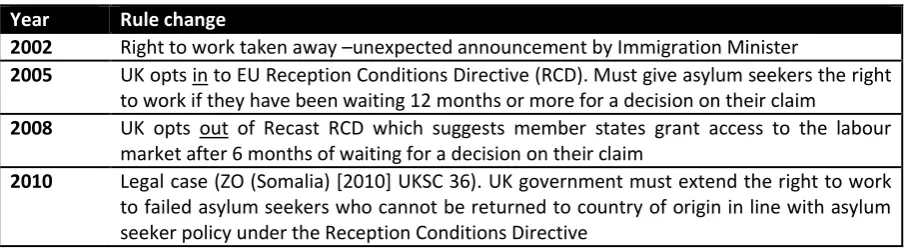
[image:4.595.67.528.637.762.2]Before 2002 it was possible for asylum seekers to apply for the right to work if they had been residing in the UK and awaiting a decision on their claim for 6 months or more. In July 2002 Beverly Hughes MP (Minister for Citizenship, Immigration and Counterterrorism) announced in the House of Commons that asylum seekers would no longer be able to apply for the right to work. However, in 2005 the UK government opted in to a European Union Directive on asylum reception conditions (European Commission 2003) which meant that they were forced to re-extend the right to work. Reluctantly, the UK government allowed asylum seekers to apply for the right to work 12 months following their initial application for asylum, and only if the delay was not seen to be their fault. They opted out of the 2008 Recast EU Reception Conditions Directive as it suggested giving the right to work after 6 months. Further restrictions were introduced in 2010, when it was announced that if granted the right to work, asylum seekers would restricted to jobs on a government shortage occupations list. The introduction of the shortage occupation list rule is linked to a legal case (ZO (Somalia) [2010] UKSC 36) which opened up the right to work to failed asylum seekers, demonstrating the restrictive tendencies of policymakers in this area. A timeline of key legislative changes is provided in Table 1.
Table 1. Timeline of policy changes
Year Rule change
2002 Right to work taken away –unexpected announcement by Immigration Minister
2005 UK opts in to EU Reception Conditions Directive (RCD). Must give asylum seekers the right
to work if they have been waiting 12 months or more for a decision on their claim
2008 UK opts out of Recast RCD which suggests member states grant access to the labour
market after 6 months of waiting for a decision on their claim
2010 Legal case (ZO (Somalia) [2010] UKSC 36). UK government must extend the right to work
4
2010 Home Office announce new rule: asylum seekers (and failed asylum seekers who cannot
be returned) who have waited 12 months for a decision on their claim can only apply for jobs on the shortage occupation list
Because asylum seekers are potentially left destitute without access to employment, under the Human Rights Act 1998 the UK government makes itself liable for the living costs of such individuals. Therefore, asylum seekers receive £36.95 per week for food, clothes and other essentials, and are accommodated on a no choice basis in private housing in a range of cities across the UK (‘dispersal’). The welfare payment is around 50% of job seekers allowance, which is itself set just above the poverty line (so as to disincentivise unemployment), and as such asylum seekers are effectively forced into a situation of poverty and (often long term) unemployment (Bales 2013, 2015). While this policy is clearly undesirable from the point of view of many asylum seekers (Doyle 2009), it nevertheless costs the state a not insignificant amount of money. A freedom of information request submitted as part of the wider project in which this research sits revealed that 2014-15 asylum support cost over £206 million and an additional £27.5 million if support for refused asylum seekers was includedi. Such an administrative burden, on a purely financial basis, does not seem consistent with the government officially pursuing an economic agenda popularly termed ‘austerity’. Furthermore, successive UK governments have gone to great effort to reduce unemployment, reduce welfare dependency, and admonish British citizens who fail to embody the ‘worker citizen’ model (Anderson 2013).
By far the most common reason given for limiting the right to work for asylum seekers is that such a policy would act as a ‘pull factor’ for economic migrants to come to the UK and claim asylum in order to access the labour market (see for example HC Deb, 23 July 2002, c1041W; HL Deb, 17 March 2014, c32). It is said that the UK would, if this policy was pursued, receive a high, and increasing, number of applications for asylum, and that this would slow down the system of assessing applications as caseworkers would be overburdened with unfounded applications. Of 93 texts in the dataset, that contained arguments against extending the right to work, 83 contained this argument. Below are seven examples of this argument being made in different fora. It is worth providing a number of examples to demonstrate the continuity and consistency of the argument across genres and over time. First, an extract from a speech by minister in the Labour government Beverley Hughes in the House of Commons on the day that the policy change was announced in 2002:
I am determined to make it clear that there is a distinct separation between asylum processes and labour migration channels. It is essential that we have a robust asylum process that works effectively and swiftly in the interests of refugees, and also is not open to abuse by those who would seek to come here to work […] Those who are granted refugee status can work immediately, and we welcome the enormous contribution that the skills and knowledge of refugees can make to our society and to our economy. However, our asylum system exists to help those fleeing persecution—those who want to come here to work must do so through the various economic routes available rather than abuse the asylum system (Beverley Hughes, HC Deb, 23 July 2002, c1041W)
5 Until recently, even undetected illegal immigrants had a strong incentive to claim asylum since, once they lodged a claim, they gained access to the benefit system, qualified for the right to work after six months and had immunity from removal while their claims and appeals were being assessed. These incentives have at last been curtailed. The recent reduction in asylum claims may simply mean that fewer illegal immigrants are now bothering to claim asylum (Lilley 2005:4)
Amongst many articles dealing with the topic in the Daily Mail newspaper, in 2006 the newspaper quoted the anti-immigration Migrationwatch-UK campaign group as follows:
Sir Andew Green, chairman of Migrationwatch UK, said: ‘Many of those who turn out to be false claimants work to send money back to relatives so allowing people to work will act as a double incentive for those least likely to be genuine asylum seekers’ (Daily Mail, 19.10.06)
The government’s response to the Joint Committee on Human Rights report on the treatment of asylum seekers (which argued for the right to work to be reintroduced) in 2007 continued to make the argument:
The Government is committed to ensuring that there is a distinct separation between asylum processes and labour migration processes. It is essential to maintain a robust asylum process that works effectively and swiftly in the interests of refugees and is not open to abuse by those who come here to work (Government response to Joint Committee on Human Rights, 2007, HL Paper 134 HC 790, p.14)
In a Home Office Impact Assessment of the policy in 2010 the same argument was made:
The Government believes it is important to maintain a distinction between economic migration and asylum. Allowing asylum seekers and failed asylum seekers permission to work is likely to encourage asylum applications and further submissions from those without a well-founded fear of persecution. This is why asylum seekers are not generally allowed to work […] Giving permission to work to asylum seekers and failed asylum seekers (with further asylum based submissions outstanding) at an earlier stage in the process would be likely to encourage abuse of the asylum system by economic migrants. (Home Office Impact Assessment, 2010)
This was echoed by a Home Office spokesman quoted in the Daily Telegraph in 2013
A Home Office spokesman said: “Opening up the labour market sends out the wrong message to potential asylum seekers, encouraging spurious claims and clogging up the system” (Daily Telegraph, 11.06.13)
In the final example below Conservative Peer Lord Attlee speaks in the House of Lords in 2014, again making the same argument using the same language, 12 years after Beverley Hughes’ original announcement:
6 deter economic migration through the asylum route and therefore properly determine genuine cases (HL Deb, 17 March 2014, c32)
These examples demonstrate the consistency over time and across genres of the argument. It is important to point out, however, that the majority of documents in the dataset where this argument appeared are political fora –the House of Commons, the House of Lords, and various parliamentary committees. Where this argument appears in the media it is in the form of a quote from a Home Office spokesperson, a government minister, or an explanation for why the policy exists which paraphrases these sources (e.g. ‘the government ended the work concession because…’). What this means is that a small number of actors, all associated with the Home Office or UKBA, espoused this argument; actors who were in positions of policy making power.
Economic rights as a pull factor?
In response to the growing salience of the economic pull factor as a policy rationale, there have been numerous studies which have sought to investigate the extent to which this assumption underpinning policy is correct. In this section I use this research to demonstrate the extent to which the pull factor entails simplifications of very complex phenomena to the extent that the policy of limiting asylum seekers’ access to the labour market seems almost entirely unfounded.
The pull factor thesis presents a ‘common sense’ understanding of motivations rooted in rational choice theory. That is, the idea that asylum seekers have a comprehensive knowledge of the rights that they will have in different countries and then make a rational choice on the basis of potential for economic gain. Yet research over the past 20 years has consistently found no significant link between economic rights and asylum destination country (Sitaropulous 2000, Holzer et al. 2002, Robinson and Sergott 2002, Day and White 2002, Castles and Loughna 2003, Thilemann 2004, Hatton 2004, 2009, Neumayer 2005, Middleton 2005, Gilbert and Koser 2006, Brekke and Aarset 2009, Crawley 2010, Keogh 2013, Toshkov 2014, Valenta 2014, Valenta and Thorshaug 2012, 2013, Valenta et al. 2015). The removal of the right to work had no impact on the volume of asylum applications in Zetter et al’s (2003) review of asylum policies across Europe 1990-2000, and the employment pull factor is further challenged by findings that asylum applications do not decrease when unemployment in host countries increases (Neumayer, 2005; Holzer et al., 2002). Asylum seekers have been found to have very little knowledge of their ultimate destination country before arriving, and limited ability to choose where they go (e.g. Brink and Pasariboe 1993, Barsky 1994, Havinga and Böcker 1999, Robinson and Sergott 2002, Gilbert and Koser 2006, Crawley 2010). Havinga and Böcker (1999:53) found, like many others (Robinson and Sergott 2002, Collyer 2003, Gilbert and Koser 2006, Toshkov 2014, Valenta 2014, Valenta and Thorshaug 2012, 2013, Valenta et al. 2015), that ‘the asylum policy and reception of asylum-seekers in the country of destination does not appear to be a dominant factor in explaining the patterns of destination for asylum-seekers’.
7 There was very little evidence that the sample respondents had a detailed knowledge of: UK immigration or asylum procedures; entitlements to benefits in the UK; or the availability of work in the UK. There was even less evidence that the respondents had a comparative knowledge of how these phenomena varied between different European countries (Robinson and Sergott 2002:viii)
In short, it is not possible to speak of one single ‘pull factor’ as the key to understanding forced migration flows and there is insufficient evidence to support the theory that access to the labour market acts as a pull factor for asylum seekers.
The pull factor assumption is an imaginary based upon this set of simplifications rooted in ‘common sense’ assumptions. While it is coherent on its own terms, it is based upon an exercise in complexity reduction which creates an understanding of the policy context which bears little relation to the messy, and extremely complex, phenomenon of forced migration. There is, furthermore, not one example in the database of texts, discussed below, of ministers or spokespeople representing the Home Office referring to evidence to support the pull factor thesis.
Underpinning the pull factor is a further set of simplifications relating to the motivations of asylum seekers, and the context in which they flee their home countries and make an application for asylum in the UK, which are relevant here. The first point to note is that it is well established amongst migration scholars that a complex relationship exists between forced and voluntary migration. Indeed, the Global Commission on International Migration argued in 2005 that ‘notions of “forced” and “voluntary” migration should be conceptualised as occurring on a continuum rather than as dichotomous categories’ (Middleton 2005:2). Within this context, many asylum seekers assume that when they reach a place of safety they will be able to continue with their lives, which is likely to include working. For example Havinga and Böcker (1999) found that economic opportunities are important for single males, though cautioned that ‘this does not imply that these groups are not real refugees or that they did not flee their country out of fear of severe persecution’. In short, economic aspirations and experiences of persecution are intertwined and are not mutually exclusive.
Why might an asylum seeker wish to work? First, research has shown that very few asylum seekers have any experience of a welfare state such as exists in the UK and imagine that they will be able, if not expected, to work and support themselves upon arrival (Robinson and Sergott 2002, Crawley 2010). Second, work is linked to improved self-esteem, improved mental health, and helps to maintain skills that asylum seekers have from their home countries (a high proportion of asylum seekers are highly educated –see Doyle 2009). Third, asylum support rates are very low, which forces asylum seekers to live in situations of poverty, to which working may be a preferable alternative (Sales 2002). In short, it is not possible to make a clear distinction between asylum seekers and economic migrants on the basis of their work related aspirations. This is because many asylum seekers will aspire to work at the same time as having experienced persecution which led them to flee their home country, even though the search for work was not the primary motivation for migrating in the first place. This does not make their application for asylum illegitimate.
8 asylum applicants as either successful, and therefore genuine, or unsuccessful and therefore disingenuous. Many applications are initially rejected (therefore at that point designated as unfounded) and then granted at appeal, thus moving from the unfounded pile to the genuine pile overnight. Even that is a simplification as it may take months or years for the appeal to go through, during which time the applicant’s status as either genuine or otherwise is unclear. Furthermore, since 1996 nine new pieces of primary legislation have been passed which have sought to make it more difficult for asylum applications to be successful. This has included restricting the definition of persecution, introducing safe country lists, and restricting asylum seeker’s access to legal aid, advice, and appeal rights (Squire 2009). What this means is that an applicant who applied for asylum in 2002 and was granted refugee status, might today be found to be ‘bogus’. The applicant need not change but the parameters of the definition of persecution, and the legal and political context mean that the application would be rejected. The binary genuine/bogus assumes that asylum applicants know and understand this changing legal context, know exactly what ‘counts’ as persecution at that moment in time, and are therefore in a position to know whether their application is legitimate or otherwise. If the life experience of the individual, which they may believe to be one in which they were persecuted, does not fit within the parameters of the current definition used by the UK government, it is assumed that persecution did not occur. In short, the genuine/bogus binary is a gross simplification of a very complex set of legal, political, and individual circumstances and processes.
If an application is rejected it is assumed, within this simplified understanding of the issue, that the applicant was disingenuous in making their application and since they did not suffer from persecution they can and should return to their home countries. In reality it is often very difficult to return failed asylum seekers to their countries of origin for a variety of reasons (Crawley et al. 2011). These include the presence of war, a lack of working airports in home countries, the denial of home governments that the would-be deportee is a citizen of their country, an inability to obtain travel documents from countries of origin, and the Home Office stating that it would not be safe for them to return. Again, the image of the bogus asylum seeker as an economic migrant who chose to migrate for work, and to make an application for asylum in the UK as a logical means by which that plan might be actuated, is a gross simplification of the circumstances of many asylum applicants.
In summary, the evidence suggests that economic rights do not act as a pull factor for asylum seekers, and that the binary understandings of forced and voluntary migration, and genuine and ‘bogus’ asylum applicants which underpin it are misguided. The pull factor is one explanation for a set of very complex processes and practices which is based on a highly simplified understanding of those processes and practices. The next section makes sense of the emergence and continued resonance of the pull factor using the concept of the ‘policy imaginary’.
The pull factor as an imaginary
1. Complexity Reduction in CPE
9 well as make decisions, we must therefore focus selectively on some aspects of the world at the same time as excluding others. Jessop suggests that while ‘the real world pre-exists complexity reduction (and is also transformed in some respects in and through complexity reduction), actors/observers have no direct access to that world apart from the sheer activity of the concrete historical situations into which they are “thrown”’ (Jessop 2009:338). The ways in which actors or observers identify ‘aspects’ of the world as significant depends on the meaning systems which they have access to and draw upon (ibid:338). In researching processes of complexity reduction, identifying these meaning systems is therefore important. The pull factor thesis is, I argue, a specific example of complexity reduction in the field of asylum policy making.
A key concept in researching complexity reduction within CPE is ‘imaginaries’ (see Jessop 2009, 2013; Sum and Jessop 2013). An imaginary is ‘a semiotic ensemble (without tightly defined boundaries) that frames individual subjects’ lived experience of an inordinately complex world and/or guides collective calculation about that world’. In other words, it is a way of understanding the world –a meaning system- as deployed in policy contexts. Imaginaries are packages of beliefs, ideas, material circumstances and processes which together form a perspective on a current situation. In moving beyond ideas, then, the concept also moves beyond a narrow focus on narratives. Imaginaries draw upon discourses around the past, the present, and the future. Jessop (2013:235) writes
there are many such imaginaries and they are involved in complex and tangled relations at different sites and scales of action... Without them, individuals cannot ‘go on’ in the world and collective actors (such as organizations) could not relate to their environments, make decisions, or pursue more or less coherent strategies
The ‘imaginaries’ concept enables researchers to link the ways that policymakers envisage future, or current, outcomes, and consequently favour particular policy approaches. However, Sum and Jessop (2013) also see a need for clear distinction between social construal and social construction. Social construals are how we understand a particular social phenomenon or situation. There is infinite potential variation in this but people select and retain particular construals which over time form an imaginary (with material consequences and causal powers) which becomes hegemonic. The pull factor thesis, then, is a specific example of a social construal which has been retained over time. Imaginaries, and their translation into institutions and social practices are, however, contingent. CPE analysis includes the role of extra-semiotic (material) as well as semiotic factors in the contingent emergence (variation), subsequent privileging (selection), and ongoing realisation (retention) of specific discursive and material practices’ (Jessop 2009:340). Variation, selection, and retention of imaginaries is a process which occurs through the ‘dialectic of path-dependency and path-shaping that emerges from the contingent co-evolution of semiotic and extra semiotic processes’ (ibid). This process makes some efforts at complexity reduction more resonant than others.
10 aspects of interactions between policymakers, which close down opportunities for contestation of the pull factor thesis.
Why actors select certain construals and how these lead to social construction is dependent on both semiosis (meanings/understandings/discourses) and factors in the material world (structural and material processes and practices). In CPE, semiosis is only viewed as effective when embedded in material practices, which includes technologies of classification, registration, and calculation, which discipline social action. Technologies play a central role in the selection and retention of specific imaginaries in that they ‘provide reference points not only in meaning making but also in the coordination of actions within and across specific personal interactions, organisations and networks, and institutional orders’ (Jessop 2009:339). Technologies include policy decision techniques and policy evaluation. There is a well-established system for managing and disciplining asylum seekers, as well as measuring the asylum system in various ways, such as monitoring the numbers of applications and success/failure rates. This system is central to the continued legitimacy of the pull factor thesis. I discuss this further in the next section
2. The pull factor as an imaginary
Politics is about practical argumentation (Fairclough 2016). Civil servants and politicians are concerned with taking practical action to address a problem that they perceive to exist. However, often politicians are in fact involved in, or committed to, more theoretical arguments at the same time as arguing for policy actions. These might be about potential futures or potential policy outcomes. In this case the aim of the policy is purportedly to solve a practical policy problem around false asylum applications being made (that is, it is framed as such) when in fact the problem – migrants being ‘pulled’ by the economic rights available in a given country- is theoretical. It is theoretical because the claim is not backed up by empirical evidence. The process by which an imaginary comes to be framed as a practical policy problem that is best solved by curtailing asylum seekers’ rights to work is the focus of this section.
As stated earlier, there are three distinct moments in the life of the imaginary. The moment of variation (emergence), that of selection, and then a longer phase of retention. The first two represent moments when a particular construal emerged from a range of possible explanations as the most salient understanding of the policy context, and it’s selection privileged a particular understanding of the ‘problem’ which suggested a constrained set of solutions. How, and why, the imaginary has been retained is then a separate, but linked, issue. Both discourses and material practices, as well as structural factors were involved in the contingent emergence, selection, and retention of the imaginary. The analysis of the policy imaginary identified through coding the database of texts is therefore structured around these moments of variation, selection and retention. But because CPE calls for an analysis which reaches beyond the discursive, the analysis also looks at extra-discursive (material, institutional, technological) factors in enabling the selection and retention of the imaginary.
Variation and selection
11 applications for asylum was a consequence of world events, including the Iraq war and military intervention in Afghanistan, which the UK government was involved in, there was a general perception amongst politicians, the media and the general public that the system was out of control (Squire 2009). Under-resourced to respond to an increase in applications, the government department responsible for assessing them in the UK was unable to cope and waiting times for a decision on an asylum claim increased. This situation became known as ‘the backlog’ and the perception that the system was out of control, and that numbers of asylum seekers were unprecedented and unmanageable was articulated as the swamping of the country by hordes of migrants (Gabrielatos and Baker 2008). Those migrants were themselves increasingly described as ‘bogus’ as it was assumed that such a high number of people could not have been genuinely persecuted.
It was at this moment that the pull factor imaginary was selected from amongst the variety of analyses on offer. If many asylum applicants were not ‘genuine refugees’ then they must be coming to the UK for other reasons. As rational utility maximising actors they must be coming to work. This conceptualisation of the problem entailed a number of simplifications which reduced the complexity of the issue to a series of easily understood ‘common sense’ interpretations. Across the texts within the dataset the asylum system was thus represented around 2002 as a machine: either one which works well so long as it is protected from abuse (as argued by the ministers responsible for the system), or inefficient, slow, chaotic and therefore subject to abuse (as argued by their detractors). Where it is efficient it is so efficient that giving asylum seekers the right to work is unnecessary. In order to maintain this efficiency it is necessary to introduce limitations on labour market access to curtail current widespread abuse and therefore presumably increase efficiency even further. Either way, ‘the system’ is an entity that is under constant threat of abuse, and therefore requires protection.
Throughout the 2002-2015 period covered in the dataset asylum applicants are therefore overwhelmingly represented as abusers of the asylum system. However, conceding that there are indeed ‘genuine’ refugees in the world, asylum seekers are represented in two ways: as either genuine refugees who have been persecuted and only want or need protection (not employment); or as economic migrants who are posing as refugees in order to obtain the legal right to work in the UK. As ‘abusers’ are the policy problem for which solutions are sought (as opposed to the existence of refugees, and therefore contexts of persecution in countries of origin targeted), this is the primary representation of asylum applicants (e.g. Select Committee on Home Affairs Minutes of Evidence, 11th September 2003, HC 1088-i). Within this representation of the situation it is very difficult to tell who is genuine and who is ‘bogus’ without going through the asylum process. Therefore, much work would be saved if the number of economic migrants applying for asylum could be reduced. This makes disincentivising asylum applications (amongst those looking for work, who are not refugees) appear to be a logical solution.
12 and early 2000s as a problem. If only a problem for administrators, these asylum seekers were nevertheless a problem. We therefore find in the 2002-2015 period a sustained interest in numbers –of applications, of recognition rates, of deportations- as both a measure for policy success; even where the policy focuses on extremely complex phenomena, and is intended to tackle non-quantifiable factors such as ‘motivations’.
Importantly, there were both discursive factors at play in the selection of the pull factor imaginary, and extra discursive factors. These extra discursive factors included the existence of multiple large scale refugee producing situations, the expansion of mass international air travel, and an under resourced processing system. In this sense, the imaginary identified within the database of texts emerged in response to a set of real-world phenomena, and yet the interpretation of the implications, and policy responses to those phenomena, was based on one, simplified, discursive framing of it –the pull factor thesis. The undesirability of this contemporary cohort of asylum seekers is likely deeply rooted in ideas of civilizational incommensurability and differential humanity which are legacies of colonialism, though official discourses are of course carefully deracialized (see Author, forthcoming).
The structural context for the selection of the imaginary in the UK is also important. Within the imaginary, migrants are either asylum applicants (who have no interest in working) or economic migrants (whose focus is working). The two categories are mutually exclusive and consequently work becomes something only of interest and/or relevance to economic migrants. The extent to which this separation has been operationalised is related to the institutional organisation of migration management within the UK government. Asylum seekers are legally distinct from all other categories of migrant, and there are limits (in relation to the 1951 Geneva Convention on the Status of Refugees) to the control that states have over them. Once in the UK, they must be permitted to make an application for asylum and that application must be properly assessed. The control of other groups of migrants is up to the discretion of nation states, and those who enter the UK without the permission of the state can legally be deported without having to go through any additional process. Despite being legally distinct, institutional responsibility for policy making on all forms of migration is held within one government department, the Home Office. There is therefore a need to create a clear and coherent migration policy regime across all types of migration and within the context of widespread hostility to migration and a perception that it is out of control, as described above. The distinction between economic migration and asylum seeking (and thus their associated economic rights, including labour market access) is therefore in part a function of the institutional and legal context in which policy is made, and it logically leads to the instituting of rules which separate the economic rights of asylum seekers from other migrants. This institutional context in part explains the selection of the imaginary.
13 Retention
How, then, was it that the imaginary was retained, even when there was no evidence to support it, and a large body of evidence, described earlier in the paper, challenging the simplifications that it was based upon? First, because the simplified understanding of the issue, the policy imaginary, continued to be espoused. Second, because the institutional framework from which it emerged, which promoted a distinct separation between working and asylum, remained. Third, because the continued use of technologies to measure asylum applications showed that applications were decreasing. While there were a variety of reasons for the decrease, not least the introduction of policies which aimed to prevent asylum seekers arriving in the UK, such as carrier sanctions, the policy was not shown to have failed. A more complex reading of government data suggests that, since the proportion of successful applications did not reach high levels (as it would if bogus applicants were discouraged from applying), strictly limiting labour market access was not having the desired effect. Nevertheless, the simplified understanding of the issue continued to be espoused, it was politically salient, and easy to understand. Finally, those affected were not a part of the electorate, decreasing the incentive to expand their rights.
Retention is similar to sedimentation - ‘all forms of routinisation that lead, inter alia, to forgetting the contested origins of discourses, practices, processes, and structures. This gives them the form of objective facts of life, especially in the social world’ (Sum and Jessop 2013:163). The denial of most asylum seekers access to the labour market has, then, become sedimented. Between 2008 and 2010 there was a large scale third sector and trade union campaign to extend the rights of asylum seekers to work. Consequently, public discussion of the issue increased and there is accordingly a spike in the number of texts in the database around this period. By this time, though the pull factor still had not been proven, it had taken on the status of ‘known fact’. That is, Home Office spokespeople and government ministers repeated in interviews, in statements, in parliamentary debates, the fact that the right to work acts as a pull factor for would be asylum seekers, which is the sole reason required to limit it. While various actors and organisations sought to politicise and re-politicise the issue (author 2016), countering with other knowledge claims, none have yet been successful. None have yet successfully dismantled the logic of the pull factor imaginary.
Conclusion
Policymaking necessitates complexity reduction in the interest of undertaking practical interventions in the social world. While this is an essential part of governance, complexity reduction can, in some circumstances, lead to deeply flawed policy rationales being adopted and acted upon. Complexity reduction, then, is key to understanding how it is that policymakers might pursue policy programmes which directly contradict the available evidence on a particular issue. One approach to making sense of these irrationalities in the policymaking process is to label simplifications ‘stories’ or narratives’ (Roe 1994, Boswell et al. 2011) and this has been the most common approach taken in studies of the politics of immigration. However, in focusing primarily on the discursive, these approaches cannot fully take account of the wider structures which make the adoption of a narrative so widespread that it becomes hegemonic and thus comes to exert causal powers. A more satisfactory approach is to understand the narrative as part of a policy imaginary which is emergent of semiotic and extra-semiotic phenomena, as advocated by cultural political economists.
14 imaginary. Not only is there no evidence to support the pull factor thesis, there is also a large body of evidence which refutes it, some produced by the government department responsible for this policy area, the Home Office. The article has presented analysis of a database of 449 texts which cover the issue of asylum seekers and the right to work in public and political fora 2002-2015. This analysis identified the dominance of the pull factor thesis amongst policymakers and yet a review of existing research reveals that this thesis is unevidenced. In explaining the sedimentation of this problematic imaginary I turned to cultural political economy, a synthesis of critical semiotic analysis and critical political economy which situates discourses in relation to extra-discursive (material, institutional, technological) factors.
Both the dominance and the inaccuracy of the pull factor thesis is widely acknowledged amongst scholars who research asylum and yet none have yet presented a systematic analysis which seeks to explain this contradiction. This paper fills this gap in the literature and in that sense it speaks to asylum and refugee studies scholars. However, more broadly, this policy area is ideal for exploring the utility of the CPE framework developed by Suma and Jessop in making sense of the troubled relationship between policymaking on complex phenomena, sedimented ideas, and evidence. What it offers is a means to understand the significance of simplified stories and the contexts from which they emerge. It is a way of nesting narratives within a broader framework which can account for not only the semiotic aspects of meaning making (narratives) but also broader material aspects such as institutional arrangements, technologies, and international political contexts. In short, a means of understanding how what politicians say fits into the cultural-political-economic contexts in which they work.
References
Anderson, B. (2013). Us and Them? The Dangerous Politics of Immigration Control. Oxford, Oxford University Press.
Bales, K. (2013). "Universal Credit: not so universal? Deconstructing the impact of the asylum support system." Journal of Social Welfare and Family Law 35(4):427-443.
Bales, K. (2015) The essential living needs of asylum seekers: Lessons learned from R (Refugee Action) v Secretary of State for the Home Department [2014] EWHC 1033, Journal of Social Welfare and Family Law, 37(2):247-249
Barsky, R. F. (1994). "Why Canada? Why Québec?": assessing the convention refugee's choice of Québec and Canada as host country in 1992. unpublished intermediary report.
Bleich, E. (2002). "Integrating Ideas into Policy-Making Analysis Frames and Race Policies in Britain and France." Comparative Political Studies 35(9):1054-1076.
Boswell, C., A. Geddes and P. Scholten (2011). "The role of narratives in migration policy making: A research framework." British Journal of Politics and International Relations 13(1):1-11.
15 Brink, M. and M. Pasariboe (1993). Asylum Seekers in the Netherlands. Amsterdam, Instituutvoor Sociale Geografie, Universityof Amsterdam.
Castles, S. Loughna, S. (2003) Trends in Asylum Migration to Industrialized Countries: 1990-2001, United Nations University Discussion Paper, No. 2003/31
Collyer, M. (2003). Explaining Change in Established Migration Systems: the Movement of Algerians to France and the UK, Sussex Migration Working Paper No.16
Crawley, H. (2010). Chance or Choice? Understanding why Asylum Seekers Come to the UK. London, Refugee Council.
Crawley, H., J. Hemmings and N. Price (2011). Coping with Destitution: Survival and Livelihood Strategies of Refused Asylum Seekers Living in the UK. Oxford: Oxfam.
Day, K. White, P. (2002) Choice or circumstance: The UK as the location of asylum applications by Bosnian and Somali refugees, GeoJournal, 56(1): 15–26.
Doyle, L. (2009). “I hate being idle” Wasted skills and enforced dependence among Zimbabwean asylum seekers in the UK. London.
Fairclough, I. (2016). Evaluating policy as practical argument: the public debate over the first UK Austerity Budget. Critical Discourse Studies, 13(1):57-77
Gabrielatos, C. and P. Baker (2008). Fleeing, Sneaking, Flooding: A Corpus Analysis of Discursive Constructions of Refugees and Asylum Seekers in the UK Press, 1996-2005. Journal of English Linguistics 36(1):5-38.
Gilbert, A. and K. Koser (2006). Coming to the UK: what do asylum seekers know about the UK before arrival? Journal of Ethnic and Migration Studies 32(7): 1209-1225.
Hatton, T. J. (2004) Seeking Asylum in Europe: Trends and policies in the OECD, Economic Policy, 38: 5–62.
Hatton, T.J. (2009) The Rise and Fall of Asylum: What Happened and Why? The Economic Journal, 119(535):183-213
Havinga, T. and A. Böcker (1999). Country of asylum by choice or by chance. Journal of Ethnic and Migration Studies 25(1): 43-61.
Holzer, T., Schneider, G., Widmer, T. (2000) The Impact of Legislative Deterrence Measures on the Number of Asylum Seekers in Switzerland (1986-1995), International Migration Review, 34(4):1182– 216.
Keogh, G. (2013) Modelling asylum migration pull-force factors in the EU-15, The Economic and Social Review, 44(3): 371–399.
Jessop, B. (2009). Cultural Political Economy and Critical Policy Studies. Critical Policy Studies 3(3-4): 336-356.
16 Lilley, P. (2005). Too much of a good thing? Towards a balanced approach to immigration. Surrey, Centre for Policy Studies.
Middleton, D. (2005). Why asylum seekers seek refuge in particular destination countries. Global Migration Perspectives Working Paper 34. Geneva, GCIM.
Neumayer, E. (2005) Bogus refugees? The determinants of asylum migration to western Europe, International Studies Quarterly, 49(3):389–409.
Robinson, V. and J. Sergott (2002). Understanding the decision making of asylum seekers, Home Office Research Study 243. London, Home Office.
Roe, E. (1994). Narrative Policy Analysis: Theory and Practice. Durham, NC, Duke University Press.
Sales, R. (2002). "The deserving and the undeserving? Refugees, asylum seekers and welfare in Britain." Critical Social Policy 22(3): 456-478.
Sitaropoulos, N. (2000) Modern Greek Asylum Policy and Practice in the Context of the Relevant European Developments, Journal of Refugee Studies, 13(1):105-17.
Squire, V. (2009). The Exclusionary Politics of Asylum. Basingstoke, Palgrave Macmillan.
Sum, N.-L. and B. Jessop (2013). Towards a Cultural Political Economy. Cheltenham, Edward Elgar.
Thielemann, E.R. (2003) Does policy matter? On Governments attempts to control unwanted migration, IIIS Discussion Paper 9, Dublin: Institute for Internal Integration Studies
Toshkov, D. (2014) The dynamic relationship between asylum applications and recognition rates in Europe (1987–2010). European Union Politics, 15(2): 192–214.
UKBA (2012). UK Border Agency Annual Report and Accounts 2011-12, HC 344. London, The Stationery Office.
UKBA (2013). Tier 2 Shortage Occupation List.
www.ukba.homeoffice.gov.uk/sitecontent/documents/workingintheuk/shortageoccupationlistnov1 1.pdf, accessed 25/10/13.
Valenta, M. (2014) The Nexus of Asylum Seeker Migrations and Asylum Policy: Longitudinal Analysis of Migration Trends in Norway, International Journal on Minority and Group Rights, 21:371-394
Valenta, M. Thorshaug, K. (2012) Asylum seekers’ perspectives on work and proof of identity: the Norwegian experience, Refugee Survey Quarterly, 31(2):76–97
Valenta, M. Thorshaug, K. (2013) Restrictions on right to work for asylum seekers: the case of the Scandinavian countries, Great Britain, and the Netherlands, International Journal on Minority and Group Rights, 20(3):459–482
Valenta, M. Zuparic-Iljic, D. Vidovic, T. (2015) The Reluctant Asylum-Seekers: Migrants at the
Southeastern Frontiers of the European Migration System, Refugee Survey Quarterly, 34 (3): 95-113
17 Zetter, R., Griffiths, D., Ferretti, S. Pearl, M. (2003). An assessment of the impact of asylum policies in Europe, 1990–2000, Home Office Online Report No. 17/03, London, Home Office
ZO (Somalia) and others: (Respondents) v Secretary of State for the Home Department (2010) UKSC 36
i FOI Ref. 38465, available at: