http://wrap.warwick.ac.uk
Original citation:
White, Leroy, Burger, Katharina and Yearworth, Mike. (2015) Understanding behaviour in problem structuring methods interventions with activity theory. European Journal of Operational Research .doi:10.1016/j.ejor.2015.07.044
Permanent WRAP url:
http://wrap.warwick.ac.uk/70997
Copyright and reuse:
The Warwick Research Archive Portal (WRAP) makes this work by researchers of the University of Warwick available open access under the following conditions. Copyright © and all moral rights to the version of the paper presented here belong to the individual author(s) and/or other copyright owners. To the extent reasonable and practicable the material made available in WRAP has been checked for eligibility before being made available.
Copies of full items can be used for personal research or study, educational, or not-for-profit purposes without prior permission or charge. Provided that the authors, title and full bibliographic details are credited, a hyperlink and/or URL is given for the original metadata page and the content is not changed in any way.
Publisher’s statement:
© 2015, Elsevier. Licensed under the Creative Commons Attribution-NonCommercial-NoDerivatives 4.0 International http://creativecommons.org/licenses/by-nc-nd/4.0/
A note on versions:
The version presented here may differ from the published version or, version of record, if you wish to cite this item you are advised to consult the publisher’s version. Please see the ‘permanent WRAP url’ above for details on accessing the published version and note that access may require a subscription.
ACCEPTED MANUSCRIPT
1 Highlights
Paper presents a conceptual framework and methodological guide for researching and
understanding OR interventions.
The paper outlines the main theoretical and methodological concerns that need to be appreciated in studying PSM interventions.
The paper explores activity theory as an approach to study them.
ACCEPTED MANUSCRIPT
2 Understanding behaviour in problem structuring methods interventions with Activity
Theory
Leroy White1, Katharina Burger, Mike Yearworth
Leroy White, Warwick Business School, University of Warwick, Coventry CV4 7AL, [email protected]
Katharina Burger, Faculty of Engineering, University of Bristol, BS8 1TN, [email protected]
Mike Yearworth, Faculty of Engineering, University of Bristol, [email protected]
Abstract
This article argues that OR interventions, particularly problem structuring methods (PSM),
are complex events that cannot be understood by conventional methods alone. In this
paper an alternative approach is introduced, where the units of analysis are the activity
systems constituted by and constitutive of PSM interventions. The paper outlines the main
theoretical and methodological concerns that need to be appreciated in studying PSM
interventions. The paper then explores activity theory as an approach to study them. A case
study describing the use of this approach is provided.
Keywords: Problem structuring methods; Behavioural OR; Activity theory; Collective
intentionality
1
Corresponding author Leroy White, Warwick Business School, University of Warwick. Email:
ACCEPTED MANUSCRIPT
3 INTRODUCTION
Organizations and organizing are increasingly accomplished through the complex interaction
of people, artefacts, instruments and practices (Clegg et al., 2002). Operational Research
(OR) interventions are exemplary in this regard, but there is a gap in our knowledge in
understanding the effect on people/outcomes, and the interventions in situ (Keys, 1997; Hämäläinen et al., 2013). In particular, there has been a dearth of strong theoretical and empirical studies on understanding OR interventions in the literature. Recently, however,
there has been some attention on studying the effectiveness of OR interventions from
social-constructivist and socio-material process perspectives (Franco, 2013; Keys, 1995;
White, 2009, 2006), leading to important agendas regarding theory, behaviour and
outcomes pertaining to (particularly soft) OR processes. We note that these studies have
recognized that interventions are both temporally enacted affairs and concerned with
becoming coordinated practices through the performance of using models as objects, but
the studies are not adequate in developing the notion of behaviour in interventions.
Therefore, some significant methodological and epistemological challenges remain (Connell,
2001; Eden, 1995; Packer and Goioechea, 2000; White, 2009, 2006).
We address the above challenges in the following ways. First, we build on recent interest
in behaviour and OR, and in particular the interest in the concept of collective behaviour as
a means for understanding how individuals working together perform effectively as an
ensemble through the mediating role of models. Second, we introduce and explore the use
of activity theory (AT) as one means to study interventions as complex interactions of
people, objects, artefacts, and instruments in context. Specifically, our socio-material
perspective differs from other approaches in that it introduces a view on the power
dynamics in the unit of analysis of an activity system, which we believe helps to differentiate
it from other methodologies.
Finally, we take as our example a case study of the participatory planning of smart city
interventions for energy efficient city district redevelopment. Here we offer a focus on the
level of proof, where many scholars of OR will agree that the nature of the link between OR
processes, behaviour and outcomes has yet to be definitively established. Specifically, since
ACCEPTED MANUSCRIPT
4 problems (Rittel and Weber, 1973) it becomes necessary to devise systematic techniques to
ensure an adequate test of the efficacy of the approaches. We draw on an in-depth method
using ethnomethodological techniques, including video analysis, to study the
micro-processes of how the intervention under study was developing and used among the
stakeholders involved (Paroutis et al, 2015; Heath, 1997).
Overall, we test the idea that OR interventions create the conditions for collective
behaviour. In doing so, we contribute to the literature on understanding behaviour in OR
processes, by employing the concepts from AT to explain the complex outcomes of
(collective) OR processes, namely social learning.
THEORETICAL AND METHODOLOGICAL CONCERNS
As with all soft OR methods, the practice of building representations of the problem is
conducted in a group, where the process is consultative and iterative. Behaviourally, the
process provides a succession of models providing different perspectives, which contribute
to a deepening understanding of the problem as new insight emerges. Also, the process
uses the sense of unease among the problem owners about the present representation of
the problem as a signal that further modelling may be needed. The question is: how can this
practice (the relation between process, model and outcomes) be understood?
The study of OR interventions has taken many forms in recent years, including at the
theoretical level focusing on the “Process of OR” through the lens of critical realism,
constructivism and pragmatism (see Keys, 1995; Mingers, 2000; Ormerod, 2006; Taket and
White, 2000a; White, 2006, to name but a few), and at the practical level through concerns
for organizational learning (Sterman, 1989), shared mental models (Kunc and Morecroft,
2008), and more recently behavioural research (Hämäläinen et al., 2013). Such studies
variously emphasize the complexity of OR methods and the significance of doing as well as of deciding, the social processes through which concepts and actions are negotiated, and the creative ways in which people use even the most abstract models and representations.
However, few studies have tackled the foundational ideas underlying these processes
directly (White, 2014), leaving the concept as largely metaphorical (Ackermann and Eden,
2011). The current work reviews some of the debates around the conceptual components of
ACCEPTED MANUSCRIPT
5 At a broader level, in organisational studies, most theories of interventions assume that
individual and organizational behaviour is logical, goal seeking and self-interested (Powell
and Di Maggio, 2012). However, in studies on soft OR interventions it is not difficult to show
that neither individuals nor organisations are likely to act in such a way very often. Yet the
expectation is for interventions to be intendedly rational and there is pressure for the
stakeholders to act in a prospectively rational manner particularly where performance is
visible and easily monitored. In contrast, there have been few attempts to articulate
alternative views; the task is not simply an intellectual challenge but a practical one.
Phillips (1984) was one of the first to conceive of an alternative orientation for OR
interventions. He introduced the term “requisite models” to distinguish a form of
representation from descriptive, normative, optimal or satisficing modelling. He claimed
that a model is requisite when “it is a representation of the problem deemed sufficiently adequate by the decision makers to provide them with a useful guide to thinking about the problem” (Phillips, 1982). In this way, requisite models do not prescribe action, - they are a guide to action, where action is a collective activity aiming at systems level improvement.
This idea has been important in a number of OR studies, for example, (Franco and
Montibeller, 2010) state that “A consequence of considering a model as a facilitative learning mechanism is the challenge of assessing what constitutes a valid model and a good model solution. Probably the best answer to this issue is to employ the concept of building a requisite model (Phillips, 1984): one that contains sufficient knowledge and information to help the client group find a way forward”.
Phillips’s (1984) argument for requisite models (and to focus on collective behaviour) was
to counter the then in vogue research on judgement and decision making drawing on the
classic work of behavioural economics (Hogarth, 1981, Simon, 1955 Kahneman and Tversky,
1984). The basis of their work is not that people have no idea how to take some decisions,
but that they think they know, but are wrong by the conventional standards of rationality. The usual response is; if they are to do better, they first have to see the error of their ways.
Indeed, many behavioural scholars think that the appropriate thing to do is to guide people
in the direction they would want to bind themselves after taking expert advice. Thus,
ACCEPTED MANUSCRIPT
6 bounded self-control, experts should attempt to nudge people's choices in certain directions
without eliminating freedom of choice (Sunstein and Thaler, 2003).
Other scholars have been critical of Kahneman and Tversky’s work, including Gigerenzer
(2006), who suggested that most behavioural research rather than focusing on “plausible heuristics that explain everything and nothing—not even the conditions that trigger one heuristic rather than another” (Gigerenzer, 1996), should be focusing on developing models that reveal mental processes that explain judgement. Similarly, Phillips claimed that the
work of classical behavioural economics not only sees people as limited and biased in their
judgements, but the research itself is limited and biased in its presumption that what people
do is all that they can do. He argues that in the processes that search for requisite models, it
is assumed that people are capable of constructing futures that deal adequately with
uncertainty, risk and the complexity they face. Phillip’s view is to focus on a more positive
interpretation of behaviour that aims to meet the challenge of finding the conditions in
which people can be “intellectual athletes rather than intellectual cripples”, i.e. to create a notion of behaviour in OR on what people can do; and to encourage a “science of better” if you will (Mingers, 2007).
The idea that OR methods can mediate positive behaviour within groups is not a new
idea. This has been acknowledged to some degree, for example by (Ackermann, 2012) who
suggested that models in soft OR represent a facilitative device. Also, (Montibeller and
Franco, 2007) discuss models as boundary objects. However, these are examples of a loose
coupling of models and the actual situation, and therefore it is difficult to infer any theory of
behaviour through representation.
In a further refinement, Franco (2013) applied the concept of boundary objects (based on Nonaka and Takeuchi (1995)) to facilitate the micro-level study of the dynamics in OR
interventions. He suggested that the notion of cognitive affordances, based on the
ecological psychology of Gibson (1979), may be useful for understanding the role of models
in collective soft OR interventions (Franco, 2013). The idea is that the use of models that
instantiate thought through systems of representation (e.g. Menary, 2006) may
supply certain enduring material aspects which may play a special role in enabling the
system to possess a given mental state (Clark, 2008). Franco discusses model affordances
ACCEPTED MANUSCRIPT
7 limitations. First, given the focus on stakeholder engagement (Eden and Ackermann, 2013),
the study could not adequately address the issues of power and contradiction (see Nicolini
et al., 2012). Second, Franco’s study while connecting the idea of boundary objects to
learning, did not explore this at the collective level. When in fact Gibson sought to extend
his ecological theory of affordances to the societal realm, he emphasised the need to reflect
on collective behaviour: “Social learning is inevitably moral, in an elementary sense of the term, and it is probably a mistake first to construct a behaviour theory without reference to social interaction, and then attach it only at the end “(Gibson 1950, p.155). This is why we suggest that the concept of reflections on OR interventions requires an embedding in a
theory and method that extends and enables a more reflexive attitude in order that power
and collective behaviour can be explored.
In dealing with these limitations, the analytical interest thus could turn towards the staging and orchestrating of problem structuring interventions that makes accountable, authoritative decision-making on behalf of clients and prospective users possible (Goodman, 2013). This line of inquiry may serve to encourage the interrogation of various ‘representatives’ and ‘representations’ in, of, and around OR practice (White, 2009). Could
this lead to a possible distinctive behavioural issue around representation as mediating the
form and content of an intervention? There could also be a focus on political
representation that seeks to establish whether the system of representation has conferred
agency to the represented, i.e. whether the representation process has distributed agency
throughout a system. In this way, the political sense of ‘representation’—as the delegation
of authority to speak and act on behalf of others (Latour, 1987; Taket and White, 2000b;
White and Taket, 2000) is taken to be merged with a semiotic conception of a sign
‘speaking’ on behalf of its object (see Taket and White, 1994).
Models as semiotic resources form an increasingly important part of our understanding
of the process, reflecting what some have termed the emergence of a problem structuring
culture (Eden and Ackermann, 2013; Ackermann, 2012). This has also been referred to as
the material agency of models and is an important part of the performativity of problem
structuring processes (Franco, 2013; White, 2006) and provides coordination of
interventions, often without those upon whom they are taking effect being knowledgeable
ACCEPTED MANUSCRIPT
8 behaviours more likely than others (Kaptelinin, 1996). Given the attention on models and
modelling in the soft OR community, in developing a theoretical lens for the behavioural
study of OR interventions, a strong analytical approach to objects and artefacts, such as
‘documents, spaces, tools, and bodies that intervene in the production of identities, responsibilities, and capacities of project constituents’ (Goodman, 2013) would thus be desirable.
Actor-network theory (ANT), an approach developed by Callon, Latour and Law, within
social studies of science has been extensively drawn on in the study of complex situations
(Callon, 1996; Latour, 1992; Law, 1992). It takes as its primary focus the relationship
between natural entities and social actors and seeks to recast our understanding of this
relationship within a new epistemology. ANT considers both people and technologies as
enacted through networks, in particular in terms of what people and things become as a
result of their position in a network, and the power that emerges (Callon, 1986; Latour,
1992). Actor-networks are often highly dynamic and inherently unstable. They can be
stabilised to some extent when people, technologies, roles, routines, and so on are aligned.
This alignment is achieved through ‘translation’ (Latour, 1992). Actor-networks are
heterogeneous and organically evolving open systems, and inscription devices (for example,
models) may help to stabilise the network and thus shape and constrain the network.
Researchers have used ANT to describe the engagement of groups of actors who have
sought to define and inscribe particular codes and standards into particular technologies,
and shown how once these have become part of the network, they are hard to reverse.
Following the arguments from Keys (1995), it is no surprise to find that some scholars of
OR have been drawn to ANT as an example of socio-material analysis of interventions. ANT
recommends that we locate interventions in a heterogeneous network of humans and
non-humans actors (Latour, 1987; 1992) and it is the observable patterns of mutual interaction
between actors that constitute the phenomena that Latour directs us to study. In response
to the network building concept of Latour and his concept of immutable mobiles, Star &
Griesemer (1989) proposed more mutable ‘boundary objects’ that facilitate translation
efforts amongst different viewpoints and agendas in collective work. This has been taken up
ACCEPTED MANUSCRIPT
9 consensus makes boundary objects attractive for the study of work across heterogeneous
organisations.
Research incorporating ANT and boundary objects understands that interventions are not
fixed, determining, or a mediating platform through which people interact and complete
tasks, but are dynamic and entangled assemblages of the social and the technical,
continually produced in practice (Orlikowski, 2005). These lenses offer analytical traction in
viewing interventions with less focus on whether or how we use models to produce certain
outcomes, and more on how stakeholders and models are interrelated in practice to
produce (more or less) stable outcomes with certain effects in the world.
A criticism of ANT is that it has a ‘flat ontology’. ANT holds that there are no pre-existing
layers (such as ‘structure’ and ‘agency’). By refusing more conceptually differentiated and
refined analyses of institutional sources of power and inequality, ANT appears to have little
to say about the systematic exclusion that prevents some social groups from having a voice
in the design and use of technologies. Another criticism is ANT’s assumption of ‘symmetry’
between humans and things. Assigning humans a comparable agentic status to technologies
has led to concerns that human motives, desires and virtues could be beyond the analytic
frame and that ethical questions may be evaded (Mutch, 2002). Yet, ANT’s emphasis on the
dynamic and relational aspects of an intervention is a useful lens for studying change and
the unintended outcomes of interventions – including the complex and unpredictable
interventions that are known to OR interventions (Keys, 1995; White, 2009). Thus, whilst
ANT can help map the network and consider certain aspects of how power flows within it, it
may not be the most suitable lens to answer micro-causal questions such as why – that is,
through whose agency and enabled and constrained by which social structures – did the
phenomenon in question emerge? For researchers who seek to answer such questions, ANT
may provide conceptual tools and inspiration, but not without providing a theory of either
human agency or the generative causality of social structures.
These important and recognized boundaries of the ANT and boundary object
perspectives are important to address, especially, given the interest in generative behaviour
in OR interventions. A central concern needs to be how relations of power are
ACCEPTED MANUSCRIPT
10 1992, p.441). Whilst it is recognized that none of the abovementioned perspectives provides
conclusive suggestions for the treatment of power (Law 2009; Star & Griesemer 1989: 413;
Kontinen, 2013), we introduce AT here that foregrounds a socio-cultural analysis of human
activity and the analysis of micro-level political dynamics in workshop settings. AT draws
attention to culturally and historically derived constructs such as rules, divison of labour and
community which are dynamically related in the unit of analysis, the activity system, with
the subject, the mediating artefacts and the activity object. Furthermore, in AT
“activity and the overlapping systems of activity are viewed as sites of domination, accommodation and resistance, as well as struggle […]. The notion of dialectical contradictions is central to [AT] and individual perspectives and interests are constantly at play in negotiating these contradictions”. (Fenwick et al., 2015, p.12)
In these features, it can be argued, that AT may retain a more humanist orientation than
ANT (Fenwick et al., 2015, p.12). AT’s emphasis on the generative (creative and voluntary)
potential of human actors to develop problem resolution approaches is also evidenced “in the clear delineation of non-human artefacts as bounded, distinct from humans, and while embedded in cultural histories, releated to the notion of mediating human activity” (Fenwick, 2010). As such, to attend to the dynamics of PSM interventions, our theoretical
approach draws on AT. We introduce AT as a novel way1 of understanding representing and
intervening through PSMs. Our use of AT is that primarily framed within the Scandinavian AT
strand, developed by Engeström and colleagues (see (Engeström, 1987)). It enables the
analysis of processes of knowledge co-creation (Blackler, 1995) and it is thus a powerful lens
through which we can analyse most forms of human activity, including OR interventions.
With its background in psychology, AT also provides an adequate theoretical lens to
conceptualise behaviour, particularly, intentionality and reflexivity, i.e. the “intermediate institutional anatomy of each central actant” and “the historically accumulated durability, the interactive dynamics and the inner contradictions of local activity systems” (Engeström, 2005a, p.55; Kaptelinin and Nardi, 2006). The goal of AT then is to understand the mental
capabilities of actors and to analyse the cultural and technical aspects of human actions. AT
also tries to trace the causes for problems in an activity system by exploring the
1 AT has been previously instrumentalised in a ‘soft dialectics’ approach combining SSM and AT
(Bratteteig and Øgrim, 1994), however without taking an enactment view on workshop activity (process)
ACCEPTED MANUSCRIPT
11 contradicting/problematic relations between the elements in an activity system and the
influence of these contradictions on the results of activity (outcome). The insights it
provides into an activity, the role it ascribes to active participation, and the significance it
attributes to incoherency and dilemma provide the basis for a framework for understanding
OR interventions and behaviour.
In the following, we further develop our theoretical perspective by first discussing the
aspect of AT relevant to our research problem. We subsequently build our approach to
studying OR interventions by focusing on how collective or social learning is enacted in the
on-going processes and use of models as artefacts. We extend this aspect of AT to study
behaviour in OR interventions by focusing on intentionality. In particular we draw on
insights into collective intentionality.
ACTIVITY THEORY
The central concerns of AT are the relationships between material action, mind and society;
the approach explores links between thought, behaviour, individual actions and collective
practices. Thus, AT is seen as rooted in practice (Schatzki, 2008). Practices constrain and
enable the processes through which activity can occur, they influence how recognition of
action is accorded and what types of relationship may be formed in an activity context
(Packer & Goicoechea, 2000). The notion of ‘activity’ in AT is a more general concept than
either the notion of an operation or action. The concept of activity draws attention to
relationships between motives and the contexts of action, and invites enquiry into the
processes through which people enact the actions in which they participate. For scholars of
AT, the interest is in the relationship between mind and culture, where activity is the
smallest unit of analysis possible, which preserves the link between mind in society and the
coherence of different actions. The link this general approach promises with the current
study on understanding OR processes is clear: the settings for different activities are not
determined by objective features but are provided by those who engage in them. OR
interventions are thus activities imposed on different situations by the participants
themselves (Franco, 2013; White, 2006).
As stated earlier, we adopt Engeström’s (1987) version of AT, which emphasizes how
ACCEPTED MANUSCRIPT
12 processes. Engeström’s version of AT locates human agents, their objectives, and the tools
and language they use, within their broader social and structural settings.
Insert Figure 1 here
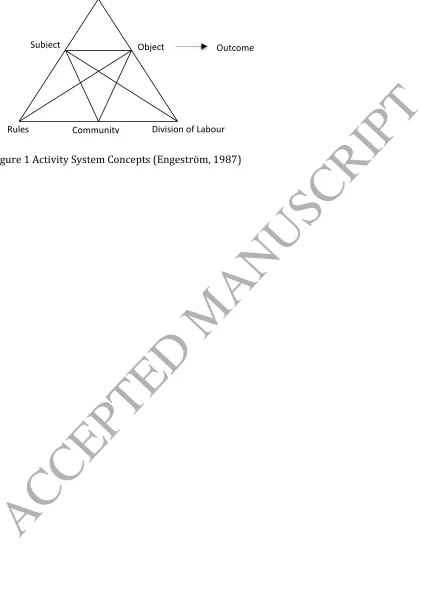
Figure 1 depicts these relations. Here, it can be seen that in AT, the construction of the
person as a subject occurs through engagement in an activity, in which interaction with
others and with the world are mediated by different forms of representation, including
language, conceptual models and other material artefacts. Subjects are thus constructed in
social contexts, formed through practical activity and in relationships of aspiration and
recognition (Packer & Goicoechea, 2000). Engeström distinguishes between different types
of artefacts:
“The first type is what artefacts, used to identify and describe objects. The second type is how artefacts, used to guide and direct processes and procedures on, within, or between objects. The third type is why artefacts, used to diagnose and explain the properties and behaviour of objects. Finally, the fourth type is where to artefacts, used to envision the future state of potential development of objects, including institutions and social systems (Engeström, 2005a, p.320)
A further distinction between different types of mediating artefacts is made, based on
the differentiation between primary (directly used in production), secondary (internal and
external representations of primary artefacts) and tertiary artefacts (imaginary artefacts)
(Wartofsky, 1979).
Insert Table 1 here
OR interventions can thus be considered as clusters of primary, secondary and tertiary
artefacts, each class simultaneously mediating different elements of the intervention
process (Bertelsen, 1998). Through the conceptual distinction between operation, action
and activity AT can conceptualise reflexivity:
ACCEPTED MANUSCRIPT
13 Furthermore, the distinction provides us with an analytical approach to get at the dynamic
mechanisms in an OR workshop setting.
The idea of mediation via models is central to AT (Kaptelinin, 1996). At one level, models may include tools that mediate people’s thoughts and behaviour. Conversely, people’s
thoughts also shape the artefacts produced and their usage. Mental models are artificial
formations and social by nature (Vygotsky, 1981). They comprise language, mnemonic
techniques, schemes, maps, drawings, signs, and other mental artefacts (John-Steiner and
Mahn, 1996). In AT, the relationships between the subject(s) and activity, artefacts or tools
always mediate the object, (i.e. it occurs in the activity). The mediating artefacts or tools are
always required when a subject interacts with the world. Thus, the notion of mediation is
central to Engeström’s theory (Engeström, 1987). Mediation in this sense should not be
understood to imply that the development of tools or language simply makes it easier to do
things that were somehow going to get done anyway. On the contrary, the notion points to
the occurrence of qualitatively new events, events that would not otherwise have been
possible. Language is an important aspect of analysis of interventions because it may
become ‘materialised’ in artefacts (Froschauer, 2009), and it may stabilise activity objects,
for example through metaphorical objects (collective symbols) with drawing power for
collective behaviour (Chiva and Alegre, 2005; Jäger, 2012). The complementary use of “ideas from sociolinguistics and from the tradition of critical discourse analysis” may be fruitful in “connecting the general principles of studying power and the actual analysis of interaction in encounters” (Kontinen, 2007, p.142) and so to trace inscribed motivations and power struggles (Kontinen, 2013). Power in AT is understood as “relational and emergent in different strategies and tactics used in negotiation that bring together different interpretations, interests, and motivations of the actors participating in negotiations” (Kontinen, 2007).
We suggest that PSMs are a form of social practice that could be understood as
model-mediated activity (see Leontiev, 1981). In Engeström’s model of AT (Engeström, 1987), there
are three processes of mediation; of tools between subject and object, of rules between
community and subject, and of the division of labour between community and object. These
are presented as transforming the nature of the contexts within which people act. Where
ACCEPTED MANUSCRIPT
14 activity should not be studied as if it were ‘for the mind alone’. As Engeström emphasizes,
people act practically, moulding their material environments, and they do this not alone but
in co-operation with others. Engeström (1987) introduced the notion of community as the collective that is interested in an object, rules which mediate the relationship between a community and the subject of an activity, and division of labour as the way the community is related to the object of the activity. Therefore, AT employs a collective, artefact-mediated
and object-oriented view of activity systems (see Figure 2) (Cole et al., 1997; Engeström,
1999). Accordingly, central to AT is the conception of collective or social learning. This is a creative accomplishment, which can only be achieved by active participation (see Bandura,
1990). The suggestion is that learning occurs as people do more than they yet know how to
do. The approach suggests that the ambiguities, uncertainties, and contradictions that are
characteristic of the human condition can provide key opportunities for individual and
collective development. This is also linked to a view of learning conceptualised as a
collective activity ‘when psychological functions contribute to the development of qualitatively new social functions’ (Schaal, 2009).
Necessary circumstances for such learning processes arise from the ambiguities and
conflicts that can be found within and between activity systems. For example, Figure 2
shows two interacting activity systems, the minimum number required for activity system
networks to evolve (Engeström, 1999). The activity object is a collective project that is
stabilized by the shared tools, signs and procedures of the activity system. The activity object (object 3 in Figure 2) acts as a boundary object between the two activity systems. It is
also conceptualised as “visible, accessible, and cumulable – allowing participants to return time and again. There must be effective feedback from and exchange among the participants acting on the object” (Engeström, 2009).
Figure 2 here
Finally, change and order in activity systems are continually negotiated in the
multi-voiced and historicised social practices and the emerging activities that are aimed at
overcoming contradictions (Engeström and Blackler, 2005). Contradictions may take place
either inside the key constructs (e.g. subject) or between them (Engeström, 1999), or they
ACCEPTED MANUSCRIPT
15 In sum, AT offers a powerful set of ideas that serves to integrate social constructivist
developments in the understanding of OR (Keys, 1995; White, 2006), boundary object
(Franco and Montibeller, 2010) and affordance-oriented perspectives (Franco, 2013). To
summarize, the key aspects are:
(1) The concept of activity. People do not just think, they act on the world and they do this
collectively. AT bridges the gap between motivation and action through processes of acting
in the world (Kaptelinin and Nardi, 2006).
(2) The nature of activity systems. Mediating mechanisms, such as tools, models, language,
social rules and the division of labour, transform the relationships between individuals and
communities in collective activity. Such mechanisms are interwoven in a complex web of
mutual interactions.
(3) Active participation. Actors learn by participating in activities and activity systems. This is
a creative and interpretative and reflexive process. Such learning is likely to be tacit rather
than explicit (Tsoukas, 2003). Collective or social learning occurs when the community of
actors construct new conceptions of their actions and develop new activity systems.
(4) The prevalence of contradiction and dilemma. These are integral features of activity
systems. They offer major opportunities for collective learning.
Extending AT: the dynamics of collective intentionality
Our objective is to understand OR interventions in terms of behavioural issues. We wish to
show that AT offers a theoretical lens to relate empirical data to the scaffolding of social (or
collective) learning. However, Engeström’s AT orientation is only partially theorized in
linking activity and behaviour. Building on the suggestion of other scholars (see (Tomasello,
2009)) the behavioural aspect of activity could be further explored through the notion of
collective intentionality (Tuomela and Miller, 2009; Gordon and Theiner, forthcoming). It is
suggested that collective intentionality enables the reaching out that occurs when people
operate across the boundaries of discrete activity systems. This was partially explored by
Engeström in the AT literature as ‘Collaborative intentionality capital’ (Engeström, 2008).
We follow the suggestion that tracing the dynamics in ‘Objects of Activity’ constitutes a way
ACCEPTED MANUSCRIPT
16 “The idea of we-intentionality is that humans have the capacity to not only recognise another agent’s intention but that humans can join intentions thus making cooperation not an accidental by product of behaviour or an aberration of behaviour, forced by the threat of punishment. Rather, humans are hard wired to cooperate, sharing goals and making plans together to achieve those common goals” (Tomasello, 2009).
Collective intentionality in this sense thus means “thinking and acting (e.g. believing, intending, performing joint actions) as members of a group (however fleeting)” (Tuomela, 2005) (see also (Tuomela, 1995)) through collaborative interactions in which participants
have a shared goal and coordinated action roles for pursuing that shared goal. A
we-intention (Tuomela and Miller, 1988) “consists of the intention of an individual to do her or his part in some prospective action of the group, along with some belief about the we-intentions of the other members of the group and about the opportunities for actions. These we-intentions make intentional joint action possible” (Preston, 2013). We suggest that AT may help to understand how subjects and communities develop collective intentionality
through activity aimed towards a ‘partially fragmented and partially disputed’ activity object
(Miettinen and Virkkunen, 2005), mediated by artefacts, rules and division of labour. This is
further expanded upon in the case analysis section of this paper.
Comparison between ANT and AT
Finally, before moving towards our empirical case, it is worth summarising the similarities
and differences between AT and ANT. Without a doubt, there are many points of contact
between ANT and AT (Miettinen, 1999; Schaal, 2009; Shaffer and Clinton, 2006, 2005). They
both comprise a unique combination of material, mental, social, institutional and historical
factors and provide analytical tools to understand the nature of the reciprocal
action-shaping of humans and nonhumans (Andrade and Ekundayo, 2011). Theoretically, AT if not
similar, is very close to ANT, particularly in the adoption of theories of language and
semiotics (Miettinen , 1995; Miettinen & Virkkunen, 2005; Latour, 1987), where humans
create a sign system which, in the first place, is used to co-ordinate actions with those of
others. This provides the essential link through which activity theorists explore the mediated
ACCEPTED MANUSCRIPT
17 One of the most significant differences for the study of soft OR interventions lies in ANT’s
principle of generalised symmetry and its consequences for understanding agency and
intentionality in humans and non-humans (Latour, 1996a; Lynch, 1996; Engeström, 1996;
Latour, 1996b). In ANT, both humans and objects can modify a state of affairs, however,
only humans are empowered with intentionality (Andrade, 2012; Andrade & Urquhart,
2010). The ANT principle of symmetry appears to lead away from specific human capacities
such as “intentionality, expression, powers of invention and ‘fabulation’” (Turner, 2011) as “any thing or human being, human intention, consciousness, desire, etc. emerges and oscillates through various translations at play in material network effects” (Fenwick, 2010).
From the point of view of AT, ANT’s conceptualisation of intentionality as a network effect
contrasts sharply with the emphasis of the creative, generative competence of human
actors (Strübing, 2005, p.333). In a social psychological view of intentionality, a human agent
is characterised as one that can “intentionally make things happen by one’s action” (Bandura, 2001, p. 2). According to Bandura (2001, p.1), the core features of agency are
“intentionality, forethought, self-regulation […] and self-reflectiveness”. Applied to collective social learning, AT thus highlights human intentionality as a pre-requisite for the
collective generative struggle with contradictions.
“Collective intentions to perform something together involve intentional dependencies between agents. These can vary in strength, but the central tenet here is that the participants voluntarily create relevant action-dependency. “(Tuomela, 2000)
In Nardi’s (1996) view, AT’s view about the primacy of human agency has a number of
benefits over a symmetrical view of human and nonhuman agency:
“The activity theory position would seem to hold greater potential for leading to a more responsible technology design in which people are viewed as active beings in control of their tools for creative purposes rather than as automatons whose operations are to be automated away, or nodes whose rights to privacy and dignity are not guaranteed” (Nardi, 1996, p.87).
In place of ANT’s symmetrical human and nonhuman actants, AT offers a stratified approach
to analysing agency arising in performances in workshop settings. Figure 3 shows a possible
overlay of ANT’s mediators and intermediaries on AT’s activity system notation to illustrate
how AT spans open a field of analytic opportunities by conceptualising an embedded human
ACCEPTED MANUSCRIPT
18 Figure 3 here
Engeström suggests that both the vertical and horizontal relations in activity systems and
activity networks should be studied, so that institutional anatomy of each actor is revealed-
i.e. the historically accumulated durability, the interactive dynamic and the internal
contradictions of local activity systems.
Overall, ANT and AT offer different –and at times potentially complementary (Andrade &
Ekundayo, 2012)- analytical ‘toolboxes’ to study how goal-directed collective behaviour,
mediated by and inscribed into emerging artefacts, may be brought about through problem
structuring interventions. An additional comparative overview of key concepts in AT, ANT
and comparing those with boundary objects, is provided in Appendix 1 [Table 2].
METHODOLOGY
Our approach for the study aligns with suggestions for developing schemes and theories for
intervention research by focusing on what participants in interventions do with each other,
and with what tools, and for what purposes, and also with what matters to the participants,
and how participants perform doing and saying things with what effects (Sandberg and
Tsoukas, 2011). In order to achieve the above, a systematic field study was conducted of the
intervention with stakeholders using a PSM. This included questionnaires, interviews and
observations. However, our main method for analysing the case was the use of videos.
Videotaping was chosen to collect data in order to be able to reconstruct the micro-level
interactions between participants through language and other tools used in the PSM
modelling process and to obtain a rich permanent primary record that could be shared
between the researchers. Video data collection was chosen with the intention to undertake
theorising that is “responsive to the phenomenon itself rather than to the characteristics of the representational systems that reconstruct it” (Jordan and Henderson, 1995, p.51).
The data analysis proceeded via transcription of the conversations of the participants in
the different groups. Our analysis of the video data then focused on key incidents (Emerson,
2004). We detail our analysis using video in the appendices. Three stages of analysis was
ACCEPTED MANUSCRIPT
19 The first stage involved reviewing the empirical material and producing basic summaries
of what was happening while the workshops were taking place. The summaries provided
contextual information informing us, at the broadest level of what was going on. In keeping
with Sandberg and Tsoukas’s (2011) suggestions, the summaries focused on the unfolding
nature of the case, concentrating on the specific details of the conduct of the workshops.
In the second stage of analysis, AT formed the basis of the lens against which the
empirical material was compared. This analysis mainly focused on ‘activity’. Thus, the unit of
analysis is neither the individual nor the organization, but the system of activity (in our
words, the intervention) (Engeström, 2001; Cobb and Bowers, 1999). We therefore
attended to the content of speech, and turn taking (Greeno, 1998), remembering that the
unit of analysis is not the perceived object or linguistic input, but focused on the active
participant, or the activity itself (Van Lier, 2000). Here, the focus is on the explanatory
properties devised to understand perception and action, and must have a relational nature
(Davids & Araújo, 2010). Engeström’s Activity Triangle (Figure 1) was used to visualise AT
system transformations in networks (Engeström, 2005). Finally, AT analytical approaches
may be complemented by artefact analysis (Hodder, 2012) and conversation analysis
(Berkowitz and Others, 1986) to provide further in-depth knowledge of activity dynamics.
However, this was not conducted on the material presented here.
The third stage drew on the analyses above to guide analysis of the data in terms of
agency within the intervention. We compared and contrasted the data, refining the analysis
and so obtaining detailed findings of the intervention as it unfolded. It is here that
participants with different knowledge, skills, and experience can be seen to be reaching out
to each other through explanations and sharing of prior knowledge, in our case, for
example, knowledge about ways to engage with site owners in problem solution and
learning processes. Diversity in workshop settings thus becomes a necessary
pre-requisite/principle of practice for social learning to occur.
The key incident presented is taken from the first workshop of an EU Smart Cities project,
which took place in March 2014. The following section presents the details of the case study
and application of AT to the study of a PSM intervention. Details of our coding and analysis
ACCEPTED MANUSCRIPT
20 CASE STUDY
The case study describes an intervention in which a PSM was employed with multiple
stakeholders to explore the use of systems thinking for energy efficient planning in the City
of Bristol in South West England. The case study took place during 2014, and hereafter will
be referred to as the STEEP project. The first part of the case describes the genesis of the
work and the relevant context. The intervention itself is then described, which covers the
processes and outputs of the work. A final part forms the analysis of the case. The details of
the analysis are based on video recordings taken during the intervention. The analysis
follows one of the participating stakeholder groups throughout the workshop. Activity
systems analysis is applied based on a loose interpretation of (Jonassen and Land, 2012)’s
operationalization of the theory. The analysis of the case is meant to be illustrative rather
than conclusive and only represents a partial analysis of the case.
Background
The context for the case is the growing concern for securing sustainable, reliable, and
affordable energy systems in EU-countries that seek to address climate change risks by
meeting EU 2020 carbon reduction targets. Opportunities for change towards lower carbon
energy systems arise from the convergence of ubiquitous IT systems with decentralised
energy technologies that create new complementarities of small-scale, local technologies
with traditional networked infrastructures. Cities are perceived to be ideal test beds due to
their limited scale, their diversity and hence opportunities for learning about the complexity
of socio-cultural practice change that accompanies technology transitions. The STEEP
project (Systems Thinking for Energy Efficient Planning) (STEEP, 2011) is an EU FP7 project
that seeks to identify innovative interventions for city district energy planning that could be
tested in the partnering cities and then have wider significance for cross-city learning.
The City of Bristol, in South-West England, is one of the partnering cities in the project,
and a representative of the local council manages the project as part of the council’s smart
city programme portfolio. In its Smart City Programme, the City Council formulates the aim
ACCEPTED MANUSCRIPT
21 commitment to create a world-class and inclusive green-digital economy. The aim is to use
smart technologies to reduce CO2 emissions by 40% by 2020 from a 2005 baseline, whilst
also meeting the city council’s social and economic objectives (Bristol City Council, 2012).
The ‘sustainable’ entrepreneurial city that is competing in the market place for
intellectual resources is a dominant model of urban development in the UK (Nurse and
North, 2013). It is predicated on the pursuit of economic growth and visions of low carbon
cities become part of a sustainable development agenda. Local decision makers may pursue
low carbon as an opportunity to create new jobs in the area, apply technology fixes to meet
national emission targets and focus on stimulating the low carbon industry which is
assumed to be a growth sector (North, 2013).
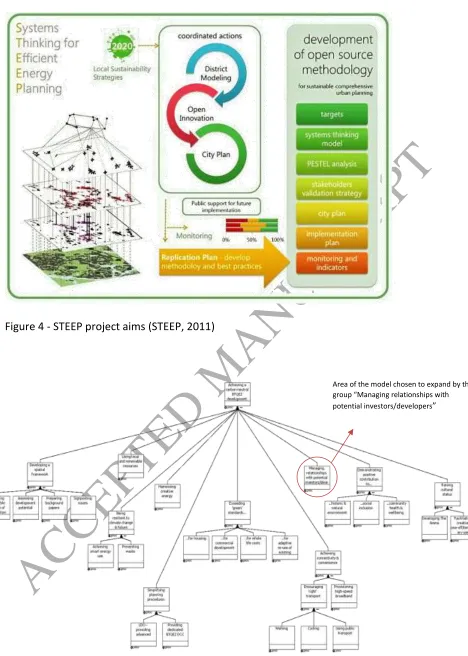
It is against this background that the STEEP project was set-up (Figure 4). The project
partners in Bristol comprise the local university, an engineering consultancy, a third sector
organisation with expertise in energy modelling, and the local council. The project proposal
document (STEEP, 2011) states that the project’s specific objectives are:
To enable all participants cities and partners to learn from the successful and
unsuccessful experiences of other cities and experts,
To integrate all stakeholders in smart city plan definition: Public administrations,
policy makers, technology providers, financial organisations, Enterprises and citizens
To better understand the complex energy, resources, social and economic flows and
their relationships,
To have a clear picture on the number, effectiveness, cost and interdependence of
the possible smart city interventions and projects,
To disseminate or application plan to other similar cities at the European scale.
Figure 4 here
The Bristol Temple Quarter Enterprise Zone (BTQEZ) is a designated regeneration area
that aims to attract businesses through reduced business rates, encourages development
through a relaxed planning application processes, and facilitates regeneration through
ACCEPTED MANUSCRIPT
22 The design of the workshops was an attempt to surface issues about inclusivity of
engagement in the debate about proposed actions. The control of a workshop invitation
process can be used to constrain the scope or ambition of the transformational goal right at
the start of the process by the owner pre-judging what might be desirable and feasible
action. The formation of a stakeholder group and the setting of the transformational goal
are necessarily co-dependent activities. In setting the original scope for the transformation,
Bristol City Council suggested a particular group of stakeholders that they thought should be
represented in the group model building workshops and they were duly invited to take part.
Whilst this could be considered as an exercise in control at an early stage to constrain
ambition it was in fact a deliberate attempt to widen participation beyond what could be
labelled as the usual inner circle of decision makers. Bristol City Council were very open to
the idea of the workshops acting as a forum in which the views of broader set of
stakeholders, such as community groups, could be aired and debated. In this respect the
whole process represented a novel approach to widening participation in the energy
planning process and resolving one of its past failings.
Workshop description
During the first stages of the STEEP project, a group model-building workshop was held to
facilitate the exploration of aspects relevant to systemic energy planning for the District
Modelling of the BTQEZ. This was the first of three planned.
The workshop was attended by representatives of technology manufacturing companies,
infrastructure operators, third-sector organisations with an interest in energy and low
carbon development in Bristol, consultancies (multi-disciplinary engineering firms and
architects), local authority employees and University academics. The invitations to
participate were sent to a variety of organisations who were known to the project partners
to have an interest in and/or relevant expertise for redevelopment projects in Bristol.
The workshop began with a BCC representative setting the context, followed by an
explanation of the methodology by a University academic. Participants were provided with
hand-outs of the outline spatial framework for the zone and high level draft models that had
been agreed amongst the STEEP project partners prior to the workshop on the basis of the
project’s perceived objectives and an analysis of existing documentation about the energy
ACCEPTED MANUSCRIPT
23 STEEP employs Hierarchical Process Modelling to structure the problem situation (Davis
et al., 2010) that allowed participants to take a wide view of ‘energy’, including building
types and usage profiles, infrastructure systems and technology, movement/transport mix,
thereby considering social practices (the changing nature of work in networking hubs, an
increasing awareness of sustainable energy behaviours and environmentally and
health-friendly travel choices).
Case Analysis
The case study can be conceptualised as an activity system as the participants are active in
the shaping and reshaping of the problem representation assisted by auxiliary artefacts,
enabling distributed agency towards the projects’ objectives, i.e. the activity object of
‘achieving a zero carbon BTQEZ’. Collaboration among the participants with varying
expertise necessitates a dynamic, dialogic relationship between the multiple actors; it is a
relationship characterized by collaborative and discursive construction of tasks (Engeström,
2004). Heterogeneous groups are typical of a PSM intervention but are radically different
from conventional teams or communities of practice (Lave and Wenger, 1991) in that
membership at the periphery is fluid. In the intervention work, participants are required to
recognize and engage with different goals of action and different expertise distributed
across group members using models or boundary objects to mediate their actions.
The activity object in action
The overall activity object was to develop an integrated approach to low carbon
development of the Enterprise Zone. In the first task, groups were asked to identify ‘missing
processes’ from the template model (a task to stimulate debate) and then, following the
structured process mapping methodology, to develop their own extension of the model
using post-it notes and the flipchart.
The top-level process of the model was ‘achieving a zero carbon BTQEZ’, which had been
identified as the overarching target for the STEEP project by the project partners during a
prior workshop. This top level process caused controversy and was met with rejection by
many participants for a) being too vague to mean anything due to a lack of measurements,
ACCEPTED MANUSCRIPT
24 operational difficulties in developing districts to become lower (not low or zero) carbon
zones, and c) as being reductionist due to its lack of consideration for other, possibly equally
– or more- important, economic and social objectives for the zone’s redevelopment.
The top-level process thus shows the qualities of an activity object, as “objects and motives […] appear to be vague, fuzzy, multi-faceted, amoeba-like and often fragmented or contested. The paradox is that objects/motives give directionality, purpose and meaning to the collective activity, yet they are frustratingly elusive” (Engeström, 2005a, p.93). The statement provided a stimulus for expansive learning and the generation of creative
alternative paths for action as it revealed contradictions inherent in complex planning
situations such as low carbon transitions.
Following one group through the workshop
The workshop overall could be described as one activity system. However, for the purpose
of this analysis, we draw the boundaries around the five different groups in which the
participants were split for the purpose of the group model building exercises. The facilitator
created the groups with a focus on preserving heterogeneity of participants based on
organisational affiliation. This analysis follows one group to exemplify the application of AT
in the study of PSM interventions. The selected group had four members: a representative
from an international engineering manufacturer (S1), a railway engineering company (S2)
[BTQEZ has Bristol’s main railway station in its centre], an energy charity representative
[part of the STEEP project team] (S3) and a Council Representative (S4) (Figure 7).
Participants were provided with a high level model as a starting point, which had been
developed by the project partners (University, City Council, Energy Charity, Engineering
Consultancy) during a training workshop, using HPM as well. Figure 5 shows the template
model as well as the segment that participants decided to expand.
Figure 5 here
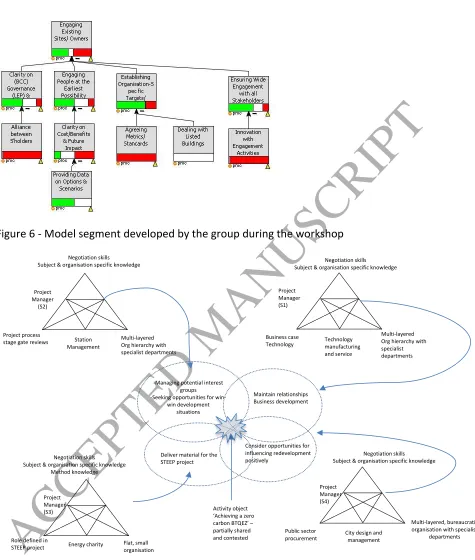
During the workshop, participants developed a new model segment, which is depicted in
figure 6, after having undergone computer processing post-workshop.
ACCEPTED MANUSCRIPT
25 The group deconstructed the problem as it had been presented to them by critically
reviewing and changing the template model, in order to then reconstruct their own
representation of the problem situation focused by a shared objective.
The process of modelling
The process may be described as de-constructing and co-constructing an activity system.
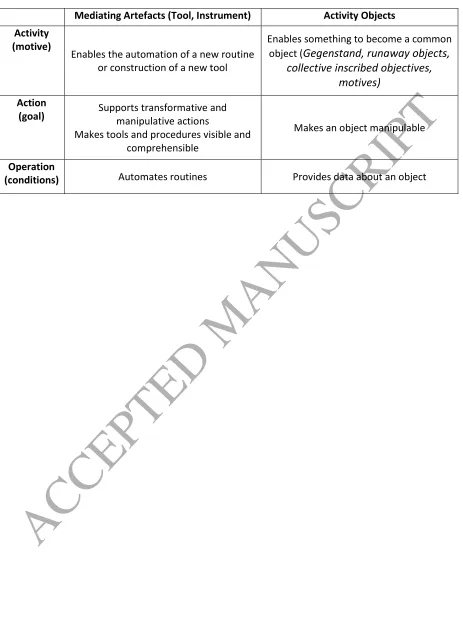
Applying Engeström’s triangular notation of activity systems, the activity systems of the
participants in the group at the start of the group workshop can be depicted as shown in
figure 7.
Figure 7 here
From Figure 7 it can be seen that the object ‘Achieving a zero carbon BTQEZ’ had to be
made intelligible by the participants in order to be interpreted or subverted in a way that
would have sufficient drawing power to create a new activity system from the
interdependence arising between the participants through the workshop, given the task to
consider the activity object as shared. As such, the participants challenged the activity
object that was suggested (achieving a zero carbon zone) and focused on a sub-object that
could be shared, and then constructed an activity system that would plausibly pursue the
chosen process (engaging site owners) (see Figure 8). The new system represents all
organisations/subjects that were represented by participants in the exercise.
Figure 8 here
From an AT perspective, the group’s plans unfold in an activity system with a clear object as formulated in Figure 8. The object is not only an expression of the participants’ beliefs,
but it is also important for the way in which they interact because it has the potential to
reduce the number of different motivations in the group. By making the object of their work
explicit, the participants restrict widening their group in order to delineate their
co-constructed activity system.
ACCEPTED MANUSCRIPT
26 Analysing the micro-level dynamics of interaction, we suggest that the development of
we-intentions (Tuomela, 2013) may be observable from the participants’ in situ group model
building activity.
Engeström (2008, p.225) suggested that in order to study collective intentionality it is
necessary to observe processes of “dwell[ing] in the object, connect[ing] and reciprocat[ing] across boundaries.” In accordance with Nicolini (zoom in/zoom out) (Nicolini, 2009), we suggest that the duration of this longitudinal relationship is relative to the episodes studied
and propose a multi-layered model of conversation episodes in group model building (a
couple of seconds/minutes, immediate) and at a higher level of feedback rounds between
groups (a couple of minutes per group, in rounds spaced by hours of modelling) which could
be extended to levels between workshops (March – June) as well as between projects and
the smart city programme.
Drawing on transcripts (Carley 1997, Kiekel et al. 2001) from the conversations and
interactions between participants during the group model building phases and from the
group’s feedback rounds, we aim to show how the conditions for we-intentionality may be
met and thus how the problem structuring process is conducive to collective intentions
becoming emergent.
The following excerpt shows a group discussion around carbon targets for the zone. It
exemplifies the identification of contradictions (different organisations have different levels
carbon targets), which are partially related to the size (and hence type of outlook (short vs
long term)) of the different companies. The participants identify that a process to deal with
the differences, without distorting competition and safeguarding an economically viable
enterprise zone with both small, innovative and large, stable businesses, is needed.
Furthermore, the rules and division of labour are implicit in the situation as the City Council
can influence the setting of targets whilst companies are likely to choose their location
based on strategic considerations which may include opportunities for clustering and/or
reduced business rates, potentially making the enterprise zone attractive.
S2
ACCEPTED MANUSCRIPT
27 S1
And also how do you align that with the targets that investors have?
And also how do you align them with the financial requirements? [pointing at a post-it note on the flipchart]
S2 And also.. we’re talking here about a long term process.. most companies live hand to mouth, and the only thing they worry about it the financial statement at
the end of the year.. because that means that we’ve got a job next year.
S4 But we’ll be looking to develop the Enterprise Zone not just with small companies …
S2 But even the big ones… S0 ..are you saying….
S4 There is an aspiration of a carbon neutral development, which isn’t bought into necessarily…
S0
So the question is.. how exactly would you overcome that? You know the disconnect, the gulf between those participating in the development of the zone? [pointing at post-it on flipchart “Engaging people at the earliest opportunity”]
S1
I think that you will have a mix of smaller and larger companies, you can’t just… you have to have innovation as well, so somehow having the engagement too is important.. the small companies are riskier with innovation, because they can … and also the University has links
S3 [adding post-it note up to model: “Establishing organisational-specific targets/drivers & Aligning with TQEZ Goals” ].
S1 So it’s engaging all the different groups in the task
In the subsequent analysis we aim to show that Tuomela & Miller’s (1988) conditions for
we-intentions – as a minimum between two participants A and B - develop during the
problem structuring process. Hence, we view collective intentionality as a sequence of
individual intentions related in a certain way (Becchio and Bertone, 2004) and we adopt the
following conditions and notation:
(a) A intends to do his/her part of X (IaXa).
(b) A believes that B will do his/her (B's) part (BaXb).
(c) A believes that B believes that he/she (A) will do his/her part (BaBbXa).
X is used to denote the joint task, Xa to denote agent A's part of X, Ia and Ba to respectively
denote A's intention and belief. A we intention (WI) between A and B consists of
(IaXa⋀BaXb⋀BaBbXa) in A's mind and (IbXb⋀BbXa⋀BbBaXb) in B's mind (Kaano et al.,
2003).
In our example, the joint task (X) is focused around the partially shared and partially
contested activity object (achieving a zero-carbon enterprise zone). S2 (henceforth A),