Generating statistical language models from interpretation grammars in
dialogue systems
Rebecca Jonson
Dept. of Linguistics, G¨oteborg University and GSLT [email protected]
Abstract
In this paper, we explore statistical lan-guage modelling for a speech-enabled MP3 player application by generating a corpus from the interpretation grammar written for the application with the Gram-matical Framework (GF) (Ranta, 2004). We create a statistical language model (SLM) directly from our interpretation grammar and compare recognition per-formance of this model against a speech recognition grammar compiled from the same GF interpretation grammar. The results show a relative Word Error Rate (WER) reduction of 37% for the SLM derived from the interpretation grammar while maintaining a low in-grammar WER comparable to that associated with the speech recognition grammar. From this starting point we try to improve our arti-ficially generated model by interpolating it with different corpora achieving great reduction in perplexity and 8% relative recognition improvement.
1 Introduction
Ideally when building spoken dialogue systems, we would like to use a corpus of transcribed di-alogues corresponding to the specific task of the dialogue system, in order to build a statistical lan-guage model (SLM). However, it is rarely the case that such a corpus exists in the early stage of the development of a dialogue system. Collect-ing such a corpus and transcribCollect-ing it is very time-consuming and delays the building of the actual dialogue system.
An approach taken both in dialogue systems
and dictation applications is to first write an in-terpretation grammar and from that generate an artificial corpus which is used as training corpus for the SLM (Rauxet al, 2003; Pakhomov et al, 2001; Fosler-Lussier & Kuo, 2001). These mod-els obtained from grammars are not as good as the ones built from real data as the estimates are arti-ficial, lacking a real distribution. However, it is a quick way to get a dialogue system working with an SLM. When the system is up and running it is possible to collect real data that can be used to improve the model. We will explore this idea by generating a corpus from an interpretation gram-mar from one of our applications.
A different approach is to compile the interpre-tation grammar into a speech recognition gram-mar as the Gemini and REGULUS compilers do (Rayneret al, 2000; Rayneret al, 2003). In this way it is assured that the linguistic coverage of the speech recognition and interpretation are kept in sync. Such an approach enables us to interpret all that we can recognize and the other way round. In the European-funded project TALK the Grammat-ical Framework (Ranta, 2005) has been extended with such a facility that compiles GF grammars into speech recognition grammars in Nuance GSL format (www.nuance.com).
bet-ter for naive users (see (Knightet al, 2001)) while speech recognition grammars are limited in their coverage depending on how well grammar writers succeed in predicting what users may say (Huang et al, 2001).
Nevertheless, as grammars only output phrases that can be interpreted their output makes the fol-lowing interpretation task easier than with the un-predictable output from an SLM (especially if the speech recognition grammar has been compiled from the interpretation grammar and these are both in sync). In addition, the grammar-based approach in the experiments reported in (Knightet al, 2001) outperforms the SLM approach on semantic error rate on in-coverage data. This has lead to the idea of trying to combine both approaches, as shown in (Rayner & Hockey, 2003). This is also something that we are aiming for.
Domain adaptation of SLMs is another issue in dialogue system recognition which involves re-using a successful language model by adapting it to a new domain i.e. a new application (Janiszeket al, 1998). If a large corpus is not available for the specific domain but there is a corpus for a collec-tion of topics we could use this corpus and adapt the resulting SLM to the domain. One may as-sume that the resulting SLM based on a large cor-pus with a good mixture of topics should be able to capture at least a part of general language use that does not vary from one domain to another. We will explore this idea by using the Gothenburg Spoken Language Corpus (GSLC) (Allwood, 1999) and a newspaper corpus to adapt these to our MP3 do-main.
We will consider several different SLMs based on the corpus generated from the GF interpreta-tion grammar and compare their recogniinterpreta-tion per-formance with the baseline: a Speech Recogni-tion Grammar in Nuance format compiled from the same interpretation grammar. Hence, what we could expect from our experiment, by looking at earlier research, is very low word error rate for our speech recognition grammar on in-grammar coverage but a lot worse performance on out-of-grammar coverage. The SLMs we are consider-ing should tackle out-of-grammar utterances bet-ter and it will be inbet-teresting to see how well these models built from the grammar will perform on in-grammar utterances.
This study is organized as follows. Section 2 introduces the domain for which we are doing
language modelling and the corpora we have at our disposal. Section 3 will describe the different SLMs we have generated. Section 4 describes the evaluation of these and the results. Finally, we re-view the main conclusions of the work and discuss future work.
2 Description of Corpora
2.1 The MP3 corpus
The domain that we are considering in this pa-per is the domain of an MP3 player application. The talking MP3 player, DJGoDiS, is one of sev-eral applications that are under development in the TALK project. It has been built with the TrindiKit toolkit (Larssonet al, 2002) and the GoDiS dia-logue system (Larsson, 2002) as a GoDiS appli-cation and works as a voice interface to a graphi-cal MP3 player. The user can among other things change settings, choose stations or songs to play and create playlists. The current version of DJ-GoDiS works in both English and Swedish.
The interpretation and generation grammars are written with the GF grammar formalism. GF is being further developed in the project to adapt it to the use in spoken dialogue systems. This adaptation includes the facility of generating Nu-ance recognition grammars from the interpretation grammar and the possibility of generating corpora from the grammars. The interpretation grammar for the domain, written in GF, translates user utter-ances to dialogue moves and thereby holds all pos-sible interpretations of user utterances (Ljungl¨of et al, 2005). We used GF’s facilities to generate a corpus in Swedish consisting of all possible mean-ingful utterances generated by the grammar to a certain depth of the analysis trees in GF’s abstract syntax as explained in (Weilhammeret al, 2006). As the current grammar is under development it is not complete and some linguistic structures are missing. The grammar is written on the phrase level accepting spoken language utterances such as e.g. “next, please”.
overlap of words in songs and artists as pronouns (such asJag(I) andDu(You)) and articles (such as Det(The)) are very common. This corpus is very domain specific as it includes many artist names, songs and radio stations that often consist of rare words. It is also very repetitive covering all com-binations of songs and artists in utterances such as “I want to listen to Mamma Mia with Abba”. All utterances in the corpus occur exactly once.
2.2 The GSLC corpus
The Gothenburg Spoken Language (GSLC) cor-pus consists of transcribed Swedish spoken lan-guage from different social activities such as auc-tions, phone calls, meetings, lectures and task-oriented dialogue (Allwood, 1999). To be able to use the GSLC corpus for language modelling it was pre-processed to remove annotations and all non-alphabetic characters. The final GSLC corpus consisted of a corpus of about 1,300,000 words with a vocabulary of almost 50,000 words.
2.3 The newspaper corpus
We have also used a corpus consisting of a col-lection of Swedish newspaper texts of 397 million words.1 Additionally, we have created a subcor-pus of the newspaper corsubcor-pus by extracting only the sentences including domain related words. With domain related words we mean typical words for an MP3 domain such as “music”, “mp3-player”, “song” etc. This domain vocabulary was hand-crafted. The domain-adapted newspaper corpus, obtained by selecting sentences where these words occurred, consisted of about 15 million words i.e. 4% of the larger corpus.
2.4 The Test Corpus
To collect a test set we asked students to describe how they would address a speech-enabled MP3 player by writing Nuance grammars that would cover the domain and its functionality. Another group of students evaluated these grammars by recording utterances they thought they would say to an MP3 player. One of the Nuance grammars was used to create a development test set by gen-erating a corpus of 1500 utterances from it. The corpus generated from another grammar written by some other students was used as evaluation test set. Added to the evaluation test set were the transcriptions of the recordings made by the third
1
This corpus was made available by Leif Gr¨onqvist, Dept. of Linguistics, G¨oteborg University
group of students that evaluated both grammars. This resulted in a evaluation test set of 1700 utter-ances.
The recording test set was made up partly of the students’ recordings. Additional recordings were carried out by letting people at our lab record ran-domly chosen utterances from the evaluation test set. We also had a demo running for a short time to collect user interactions at a demo session. The fi-nal test set included 500 recorded utterances from 26 persons. This test set has been used to com-pare recognition performance between the differ-ent models under consideration.
The recording test set is just an approximation to the real task and conditions as the students only capture how they think they would act in an MP3 task. Their actual interaction in a real dialogue situation may differ considerably so ideally, we would want more recordings from dialogue sys-tem interactions which at the moment constitutes only a fifth of the test set. However, until we can collect more recordings we will have to rely on this approximation.
In addition to the recorded evaluation test set, a second set of recordings was created covering only in-grammar utterances by randomly generat-ing a test set of 300 utterances from the GF gram-mar. These were recorded by 8 persons. This test set was used to contrast with a comparison of in-grammar recognition performance.
3 Language modelling
To generate the different trigram language models we used the SRI language modelling toolkit (Stol-cke, 2002) with Good-Turing discounting.
The first model was generated directly from the MP3 corpus we got from the GF grammar. This simple SLM (namedMP3GFLM) has the same vo-cabulary as the Nuance Grammar and models the same language as the GF grammar. This model was chosen to see if we could increase flexibility and robustness in such a simple way while main-taining in-grammar performance.
We also created two other simple SLMs: a class-based one (with the classesSong,Artist
and Radiostation) and a model based on a variant of the MP3 corpus where the utterances in which songs and artists co-occur would only match real artist-song pairs (i.e. including some music knowledge in the model).
models considered although we only report the re-sults for the MP3GFLMin this article (the class-based model gave a slightly worse result and the a other slightly better result).
In addition to this we used our general corpora to produce three different models: GSLCLMfrom the GSLC corpus, NewsLM from the newspaper corpus andDomNewsLMfrom the domain adapted newspaper Corpus.
3.1 Interpolating the GSLC corpus and the MP3 corpus
A technique used in language modelling to com-bine different SLMs is linear interpolation (Jelinek & Mercer, 1980). This is often used when the do-main corpus is too small and a bigger corpus is available. There have been many attempts at com-bining domain corpora with news corpora, as this has been the biggest type of corpus available and this has given slightly better models (Janiszeket al, 1998; Rosenfeld, 2000a). Linear interpolation has also been used when building state dependent models by combining the state models with a gen-eral domain model (Xu & Rudnicky, 2000; Sol-sonaet al, 2002).
Rosenfeld (Rosenfeld, 2000a) argues that a lit-tle more domain corpus is always better than a lot more training data outside the domain. Many of these interpolation experiments have been carried out by adding news text, i.e. written language. In this experiment we are going to interpolate our do-main model (MP3GFLM) with a spoken language corpus, the GSLC, to see if this improves perplex-ity and recognition rates. As the MP3 corpus is generated from a grammar without probabilities this is hopefully a way to obtain better and more realistic estimates on words and word sequences. Ideally, what we would like to capture from the GSLC corpus is language that is invariant from domain to domain. However, Rosenfeld (Rosen-feld, 2000b) is quite pessimistic about this, argu-ing that this is not possible with today’s interpo-lation methods. The GSLC corpus is also quite small.
The interpolation was carried out with the SRILM toolkit2based on equation 1.
M ixGS LC M P3GF =λ∗M P3GF LM+ (1−λ)∗GS LC LM
(1)
The optimal lambda weight was estimated to 0.65 with the SRILM toolkit using the develop-ment test set.
2
http://www.speech.sri.com/projects/srilm, as of 2005.
3.2 Interpolating the newspaper corpus and the MP3 corpus
We also created two models in the same way as above by interpolating the two variants of the news corpus with our simplest model.
M ixN ew sM P3GF =λ∗M P3GF LM+ (1−λ)∗N ew sLM
(2)
M ixD om N ew sM P3GF =λ∗M P3GF LM+(1−λ)∗D om N ew sLM
(3)
In addition to these models we created a model where we interpolated both the GSLC model and the domain adapted newspaper model with
MP3GFLM. This model was namedTripleLM.
3.2.1 Choice of vocabulary
The resulting mixed models have a huge vocab-ulary as the GSLC corpus and the newspaper cor-pus include thousands of words. This is not a con-venient size for recognition as it will affect accu-racy and speed. Therefore we tried to find an opti-mal vocabulary combining the sopti-mall MP3 vocabu-lary of around 300 words with a smaller part of the GSLC vocabulary and the newspaper vocabulary.
We used the the CMU toolkit (Clarkson & Rosenfeld, 1997) to obtain the most frequent words of the GSLC corpus and the News Corpus. We then merged these vocabularies with the small MP3 vocabulary. It should be noted that the over-lap between the most frequent GSLC words and the MP3 vocabulary was quite low (73 words for the smallest vocabulary) showing the peculiarity of the MP3 domain. We also added the vocabu-lary used for extracting domain data to this mixed vocabulary. This merging of vocabularies resulted in a vocabulary of 1153 words. The vocabulary for theMP3GFLMand the MP3NuanceGris the small MP3 vocabulary.
4 Evaluation and Results
4.1 Perplexity measures
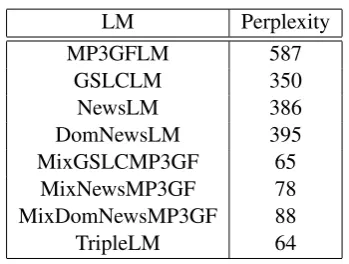
The 8 SLMs (all using the vocabulary of 1153 words) were evaluated by measuring perplexity with the tools SRI provides on the evaluation test set of 1700 utterances.
Table 1:Perplexity for the different SLMs.
LM Perplexity
MP3GFLM 587
GSLCLM 350
NewsLM 386
DomNewsLM 395 MixGSLCMP3GF 65
MixNewsMP3GF 78 MixDomNewsMP3GF 88 TripleLM 64
theMP3GFLMwhich indicates that our MP3 gram-mar is too restricted and differs considerably from the students’ grammars.
Lower perplexity does not necessarily mean lower word error rates and the relation between these two measures is not very clear. One of the reasons that language model complexity does not measure the recognition task complexity is that language models do not take into account acoustic confusability (Huanget al, 2001; Jelinek, 1997). According to Rosenfeld (Rosenfeld, 2000a), a per-plexity reduction of 5% is usually practically not significant, 10-20% is noteworthy and a perplex-ity reduction of 30% or more is quite significant. The above results of the mixed models could then mean an improvement in word error rate over the baseline model MP3GFLM. This has been tested and is reported in the next section. In addition, we want to test if we can reduce word error rate using our simple SLM opposed to the Nuance grammar (MP3NuanceGr) which is our recognition base-line.
4.2 Recognition rates
The 8 SLMs under consideration were converted with the SRILM toolkit into a format that Nuance accepts and then compiled into recognition pack-ages. These were evaluated with Nuance’s batch recognition program on the recorded evaluation test set of 500 utterances (26 speakers). Table 2 presents word error rates (WER) and in parenthe-sis N-Best (N=10) WER for the models under con-sideration and for the Nuance Grammar.
As seen, our simple SLM, MP3GFLM, im-proves recognition performance considerably compared with the Nuance grammar baseline (MP3NuanceGr) showing a much more robust behaviour to the data. Remember that these two models have the same vocabulary and are both
de-Table 2:Word error rates(WER) for the recording test set
LM WER(NBest) MP3GFLM 37.11 (29.48) GSLCLM 83.04 (71.51) NewsLM 61.62 (49.53) DomNewsLM 45.03 (31.58) MixGSLCMP3GF 34.58 (22.68) MixNewsMP3GF 38.00 (27.37) MixDomNewsMP3GF 34.07 (22.07) TripleLM 33.97 (22.02) MP3NuanceGr 59.37 (53.19)
rived from the same GF interpretation grammar. However the flexibility of the SLM gives a relative improvement of 37% over the Nuance grammar. The models giving the best results are the models interpolated with the GSLC corpus and the domain news corpus in different ways which at best gives a relative reduction in WER of 8% in comparison withMP3GFLMand 43% compared with the base-line. It is interesting to see that the simple way we used to create a domain specific newspaper cor-pus gives a model that better fits our data than the original much larger newspaper corpus.
4.3 In-grammar recognition rates
To contrast the word error rate performance with in-grammar utterances i.e. utterances that the orig-inal GF interpretation grammar covers, we car-ried out a second evaluation with the in-grammar recordings. We also used Nuance’s parsing tool to extract the utterances that were in-grammar from the recorded evaluation test set. These few record-ings (5%) were added to the in-grammar test set. The results of the second recognition experiment are reported in Table 3.
Table 3:WER on the in-grammar test set
LM WER (NBest) MP3GFLM 4.95 (2.04)
GSLCLM 78.07 (64.15) NewsLM 48.03 (36.64) DomNewsLM 26.34 (15.25) MixGSLCMP3GF 14.23 (6,29)
MixNewsMP3GF 18.63 (10.22) MixDomNewsMP3GF 15.57 (6.13)
[image:5.595.95.270.85.217.2]The in-grammar results reveal an increase in WER for all the SLMs in comparison to the baselineMP3NuanceGr. However, the simplest model (MP3GFLM), modelling the language of the grammar, do not show any greater reduction in recognition performance.
4.4 Discussion of results
The word error rates obtained for the best mod-els show a relative improvement over the Nuance grammar of 40%. The most interesting result is that the simplest of our models, modelling the same language as the Nuance grammar, gives such an important gain in performance that it lowers the WER with 22%. We used the Chi-square test of significance to statistically compare the results with the results of the Nuance grammar show-ing that the differences of WER of the models in comparison with the baseline are all signifi-cant on the p=0.05 significance level. However, the Chi-square test points out that the difference of WER for in-grammar utterances of the Nu-ance model and theMP3GFLMis significant on the p=0.05 level. This means that all the statistical lan-guage models significantly outperform the base-line i.e. the Nuance Grammar MP3NuanceGr
on the evaluation test set (being mostly out-of-coverage) and that theMP3GFLMoutperforms the baseline overall as the difference of WER in the in-grammar test is significant but very small.
However, as the reader may have noticed, the word error rates are quite high, which is partly due to a totally independent test set with out-of-vocabulary words (9% OOV for theMP3GFLM ) indicating that domain language grammar writing is very subjective. The students have captured a quite different language for the same domain and functionality. This shows the risk of a hand-tailored domain grammar and the difficulty of pre-dicting what users may say. In addition, a fair test of the model would be to measure concept error rate or more specifically dialogue move error rate (i.e. both ‘yes’ and ‘yeah’ correspond to the same dialogue move answer(yes)). A closer look at the MP3GFLMresults give a hint that in many cases the transcription reference and the recogni-tion hypothesis hold the same semantic content in the domain (e.g. confusing the Swedish preposi-tions ‘i’ (into) and ‘till’ (to) which are both used when referring to the playlist). It was manually estimated that 53% of the recognition hypotheses
could be considered as correct in this way opposed to the 65% Sentence Error Rate (SER) that the automatic evaluation gave. This implies that the evaluation carried out is not strictly fair consid-ering the possible task improvement. However, a fair automatic evaluation of dialogue move error rate will be possible only when we have a way to do semantic decoding that is not entirely depen-dent on the GF grammar rules.
The N-Best results indicate that it could be worth putting effort on re-ranking the N-Best lists as both WER and SER of the N-Best candidates are considerably lower. This could ideally give us a reduction in SER of 10% and, considering dia-logue move error rate, perhaps even more. More or less advanced post-process methods have been used to analyze and decide on the best choice from the N-Best list. Several different re-ranking meth-ods have been proposed that show how recogni-tion rates can be improved by letting external pro-cesses do the top N ranking and not the recognizer (Chotimongkol & Rudnicky, 2001; van Noordet al., 1997). However, the way that seems most ap-pealing is how (Gabsdil & Lemon, 2004) and (Ha-cioglu & Ward, 2001) re-rank N-Best lists based on dialogue context achieving a considerable im-provement in recognition performance. We are considering basing our re-ranking on the informa-tion held in the dialogue informainforma-tion state, knowl-edge of what is going on in the graphical interface and on dialogue moves in the list that seem appro-priate to the context. In this way we can take ad-vantage of what the dialogue system knows about the current situation.
5 Concluding remarks and future work
vocabu-lary of this model is in sync with our GF interpre-tation grammar. The results seem comparable with those obtained by (Bangalore & Johnston, 2004) using random generation to produce an SLM from an interpretation grammar.
Although interpolating our MP3 model with the GSLC corpus and the newspaper corpora gave a large perplexity reduction it did not have as much impact on WER as expected even though it gave a significant improvement. It seems from the tests that the quality of the data is more important than the quantity. This makes extraction of domain data from larger corpora an important issue and increases the interest of generating artificial cor-pora.
As the approach of using SLMs in our dia-logue systems seems promising and could im-prove recognition performance considerably we are planning to apply the experiment to other ap-plications that are under development in TALK when the corresponding GF application grammars are finished. In this way we hope to find out if there is a tendency in the performance gain of a statistical language model vs its correspondent speech recognition grammar. If so, we have found a good way of compromising between the ease of grammar writing and the robustness of SLMs in the first stage of dialogue system development. In this way we can use the knowledge and intuition we have about the domain and include it in our first SLM and get a more robust behaviour than with a grammar. From this starting point we can then collect more data with our first prototype of the system to improve our SLM.
We have also started to look at dialogue move specific statistical language models (DM-SLMs) by using GF to generate all utterances that are specific to certain dialogue moves from our in-terpretation grammar. In this way we can pro-duce models that are sensitive to the context but also, by interpolating these more restricted mod-els with the general GF SLM, do not restrict what the users can say but take into account that cer-tain utterances should be more probable in a spe-cific dialogue context. Context-sensitive models and specifically grammars for different contexts have been explored earlier (Baggia et al, 1997; Wrightet al, 1999; Lemon, 2004) but generating such language models artificially from an interpre-tation grammar by choosing which moves to com-bine seems to be a new direction. Our first
ex-periments seem promising but the dialogue move specific test sets are too small to draw any conclu-sions. We hope to report more on this in the near future.
Acknowledgements
I am grateful to Steve Young, Robin Cooper and the EACL reviewers for comments on previous versions of this paper. I would also like to thank Aarne Ranta, Peter Ljungl¨of, Karl Weilhammer and David Hjelm for help with GF and data col-lection and finally Nuance Communications Inc. for making available the speech recognition soft-ware used in this work. This work was supported in part by the TALK project (FP6-IST 507802, http://www.talk-project.org/).
References
Allwood, J. 1999. The Swedish Spoken Language Cor-pus at G¨oteborg University. InFonetik 99, Gothen-burg Papers in Theoretical Linguistics 81. Dept. of Linguistics, University of G¨oteborg.
Baggia P., Danieli M., Gerbino E., Moisa L. M., and Popovici C. 1997. Contextual Information and Spe-cific Language Models for Spoken Language Un-derstanding. InProceedings of SPECOM’97, Cluj-Napoca, Romania, pp. 51–56.
Bangalore S. and Johnston M. 2004. Balancing Data-Driven And Rule-Based Approaches in the Context of a Multimodal Conversational System. In Proceed-ings of Human Language Technology conference. HLT-NAACL 2004.
Chotimongkol A. and Rudnicky A.I. 2001. N-best Speech Hypotheses Reordering Using Linear Re-gression. InProceedings of Eurospeech 2001. Aal-borg, Denmark, pp. 1829–1832.
Clarkson P.R. and Rosenfeld R. 1997. Statistical Language Modeling Using the CMU-Cambridge Toolkit. InProceedings of Eurospeech.
Fosler-Lussier E. and Kuo H.-K. J. 2001. Using Se-mantic Class Information for Rapid Development of Language Models within ASR Dialogue Systems. In
Proceedings of ICASSP-2001, Salt Lake City, Utah.
Gabsdil M. and Lemon O. 2004. Combining Acoustic and Pragmatic Features to Predict Recognition Per-formance in Spoken Dialogue Systems. In Proceed-ings of ACL, Barcelona.
Hacioglu K. and Ward W. 2001. Dialog-context de-pendent language modeling combining n-grams and stochastic context-free grammars. InProceedings of ICASSP-2001, Salt Lake City, Utah.
Huang X., Acero A., Hon H-W. 2001. Spoken Lan-guage Processing: A guide to theory, algorithm and system development.Prentice Hall.
Janiszek D., De Mori R., Bechet F. 1998. Data Aug-mentation And Language Model Adaptation. Uni-versity of Avignon 84911 Avignon Cedex 9 - France.
Jelinek, F. and Mercer, R. 1980. Interpolated Estima-tion of Markov Source Parameters from Sparse Data. In Pattern Recognition in Practice. E. S. Gelsema and L. N. Kanal, North Holland, Amsterdam.
Jelinek, F. 1997.Statistical Methods for Speech Recog-nition.MIT Press.
Knight S., Gorrell G., Rayner M., Milward D., Koeling R. and Lewin I. 2001. Comparing Grammar-Based and Robust Approaches to Speech Understanding: A Case Study. InProceedings of Eurospeech 2001.
Larsson S. 2002.Issue-based Dialogue Management.
PhD Thesis, G¨oteborg University.
Larsson S., Berman A., Gr¨onqvist L., Kronlid, F. 2002. TRINDIKIT 3.0 Manual. D6.4, Siridus Project, G¨oteborg University.
Lemon O. 2004. Context-sensitive speech recognition in ISU dialogue systems: results for the grammar switching approach. In Proceedings of CATALOG, 8th Workshop on the Semantics and Pragmatics of Dialogue, Barcelona.
Ljungl¨of P., Bringert B., Cooper R., Forslund A-C., Hjelm D., Jonson R., Larsson S. and Ranta A. 2005. The TALK Grammar Library: an Integration of GF with TrindiKit. Deliverable 1.1, TALK project.
Nuance Communications. http://www.nuance.com, as of May 2005.
Pakhomov SV., Schonwetter M., Bachenko, J. 2001. Generating Training Data for Medical Dictations. In
Proceedings NAACL-2001.
Ranta A. 2004. Grammatical Framework. A Type-Theoretical Grammar Formalism. InThe Journal of Functional Programming., Vol. 14, No. 2, pp. 145– 189.
Ranta A. Grammatical Framework Homepage http://www.cs.chalmers.se/˜aarne/GF, as of May 2005.
Raux A., Langner B., Black A. and Eskenazi M. 2003. LET’S GO: Improving Spoken Dialog Systems for the Elderly and Non-natives. InProceedings of Eu-rospeech 2003.Geneva, Switzerland.
Rayner M., Hockey B.A., James F., Owen Bratt E., Goldwater S., Gawron J.M. 2000. Compiling Lan-guage Models from a Linguistically Motivated Uni-fication Grammar. InProceedings of COLING-2000.
Rayner M., Hockey B.A., Dowding J. 2003. An Open-Source Environment for Compiling Typed Unifica-tion Grammars into Speech Recognisers. In Pro-ceedings of EACL, pp. 223–226.
Rayner M. and Hockey B.A. 2003. Transparent combi-nation of rule-based and data-driven approaches in speech understanding. InProceedings of EACL.
Rosenfeld R. 2000. Two decades of statistical language modeling: Where do we go from here? In Proceed-ings of IEEE:88(8).
Rosenfeld R. 2000. Incorporating Linguistic Structure into Statistical Language Models. InPhilosophical Transactionsof the Royal Society of London A, 358.
Solsona R., Fosler-Lussier E., Kuo H.J., Potamianos A. and Zitouni I. 2002. Adaptive Language Mod-els for Spoken Dialogue Systems. InProceedings of ICASSP-2002, Orlando, Florida, USA.
Stolcke A. 2002. SRILM – An Extensible Language Modeling Toolkit. In Proceedings of ICSLP-2002, Vol. 2, pp. 901–904, Denver.
van Noord G., Bouma G., Koeling R. and Nederhof, M. 1999. Robust Grammatical Analysis for Spoken Dialogue Systems. InJournal of Natural Language Engineering, 5(1), pp. 45–93.
Wright H., Poesio M. and Isard S. 1999. Using high level dialogue information for dialogue act recogni-tion using prosodic features. InDIAPRO-1999, pp. 139–143.
Weilhammer K., Jonson R., Ranta A, Young Steve. 2006. SLM generation in the Grammatical Frame-work. Deliverable 1.3, TALK project.