Negative Training Data can be Harmful to Text Classification
Xiao-Li Li
Bing Liu
See-Kiong Ng
Institute for Infocomm Research University of Illinois at Chicago Institute for Infocomm Research 1 Fusionopolis Way #21-01,
Connexis Singapore 138632
851 South Morgan Street, Chicago, IL 60607-7053, USA
1 Fusionopolis Way #21-01, Connexis Singapore 138632
[email protected] [email protected] [email protected]
Abstract
This paper studies the effects of training data on binary text classification and postulates that negative training data is not needed and may even be harmful for the task. Traditional binary classification involves building a clas-sifier using labeled positive and negative training examples. The classifier is then ap-plied to classify test instances into positive and negative classes. A fundamental assump-tion is that the training and test data are iden-tically distributed. However, this assumption may not hold in practice. In this paper, we study a particular problem where the positive data is identically distributed but the negative data may or may not be so. Many practical text classification and retrieval applications fit this model. We argue that in this setting nega-tive training data should not be used, and that PU learning can be employed to solve the problem. Empirical evaluation has been con-ducted to support our claim. This result is im-portant as it may fundamentally change the current binary classification paradigm.
1
Introduction
Text classification is a well-studied problem in machine learning, natural language processing, and information retrieval. To build a text classifier, a set of training documents is first labeled with pre-defined classes. Then, a supervised machine learn-ing algorithm (e.g., Support Vector Machines (SVM), naïve Bayesian classifier (NB)) is applied to the training examples to build a classifier that is subsequently employed to assign class labels to the instances in the test set. In this paper, we focus on binary text classification with two classes (i.e. pos-itive and negative classes).
Most learning methods assume that the training and test data have identical distributions. However, this assumption may not hold in practice, i.e., the training and the test distributions can be different. The problem is called covariate shift or sample
selection bias (Heckman 1979; Shimodaira 2000;
Zadrozny 2004; Huang et al. 2007; Sugiyama et al. 2008; Bickel et al. 2009). In general, this problem is not solvable because the two distributions can be arbitrarily far apart from each other. Various as-sumptions were made to solve special cases of the problem. One main assumption was that the condi-tional distribution of the class given an instance is the same over the training and test sets (Shimodai-ra 2000; Huang et al. 2007; Bickel et al. 2009).
In this paper, we study another special case of the problem in which the positive training and test samples have identical distributions, but the nega-tive training and test samples may have different distributions. We believe this scenario is more ap-plicable for binary text classification. As the focus in many applications is on identifying positive in-stances correctly, it is important that the positive training and the positive test data have the same distribution. The distributions of the negative train-ing and negative test data can be different. We be-lieve that this special case of the sample selection bias problem is also more applicable for machine learning. We will show that a partially supervised learning model, called PU learning (learning from
Positive and Unlabeled examples) fits this special case quite well (Liu et al. 2002).
Following the notations in (Bickel et al. 2009), our special case of the sample selection bias prob-lem can be formulated as follows: We are given a training sample matrix XLwith row vectors x1, …,
xk. The positive and negative training instances are governed by different unknown distributions p(x|λ)
and p(x|δ) respectively. The element yi of vector y = (y1, y2, …, yk) is the class label for training in-stance xi (yi ∈{+1, -1}, where +1 and -1 denote positive and negative classes respectively) and is drawn based on an unknown target concept p(y|x). In addition, we are also given an unlabeled test set in matrix XTwith rows xk+1, …, xk+m. The (hidden) positive test instances in XT are also governed by the unknown distribution p(x|λ), but the (hidden) negative test instances in XT are governed by an unknown distribution, p(x|θ), where θmay or may not be the same as δ. p(x|θ) and p(x|δ) can differ arbitrarily, but there is only one unknown target conditional class distribution p(y|x).
This problem setting is common in many appli-cations, especially in those applications where the user is interested in identifying a particular type of documents (i.e. binary text classification). For ex-ample, we want to find sentiment analysis papers in the literature. For training a text classifier, we may label the papers in some EMNLP proceedings as sentiment analysis (positive) and non-sentiment analysis (negative) papers. A classifier can then be built to find sentiment analysis papers from ACL and other EMNLP proceedings. However, this la-beled training set will not be appropriate for identi-fying sentiment analysis papers from the WWW, KDD and SIGIR conference proceedings. This is because although the sentiment analysis papers in these proceedings are similar to those in the train-ing data, the non-sentiment analysis papers in these conferences can be quite different. Another exam-ple is email spam detection. A spam classification system built using the training data of spam and non-spam emails from a university may not per-form well in a company. The reason is that al-though the spam emails (e.g., unsolicited commercial ads) are similar in both environments, the non-spam emails in them can be quite different. One can consider labeling the negative data in each environment individually so that only the negative instances relevant to the testing environ-ment are used to train the classifier. However, it is often impractical (if not impossible) to do so. For example, given a large blog hosting site, we want to classify its blogs into those that discuss stock markets (positive), and those that do not (nega-tive). In this case, the negative data covers an arbi-trary range of topics. It is clearly impractical to label all the negative data.
Most existing methods for addressing the
sam-ple selection bias problem work as follows. First, they estimate the bias of the training data based on the given test data using statistical methods. Then, a classifier is trained on a weighted version of the original training set based on the estimated bias. In this paper, we show that our special case of the sample selection bias problem can be solved in a much simpler and somewhat radical manner—by simply discarding the negative training data alto-gether. We can use the positive training data and the unlabeled test data to build the classifier using the PU learning model (Liu et al. 2002).
PU learning was originally proposed to solve the learning problem where no labeled negative train-ing data exist. Several algorithms have been devel-oped in the past few years that can learn from a set of labeled positive examples augmented with a set of unlabeled examples. That is, given a set P of positive examples of a particular class (called the
positive class) and a set U of unlabeled examples
(which contains both hidden positive and hidden negative examples), a classifier is built using P and
U to classify the data in U as well as future test data into two classes, i.e., those belonging to P
(positive) and those not belonging to P (negative). In this paper, we also propose a new PU learning method which gives more consistently accurate results than the current methods.
2
Related Work
A key assumption made by most machine learning algorithms is that the training and test samples must be drawn from the same distribution. As mentioned, this assumption can be violated in prac-tice. Some researchers have addressed this problem under covariate shift or sample selection bias. Sample selection bias was first introduced in the econometrics by Heckman (1979). It came into the field of machine learning through the work of Za-drozny (2004). The main approach in machine learning is to first estimate the distribution bias of the training data based on the test data, and then learn using weighted training examples to compen-sate for the bias (Bickel et al. 2009).
Shimodaira (2000) and Sugiyama and Muller (2005) proposed to estimate the training and test data distributions using kernel density estimation. The estimated density ratio could then be used to generate weighted training examples. Dudik et al. (2005) and Bickel and Scheffer (2007) used maxi-mum entropy density estimation, while Huang et al. (2007) proposed kernel mean matching. Su-giyama et al. (2008) and Tsuboi et al. (2008) esti-mated the weights for the training instances by minimizing the Kullback-Leibler divergence be-tween the test and the weighted training distribu-tions. Bickel et al. (2009) proposed an integrated model. In this paper, we adopt an entirely different approach by dropping the negative training data altogether in learning. Without the negative train-ing data, we use PU learntrain-ing to solve the problem (Liu et al. 2002; Yu et al. 2002; Denis et al. 2002; Li et al. 2003; Lee and Liu, 2003; Liu et al. 2003; Denis et al. 2003; Li et al. 2007; Elkan and Noto, 2008; Li et al. 2009; Li et al. 2010). We will dis-cuss this learning model further in Section 3.
Another related work to ours is transfer learning or domain adaptation. Unlike our problem setting, transfer learning addresses the scenario where one has little or no training data for the target domain, but has ample training data in a related domain where the data could be in a different feature space and follow a different distribution. A survey of transfer learning can be found in (Pan and Yang 2009). Several NLP researchers have studied trans-fer learning for diftrans-ferent applications (Wu et al. 2009a; Yang et al. 2009; Agirre & Lacalle 2009; Wu et al. 2009b; Sagae & Tsujii 2008; Goldwasser & Roth 2008; Li and Zong 2008; Andrew et al.
2008; Chan and Ng 2007; Jiang and Zhai 2007; Zhou et al. 2006), but none of them addresses the problem studied here.
3
PU Learning Techniques
In traditional supervised learning, ideally, there is a large number of labeled positive and negative amples for learning. In practice, the negative ex-amples can often be limited or unavailable. This has motivated the development of the model of
learning from positive and unlabeled examples, or
PU learning, where P denotes a set of positive ex-amples, and U a set of unlabeled examples (which contains both hidden positive and hidden negative instances). The PU learning problem is to build a classifier using P and U in the absence of negative examples to classify the data in U or a future test data T. In our setting, the test set T will also act as the unlabeled set U.
PU learning has been investigated by several re-searchers in the past decade. A study of PAC learn-ing for the settlearn-ing under the statistical query model was given in (Denis, 1998). Liu et al. reported the sample complexity result and showed how the problem may be solved (Liu et al., 2002). Subse-quently, a number of practical algorithms (e.g., Liu et al., 2002; Yu et al., 2002; Li and Liu, 2003) were proposed. They generally follow a two-step strategy: (i) identifying a set of reliable negative
documents RN from the unlabeled set; and then (ii) building a classifier using P (positive set), RN (re-liable negative set) and U-RN (unlabelled set) by applying an existing learning algorithm (such as naive Bayesian classifier or SVM) iteratively. There are also some other approaches based on unbalanced errors (e.g., Liu et al. 2003; Lee and Liu, 2003; Elkan and Noto, 2008).
In this section, we first introduce a representa-tive PU learning technique S-EM, and then present a new technique called CR-SVM.
3.1
S-EM Algorithm
S-EM (Liu et al. 2002) is based on naïve Bayesian classification (NB) (Lewis, 1995; Nigam et al., 2000) and the EM algorithm (Dempster et al. 1977). It has two steps. The first step uses a spy
Step 1: Extracting reliable negatives RN from U using a spy technique
The spy technique in S-EM works as follows (Fig-ure 1): First, a small set of positive examples (de-noted by SP) called “spies” is randomly sampled from P (line 2). The default sampling ratio in S-EM is s = 15%. Then, an NB classifier is built us-ing P–SP as the positive set and U∪SP as the neg-ative set (lines 3-5). The NB classifier is applied to classify each u ∈U∪SP, i.e., to assign a probabil-istic class label p(+|u) (+ means positive) to u. The idea of the spy technique is as follows. Since the spy examples were from P and were put into U as negatives in building the NB classifier, they should behave similarly to the hidden positive instances in
U. We thus can use them to find the reliable nega-tive set RN from U. Using the probabilistic labels of spies in SP and an input parameter l (noise lev-el), a probability threshold t is determined. Due to space constraints, we are unable to explain l. De-tails can be found in (Liu et al. 2002). t is then used to find RN from U (lines 8-10).
1. RN ←∅; // Reliable negative set
2. SP ←Sample(P, s%); // spy set
3. Assign each example in P – SP the class label +1; 4. Assign each example in U ∪SP the class label -1; 5. C ←NB(P – SP, U∪SP); // Produce a NB classifier 6. Classify each u ∈U∪SP using C;
7. Decide a probability threshold t using SP and l; 8. For each u ∈U do
9. If its probability p(+|u) < t then
10. RN ←RN ∪ {u};
Figure 1. Spy technique for extracting RN from U
Step 2: Learning using the EM algorithm
Given the positive set P, the reliable negative set
RN, and the remaining unlabeled set U–RN, we run EM using NB as the base learning algorithm.
The naive Bayesian (NB) method is an effective text classification algorithm. There are two differ-ent NB models, namely, the multinomial NB and the multi-variate Bernoulli NB. In this paper, we use the multinomial NB since it has been observed to perform consistently better than the multi-variate Bernoulli NB (Nigam et al., 2000).
Given a set of training documents D, each doc-ument di ∈ D is an ordered list of words. We use
wdi,kto denote the word in position k of di, where each word is from the vocabulary V={w1, … , w|v|},
which is the set of all words considered in
classifi-cation. We also have a set of classes C = {c1, c2}
representing positive and negative classes. For classification, we compute the posterior probability Pr(cj|di). Based on the Bayes rule and multinomial model, we have
(1)
and with Laplacian smoothing,
(2)
where N(wt,di) is the number of times that the word
wt occurs in document di, and Pr(cj|di) {0,1} de-pending on the class label of the document. As-suming that probabilities of words are independent given the class, we have the NB classifier:
(3)
EM (Dempster et al. 1977) is a popular class of iterative algorithms for maximum likelihood esti-mation in problems with incomplete data. It is of-ten used to address missing values in the data by computing expected values using the existing val-ues. The EM algorithm consists of two steps, the E-step and the M-step. The E-step fills in the miss-ing data, and M-step re-estimated the parameters. This process is iterated till satisfaction (i.e. con-vergence). For NB, the steps used by EM are iden-tical to those used to build the classifier (equations (3) for the E-step, and equations (1) and (2) for the
∑ ∑
∑
= ==
+ + = |V|
s | D |
i s i j i
| D |
i t i j i
j t d | c d , w N | V | d | c d , w N c | w 1 1 1 ) )Pr( ( ) )Pr( ( 1 ) Ρr( ∈
1. Each document in P is assigned the class label 1; 2. Each document in RN is assigned the class label −1; 3. Learn an initial NB classifier f from P and RN,
us-ing Equations (1) and (2); 4. Repeat
5. For each document diin U-RN do // E-Step
6. Using the current classifier f compute Pr(cj|di) using Equation (3);
7. Learn a new NB classifier f from P, RN and U-RN by computing Pr(cj) and Pr(wt|cj), using
Equations (1) and (2); // M-Step
8. Until the classifier parameters stabilize
9. The last iteration of EM gives the final classifier f ; 10. For each document diin U do
11. If its probability Pr(+|di) ≥ 0.5then
12. Output di as a positive document;
13. else Output di as a negative document
Figure 2. EM algorithm with the NB classifier
| | ) | ( r ) ( r | | 1 D d c c D
i j i
j
∑
=Ρ = Ρ
∑
=∏
∏
= = Ρ Ρ Ρ Ρ =Ρ ||
1 | | 1 , | | 1 , ) | ( r ) ( r ) | ( r ) ( r ) | ( r C r d
k d k r
r d
k d k j
M-step). In EM, Pr(cj|di) takes the value in [0, 1]
instead of {0, 1} in all the three equations.
The algorithm for the second step of S-EM is
given in Figure 2. Lines 1-3 build a NB classifier f
using P and RN. Lines 4-8 run EM until conver-gence. Finally, the converged classifier is used to classify the unlabeled set U (lines 10-13).
3.2
Proposed CR-SVM
As we will see in the experiment section, the per-formance of S-EM can be weak in some cases. This is due to the mixture model assumption of its NB classifier (Nigam et al. 2000), which requires that the mixture components and classes be of one-to-one correspondence. Intuitively, this means that each class should come from a distinctive distribu-tion rather than a mixture of multiple distribudistribu-tions. In our setting, however, the negative class often has documents of mixed topics, e.g., representing the broad class of everything else except the top-ic(s) represented by the positive class.
There are some existing PU learning methods based on SVM which can deal with this problem, e.g., Roc-SVM (Li and Liu, 2003). Like S-EM, Roc-SVM also has two steps. The first step uses Rocchio classification (Rocchio, 1971) to find a set of reliable negatives RN from U. In particular, this method treats the entire unlabeled set U as negative documents and then uses the positive set P and the unlabeled set U as the training data to build a Roc-chio classifier. The classifier is subsequently ap-plied to classify the unlabeled set U. Those documents that are classified as negative are then considered as reliable negative examples RN. The second step of Roc-SVM runs SVM iteratively (instead of EM). Unlike NB, SVM does not make any distributional assumption.
However, Roc-SVM does not do well due to the weakness of its first step in finding a good set of reliable negatives RN. This motivates us to propose a new SVM based method CR-SVM to detect a better quality RN set. The second step of CR-SVM is similar to that in Roc-SVM.
Step 1: Extracting reliable negatives RN from U using Cosine and Rocchio
The first step of the proposed CR-SVM algorithm for finding a RN set consists of two sub-steps: Sub-step 1 (extracting the potential negative set
PN using the cosine similarity): Given the positive
set P and the unlabeled set U, we extract a set of potential negatives PN from U by computing the similarities of the unlabeled documents in U and the positive documents in P. The idea is that those documents in U that are very dissimilar to the doc-uments in P are likely to be negative.
1. PN = ∅;
2. Represent each document in P and U as vectors us-ing the TF-IDF representation;
3. For each dj∈ P do
4.
5. ;
6. For each dj∈ P do
7. compute cos(pr, dj) using Equation (4);
8. Sort all the documents dj∈P according to cos(pr, dj)
in decreasing order;
9. ω = cos(pr, dp) where dpis ranked in the position of
(1- l)*|P|;
10.For each di∈U do
11. If cos(pr, di)<ωthen
12. PN = PN∪{di}
Figure 3. Extracting potential negatives PN from U The detailed algorithm is given in Figure 3. Each document in P and U is first represented as a vector d = (q1, q2, …, qn) using the TF-IDF scheme (Salton 1986). Each element qi (i=1, 2, …, n) in d represents a word feature wi. A positive representa-tive vector (pr) is built by summing up the docu-ments in P and normalizing it (lines 3-5). Lines 6-7 compute the similarities of each document dj in P with prusing the cosine similarity, cos(pr, dj).
Line 8 sorts the documents in P according to their cos(pr, dj) values. We want to filter away as
many as possible hidden positive documents from
U so that we can obtain a very pure negative set. Since the hidden positives in U should have the same behaviors as the positives in P in terms of their similarities to pr, we set their minimum simi-larity as the threshold value ω which is the mini-mum similarity before a document is considered as a potential negative document:
j j P
P
j ∈
=
= cos(pr,d ),d
min| |
1
ω (4)
In a noiseless scenario, using the minimum simi-larity is acceptable. However, most real-life appli-cations contain outliers and noisy artifacts. Using the absolute minimum similarity may be unrelia-ble; the similarity cos(pr, dj) of an outlier
docu-2 |
|
1 || ||
* | |
1 ∑
=
= P
j j j
P d
d pr
2
|| ||
/ pr
ment djin P could be near 0 or smaller than most (or even all) negative documents. It would there-fore be prudent to ignore a small percentage l of the documents in P most dissimilar to the repre-sentative positive (pr) and assume them as noise or outliers. Since we do not know the noise level of the data, to be safe, we use a noise level l = 5% as the default. The final classification result is not sensitive to l as long as it is not too big. In line 9, we use the noise level l to decide on a suitable ω. Then, for each document di in U, if its cosine simi-larity cos(pr, di) < ω, we regard it as a potential negative and store it in PN (lines 10-12).
Our experiment results showed that PN is still not sufficient or big enough for accurate PU learn-ing. Thus, we need to do a bit more work to find the final RN.
Sub-step 2 (extracting the final reliable negative set RN from U using Rocchio with PN): At this point, we have a positive set P and a potential neg-ative set PN where PN is a purer negative set than
U. To extract the final reliable negatives, we em-ploy the Rocchio classification to build a classifier
RC using P and PN (We do not use SVM here as it is very sensitive to the noise in PN). Those docu-ments in U that are classified as negatives by RC
will then be regarded as reliable negatives, and stored in set RN.
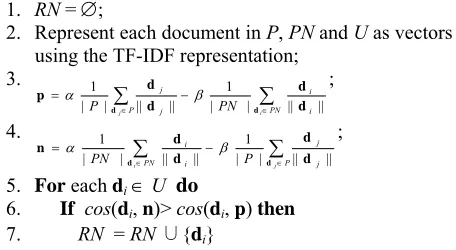
The algorithm for this sub-step is given in Fig-ure 4. Following the Rocchio formula, a positive and a negative prototype vectors p and n are built (lines 3 and 4), which are used to classify the doc-uments in U (lines 5-7). α and β are parameters for adjusting the relative impact of the positive and negative examples. In this work, we use α = 16 and
β = 4 as recommended in (Buckley et al. 1994).
Step 2: Learning by running SVM iteratively This step is similar to that in Roc-SVM, building
the final classifier by running SVM iteratively with the sets P, RN and the remaining unlabeled set Q
(Q = U – RN).
The algorithm is given in Figure 5. We run SVM classifiers Si (line 3) iteratively to extract more and more negative documents from Q. The iteration stops when no more negative documents can be extracted from Q (line 5). There is, howev-er, a danger in running SVM iteratively, as SVM is quite sensitive to noise. It is possible that during some iteration, SVM is misled by noisy data to extract many positive documents from Q and put them in the negative set RN. If this happens, the final SVM classifier will be inferior. As such, we employ a test to decide whether to keep the first SVM classifier or the final one. To do so, we use the final SVM classifier obtained at convergence (called Slast, line 9) to classify the positive set P to see if many positive documents in P are classified as negatives. Roc-SVM chooses 5% as the thre-shold, so CR-SVM also uses this threshold. If there are 5% of positive documents (5%*|P|) in P that are classified as negative, it indicates that SVM has gone wrong and we should use the first SVM clas-sifier (S1). In our experience, the first classifier is
always quite strong; good results can therefore be achieved even without catching the last (possibly better)classifier.
The main difference between Roc-SVM and CR-SVM is that Roc-SVM does not produce PN. It simply treats the unlabeled set U as negatives for extracting RN. Since PN is clearly a purer negative set than U, the use of PN by CR-SVM helps ex-tract a better quality reliable negative set RN which subsequently allows the final classifier of CR-SVM to give better results than Roc-CR-SVM.
Note that the methods (S-EM and CR-SVM) are all two-step algorithms in which the first step and the second step are independent of each other. The algorithm for the second step basically needs a good set of reliable negatives RN extracted from U. This means that one can pick any algorithm for the first step to work with any algorithm for the second step. For example, we can also have CR-EM which uses the algorithm (shown in Figures 3 and 4) of the first step of CR-SVM to combine with the al-gorithm of the second step of S-EM. CR-EM ac-tually works quite well as it is also able to exploit the more accurate reliable negative set RN ex-tracted using cosine and Rocchio.
1. RN = ∅;
2. Represent each document in P, PN and U as vectors using the TF-IDF representation;
3. ;
4. ;
5. For each di∈U do
6. If cos(di, n)> cos(di, p) then
[image:6.612.69.297.57.182.2]7. RN = RN∪{di}
Figure 4. Identifying RN using the Rocchio classifier
∑ ∑
∈ ∈
− =
PN i i P j
j
i
j PN
P d d d
d d
d p
|| || | |
1 || || | |
1 β
α
∑ ∑
∈ ∈
− =
P j j PN i
i
j
i P
PN d d d
d d
d n
|| || | |
1 || || | |
1 β
4
Empirical Evaluation
We now present the experimental results to support our claim that negative training data is not needed and can even harm text classification. We also show the effectiveness of the proposed PU learning methods CR-SVM and CR-EM. The following methods are compared: (1) traditional supervised learning methods SVM and NB which use both positive and negative training data; (2) PU learning methods, including two existing methods S-EM and Roc-SVM and two new methods CR-SVM and CR-EM, and (3) one-class SVM (Schölkop et al., 1999) where only positive training data is used in learning (the unlabeled set is not used at all).
We used LIBSVM1 for SVM and one-class
SVM, and two publicly available2 PU learning
techniques S-EM and Roc-SVM. Note that we do not compare with some other PU learning methods such as those in (Liu et al. 2003, Lee and Liu, 2003 and Elkan and Noto, 2008) as the purpose of this paper is not to find the best PU learning method but to show that PU learning can address our spe-cial sample selection bias problem. Our current methods already do very well for this purpose.
4.1 Datasets and Experimental Settings
We used two well-known benchmark data collec-tions for text classification, the Reuters-21578 col-lection3 and the 20 Newsgroup collection 4 .
Reuters-21578 contains 21578 documents. We used the most populous 10 out of the 135 catego-ries following the common practice of other re-searchers. 20 Newsgroup has 11997 documents from 20 discussion groups. The 20 groups were also categorized into 4 main categories.
We have performed two sets of experiments, and just used bag-of-words as features since our objective in this paper is not feature engineering.
(1) Test set has other topic documents. This set of experiments simulates the scenario in which the negative training and test samples have different distributions. We select positive, negative and
oth-ertopic documents for Reuters and 20 Newsgroup,
and produce various data sets. Using these data sets, we want to show that PU learning can do
1http://www.csie.ntu.edu.tw/~cjlin/libsvm/
2http://www.cs.uic.edu/~liub/LPU/LPU-download.html 3http://www.research.att.com/~lewis/reuters21578.html 4http://people.csail.mit.edu/jrennie/20Newsgroups/
ter than traditional learning that uses both positive and negative training data.
For the Reuters collection, each of the 10 cate-gories is used as a positive class. We randomly select one or two of the remaining categories as the negative class (denoted by Neg 1 or Neg 2), and then we randomly choose some documents from the rest of the categories as othertopic documents. These othertopic documents are regarded as tives and added to the test set but not to the nega-tive training data. They thus introduce a different distribution to the negative test data. We generated 20 data sets (10*2) for our experiments this way.
The 20 Newsgroup collection has 4 main cate-gories with sub-catecate-gories5; the sub-categories in
the same main category are relatively similar to each other. We are able to simulate two scenarios: (1) the other topic documents are similar to the negative class documents (similar case), and (2)
the othertopic documents are quite different from
the negative class documents (different case). This allows us to investigate whether the classification results will be affected when the othertopic docu-ments are somewhat similar or vastly different from the negative training set. To create the train-ing and test data for our experiments, we randomly select one sub-category from a main category (cat
1) as the positive class, and one (or two) sub-category from another sub-category (cat 2) as the nega-tive class (again denoted by Neg 1 or Neg 2). For
the other topics, we randomly choose some
5 The four main categories and their corresponding
sub-categories are: computer (graphics, os, ibmpc.hardware, mac.hardware, windows.x), recreation (autos, motorcycles, baseball, hockey), science (crypt, electronics, med, space), and
talk (politics.misc, politics.guns, politics.mideast, religion).
1. Every document in P is assigned the class label +1; 2. Every document in RN is assigned the label –1; 3. Use P and RN to train a SVM classifier Si, with i =
1 initially and i = i+1 with each iteration (line 3-7); 4. Classify Q using Si. Let the set of documents in Q
that are classified as negative be W;
5. If(W = ∅) then stop;
6. else Q = Q – W;
7. RN = RN∪W
8. goto (3);
9. Use the last SVM classifier Slast to classify P;
10. If more than 5% positives are classified as negative
11. then use S1 as the final classifier;
12. else use Slast as the final classifier;
ments from the remaining sub-categories of cat 2 for the similar case, and some documents from a randomly chosen different category (cat 3) (as the
other topic documents) for the different case. We
generated 8 data sets (4*2) for the similar case, and 8 data sets (4*2) for the different case.
The training and test sets are then constructed as follows: we partition the positive (and similarly for the negative) class documents into two standard subsets: 70% for training and 30% for testing. In order to create different experimental settings, we vary the number of the other topic documents that are added to the test set as negatives, controlled by a parameter α, which is a percentage of |TN|, where |TN| is the size of the negative test set without the
other topic documents. That is, the number of
oth-er topic documents added is α×|TN|.
(2) Test set has no other topic documents. This set of experiments is the traditional classification in which the training and test data have the same distribution. We employ the same data sets as in (1) but without having any other topic documents in the test set. Here we want to show that PU learn-ing can do equally well without uslearn-ing the negative training data even in the traditional setting.
4.2 Results with Other Topic Documents in Test Set
We show the results for experiment set (1), i.e. the distributions of the negative training and test data are different (caused by the inclusion of other topic
documents in the test set, or the addition of other
topic documents to complement existing negatives
in the test set). The evaluation metric is the F-score on the positive class (Bollmann and Cherniavsky, 1981), which is commonly used for evaluating text classification.
4.2.1 Results on the Reuters data
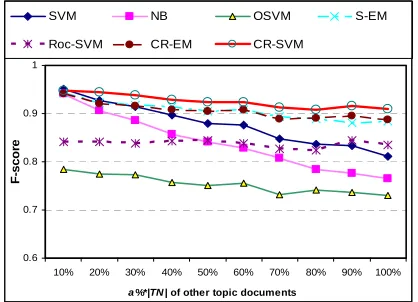
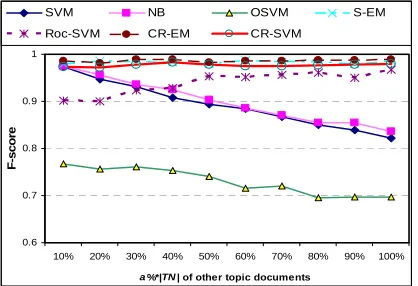
Figure 6 shows the comparison results when the negative class contains only one category of doc-uments (Neg 1), while Figure 7 shows the results when the negative class contains documents from two categories (Neg 2) in the Reuters collection. The data points in the figures are the averages of the results from the corresponding datasets.
Our proposed method CR-SVM is shown to per-form consistently better than the other techniques. When the size of the other topic documents (x -axis) in the test set increases, the F-scores of the
two traditional learning methods SVM and NB decreased much more dramatically as compared with the PU learning techniques. The traditional learning models were clearly unable to handle dif-ferent distributions for training and test data. Among the PU learning techniques, the proposed CR-SVM gave the best results consistently. Roc-SVM did not do consistently well as it did not manage to find high quality reliable negatives RN
[image:8.612.322.531.290.441.2]sometimes. The EM based methods (CR-EM and S-EM) performed well in the case when we had only one negative class (Figure 6). However, it did not do well in the situation where there were two negative classes (Figure 7) due to the underlying mixture model assumption of the naïve Bayesian classifier. One-class SVM (OSVM) performed poorly because it did not exploit the useful infor-mation in the unlabeled set at all.
[image:8.612.322.531.466.612.2]Figure 6.Results of Neg 1 using the Reuter data
Figure 7.Results of Neg 2 using the Reuter data
4.2.2 Results on 20 Newsgroup data
Recall that for the 20 Newsgroup data, we have two settings: similar case and different case. Similar case: Here, the othertopic documents are
0.6 0.7 0.8 0.9 1
10% 20% 30% 40% 50% 60% 70% 80% 90% 100%
a %*|TN | of other topic documents
F-s
c
o
re
SVM NB OSVM S-EM
Roc-SVM CR-EM CR-SVM
0.5 0.6 0.7 0.8 0.9 1
10% 20% 30% 40% 50% 60% 70% 80% 90% 100%
a %*|TN | of other topic documents
F-sco
re
SVM NB OSVM S-EM
similar to the negative class documents, as they belong to the same main category.
[image:9.612.319.533.214.369.2]The comparison results are given in Figure 8 (Neg 1) and Figure 9 (Neg 2). We observe that CR-EM, S-EM and CR-SVM all performed well. EM based methods (CR-EM and S-EM) have a slight edge over CR-SVM. Again, the F-scores of the traditional supervised learning (SVM and NB) deteriorated when more other topic documents were added to the test set, while CR-EM, S-EM and CR-SVM were able to remain unaffected and maintained roughly constant F-scores. When the negative class contained documents from two cate-gories (Neg 2), the F-scores of the traditional learning dropped even more rapidly. Both Roc-SVM and One-class Roc-SVM (ORoc-SVM) performed poorly, due to the same reasons given previously.
Figure 8. Results of Neg 1, similar case – using the 20
Newsgroup data
Figure 9. Results of Neg 2, similar case – using the 20
Newsgroup data
Different case: In this case, the other topic docu-ments are quite different from the negative class documents, since they are originated from different main categories.
The results are shown in Figures 10 (Neg 1) and 11 (Neg 2). The trends are similar to those for the
similar case, except that the performance of the
traditional supervised learning methods (SVM and NB) dropped even more rapidly with more other
topic documents. As the other topic documents
have very different distributions from the negatives in the training set in this case, they really confused the traditional classifiers. In contrast, the three PU learning techniques were still able to perform con-sistently well, regardless of the number of other
[image:9.612.81.291.279.429.2]topic documents added to the test data.
Figure 10. Results of Neg 1, different case – using the
[image:9.612.321.531.401.558.2]20 Newsgroup data
Figure 11. Results of Neg 2, different case – using the
20 Newsgroup data
In summary, the results showed that learning with negative training data based on the traditional paradigm actually harms classification when the identical distribution assumption does not hold.
4.3 Results without Other Topic Documents in Test Set
Given an application, one may not know whether 0.6
0.7 0.8 0.9 1
10% 20% 30% 40% 50% 60% 70% 80% 90% 100%
a %*|TN | of other topic documents
F
-sco
re
SVM NB OSVM S-EM
Roc-SVM CR-EM CR-SVM
0.6 0.7 0.8 0.9 1
10% 20% 30% 40% 50% 60% 70% 80% 90% 100%
a %*|TN | of other topic documents
F-score
SVM NB OSVM S-EM
Roc-SVM CR-EM CR-SVM
0.6 0.7 0.8 0.9 1
10% 20% 30% 40% 50% 60% 70% 80% 90% 100%
a %*|TN| of othe r topic docume nts
F-s
c
or
e
SVM NB OSVM S-EM
Roc-SVM CR-EM CR-SVM
0.6 0.7 0.8 0.9 1
10% 20% 30% 40% 50% 60% 70% 80% 90% 100%
a %*|TN| of othe r topic docume nts
F-sc
or
e
SVM NB OSVM S-EM
[image:9.612.82.291.465.608.2]the identical distribution assumption holds. The above results showed that PU learning is better when it does not hold. How about when the as-sumption does hold? To find out, we compared the results of SVM, NB, and three PU learning me-thods using the datasets without any other topic
documents added to the test set. In this case, the training and test data distributions are the same.
Table 1 shows the results for this scenario. Note that for PU learning, the negative training data were not used. The traditional supervised learning techniques (SVM and NB), which made full use of the positive and negative training data, only per-formed just about 1-2% better than the PU learning method CR-SVM (which is not statistically signifi-cant based on paired t-test). This suggests that we can do away with negative training data, since PU learning can perform equally well without them. This has practical importance since the full cover-age of negative training data is hard to find and to label in many applications.
[image:10.612.71.301.427.510.2]From the results in Figures 6–11 and Table 1, we can conclude that PU learning can be used for binary text classification without the negative training data (which can be harmful for the task). CR-SVM is our recommended PU learning method based on its generally consistent performance.
Table 1. Comparison of methods without other
docu-ments in test set
Methods
Reuters (Neg 1)
Reuters (Neg 2)
20News (Neg 1)
20News (Neg 2)
SVM 0.971 0.964 0.988 0.990
NB 0.972 0.947 0.988 0.992
S-EM 0.952 0.921 0.974 0.975
CR-EM 0.955 0.897 0.983 0.986 CR-SVM 0.960 0.959 0.967 0.974
5
Conclusions
This paper studied a special case of the sample se-lection bias problem in which the positive training and test distributions are the same, but the negative training and test distributions may be different. We showed that in this case, the negative training data should not be used in learning, and PU learning can be applied to this setting. A new PU learning algorithm (called CR-SVM) was also proposed to overcome the weaknesses of the current two-step algorithms.
Our experiments showed that the traditional classification methods suffered greatly when the distributions are different for the negative training
and test data, but PU learning does not. We also showed that PU learning performed equally well in the ideal case where the training and test data have identical distributions. As such, it can be advanta-geous to discard the potentially harmful negative training data and use PU learning for classification. In our future work, we plan to do more compre-hensive experiments to compare the classic super-vised learning and PU learning techniques with different kinds of settings, for example, by varying the ratio between positive and negative examples, as well as their sizes. It is also important to explore how to catch the best iteration of the SVM/NB classifier in the iterative running process of the algorithms. Finally, we would like to point out that it is conceivable that negative training data could still be useful in many cases. An interesting direc-tion to explore is to somehow combine the ex-tracted reliable negative data from the unlabeled set and the existing negative training data to further enhance learning algorithms.
References
Agirre E., Lacalle L.O. 2009. Supervised Domain
Adap-tion for WSD. Proceedings of the 12th Conference of
the European Chapter for Computational Linguistics (EACL09), pp 42-50.
Andrew A., Nallapati R., Cohen W., 2008. Exploiting Feature Hierarchy for Transfer Learning in Named
Entity Recognition, ACL.
Bickel, S., Bruckner, M., and Scheffer. 2009. T.
Dis-criminative learning under covariate shift. Journal of
Machine Learning Research.
Bickel S. and Scheffer T. 2007. Dirichlet-enhanced
spam filtering based on biased samples. In Advances
in Neural Information Processing Systems.
Bollmann, P.,& Cherniavsky, V. 1981.
Measurement-theoretical investigation of the mz-metric.
Informa-tion Retrieval Research.
Buckley, C., Salton, G., & Allan, J. 1994. The effect of adding relevance information in a relevance
feed-back environment, SIGIR.
Blum, A. and Mitchell, T. 1998. Combining labeled and
unlabeled data with co-training. In Proc. of
Compu-tational Learning Theory, pp. 92–10.
Chan Y. S., Ng H. T. 2007. Domain Adaptation with
Active Learning for Word Sense Disambiguation,
ACL.
Dempster A., Laird N. and Rubin D.. 1977. Maximum
likelihood from incomplete data via the EM algorithm,
Journal of the Royal Statistical Society.
Denis F., Laurent A., Rémi G., Marc T. 2003. Text clas-sification and co-training from positive and unlabeled
examples. ICML.
Denis, F, Rémi G, and Marc T. 2002. Text
Classifica-tion from Positive and Unlabeled Examples. In
Pro-ceedings of the 9th International Conference on Information Processing and Management of Uncer-tainty in Knowledge-Based Systems.
Downey, D., Broadhead, M. and Etzioni, O. 2007.
Lo-cating complex named entities in Web Text. IJCAI.
Dudik M., Schapire R., and Phillips S. 2005. Correcting sample selection bias in maximum entropy density
estimation. In Advances in Neural Information
Proc-essing Systems.
Elkan, C. and Noto, K. 2008. Learning classifiers from
only positive and unlabeled data. KDD, 213-220.
Goldwasser, D., Roth D. 2008. Active Sample Selection
for Named Entity Transliteration, ACL.
Heckman J. 1979. Sample selection bias as a
specifica-tion error. Econometrica, 47:153–161.
Huang J., Smola A., Gretton A., Borgwardt K., and Scholkopf B. 2007. Correcting sample selection bias
by unlabeled data. In Advances in Neural
Informa-tion Processing Systems.
Jiang J. and Zhai C. X. 2007. Instance Weighting for
Domain Adaptation in NLP, ACL.
Lee, W. S. and Liu, B. 2003. Learning with Positive and Unlabeled Examples Using Weighted Logistic
Re-gression. ICML.
Lewis D. 1995. A sequential algorithm for training text
classifiers: corrigendum and additional data. SIGIR
Forum, 13-19.
Li, S., Zong C., 2008. Multi-Domain Sentiment
Classifi-cation, ACL.
Li, X., Liu, B. 2003. Learning to classify texts using
positive and unlabeled data, IJCAI.
Li, X., Liu, B., 2005. Learning from Positive and
Unla-beled Examples with Different Data Distributions.
ECML.
Li, X., Liu, B., 2007. Learning to Identify Unexpected
Instances in the Test Set. IJCAI.
Li, X., Yu, P. S., Liu B., and Ng, S. 2009. Positive
Unlabeled Learning for Data Stream Classification,
SDM.
Li, X., Zhang L., Liu B., and Ng, S. 2010. Distribution-al Similarity vs. PU Learning for Entity Set Expan-sion, ACL.
Liu, B, Dai, Y., Li, X., Lee, W-S., and Yu. P. 2003.
Building text classifiers using positive and unlabeled
examples. ICDM, 179-188.
Liu, B, Lee, W-S, Yu, P. S, and Li, X. 2002. Partially
supervised text classification. ICML, 387-394.
Nigam, K., McCallum, A., Thrun, S. and Mitchell, T. 2000. Text classification from labeled and unlabeled
documents using EM. Machine Learning, 39(2/3),
103–134.
Pan, S. J. and Yang, Q. 2009. A survey on transfer
learning. IEEE Transactions on Knowledge and
Da-ta Engineering, Vol. 99, No. 1.
Rocchio, J. 1971. Relevant feedback in information retrieval. In G. Salton (ed.). The smart retrieval
sys-tem:experiments in automatic document processing,
Englewood Cliffs, NJ, 1971.Sagae K., Tsujii J. 2008.
Online Methods for Multi-Domain Learning and
Adaptation, EMNLP.
Salton G. and McGill M. J. 1986. Introduction to
Mod-ern Information Retrieval.
Schölkop f B., Platt J.C., Shawe-Taylor J., Smola A.J., and Williamson R.C. 1999. Estimating the support
of a high-dimensional distribution. Technical report,
Microsoft Research, MSR-TR-99-87.
Shimodaira H. 2000. Improving predictive inference under covariate shift by weighting the log-likelihood
function. Journal of Statistical Planning and
Infer-ence, 90:227–244.
Sugiyama M. and Muller K.-R. 2005. Input-dependent estimation of generalization error under covariate
shift. Statistics and Decision, 23(4):249–279.
Sugiyama M., Nakajima S., Kashima H., von Bunau P., and Kawanabe M. 2008. Direct importance estima-tion with model selecestima-tion and its applicaestima-tion to
co-variate shift adaptation. In Advances in Neural
Information Processing Systems.
Tsuboi J., Kashima H., Hido S., Bickel S., and Sugi-yama M. 2008. Direct density ratio estimation for
large-scale covariate shift adaptation. In
Proceed-ings of the SIAM International Conference on Data Mining, 2008.
Wu D., Lee W.S., Ye N. and Chieu H. L. 2009. Domain
adaptive bootstrapping for named entity recognition,
ACL.
Wu Q., Tan S. and Cheng X. 2009. Graph Ranking for
Sentiment Transfer, ACL.
Yang Q., Chen Y., Xue G., Dai W., Yu Y. 2009. Hete-rogeneous Transfer Learning for Image Clustering
via the SocialWeb, ACL
Yu, H., Han, J., K. Chang. 2002. PEBL: Positive exam-ple based learning for Web page classification using SVM. KDD, 239-248.
Zadrozny B. 2004. Learning and evaluating classifiers
under s ample selection bias, ICML.
Zhou Z., Gao J., Soong F., Meng H. 2006. A Compara-tive Study of DiscriminaCompara-tive Methods for Reranking LVCSR N-best Hypotheses in Domain Adaptation