doi:10.4236/ajcm.2011.12011 Published Online June 2011 (http://www.scirp.org/journal/ajcm)
The Odd-Point Ternary Approximating Schemes
Ghulam Mustafa*, Abdul Ghaffar, Faheem Khan
Department of Mathematics, The Islamia University of Bahawalpur Pakistan, Bahawalpur, Pakistan E-mail:{mustafa_rakib, gulzarkhan143}@yahoo.com, [email protected]
Received April 1, 2011; revised May 3, 2011; accepted May 15, 2011
Abstract
We present a general formula to generate the family of odd-point ternary approximating subdivision schemes with a shape parameter for describing curves. The influence of parameter to the limit curves and the suffi-cient conditions of the continuities from C0 to C5 of 3- and 5-point schemes are discussed. Our family of 3-point and 5-point ternary schemes has higher order of derivative continuity than the family of 3-point and 5-point schemes presented by [16]. Moreover, a 3-point ternary cubic B-spline is special case of our family of 3-point ternary scheme. The visual quality of schemes with examples is also demonstrated.
Keywords: Approximating Subdivision Scheme, Derivative Continuity, Smoothness Convergence, Shape Parameters, Laurent Polynomial
1. Introduction
Subdivision schemes are important and powerful tools for generation of smooth curves and surfaces from a set of control points by means of iterative refinement. Their popularity is due to the facts that subdivision algorithms are easy to implement and suitable for computer applica-tions. If the limit curve/surface approximate the initial control polygon and that after subdivision, the newly generated control points are not in the limit curve/ sur-face, the scheme is said to be approximating. It is called interpolating if after subdivision, the control points of the original control polygon and the new generated control points are interpolated on the limit curve/surface.
Beccari et al. [1] introduced an interpolating 4-point 2
C ternary non-stationary subdivision scheme with ten-sion control. Hassan and Dodgson [2] presented ternary and three-point univariate subdivision schemes. Khan and Mustafa [3] offered ternary six-point interpolating subdivision scheme. Ko et al. [4] presented a ternary 4-point approximating subdivision scheme. Dyn [5] gave the analysis of interpolatory subdivision schemes by the formalism of Laurent polynomials. [6,7] and [8] also introduced the analysis of the scheme by Laurent poly-nomials methods. Sabin [9] has presented eigenanalysis and artifacts of subdivision curves and surfaces. Levin [10] has presented the polynomial generation and quasi interpolation in stationary non-uniform subdivision sche- mes. Hormann et al. [11] introduced a family of subdivi-sion schemes with cubic precisubdivi-sion. Dyn et al. [12] have
presented polynomial reproduction by symmetric sche- mes.
Since higher arity schemes have very nice properties (i.e. high smoothness, high approximation order and lower support) than their counterpart of lower arity schemes. Therefore research communities are gaining interest in introducing higher arity schemes (i.e. ternary, quater-nary,…, a-ary). Mustafa and Khan [13] offered a new 4- point C3 quaternary approximating subdivision scheme. Lian [14] generalized classical 4-point and 6-point inter-polating schemes to a-ary interpolating schemes for any integer a3. These new a-ary schemes are derived from corresponding two scale functions, a notion from the content of wavelets. Lian [15] has also introduced a-ary 3-point and 5-point interpolating schemes for ar-bitrary odd integer a3. Unfortunately, schemes pre-sented by [15] have very stumpy smoothness that is Lian’s 3- and 5-point schemes have C1 continuity while schemes introduced in this article have C2 and C5 continuity respectively. Lian [16] also offered 2m-point and (2m1) -point interpolating a -ary schemes for curve design. Mustafa and Rehman [17] introduced the explicit formulae to generate the mask of (2b4)-point n-ary subdivision scheme. Siddiqi and Rehan [18] in-troduced modified form of binary and ternary 3-point subdivision schemes which are C1and C2in the inter-vals
1 , 5
8 24
and
1 , 7
72 72intervals are too narrow to provide freedom for curve designing. This motivates us to present the family of odd-point ternary schemes with high smoothness and more degree of freedom for curve designing.
The paper is organized as follows: we recall basic definitions and preliminary results in Section 2. The family of odd-point ternary approximating schemes and analysis by Laurent formalism of one odd-point ternary scheme is presented in Section 3. Basic properties of odd-point ternary schemes are discussed in Section 4. Comparison with existing odd-point ternary schemes is also shown in this section. A few remarks and future work constitute Section 5.
2. Preliminaries
A general compact from of univariate ternary subdivision scheme S which maps polygon fk
fik i Z to arefined polygon fk 1
fik 1 i Z
is defined by
1
3 ,
k k
i j i i j Z
f f
i Z , (2.1)where the set a
a i Zi:
of coefficients is called the mask at kth level of refinement. A necessary condi-tion for the uniform convergence of subdivision scheme (2.1) is that3j 3j1 3j 2 1.
j Z j Z j Z
(2.2)A subdivision scheme is uniformly convergent if for any initial data 0 { o: }
i
f f i Z , there exists a con-tinuous function f such that for any closed interval
IR, satisfies
3 lim sup
k
k i I (3 ) 0.
k k
i
f f i
Obviously, f S f 0.
For analysis of scheme, the z-transform of the mask ( ) i i,
i Z
z a z
(2.3)which is usually called the Laurent polynomial of scheme and plays a crucial role in the analysis of the scheme. From (2.2) and (2.3) the Laurent polynomial of convergent subdivision scheme satisfies
2 /3 4 /3
( i ) ( i ) 0
a e a e
and a(1)3. (2.4) This condition guarantees the existence of a related sub-division scheme for the divided differences of the origi-nal control points and the existence of an associated Laurent polynomial a(1)( )z
2 (1)
2
3
( ) ( ).
1
z
a z a z
z z
The subdivision scheme S1 with Laurent polynomial
(1)
( )
a z , is related to scheme S with Laurent polyno-mial a z( ) by the following theorem.
Theorem 2.1. [1] Let S denote a subdivision scheme with Laurent polynomial a z( ) satisfying (2.4). Then there exists a subdivision scheme S1 with the property
1
1 , ( )
k k
f S f a z
where fk S fk 0
and {( ) 3 ( 1 );
k k k k k i i i
f f f f
}
i Z . Furthermore, S is a uniformly convergent if and only if 1
1
3S converges uniformly to zero function
for all initial data f0, in the sense that
lim 0
k
0 1 1
0 3
k
S f
The above theorem indicates that for any given scheme S, with mask ' 'a . satisfying (2.2), we can prove the uniform convergence of S by deriving the mask of
1
1
3S and computing
1 1 3i S
for i1, 2, 3,,L ,
where L is the first integer for which
1 1 1 3L
S . If
such an L exists, then S converges uniformly. Since there are three rules for computing the values at next refinement level, so we define the norm
3 3 1 3 2
max j, , j j
j Z j Z j Z
S a a
, (2.5)and
[ , ] 3
1
max ; 0, 1, 2, ,3 1
3 L
L
n L L
n i j
j Z
S b i
, (2.6)where
1
[ , ] 3
1
1
( ) ( )
3
L n
n L j
L j
b z a z
, (2.7)and
2 2
( ) ( 1)
2 2
3 3
( ) ( ) ( ),
1 1
1.
n
n z n z
a z a z a z
z z z z
n
(2.8)
Theorem 2.2. [6] Let S be subdivision scheme with a
characteristic polynomial ( ) 1 2 ( ) 2
3 n z z
a z q z
z
. If
the subdivision scheme Sn corresponding to the poly-nomial q z( ) converges uniformly, then S f 0
n
Corollary 2.3. [6] If S is a subdivision scheme of the form above and 1 1
3Sn converges uniformly to the zero function for all initial data f0 then
0 n
S f C R for any initial control polygon f0. Corollary 2.3 indicates that for any given ternary sub-division scheme S, we can prove S f 0C Rn( ) by first deriving the mask of 1 1
3Sn and then computing
1 1 3i
n S
for i1, 2, 3,,L, where L is the first
integer for which
1 1 1 3L
n S
If such an L exists,
then S f 0C Rn( ).
3. The Odd-Point Ternary Approximating
Schemes
Here we propose the general formula for odd-point ter-nary approximating subdivision schemes with one pa-rameter in the form of Laurent polynomial
1 2
2
1
( ) (1 )
3
1 5 1
2
12 6 12
n n
a z z z
z z (3.1)
where 2n3, n0. Although one can easily gen-erate
2n3
-point ternary schemes for n0 from (3.1), for simplicity, we generate and discuss the smoothness of only 3-point ternary scheme. The smoothness of other odd-point ternary schemes can be computed in similar way. Moreover, for n0 ,1 / 4
(3.1) simplifies to [1, 4, 10, 16, 19, 16, 10, 4, 1] / 27 which is just 3-point ternary cubic B-spline.
3.1. A 3-Point Ternary Scheme
From (3.1) for n0, we get Laurent polynomial for 3-point scheme
2 [3]
3 4 5
6 7 8
1 1 13 37
( )
9 12 12 12
35 41 35
2 2 2
6 6 6
37 13 1
12 12 12
a z z z
z z z
z z z
.
This gives the mask of 3-point scheme
[3]
1 1 13 37
0, , 0, 0, , , ,
9 12 12 12
35 41 35
2 , 2 , 2 ,
6 6 6
37 13 1
, , , 0, 0, , 0
12 12 12
a
.
From the above mask, we suggest following 3-point ternary approximating scheme
1 3 1 1 3 1 1 1 3 2 37 35 2 12 6 1 , 9 1 12 13 41 2 12 6 1 , 9 13 12 1 35 2 12 6 1 9 37 12 k k i i k i i k i k k i i k i i k i k k i i k i i f f f f f f f f f f f 1 . k i f (3.2)
From (2.8), we have 2 (1)
[3] 2 [3]
3
( ) ( ).
1 z
a z a z
z z This implies 2 2 (1) [3]
3 4 5 6
1
2 12
3 17 1
2 2
6 12
z z z
a
z z z z
and (1) [3] 1 17
0, , 0, 0, , 1, 2, 2 ,
12 6
1
3 1
2, 1, , 0, 0, , 0
12 a From (2.7), we have
2 [1, 1] (1)
[3] 2 [3]
1 1 3
( ) ( )
3 3 1
z
b a z a z
z z . This implies 2 3 2 [1, 1]
4 5 6
1 17 2 2 12 6 9 1 2 12
z z z
z b
z z z
This can be written as
3 2
[1, 1] 1 0
5
1 2 3
1 12 1 17 2 2 6 9 1 2 12 z z
b z z
z
z z z
(3.3)
If S1[3] is the scheme corresponding to
(1) [3]
a , then for 0
C continuity, we require that a[3](1) satisfies (2.2),
which it does and
1[3]1 1
3
L
S
Since from (2.6), for
1
L , we have
[1, 1]
1 3
1
max ; 0, 1, 2
3 j Z i j
S b i
.This implies that
[1, 1]
1 3
1
max ; 0, 1, 2
3 j Z i j
S b i
.for integer values of j ( 3 3j3 ) that is
1, 0, 1
j and from (3.3), we get
1 [1, 1]
3 3 0 3 1
1 1 1 17 1
2
9 12 9 6 12
2 1 1 17
2
9 12 9 6
j j
b b b b
, 1 [1, 1]1 3 2 1 4
1
1 2 1
= 0
9 9 3
j j
b b b b
, and 1 [1, 1]2 3 1 2 5
1
2 1 1
0
9 9 3
j j
b b b b
.Summarizing, we get following for 19 35
12 12
[3] 1 1 3
2 1 1 17 1
max 2 , 1
9 12 9 6 3
S
. (3.4)
Then by Theorem 2.1, 3-point scheme is C0. From (2.8), we have
[3] 2 (2) (1) [3] 2 3 ( ) ( ) 1 z
a z a z
z z . This implies 2 (2) 4 [3] 3 4 1 11 2 12 12 ( ) 11 1 2 12 12 z z a z z
z z , and (2) [3] 1 11
0, , 0, 0, , 2 ,
12 12
1
3 11 1
1, 2 , , 0, 0, , 0
12 12 a .
If S[3]2 is the scheme corresponding to
(2) [3]
a , then for 1
C continuity, we require that a[3](2) satisfies (2.2),
which it does and
1 S3 [3]2 1.L
Since from (2.6),
for 13 23
18 18
and L1, we have
[3] 2
1
3
1 1 1 11 1
max 2 , 1
3 12 3 12 3
S
, (3.5)
then by Corollary 2.3, 3-point scheme is C1. From (2.8) we have [3] 2 (3) (2) [3] 2 3 ( ) ( ) 1 z
a z a z
z z . This implies 2 (3) 4 [3] 3 4 1 11 2 12 12 ( ) 11 1 2 12 12 z z a z z
z z , and (3) [3] 1
0, , 0, 0, ,
12 1
3 5 1
2 , , 0, 0, , 0
6 12 a .
If S[3]3 is the scheme corresponding to
(3) [3]
a , then for 2
C continuity, we require that a[3](3) satisfies (2.2),
which it does and
1 S[3]3 1 3L
. Since from (2.6), for
1 11
[3] 3
1 1 5
max , 2 1
3 12 6
L
S
, (3.6)
then by Corollary 2.3, 3-point scheme is C2 .
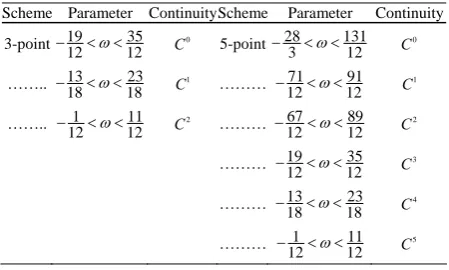
Remark: The continuity of 5-point ternary scheme can be computed in a similar fashion. The sufficient con-ditions for the order of continuity of proposed 3-point and 5-point ternary schemes for certain ranges of pa-rameter are given in Table 1.
4. Basic Properties of the Schemes
In this section, we discuss basic properties of odd-point ternary approximating subdivision schemes that are their precision set and support of basic limits function.
4.1. Precision Set
Here, we find the precision set of 3-point ternary scheme.
Lemma 4.1. The proposed 3-point ternary precision set scheme has quadratic precision for and cubic at
1 4 .
Proof. We carry out this result by taking our origin the middle of an original span with ordinate , ( 3) , n
( 1) , (1) , (3) , n n n
If yxn, then we have
1 2 3 4
5 4 3 2
1 1 2 3 4
5 4 3 2 1
[ ] , ( 3) ( 1) (1) , ( 3) ( 1) (1) , ( 3) ( 1) (1) , ( 1) (1) (3) , ( 1) (1) (3) , ( 1) (1) (3) ,
n n n n
n n n n
n n n n n
n n n n n
y a a a a
a a a a
a a a a a
a a a a a
where 1
1 37 9 12 a
, 2
1 35 2 9 6 a
, 3
1 9 a
1 12
, 4
1 13 9 12 a
, 5
1 41 2 9 6 a
,
If y x1
, then
5 1 1 5
[ ] , 1, , , 1, ,
3 3 3 3
y
2 2 2 2 2 , , , , , ,
3 3 3 3 3 y
,
2
[ y], where represents the differences of the vertices.
If y x2
, then
101 8 29 8 29 8
[ ] , , , ,
27 9 27 9 27 9
29 8 29 8 101 8
, , ,
27 9 27 9 27 9
y
[image:5.595.311.536.104.239.2],
Table 1. The order of continuities of proposed 3-point and
5-point ternary approximating schemes are given below.
Scheme Parameter ContinuityScheme Parameter Continuity
3-point 19 35 12 12
C0 5-point 28 131 3 12
C0
…….. 13 23 18 18
C1 ……… 71 91
12 12
C1
…….. 1 11 12 12
C2
……… 67 89 12 12
C2
……… 19 35 12 12
C3
……… 13 23 18 18
C4
……… 1 11 12 12
C5
Taking further differences, we get [3y. If y x3, then
89 8 35 8 5 8
[ ] , , , ,
9 3 27 3 9 3
5 8 35 8 89 8 , , ,
9 3 9 3 9 3
y
,
by taking further differences, we have
4
[ y, , ,, 4
[ y 0, at =1
4
,
Thus by [9], the proposed scheme has quadratic preci-sion and cubic at 1
4
. Similarly one can easily prove that proposed 5-point ternary approximating sub-division scheme has quintic (i.e. 5) precision set for and sextic (i.e. 6) at 1
4
.
4.2. Remark
Actually, due to the referee’s implication/allusion, we can find the approximation order of proposed 3-point ternary scheme by taking 1
4
. The mask of 3-point
scheme at 1 4
simplifies to [1, 4, 10, 16, 19, 16,
10, 4, 1] / 27, which is just the ternary cubic B-spline. Now according to the precision analysis this scheme has cubic precision, which is totally correct because cubic polynomials are special case of cubic B-spline, of course. However, B-splines are well-known to have approxima-tion order 2
( )
o h . Here it is pointed that the presented version of the paper owes much to the precise and kind remarks of the anonymous referee.
4.3. Support of Basic Limit Function
function of proposed scheme for the following data
0 1, 0,
0, 0.
i
i f
i
[image:6.595.65.279.224.669.2] (4.4)
Figure 1 (a) and (b) show the basic limit functions,
0i
S f
of proposed µ-point ternary approxi-mating schemes, for 2n3, 0,1n respectively. The following theorem is related to the support of basic limit functions for odd-point ternary schemes.
Theorem 4.4. The basic limit functions of pro-
(a)
(b)
Figure 1. The basic limit functions of proposed schemes at 1
= 12
ω . (a) 3-point scheme; (b) 5-point scheme.
posed -point ternary approximating scheme has sup-port width s n 1, for 2n3, n0, which implies that it vanishes outside the interval 1,
2 n
1 2
n
Proof. Since the basic function is the limit function of the scheme for the data(4.1), its support width ′s′can be determine by computing how for the effect of the non-zero vertex f00 will propagate along by. As the
mask of -point scheme is 3 -long sequence by centering it on that vertex, the distances to the last of its left and right non-zero coefficients are equal to 1.
(a) (b)
(c) (d)
[image:6.595.305.536.263.639.2](e) (f)
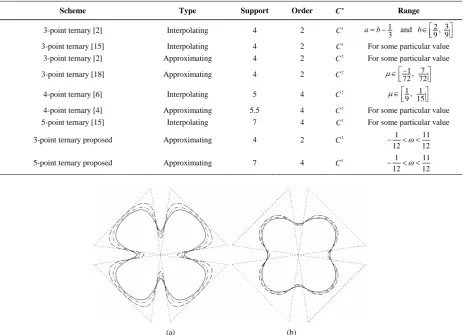
Table 2. Comparison of proposed 3- and 5-point ternary schemes.
Scheme Type Support Order Cn Range
3-point ternary [2] Interpolating 4 2 C1 1 3
a b and 2 , 3 9 9
b
3-point ternary [15] Interpolating 4 2 C1 For some particular value 3-point ternary [2] Approximating 4 2 C2 For some particular value
3-point ternary [18] Approximating 4 2 C2 1 , 7 72 72
4-point ternary [6] Interpolating 5 4 C2 1, 1 9 15
4-point ternary [4] Approximating 5.5 4 C2
For some particular value 5-point ternary [15] Interpolating 7 4 C1
For some particular value
3-point ternary proposed Approximating 4 2 C2 1 11 12 12
5-point ternary proposed Approximating 7 4 C5 1 11 12 12
(a) (b)
Figure 3. Dotted lines indicate initial polygons. Dashes, dashes dot and solid line show the visual smoothness of proposed
schemes for the parametric value at =-1
12
ω , =1 6
ω and =1
3
ω respectively. (a) 3-point scheme; (b) 5-point scheme.
At the first subdivision step, we see that the vertices on the both sides of f01 at
1 3
n
are the furthest non- zeronew vertices. At each refinement, the distances on both sides are reduced by thefactor 1
3. At the next step of the scheme this will propagate along by 1 1
3 3
n
onboth sides. Hence after k subdivision steps the fur-thest non-zero vertex on the left will be at
12
0 1
1 1 1 1
1 ...
3 3 3 3 3
k
k j
j n
n
. Sothe total support width is
1
0
1 1
2
3 3
k
j j n
1 n .
[image:7.595.66.532.111.446.2]4.4. Comparison and Application
Table 2 shows that the support size and continuity of proposed 3-point ternary scheme is same as 3-point ter-nary scheme introduced by [18]. It is also declared that the scheme introduced by [18] is C2 for
1 , 7
72 72
while our 3-point scheme is C2 for
1, 11
12 12 which
In Table 2, we have pointed out that proposed 5-point ternary scheme is C5 continuous while the 5-point ter-nary scheme of [15] is C1.
Figure 2 shows the visual comparison of 3- and 5-point ternary interpolating schemes of Lian [15] with the proposed 3- and 5-point ternary approximating schemes. Figure 3 is exposed to show the role of shape parameter when proposed 3- and 5-point schemes applied on discrete data points. From this figure, we see that the behavior of the limiting curve acts as tightness when the choice of shape parameter vary from right to left in the interval
1, 11
12 12
.
5. Conclusions
The family of odd-point approximating schemes for curve design has established. Smoothness and approximation order of 3- and 5-point ternary schemes have been dis-cussed. Support of family of odd-point ternary schemes has computed in general. It has been shown that pro-posed schemes are better then existing odd-point ternary schemes in the sense of smoothness. The family of even-point ternary approximating schemes will be stud-ied in detail in the forthcoming paper.
6. Acknowledgements
The presented version of the paper owes much to the precise and kind remarks of the anonymous referee. This work is supported by the Indigenous Ph. D. Scholarship Scheme of Higher Education Commission (HEC) Paki-stan
7. References
[1] C. Beccari, Gcasiola and L. Romani, “An Interpolating 4-Point C2
Ternary Non-Stationary Subdivision Scheme with Tension Control,” Computer Aided Geometric
De-sign, Vol. 24, No. 4, 2007, pp. 210-219.
doi:10.1016/j.cagd.2007.02.001
[2] M. F. Hassan, “Further Analysis of Ternary and 3-Point Univariate Subdivision Schemes,” Technical Report 599, University of Cambridge Computer Laboratory, ISSN 1476-2986, 2004.
[3] K. P. Ko, B.-G. Lee and G. Yoon, “A Ternary 4-Point Approximating Subdivision Scheme,” Applied
Mathemat-ics and Computation, Vol. 190, No. 2, 2007, pp. 1563- 1573. doi:10.1016/j.amc.2007.02.032
[4] S. S. Siddiqi and K. Rehan, “Modified Form of Binary and Ternary 3-Point Subdivision Scheme,” Applied
Mathematics and Computation, Vol. 216, No. 3, 2010, pp. 970-982. doi:10.1016/j.amc.2010.01.115
[5] M. F. Hassan, N. A. Dodgson, “Ternary and Three-Point Univariate Subdivision Schemes,” In: A. Cohen, J. L.
Marrien, L. L. Schumaker, Eds., Curve and Surface
Fit-ting: Sant-Malo 2002, Nashboro Press, Brentwood, 2003, pp. 199-208.
[6] M. F. Hassan, I. P. Ivrissimitzis, N. A. Dodgson and M. A. Sabin, “An Interpolating 4-Point C2
Ternary Sta-tionary Subdivision Scheme,” Computer Aided
Geomet-ric Design, Vol. 19, No. 1, 2002, pp. 1-18.
doi:10.1016/S0167-8396(01)00084-X
[7] F. Khan and G. Mustafa, “Ternary Six-Point Interpolating Subdivision Scheme,” Lobachevskii Journal of
Mathe-matics, Vol. 29, No. 3, 2008, pp. 153-163.
[8] D. Levin, “Using Laurent Polynomial Representation for the Analysis of Non-Uniform Binary Subdivision Schemes,” Advances in Computational Mathematics, Vol. 11, No. 1, 1999, pp. 41-54.
doi:10.1023/A:1018907522165
[9] G. Mustafa and F. Khan, “A New 4-Point C3 Quater-nary Approximating Subdivision Scheme,” Abstract and
Applied Analysis, Vol. 2009, 2009, Article ID 301967.
doi:10.1155/2009/301967
[10] M. Sabin, “Eigenanalysis and Artifacts of Subdivision Curves and Surfaces, Tutorials on Multiresolution in Geometric Modeling,” In: A. Isle, E. Quak and M. S. Floater, Eds., Springer, Berlin, 2002, pp. 69-92.
[11] N. Dyn, K. Hormann, M. A. Sabin and Z. Shen, “Poly-nomial Reproduction by Symmetric Subdivision Schemes,” Journal of Approximation Theory, Vol. 155, No. 1, 2008, pp. 28-42. doi:10.1016/j.jat.2008.04.008
[12] G. Mustafa, and A. R. Najma, “The Mask of
2b4
- Point n-ary Subdivision Scheme,” Computing, Vol. 90, No. 1-2, 2010, pp. 1-14. doi:10.1007/s00607-010-0108-x[13] J.-A. Lian, “On a-ary Subdivision for Curve Design: III. 2m-Point and
2m1
-Point Interpolatory Schemes,”Applications and Applied Mathematics: An International Journal, Vol. 4, No. 2, 2009, pp. 434-444.
[14] K. Hormann and M. A. Sabin, “A Family of Subdivision Schemes with Cubic Precision,” Computer Aided Geo-metric Design, Vol. 25, No. 1, 2008, pp. 41-52.
doi:10.1016/j.cagd.2007.04.002
[15] A. Levin, “Polynomial Generation and Quasi-Interpolation in Stationary and Non-Uniform Subdivision Schemes,”
Computer Aided Geometric Design, Vol. 20, No. 1, 2003, pp. 41-60. doi:10.1016/S0167-8396(03)00006-2
[16] J.-A. Lian, “On a-ary Subdivision for Curve Design: II. 3-Point and 5-Point Interpolatory Schemes,” Applications
and Applied Mathematics: An International Journal, Vol. 3, No. 2, 2008, pp. 176-187.
[17] Y. Tang, K. P. Ko and B.-G. Lee, “A New Proof of Smoothness of 4-Point Deslauriers-Dubic Scheme,”
Journal of Applied Mathematics and Computing, Vol. 18, No. 1-2, 2005, pp. 553-562.
[18] J.-A. Lian, “On a-ary Subdivision for Curve Design: I. 4-Point and 6-Point Interpolatory Schemes,” Applications
![Figure 2. Comparison: Dotted lines indicate initial polygons. Thin solid and bold solid continuous curves are generated by proposed ternary approximating scheme and Lian [15] ternary interpolating schemes respectively](https://thumb-us.123doks.com/thumbv2/123dok_us/9063986.402771/6.595.305.536.263.639/comparison-indicate-polygons-continuous-generated-approximating-interpolating-respectively.webp)