Experimental Investigation on Parametric
Optimization of MIG welding process on Mild Steel
E34 by using Taguchi Technique
Nakul Agwan1, Kishor Madavi2, Saili Kulkarni3, Akshay Harkal3
1,4
PG Scholar, Department of Mechanical Engineering, Government College of Engineering Aurangabad, Maharashtra, India
2,3
Assistant Professor, Department of Mechanical Engineering, Government College of Engineering Aurangabad, Maharashtra, India
Abstract: The MIG welding parameters are the most important factors affecting the quality, productivity and cost of welding in industries. This paper aims to study the effect of welding parameters such as welding current, flux and gas flow rate on penetration on MS E34 by using activated fluxes such as SiO2, ZnO and Al2O3. All the parameters are optimized by using L9 orthogonal array in MINITAB. Another statistical tool such as ANOVA is also used to determine the percentage contribution of these parameters and then a linear relationship is established between these parameters and the output by using Regression analysis.
Keywords: Gas Metal ARC Welding (GMAW), Taguchi Technique, Penetration, Activating Flux, Signal to Noise Ratio (S/N Ratio), Analysis Of Variance (ANOVA)
I. INTRODUCTION
Metal inert gas welding is also known as gas metal arc welding. MIG welding is an arc welding process where the heat for welding is generated by arc between consumable electrode and the work material. It is a semi-automatic or can be fully automatic process in some industries by which the arc length and feeding of wire into the arc can be controlled automatically or by the operator skills. It is required to position the gun at a correct angle and moving it along the seam at a controlled travel speed in the metal transfer which depends upon modular and spray transfer. Through a welding gun a continuous and consumable electrode wire and a shielding gas such as CO2, Argon, Helium or a combination is fed. In the present research work 80% argon and 20% carbon gas is combinedly
used as shielding gas. Shielding gas protects the weld pool against the atmospheric contamination. Activated flux is a mixture of inorganic material suspended in volatile medium (acetone, ethanol etc.). Inactivated flux MIG process, a thin layer of the fine flux is applied on the surface of the base metal with brush before welding. There are different types of fluxes (oxides) used in welding like Fe2O3, ZnO, SiO2, MgCO3, Al2O3 etc. As a result, the penetration of the weld bead is significantly increased. The most essential
factors that affects the welding are majorly current,gas flow rate ,voltage, welding speed and groove angle root face gap. The effect of factor i.e. parameter of response is penetration that has been presented in this research work. Input parameters are current, flux and gas flow rate based on literature review and economical suitability of industrial application while the output parameter is penetration. Mild steel E34 of size 100×60×3mm which has vast application in various sectors and is being used by BADVE ENGINEERING PVT LTD on large scale for production of various subassembly parts.
II. LITERATUREREVIEW
Vikas Chauhan et al. [1] have optimized process parameters of MIG welding for Stainless Steel (SS-304) and low carbon steel using Taguchi design method. Three parameters of MIG welding viz. current, voltage and travel speed were taken for the analysis. The analysis for signal-to-noise ratio was done for higher-the-better quality characteristics.
Rahul Malik et al.[2] studied optimization for hardness and tensile strength by using taguchi method on mild steel and high speed steel using MIG welding. For tensile strength the greatest effect in decreasing order was: voltage, current and gas flow rate respectively. For hardness the most influencing parameter was current then voltage and lastly gas flow rate.
Erdal Karadeniz et al.[3]investigated the effect of welding parameters on depth of penetration of 2.5mm thick 6842 steel material. The depth of penetration was increased by increasing the current ,other parameters also have an effect on penetration. With increase in speed the depth of penetration was first increased and then decreased.
Her-Yeuh Huang. [4] studied the effect of A-flux on AISI 1020 carbon steel of 5mm thickness by GMAW. The input parameters were current,voltage,speed and joint gap while the output parameters were penetration ,weld area, angular distortion ,tensile strength, hardness ,welding arc . Joint gap was not found to be an important parameter. MgCO3 gave best result than Fe2O3 and SiO2. Due to
A-flux there was increase in penetration and weld area while decrease in angular distortion further better tensile strength and hardness was achieved
III.MATERIALSELECTIONANDEXPERIMENTALPROCEDURE
A. Material Selection
Mild steel E34 (MS E34) has been used for the welding purpose having dimensions as 100mm×60mm×3mm thickness. This material study was taken into consideration because of its wide use in production of 3 wheeler chassis made by BADVE ENGINEERING PVT LTD using Metal Inert Gas Welding . The chemical composition of mild steel is given in Table 1.
Material % present
%C 0.047
%Mn 0.25
%S 0.008
[image:2.612.185.427.567.688.2]%P 0.013
Table 1: Chemical Composition
B. Experimental Procedure
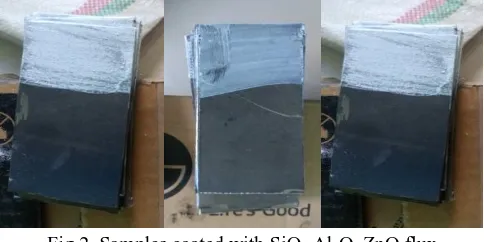
Sample of 100mm×60mm×3mm mild steel (MS E34) material plate has been used as it has a wide scale of application in industries. On optical emission spectrometer machine the sample was confirmed for MS E34 from S.N. METALLURGICAL SERVICES, B-70, MIDC, Waluj, Aurangabad, and in table-1 chemical composition of MS E34 examination results are shown. Then MS E34 sheet is cut into the required shape by cutting process and on the backside of plate tracking was done to prevent distortion of welded sample. A root face gap of 1mm was made by grooving the face at angle 600 and the root gap was zero. After this the sheet was rubbed with the silicon carbide paper for removing the impurities and lastly the samples were cleaned by acetone with the help of brush. At the joint fine paste of flux and acetone was applied with the help of brush and welding was done.
Fig.2. Samples coated with SiO2,Al2O3,ZnO flux
C. Design of Experiment by Taguchi Technique
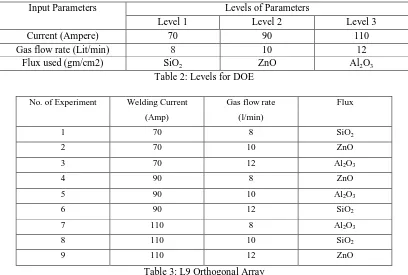
The taguchi method is used to improve the quality of product and processes. Improved quality results when a higher level of performance is consistently obtained. The highest possible performance is obtained by determining the optimum combination of design factors. In this study For the DOE, Taguchi technique in Minitab 18 was applied that reduces the number of experiments that are to be performed. According to the number of factors and their levels the corresponding orthogonal array is chosen from the set of predefined orthogonal array. In this experiment 3 factors along with their 3 levels are chosen for which the corresponding OA is L9 as shown in the table-3. The levels for DOE is shown in table-2.
Input Parameters Levels of Parameters
Level 1 Level 2 Level 3
Current (Ampere) 70 90 110
Gas flow rate (Lit/min) 8 10 12
Flux used (gm/cm2) SiO2 ZnO Al2O3
Table 2: Levels for DOE
No. of Experiment Welding Current (Amp)
Gas flow rate (l/min)
Flux
1 70 8 SiO2
2 70 10 ZnO
3 70 12 Al2O3
4 90 8 ZnO
5 90 10 Al2O3
6 90 12 SiO2
7 110 8 Al2O3
8 110 10 SiO2
[image:3.612.102.510.180.455.2]9 110 12 ZnO
Table 3: L9 Orthogonal Array
IV.RESULTS&DISCUSSION
A. Results & Analysis for Depth of Penetration
The results of metal inert gas welding for Depth of Penetration with Activated flux are as shown in the table below. It’s found that SiO2 Flux gives maximum Depth of Penetration at 70amp, 90amp, 110amp
I (Amp) GFR (l/min) flux Penetration (mm) S/N ratio
70 8 SiO2 1.660 4.40216
70 10 ZnO 1.125 1.02305
70 12 Al2O3 1.338 2.52912
90 8 ZnO 1.460 3.28706
90 10 Al2O3 1.746 4.84088
90 12 SiO2 2.050 6.23508
110 8 Al2O3 1.444 3.19134
110 10 SiO2 2.450 7.78332
110 12 ZnO 2.108 6.47741
Table 4: Depth of Penetration
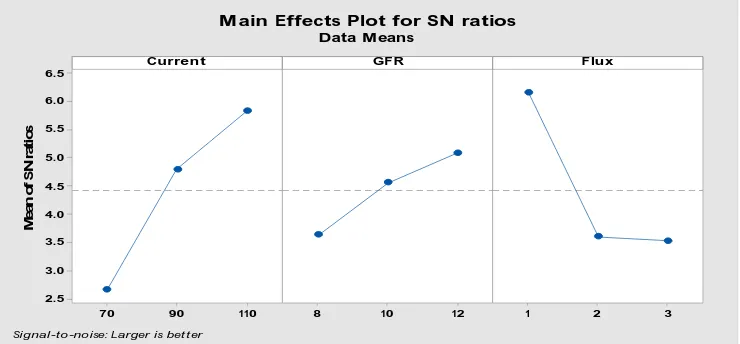
From above table it’s been found that SiO2 flux with 110 ampere current and gas flow rate 10 l/min gives maximum Depth of
[image:3.612.112.502.531.694.2]110 90
70 6.5
6.0
5.5
5.0
4.5
4.0
3.5
3.0
2.5
12 10
8 1 2 3
Current
M
e
a
n
o
f
S
N
r
a
ti
o
s
GFR Flux
Main Effects Plot for SN ratios
Data Means
Signal-to-noise: Larger is better
Chart 1: Means plot for Depth of Penetration
From above chart we note that the optimum parameters are - 110 amp Current, 12 lit/ min and SiO2 flux of gas flow rate i.e.
A3,B3,C1. And can be seen in the L9 orthogonal array.
B. ANOVA & Main Effect Plots
The knowledge of the contribution of individual factors is critically important for the control of the final response. The ANOVA is a common statistical technique used to determine the percent contribution of each factor for the experimental results. ANOVA of Mild Steel E34 (MS E34) material data for Depth of Penetration is shown in Table 5.
Source DF Seq SS Contribution Adj SS Adj MS F-Value P-Value
Current 2 7.536 40.49% 7.536 3.7680 5.22 0.161
GFR 2 2.578 13.85% 2.578 1.2888 1.79 0.359
Flux 2 7.055 37.91% 7.055 3.5275 4.89 0.170
Error 2 1.443 7.75% 1.443 0.7215
Total 8 18.611 100.00%
[image:4.612.122.492.79.251.2]S =0.849414 R-sq = 92.25% R-sq(adj)= 68.99%
Table 5: ANOVA for Depth of Penetration of Mild Steel E34 Material
From the ANOVA calculations it is found that the percentage contribution of current is highest which is 40.49%, followed by flux with 37.91 % and then gas flow rate with 13.85%.
C. Confirmation Test
Generalized penetration equation in terms of current, voltage and gas flow rate obtained from regression analysis . Regression Equation for Depth of Penetration is
DOP = 0.067 + 0.01566 Current + 0.0777 GFR - 0.2720 Flux
Table 6 below shows the results obtained from the confirmation test. Test Predicted value Experimental value Error
Penetration 2.450 2.324 5.14%
[image:4.612.121.488.372.532.2]V. CONCLUSION
A. The percentage contribution of various parameters in above metal inert gas welding process for Depth of Penetration are as follows: 40.49% Current, 37.91% flux and 13.85% gas flow rate. From the above results,Current was found to be the most influencing parameter followed by flux and gas flow rate for penetration. With increase in current the heat input also raises, leading to increase in penetration. Activated flux also has vital role in weld penetration.
B. The optimum conditions for penetration are 110 amp Current, SiO2 flux and 12 lit/ min of gas flow rate.
VI.ACKNOWLEDGEMENT
This study was supported by BADVE ENGINEERING PVT. LTD. And Government College of Engineering,Aurangabad.
REFERENCES
[1] Vikas Chauhan, R. S. Jadoun (2014) “Parametric optimization of MIG welding for stainless steel (SS-304) and low carbon steel using Taguchi design method”, International Journal of Advanced Technology & Engineering Research (IJATER), vol. 2, no. 1, pp. 224-229.
[2] Er Rahul Malik, Er Surjeet Gahlot, Dr S.K. Jarial (2015), “Parameters Optimization for Tensile Strength & Hardness of MIG Welding Joint of HSS & Mild Steel by Using Taguchi Technique”, International Journal of Enhanced Research in Science, Technology & Engineering Vol. 4 Issue 8 ISSN: 2319-7463. [3] Erdal Karadeniz , Ugur Ozsarac, Ceyhan Yildiz (2007), “The effect of process parameters on penetration in gas metal arc welding processes”, Materials and
Design 28,649–656
[4] Her-Yeuh Huang (2010), “Effects of activating flux on the welded joint characteristics in gas metal arc welding”, Materials and Design 31,2488–2495 [5] Patil, S. R. and Waghmare, C. A. 2013. Optimization of Mig Welding Parameters for Improving Strength of Welded Joints. International Journal of Advanced
Engineering Research and Studies, II : 14-16.
[6] Sapakal, S. V.and Telsang, M.T.2012. Parametric Optimization of Mig Welding using Taguchi Design Method. International Journal of Advanced Engineering Research and Studies, I: 28-30.
[7] Kumar, P., Roy, B. K. and Nishant. 2013. Parameters Optimization for Gas Metal Arc Welding of Austenitic Stainless Steel (AISI 304) & Low Carbon Steel using Taguchi’s Technique. International Journal of Engineering and Management Research, 3: 18-22.
[8] Shubham Gothi, Sagar Ramavat (2017), “Experimental Investigation for Parametric Optimization of Gas Metal Arc Welding Processfor Welding Of AISI 1018”,
IJARIIE Vol.3 Issue 2- ISSN(O)-2395-4396.
[9] Joseph I. Achebo (2011),“Optimization of GMAW Protocols and Parameters for Improving Weld Strength Quality Applying the Taguchi Method”, Proceedings of the World Congress on Engineering, Vol I.
[10] Rakesh Sharma, Jagdeep Singh(2014),“Parametric Optimization of MIG Welding for MS 5986 Fe 410 using Taguchi Method, Int. Journal of Applied [11] Shreyash Patel “An Experimental Investigation on the Effect of MIG Welding parameters on the weld joint using Taguchi method”, International Journal of
Advance Engineering and Research Development Volume 1, Issue 12, December -2014
[12] Srivani Valluru, “Investigation of Process Parameters during MIG Welding of AISI1010 Mild Steel Plates”, Thesis, S.V. University college of engineering, Tirupati, Andhra Pradesh, India.