Plug Latent Structures and Play Coreference Resolution
Sebastian Martschat, Patrick Claus and Michael Strube Heidelberg Institute for Theoretical Studies gGmbH
Schloss-Wolfsbrunnenweg 35 69118 Heidelberg, Germany
(sebastian.martschat|patrick.claus|michael.strube)@h-its.org
Abstract
We presentcort, a modular toolkit for de-vising, implementing, comparing and an-alyzing approaches to coreference resolu-tion. The toolkit allows for a unified rep-resentation of popular coreference reso-lution approaches by making explicit the structures they operate on. Several of the implemented approaches achieve state-of-the-art performance.
1 Introduction
Coreference resolution is the task of determining which mentions in a text refer to the same en-tity. Machine learning approaches to coreference resolution range from simple binary classification models on mention pairs (Soon et al., 2001) to complex structured prediction approaches (Durrett and Klein, 2013; Fernandes et al., 2014).
In this paper, we present a toolkit that imple-ments a framework that unifies these approaches: in the framework, we obtain a unified representa-tion of many coreference approaches by making explicit thelatent structuresthey operate on.
Our toolkit provides an interface for defining structures for coreference resolution, which we use to implement several popular approaches. An evaluation of the approaches on CoNLL shared task data (Pradhan et al., 2012) shows that they obtain state-of-the-art results. The toolkit also can perform end-to-end coreference resolution.
We implemented this functionality on top of the coreference resolution error analysis toolkit cort (Martschat et al., 2015). Hence, this toolkit now provides functionality for devising, implementing, comparing and analyzing approaches to corefer-ence resolution. cort is released as open source1 and is available from the Python Package Index2.
1http://smartschat.de/software
2http://pypi.python.org/pypi. Install it via
pip install cort.
2 A Framework for Coreference Resolution
In this section we briefly describe a structured pre-diction framework for coreference resolution.
2.1 Motivation
The popular mention pair approach (Soon et al., 2001; Ng and Cardie, 2002) operates on alist of mention pairs. Each mention pair is considered in-dividually for learning and prediction. In contrast, antecedent tree models (Yu and Joachims, 2009; Fernandes et al., 2014; Bj¨orkelund and Kuhn, 2014) operate on atreewhich encodes all anaphor-antecedent decisions in a document.
Conceptually, both approaches have in common that the structures they employ are not annotated in the data (in coreference resolution, the annota-tion consists of a mapping of menannota-tions to entity identifiers). Hence, we can view both approaches as instantiations of a generic structured prediction approach with latent variables.
2.2 Setting
Our aim is to learn a prediction function f that, given an input document x ∈ X, predicts a pair (h, z)∈ H×Z.his the (unobserved) latent struc-ture encoding the coreference relations between mentions in x. z is the mapping of mentions to entity identifiers (which is observed in the training data). Usually,zis obtained fromhby taking the transitive closure over coreference decisions en-coded in h. H and Z are the spaces containing all such structures and mappings.
2.3 Representation
For a document x ∈ X, we write Mx =
{m1, . . . , mn} for the mentions in x.
Follow-ing previous work (Chang et al., 2012; Fernandes et al., 2014), we make use of a dummy mention which we denote asm0. Ifm0 is predicted as the
antecedent of a mentionmi, we considermi
non-anaphoric. We defineM0
x ={m0} ∪Mx.
Inspired by previous work (Bengtson and Roth, 2008; Fernandes et al., 2014; Martschat and Strube, 2014), we adopt a graph-based represen-tation of the latent structuresh∈ H. In particular, we express structures by labeled directed graphs with vertex setM0
x.
m0
m1
m2
m3
m4
[image:2.595.114.249.183.278.2]m5
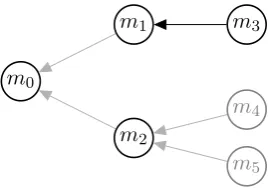
Figure 1: Latent structure underlying the mention ranking and the antecedent tree approach. The black nodes and arcs represent one substructure for the mention ranking approach.
Figure 1 shows a structure underlying the men-tion ranking and the antecedent tree approach. An arc between two mentions signals coreference. For antecedent trees (Fernandes et al., 2014), the whole structure is considered, while for mention ranking (Denis and Baldridge, 2008; Chang et al., 2012) only the antecedent decision for one anaphor is examined. This can be expressed via an appropriate segmentation into subgraphs which we refer to as substructures. One such substruc-ture encoding the antecedent decision for m3 is
colored black in the figure.
Via arc labels we can express additional infor-mation. For example, mention pair models (Soon et al., 2001) distinguish betweenpositiveand neg-ativeinstances. This can be modeled by labeling arcs with appropriate labels, such as+and−.
2.4 Inference and Learning
As is common in natural language processing, we model the prediction of(h, z)via a linear model. That is,
f(x) =fθ(x) = arg max
(h,z)∈H×Zhθ, φ(x, h, z)i,
whereθ ∈ Rdis a parameter vector andφ: X ×
H × Z → Rd is a joint feature representation
for inputs and outputs. When employing substruc-tures, one maximization problem has to be solved
for each substructure (instead of one maximization problem for the whole structure).
To learn the parameter vector θ ∈ Rd from
training data, we employ a latent structured per-ceptron (Sun et al., 2009) with cost-augmented inference (Crammer et al., 2006) and averaging (Collins, 2002).
3 Implementation
We now describe our implementation of the frame-work presented in the previous section.
3.1 Aims
By expressing approaches in the framework, re-searchers can quickly devise, implement, com-pare and analyze approaches for coreference res-olution. To facilitate development, it should be as easy as possible to define a coreference resolution approach. We first describe the general architec-ture of our toolkit before giving a detailed descrip-tion of how to implement specific coreference res-olution approaches.
3.2 Architecture
The toolkit is implemented in Python. It can pro-cess raw text and data conforming to the format of the CoNLL-2012 shared task on coreference res-olution (Pradhan et al., 2012). The toolkit is or-ganized in four modules: the preprocessing
module contains functionality for processing raw text, the core module provides mention extrac-tion and computaextrac-tion of menextrac-tion properties, the
analysismodule contains error analysis
meth-ods, and thecoreferencemodule implements the framework described in the previous section. 3.2.1 preprocessing
By making use of NLTK3, this module provides classes and functions for performing the prepro-cessing tasks necessary for mention extraction and coreference resolution: tokenization, sentence splitting, parsing and named entity recognition. 3.2.2 core
We employ a rule-based mention extractor, which also computes a rich set of mention attributes, in-cluding tokens, head, part-of-speech tags, named entity tags, gender, number, semantic class, gram-matical function and mention type. These at-tributes, from which features are computed, can be extended easily.
cort visualization: wsj_0174_part_000
1.ORTEGA ENDED a truce with the Contras and said elections were threatened .
2.The Nicaraguan president , citing attacks by the U.S. backed rebels , suspended a 19 month old cease fire and accused Bush of `` promoting death . ''
3.While he reaffirmed support for the country 's Feb. 25 elections , Ortega indicated that renewed U.S. military aid to the Contras could thwart the balloting .
4.He said U.S. assistance should be used to demobilize the rebels . 5.A White House spokesman condemned the truce suspension as ``
deplorable '' but brushed off talk of renewing military funding for the insurgents .
6.The Contra military command , in a statement from Honduras , said Sandinista troops had launched a major offensive against the rebel forces .
7.East German leader Krenz called the protests in his country a `` good sign , '' saying that many of those marching for democratic freedoms were showing support for `` the renovation for socialism . ''
8.The Communist Party chief , in Moscow for talks with Soviet officials , also said East Germany would follow Gorbachev 's restructuring plans .
9.Thousands of East Germans fled to Czechoslovakia after the East Berlin government lifted travel restrictions .
10.The ban on crossborder movement was imposed last month after a massive exodus of emigres to West Germany .
11.Also , a Communist official for the first time said the future of the Berlin
Documents
wsj_0174_part_000
wsj_2278_part_000 wsj_2400_part_000 wsj_2401_part_000 wsj_2402_part_000 wsj_2403_part_000 wsj_2404_part_000
Errors (45) Precision (16)
NAM: 5 NOM: 10 PRO: 1
Recall (29)
NAM: 6 NOM: 21 PRO: 2
Reference Entities
ORTEGA truce
Contras elections suspended Bush White House leader Krenz
System Entities
ORTEGA Contras elections president rebels Bush country balloting
Recall Recall
Recall
[image:3.595.74.289.84.280.2]Recall
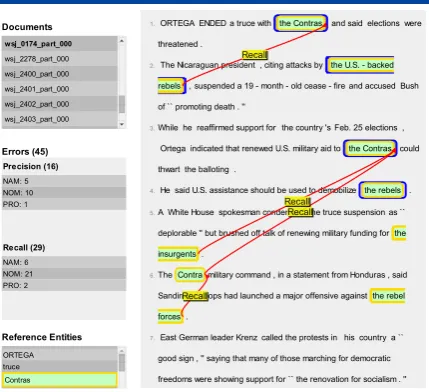
Figure 2: Visualization of errors.
3.2.3 analysis
To support system development, this module implements the error analysis framework of Martschat and Strube (2014). Users can extract, analyze and visualize recall and precision errors of the systems they are working on. Figure 2 shows a screenshot of the visualization. A more detailed description can be found in Martschat et al. (2015).
3.2.4 coreference
This module provides features for coreference resolution and implements the machine learning framework described in the previous section.
We implemented a rich set of features employed in previous work (Ng and Cardie, 2002; Bengtson and Roth, 2008; Bj¨orkelund and Kuhn, 2014), in-cluding lexical, rule-based and semantic features. The feature set can be extended by the user.
The module provides a structured latent percep-tron implementation and contains classes that im-plement the workflows for training and prediction. As its main feature, it provides an interface for defining coreference resolution approaches. We already implemented various approaches (see Sec-tion 4).
3.3 Defining Approaches
The toolkit provides a simple interface for devis-ing coreference resolution approaches via struc-tures. The user just needs to specify two func-tions: an instance extractor, which defines the
Listing 1Instance extraction for the mention rank-ing model with latent antecedents.
def extract_substructures(doc):
substructures = []
# iterate over mentions
for i, ana in enumerate(
doc.system_mentions): ana_arcs = []
# iterate in reversed order over # candidate antecedents
for ante in sorted(
doc.system_mentions[:i], reverse=True):
ana_arcs.append((ana, ante))
substructures.append(ana_arcs)
return substructures
Listing 2Decoder for the mention ranking model with latent antecedents.
class RankingPerceptron( perceptrons.Perceptron):
def argmax(self, substructure,
arc_information): best_arc, best_arc_score, \
best_cons_arc, best_cons_arc_score, \ consistent = self.find_best_arcs(
substructure, arc_information)
return ([best_arc], [], [best_arc_score], [best_cons_arc], [], [best_cons_arc_score], consistent)
search space for the optimal (sub)structures, and adecoder, which, given a parameter vector, finds optimal (sub)structures. The toolkit then performs training and prediction using these user-specified functions. The user can further customize the ap-proach by definingcost functionsto be used dur-ing cost-augmented inference, and clustering al-gorithmsto extract coreference chains from latent structures, such as closest-first (Soon et al., 2001) or best-first (Ng and Cardie, 2002).
In the remainder of this section, we present an example implementation of the mention ranking model with latent antecedents (Chang et al., 2012) in our toolkit.
3.3.1 Instance Extractors
la-Listing 3 Cost function for the mention ranking model with latent antecedents.
def cost_based_on_consistency(arc):
ana, ante = arc
consistent = \
ana.decision_is_consistent(ante)
# false new
if not consistent and \
ante.is_dummy():
return 2
# wrong link
elif not consistent:
return 1
# correct
else:
return 0
tent structure for one document into substructures, and the candidate arcs for each substructure.
Listing 1 shows source code of the instance ex-tractor for the mention ranking model with latent antecedents. In this model, each antecedent de-cision for a mention corresponds to one substruc-ture. Therefore, the extractor iterates over all tions. For each mention, arcs to all preceding men-tions are extracted and stored as candidate arcs for one substructure.
3.3.2 Decoders
The decoder solves the maximization problems for obtaining the highest-scoring latent substruc-tures consistent with the gold annotation, and the highest-scoring cost-augmented latent substruc-tures.
Listing 2 shows source code of a decoder for the mention ranking model with latent antecedents. The input to the decoder is asubstructure, which is a set of arcs, and a mapping from arcs to infor-mation about arcs, such as features or costs. The output is a tuple containing
• a list of arcs that constitute the highest-scoring substructure, together with their la-bels (if any) and scores,
• the same for the highest-scoring substructure consistent with the gold annotation,
• the information whether the highest-scoring substructure is consistent with the gold anno-tation.
To obtain this prediction, we invoke the aux-iliary function self.find best arcs. This function searches through a set of arcs to find the overall scoring arc and the overall highest-scoring arc consistent with the gold annotation.
Furthermore, it also outputs the scores of these arcs according to the model, and whether the pre-diction of the best arc is consistent with the gold annotation.
For the mention ranking model, we let the func-tion search through all candidate arcs for a sub-structure, since these represent the antecedent de-cision for one anaphor. Note that the mention ranking model does not use any labels.
The update of the parameter vector is handled by our implementation of the structured percep-tron.
3.3.3 Cost Functions
Cost functions allow to bias the learner towards specific substructures, which leads to a large mar-gin approach. For the mention ranking model, we employ a cost function that assigns a higher cost to erroneously determining anaphoricity than to se-lecting a wrong link, similar to the cost functions employed by Durrett and Klein (2013) and Fer-nandes et al. (2014). The source code is displayed in Listing 3.
3.3.4 Clustering Algorithms
The mention ranking model selects one antecedent for each anaphor, therefore there is no need to cluster antecedent decisions. Our toolkit provides clustering algorithms commonly used for men-tion pair models, such asclosest-first(Soon et al., 2001) orbest-first(Ng and Cardie, 2002).
3.4 Runningcort
cortcan be used as a Python library, but also pro-vides two command line toolscort-trainand
cort-predict.
4 Evaluation
We implemented a mention pair model with best-first clustering (Ng and Cardie, 2002), the mention ranking model with closest (Denis and Baldridge, 2008) and latent (Chang et al., 2012) antecedents, and antecedent trees (Fernandes et al., 2014). Only slight modifications of the source code dis-played in Listings 1 and 2 were necessary to im-plement these approaches. For the ranking models and antecedent trees we use the cost function de-scribed in Listing 3.
MUC B3 CEAF
e
Model R P F1 R P F1 R P F1 Average F1
CoNLL-2012 English test data
Fernandes et al. (2014) 65.83 75.91 70.51 51.55 65.19 57.58 50.82 57.28 53.86 60.65 Bj¨orkelund and Kuhn (2014) 67.46 74.30 70.72 54.96 62.71 58.58 52.27 59.40 55.61 61.63
Mention Pair 67.16 71.48 69.25 51.97 60.55 55.93 51.02 51.89 51.45 58.88 Ranking: Closest 67.96 76.61 72.03 54.07 64.98 59.03 51.45 59.02 54.97 62.01 Ranking: Latent 68.13 76.72 72.17 54.22 66.12 59.58 52.33 59.47 55.67 62.47 Antecedent Trees 65.34 78.12 71.16 50.23 67.36 57.54 49.76 58.43 53.75 60.82
Table 1: Results of different systems and models on CoNLL-2012 English test data. Models below the dashed lines are implemented in our toolkit.
scorer (Pradhan et al., 2014), which computes the average of the evaluation metrics MUC (Vi-lain et al., 1995), B3, (Bagga and Baldwin, 1998)
and CEAFe(Luo, 2005). The models are trained
on the concatenation of training and development data.
The evaluation of the models is shown in Table 1. To put the numbers into context, we compare with Fernandes et al. (2014), the winning system of the CoNLL-2012 shared task, and the state-of-the-art system of Bj¨orkelund and Kuhn (2014).
The mention pair model performs decently, while the antecedent tree model exhibits perfor-mance comparable to Fernandes et al. (2014), who use a very similar model. The ranking models out-perform Bj¨orkelund and Kuhn (2014), obtaining state-of-the-art performance.
5 Related Work
Many researchers on coreference resolution re-lease an implementation of the coreference model described in their paper (Lee et al., 2013; Durrett and Klein, 2013; Bj¨orkelund and Kuhn, 2014, in-ter alia). However, these implementations imple-ment only one approach following one paradigm (such as mention ranking or antecedent trees).
Similarly to cort, research toolkits such as BART (Versley et al., 2008) or Reconcile (Stoy-anov et al., 2009) provide a framework to im-plement and compare coreference resolution ap-proaches. In contrast to these toolkits, we make the latent structure underlying coreference ap-proaches explicit, which facilitates development of new approaches and renders the development more transparent. Furthermore, we provide a generic and customizable learning algorithm.
6 Conclusions
We presented an implementation of a frame-work for coreference resolution that represents ap-proaches to coreference resolution by the struc-tures they operate on. In the implementation we placed emphasis on facilitating the definition of new models in the framework.
The presented toolkitcort can process raw text and CoNLL shared task data. It achieves state-of-the-art performance on the shared task data.
The framework and toolkit presented in this pa-per help researchers to devise, analyze and com-pare representations for coreference resolution.
Acknowledgements
We thank Benjamin Heinzerling for helpful com-ments on drafts of this paper. This work has been funded by the Klaus Tschira Foundation, Ger-many. The first author has been supported by a HITS Ph.D. scholarship.
References
Amit Bagga and Breck Baldwin. 1998. Algorithms for scoring coreference chains. In Proceedings of the 1st International Conference on Language Resources and Evaluation, Granada, Spain, 28–30 May 1998, pages 563–566.
Eric Bengtson and Dan Roth. 2008. Understanding the value of features for coreference resolution. In
Proceedings of the 2008 Conference on Empirical Methods in Natural Language Processing,Waikiki, Honolulu, Hawaii, 25–27 October 2008, pages 294– 303.
In Proceedings of the 52nd Annual Meeting of the Association for Computational Linguistics (Volume 1: Long Papers),Baltimore, Md., 22–27 June 2014, pages 47–57.
Kai-Wei Chang, Rajhans Samdani, Alla Rozovskaya, Mark Sammons, and Dan Roth. 2012. Illinois-Coref: The UI system in the CoNLL-2012 shared task. In Proceedings of the Shared Task of the 16th Conference on Computational Natural Lan-guage Learning, Jeju Island, Korea, 12–14 July 2012, pages 113–117.
Michael Collins. 2002. Discriminative training meth-ods for Hidden Markov Models: Theory and experi-ments with perceptron algorithms. InProceedings of the 2002 Conference on Empirical Methods in Natural Language Processing,Philadelphia, Penn., 6–7 July 2002, pages 1–8.
Koby Crammer, Ofer Dekel, Joseph Keshet, Shai Shalev-Shwartz, and Yoram Singer. 2006. Online passive-aggressive algorithms. Journal of Machine Learning Research, 7:551–585.
Pascal Denis and Jason Baldridge. 2008. Specialized models and ranking for coreference resolution. In
Proceedings of the 2008 Conference on Empirical Methods in Natural Language Processing,Waikiki, Honolulu, Hawaii, 25–27 October 2008, pages 660– 669.
Greg Durrett and Dan Klein. 2013. Easy victories and uphill battles in coreference resolution. In Pro-ceedings of the 2013 Conference on Empirical Meth-ods in Natural Language Processing,Seattle, Wash., 18–21 October 2013, pages 1971–1982.
Eraldo Fernandes, C´ıcero dos Santos, and Ruy Milidi´u. 2014. Latent trees for coreference resolution. Com-putational Linguistics, 40(4):801–835.
Heeyoung Lee, Angel Chang, Yves Peirsman, Nathanael Chambers, Mihai Surdeanu, and Dan Ju-rafsky. 2013. Deterministic coreference resolu-tion based on entity-centric, precision-ranked rules.
Computational Linguistics, 39(4):885–916.
Xiaoqiang Luo. 2005. On coreference resolution performance metrics. In Proceedings of the Hu-man Language Technology Conference and the 2005 Conference on Empirical Methods in Natural Lan-guage Processing, Vancouver, B.C., Canada, 6–8 October 2005, pages 25–32.
Sebastian Martschat and Michael Strube. 2014. Recall error analysis for coreference resolution. In Pro-ceedings of the 2014 Conference on Empirical Meth-ods in Natural Language Processing, Doha, Qatar, 25–29 October 2014, pages 2070–2081.
Sebastian Martschat, Thierry G¨ockel, and Michael Strube. 2015. Analyzing and visualizing corefer-ence resolution errors. In Proceedings of the 2015 Conference of the North American Chapter of the
Association for Computational Linguistics: Demon-strations,Denver, Col., 31 May – 5 June 2015, pages 6–10.
Vincent Ng and Claire Cardie. 2002. Improving ma-chine learning approaches to coreference resolution. InProceedings of the 40th Annual Meeting of the As-sociation for Computational Linguistics, Philadel-phia, Penn., 7–12 July 2002, pages 104–111. Sameer Pradhan, Alessandro Moschitti, Nianwen Xue,
Olga Uryupina, and Yuchen Zhang. 2012. CoNLL-2012 Shared Task: Modeling multilingual unre-stricted coreference in OntoNotes. InProceedings of the Shared Task of the 16th Conference on Com-putational Natural Language Learning,Jeju Island, Korea, 12–14 July 2012, pages 1–40.
Sameer Pradhan, Xiaoqiang Luo, Marta Recasens, Ed-uard Hovy, Vincent Ng, and Michael Strube. 2014. Scoring coreference partitions of predicted men-tions: A reference implementation. In Proceed-ings of the 52nd Annual Meeting of the Association for Computational Linguistics (Volume 2: Short Pa-pers),Baltimore, Md., 22–27 June 2014, pages 30– 35.
Wee Meng Soon, Hwee Tou Ng, and Daniel Chung Yong Lim. 2001. A machine learning ap-proach to coreference resolution of noun phrases.
Computational Linguistics, 27(4):521–544.
Veselin Stoyanov, Claire Cardie, Nathan Gilbert, Ellen Riloff, David Buttler, and David Hysom. 2009. Reconcile: A coreference resolution research plat-form. Technical report, Cornell University.
Xu Sun, Takuya Matsuzaki, Daisuke Okanohara, and Jun’ichi Tsujii. 2009. Latent variable perceptron al-gorithm for structured classification. InProceedings of the 21th International Joint Conference on Artifi-cial Intelligence, Pasadena, Cal., 14–17 July 2009, pages 1236–1242.
Yannick Versley, Simone Paolo Ponzetto, Massimo Poesio, Vladimir Eidelman, Alan Jern, Jason Smith, Xiaofeng Yang, and Alessandro Moschitti. 2008. BART: A modular toolkit for coreference resolu-tion. InCompanion Volume to the Proceedings of the 46th Annual Meeting of the Association for Com-putational Linguistics,Columbus, Ohio, 15–20 June 2008, pages 9–12.
Marc Vilain, John Burger, John Aberdeen, Dennis Con-nolly, and Lynette Hirschman. 1995. A model-theoretic coreference scoring scheme. In Proceed-ings of the 6th Message Understanding Conference (MUC-6), pages 45–52, San Mateo, Cal. Morgan Kaufmann.
Chun-Nam John Yu and Thorsten Joachims. 2009. Learning structural SVMs with latent variables. In