
Design of a conversion rate optimization tool for E commerce
58
0
0
Full text
(2) Abstract Conversion rate optimization (CRO) is a methodology used in E-commerce to increase revenue by optimizing the user experience for maximum purchases. However, this process is difficult for many E-commerce operators. A tool was conceptualized that would make the process easily accessible to most E-commerce operators. In the present paper, the design of this tool is documented up to the minimal viable product (MVP) stage. State of the art research was done to provide an overview over the current industry practices around conversion rate optimization, the E-commerce market as well as business development in connection with product development. Related products are compared against a preliminary set of requirements. Then, a practical implementation of the Lean Startup framework was formed and combined with other methodologies for the design of a product and the business model around it. The results of the execution of the methodology are presented. This includes interview evaluations, mockups, a mock sales page, an evaluation of an advertising campaign, pricing considerations and technical product aspects. The iterative design process resulted in a tool that presents an array of potential user experience (UX) changes that shop owners could test. The testing infrastructure as well as the implementation of the UX cases are already in place and therefore the implementation of the cases can be done with very little configuration. Potential users responded positively to the prototype. The process as well as the product is then critically discussed and a future road map is given. The final design of the MVP is fit for development.. 2.
(3) Acknowledgements No good work is done without collaboration and no collaboration should go without appreciation. Without the help of some key people this project would not have been possible, all of whom I’d like to thank. Firstly, I’d like to thank Dr. Kasia Zalewska, my supervisor who patiently guided me through the process. Throughout many turning points of this project, she instilled faith in me and my idea and was always helpful and quick in her responses. Secondly, I’d like to thank Dr. Mannes Poel, my critical observer. Without Mannes’ rigorous examination, my thesis would have severly lacked in academic depth as well as critical judgment. Additionally, I am thankful for my interview partners for openly sharing their practices that provided me with a much more concise understanding of the E-commerce industry and business operations.. 3.
(4) Contents 1. Introduction ............................................................................................................... 6 1.1. E-Commerce .................................................................................................................. 6. 1.2. Conversion Rate Optimization ....................................................................................... 6. 1.3. Challenge and Project .................................................................................................... 6. 1.4. Lean Startup framework ................................................................................................ 7. 1.5. Report Outline ............................................................................................................... 7. 2. State of the Art Research .......................................................................................... 8 2.1 2.1.1. The Build Measure Learn Cycle................................................................................. 9. 2.1.2. The Minimum Viable Product (MVP) ........................................................................ 9. 2.1.3. Measure & Innovative Accounting ........................................................................... 9. 2.1.4. Customer Development.......................................................................................... 10. 2.1.5. Lean Canvas ............................................................................................................ 10. 2.2. Model for Adaption of Lean Startup Principles in Product Development ................... 11. 2.2.1. Problem / Solution Fit ............................................................................................. 12. 2.2.2. Product / Launch Fit................................................................................................ 12. 2.2.3. Product / Market Fit ............................................................................................... 13. 2.3. Market Research ......................................................................................................... 13. 2.3.1. E-commerce Industry Outlook ................................................................................ 13. 2.3.2. E-Commerce Software Ecosystem .......................................................................... 13. 2.3.3. Conversion Rate Optimization ................................................................................ 14. 2.4. Opportunity for an E-Commerce Tool ......................................................................... 15. 2.4.1. Problem Statement (Motivation) ........................................................................... 15. 2.4.2. Proposed Solution (Value Proposition) ................................................................... 16. 2.4.3. Risk Hypothesis and Market Outlook (Viability) ..................................................... 16. 2.5 3. Related Products ......................................................................................................... 17 Methodology............................................................................................................ 19. 3.1. Problem validation ...................................................................................................... 19. 3.1.1. Problem Interview Outline and Objectives ............................................................. 19. 3.1.2. Survey Design ......................................................................................................... 23. 3.2 3.2.1. Solution Development ................................................................................................. 23 Stakeholder Analysis. 23. 3.2.2. Requirement Analysis ............................................................................................. 24. 3.2.3. Interface Design ...................................................................................................... 24. 3.2.4. Branding ................................................................................................................. 24. 3.3 3.3.1 4. Overview of the Lean Startup framework ..................................................................... 8. Solution Validation ...................................................................................................... 25 Solution Interview Outline and Objectives ............................................................. 25.
(5) 3.3.2 3.4. Marketing ............................................................................................................... 27 MVP Design ................................................................................................................. 28. 3.4.1. UX Hypotheses........................................................................................................ 28. 3.4.2. Financial Considerations ......................................................................................... 29. 3.4.3. Preliminary Pricing Considerations ......................................................................... 29. 3.4.4. Technical Considerations ........................................................................................ 30. 4. Results ...................................................................................................................... 31 4.1. Initial Lean Canvas and Requirements......................................................................... 31. 4.2. Problem Validation ...................................................................................................... 32. 4.2.1. Interview Evaluation ............................................................................................... 32. 4.2.2. Survey Evaluation ................................................................................................... 33. 4.2.3. Conclusions to problem validation ......................................................................... 33. 4.2.4. Post Problem Validation Lean Canvas .................................................................... 35. 4.3. Solution Development ................................................................................................. 36. 4.3.1. Requirement Analysis ............................................................................................. 36. 4.3.2. Branding ................................................................................................................. 36. 4.3.3. Wireframes ............................................................................................................. 38. 4.4. Solution Validation ...................................................................................................... 39. 4.4.1. Interview Evaluation ............................................................................................... 39. 4.4.2. Marketing Campaign Evaluation ............................................................................. 40. 4.4.3. Conclusions to Solution Validation ......................................................................... 42. 4.5. MVP Design ................................................................................................................. 42. 4.5.1. MoSCoW Analysis ................................................................................................... 43. 4.5.2. UX Hypotheses........................................................................................................ 43. 4.5.3. Statistical Model ..................................................................................................... 45. 4.5.4. Class Diagram ......................................................................................................... 46. 4.5.5. Stack and Infrastructure ......................................................................................... 48. 4.5.6. Financial Considerations ......................................................................................... 49. 4.5.7. Final Lean Canvas.................................................................................................... 51. 5. Discussion ................................................................................................................ 51 5.1. Reflection of Methodologies and Process ................................................................... 53. 5.2. Future Roadmap .......................................................................................................... 54. 5.3. Conclusions to Research Questions ............................................................................. 53. 6. References ............................................................................................................... 55. 7. Appendix .................................................................................................................. 55. 5.
(6) 1. Introduction. This chapter provides a short thematic introduction to the subject of E-commerce, conversion rate optimization and the challenge that led to this bachelor project. The chapter will conclude with the outline of the project as well as the limitations.. 1.1. E-Commerce E-Commerce has grown to a behemoth of an industry with a market size of 1,9 Trillion Euros in. revenue globally [1]. With a steady growth averaging 14% [1] the past three years, e-commerce is the fastest growing industry in Europe [2]. As more users are flocking from traditional retail to ECommerce, global revenue is expected to double by 2020 [14]. Accompanying this growth, there has not only been an increase in the diversity shop software [17] but also supporting tools that facilitate sales, marketing, accounting, inventory management, design and fulfilment.. 1.2. Conversion Rate Optimization Conversion rate optimization (CRO) is a system that aims to increase the percentage of visitors. to a website that convert into customers (conversion rate) [16]. It can be used as an overarching indicator to drive many different changes to an e-commerce shop, especially marketing and UX changes. The main method for CRO is to make hypotheses about potential changes to then test variations and track them to make statistical conclusions about these changes. CRO is a vital aspect of e-commerce strategy because it can increase revenue drastically. The following are examples of hypotheses that could ultimately increase the conversion rate: I.. “Changing the ‘add to cart’-button from the current color to red will increase the ‘add to cart’-rate.”. II.. “Add graphical security certificates to the header of the page will decrease cart abandonment.”. 1.3. Challenge and Project However, the problem is that setting up different tests for UX changes is an arduous process.. Shop owners often need to use external tools, that are not directly integrated within their ecommerce software to track the effects of their variations. This process can be very challenging for various reasons. First, coming up with hypotheses for UX changes depends usually on usability tests or UX changes that other companies have made. Secondly, the technical implementation for testing can require changes in the source code of product pages to fit tracking codes, design changes and distribution of these variations [16]. This project outlines the design a tool that attempts to solve these problems for shop operators: a tool that proposes hypotheses for UX changes that also implements these changes with very little configuration as well as the testing infrastructure to collect the test result data. This tool would not have any users if it wasn’t tied in an existing E-commerce ecosystem as a plugin because most shop operators use widely accepted E-commerce software solutions. Without 6.
(7) users and data this tool could not thrive and thus the most promising application of this tool would be the distribution as a commercial plugin. This means the tool is a product and the terms will be used interchangeably throughout the thesis. Thus, the process of building this tool leans heavily on an adaption of the Lean Startup framework, a business framework for new product development [11]. The Lean Startup framework draws much of its metaconcepts from User-Centered Design and ensures that design choices made throughout the process focus on the user’s value. The goal of the project will be to validate the problem, iteratively design a solution, validate the solution and design the minimal viable product (MVP). The scope of this project is to arrive at a design for a MVP. The design choices are justified by the insights gathered from the application of the Lean Startup framework in iterative design stages. Finally, an analysis of future recommendations is given using data gathered during the design process. The project is guided by the following research questions: -. RQ1: How can this idea be validated using the Lean Startup framework?. -. RQ2: What does the framework for the business model for this solution look like (Lean Canvas)?. 1.4. Lean Startup framework Lean Startup is a methodology for developing products with the aim to cut development cycles. by combining hypothesis-driven experimentation, iterative design processes, and validated learning [11]. The main hypothesis behind the Lean Startup paradigm is that startups can reduce market risks and leap ahead in finding a product market fit through a combination of iterative design stages that are sensitive to customer feedback. The basic business assumptions are then validated and combined in a framework of hypotheses for further testing.. 1.5. Report Outline This section contains the outline of the thesis. Chapter 2 starts out with the state of the art research about the Lean Startup framework, a model. of adaption for this project, market research, a detailed description of the opportunity for this product and related products. Chapter 3 contains the methodology for the problem validation, solution development, solution validation as well as the MVP design. Chapter 4 documents the results of the execution of the methodology Finally, chapter 5 discusses the methodologies and results, a future roadmap and the conclusions to the research questions.. 7.
(8) 2. State of the Art Research This chapter contains the state of the art for the relevant thematic themes of the project. It starts. with an overview of the Lean Startup framework in which the main concepts are summarized. The chapter continues with a practical application of the Lean Startup framework relevant to this project. The chapter then goes on about the E-commerce industry as a whole and how CRO plays a role in it. Finally, the chapter ends with an outline of the opportunity of this tool as well as related products.. 2.1. Overview of the Lean Startup framework In recent years, a new business paradigm has taken over innovation management and startup. culture. This set of methodologies is now being taught in universities and business summits. “Lean Startup” is a paradigm that can make the process of developing a new product less risky. It favors experimentation as opposed to elaborate planning, customer feedback over intuition, and iterative design over traditional “big design up front” development [13]. Large companies such as GE and Intuit have adapted the Lean Startup framework for small agile teams to pursue new business opportunities. Traditional methods of business development dictate every business to start with a business plan – a ‘report’ that includes the problem, the opportunity and the solution that the new company will provide. Additionally, it includes a five-year forecast for cash flow, balance sheets and revenue. This report can then be taken to banks or other investors for funding [13]. However, the idea behind a business plan and large up-front development of an idea are damning: 1) Business plans rarely depict the first contact to the market accurately. 2) Five-year operational plans are inherently speculative since they are based on uncertain future events. 3) The longer time is spent on developing a product, the less flexible the product becomes for pivotal points that are a result of customer feedback. Subsequently, more than 75% of startups traditionally fail [13]. The ‘Lean Startup’ methodology takes a radically different approach to business development. First, entrepreneurs must accept that all their assumptions are nothing more but good guesses. These guesses can be formulated as hypothesis that can be tested. Rather than forming an extensive business plan, the entrepreneur compiles all these hypotheses in a framework called the ‘business model canvas’ [11]. Second, Lean startups deploy a “get out of building” approach called customer development to test their hypotheses which was first conceptualized and written about by Steve Blank, a successful Silicon Valley serial-entrepreneur. This is essentially a poll of potential users, purchasers, and partners for feedback on all elements of the business model, including features, pricing, distribution channels and growth strategies [13]. Third, Lean startups use agile development for their technical implementation. Agile development originated in the software industry and describes an iterative and incremental development process of the product largely influenced by customer feedback [13]. The core tenants of the Lean Startup framework include: -. The Build Measure Learn Cycle. -. The Minimum Viable Product. -. Measure & Innovative Accounting. -. Customer Development. -. The Lean Canvas. 8.
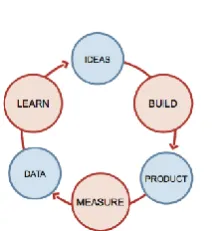
(9) 2.1.1. The Build Measure Learn Cycle. Figure 1 Illustration of the validated learning concept For anything that a customer comes in contact with, learning the customer’s preferences about that point of contact is crucial. The emphasis here is on ‘learning’. Validated learning means to base the least amount of decisions on assumptions but rather test them as far as possible [11]. The Lean Startup interprets this learning process to be cyclical (Figure 1) in which every decision can lead to an outcome that can be measured and learned from. 2.1.2. The Minimum Viable Product (MVP). The idea behind deploying a product that does not have the full array of desirable features yet is to gain as much insight from the customer as possible. It is the fastest way of going through the buildmeasure-learn feedback loop and therefore a crucial exercise of validated learning. A main rule behind building an MVP is to remove any features, process or effort that does not contribute directly to the learning the entrepreneur seeks [11]. Since an MVP is an elemental point of contact with the customer that can establish a vast amount of useful data it is a learning milestone. 2.1.3. Measure & Innovative Accounting. According to the Lean Startup principles, a startup has two constant priorities: -. Assessing the businesses’ current situation rigorously and truthfully. -. Design experiments for further testing of hypotheses. This again shows the stark focus on empirical learning for business choices that echo throughout the theory. Innovative accounting refers to a systematic approach to measure progress and achievement of actual validated learning. Innovative accounting is broken down into three steps: -. Gather user data after the release of the MVP to assess the company’s position. -. Shift the efforts slightly from the baseline towards the ideal. -. While shifting, the company reaches a decision point: pivot or persevere. IA forces the startup systematically to push towards a direction. If the company is making good progress, the startup should persevere with the assumption of the baseline. If it isn’t, the company has to pivot into a direction that the acquired data has suggested. If after this pivot experiments are overall more productive, the pivot was successful [11]. 9.
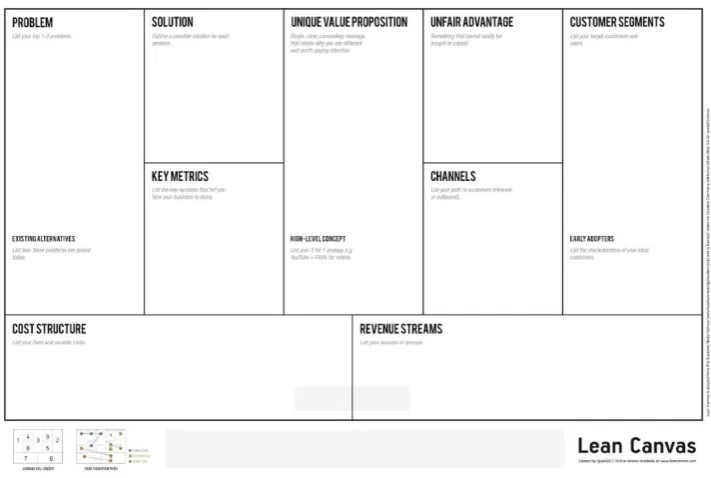
(10) 2.1.4. Customer Development. Customer development (CD) makes up a fundamental pillar of the Lean Startup framework and describes the methodology behind forming and testing hypotheses. It was first introduced by Steve Blank and was designed to guide the path to validate and execute scalable business models [11]. The basic premise behind Blank’s model of customer development is that there are no facts and conclusions to be made “within the building” which means that the companies have to get out and build a relationship with potential customers to better understand their needs. Blank criticized Cooper and Kleinschmidt’s [26] model of new product development (NPD), stating that it companies dedicate an elaborate planning and development process to build products that might not be well received at all. Blank’s customer development method is therefore a way to radically cut down risks when starting new ventures [13]. CD is a way of emulating the scientific process for business. Different business assumptions, such as “Ecommerce shop owners see the value of split testing”, can be formed into hypotheses to be tested. These experiments are usually a process of evaluating customer feedback. There are many different types of feedback that a startup can receive from potential customers. Most of them can be categorized into qualitative, quantitative feedback or a mixture of both: Qualitative -. Interviews. -. Reviews on other products that validate the problem. -. Articles from the industry. Quantitative -. Monetary cost-benefit analysis of the product. -. Surveys. -. Ratings on products that fulfill a similar purpose. This feedback is then evaluated to either support or reject the hypothesis. According to the results it can be then concluded to reject or validate the hypothesis. Finally, new hypotheses can be formed based on the results of the previous one. 2.1.5. Lean Canvas. The Lean Canvas (Figure 2) is a framework to combine hypotheses of a business model to test and validate a business model, measure progress and communicate learning with internal and external stakeholders [23]. It was conceptualized as an alternative to traditional business plans that often times take weeks to put together because of the extensive requirements to include forecasts for cash flows and balances for years ahead of development. The main is that it should only take a few hours to put together and that the statements are hypotheses that can easily be verified.. 10.
(11) Figure 2 An empty depiction of the Lean Canvas It captures an overview of the following elements of a business model: -. Problem: The problems that the product is trying to solve.. -. Customer Segments: The target customer segment / users. -. Unique Value Proposition: What sets apart the solution to other solutions that solves the problem. -. Solution: The possible solutions to each problem. -. Channels: The channels of acquisition (inbound, outbound). -. Cost Structure: The costs (fixed and variable) associated with the business. -. Key Metrics: The key metrics that will determine the business’ success. -. Unfair Advantage: The part of the business that cannot easily be bought or copied. 2.2. Model for Adaption of Lean Startup Principles in Product. Development In “Running Lean” Maurya models the adaption of Lean Startup principles into concrete steps for product development and gives concrete guidelines for implementation of the framework [23]. The model is focused on technology applications, especially subscription-based business models and therefore provides a well-fitting framework for the development of this present projects development. Maurya adaption model can roughly be summarized into three parts: 1.. Problem / Solution Fit: Is the problem worth solving?. 2.. Product / Market Fit: Is the solution something people want?. 11.
(12) 3. 2.2.1. Scale: How to accelerate growth? Problem / Solution Fit. Maurya suggests starting by creating a framework of hypothesis using the Lean Canvas. This is the first iteration of the Lean Canvas and is adjusted throughout the process. After capturing the framework of hypotheses for the business model Maurya suggests to interview customers as part of CD. Maurya [23] suggests to separate interviews into different types of interviews: “Problem Interviews”, “Solution Interviews” and “MVP Interviews” (later step) that are conducted chronologically in sets of at least 10 customers. These stages correspond to the building process of the product and make sure that the development goes hand in hand with the customer development. In the first set of interviews – the “Problem Interviews” – the problems should be illuminated further and rank the problems in order of significance. These interviews are supposed to not mention solutions at all but are rather used to lay out the problems that the solutions will address. These interviews have the objective to find out the current solutions to the problems, new problems that come up and gauge the level of excitement around solving each problem. These interviews are also meant to already modify the problem hypothesis qualitatively: if some current problems are not mentioned in any of the interviews, they can be thrown out. In this stage, it is also important to segment early adopters, prioritize their biggest problems and understand their used solutions [23]. The second round of interviews – the “Solution Interviews” are focused on the proposed solution. The main objectives of this stage is to learn the minimum features that the solution must have to secure the early adopter and how much they would be willing to pay for it. At this stage, a mock-up or a prototype can be shown as an approximation of the MVP. The feedback will be used to adjust the demo as the interview round progresses. At this stage, beta testers for the MVP can be recruited with incentives such as a rebate but it is important to not promise to provide it for free in order to manage expectations of cost. At the end of this stage, it is important to have a well-adjusted mapping of features to priority problems that potential customers have identified [23]. 2.2.2. Product / Launch Fit. After the first two rounds of interviews, it is time to design the MVP. Alongside the development of the MVP Maurya recommends building a product page that allows for deployment and measuring of sales. The last step must have crystalized into a list of problems sorted by priorities that are mapped to key features that the MVP must contain. By now, CD should also be extensive enough to have a list of early adopters that are eager to try the product. These features need to be translated to a framework of requirements and development can begin. Maury also outlines agile development and continuous deployment – which is a form of rapid development in which the iteration of the software is tested and deployed constantly. During this stage, not much happens on the business aspect as there is no insight to be gained from CD. Maury stresses to release the MVP as quickly as possible to continue the learning process. Before launching the MVP, a sales website as well as testing infrastructure needs to be in place to enable CRO. The next round of interviews – the “MVP Interviews” – accompanies the iteration of the MVP. Main objective of these interviews are to test how well the MVP delivers on the unique value proposition (UVP) and diagnose obstacles of the sign-up and on-boarding process. The MVP needs to 12.
(13) be adapted after the first five interviews. The MVP needs to be tested and tweaked until 80% of the potential early adopters in this stage have been converted into paying customers [23]. The product is then ready to launch. 2.2.3. Product / Market Fit. Since the next step of product development is much out of scope of this project, it will be summarized shortly. The next step is to optimize the product to increase retention of the product to 40%. Another key metric is to poll existing users to see if they would be “very disappointed” if the product would be discontinued. If these two measures are passed, the next focus should be growth. To scale, the “key engine of growth” needs to be determined. This can be a referral mechanism for instance by viral mechanisms. If the business is subscription-based, optimizing for retention is the key growth format. If growth can only be accommodated by high conversion costs, funding is the key to scale.. 2.3. Market Research This market research focuses on providing an overview over the E-commerce industry. 2.3.1. E-commerce Industry Outlook. Trillion (€). Year. 1058. 1077. 1336. 1548. 1915. 2012. 2013. 2014. 2015. 2016. 2352. 2017. 2860. 2018. 3418. 2019. 4058. 2020. Figure 3 Global E-commerce revenue until 2016 and forecast between 2017 and 2020 [14] In the past five years, global e-commerce revenue has doubled to 1,9 trillion Euros [1] (Figure 1). In Europe, E-commerce has grown at a rate of 14% annually in the past three years, which makes it one of the fastest growing industry in Europe [2]. The penetration of internet usage, increase in consumer trust in online payment and more diverse supply of goods are all major contributors to this trend [18]. Forecasts estimate e-commerce to continue to grow and double in the next four years [14]. 2.3.2. E-Commerce Software Ecosystem. The rapid growth coupled with the thematic closeness to other online industries such as social media has blessed the e-commerce industry with an impressive rate of innovation. The landscape of e-commerce platforms has changed dramatically in the past years. A rich diversity of platforms has arisen with different developing institutions attempting to cater to different needs of different businesses. In the past years, the hosted solution Shopify has established itself as the market leader judging by estimates that take into account the products’ market share, vendor size and social impact 13.
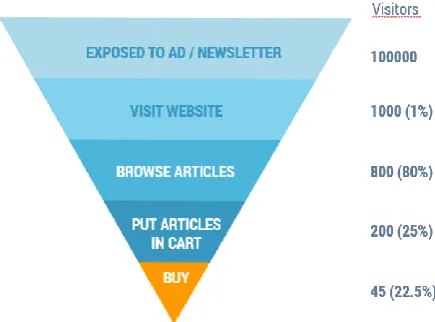
(14) [19]. One of Shopify’s unique selling points was that it is a hosted solution that uses a subscriptionbased model to deliver its service [20]. This makes the setup of a shop relatively simple compared to self-hosting solutions that often times take much longer to configure and install on a businesses’ own server. Due to Shopify’s rapid growth and accessibility for developers, Shopify’s platform is chosen for this product’s development. Note: The Shopify ecosystem describes plugins as “Shopify apps”. These terms will be used interchangeably throughout the thesis were they are more appropriate. 2.3.3. Conversion Rate Optimization. Figure 4 An example of a classic conversion funnel Conversion rate optimization (CRO) is a system that aims to increase the percentage of visitors to a website that convert into customers (conversion rate) [16]. It is used by shop operators, UX designers and marketers to judge the success of products, product presentations, interface design, marketing campaigns, etc. Unlike traditional retail, in E-Commerce it is possible to record every customer interaction at low cost to attempt to correlate variations in design or strategy with conversion [16]. This provides ample opportunity to systematically increase conversion rate to ultimately increase revenue. Figure 4 shows a classic example of an E-commerce sales funnel. It shows the different steps that illustrate customer journeys from being exposed to an ad to a conversion. Different steps along the sales funnel are defined by different metrics: -. Click Through Rate (CTR): The rate of people that click on the ad / link in the e-mail. -. E-Mail Open Rate: The rate of people that open an E-Mail from a campaign. -. Add to Cart Rate: The rate of people that add an article to the cart after visiting the article page. -. Conversion Rate (CR): The rate of people that buy something from the shop after visiting the shop. There are more metrics that can be measured and given their own name – some more significant than others. Overall, the conversion rate is among the most important metric for an e-commerce website [16] because it has the biggest effect on revenue. However, in a sales funnel, each optimization along the way has a multiplying effect on the next step. If the e-mail open rates are 14.
(15) increased by 50%, that means an increase in revenue of 50%, everything else being equal. It is therefore highly within a businesses’ interest to put effort into the optimization of their customer journeys through systematic testing of their variables. Methodology for Conversion Rate Optimization An existing dominant method in testing for CRO is called A/B testing. A/B testing refers to randomized experiments with two variants, A and B, which usually are the control and the variation in a controlled experiment [24]. It is a form of statistical hypothesis testing that can be used to test many different variables, such as ads, UX flows, product titles.. 2.4. Opportunity for an E-Commerce Tool Ash Maurya has developed a systematic approach to Lean Startup principles during product. development. According to Maurya, there are crucial aspects when assessing a Problem / Solution Fit [23]: -. Is it something customers want? (must-have). -. Will they pay for it? (viable). -. Can it be solved? (feasibility). These questions combined help answer the question “Do I have a problem worth solving?” which is the guiding question in product developing under Lean Startup principles. This chapter attempts to assess this opportunity. 2.4.1. Problem Statement (Motivation). Implementing A/B testing in existing e-commerce shops is not a trivial task. Companies need to orchestrate the generation of hypotheses, the technical implementation of their testing infrastructure and the evaluation of their tests. The generation of hypotheses for UX changes require usability considerations to form different variations in their design [16]. These usability factors play major roles in designing UX variations: -. Effectiveness: How well the design leads to a certain outcome. -. Aesthetics: How pleasing it is to look at. -. Accessibility: How easy it is to use. Another effective way to find UX hypotheses is to look at industry recommendations by companies that have tested different UX elements extensively. Often times, the design of a web shop is done by external firms which means that design variations need to be done in collaboration with that firm. This is resource intensive, as these collaborations are often times non-iterative. The implementation of these tests can also be difficult for shop operators because it requires changes in the source code as well as testing infrastructure that most shop operators are not familiar with. The tests then need to be evaluated and the shop needs to be adjusted according to the test results. CRO has become crucial to the e-commerce industry and has established itself as a dominant business practice among the biggest firms in the industry [16]. On-site CRO has a direct impact on 15.
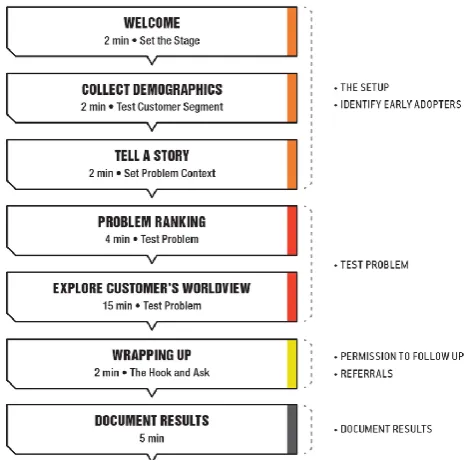
(16) revenue and amplifies all marketing efforts since it makes them more efficient through its multiplying effect. This works in the following way: For example, if marketing efforts can generate 10.000 visitors a month at a cost of 3000€, the cost per visitor is 0,30€. If the conversion rate is 10% the cost per conversion is 3€. If the conversion rate can be optimized to 15%, the new cost per conversion is 2€. This means the marketing efforts are now 50% more efficient. 2.4.2. Proposed Solution (Value Proposition). The proposed solution to this problem is a that can be installed through the Shopify app marketplace as a plugin. This tool suggests testable hypotheses that can be tested automatically through already implemented testing infrastructure. This means that instead of implementing the UX variation and the testing infrastructure separately and manually, the plugin aims to do this for the user. The user (shop operator) can browse proposed UX changes that have already been pre-designed through qualitative analysis of other optimization cases. Many optimization cases have been hypothesized and tested by other shops which are outlined in the “state of the art” [32 ]. These optimization cases are accessible online but of course don’t work with every shop. It’s therefore still important to test these hypotheses for users in their own shop. Below are some example hypotheses that the user would have the option to test: III. “Changing the ‘add to cart’-button from the current color to red will increase the ‘add to cart’-rate.” IV. “Add graphical security certificates to the header of the page will decrease cart abandonment.” V.. “Adding graphical aids to the checkout process will decrease cart abandonment.”. VI. “Offering an instant coupon for newsletter sign-ups will increase newsletter sign-ups.” VII. “Adding logistical information to the top of the page will increase ‘add to cart’-rate.” With all the UX changes predesigned and testing infrastructure implemented, the user simply needs to start the test and the tool would automatically log the test and evaluate it as soon as statistical significance has been reached. The aim is to create the biggest impact on conversion with the least effort spend in configuration and design by the user. This takes away the difficulties that come with setting up tests and hypotheses. This tool will then be offered in a subscription based model to keep the costs for shop operator analog to their usage. It should be built as a plugin and distributed through existing e-commerce plugin marketplaces. This cuts down configuration time even more. Optimally, all the user needs to do is to install the plugin, browse the hypotheses and start the test. The user will then be informed when the test results are conclusive. 2.4.3. Risk Hypothesis and Market Outlook (Viability). Technical Feasibility This product is not a technical innovation, it’s a workflow innovation. The technology for administering these tests is widely available [16]. CRO as a concept is also widely used and the most. 16.
(17) common UX-based optimization cases are also widely publicized. The technical feasibility of the product can therefore be hypothesized to be quite manageable. The leading e-commerce platforms come with their own ecosystems for plugins and themes that often times are organized in their own marketplace. These module stores often provide shop operators with an easy solution to install and maintain extra modules which extend the features of their e-commerce solution. These marketplaces are large markets of their own. For example, “SEO Manager” is a Shopify plugin by a company called venntov that focuses on the optimization of meta tags that help product pages rank better on search engines. With 6000 active installs at a 20$ minimum monthly subscription fee, this plugin can be estimated to generate at least $120.000 in monthly revenue [21]. This shows that users are very willing to spend money on tools to increase their revenue because it affects their bottom line positively. The cost structure seems low enough to test these tools and see if they work for the respective store. Many of these plugins are being sold through the marketplaces that aim to increase revenue through various ways. The exact e-commerce platform for which is tool will be built is to be determined and justified in a later chapter. With over four million shop sites online worldwide, this proposed product seems to have a viable market if it delivers its value proposition. As mentioned above, he innovation lies within combining known concepts and creating a comfortable implementation at the cost of flexibility and customizability. One major risk could be that users will not want to compromise flexibility and customizability of their tests. Subsequently, the specialized hypothesis for the viability of this solution is: “Shop operators are willing to spend money to manage their UX-based CRO workflow with limited customizability.”. 2.5. Related Products To analyse existing solutions systematically, the following criteria was set: I. II. III.. Product enables A/B split testing of UX changes and its evaluation Product facilitates hypotheses generation for UX changes Product deploys the tests (sets up testing infrastructure, UX changes). Only products or services that attempt to solve at least one of these criteria will be considered. Using Maurya’s model, the solutions will be evaluated based on the following aspects, similarly to how one would critically evaluate the own product [23]: 1). Problem Fit: Does the solution address the problems stated above?. 2). Popularity: How often has the product sold? How satisfied seem the users?. 3). Price: What is the pricing model for the product?. 4). Channels: How is the product being distributed?. 5). UVP: What is the unique value proposition?. These are the five most revelant dimensions because they provide insight into what the product offers, how well it solves the problems, how much people are willing to pay for it and what distinguishes the product from others. 17.
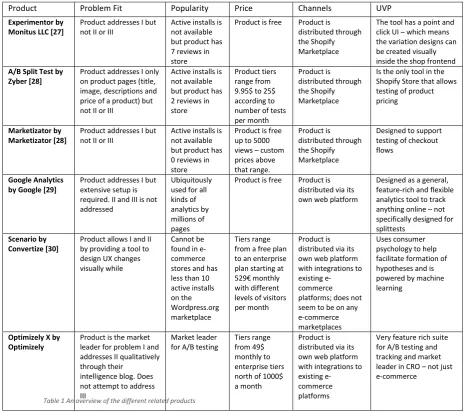
(18) Product. Problem Fit. Popularity. Price. Channels. UVP. Experimentor by Monitus LLC [27]. Product addresses I but not II or III. Product is free. Product is distributed through the Shopify Marketplace. A/B Split Test by Zyber [28]. Product addresses I only on product pages (title, image, descriptions and price of a product) but not II or III. Active installs is not available but product has 7 reviews in store Active installs is not available but product has 2 reviews in store. Product is distributed through the Shopify Marketplace. Marketizator by Marketizator [28]. Product addresses I but not II or III. Google Analytics by Google [29]. Product addresses I but extensive setup is required. II and III is not addressed. Product tiers range from 9.95$ to 25$ according to number of tests per month Product is free up to 5000 views – custom prices above that range. Product is free. The tool has a point and click UI – which means the variation designs can be created visually inside the shop frontend Is the only tool in the Shopify Store that allows testing of product pricing. Scenario by Convertize [30]. Product allows I and II by providing a tool to design UX changes visually while. Tiers range from a free plan to an enterprise plan starting at 529€ monthly with different levels of visitors per month. Optimizely X by Optimizely. Product is the market leader for problem I and addresses II qualitatively through their intelligence blog. Does not attempt to address III. Product is distributed via its own web platform with integrations to existing ecommerce platforms; does not seem to be on any e-commerce marketplaces Product is distributed via its own web platform with integrations to existing ecommerce platforms. Active installs is not available but product has 0 reviews in store Ubiquitously used for all kinds of analytics by millions of pages Cannot be found in ecommerce stores and has less than 10 active installs on the Wordpress.org marketplace Market leader for A/B testing. Tiers range from 49$ monthly to enterprise tiers north of 1000$ a month. Table 1 An overview of the different related products. Product is distributed through the Shopify Marketplace. Designed to support testing of checkout flows. Product is distributed via its own web platform. Designed as a general, feature-rich and flexible analytics tool to track anything online – not specifically designed for splittests Uses consumer psychology to help facilitate formation of hypotheses and is powered by machine learning. Very feature rich suite for A/B testing and tracking and market leader in CRO – not just e-commerce. Table 1 provides an overview of the different related products using the aforementioned criterias. It shows that none of the products address problem III and only some address problem II. This could mean that problem III is not worth solving or that it was not deemed a good fit for these products. Also, most products have a free pricing tier. Most of these products also are platforms that allow a wide variety of UX testing capabilities. All of these products (except for Scenario) are very popular which is how they have been found in the first place.. 18.
(19) 3. Methodology This chapter presents the methods and techniques and how they are applied in this project.. Throughout the project, the Lean Canvas is used to show the iteration of the business framework between stages. An initial Lean Canvas is made before the problem validation stage.. 3.1. Problem validation As already mentioned in chapter 2.2, the project will lean heavily on Maurya’s recommendations. for the application of the Lean Startup. One major part of this is the problem validation stage. 3.1 outlines the techniques used by Maurya for this stage. The problem validation stage conclusion tries to answer the following questions: Product risk: What are you solving (Problem) Customer Risk: Who has the pain? (Customer Segment) Market risk: Who is the competition (Existing Alternatives) Afterwards, the conclusions reached will be used to iterate on the Lean Canvas. 3.1.1. Problem Interview Outline and Objectives. Maurya outlines problem interviews to be interviews that focus on validating the business hypothesis around the “problem-customer segment” pair. This means, in the problem interviews the following key questions should be answered: VIII. Product risk: What problem are we solving? o. How do customers rank these three problems?. IX. Market risk: Who is the competition? o X.. How do customers solve these problems today?. Customer risk: Who has the pain? o. Is this a viable customer segment?. Maurya states that in order to really understand the customer and answer these questions, the customers world view needs to be explored and illuminated. Maruya also provides a sample structure for the interview (figure 5).. 19.
(20) Figure 5 Deconstructed problem interview script by Maurya. The interview can be broken down to the different parts outlined in figure 5. For the present product this will look like this: Welcome (Set the stage) Thank you for meeting with me today. I am working on a Shopify plugin that makes conversion rate optimization easy and straight-forward. I got the idea when working with other e-commerce operators when I realized how difficult it is for most shop owners to setup the most basic testing infrastructure. But before getting too far ahead, I wanted to make sure these are problems that enough shop owners are facing to see if it is a product worth building. So, in this interview I would like to describe the main problems my product will address to see which ones resonate with you. I’d like to stress that this is not a finished product yet and I am not trying to sell you anything. My main goal is to learn from you, not to pitch to you. Collect Demographics (test customer segment). XI. How long have you been selling through Shopify? XII. How many packages do you send out monthly? XIII. What is your monthly revenue (if you are comfortable disclosing)? XIV. Who built the shop for you? (Agency, in-house, …) XV. Do you know what conversion optimization or A/B testing is? XVI. Do you use any paid apps from the Shopify app marketplace? Tell a Story (Set Problem Context) Thanks. Let me tell you about the problems that I am trying to tackle. Testing your user experience with split testing can increase a store’s conversion rates and average order value substantially. However, the process of setting up these tests are often times painful because they require external tools and maybe even coding. Coming up with these hypotheses is also difficult because store owners would need some industry knowledge around testing user experiences. For some shop owners I know, they didn’t even know where to start testing or how to evaluate it. Some others did not want their agency to bill them more hours for alternate designs when it was just a matter of a button variation. Do any of these problems resonate with you? Problem Ranking (Test Problem) Please rank these problems:. XVII. Do you have problems coming up with UX variations to test (testing hypotheses)? XVIII.. Do you find it painful to make the variations of your store (technical aspect)?. 20.
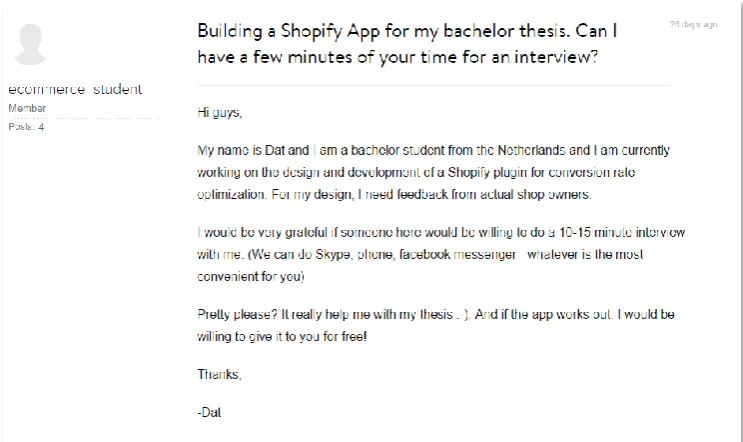
(21) XIX. Do you find the setup of testing tools (g analytics, etc.) difficult? XX. Do you think testing your UX can increase your revenue? Explore Customer’s Worldview (Test Problem) This part of the interview is meant to be off-script. However, these questions below outline a general guidance.. XXI. Have you done split tests for your shop? o. o. Yes ▪. Which tools are you using? And how did you first hear of them?. ▪. What is your workflow?. ▪. Who setup the tests for you (technical aspect)?. ▪. Where do you get ideas for testing hypotheses?. ▪. Was it worth it?. ▪. How much effort do you put into testing?. ▪. Why not?. ▪. Would you do it if someone did most of the work for you?. No. Wrapping up (Hook and Ask) As I mentioned before, this is not a finished product but I am building a Shopify app that will help shop owners implement split tests to raise revenue. Based on what we talked about today, would you be willing to see the product when we have something ready?. Main Interview Objectives The design of the interview as loosely based on Maurya’s model. The main interview objectives were to understand the following about potential customers: XXII. The acquisition of paid Shopify plugins XXIII.. Whether or not the customer knows A/B testing and its potential impact on the. bottom line XXIV.. Who is responsible for the technical development and administration of the shop. XXV. If they had experienced problems with the ideation of UX changes XXVI.. What their testing workflow looks like. XXVII.. If the technical implementation of these tests is a pain. At the end of the interview it is important to ask for further contact to build a relationship. This will make it easier to find interview partners and beta testers further down the line. The main motivation of this interview was to gauge the problem points and their priorities for the design of the solution as well as identify problems and considerations that have not been thought of before. Interviewee Acquisition According to Maurya, acquiring interviewees should start with first-degree contacts – immediate contacts that meet the target customer demographic. Some of this feedback might be biased. The next step is to ask for introductions and connections. The next step is to cold e-mail and submit forum posts. For this interview, it is suitable to directly post to the Shopify forums since it is the official community for Shopify shop owners which are the target demographic. A simple post was made to the “Shopify Apps” discussion forum (Figure 8). 21.
(22) Figure 6 Asking for an inverview on the official Shopify forums. Interview Setup The interview was recorded using Callnote, a program designed to record phone calls to *.mp3. The calling platform was Facebook messenger since it happened to be the most widely used platform amongst interviewees.. 22.
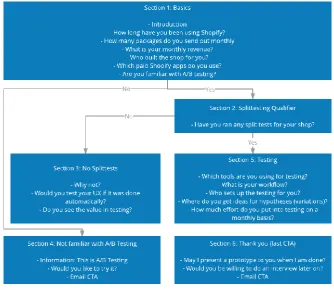
(23) 3.1.2. Survey Design. Additionally, a survey was designed based on this interview structure in order to allow answers. Figure 7 Interactive survey logic based on qualifiers. CTA stands for “call to action” from potential clients that have a lower threshold for answering since survey participation usually takes less time and therefore potential clients with less time are more likely to answer the survey than to agree to an interview. This interactive survey represents a simplified version of the interview organized in a logic tree based on qualifiers (Figure 7). The survey was done using Google forms and was distributed via an e-mail newsletter to 1600 ecommerce operators by the CEO and founder of FOMO (another Shopify sales app).. 3.2. Solution Development The development of the solution is based on the results from the problem validation stage. 3.2. outlines other methods that aided the development of the solution. Some methods used in the solution development will be used again iteratively during the MVP design. 3.2.1. Stakeholder Analysis. Stakeholders are individuals or companies affected by this project. They can be divided by the strength of their relationship to the project [42]:. 23.
(24) Primary stakeholders are people that are directly affected by the results of the project. The most important primary stakeholders are the (beta) users of the tool. This is obviously because it affects their revenue. Secondary stakeholders are people indirectly affected by this project. For instance this could be other shop owners that are competing with shop owners that have the tool or developers of other tools that serve a purpose similar to that of this tool. The former are mildly affected but in a head-tohead example between two competitors – if one is using the tool and the other one isn’t, the former would have a clear advantage given that the tool works. This is only the case assuming that this tool works. The latter are affected by having their tool compete with this tool. Key stakeholders are people that have an interest in the outcome of this project but are not directly affected by it. For instance, this would be the client or commissioner of this project. Since this project has no client or commissioner, the only key stakeholder is the developer / owner of the product – the author of this thesis. 3.2.2. Requirement Analysis. To prioritize stakeholder requirements, Maurya gives some suggestions. However, the ground this analysis further, the MoSCoW method [43] is used. This method categorizes requirements in four categories: -. Must have: This requirement has to be met. -. Should have: This requirement is important but the product can still function without it. -. Could have: This requirement is desirable but not necessary. -. Won’t have: This requirement is not expected to be fulfilled in this iteration but could potentially be realized further down the road. The requirements are conjured from the client interviews, state of the art research and expert opinions. The MoSCoW method will be used complimentary to Maurya’s suggestions rather than supplementary, which means that the amount of requirements will still underlie Maurya’s suggestions. 3.2.3. Interface Design. The interface design will use a basic 12-column modular grid [44]. For the interface design, wireframes will be made using Lucidchart. After an iterative process, the interface will be built with Adobe Photoshop. 3.2.4. Branding. At this stage, the product needs an identity so that contacts can be converted to potential leads. A semantic differential is done using Fry’s methodology [39]. A semantic differential is a branding model that uses the perception of polar brand images on a linear scale to define a brand. Afterwards, a provisionary name, logo and vision are crafted.. 24.
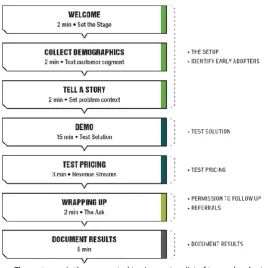
(25) The branding and the app design is made and iterated upon with the feedback of two designers from Agency A1.. 3.3. Solution Validation After the completion of the validation stage Maurya recommends to proceed to formulate and. test the solution. This solution builds upon the understanding of a prioritized problem list and existing alternatives as well as the customer segment’s world view. This stage is meant to validate the solution to the problems, anchor a pricing point and focus the customer segmentation. Maurya states that in this state a demo should be build and then an interview should be conducted, in which the demo is shown and the customer’s interest is peaked. Additionally, other marketing channels are used to get validate the solution further. 3.3.1. Solution Interview Outline and Objectives. The interview is setup and ends similarly to the problem interview, however it is primarily concerned with showing off a demo or a video of a prototype (Figure 10). For this prototype, Maurya recommends to build a realistic looking demo that takes away the customer’s need to fill in the gaps with their own fantasy.. Figure 10: Maurya’s Solution Interview. The customer is then prompted to sign-up to a list of ten early adopters at the price point that is deemed reasonable. The interview script will be inspired by Maury’s suggestions. Welcome (set the stage). 1. All people and companies mentioned are listed in 3.5 People and Organizations. 25.
(26) Thank you very much for taking the time to speak to me today. I am currently working on a Shopify app that implements conversion optimization cases in your store easy and quick. I got the idea after talking to many e-commerce operators that were frustrated with the implementation of conversion optimization cases. The interview will work like this. I’ll start by describing the problems we are tackling and I will ask you if they resonate with you. I also would like to show you an early video demo of our application. I’d like to stress that we don’t have a finished product yet but we are working on a MVP that will come out soon and you can be among the first that we will contact. But let’s not get too far ahead of ourselves. Collect demographics (Test customer segment) I would like to ask you some questions about your store to get all the basic demographics out of the way. You are obviously always welcome to tell me to skip the question if you don’t want the answer to be public.. XXVIII.. How long have you been selling on Shopify?. XXIX.. How many packets do you send out monthly?. XXX. Have you tried A/B testing? XXXI.. Who implemented these tests and what does your workflow look like?. Tell a Story Great, thanks. So, let me tell you about the problems we are solving. I work for an agency and we consult a few e-commerce owners. Every time they wanted to test variations of their site design, the process was painful. Firstly, they didn’t really know what to test for because they are not UX designers, but they understand the value of A/B testing. They had to discuss the changes internally, the changes would have to go to our UI designer, then a round of back-and-forth emailing would ensure until it is approved. The approved design was then developed by one of our developers and implemented by our digital strategists. This was a long and arduous process that we had to go through with each customer. However, many of the insights gained we shared among our customers. That brought us to the idea of automated testing setups for our customers. Does any of this resonate with you? [If there is no strong problem resonance, continue with problem interview] Demo (Test solution) The product I am building is a Shopify app that allows you to pick from CRO cases that are proven and implement them in your store with just a few clicks. For example, testing different trust badges around your store of two different add-to-cart button. The way it works is, you get a suggestion to change the color of your “add-to-cart”-button and you can start the test. The app will then divert half of your visitors to the regular website and the other half to a variation of your storefront that has the different button implemented. The app then measures the conversions and can give you a conclusion to the test as soon as a statistical significance of 97% is reached. You can then choose to implement the UX change or abandon it. Then, you can choose the next test and continuously improve your CRO with these crowd-sourced tests. Let me show you a video.. XXXII.. What part of the demo did you like the most?. XXXIII.. Which could you live without?. XXXIV.. Are there any additional features we are missing?. Test Pricing (Revenue Streams) So, let’s talk about pricing next. We wanted to make sure that we hit scalable pricing model that is subscription based to make the pricing the most transparent easy to calculate for our customers. Would you pay XX$ a month for unlimited access to all test cases?. XXXV.. How would you feel about a guarantee that it will raise your revenue by 10% in 3 months?. XXXVI.. Would you participate in a free trial?. 26.
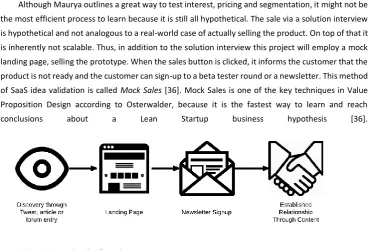
(27) XXXVII.. Would you sign up if this trial had a positive outcome for you?. Wrapping up (the ask) Thank you for your time today you have been very helpful. We are selecting 5 customers to test our tool with. These customers would receive our product for free the first 3 months after launch. Would you like to give our MVP a spin when we are ready?. Interview Acquisition One of the biggest difficulties with the problem interview was the acquisition of interviewees. Ecommerce owners seem to not be very forthcoming with their numbers and business practices. After all, their processes account for most of their value added in the supply chain. This time, the interview acquisition is focused on directly communicating with potential customers on Twitter. Twitter has grown into a major B2B lead generation channel and many e-commerce businesses rely on Twitter as one of their main social media channels [35]. Contacting people directly via Twitter is personal and it is a direct ask. Interview Evaluation The interview evaluation will be based on if the interviewee responds well to the solutions outlined in the Lean Canvas. The second major goal will be how much the user would be willing to pay for the product. 3.3.2. Marketing. Although Maurya outlines a great way to test interest, pricing and segmentation, it might not be the most efficient process to learn because it is still all hypothetical. The sale via a solution interview is hypothetical and not analogous to a real-world case of actually selling the product. On top of that it is inherently not scalable. Thus, in addition to the solution interview this project will employ a mock landing page, selling the prototype. When the sales button is clicked, it informs the customer that the product is not ready and the customer can sign-up to a beta tester round or a newsletter. This method of SaaS idea validation is called Mock Sales [36]. Mock Sales is one of the key techniques in Value Proposition Design according to Osterwalder, because it is the fastest way to learn and reach conclusions. about. a. Lean. Startup. business. hypothesis. [36].. Figure 8 A mock sales funnel Using this technique (Figure 8), the converting customers are collected and make up a list of customers that practically already explicitly stated their buying consent. This list can prove invaluable. 27.
(28) for CD later on. These relationships can be furthered with content marketing and are a promising source of potential beta testers for the launch of the MVP and future interviews. Landing Page Design and Infrastructure Landing pages are sales pages and therefore require similar considerations [37]: XXXVIII.. Clear and concise headlines. XXXIX.. Trust indicators. XL. Calls to action XLI. Images and videos that show the product XLII. A/B testing WordPress will be used with the plugin “Simple Site Tester” that allows quick A/B testing between versions. The theme framework used is Avada. The headlines can also be tested. Headlines will be written using Edd’s methodology for strategic copywriting [38]. Trust indicators are things such as security badges or social proof. These trust indicators mitigate buyer’s anxiety and ultimately lead to higher conversions.. 3.4. MVP Design. 3.4.1. UX Hypotheses. The potential UX hypotheses will be selected from two sources: -. Shopify CRO apps: There are Shopify plugins that implement a single CRO case. Since these are therefore directly tested by users with reviews accessible through the Shopify store, they are a perfect source for inspiration for UX hypotheses for the tool. This is fitting because the reviews and number of users are stark evidence for the UX cases positively affecting the CR.. -. Articles by CRO experts: On a recommendation by Agency A2, articles by experts will be used as a source for inspiration as well. To select these systematically, the articles are selected by the authority of the writer which is determined by how many people link to the article. For this, ahrefs is used. Ahrefs is a tool that indexes 12 trillion links from 6 billion websites. Ahrefs then rates these links to form a domain rating and a URL rating. The higher the URL rating between 0 and 100, the higher the more authority the backlinks hold which is a good indicator for the authority of a piece of content. If (unweighed) backlinks alone were used, spammers would rank higher. Only recommendations are selected that could be solved with a universal UX change, so for. 2. All people and companies mentioned are listed in 3.5 People and Organizations. 28.
(29) example "better product images" can't be solved programmatically, however "implement a red add-to-cart button" could. 3.4.2. Financial Considerations. Financial considerations include the pricing considerations of 3.4.3 as well as a break-even analysis, a cash flow analysis and a cost function. This cost function is linear and takes into account fixed and variable costs according to different growth rates. The growth rates are estimated based on recommendations by Agency A. Since the distribution of this tool would constitute a software startup the cash flow analysis is not as crucial as it would be for a manufacturing company for example since most costs are in manhours rather than monetary. 3.4.3. Preliminary Pricing Considerations. Pre-launch Pricing Considerations According to Maurya, pricing considerations should be made at this point to anchor the value for prospective customers. The pricing strategy of a SaaS product is one of the key elements of sales and should be tested thoroughly through A/B testing to achieve the highest revenue. However, due to the lack of data for testing and for the sake of speed, a faster pricing strategy model will be used using empirical pricing guidelines (Figure 8).. Figure 9 The Pricing Strategy Guideline Framework for SaaS vendors according to Spruit 29.
(30) Pricing Structure The pricing model will be subscription-based because it suits the market trend amongst Shopify apps and because it most closely correlates to Lean principles in its business development. For a transparent cost structure, the subscription should scale with unique visitors a month. This has been done by apps like Klaviyo [40]. This makes it easy for the shop operator to calculate his/her costs. Since the app focuses on being very intuitive and simple, one of the key requirements is ease of use which optimally also requires the least amount of support. Nevertheless, support cases might arise in which there should be at one point an online community as well as a ticket system. An estimate of the cost and time necessary to keep up a customer support infrastructure would depend on many factors, such as monthly active users, UI efficiency, etc. and should therefore not be considered at this point. Value Creation Value creation is a core factor in determining the worth of this product. For this, the average increased conversions can be used as basis for calculations of added benefit and thus return on investment for the client. If the application can increase conversions by 10%, a store making 50.000€ monthly would gain 5.000€ in revenue. At an average order value of 50€ that takes 1000 purchases. At a conversion rate of 2,5% (which is average [41]) that would take around 40.000 visitors. At 50€ monthly that is 1% of the added revenue and seems reasonable. A free trial of 45 days will be offered. A more elaborate pricing and financial scheme will be considered before the launch of the MVP. 3.4.4. Technical Considerations. Technical considerations about the stack are made on recommendation of Agency A. The class diagram is part of the Unified Modeling Language (UML) [45].. 3.5. People and Organizations Throughout the thesis, companies and CEOs of companies are mentioned. For fluidity, these. companies are notated as Company A, Company B, and so forth. This is the list of companies involved. -Company A: AER is a GoPro accessory company that is based in Enschede. AER is a startup that was founded in 2015 that successfully raised 150.000€ through Kickstarter in 2016. -Company B: Lensball is a camera accessory company that sells spherical lenses that can be used for photography. Lensball was founded as a dropshipping company in 2016 and now averages around 1000 orders a month. -Company C: Geyser is an American company that sells patriotic merchandise. They initially started in 2016 but due to technical issues are going through an IT restructuring -Company D: Burgenland Verpackungen is a German company that sells plastic tableware and party decoration. It is a partner company of Rehoca, a wholesale packaging manufacturer and retailer -Agency A: Transmedial is a creative design agency based in Germany. Transmedial has been involved in over 300 projects and currently maintains 120 clients’ media presence.. 30.
(31) 4. Results This chapter presents the results of the executiong of the methods. Section 4.1 presents the. initial Lean Canvas and preliminary requirements. 4.2 presents the problem validation stage. 4.3 contains the solution development stage. 4.4 contains the solution validation. The chapter ends with the MVP design in 4.5. This stages are chronologically.. 4.1. Initial Lean Canvas and Requirements. Figure 10 Initial Lean Canvas The initial lean canvas (Figure 9) encompasses the framework of hypotheses for the initial idea. The point of focus here are the problem statements since all other components are hinging on them. The next step is to validate these problems. As outlined in chapter 2, the Lean Canvas is a fluid framework of a business hypothesis and will evolve throughout the process. Problems Problem 1: A/B testing is a pain to setup for shop owners because they lack the technical skills. Problem 2: A/B testing takes a wide range of different skills. A UX hypothesis is needed, followed by a design, development, deployment and statistical analysis. Problem 3: Coming up with different case hypotheses is difficult because most eCommerce firms do not have dedicated UX designers. Solution A preliminary solution is a platform on which shops can develop tests easily and share them with other shops. This way people can replicate other people’s success and shops don’t spend all these resources on just themselves. This would also mean the platform is user generated. 31.
(32) Key Metrics The key metrics are the reviews in the Shopify app store as they are good indicators for user satisfaction. Also, the number of paid subscriptions is relevant for the business since this makes up the main revenue stream. Finally, the number of successful tests indicate the value that this plugin has brought to clients. Revenue Streams The monetization model would be a recurring monthly fee (a subscription) for users using the platform. Unique Value Proposition As outlined in the initial proposed solution in 2.4, this product offers an array of pre-designed solutions by other users. Channels As described in 2.3.2, Shopify is the most promising platform for the platform to be sold on. Requirements These preliminary requirements serve as a starting point for future requirement considerations and are the same critery that were mentioned in 2.5: I. II. III.. 4.2. Product enables A/B split testing of UX changes and its evaluation Product facilitates hypotheses generation for UX changes Product deploys the tests (sets up testing infrastructure, UX changes). Problem Validation. The problem validation stage as described in 3.1 contains the conclusions about the problem itself. 4.2.1. Interview Evaluation. In total, three interviews were conducted. They can be accessed via Google drive [33]. The acquisition did not go well, no one on the Shopify forums was actually interested in doing an interview. The interview partners were all immediate contacts. However, many hypotheses were confirmed and the problems resonated with the potential clients. The following are the key qualitative highlights of the interviews. The interview with the CEO and founder of Company A resulted in a qualitative validation of the first problem hypothesis, that A/B testing is difficult to setup and that they wanted to setup A/B tests but so far, they did not have the right tools that made it convenient for them to do so. They lack developers so coding their own A/B tests was out of question. They also seemed very enthusiastic about someone trying to solve this problem and happily agreed to keep in touch. The second interview with CEO and founder of Company B also resulted in a qualitative validation of the first problem hypothesis. The company tried to do A/B testing without tools and were not able to reach a good conclusion to their test because of the lack of proper tools. The interviewee stated that he was too overwhelmed by tools that required coding. According to him, finding hypotheses to tests was not their main pain point but rather the implementation of the tests. The third interview with CEO and co-founder of Company C resulted in a qualitative validation of all the problem hypotheses. They wanted to setup testing but never did because they did not know 32.
Figure
![Figure 3 Global E-commerce revenue until 2016 and forecast between 2017 and 2020 [14]](https://thumb-us.123doks.com/thumbv2/123dok_us/9757105.476728/13.595.117.503.375.511/figure-global-e-commerce-revenue-forecast.webp)
+7
Related documents
For example, local health activists may prioritize lowering prices, which they may believe can be accomplished without the explicit use of IP flexibilities, or they may regard
135 Fair use is not only an affirmative defense but also a user’s right “authorized by the law.” 136 A user who “makes a fair use of the work is not an infringer of the
The Eleventh and Twelfth Finance Commissions attempted to use grant distribution as a negative incentive for ensuring achievements in deficit targets. While the Eleventh
All seven of our programs offer an empirically based, trauma informed, positive youth development approach to help young men and women learn how to live
The inclusion o f a local search phase (as discussed in Section 3.5.1) is an obvious area for improving any ACO algorithm; it will always im prove the performance o f the
Other Legislation: HB 967 (provides that circuit courts have exclusive origi- nal jurisdiction of unresolved arbitration actions involving Florida Motor Vehicle
This Transcend Wi-Fi SD Card Compatibility List only provides the devices which basic function may be compatible with Transcend Wi-Fi SD Card, and is effective upon its release
(ii) Unless you are paying under a Credit Agreement, if we agree that you may transfer to a different course, we will transfer the fees paid for the Distance Learning Package
