Metaphor Detection through Term Relevance
Marc Schulder Spoken Language Systems
Saarland University Saarbr¨ucken, Germany
Eduard Hovy
Language Technologies Institute Carnegie Mellon University
Pittsburth, PA, USA [email protected]
Abstract
Most computational approaches to metaphor detection try to leverage either conceptual metaphor mappings or selec-tional preferences. Both require extensive knowledge of the mappings/preferences in question, as well as sufficient data for all involved conceptual domains. Creating these resources is expensive and often limits the scope of these systems.
We propose a statistical approach to metaphor detection that utilizes the rarity of novel metaphors, marking words that do not match a text’s typical vocabulary as metaphor candidates. No knowledge of semantic concepts or the metaphor’s source domain is required.
We analyze the performance of this approach as a stand-alone classifier and as a feature in a machine learning model, reporting improvements in F1 measure
over a random baseline of 58% and 68%, respectively. We also observe that, as a feature, it appears to be particularly useful when data is sparse, while its effect diminishes as the amount of training data increases.
1 Introduction
Metaphors are used to replace complicated or un-familiar ideas with un-familiar, yet unrelated concepts that share an important attribute with the intended idea. In NLP, detecting metaphors and other non-literal figures of speech is necessary to interpret their meaning correctly. As metaphors are a pro-ductive part of language, listing known examples is not sufficient. Most computational approaches to metaphor detection are based either on the the-ory of conceptual mappings (Lakoff and John-son, 1980) or that of preference violation (Wilks, 1978).
Lakoff and Johnson (1980) showed that metaphors have underlying mappings between two conceptual domains: The figurative source
domain that the metaphor is taken from and the literaltargetdomain of the surrounding context in which it has to be interpreted. Various metaphors can be based on the same conceptual metaphor mapping, e.g. both “The economy is a house of cards” and “the stakes of our debates appear small”match POLITICSIS AGAME.
Another attribute of metaphors is that they violate semantic selectional preferences (Wilks, 1978). The theory of selectional preference ob-serves that verbs constrain their syntactic argu-ments by the semantic concepts they accept in these positions. Metaphors violate these con-straints, combining incompatible concepts.
To make use of these theories, extensive knowl-edge of pairings (either mappings or preferences) and the involved conceptual domains is required. Especially in the case of conceptual mappings, this makes it very difficult for automated systems to achieve appropriate coverage of metaphors. Even when limited to a single target domain, detecting all metaphors would require knowledge of many metaphoric source domains to cover all relevant mappings (which themselves have to be known, too). As a result of this, many systems attempt to achieve high precision for specific mappings, rather than provide general coverage.
Many approaches (Gedigian et al., 2006; Krish-nakumaran and Zhu, 2007; Mohler et al., 2013; Tsvetkov et al., 2013, and more) make use of man-ually crafted knowledge bases such as WordNet or FrameNet to establish concept domains. Other re-cent works establish domains via topic modeling (Shutova et al., 2010; Heintz et al., 2013), ad-hoc clustering (Strzalkowski et al., 2013) or by using semantic similarity vectors (Hovy et al., 2013).
We introduce term relevance as a measure for how “out of place” a word is in a given
text. Our hypothesis is that words will often be out of place because they are not meant literally, but rather metaphorically. Term relevance is based on term frequency measures for target domains and mixed-domain data. The advantage of this approach is that it only requires knowledge of a text’s literal target domain, but none about any source domains or conceptual mappings. As it does not require sentence structure information, it is also resistant to noisy data, allowing the use of large, uncurated corpora. While some works that utilize domain-mappings circumvent the need for pre-existing source data by generating it them-selves (Strzalkowski et al., 2013; Mohler et al., 2013), our approach is truly source-independent.
We present a threshold classifier that uses term relevance as its only metric for metaphor detec-tion. In addition we evaluate the impact of term relevance at different training sizes.
Our contributions are:
• We present a measure for non-literalness that only requires data for the literal domain(s) of a text.
• Our approach detects metaphors indepen-dently of their source domain.
• We report improvements for F1 of 58%
(stand-alone) and 68% (multi-feature) over a random baseline.
2 Term Relevance
We hypothesize that novel metaphoric language is marked by its unusualness in a given context. There will be a clash of domains, so the vocab-ulary will be noticeably different1. Therefore, an
unusual choice of words may indicate metaphoric-ity (or non-literalness, at the least).
We measure this fact through a domain-specific
term relevance metric. The metric consists of two features: Domain relevance, which measures whether a term is typical for the literal target do-main of the text, and common relevance, which indicates terms that are so commonly used across domains that they have no discriminative power. If a term is not typical for a text’s domain (i.e. 1Strongly conventionalized metaphors will not meet this expectation, as they have become part of the target domain’s vocabulary. Such metaphors can be easily detected by con-ventional means, such as knowledge bases. Our concern is therefore focused on novel metaphors.
has a low relevance), but is not very common ei-ther, it is considered a metaphor candidate. This can of course be extended to multiple literal do-mains (e.g. a political speech on fishing regula-tions will have both governance and maritime vo-cabulary), in which case a word is only considered as a metaphor if it is untypical for all domains in-volved.
2.1 Metric
We base domain relevance on TF-IDF (term fre-quency inverse document frefre-quency), which is commonly used to measure the impact of a term on a particular document. Terms with a great im-pact receive high scores, while low scores are as-signed to words that are either not frequent in the document or otherwise too frequent among other documents.
We adapt this method fordomain relevance (dr)
by treating all texts of a domain as a single “doc-ument”. This newterm frequency inversedomain frequency measures the impact of a term on the domain.
tfdom(t, d) = # of term# of terms in domaintin domaindd (1)
idfdom(t) = log# of domains containing# of domains t (2)
dr(t, d) = tfdom(t, d)×idfdom(t) (3) To detect metaphors, we look for terms with low scores in this feature. However, due to the nature of TF-IDF, a low score might also indicate a word that is common among all domains. To filter out such candidates, we use normalizeddocument fre-quencyas acommon relevanceindicator.
cr(t) = # of documents containing# of documents t (4)
In theory, we could also usedomain frequency
to determine common relevance, as we already compute it for domain relevance. However, as this reduces the feature’s granularity and otherwise be-haves the same (as long as domains are of equal size), we keep regular document frequency.
2.2 Generating Domains
source domains. This reduces the required num-ber of domain data sets significantly without rul-ing out any particular metaphor mapprul-ings.
We extract domain-specific document collec-tions from a larger general corpus, using the key-word query search of Apache Lucene2, a software
for indexed databases. The keywords of the query search are a set of seed terms that are considered typical literal terms for a domain. They can be manually chosen or extracted from sample data. For each domain we extract the 10,000 highest ranking documents and use them as the domain’s dataset.
Afterwards, all remaining documents are ran-domly assigned to equally sized pseudo-domain datasets. These pseudo-domains allow us to com-pute the inverse of the domain frequencyfor the TF-IDF without the effort of assigning all docu-ments to proper domains. Thedocument frequency
score that will be used ascommon relevanceis di-rectly computed on the documents of the complete corpus.
3 Data
We make use of two different corpora. The first is the domain-independent corpus required for com-puting term relevance. The second is an evalua-tion corpus for the governancedomain on which we train and test our systems.
Both corpora are preprocessed using NLTK (Loper and Bird, 2002)3. After tokenization,
stop-words and punctuation are removed, contractions expanded (e.g. we’ve to we have) and numbers generalized (e.g. 1990’s to@’s). The remaining words are reduced to their stem to avoid data spar-sity due to morphological variation.
In case of the domain corpus, we also removed generic web document contents, such as HTML mark-up, JavaScript/CSS code blocks and similar boilerplate code4.
3.1 Domain Corpus
As a basis for term relevance, we require a large corpus that is domain-independent and ideally also style-independent (i.e. not a newspaper corpus or
2http://lucene.apache.org/core/
3http://nltk.org
4Mark-up and boilerplate removal scripts adapted
from http://love-python.blogspot.com/
2011/04/html-to-text-in-python.html and
http://effbot.org/zone/re-sub.htm
Wikipedia). The world wide web meets these re-quirements. However, we cannot use public online search engines, such as Google or Bing, because they do not allow a complete overview of their in-dexed documents. As we require this provide to generate pseudo-domains and compute the inverse document/domain frequencies, we use a precom-piled web corpus instead.
ClueWeb095 contains one billion web pages,
half of which are English. For reasons of process-ing time and data storage, we limited our experi-ments to a single segment (en0000), containing 3 million documents. The time and storage consid-erations apply to the generation of term relevance values during preprocessing, due to the require-ments of database indexing. They do not affect the actual metaphor detection process, therefore, we do not expect scalability to be an issue. As ClueWeb09 is an unfiltered web corpus, spam fil-tering was required. We removed 1.2 million spam documents using theWaterloo Spam Ranking for ClueWeb096by Cormack et al. (2011).
3.2 Evaluation Corpus
Evaluation of the two classifiers is done with a cor-pus of documents related to the concept of gov-ernance. Texts were annotated for metaphoric phrases and phrases that are decidedlyin-domain, as well as other factors (e.g. affect) that we will not concern ourselves with. The focus of annotation was to exhaustively mark metaphors, irrespective of their novelty, but avoid idioms and metonymy.
The corpus is created as part of the MICS: Metaphor Interpretation in terms of Culturally-relevant Schemasproject by the U.S. Intelligence Advanced Research Projects Activity (IARPA). We use a snapshot containing 2,510 English sen-tences, taken from 312 documents. Of the 2,078 sentences that contain metaphors, 72% contain only a single metaphoric phrase. The corpus con-sists of around 48k tokens, 12% of which are parts of metaphors. Removing stopwords and punctua-tion reduces it to 23k tokens and slightly skews the distribution, resulting in 15% being metaphors.
We divide the evaluation data into 80% devel-opment and 20% test data. All reported results are based on test data. Where training data is required for model training (see section 5), ten-fold cross validation is performed on the development set.
5http://lemurproject.org/clueweb09/
6http://plg.uwaterloo.ca/˜gvcormac/
Subdomain Seed Terms
Executive administer rule govern lead
Legislative pass law regulate debate parliament Judicial judge hearing case rule case
sentence
Administr. administer manage issue permits analyze study facilitate obstruct Enforcement enforce allow permit require war
make mandate defeat overcome Economy budget tax spend plan finances Election vote campaign canvass elect defeat
form party create platform
Acceptance government distrust (de)legitimize authority reject oppose strike flag protest pride salute march accept
Table 1: Manually selected seed terms for docu-ment search queries. The 10k docudocu-ments with the highest relevance to the seeds are assigned to the subdomain cluster.
4 Basic Classification
To gain an impression of the differentiating power of tf-idf in metaphor detection, we use a basic threshold classifier (tc) that uses domain relevance (dr) and common relevance (cr) as its only fea-tures. Given a wordw, a target domaindand two thresholdsδandγ:
tc(w, d) =
metaphor ifdr(w, d)< δ
andcr(w)< γ literal otherwise (5)
In cases where a text has more than one literal do-main or multiple relevant subdodo-mains are avail-able, a word is only declared a metaphor if it is not considered literal for any of the (sub)domains.
4.1 Seed Terms
The threshold classifier is evaluated using two dif-ferent sets of seed terms. The first set is com-posed of 60 manually chosen terms7 from eight governancesubdomains. These are shown in table 1. Each subdomain corpus consists of its 10,000 highest ranking documents. We do not subdi-vide the evaluation corpus into these subdomains. Rather, we assume that each sentence belongs to
7Terms were chosen according to human understanding of typical terms forgovernance. No optimization of the term choices was performed thereafter.
[image:4.595.311.521.64.205.2]principl financi legisl congress crisi corpor famili middl compani futur countri global negoti medicaid unit industri promis polici constitut save obama health creat capitalist hous clinton nation dream american busi nuclear amend great medicar care econom million feder recoveri job commun potenti polit freedom law prosper energi elect program new
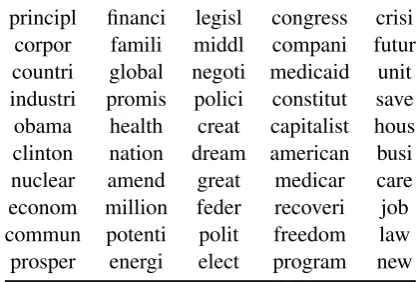
Table 2: The fifty stems with the highest tf-idf score in the gold data. Used as seed terms for doc-ument search, generating a singlegovernance do-main. Stems are listed in no particular order.
all eight subdomains8, so a word is only
consid-ered a metaphor if it is non-literal for all of them. Preliminary experiments showed that this provides better performance than using a single domain cor-pus with more documents.
As the first set of seeds is chosen without sta-tistical basis, the resulting clusters might miss im-portant aspects of the domain. To ensure that our evaluation is not influenced by this, we also in-troduce a second seed set, which is directly based on the development data. As we mentioned in section 3.2, sentences in the MICS corpus were not only annotated for metaphoric phrases, but also for such that are decidedly domain-relevant. For example in the sentence“Oureconomyis the strongeston earth”,economy is annotated as in-domain andstrongestas metaphor.
Based on these annotations, we divide the en-tire development data into three bags of words, one each for metaphor, in-domain and unmarked words. We then compute TF-IDF values for these bags, as we did for the domain clusters. The fifty terms9 that score highest for the in-domain bag
(i.e. those that make the texts identifiable as gover-nancetexts) are used as the second set of seeds (ta-ble 2). It should be noted that while the seeds were based on the evaluation corpus, the resulting term relevance features were nevertheless computed us-ing clusters extracted from the web corpus.
8As our evaluation corpus does not specify secondary do-mains for its texts (e.g. fishery), we chose not to define any further domains at this point.
F1 Prec Rec Random 0.222 0.142 0.500
All Metaphor 0.249 0.142 1.000 T-hold: Manual Seeds 0.350 0.276 0.478
[image:5.595.73.288.63.153.2]T-hold: 50-best Seeds 0.346 0.245 0.591
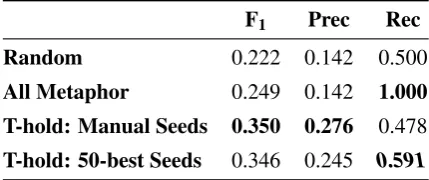
Table 3: Summary of best performing settings for each threshold classifier model. Bold bers indicate best performance; slanted bold num-bers: best threshold classifier recall. All results are significantly different from the baselines with
p <0.01.
4.2 Evaluation
We evaluate and optimize our systems for the F1
metric. In addition we provide precision and re-call. Accuracy on the other hand proved an inap-propriate metric, as the prevalence of literal words in our data resulted in a heavy bias. We eval-uate on a token-basis, as half of the metaphoric phrases consist of a single word and less than 15% are more than three words long (including stop-words, which are filtered out later). Additionally, evaluating on a phrase-basis would have required grouping non-metaphor sections into phrases of a similar format.
Based on dev set performance, we choose a do-main relevance thresholdδ= 0.02and a common relevance threshold γ = 0.1. We provide a ran-dom baseline, as well as one that labels all words as metaphors, as they are the most frequently en-countered baselines in related works. Results are shown in table 3.
Both seed sets achieve similar F-scores, beating the baselines by between 39% and 58%, but their precision and recall performance differs notably. Both models are significantly better than the base-line and significantly different from one another withp < 0.01. Significance was computed for a two-tailedt-test usingsigf(Pad´o, 2006)10.
Using manually chosen seed terms results in a recall rate that is slightly worse than chance, but it is made up by the highest precision. The fact that this was achieved without expert knowledge or term optimization is encouraging.
The classifier using the fifty best governance
terms shows a stronger recall, most likely
be-10http://www.nlpado.de/˜sebastian/
software/sigf.shtml
cause the seeds are directly based on the develop-ment data, resulting in a domain cluster that more closely resembles the evaluation corpus. Preci-sion, on the other hand, is slightly below that of the manual seed classifier. This might be an effect of the coarser granularity that a single domain score offers, as opposed to eight subdomain scores.
5 Multi-Feature Classification
Using term relevance as the only factor for metaphor detection is probably insufficient. Rather, we anticipate to use it either as a pre-filtering step or as a feature for a more complex metaphor detection system. To simulate the latter, we use an off-the-shelf machine learning classifier with which we test how term relevanceinteracts with other typical word features, such aspart of speech. As we classify all words of a sentence, we treat the task as a binary sequential labeling task.
Preliminary tests were performed with HMM, CRF and SVM classifiers. CRF performance was the most promising. We use CRFsuite (Okazaki, 2007)11, an implementation of conditional random
fields that supports continuous values via scaling factors. Training is performed on the development set using ten-fold cross validation.
We present results for bigram models. Larger n-grams were inspected, too, including models with look-ahead functionality. While they were slightly more robust with regard to parameter changes, there was no improvement over the best bigram model. Also, as metaphor processing still is a low resource task for which sufficient training data is hard to come by, bigrams are the most accessible and representative option.
5.1 Training Features
We experimented with different representations for the term relevance features. As they are con-tinuous values, they could be used as concon-tinuous features. Alternatively, they could be represented as binary features, using a cut-off value as for our threshold classifier. In the end, we chose a hy-brid approach where thresholds are used to create binary features, but are also scaled according to their score. Thresholds were again determined on the dev set and set toδ = 0.02andγ = 0.79.
Each domain receives an individual domain evance feature. There is only a single common
rel-11http://www.chokkan.org/software/
F1 Prec Rec All Metaphor 0.249 0.142 1.000 T-hold: Manual Seeds 0.350 0.276 0.478
CRF: Basic 0.187 0.706 0.108
CRF: Rel 0.219 0.683 0.130
CRF: PosLex 0.340 0.654 0.230
[image:6.595.73.289.63.190.2]CRF: PosLexRel 0.373 0.640 0.263
Table 4: Summary of best performing settings for each CRF model. Bold numbers indicate best per-formance; slanted bold numbers: best CRF re-call. All results are significantly different from the baseline withp <0.01.
evance feature, as it is domain-independent. Sur-prisingly, we found no noteworthy difference in performance between the two seed sets (manual and 50-best). Therefore we only report results for the manual seeds.
In addition to term relevance, we also provide part of speech (pos) and lexicographer sense (lex) as generic features. The part of speech is auto-matically generated using NLTK’sMaximum
En-tropy POS Tagger, which was trained on thePenn Treebank. To have a semantic feature to compare our relevance weights to, we include WordNet’s lexicographer senses (Fellbaum, 1998), which are coarse-grained semantic classes. Where a word has more than one sense, the first was chosen. If no sense exists for a word, the word is given asense unknownplaceholder value.
5.2 Performance Evaluation
Performance of the CRF system (see table 4) seems slightly disappointing at first when com-pared to our threshold classifier. The best-performing CRF beats the threshold classifier by only two points of F-score, despite considerably richer training input. Precision and recall perfor-mance are reversed, i.e. the CRF provides a higher precision of 0.6, but only detects one out of four metaphor words. All models provide stable results for all folds, their standard deviation (about 0.01 for F1) being almost equal to that of the baseline.
All results are significantly different from the baseline as well as from each other withp <0.01, except for the precision scores of the three non-basic CRF models, which are significantly differ-ent from each other withp <0.05.
0 0.05 0.1 0.15 0.2 0.25 0.3 0.35 0.4
200 400 600 800 1000 1200 1400 1600 1800
0 0.05 0.1 0.15 0.2 0.25 0.3 0.35 0.4
F1
Number of Training Sentences
Models CRF Basic
CRF PosLex Threshold
+ Relevance + Relevance Baseline
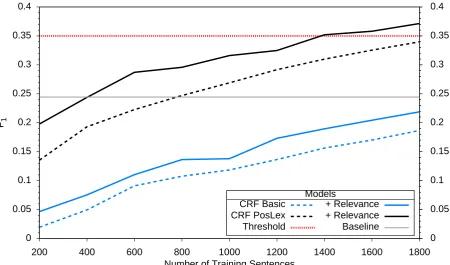
[image:6.595.76.527.430.695.2]Adding term relevance provides a consistent boost of 0.025 to the F-score. This boost, however, is rather marginal in comparison to the one pro-vided by part of speech and lexicographer sense. A possible reason for this could be that the item weights learned during training correspond too closely to our term relevance scores, thus making them obsolete when enough training data is pro-vided. The next section explores this possibility by comparing different amounts of training data.
5.3 Training Size Evaluation
With 2000 metaphoric sentences, the dataset we used was already among the largest annotated cor-pora. By reducing the amount of training data we evaluate whether term relevance is an efficient fea-ture when data is sparse. To this end, we repeat our ten-fold cross validations, but withhold some of the folds from each training set.
Figure 1 compares the performance of CRF fea-ture configurations with and without term rele-vance. In both cases adding term relevance out-performs the standard configuration’s top perfor-mance with 400 sentences less, saving about a quarter of the training data.
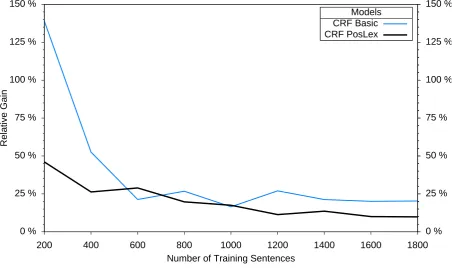
In figure 2 we also visualize the relative gain that adding term relevance provides. As one can see, small datasets profit considerably more from our metric. Given only 200 sentences, the PosLex
model receives 4.7 times the performance gain from term relevance it got at at maximum training size. The basic model has a factor of 6.8. This sup-ports our assumption that term relevance is similar to the item weights learned during CRF training. As labeled training data is considerably more ex-pensive to create than corpora for term relevance, this is an encouraging observation.
6 Related Work
For a comprehensive review on computational metaphor detection, see Shutova (2010). We limit our discussion to publications that were not cov-ered by the review. While there are several papers evaluating on the same domain, direct comparison proved to be difficult, as many works were either evaluated on a sentence level (which our data was inappropriate for, as 80% of sentences contained metaphors) or did not provide coverage informa-tion. Another difference was that most evaluations were performed on balanced datasets, while our own data was naturally skewed for literal terms.
Strzalkowski et al. (2013) follow a related hy-pothesis, assuming that metaphors lack topical re-latedness to in-domain words while being syntac-tically connected to them. Instead of using the metaphor candidate’s relevance to a target domain corpus to judge relatedness, they circumvent the
0 % 25 % 50 % 75 % 100 % 125 % 150 %
200 400 600 800 1000 1200 1400 1600 1800
0 % 25 % 50 % 75 % 100 % 125 % 150 %
Relative Gain
Number of Training Sentences
[image:7.595.73.528.473.741.2]Models CRF Basic CRF PosLex
need for pre-existing source data by generating ad-hoc collocation clusters and check whether the two highest ranked source clusters share vocab-ulary with the target domain. Further factors in their decision process are co-ocurrences in sur-rounding sentences and psycholinguistic image-ability scores (i.e. how easy it is to form a men-tal picture of a word). Evaluating on data in the
governance domain, they achieve an accuracy of 71% against anall metaphorbaseline of 46%, but report no precision or recall.
Mohler et al. (2013) and Heintz et al. (2013) also evaluate on the governance domain. Rather than detecting metaphors at a word-level, both de-tect whether sentences contain metaphors. Mohler et al. (2013) compare semantic signatures of sen-tences to signatures of known metaphors. They, too, face a strong bias against the metaphor label and show how this can influence the balance be-tween precision and recall. Heintz et al. (2013) classify sentences as containing metaphors if their content is related to both a target and source do-main. They create clusters via topic modeling and, like us, use manually chosen seed terms to asso-ciate them with domains. Unlike our approach, theirs also requires seeds of all relevant source do-mains. They observe that identifying metaphors, even on a sentence level, is difficult even for ex-perienced annotators, as evidenced by an inter-annotator agreement ofκ= 0.48.
Shutova et al. (2010) use manually annotated seed sentences to generate source and target do-main vocabularies via spectral clustering. The re-sulting domain clusters are used for selectional preference induction in verb-noun relations. They report a high precision of 0.79, but have no data on recall. Target concepts appearing in similar lexico-syntactic contexts are mapped to the same source concepts. The resulting mappings are then used to detect metaphors. This approach is notable for its combination of distributional clustering and selec-tional preference induction. Verbs and nouns are clustered into topics and linked through induction of selectional preferences, from which metaphoric mappings are deduced. Other works (S´eaghdha, 2010; Ritter et al., 2010) use topic modeling to di-rectly induce selectional preferences, but have not yet been applied to metaphor detection.
Hovy et al. (2013) generalize semantic prefer-ence violations from verb-noun relations to any syntactic relation and learn these in a supervised
manner, using SVM and CRF models. The CRF is not the overall best-performing system, but achieves the highest precision of 0.74 against an all-metaphor baseline of 0.49. This is in line with our own observations. While they argue that metaphor detection should eventually be per-formed on every word, their evaluation is limited to a single expression per sentence.
Our work is also related to that of Sporleder and Li (2009) and Li and Sporleder (2010), in which they detect idioms through their lack of seman-tic cohesiveness with their context. Cohesiveness is measured via co-occurence of idiom candidates with other parts of a text in web searches. They do not make use of domains, basing their measure entirely on the lexical context instead.
7 Conclusion
We have presented term relevance as a non-literalness indicator and its use for metaphor de-tection. We showed that even on its own, term rel-evance clearly outperforms the baseline by 58% when detecting metaphors on a word basis.
We also evaluated the utility of term relevance as a feature in a larger system. Results for this were mixed, as the general performance of our system, a sequential CRF classifier, was lower than anticipated. However, tests on smaller train-ing sets suggest that term relevance can help when data is sparse (as it often is for metaphor process-ing). Also, precision was considerably higher for CRF, so it might be more useful for cases where coverage is of secondary importance.
Acknowledgements
We would like to thank the reviewers and proof-readers for their valuable input.
This research effort was in part supported by the German Academic Exchange Service (DAAD) scholarship program PROMOS with funds from the Federal Ministry of Education and Research (BMBF), awarded by the International Office of Saarland University as well as by the Intelligence Advanced Research Projects Activity (IARPA) via Department of Defense US Army Research Laboratory contract number W911NF-12-C-0025. The U.S. Government is authorized to reproduce and distribute reprints for Governmental purposes notwithstanding any copyright annotation thereon. Disclaimer: The views and conclusions con-tained herein are those of the authors and should not be interpreted as necessarily representing the official policies or endorsements, either expressed or implied, of DAAD, BMBF, IARPA, DoD/ARL or the German or U.S. Government.
References
Gordon V. Cormack, Mark D. Smucker, and Charles L. A. Clarke. 2011. Efficient and effective spam filtering and re-ranking for large web datasets. In-formation retrieval, 14(5):441–465.
Christiane Fellbaum. 1998. ed. WordNet: an elec-tronic lexical database. MIT Press, Cambridge MA, 1:998.
Matt Gedigian, John Bryant, Srini Narayanan, and Bra-nimir Ciric. 2006. Catching metaphors. In Pro-ceedings of the HLT/NAACL-06 Workshop on Scal-able Natural Language Understanding, pages 41– 48.
Ilana Heintz, Ryan Gabbard, Mahesh Srinivasan, David Barner, Donald S Black, Marjorie Freedman, and Ralph Weischedel. 2013. Automatic extraction of linguistic metaphor with lda topic modeling. Pro-ceedings of the ACL-13 Workshop on Metaphor, page 58.
Dirk Hovy, Shashank Srivastava, Sujay Kumar Jauhar, Mrinmaya Sachan, Kartik Goyal, Huiying Li, Whit-ney Sanders, and Eduard Hovy. 2013. Identifying metaphorical word use with tree kernels. Proceed-ings of the ACL-13 Workshop on Metaphor, page 52. Saisuresh Krishnakumaran and Xiaojin Zhu. 2007. Hunting elusive metaphors using lexical resources.
InProceedings of the HLT/NAACL-07 Workshop on
Computational Approaches to Figurative Language, pages 13–20. Association for Computational Lin-guistics.
George Lakoff and Mark Johnson. 1980. Metaphors we live by, volume 111. University of Chicago Press.
Linlin Li and Caroline Sporleder. 2010. Using gaus-sian mixture models to detect figurative language in context. InProceedings of NAACL-10, pages 297– 300. Association for Computational Linguistics. Edward Loper and Steven Bird. 2002. NLTK: The
natural language toolkit. In Proceedings of the COLING/ACL-02 workshop on Interactive presen-tation sessions, pages 63–70. Association for Com-putational Linguistics.
Michael Mohler, David Bracewell, David Hinote, and Marc Tomlinson. 2013. Semantic signatures for example-based linguistic metaphor detection. Pro-ceedings of the ACL-13 Workshop on Metaphor, page 27.
Naoaki Okazaki, 2007. CRFsuite: a fast implementa-tion of condiimplementa-tional random fields (CRFs).
Sebastian Pad´o, 2006. User’s guide tosigf: Signifi-cance testing by approximate randomisation. Alan Ritter, Oren Etzioni, et al. 2010. A latent
dirich-let allocation method for selectional preferences. In ACT-10, pages 424–434. Association for Computa-tional Linguistics.
Diarmuid ´O S´eaghdha. 2010. Latent variable models of selectional preference. In Proceedings of ACL-10, pages 435–444. Association for Computational Linguistics.
Ekaterina Shutova, Lin Sun, and Anna Korhonen. 2010. Metaphor identification using verb and noun clustering. In Proceedings of COLING-10, pages 1002–1010. Association for Computational Linguis-tics.
Ekaterina Shutova. 2010. Models of metaphor in NLP.
InProceedings of ACL-10, pages 688–697.
Associ-ation for ComputAssoci-ational Linguistics.
Caroline Sporleder and Linlin Li. 2009. Unsupervised recognition of literal and non-literal use of idiomatic expressions. InProceedings of EACL09, pages 754– 762. Association for Computational Linguistics. Tomek Strzalkowski, George Aaron Broadwell, Sarah
Taylor, Laurie Feldman, Boris Yamrom, Samira Shaikh, Ting Liu, Kit Cho, Umit Boz, Ignacio Cases, et al. 2013. Robust extraction of metaphors from novel data. Proceedings of the ACL-13 Workshop on Metaphor, page 67.
Yulia Tsvetkov, Elena Mukomel, and Anatole Gersh-man. 2013. Cross-lingual metaphor detection us-ing common semantic features. Proceedings of the ACL-13 Workshop on Metaphor, page 45.